






Abstract
Coatis [including Nasua nasua, the ring-tailed coati], are medium-sized mammals widely distributed in the Americas. They are social animals, whose normal diet includes insects, fruits, and small vertebrates, and rarely prey on larger sized animals. There are, to our knowledge, no reports in the medical literature of attacks on humans. This report describes a coati attack on 2 children in their home. The children sustained deep scratches and bites. The animal may have injured the humans in a defensive strike, but motivation for attack was uncertain. Coati attacks may occur in places where there is interaction between these mammals and humans.
Introduction
Coatis (in the indigenous Brazilian Tupi language, “pointed nose”) are gregarious carnivores and members of the Procyonidae family, the same as the raccoons. There are 3 species, all confined to the Americas: Nasua narica, 1 found from Northern Colombia to Southern Arizona, New Mexico, and Texas; Nasua (or Nasuella) olive, 2 which occurs in the Andes Ridges of Venezuela, Colombia, and Ecuador, and Nasua nasua, 1 the ring-tailed coati, which is widely distributed in South America, occurring in Colombia, Venezuela, Guyana, Suriname, Peru, Bolivia, Argentina, Uruguay, Paraguay, and Brazil. 3 –8
Coatis are average size animals, weighing between 2.5 and 10 kg, measuring 40 to 65 cm in length with a tail of about 50 cm, and males are larger than females.9,10 They have an enlarged head ending in a long narrow protruding, pointed, and very mobile snout. Color varies depending on distribution area, and its tail has brighter color rings than the rest of its coat. 11 The forelimbs are shorter than the hind limbs and the ends of the legs are dark with well-developed sharp claws (Figure 1). Coatis are diurnal and semiarboreal animals. They are sociable and can live in bands of up to 30 individuals, 11 consisting of adult females (over 2 years) and young individuals of both sexes.
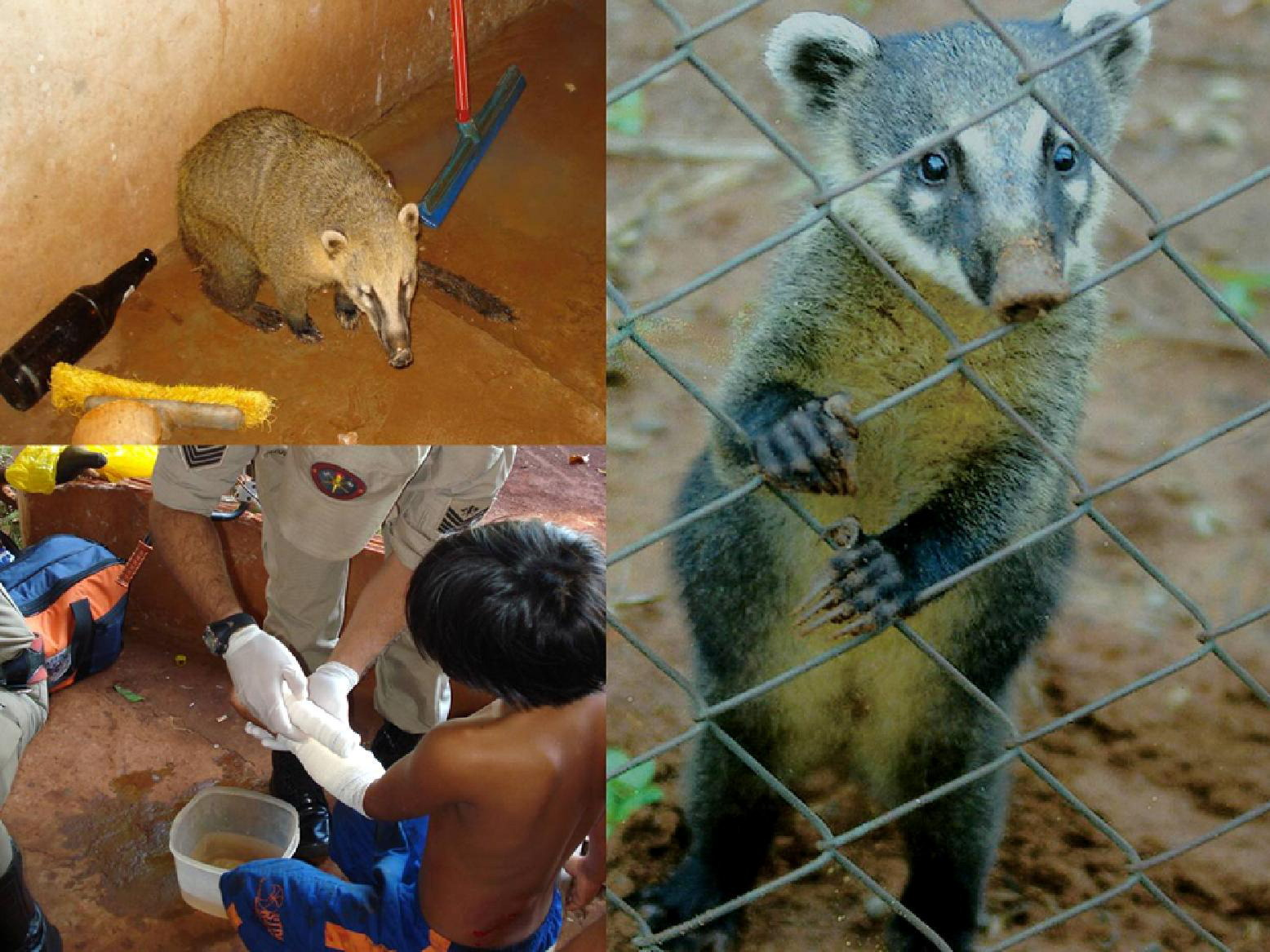
Left, above: the coati that caused the wounds in the children, still in the house. Below: team of firefighters providing initial aid to victims. Note in this image the round wound in the lower back of the boy. Right: the ring-tailed coati. Note the sharp claws.
Adult males are solitary and only join the groups during the mating season, which lasts just under a month. 12 –14 Reproduction is synchronous throughout the population, 15 allowing social activities to be maintained which are of great importance for youngster learning. 16
Coati diet includes mainly insects, their larvae, and other arthropods. They also consume a variety of fruits, bromeliads, and occasionally small vertebrates. 4 ,9,11,14,15,17–20 However, there are descriptions of them consuming greater mammals such as the capuchin monkey (Cebus nigritus), the pigmy Brocket deer (Mazama nana), the paca (Cuniculus paca), and the coypu or nutria (Myocastor coypus), suggesting a strong potential for predation. 20 There are also records of a necrophagous diet. 21 In areas of anthropogenic influence they are often observed feeding on garbage. 22 They can also be regarded as seed dispersers as they consume fruits and defecate intact seeds. 19 ,22,23
In the Brazilian Pantanal, coatis are found naturally infected with different Trypanosoma cruzi populations, highlighting the importance of this species in the maintenance of different transmission cycles. 24 The species is a natural host for the “star tick” (Amblyomma cajennense), the main reservoir of Rickettsia rickettsii, the cause of Brazilian spotted fever. 25 They also participate in the enzootic cycle of Leishmania shawi, an agent of mucocutaneous leishmaniasis, 26 and are a described but little known reservoir for the rabies virus. 27 With forest fragmentation, the extinction of top predators can lead to an increased density of medium size species with generalists such as coatis (mesopredators), which may in turn cause drastic changes in small vertebrate communities 28 –33 and allow these animals to have increased contact with humans and urban environments.
Summary of the cases
A 9-year-old boy and a 6-year-old girl, both inhabitants of the Indian village of Jaguapirú, Dourados, Mato Grosso do Sul State, Brazil, were victims of an attack by a coati at 7:30 a.m. on April 23, 2010 while they slept. The residence, made of concrete, is located in a rural area near a highway and the motivation for attack was uncertain.
Lesions in the male patient were characterized by 2 deep incised wounds with approximately 5 cm of exposed subcutaneous tissue in the distal third of the anterior left forearm, 3 cm on the inner left wrist, and 2 flat wounds, the largest measuring 3 × 0.5 cm, in the left arch of the lumbar region (Figure 2).
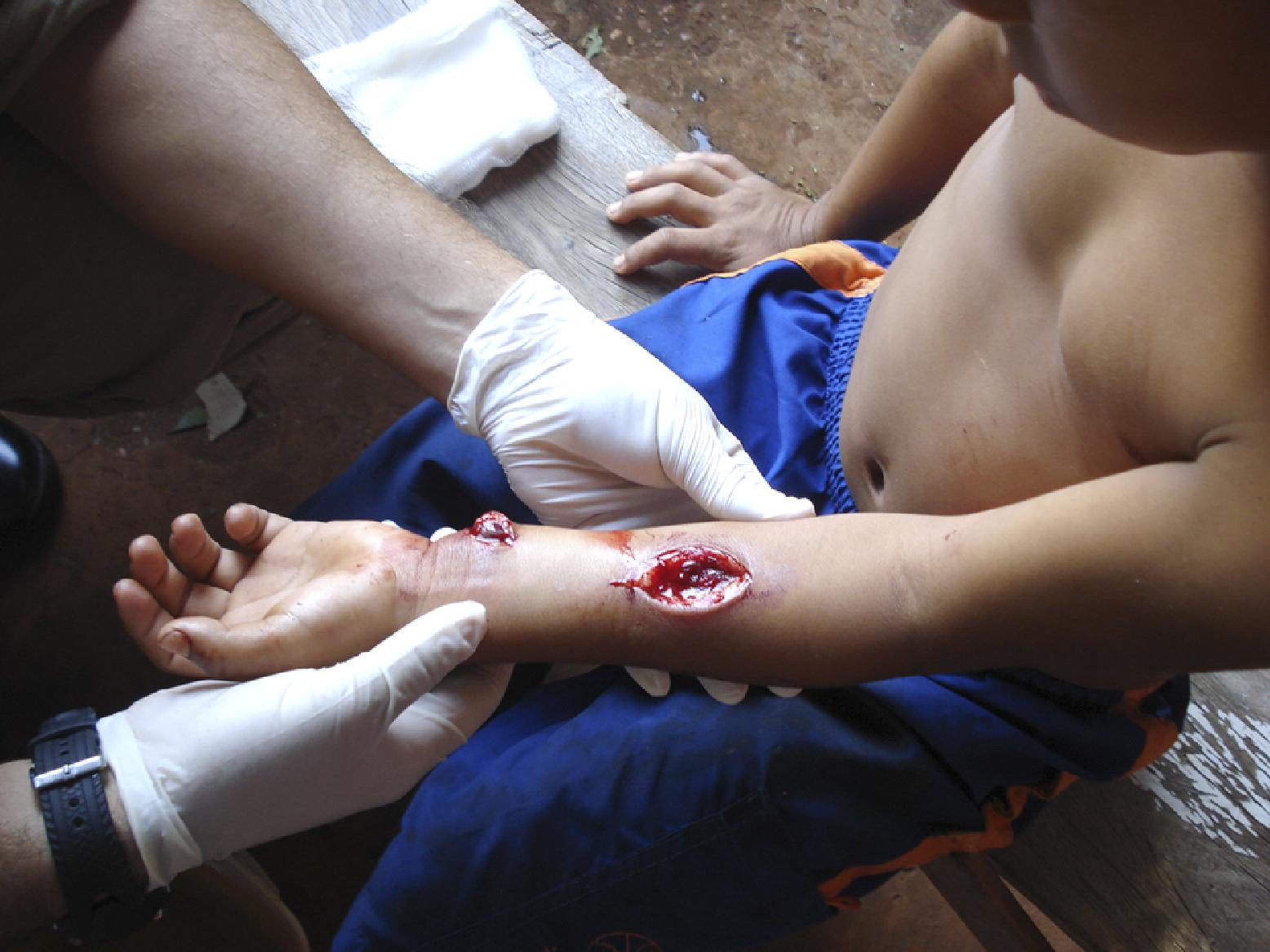
The male patient presented 2 deep incised wounds with approximately 5 cm of exposed subcutaneous tissue in the distal third of the anterior left forearm and 3 cm on the inner left wrist.
The female patient presented an irregular, triangular-shaped laceration of approximately 3 × 1.5 cm, which was moderately deep with a small flap of skin hanging on the outside of the left knee (Figure 3).
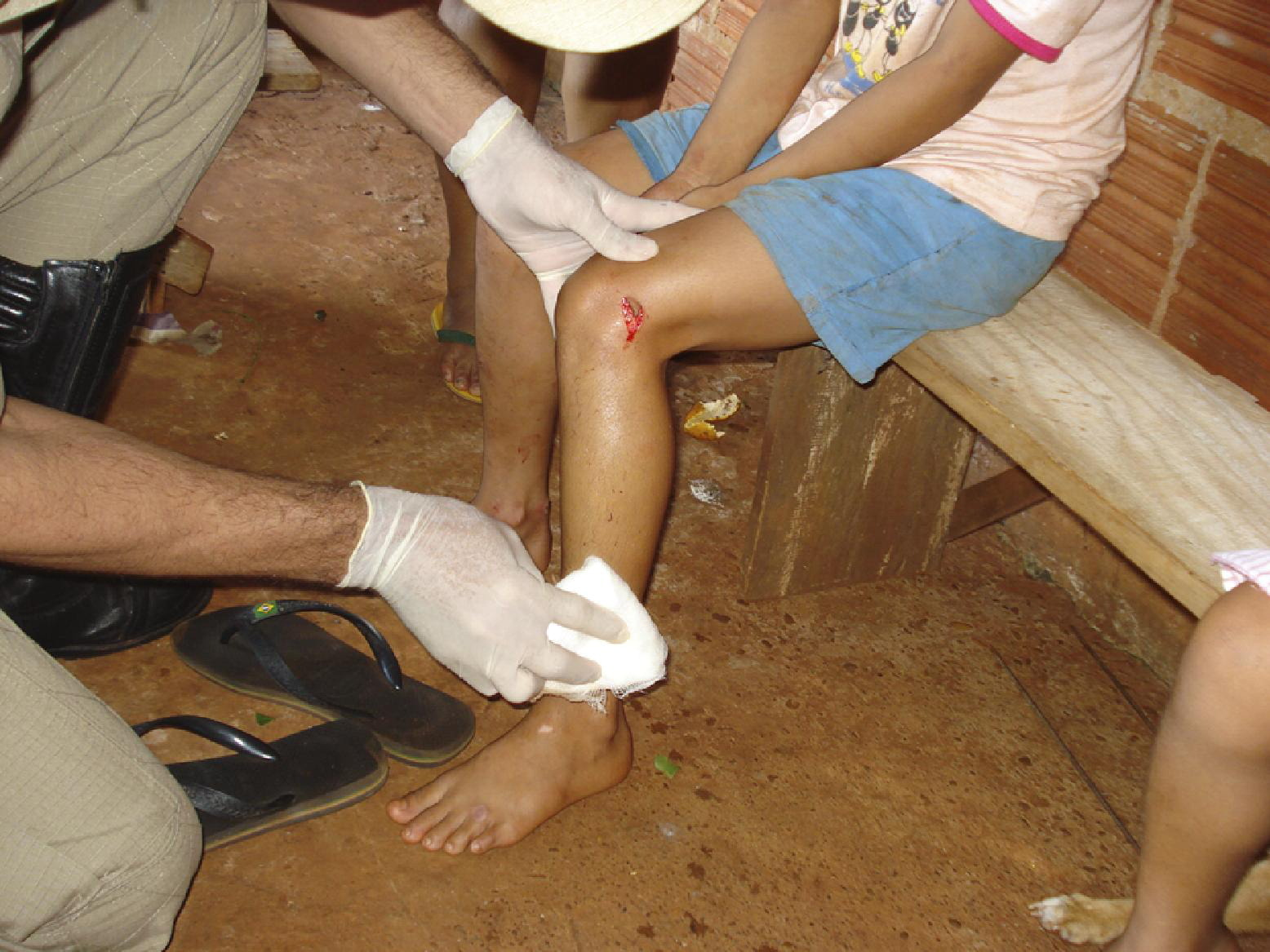
The female patient presented an irregular triangular-shaped laceration of approximately 3 × 1.5 cm, moderately deep with a small flap of hanging skin on the outside of the left knee.
The patients were treated by Dourados 2nd Firefighting Combat Team and taken to Vila Hospital, where they were treated with intensive washing and dressing of the wounds, and postexposure rabies prophylaxis.
Discussion
These cases have been described due to lack of reports in the medical literature on coati attacks, despite the animal's wide geographic distribution and abundance. 20 The motivation for these attacks was unclear. It is interesting to note that there are reports in the lay media of attacks. 34 Those attacks were associated with the presence of food in the victims' hands.
We suspect that the animal entered the house, was startled when the children awakened, and attacked when it felt threatened. The resulting lacerations were probably caused by the animal's claws, but the 1 circular laceration on the boy's back resembled a bite wound. It is possible that the attack occurred due to the presence of food in the home or even as a possible predatory attack given that there are reports of coatis attacking relatively large animals such as deer.
Coatis can cause serious injuries to humans with their long claws, sharp teeth, and strong jaw muscles. 35 While the injuries were not severe in these children, this may be due to the rapid intervention by the victims' family. Attacks by coatis, although not reported in the medical literature, appear to occur for several reasons in places where there is interaction between them and humans. It is important to be aware of the risks associated with coatis as they are common and increasingly present in areas frequented by people.
Footnotes
Acknowledgments
The authors thank the Dourados 2nd Firefighting Combat Team, Mato Grosso do Sul State, especially soldier Éden Nascimento da Silva from the Social Communication Sector, and Ricardo Franchim, from the Lauro de Souza Lima Institute, Bauru, São Paulo State.