






Abstract
In the late autumn of 1939, shortly after Second World War had commenced, the Soviet Union invaded Finland. This act of military aggression, henceforth known to history as the Winter War, was ostensibly carried out to secure a buffer state and better protect major urban areas such as St. Petersburg (then known as Leningrad). The Red Army's attack through the forests of northern Finland was a poorly calculated operation—in the little more than 3 months that the conflict lasted, the Soviets suffered extensive losses. The hit-and-run tactics of the small, winter-savvy Finnish Army resulted in a not significant number of Red Army casualties. But from the Soviet perspective, the Finnish soldiers were merely an annoyance compared with the real enemy—the environment. Cold injury reached epidemic proportions in the Red Army during this short conflict, apparently caused in large part by ignorance of environmental realities by the Soviet high command. Paradoxically, the Soviets arguably possessed the most extensive and sophisticated body of knowledge about cold injury prevention and treatment on earth by the late 1930s. There were significant lessons learned by the Soviets during the Winter War, however. When Germany invaded the Soviet Union in 1941, the Red Army very successfully applied these lessons during 4 years of vicious winter battles on the Eastern Front.
Introduction
Essays appearing in the Lessons from History section of Wilderness and Environmental Medicine generally do not broach topics relevant to the course of world wars. However, the 1939–1940 Russo-Finnish Winter War provided important, if harsh, lessons about subarctic winter combat taught by the defenders (Finland) to the invaders (the Soviet Union). This short campaign, lasting from November 30, 1939, to March 13, 1940, saw one million Soviet soldiers thrown against 300,000 Finnish soldiers—most of whom were reservists. In one battle alone, Suomussalmi, the Soviets lost 27,500 men by exposure and combat injuries, whereas the Finns lost only 900 killed and 1,770 wounded. 1 The loss of 200,000 Soviet soldiers by the end of the campaign—many to cold and starvation—compared with 25,000 Finns killed provided a poignant reminder that warfare conducted in harsh wilderness environments may require improvisational strategic thinking to avoid being defeated by the harsh environment or a foe who is at home in the harsh environment.
Background
As part of the Napoleonic-era conflict in 1808–09, Russia's war with (and defeat of) Sweden wrested Finland away from Sweden to become part of the empire of the Russian Czars. This change in masters brought peace that lasted until the 1917 Bolshevik revolution in Russia. With the attendant confusion of this enormous governmental change in Russia, Finland took advantage of the disorder to assert its independence for the first time in recorded history. 2 The Soviet Union subsequently became Finland's giant—and rather threatening—neighbor. Thus, perhaps there was a certain inevitability to the 1939 Soviet invasion, given this history. Stalin's pretext for this action was that the Soviet–Finnish border was too close to St. Petersburg, or Leningrad as it was then known, for comfort. The recent outbreak of the Second World War with Germany's invasion of Poland in September 1939 may well have influenced Stalin's decision on this matter. Additional Soviet “buffer” territory might have been seen as potentially useful in protecting Leningrad from foreign invasion. Stalin's Soviet Army invaded Finland via her vast, dense deciduous forests on November 30. The Finns had never seriously considered that the Soviets would send large conventional forces into such terrain at that time of year. However, it is likely that Stalin had never expected to fight a winter war; he instead may have anticipated or imagined happy Finnish workers welcoming the Red Army as liberator from their wicked capitalist bosses.
Russia was known to have had standing ski troops since the end of the 17th century, but apparently wasted their tactical potential; these troops were typically deployed with as much imagination as infantry on parade.
3
Such troops were, at any rate, not effectively used in any significant number during the 1939–40 war with Finland. By stark comparison, the Finns' intimate relationship with winter served them well, and provided a rather perfect opportunity to practice an “offensive defense” in respect to tactical maneuvers against a conventional foe (Figure). Virtually everyone of military age in Finland could ski, so special instruction by the military was as superfluous as having to teach infantry troops to walk. With its endless forests and lakes, most of the Finnish countryside was a welcoming winter battlefield for the reservists called into service. Moreover, the Finns had learned the military value of the ski as far back as 900–1000
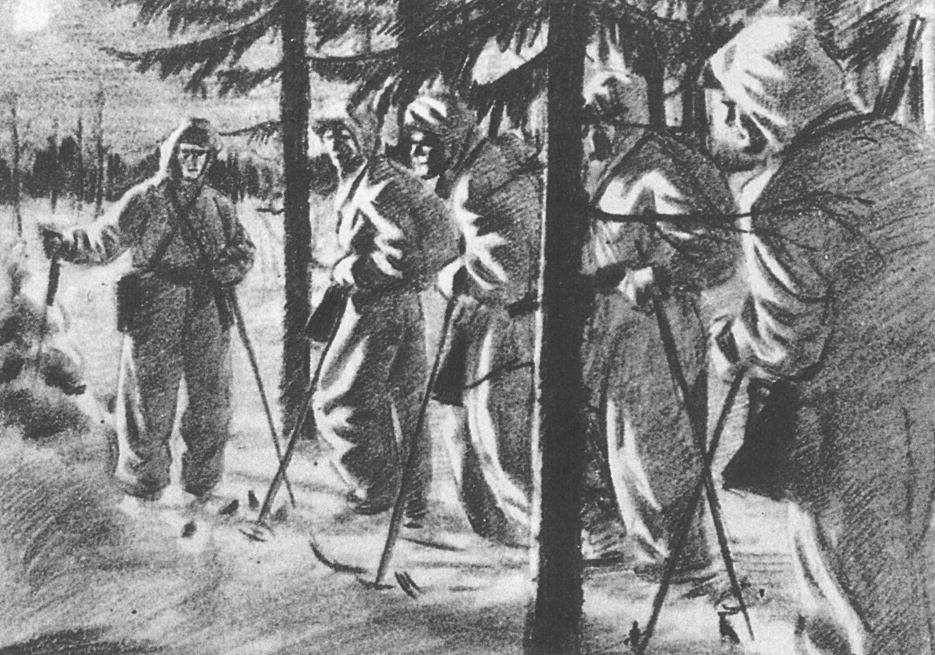
Sketch by an unknown artist depicting Finnish ski troops—known to Soviet soldiers as the “White Death”— during the 1939–40 Winter War. Such small units of the Finnish army were able to make very effective guerrilla-style attacks on the Soviet troops, especially as the conventional Soviet forces struggled along the poor forest roads of northern Finland in the midst of harsh winter conditions.
The Soviet Army in 1939: Prepared in Theory for Winter Warfare
Compared with the Soviets, the Finnish military could not in any way measure up in troop numbers and technology, but the indigenous war-making style of the Finns provided effective compensation for the majority of the conflict. Belaya Smert (the White Death) was the term Soviet soldiers came to use when referring to this winter war in the wilderness, and the term applied equally to death by way of Finnish soldier or the brutal winter environment in northern Finland. When the Finns began a counteroffensive on December 12 with the temperature at −40°C, the cold was their ally. Layering of clothes in cold conditions was a well-known principle to the Finnish ski troops, and was additionally well used by them in practice.
The contrast with the Soviet troops was stark. Because the Soviets had neither proper clothing nor shelter for the conditions, the Finns would space guerilla-style attacks so that the cold would have time to do its work of spreading depression and demoralization. The standard Red Army diet of black bread and unsweetened tea would not have been adequate fuel for Soviet soldiers in the harsh winter conditions of northern Finland. Tending to the wounded in arctic cold had its own special challenges. Aside from the obvious problems associated with keeping the wounded from freezing to death, any drugs in liquid form required special attention. Finnish medics learned to deal with this when anticipating a battle by tucking ampules of morphine inside their mouths or taping them to their armpits. 2 Perhaps more importantly, however, a wounded Finnish soldier was usually transported back to a warm aid-station bunker within 1 hour of receiving his injury, whereas his Russian counterpart knew only escalation of cold-induced misery and pain when wounded. Adding insult to injury, most of the Soviet units were marched into the great north central forests of Finland from their rail debarkation points on the Murmansk line, a distance of up to 200 miles. Losses of manpower in these units of nearly 10% to cold injury was seen before they had even crossed the Finnish border. 2
Ironically, investigators at the Kirov Institute in the Soviet Union had carried out a series of experimental studies examining frostbite treatment in the early 1930s.
4
They were the first to publish findings suggesting that rapid rewarming of a frozen body part in water provided improved treatment results compared with slow rewarming. In the English translation of Ariev's Monograph on Frostbite,
5
originally published in the Soviet Union in 1938, the results of many of these studies are reported. In an effort to recognize that the best treatment for frostbite is most certainly prophylaxis of injury in the first instance, a section titled “Methods of Collective Prophylaxis of Frostbite” states: In the worker's and peasant's Red Army, the most effective method of collective prophylaxis against frostbite is medical education … . The medical service of the army must strive to convince every junior officer and Red Army soldier of the importance of prophylaxis in frostbite, and see that he has mastered its methods to perfection.5(p94)
In reality, for the Soviet troops that were deployed during the Winter War with Finland, effective cold-injury prophylaxis was not practiced on any sort of wide-scale basis, let alone rapid rewarming of frostbite. The circumstances of combat combined with continuous subzero temperatures made the mere heating of water simply to provide hot drinks or soup a major logistical issue.
During the Winter War it was apparent to all who cared to notice that the Soviet Army was less than adept at preventing frostbite in its troops. It seems rather paradoxical that the sophisticated nature of Soviet science concerning cold-related injury (very likely the best cold-injury science anywhere in the world by the late 1930s) was so completely ignored by the Soviet Army. At least a portion of the apparent lack of Soviet preparation for winter combat in 1939 may have been attributable to the occasional arrogance, perhaps politically motivated, that can be detected in Ariev's Monograph on Frostbite, for instance: In comparison with the bourgeois troops, the Red Army personnel presents an incomparably more favorable prospect for medical educational work, since the Red Army soldier is accustomed to act with full consciousness in every instance and will combat frostbite with the same consciousness.5(p94)
Unfortunately, the extensive findings of Soviet scientists working in the area of cold-injury prevention and treatment did not make their way to the West until after the Second World War. Post–Second World War interest in cold-injury science was prompted in the West by fears of the NATO–Soviet Cold War becoming a proper war. As such, there was concern that Western armies might, once again, be fighting a large-scale war in the plains and mountains of central Europe where the winter cold can be intense. The 1955 English translation of Ariev's work was thus very important for Western scientists who needed to better understand the state of the science before embarking on their own original cold-injury research. It contains a massive historical review of what was known (internationally) about frostbite before the 1930s, as well as what were the most recent scientific findings in the immediate years leading up to the Second World War. The translation was undertaken by Dr. Iser Steiman—a physician and naturalized Canadian citizen originally from Dvinsk, Latvia. The work was largely done during Steiman's period at Yale University, where he was able to immerse himself in Yale's peerless Medical History Library. 6
Lessons Learned
The Soviets discovered that their troops were not, by and large, prepared for winter warfare. Clothing and equipment, management of cold-related (and other) injury, and use of ski troops had all been embarrassingly ineffective or simply absent. Personal accounts by Soviet soldiers shed light on the difficulties the troops faced. Georgi Prusakov recalled that only 136 of 764 men of his battalion returned from the Winter War with Finland, and not all of the losses were related to combat: Many suffered frostbite, although we had goose fat against frostbite [which was applied directly to exposed areas of skin]. Many men suffered frostbite due to their own negligence—during short breaks during the advance, why not pull out warm valenki [felt] boots from your bag and change? No, they preferred to stay in jackboots, and there you go.
7
Although goose fat was a well-known tradition for producing a warming skin sensation, modern research suggests that “protective” ointments may cause a false sensation of safety, leading to increased risk of frostbite as a result of neglect of other protective measures. In fact, test emollients most often have more of an objectively cooling than a warming effect on skin.8,9
The Soviets were also aware of another novel, but evidence-based, prophylactic measure against frostbite that was worth considering for mass use—“foot cloths” soaked in cabinetmaker's glue (with the addition of glycerin to prevent the glue from hardening)! Foot cloths treated in this manner … remain for weeks on the soldier's feet, and may be afterwards removed in a warm bath. Experiments [were made] on a monkey by gluing one foot according to the described method while the other foot was used as a control and was not treated with glue. After exposing both feet for 30 min. to a temperature of minus 15 degrees C, signs of frostbite developed only in the control paw. In a second [control] monkey, the paws were frozen hard. Later one of them [the paw of yet another monkey] was wrapped in pieces of material soaked in glue after it had been wrung out for a short time. The other [paw] was not subjected to any treatment. As a result of the second experiment the therapeutic effect of the use of glued bandages was corroborated, since the paw with the bandage covered with glue showed no signs of frostbite; at the same time the control paw developed blisters and other severe local symptoms.5(p98)
No report has been identified in English, however, that discusses the usefulness of foot cloths soaked in glue for frostbite prophylaxis by Soviet troops in cold weather field operations during the Winter War or subsequent Second World War battles. What is known, however, is that the Red Army recorded more than 132,000 frostbite casualties (requiring evacuation to hospital) during the short 1939–40 Winter War. In the words of one Soviet soldier, a Private Nikolai Guzhva, “There, not many died from [enemy] fire, more died from freezing.” 7
Just staying alive from day to day in the deep-freeze of the northern forests, given their lack of preparedness for the environmental conditions they faced, was a great challenge for Soviet troops during the winter of 1939–40. Adding combat to the mix decreased the odds of survival considerably further. The massive amount of Soviet men and materiel thrown at the Finns during the few short months of the 1939–40 Winter War was, nonetheless, the eventual face-saving strategy of the conflict's Goliath. Fighting ceased in March 1940 with the signing of the Moscow Peace Treaty. Finland ceded approximately 10% of its prewar territory and 30% of its economic assets to the Soviet Union. Most importantly, however, Finland retained its sovereignty and definitely enhanced its international reputation in many respects. The Soviet forces most certainly did not accomplish their objective of the total subjugation of Finland.
The ramifications of this relatively short winter clash went far beyond that of a regional conflict, the fate of Finland, or the security of Leningrad. Germany had been watching the course of events with the greatest attention. It would be hard to believe that the apparent weakness of the Soviet Army against a “minor” foe such as Finland did not factor into Hitler's decision to attack the Soviet Union the following year. The effect of the Finnish war on the Red Army itself was perhaps equally as providential. Stalin was so castigated by the Winter War that he allowed the Soviet high command to reform the armed forces—even though he had annihilated the Old Guard of the army just a few years earlier during his infamous purges. The dearth of effective strategic and tactical operational potential in the Soviet Army, at least when it came to unconventional fighting in a harsh environment, was clearly exposed in the forests and snowdrifts of Finland.
A New Foe and Mastering the Game
When Germany invaded the Soviet Union in 1941, the Soviets were able to turn the tables and learn from the Finnish experience by both adopting and adapting the Finn's tactics and strategy with regard to guerrilla warfare. Defending their home turf, the Soviets deployed thousands of ski troops who repeatedly outmaneuvered the Germans during nearly 4 years of cruel winter combat on the Eastern Front.
1
This may seem surprising given that Germany and Austria had always paid a great deal of attention to ski training in their armies.
10
However, it seems that during the invasion of the Soviet Union, Germany gave a low priority to alpine troops, perhaps in large part because they did not have sufficient respect for Soviet military competence (or the Russian climate). Germany did not even, as a matter of course, adequately outfit its troops with basic winter clothing suitable for the harsh weather they encountered on the Eastern Front during the winters of 1941–44. The Germans wore leather, calf-high boots, and standard woolen field uniforms. Soldiers tried to increase the scanty insulation provided by such footwear and garments by stuffing them with rags and newspaper. The Soviets, on the other hand, had learned from their previous winter warfare experience and were now equipped with felt-lined boots and quilted clothes. The Soviets also learned to make the best use of Siberian troops brought from the east for winter engagements—the Siberians knew how to live in the cold, harsh conditions and could effectively avoid cold injuries. Winter temperatures on this “Russian Front” reached −40°C (and often lower) not infrequently. The German army suffered great numbers of cold-related casualties—an estimated 200,000 cases of debilitating frostbite injury just during the winter of 1941–42 alone.
11
This occurred largely because of inadequate winter clothing and equipment as a result of the indecision and poor logistical planning of the German high command. A high-ranking German general and Panzer tank chief named Guderian described the winter field conditions with painful clarity: Only he who saw the endless expanse of Russian snow during this winter of our misery, and felt the icy wind that blew across it, burying in snow every object in its path; who drove for hour after hour through that no-man's land only at last to find too thin shelter, with insufficiently clothed half-starved men; and who also saw, by contrast, the well fed and warmly clad and fresh Siberians [commonly utilized by the Soviets during winter offensives], fully equipped for winter fighting; only a man who knew all that can truly judge the events that now occurred.12(p175)
And in a moment of depression, as the thermometer dropped to −63°C, Guderian wrote to his wife: The icy cold, the lack of shelter, the shortage of clothing, the heavy losses of men and equipment, the wretched state of our fuel supplies, all this makes the duties of a commander a misery, and the longer it goes on the more I am crushed by the enormous responsibility which I have to bear … .12(p174)
One might surmise that the German Army gave very little thought to cold weather operations during the Second World War, but this was not the case based on the cold weather training manual they produced in 1942, titled German Winter Warfare.
13
However, even though this publication was based on the German experience in the Soviet campaign of the previous winter, it failed to provide realistic guidance and instead gave a falsely optimistic impression of how the German soldier had coped with the winter conditions on the Eastern Front during the previous year: Experience teaches us that the German soldier knows how to master the difficulties of the Russian winter, and that he is superior to the enemy even in winter. He is capable, not only of defending himself against the Russian, but also of annihilating him in the attack.13(p4)
The manual then suggests how the German soldier achieves this superiority—but obviously such theoretical best-case training, etc, did not make its way out of the pages of the German Winter Warfare manual and into practice: Prerequisites for this superiority are as follows: psychological preparation for the hardships of winter warfare, appropriate training and adaptation, familiarity with winter combat methods, and proper equipment and employment of expedients.13(p7)
In fact, one can easily see a common thread running through the language in this manual and that from Ariev's Monograph on Frostbite
5
regarding the Soviet soldier before the 1939 Winter War with Finland. Glossing over the real difficulties involved with avoiding cold injury during winter military operations may have been “business as usual” for the Soviet and German propaganda machines of this era, but clearly it did not always serve the best interest of soldiers in the field who were struggling for their lives against both human and environmental adversaries. For instance, Professor Hans Killian, a German combat surgeon with the 16th Army on the Eastern Front during World War II: personally supervised the treatment of 5,243 cases of first-degree frostbite, 12,937 cases of second-degree, and 1,455 cases of third-degree with 393 amputations, all in the winter of 1941–42.14(p330)
In addition, German Army pathologists reported that one third of autopsies performed during the winter of 1941–42 showed evidence of frostbite. Of the frostbitten German troops that survived long enough to receive treatment for cold injury, 40% were out of commission for 3 months and 10% for 6 months, and 2% were fit only for service at bases in Germany. 14
Killian later wrote that the occurrence of cold injuries in every war waged in the cold should not be taken as an indictment of the medical officers, quartermasters, and commanders, but it is a consequence of war itself. Killian suggested that cold injury “is a badge of depression, demoralization, and defeat.” 14 The Germans learned the same bitter lesson about invading Russia as Napoleon had in 1812.15,16 Undoubtedly, sometimes the press of battle makes achieving proper protection against the cold very difficult. However, all else being equal, militaries the world over have found that adequate supervision, training, and discipline of troops, in addition to strong morale and decent food and equipment, can significantly lower the risk of environmental-related injury (be it cold, heat, or altitude).
Conclusions
In summary, the Soviet Union was not the only country eventually involved in the Second World War that was able to apply lessons learned from the 1939–40 Soviet–Finnish Winter War for the purpose of enhancing tactical and strategic operational effectiveness in a harsh northern climate. With Germany's April 1940 invasion and subsequent occupation of Norway until 1945, the ski troops of the Norwegian resistance were able to perpetrate many successful and important acts of sabotage on their Nazi occupiers during the winter months of those years. 10