






Abstract
Frostbite and other cold injuries on the early polar expeditions were common. This paper explains how frostbite was described, prevented, and treated on the Antarctic expeditions of the heroic age, comparing them with modern recommendations. Nonfreezing cold injury probably also occurred but was not differentiated from frostbite, and chilblains were also described.
Introduction
During the heroic age of Antarctic exploration (1895–1922), there were at least 18 expeditions to the Antarctic, and the literature of this period contains vivid descriptions of the medical conditions encountered. Perhaps the commonest of these was frostbite. The causes, symptoms, and signs are as relevant today as they were then. The aim of this paper is to describe the recommendations made, at that time, for the prevention and treatment of frostbite, and to compare these with modern advice.
Prevention of Frostbite
The prevention of frostbite requires some understanding of its causes. Doctor Macklin (surgeon on 2 of Shackleton's expeditions, and with experience of the cold during the Russian campaign of the First World War) wrote “the time that it [bare skin] can be exposed [before developing frostbite] depends upon the temperature, the amount of moisture present, and the strength of wind … . Much depends upon the circulation, for if a job is attempted after the body has been for some time at rest frost-bite sets in quickly. If, on the other hand, the individual has been working hard, walking or running, and the blood is pulsating actively, the hands and other parts can be exposed for comparatively long periods without harm.” 1
Ponting describes the effect of wind rather more poetically: “Seventy or eighty degrees of frost can be endured by any healthy individual if seasonably clothed and there be no wind. But if a breeze, be it ever so gentle, gets astir in such a temperature, it behooves one to be well alert, for Jack Frost is ever on the watch to take his toll, and he will bite as often and as deep as he gets the chance.” 2
Macklin said that predisposing causes were “cold (of the body generally), fatigue, exhaustion, hunger and vitamin deficiency, especially scurvy.” 3 In cold conditions, exhaustion is likely to be associated with a low core temperature and dehydration, both of which predispose to frostbite by reducing the supply of warm blood to the tissues and because the exhausted person will fail to take adequate precautions against the cold. 1
The importance of maintaining body temperature, ensuring good nutrition, and avoiding moisture are all recognized in recent guidelines on preventing frostbite as is the role of exercise, while avoiding exhaustion. 4 (Scurvy, though, is no longer a problem.) These guidelines also stress the importance of maintaining hydration. This was not mentioned by the doctors at the time or expedition members who were sledding and were probably chronically dehydrated as the Antarctic is very dry. On the march, all water had to be melted from snow, and fuel was limited. The effect of wind on the cooling rate can now be quantified by use of the wind chill factor.
Appropriate clothing is, of course, vital, and Macklin said that
Some individuals seem to be less prone to frostbite than others. 5 On Scott's Terra Nova expedition (1910–13), “Bowers … enjoyed a greater resistance to cold than any man on this expedition …”7(p213) and “… was never worried by frost-bitten feet.”7(p244)
Scott noted that “places that have been frost-bitten become extraordinarily susceptible to a recurrence of the evil. …” Those who overwintered the first season had all been frostbitten to a greater or lesser extent, “consequently it was much rarer to see people working with bare hands than it was in the first winter, when so many delighted to show their scorn of cold fingers.”8(pp183–4)
Frostbite also resulted from touching metal, and this was prevented by covering the metallic portions of instruments with flannel. Scott warned in rhyme: “Ah me what perils do environ the man who meddles with cold iron”8(p350)
On the Southern Cross expedition (1898–1900), “the men rubbed glycerine into their faces and hands … .” 11 to prevent frostbite, and Bernacchi (who had been on that earlier expedition) complained that this was not available on the Discovery (1901–04). 12 Macklin accepted that “[v]aseline and glycerine have been used on the face to protect it from strong winds, and apparently with success,” 3 but elsewhere warned, “[t]he application of Vaseline or ointment is the worst treatment possible, especially if the part is liable to be again exposed to cold” and describes experiments that he had done to confirm that. 1 More recent work supports Macklin's view and suggests that although petroleum jelly makes the skin feel warmer, it has no effect on skin temperature and by creating a false sense of security might lead to an increased risk of frostbite through neglect of efficient alternative measures.13,14 Rubbing fat into the skin also makes it more difficult to see frostbite. 5
Sites of Frostbite
The commonest sites of frostbite were the face, the feet, and the hands.
“Even in the coldest places it is necessary to keep ones face … uncovered,”8(p183) and so it is often frostbitten, a problem described in rhyme by Dr Levick, surgeon to the Terra Nova's Northern party 1910–13: “Wrapped up in your windproof your body's all right With your hand lying snug in its mitten But your beautiful nose is exposed to frostbite And as often as not is frostbitten Whatever you wear in the wind, there remains The ever insoluble puzzle Of how to be happy though blue in the face With icicles stuck to your muzzle”
15
Frostbite of the face was often combined with sunburn. Frostbite of the hands was also common but is easily detected by simply removing the gloves, so “the parts most liable to permanent damage are the feet.” 3
Gourdon describes a case of frostbite of the penis on the Français expedition (1903–05) which healed with scarring that caused a phimosis requiring surgery (presumably a circumcision) when the sufferer returned to Buenos Aires. 16 Other cases have been mentioned but not described.17,18 Frostbite of the penis is uncommon but recognized. 19
Symptoms
Scott wrote, “under ordinary conditions one has a distinct sensation on being frost-bitten; the blood seems to recede from the veins in the exposed part with a suddenness that almost conveys the sound of a ‘click’ and the feeling of a prick with a sharp instrument.” However “the frost-bites that come when people are doing hard work are more serious, as the first prick may pass unnoticed and the superficial freezing continues to take deeper hold without any further sensation.”8(p183) Charcot stressed that frozen skin is painless
Whereas frostbite in the face and hands will usually be recognized early, this lack of symptoms is particularly dangerous in the feet. Amundsen wrote, “How often has it happened that men have had their feet frozen off without knowing it! … The fact is that in this case sensation is a somewhat doubtful guide, for the feet lose all sensation. It is true that there is a transitional stage, when one feels the cold smarting in one's toes, and tries to get rid of it by stamping the feet. As a rule this is successful; the warmth returns, or the circulation is restored; but it occasionally happens that sensation is lost at the very moment when these precautions are taken. And then one must be an old hand to know what has happened. Many men conclude that, as they no longer feel the unpleasant smarting sensation, all is well; and at the evening inspection a frozen foot of tallow-like appearance presents itself.”6(pp82–83)
On the winter journey to Cape Crozier in 1911, aptly described as “The Worst Journey in the World,” 7 Dr Wilson was expected to do the, surely impossible, task of diagnosing frostbite from the symptoms alone. Cherry-Garrard said that “Wilson's knowledge as a doctor came in here: many a time he had to decide from our descriptions of our feet whether to camp or to go on for another hour. A wrong decision meant disaster, for if one of us had been crippled the whole party would have been placed in great difficulties. Probably we should all have died.”7(p244)
Initial Treatment of Frostbite
Early recognition of frostbite is important, 4 and Macklin advised, “[i]t is good practice for men in company to scrutinize each others' faces, and a valuable piece of equipment is a small mirror in which a man without companions can examine his own face.” 1
Frostnip is not mentioned, although is easily recognized in a description by Amundsen: “Our time was also a good deal taken up with thawing noses and cheeks as they froze—not that we stopped; we had no time for that. We simply took off a mit, and laid the warm hand on the frozen spot as we went; when we thought we had restored sensation, we put the hand back into the mit.”6(p99)
Different depths of frostbite were recognized. Scott describes superficial and deep frostbite, and Dr Atkinson, surgeon to Scott's Terra Nova expedition, describes first-, second-, and third-degree frostbites. 20
The traditional initial treatment is described by Nordenskjöld, leader of the Swedish expedition, 1901–03 “the two biggest [toes] … were quite hard and shriveled. I pinched them and pricked them, but he felt nothing, so I took in a basin of snow and began to rub them. I rubbed and rubbed. …” 21 In this case, the treatment was successful, but Wilson learned that traditional treatments were harmful: “The first frost bite I saw affected the ears of … . Lieut. Shackleton. Having heard from my youth up that a frostbite should be rubbed with snow I did so, with the result that the skin immediately came off, not from too vigorous a rubbing but from the fact that at temperatures below zero the snow is as hard as sand. … From that time on I never rubbed a frostbite finding that it was far better to bring back the circulation by merely applying the bare hand or by gentle massage, or by making the frozen individual swing his arms.” 22
On Shackleton's Nimrod expedition (1907–09), Priestley found that rubbing with snow was “as painful as any I know, for the Antarctic snow is invariably in small sharp crystals, very brittle and hard,”23(p400) and Charcot said that rubbing with crystalline or compressed snow could cause excoriations and even harm. 5
By the end of the heroic age Macklin said, “Treatment on the spot consists … [of] applying dry, gentle warmth. Very light massage may be used but violent rubbing, especially of the face, is liable to remove the cuticle and leave a weeping sore.” 1
Charcot recommended vigorous massage alternating with gentle rewarming. If the snow was soft, the massage could be done with that, but otherwise he recommended rubbing with the bare hand or even the gloved hand if the wool was not too rough. 5
Gentle rewarming of the hands was achieved by placing them in the axilla but rewarming the foot required another's help and was uncomfortable: “Every now and then one of our party's feet go, and the unfortunate beggar has to take his leg out of his sleeping bag and have his frozen foot nursed into life again by placing it inside the shirt, against the skin of his almost equally unfortunate neighbour.”23(p342) Macklin warned that “too great heat is bad. The circulation must be coaxed back gently.” 1 The main reason for this, which he does not say, is the likelihood of causing a burn. This was demonstrated when Wild's “fingers went and to bring back the circulation he put them over the lighted Primus, a terrible thing to do. As a result he was in agony.”24(p286)
On a modern expedition, frostbite would usually lead to evacuation, and it is recommended that rewarming in the field should only occur if definitive care is more than 2 hours away and if the frozen part can be kept thawed and warmed until reaching such care. 4 However, the early explorers were often days or weeks from their base and were usually determined to reach some goal so would continue, despite frostbites.
Macklin said that “[a] part that does not immediately come back to normal must be kept warm and dry, and the application of a little methylated spirit or turpentine is good … .” 1 It is uncertain as to why he recommended this, other than, perhaps, feeling the need to do something rather than nothing.
The emphasis on gentle rewarming is interesting as Paton, in a history of the treatment of frostbite, 25 says that rubbing with snow was still being recommended by the US Army in 1917, and even as late as 1942, Greene wrote, “[t]radition and modern science combine to urge that the frostbitten or chilled limb is kept at a temperature just above freezing point.” 26 Rapid rewarming of frostbite did not become accepted practice until the early 1960s. 21
Later Treatment
Macklin recommended that “[t]he limb should be raised, rested, and dry, warm (not hot) dressings applied,” and warned that “cases take a long time to recover fully.” 1
Blisters were lanced and ulcers were dressed. Atkinson advised boracic lotion and ointment (an antiseptic) or Hazeline cream (a commercial preparation of witch hazel). 20 He got severe frostbite of the hand (Figure 1), and that is presumably how he was treated (Figure 2). Charcot recommended picric acid. 5 This was used as an antiseptic 27 that would encourage the formation of a coagulum and thus seal a raw surface from infection. 28 On Scott's final expedition, Wilson dressed Evans's fingers with “boric Vaseline.”29(p240) Evidence is lacking as to the best treatment of blisters, 4 but aspiration or debridement of clear or cloudy blisters is still common practice. There is no evidence to support the use of antiseptics, but modern antiseptics are unlikely to cause harm. 4 The use of Hazeline is interesting. This has antiinflammatory actions, 30 but there is no evidence to support its use in frostbite. However, another plant extract, aloe vera, does have some benefit. 4
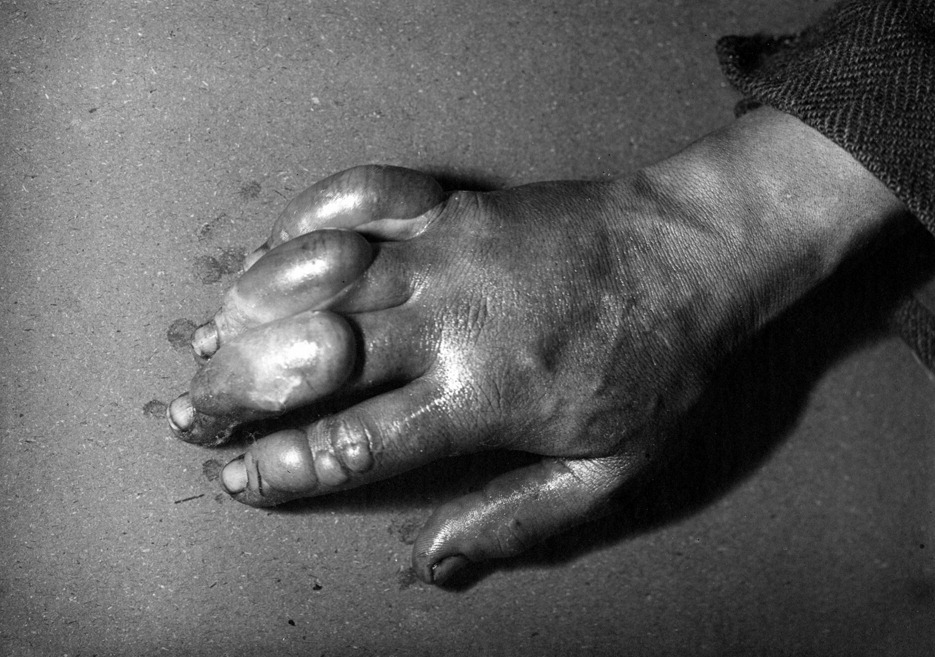
Doctor Atkinson's frostbitten hand.
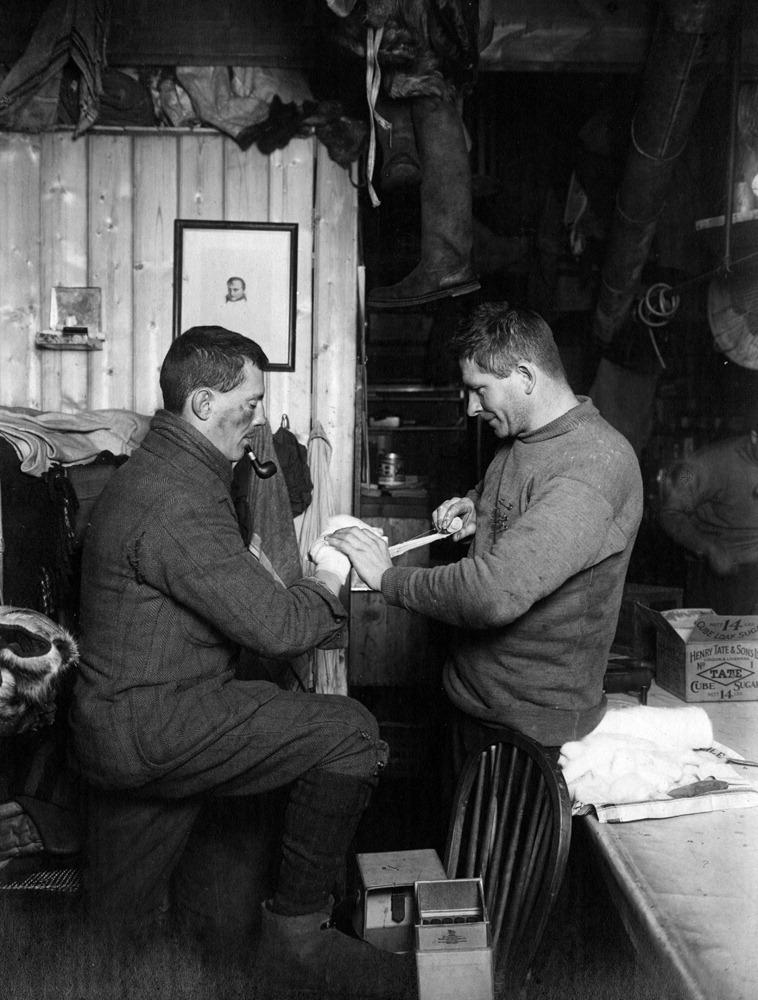
Edgar Evans dressing Atkinson's frostbitten hand.
Another dressing used was “Newskin.”23(p377) This was a collodion (pyroxylin in ether and alcohol). When applied to the skin, the solvents evaporated and the pyroxylin formed a protective skin over the wound.
Frostbite of the fingers could cause loss of the nails. Scott wrote, “Evans has dislodged two finger nails tonight; his hands are really bad …,” adding, “… and to my surprise he shows signs of losing heart over it.”31(p387) This would surely not surprise the modern reader! Wilson noted that “the effect of frostbite on nails is very unexpected sometimes. I had one superficial frost-bite on one of my big toes at Cape Crozier in July and half the nail only was killed, so that now it has broken half across, half dead and half still growing.”29(p176)
Gangrene
During this era, 2 amputations were performed. During the Nimrod expedition, Brocklehurst developed frostbite while climbing Mount Erebus. Both big toes were black, and 4 more toes were also frostbitten. Doctor Marshall amputated his big toe about 4 weeks later.23(p218) On the Endurance expedition (1914–17), Blackborrow developed frostbite of his toes on the boat journey to Elephant Island. The medical officers tried to delay surgery until after they had been rescued but were forced to operate on the island and amputated all the toes of his left foot after 2 months.24(p262) Modern advice would be to wait much longer, but it is clear that amputation (for open fractures, as well as for frostbite) was resorted to much earlier, before antibiotics, probably because of the severe, and possible life-threatening, consequences of infection.
Other Cold Injuries
Other cold injuries also occurred. Macklin said that “a milder though similarly produced effect leads to an irritable condition resembling chilblains. It affects commonly the tips of the ears.” 1 Charcot said that he did not know of a truly efficacious treatment for these, but he had treated them by rubbing with alcohol and with the application of picric acid. 5 The rationale for this treatment is uncertain.
Another foot problem occurred on Shackleton's boat journey. “After the third day our feet and legs had swelled, and began to be superficially frostbitten from the constant soaking in sea water, with the temperature at times nearly down to zero; and a lack of exercise. During the last gale they assumed a dead-white colour and lost surface feeling …”32(p73) When their feet had recovered, “we still shambled a bit, and whenever they got dry they felt as if burning.”32(p102) This was probably nonfreezing cold injury, although it would not have been recognized as such, as the difference between freezing and nonfreezing injury was not appreciated until the First World War when it was realized that many of the cases of “frostbite” from the trenches had not been exposed to freezing temperatures. 33
Conclusions
The clinical features and risks of frostbite have not changed and are still of relevance, and most of the risk factors for the development of frostbite that are described in recent guidelines were recognized 100 years ago. The doctors on the expeditions had discovered the benefits of warming frostbite long before this was accepted practice. For established frostbite, blisters were usually lanced and dressings were applied, using the antiseptics of the time. Amputation was performed at a much earlier stage than would now be done. The exact reasons for the amputations were not stated, but they were probably done because of fear of infection in the days before antibiotics.
Footnotes
Funding
This research was made possible by a research grant from the Wellcome Trust to study medicine during the heroic age of Antarctic Exploration.