






Abstract
Single nucleotide polymorphism genotyping provides a supplement for conventional short tandem repeats-based kits currently used for human identification. GenPlex (Applied Biosystems (AB), Foster City, CA) is an SNP-genotyping kit based on a multiplex of 48 informative, autosomal SNPs from the SNP
The reaction scheme consisted of numerous steps and was cumbersome to perform consistently manually. Automation was accomplished with a Biomek-3000 (Beckmann Coulter) laboratory-automated workstation using five in-house-developed methods. All methods allowed the user to select the number of subsequent injections to the capillary electrophoresis instrument (ABI 3130
A total of 286 samples were analyzed in duplicates with the GenPlex reaction using the Biomek-3000. The results were compared with those obtained from the same samples using the SNaPshot(AB) single-base extension system. Full concordance of the results was obtained in all but one sample. The results demonstrate that the Biomek-3000 can perform a series of complex reactions leading to highly consistent forensic genetic SNP-typing results.
Introduction
Common to most of the forensic genetic analytic methods performed today is the use of short tandem repeats (STRs) to provide discriminatory power.
1
For additional discriminatory power between closely related individuals, several different STR kits may be required. Alternatively, single nucleotide polymorphisms (SNPs) may be used.
2,3
One chemistry used for SNP discrimination is based on the SNaPshot (Applied Biosystems (AB), Foster City, CA) single-base extension (SBE) system together with capillary electrophoresis with multicolor fluorescence detection of the resulting SBE oligonucleotides. We currently use SNP typing based on the SNaPshot system using 49 of the originally 52 SNP
Use of complex genetic analytic methods provide an option for the technician to accidentally introduce pipetting or sample misplacement errors. Standardization of complex genetic analytic methods can be achieved using a relatively small and simple automated liquid-handling robot. Initial concerns regarding the Biomek-3000 were the limited deck size and flexibility. Pipette tips filled with sample material may pass over sample wells, which could introduce a minute risk of sample-to-sample contamination. Before handling real samples, this risk should be evaluated.
The GenPlex assay was initially rejected in our laboratory. The GenPlex protocol includes a large number of pipetting steps rendering the process vulnerable to pipetting errors when performed manually, increasing the risk of work-related injuries such as musculoskeletal ailments to the technical staff. 5 The GenPlex assay protocol and reagents were recently made commercially available by AB. Combined with a much simpler analysis process of the data, this makes Gen-Plex more attractive than the in-house-developed SBE system that is not commercially available to other forensic genetics laboratories hampering performance tests and result comparison. The purpose of the current study was to set up the complex GenPlex reaction on a simple, automated liquid handler. Subsequently, the performance of the automated solution relative to both manual pipetting and the SNaPshot system targeting the 46 of the 48 SNPs included in the GenPlex reaction was evaluated.
Experimental
Samples
Samples from 286 individuals, 111 Danes, 88 Green-landers, and 87 Somalis, were used. DNA from approximately two thirds of the samples were extracted from 200 μL of blood using the QIAamp DNA blood mini kit (Qiagen GmbH, Hilden, Germany) according to the manufacturer's instructions. The remaining samples were buccal cells on FTA-cards (Whatman Inc., Clifton, NJ). From each FTA-card, a 1.2-mm diameter punch was isolated into a 96-well microtiter plate (twin.tec, Eppendorf, Hamburg, Germany) using a BSD600-Duet semiautomated punch system (BSD robotics, Queensland, Australia). Between each sample punch, a cleaning punch without biologic material was punched into a waste container. The microtitreplates were prefilled with 10 μL of Milli-Q water using a Biomek NX-Span-8 (Beckman Coulter (BC), Fullerton, CA). FTA-card punches were washed three times with 150 μL of Milli-Q water using a Biomek NX-Span-8 (BC) equipped with two Variomag heater/shakers (Variomag, Daytona Beach, FL). Each washing sequence was followed by 15-min incubation at room temperature at 1000 rpm on a Variomag heater/shaker. After washing, the plates were dried at 60 °C at 200 rpm for 45 min or until dry on the Variomag heater/shakers.
PCR Amplification
An overview of the GenPlex SNP-genotyping system is shown in Figure 1. The SNP markers and the GenPlex protocol were described in detail elsewhere.
6
In brief, master mix for a multiplex PCR containing 96 primers amplifying 48 DNA fragments varying in length from 59 to 115 bp and the amelogenin gender marker primer resulting in a 105 bp (X) and 111 bp (Y) products was prepared. The PCR primers were derived from the original SNP

The GenPlex SNP-genotyping assay. The steps performed on the Biomek-3000 are highlighted with a gray background.
General Automation on the Biomek-3000
The Biomek-3000 used in the present study was equipped with 12 deck-tray positions. The following instruments were included on the deck: one rack housing a P20, P200, MP20, and a MP-200 pipetting tool; eight plate positions and three ManualLatch pipette tip holders. All pipetting operations were performed using either 20- or 180-μL filter tips (Axygen Scientific Inc., Union City, CA). All the methods used to operate the Biomek-3000 were developed in-house using the Biomek software version 3.3 (build 14; BC). The pipetting techniques and liquid types used in the five methods are listed in Table 1. Prints of the five methods and the deck layouts are available as Supplementary Information. An example of the settings used in an in-house-developed liquid type is provided in Figure 2. Pauses were included in methods when user intervention was required to either replenish tips or transfer a plate to an incubator. All the methods were scalable to the number of subsequent injections (1–6) on the ABI 3130
Pipetting techniques and liquid classes used on the Biomek-3000 for the GenPlex reaction
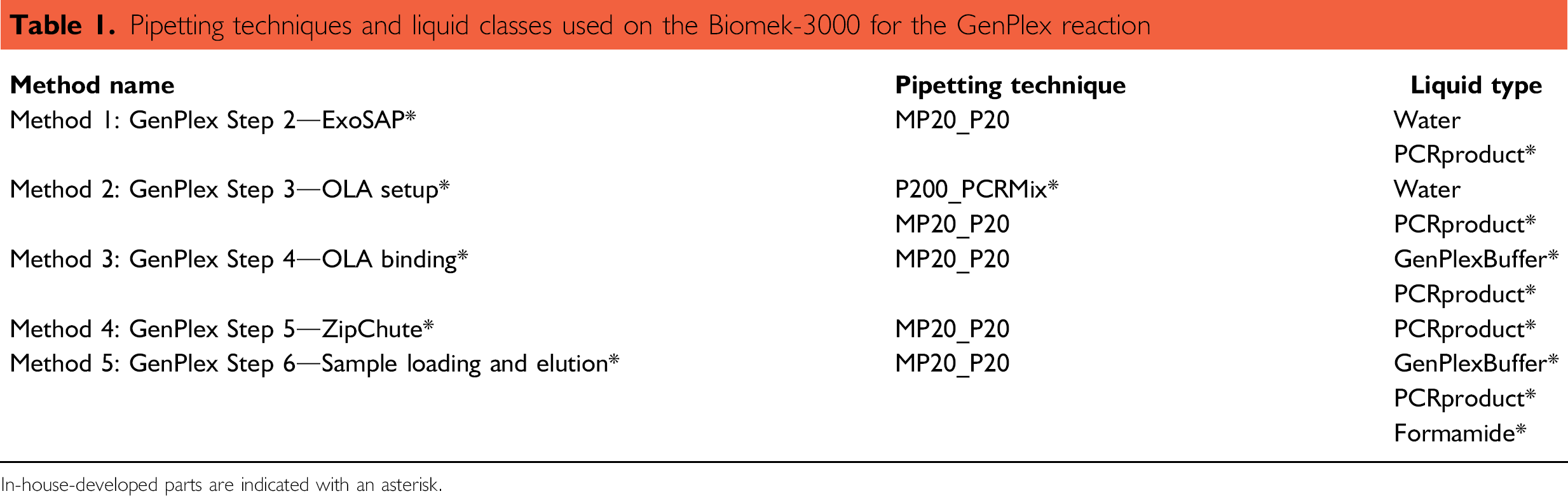
In-house-developed parts are indicated with an asterisk.

Example of the settings used in a liquid type. The GenPlexBuffer liquid type was optimized for pipetting the various wash buffers used in the reaction scheme. Some buffers appeared to contain detergents. For reproducible pipetting, the aspiration and dispense speed was reduced from 200 to 100 μL/s compared with the default values for water. The blowout volume was increased from 5 to 10 μLto empty the pipette tip completely. Finally, the tip touch speed was reduced from 100% to 50% to capture potential exterior droplets.

Workflow of the GenPlex SNP-genotyping assay.
PCR Reaction Clean Up
After the PCR reaction, unincorporated nucleotides and primers were removed by adding 2 μL of ExoSAP-IT (USB Corporation, Cleveland, OH) to 10 μL of PCR product in the wells of empty microtiter plates using a Biomek-3000 (BC). The plate was briefly centrifuged at 1600 × g for 1 min and incubated in an AB 9700 thermal cycler for 30 min at 37 °C followed by 30 min at 99.9 °C and holding at 4 °C.
Phosphorylation and Oligo-Ligation Assay
The PCR products were used directly as templates for hybridization and ligation with two different kinds of oligos: (1) biotinylated LSOs binding immediately downstream of each SNP sites, and (2) ASOs binding directly to the alleles upstream of the sequences. Each ASO was identifiable through a reporting sequence complementary to a ZipChute detection probe. 7 Using the Biomek-3000, 10 μL ZipChute Hybridization Master Mix containing 10 μL of 2× SNPlex OLA Master Mix, 0.1 μL of 100 × OLA oligos, 0.1 μLof 100× dATP, and 0.1 μL of gender-determination oligos per reaction was combined with 10 μL of ExoSAP-treated PCR product in a new microtiter plate. The microtiter plate was sealed (MicroAmp Clear Adhesive Film, AB), vortexed briefly and centrifuged for 1600 × g for 30 s. Using an AB 9700 thermal cycler, the plate was incubated for 30 min at 48 °C, 20 min at 90 °C, 25 cycles of 15 s at 94 °C, 30 s at 54 °C, extending for 10 min at 99 °C, and finalizing at 4 °C hold step. The plate was briefly centrifuged at 1600 × g to collect the sample.
Binding OLA Products and Biotinylated Strand Isolation
Before the binding of the biotinylated OLA products, the streptavidin-coated SNPlex plate (AB) was washed three times on the Biomex-3000 by repeatedly distributing and removing 140 μL of Hybridization Wash Buffer SNPlex system (AB). A master mix containing 25 μL of Hybridization Binding Buffer SNPlex system (AB) and 0.0125 μL of Positive Hybridization Control (AB) per reaction was prepared. Using the Biomek-3000, 25 μL of the master mix was added to each well of the SNPlex plate. Subsequently, 5 μL of each OLA product was added to each well. The SNPlex plate was sealed and incubated for 60 min at room temperature in an Eppendorf Thermomixer (Eppendorf) at 700 rpm. After a brief centrifugation, supernatant was removed and the SNPlex plate was washed four times with Hybridization Wash Buffer (AB) using 140 μL volumes, the Biomek-3000 and the GenPlexBuffer liquid type. The plate was dried by inverting it on a paper towel and centrifuging at 1600 × g for 30 s.
ZipChute Hybridization
A ZipChute Hybridization Master Mix was combined manually containing 0.05 μL of ZipChute Mix, SNPlex system (AB); 11.25 μL of Denaturant, SNPlex system (AB) and 13.7 μL of ZipChute Dilution Buffer, SNPlex system (AB) per reaction. Using the Biomek-3000, 25 μL of the Zip-Chute Hybridization Master Mix was distributed to each well of the SNPlex plate. The plate was sealed and incubated for 60 min at 37 °C at 700 rpm on a Thermomixer.
Preparation of Sample Loading Mix and ZipChute Elution
The SNPlex plate was centrifuged for 30 s at 1600 × g and the supernatant removed using the Biomek-3000. A Sample Loading Mix containing 0.6 μL of LIZ 48-Plex Size Standard (AB) and 16.9 μL of Sample Loading Reagent (AB) per reaction was prepared. The Biomek-3000 was used to distribute 17.5 μL of the sample loading mix to each well of the SNPlex plate. The plate was sealed and incubated at 37 °C for 5 min.
Plate Preparation for Electrophoresis
The SNPlex plate was centrifuged for 30 s at 1600 × g and 10 μL from each well and transferred to a fresh electrophoresis plate (Axygen). To each ladder well, 10 μL of fresh Sample Loading Mix was added manually and combined with 1.25 μL of SNPlex allelic ladder (AB). One negative control was included on each plate. The GenPlex products were separated on a 16-capillary ABI 3130
Data Interpretation
Multicolor fluorescence capillary electrophoresis results were analyzed with the cluster analysis program implemented in the GeneMapper software version 4.0 (AB).
Results and Discussion
A total of 286 samples were processed twice with the Gen-Plex SNP-genotyping assay. All samples were previously analyzed by SBE as described. 3 First, the performance of the GenPlex SNP-genotyping assay was evaluated by manually processing 15 samples. The resulting SNP profile for each sample was compared with the results from the SBE reaction. Full concordance was obtained for all overlapping SNPs. The same samples were processed using the five methods developed for the Biomek-3000. Complete concordance was obtained by the duplicate GenPlex SNP genotyping. Concordance was observed between the GenPlex and the SBE-based SNP-genotyping results in all the samples except for one allele in one sample. 8 No significant difference in performance was observed between the various source materials. Results from a representative sample processed both manually and using the Biomek-3000 are shown in Figure 4.

GenPlex SNP-genotyping results analyzed and presented graphically by GeneMapper 4.0. (A) Representative sample was processed manually. (B) The same sample was processed on the Biomek-3000.
Some automated liquid handlers have an option for describing a safe line of travel for the pipetting tool. This option may be used to prevent the pipetting tool to travel over, for example, a PCR plate, an option the Biomek-3000 does not have. By thoughtful layout of the liquid-handler deck in combination with each method, the movement of the pipetting tool over sensitive plates may be reduced. A total of 286 samples with known SNP genotypes were processed twice with the GenPlex SNP-genotyping assay. The robotic procedures last approximately 8 h for a full 96-well plate. We have implemented a procedure with a total duration of the process of roughly two working days for one full plate containing up to 88 samples and controls. No indication of cross-contamination between samples was observed. This indicates that the deck layout in combination with liquid types chosen for the Biomek-3000 prevented sample-to-sample contamination.
Conclusions
Advanced pipetting can be performed on a small and affordable, automated liquid handler such as the Biomek-3000 with an intermediate throughput. The main advantages of using an automated liquid handler are (1) minimizing occupational injuries due to intensive manual pipetting, (2) minimizing the variation in volume of dispensed liquid, and (3) eliminating pipetting errors. The complexity of the GenPlex assay was solved by using a small automated liquid handler. The complexity of the SNaPshot assay makes it necessary to use highly skilled human resources or the development of advanced IT expert systems. The GenPlex SNP-genotyping results were all in agreement with the expectations except for one SNP-allele assignment in one sample. This demonstrates that no sample misplacement or sample-to-sample contamination occurred.
Acknowledgments
We thank Applied Biosystems (AB), Foster City, CA, for making the GenPlex SNP-genotyping reagents available to us and Andrew Louka, Ph.D., Yogesh Prasad, Ph.D., and Rixun Fang, Ph.D., AB, for helpful discussions.