



Abstract
The new ASTM E1989–98 Laboratory Equipment Control Interface Specification (LECIS) is a robust standard definition of equipment behavior while under remote control. The goal of the standardization effort is to facilitate “plug-and-play” integration of laboratory automation with standard hardware behavior and software interfaces. The LECIS standardizes laboratory equipment behavior and a message passing scheme between the controller and equipment that synchronizes this behavior. Commercial adoption of this new standard is well under way.
Keywords
1. INTRODUCTION
Automation in the analytical laboratory is able to lower the cost, increase the speed, and increase the reproducibility of sample analysis. However when chemists try to automate multiple steps in a process, they frequently must integrate equipment from different vendors. The task is made exceedingly difficult by the heterogeneous, idiosyncratic equipment behaviors and proprietary interfaces. Not only does this difficulty increase the cost of developing automated systems, often this difficulty limits the ultimate performance and reliability of the systems.
The ASTM E1989–98 LECIS was developed to standardize equipment behaviors. It was developed as a generic standard that is applicable to a wide variety of equipment, from simple electronic balances to complex analytical instruments. The LECIS-defined instrument control protocol standardizes the application layer (see
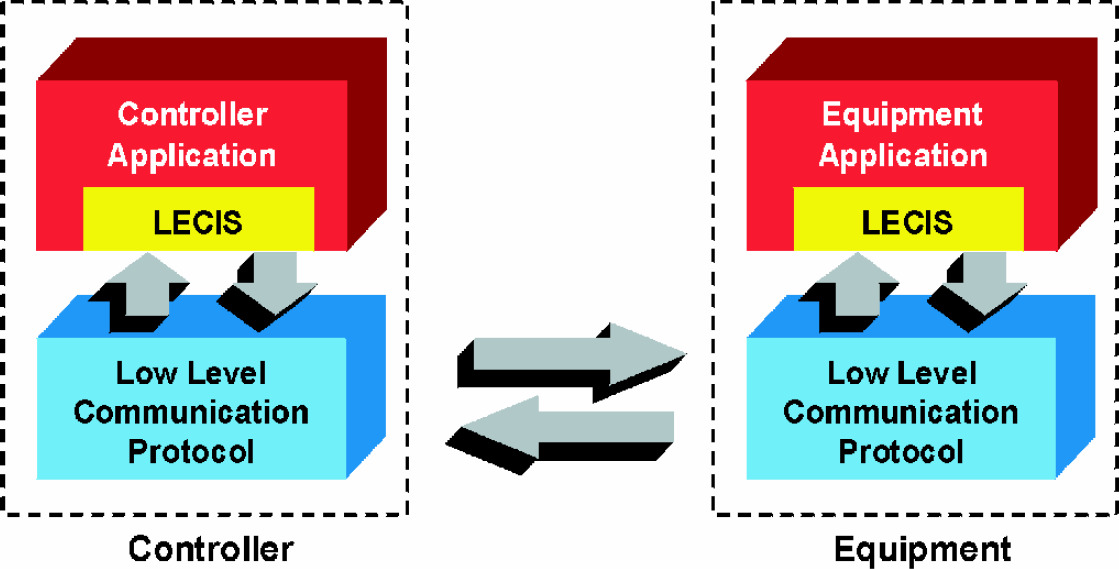
Protocol Hierarchy
1.1 ORIGINS
The LECIS was developed as a result of years of work by the National Institute of Standards and Technology (NIST) Consortium on Automated Analytical Laboratory Systems (CAALS). One of the products of this industry consortium was the definition of a standard Common Command Set. This recommended command set was formalized into the LECIS standard by the ASTM E-49–52 subcommittee on Computerization of Analytical Sciences Data within the ASTM E-49 committee on Computerization of Material and Chemical Property Data. The LECIS defines the standard equipment behavior, and the messages that coordinate them, in terms of the interaction model described, in part, by the General Equipment Interface Specification (GEIS) developed by the Intelligent Systems and Robotics Center at Sandia National Laboratory. Versions of this standard have been used extensively in automation and robotics efforts at Los Alamos National Laboratory.
2. CONTROL PARADIGM
The LECIS instrument control concept is based on interactions between the controller and the equipment. In these interactions, states define discrete equipment operating behaviors. Transitions between states are signaled by messages that synchronize the execution of standard behaviors; either command messages from the controller or event messages from the equipment.
The standard LECIS interactions are described in form of state diagrams.
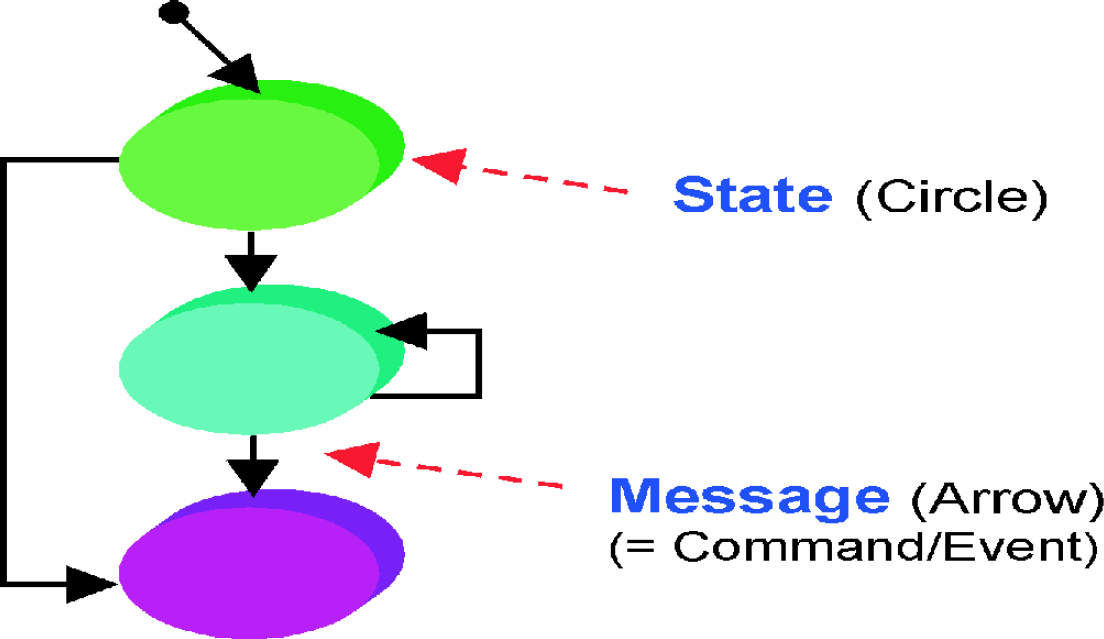
Interaction State Diagram Example
Standard-compliant instruments must support every interaction defined by the standard. The interaction models “fall through” states with defined behaviors that are not appropriate for individual equipment — simply exiting the state with the appropriate message without doing anything. This requirement allows the instrument controller to follow a standard control model regardless of equipment type.
2.1 INTERACTION CATEGORIES
The ASTM E1989–98 LECIS standard specifies required interactions. Required interactions are interactions that all instruments must support. The interaction model can also be used to describe equipment-specific behaviors in the form of interactions with defined message exchanges. Equipment manufacturers define equipment-specific interactions.
The standard also differentiates between primary and secondary interactions. Primary interactions are interactions that are started upon powering-on of an instrument. These types of interactions do not terminate until the instrument is powered down. Only one instance of a primary interaction can exist at any time. An analogy to a primary interaction is the old single-user MS DOS operating system. When the PC is booted, the MS-DOS command interpreter is loaded and invoked and remains running until the PC is turned off. There can be only one command interpreter running at any time.
The LECIS defines two primary interactions, the Control Flow interaction, which governs equipment initialization, configuration, and regular operations, and the Local/Remote Control interaction which manages the transition between local and remote control of the equipment.
Secondary interactions are interactions that can be started and terminated at run-time. It is also possible to create multiple instance of the same interaction, allowing standard control of multitasking behavior.
The ASTM E1989-98 standard defines the following required secondary interactions:
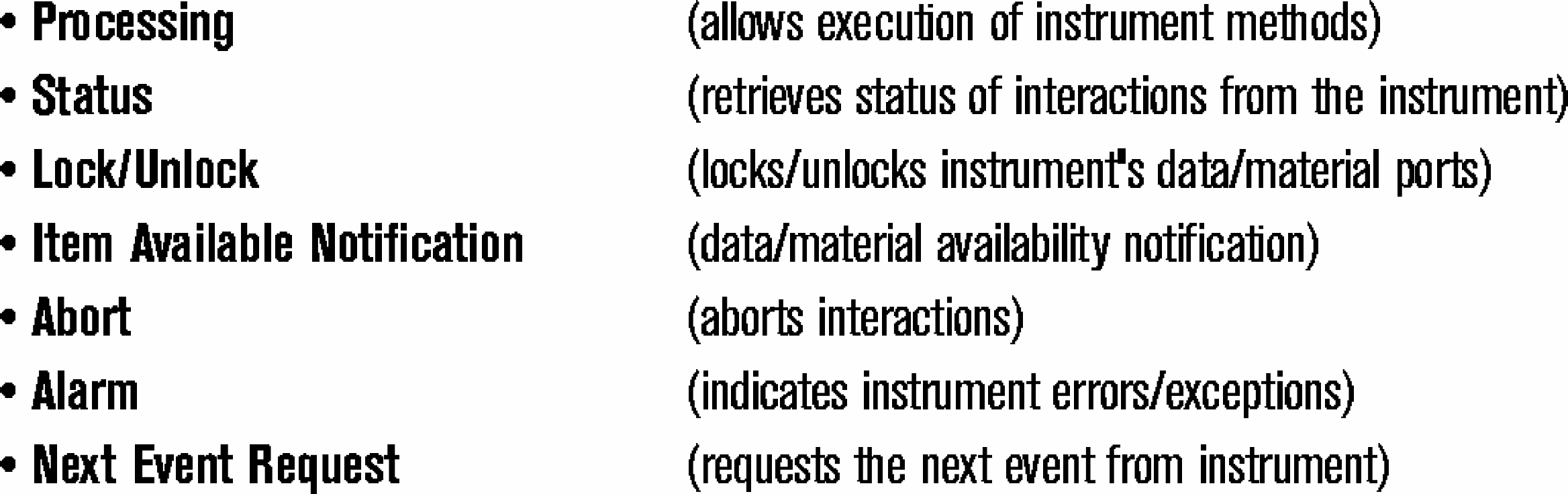
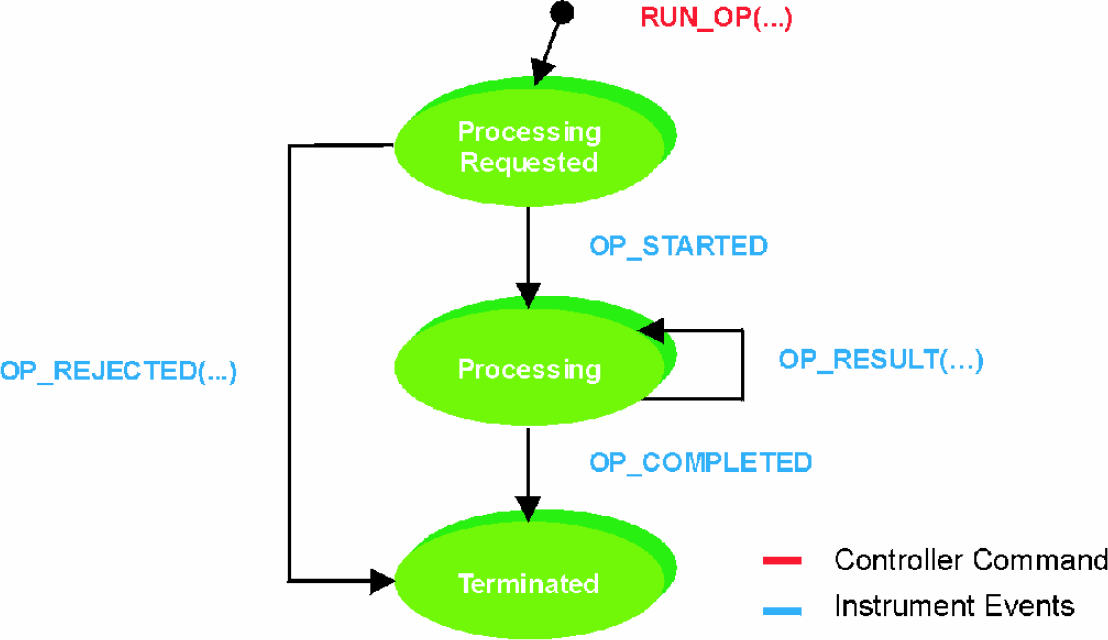
Processing Interaction
3. STATUS AND DIRECTIONS
Los Alamos National Laboratory has successfully implemented the ASTM E1989–98 standard on an internally-developed Microtiter plate stacker (controlled by a Keyence PLC). As part of this project a General-Purpose LECIS Instrument Controller software was written (running under MS Windows) to serve as an implementation guide to the standard.
Los Alamos National Laboratory is currently working, with varying degrees of formality, with Bristol-Myers Squib, CRS Robotics, Inc., and ErgoTech Systems, Inc. to facilitate commercial adoption of the LECIS standard. Bristol-Myers Squibb intends to build standard-compliant, Active-X-based controls for their laboratory instruments. CRS Robotics, Inc. recently committed to add an ASTM E1989–98 interface to their POLARA™ laboratory automation software. ErgoTech Systems, Inc. is developing a supported open source reference software implementation of the standard.
The goal of this collaborative effort is also to develop a CORBA (Common Request Broker Architecture) and DCOM (Distributed Component Model) IDL (Interface Definition Language) version of the ASTM E1989–98 standard. The CORBA and DCOM IDL standard extensions will further simplify the development and implementation of new laboratory equipment driver software.
NCCLS (formerly National Consortium for Clinical Laboratory Standards) recently incorporated the LECIS behavior definitions in their proposed AUTO3-P Communications with Automated Clinical Laboratory Systems, Instruments, Devices, and Information Systems standard.
Many companies have expressed their interest in the new ASTM E1989–98 instrument control standard. More information and progress reports on the development and implementation of the standard is currently available on the web at
CONCLUSIONS
The LECIS standard offers substantial benefits. The goal of the LECIS standard and follow-on standard development is to standardize equipment behavior while under remote control. A common, standard, device-independent remote control interface fosters “plug-and-play” instrument interfacing. This will reduce the cost of integrating equipment into an automated laboratory. More important, the LECIS standardizes a robust instrument behavior that is amenable to deterministic remote control and sophisticated scheduling. Automated systems created by integrating equipment that follows this behavior model can be controlled more robustly and scheduled more effectively, increasing the reliability, usability, and throughput.