



Abstract

Microchip capillary electrophoresis experienced a great success since its introduction. 1 2 The advantages of microfluidic systems, such as high performance, versatility, low reagent consumption, high throughput and automation capabilities, have been described. 3 Lab-on-a-chip devices have been used for separation and/or handling minute amounts of samples through microfluidic networks. 4 5 Most miniaturized capillary electrophoresis systems have been fabricated on glass and plastic substrates. 3 6 Yet, the glass fabrication processes are time-consuming, and the resulting microsystems are expensive for use as disposable devices. In contrast, polymers offer an attractive alternative to glass as substrate materials for high-volume production of microchip capillary electrophoresis systems. 6 7 The fabrication procedures used to create plastic devices are based on replication 8 ensuring device reproducibility at considerably lower costs than those used for glass. These advantages make polymeric devices attractive for generating truly integrated disposable devices for ‘in-the-field’ or ‘point-of-care’ applications.
The ultimate goal of this report is to develop a fully disposable analytical microsystem by coupling the low-cost poly(methylmethacrylate) (PMMA) microchips with extremely inexpensive thick-film amperometric detectors. The realization of such disposable microchip-CE-EC requires that their analytical performance is not compromised compared to common glass-based CE microchips with amperometric detection. 9 Figure 1 shows a schematic of the PMMA-CE-EC microchip setup including the position of the reservoirs containing running buffer and sample.
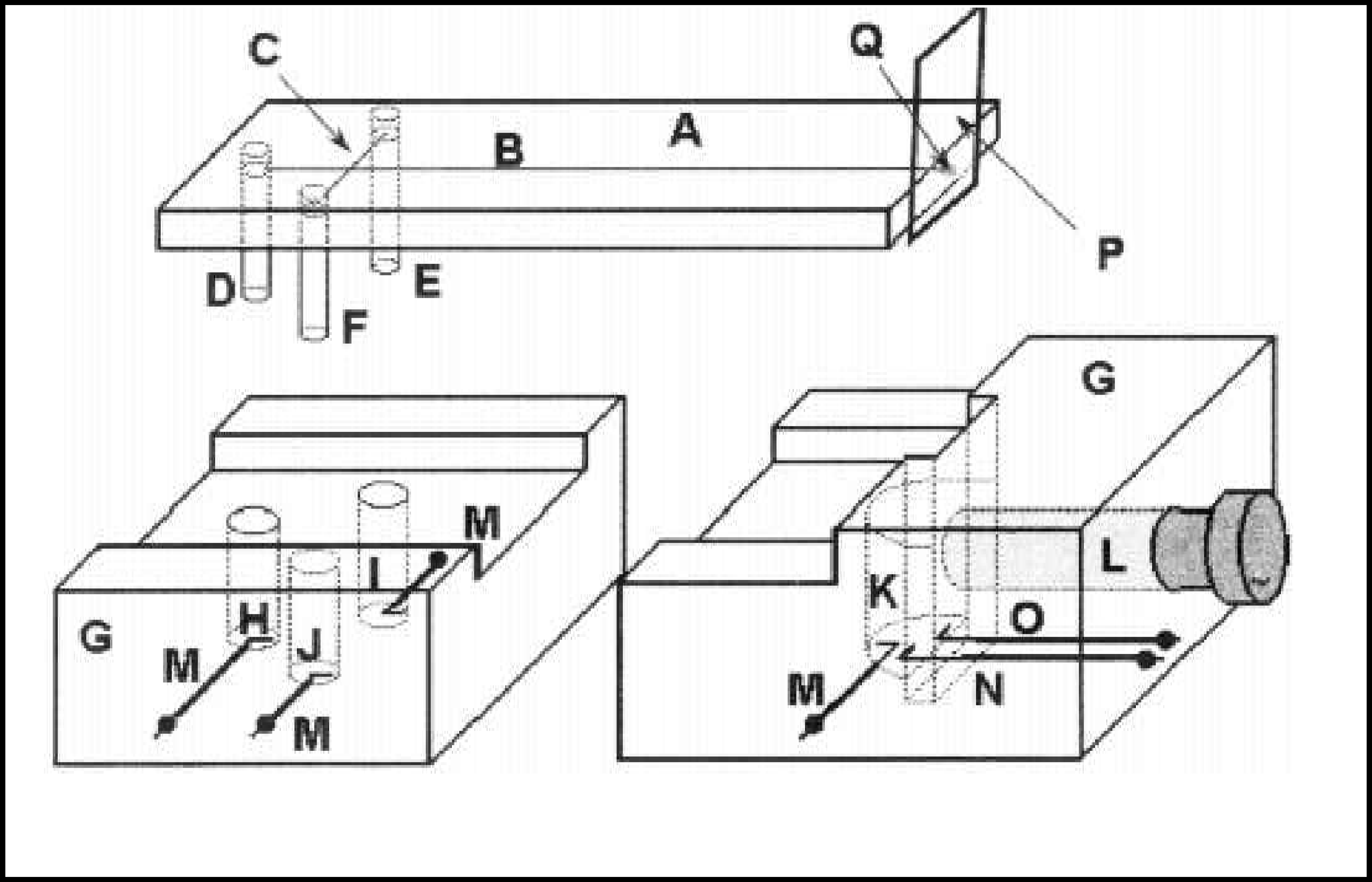
Lab-on-a-chip with amperometric detection. (A) PMMA microchip, (B) separation channel, (C) injection channel, (D) pipette tip for buffer reservoir, (E) pipette tip for sample reservoir, (F) pipette tip for reservoir not used, (G) plexi glass holder, (H) running buffer reservoir, (I) sample reservoir, (J) reservoir not used, (K) detection reservoir, (L) plastic screw, (M) high voltage power electrodes, (N) counter electrode, (O) reference electrode, (P) detection electrode, (Q) channel outlet.
Figure 2 displays electropherograms obtained with the PMMA-CE-EC microchips for mixtures of aminophenols
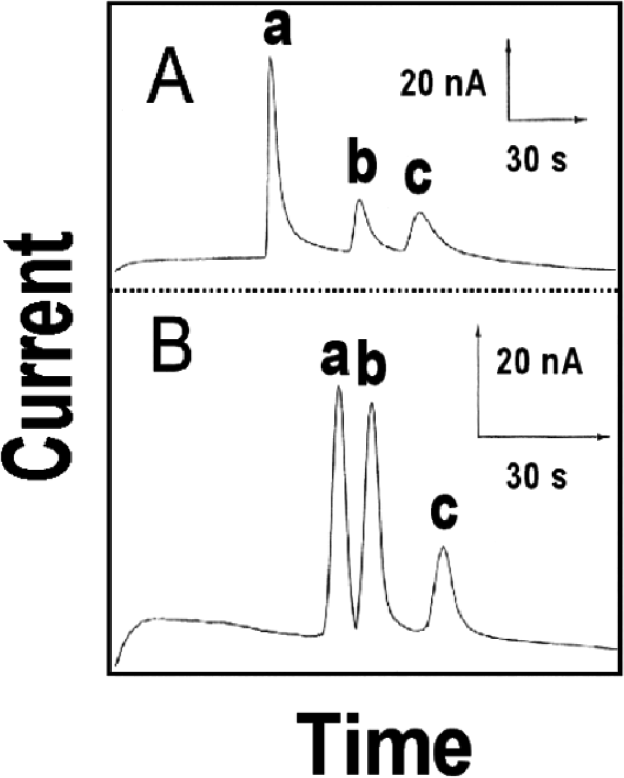
Electropherograms for mixtures containing (A) 1 mM 4-aminophenol (a), 2-aminophenol (b) and 3-aminophenol (c) and (B) 100 μM hydrazine (a), 100 μM methylhydrazine (b) and 300 μM 1,2-dimethylhydrazine (c) and obtained at the PMMA-CE-EC chip. Conditions A: Separation and injection field strength, +175 V/cm; detection potential, +0.8 V; gold-modified thick-film electrode; acetate buffer (20 mM, pH 5.0) as the running buffer. Conditions B: Separation and injection field strength, +140 V/cm; detection potential, +0.5 V; palladium-modified thick-film electrode; phosphate buffer (10 mM, pH 7.3) as the running buffer.
A; 4-aminophenol (a),
2-aminophenol (b)
and 3-aminophenol (c)
and hydrazines
B; hydrazine (a),
methylhydrazine (b),
and 1,2-dimethylhydrazine (c).
Microchip assays of aminophenols and hydrazines were also performed using glass-CE-EC microchips. The resulting data indicate that the analytical performance is not compromised by using the low-cost PMMA microchip. For example, the number of theoretical plates of 2-aminophenol on the PMMA and glass devices is 24570 N/m and 16892 N/m, respectively, and of methylhydrazine is 31348 N/m and 35211 N/m, respectively. In both cases the thick-film amperometric detector allows a convenient quantification of the compounds tested.
The performance characteristics of the PMMA-CE-EC microsystem were subsequently studied using catecholamines. Influence of the separation field upon separation efficiency of PMMA-CE-EC device was examined. For dopamine and catechol the plate number increases to maximum values of 19002 N/m and 20632 N/m, respectively, upon raising the separation field strength between +132 and +219 V/cm, and decreases (to 3386 N/m and 1614 N/m, respectively) upon raising the separation field to +439 V/cm. The separation field strength has negligible effect upon the peak-to-peak background noise level (70 pA) for field strengths ranging from +132 to +263 V/cm. Flat baseline is observed using separation field strengths lower than +263 V/cm. Subsequent experiments thus employed a separation field of+219 V/cm.
Hydrodynamic voltammograms for the oxidation of dopamine and catechol were studied. Both the compounds display similar profiles, with a gradual increase of the response between +0.3 and +0.9 V and leveling off the response thereafter. The half-wave potentials are +0.53 V and +0.65 V for dopamine and catechol, respectively. Subsequent amperometric detection employed the detection potential of +0.7 V that offered the most favorable signal-to-noise characteristics.
A calibration experiment involving sample mixtures containing increasing levels of dopamine and catechol (in 40 μM steps) yielded well-defined peaks, proportional to the analyte concentration. The favorable calibration characteristics are summarized in Table 1. The response of the thick-film amperometric detector was found to be linear in the range 40–1000 μM for dopamine and catechol. The limit of detection was 5.2×10⁻⁷ M for dopamine and 1.3×10⁻⁶ M for catechol which is comparable with previously published values for glass CE-EC 9 . The fast and sensitive response of the PMMA device/thick-film detector system is coupled with good reproducibility. A series of eight repetitive injections of a mixture containing 100 μM dopamine and 200 μM catechol (using the same detector strip) resulted in standard deviations of mean 1.74 and 5.02 μM, respectively. As both the PMMA-CE chip and the detector strip are very inexpensive, either one can be readily disposed.
In conclusion, the results demonstrate that the combination of inexpensive thick-film amperometric electrodes with microchip PMMA-CE systems results in flexible analytical devices. The versatility and low cost of the presented microfluidic devices are coupled to an attractive performance, with low detection limits and good precision. Such coupling of PMMA substrate materials and thick-film amperometric detection holds great promise for mass production of disposable microfluidic analytical devices. A single-use application (i.e., a totally disposable microsystem) may be realized for meeting the needs of numerous clinical or environmental decentralized testing.
Calibration Parameters of Dopamine and Catechol using PMMA-CE-EC microchip device.
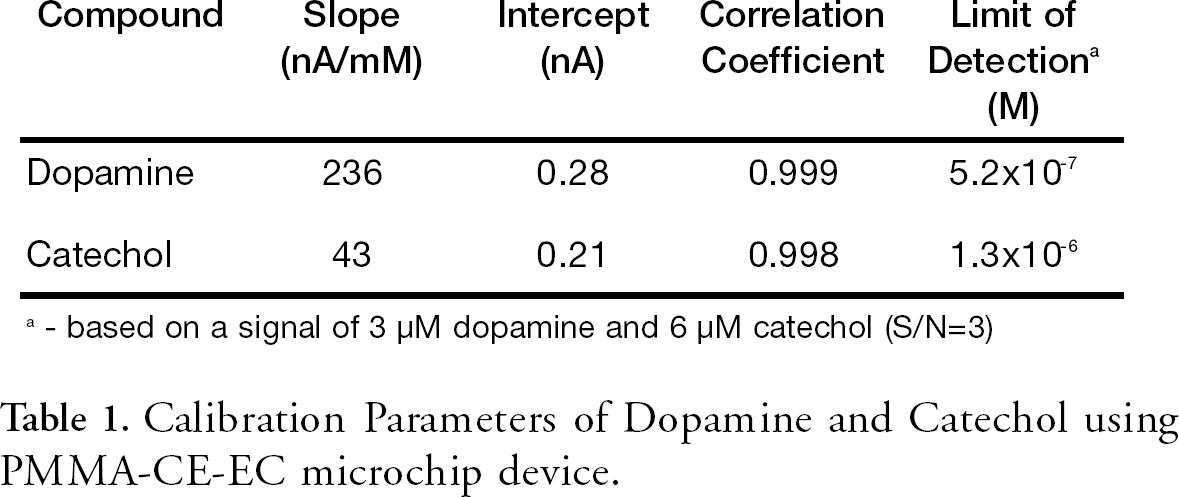
- based on a signal of 3 μM dopamine and 6 μM catechol (S/N=3)
ACKNOWLEDGEMENTS
This research was supported by ONR, EPA, NASA/JPL and NIH grants.