




Abstract
This paper describes the first phase in development of a mobile robot that can navigate aerial power transmission lines completely unattended by human operator. Its ultimate purpose is to automate inspection of power transmission lines and their equipments.
The authors have developed a scaled functional model of such a mobile robot with a preliminary simple computer based on-off controller.
MoboLab (Mobile Laboratory) navigates a power transmission line between two strain towers. It can maneuver over obstructions created by line equipments such as insulators, warning spheres, dampers, and spacer dampers. It can also easily negotiate the towers by its three flexible arms. MoboLab has an internal main screw which enables the robot to move itself or its two front and rear arms independently through changing gripped points. When the front arm gets close to an obstacle, the arm detaches from the line and goes down, the robot moves forward, the arm passes the obstacle and grippes the line again. In a same way another arms pass the obstacle.
Introduction
In recent years it has become a necessity to perform inspection work without suspending electric power supply. Two methods of accomplishing this task have been developed: aerial inspection by a helicopter and mobile robots. Performing the inspection with helicopters is costly, needs stabilized platform, and is boring for operators because of manually tracking of lines. Furthermore, with introduction of fiber-optic overhead ground wires (OPGW) as a high quality data transmission line, precise inspection is required but aerial inspection by helicopter does not provide such a degree of precision. In case of using Unmanned Aerial Vehicles (UAVs) the cost is high as well, and the project is very complicated [Matthew, 2000].
In 1989, by Aoshima and his colleagues, an autonomous wire mobile robot with multi-unit structure for inspection of power transmission wires was developed [Aoshima et. al. 1989]. The proposed mechanism could avoid obstacles and change its path to the branch wire but the total mechanism was complex in control. In 1991, by Sawada and his group, development of a mobile robot for inspection of a guard cable through eddy current was reported. This robot also presented a mechanism for tower transposition [Sawada et. al., 1991]. Also in 1991 same project was done by Higuchi and his group. This robot could move on a ground wire stretched on the top of the towers and also was able to go over the towers [Higuchi et. al., 1991]. The robot stability in both Sawada's and Higuchi's projects was low, and the last one was also complex in control. Other related work can be found in [Wolff et. al., 2001] that the main concept of the proposed design in this paper is from this work and used with permission from the authors. Another project has been recently done by Li and his group. The obstacle avoidance procedure in this project is same as presented project in this paper but the mechanism is more complicated [Li et. al., 2004]. A mobile robot for visual inspection of power transmission lines with ability to pass the towers, [Adinan et. al., 2004], is the other related project which has been done in this field. Owing to the fact that there are so many problems in obstacle avoidance and navigation on power transmission lines, the research works for the best mechanism for such a robot is still on the way.
The authors of this paper have endeavored to develop a mobile robot for negotiating suspended lines over power transmission towers. The robot should be able to avoid obstacles and traverse towers. In addition to high stability and low complexity of mechanism, appropriate velocity, flexibility with respect to size of obstacles and curvature of the path have been considered in the proposed design. In first phase of the project that will be described herein below in this paper, a one-fifth scaled model of mechanical mechanism with a minimum system controller was built.
Mechanical System
Obstructions
To move along power transmission lines, the robot should be able to overcome obstructions on the line such as warning spheres, dampers, spacers, spacer dampers, and etc. The robot also should be able to go from one span to another by traversing the towers.
Mechanical Model
During the development of the mechanical architecture for the inspection robot, all the requirements related to:
Autonomous traveling Passing obstructions especially towers Fast traveling and fast traversing of obstructions Ability to carry certain amount of load Capability of climbing inclined paths according to slope of the lines Low energy consumption Simplicity in control
were considered. An improving methodology was adopted to design a mechanical prototype of the robot step by step by full three dimensional modeling of each part in MDT (AutoDesk Mechanical Desktop) and then simulating the designed mechanism in ADAMS. To meet the all above mentioned requirements, the following mechanism in Fig. 1 was proposed.

Designed mechanism: 1) gripping mechanism, 2) driving system, 3) one of three arm mechanisms and 4) arm driving mechanism
MoboLab has three similar grippers (1 in Fig. 1) installed on top of each arm. Grippers have four similar wheels which are adapted with the radius of cross section of the line. These grippers can independently open and close to fix or detach the robot from the line. When MoboLab is hanged from the line by the grippers, motors in driving system (2 in Fig. 1) drive one wheel in each side of middle gripper as drive wheels of the robot. The robot also has three flexible arms (3 in Fig. 1) that can go up and down with their gripping systems. The front and back arms are able to move along the robot length synchronously thanks to arm driving mechanism (4 in Fig. 1) and two connection rods which have connected the front and back arms. The Middle arm is fixed to the robot body and only can move with the robot.
All of the movements of MoboLab are simply done by power screw mechanisms. The main point in power screw linear motion systems is the fact that the nut has to slide along its screw when the screw rotates and the nut is guided and can not rotate. Power screw systems, as they are called, have high power transmission ratios (pitch over the circumference), so you can use them as gear boxes too.
When the robot detects an obstruction, the gripper of the closest arm to the obstacle is opened and the arm goes down to avoid contact and then it is translated forwards to pass the obstacle. After traversing the obstacle, the arm goes up and grips the line on the other side of the obstruction. All the operations done by the robot in obstacle traversing are shown in Fig. 2 and are demonstrated in Extension 1.

Obstacle traversing in MoboLab
MoboLab has an arm driving mechanism which plays two roles for the robot: translating two movable arms along the robot and translating the robot itself. Movable arms are seated over two nuts (red parts in Fig. 2) of main screw (green part in Fig. 2) of the robot. This main screw is attached to the robot body i.e. the green part in Fig. 2 is representative of robot body as well. If the main screw is driven, while the middle gripper has been clamped to the line, both movable arms will translate together along the line. In a same way there is another possibility to fix two movable arms to the line and drive the screw to translate the robot body.
To traverse obstructions with various dimensions, assume that the length of obstacle along the line is D1 and its height above or under the line does not exceed from half of D2, then we have:
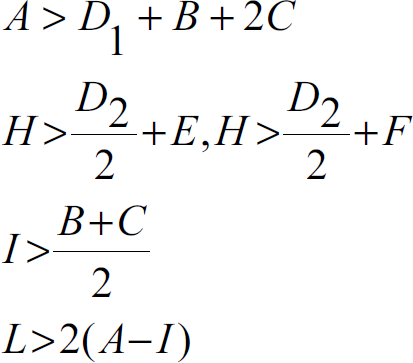
With this mechanism, there is not any limitation about obstacle dimensions in direction that is perpendicular to the plane of (D1, D2).
Movement of arms translates the center of gravity of MoboLab as shown in Fig. 4. The center of gravity of the robot moves along the presented line symmetrically with respect to middle arm. The center of gravity also goes below this line because of downward movements of arms. The most critical situation that causes instability in the robot is when one arm is in farthest position from the others and is not clamped to the line. The weight force vector is out of supports line in this situation. In this case, stability of the robot depends on length of C in Fig. 3 i.e. the distance between two sets of wheels in the middle gripper. The other cases in stability study of MoboLab are not so critical because the center of gravity is between the supports.
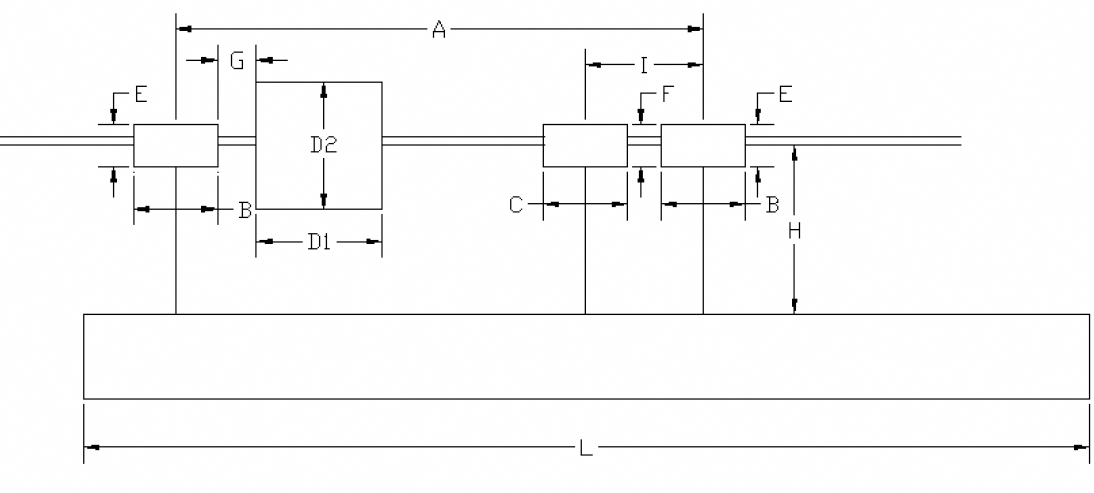
Geometrical parameters of MoboLab

The path of center of gravity in MoboLab
All of the mechanisms in MoboLab modeled and simulated in ADAMS. The dynamic performance of all of the mechanisms was examined and according to the simulation results, the design process was improved.
To simulate the robot, we can adopt either backward or forward approaches. In first one, velocities are knows and we want to find dynamic characteristics such as torques, forces, and etc. and in forward approach the case is vise versa. We adopted both of the approaches to improve the results. Some of the simulation results are shown in Fig. 5.
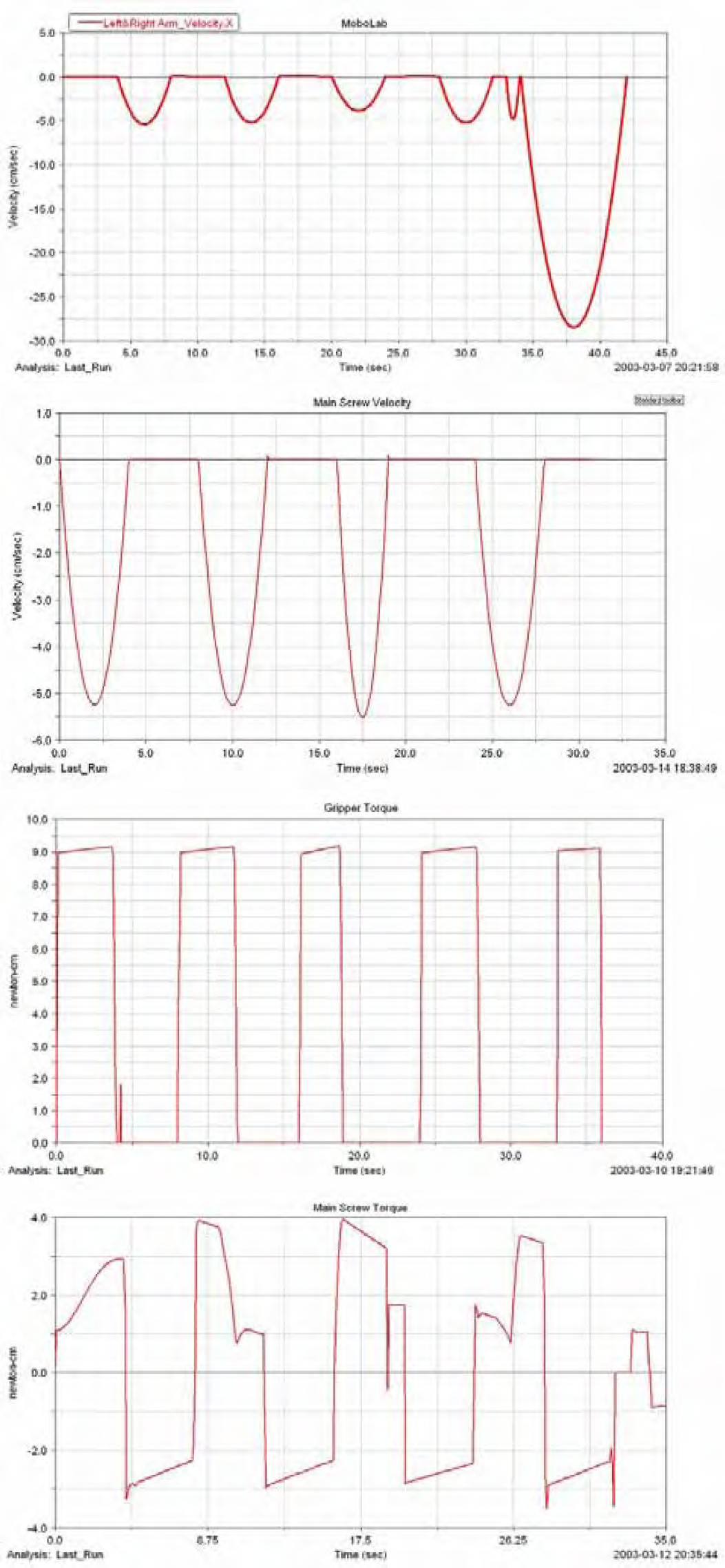
Simulation results in 35 seconds simulation time according to Extension 1. From up to down: MoboLab speed variations, speed variations of arm driving mechanism, torque variations in grippers and arm driving mechanism torque variations
Specifications of scaled model
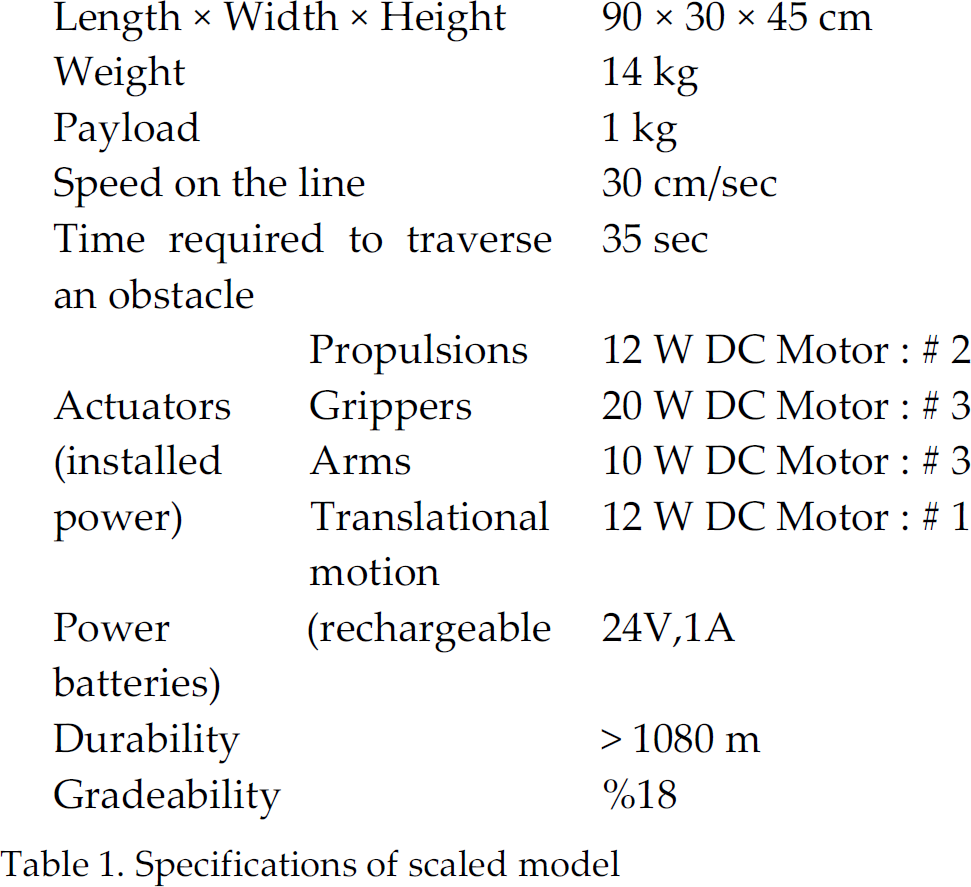
Specifications of scaled model
Minimum time for obstacle traversing Simple to do and gear head drive systems In emergency conditions robot movement can be done with obstacle traversing mechanism as well High stability thanks to three clamping positions and flexible arms which are able to be shorten and attach the robot to the line in windy climate Appropriate for other paths that are not parabolic. Length of arms can be adjusted during the movement according to slope of the path to keep the robot horizontal in all conditions. MoboLab also has three hinged joints at the end of each arm that allow the grippers to be adjusted according to the slope of the line. That means only grippers are sloped and the arms remain vertical in all cases. Ability to modify with an extra mechanism for traversing tension towers.
Control System
A PC based control system is adopted to control MoboLab. User can input his/her commands via a GUI in control program. These commands are transferred into control board and the appropriate motor is driven via relay board. To ensure precise driving, obstacle avoidance, and data acquisition, the data which are gathered from the line as well as the data from various parts of the robot are transferred to the control board as necessary inputs to make decisions according to control strategy or these data are transferred to PC as inspection data.
In this experimental model we installed a small camera that captures video from the line and can be turned on or off by the operator via a PC. User also can capture images whenever and wherever it is necessary.

Scaled experimental model

A sample of GUI Control Panel

Control System of MoboLab
In this project, an experimental mechanical mechanism of a tool for automating the inspection of power transmission live lines has been developed. This new mechanism help to inspect the line without interruption and with high precision which is a result of minimum distance to the line. Autonomy of MoboLab increases the safety of the maintenance procedure and decreases the inspection time due to fast obstacle traversing. This robot can be used as basis for future developments; generating a fully autonomous system equipped with special tools to carry out inspection and repair in power transmission lines.
Index to multimedia Extension
The multimedia extension to this article can be found online by following the hyperlinks from www.ars-journal.com.
Extension 1: Movie clip, a 35-second video file which demonstrates the obstacle traversing procedure of MoboLab on a straight line.
Footnotes
6. Acknowledgment
We have especial thanks for professor Amir Khajepour and Adrien Wolff in mechanical engineering department of university of Waterloo in Canada because of their generously cooperation to share their ideas with us and actually, the main idea of this project originally belongs to them. We also thank engineers of Research Center of Ministry of Energy of I.R. of Iran because of their kindly cooperation during this project.