




Abstract
Background
A number of studies have been conducted to explore the relationship between CD24 expression and the prognosis of breast cancer; however, the results remain inconsistent. Therefore, we performed this meta-analysis to clarify the impact of CD24 expression on clinicopathological features and prognosis of breast cancer.
Methods
A comprehensive literature search for relevant studies was performed, and statistical analysis was conducted using Stata software.
Results
Twenty studies, including 5,179 cases, were included in this meta-analysis. The pooled analysis indicated that CD24 expression was associated with lymph node invasion (odds ratio [OR] = 0.68, for negative vs. positive, 95% confidence interval [95% CI], 0.53-0.87, p = 0.002) and TNM stage (OR = 0.63, for I + II vs. III + IV, 95% CI, 0.49-0.81, p<0.001). The prognosis analysis also suggested CD24 overexpression indicated a poorer 5-year overall survival (OS) rate (relative risk ratio [RR] = 0.93, 95% CI, 0.86-0.99, p = 0.03) and 5-year disease-free survival (DFS) rate (RR = 0.90, 95% CI, 0.83-0.98, p = 0.02). However, CD24 expression had no correlation with tumor size, tumor grade, distance metastasis, estrogen receptor (ER) status, progesterone receptor (PR) status, or HER2 status.
Conclusions
Our results suggest that higher CD24 expression is significantly associated with lower OS rate, lower DFS rate and some clinicopathological factors such as lymph node invasion and TNM stage. This meta-analysis suggested that CD24 is an efficient prognostic factor in breast cancer.
Introduction
Breast cancer is the most frequently diagnosed cancer among females worldwide, and alone accounts for about 25% of all cancer cases among females. Furthermore, its incidence rates have been rising in many countries (1). Although many patients may benefit from systemic treatment, such as cytotoxic, hormonal, and immunotherapeutic agents, patients with advanced breast cancer may suffer tumor recurrence or metastasis within several years after treatment (2). Therefore, searching for more sensitive diagnostic and prognostic markers for the early stages of the disease is of particular importance.
CD24 is a 27 amino acid glycoprotein, and is found to be overexpressed in various types of tumors, such as pancreatic carcinomas, ovarian cancer, lung cancer, gastric cancer, liver cancer, renal cell carcinoma and B-cell lymphoma (3, 4). Additionally, CD24 overexpression is correlated with the prognosis of many types of cancer and may be used as an important biomarker (5, 6).
Many studies have been conducted to explore the important roles of CD24 implicated in the clinicopathological features and the prognosis of breast cancer (7–25); however, the results have been inconsistent. While studies by Kristiansen et al (6), Surowiak et al (8), Athanassiadou et al (9), Kim et al (15) and Kwon et al (22) suggested that CD24 overexpression is an unfavorable prognostic factor in breast cancer, studies by Bernardi et al (13), Ahmed et al (17), Adamczyk et al (19) and Zhang et al (23) found no association between CD24 expression and prognosis of breast cancer patients. A study by Alexandra et al (12) found that prognosis was poorer in patients bearing CD24(-) tumors. These inconsistent results may be due to the different antibodies used, the different cutoff values and the variable definitions of CD24 expression used in the different studies. To address this controversial issue, a meta-analysis was conducted to explore the relationship between CD24 and the clinicopathological features and prognosis of breast cancer.
Methods
Search strategy
Eligible studies were retrieved by searching the PubMed, Embase and Web of Science (for dates up to November 30, 2016) using the following combination of keywords: “CD24 or CD24A” and “breast” and “cancer or neoplasm or carcinoma.” In addition, the references cited in the articles and reviews were also manually searched to avoid missing other studies.
Study selection
Studies meeting the following inclusion criteria were included: (i) full text publication that evaluated the association between the clinicopathological features or prognosis factors and the expression of CD24 in breast cancer by immunohistochemistry (IHC); (ii) relative risk ratios (RRs) and their 95% confidence intervals (95% CIs) were reported or could be estimated from the data presented. Those reviews, systemic reviews or meta-analyses, conference abstracts or letters, and those that did not provide sufficient data or did not use IHC were excluded.
Data extraction
Two investigators (K.Q. and Z.-L. C.) independently extracted data from the studies. Disagreement was resolved by discussion. The following information was recorded from each study included: name of first author, publication year, population and ethnicity, number of cases, clinicopathological parameters, TNM stage, estrogen receptor (ER) status, progesterone receptor (PR) status, HER2 status and survival of patients. We also extracted the stage of disease in the patients, antibodies and their dilutions, cutoff values, location of CD24 expression and its positive rate. For those studies which did not provide 5-year overall survival (OS) and 5-year disease-free survival (DFS) directly, Kaplan-Meier curves were read by GetData Graph Digitizer (http://getdata-graph-digitizer.com/, accessed February 6, 2017).
Statistical analysis
Statistical analysis was performed using Stata version 11.0 (Stata Corp., College Station, TX, USA). Comparisons of CD24 expression in groups with different clinicopathological features and prognostic factors of breast cancer were assessed by pooled estimates of odds ratio (ORs) and relative risk ratio (RRs) as well as the 95% confidence interval. A p value less than 0.05 was considered statistically significant. The chi-squared (χ2) test and I2 statistic were calculated to assess heterogeneity across studies. A fixed-effects model (Mantel-Haenszel model) was used when there was no heterogeneity among the trials. Otherwise, the random-effects model (DerSimonian-Laird) was used. Any potential publication bias was determined by Begg's and Egger's tests. Two authors (K.Q. and Z.-L. C.) performed the statistical analysis independently and got the same results.
Results
Search results and study characteristics
Figure 1 shows the detailed literature selection procedure. To start, 2,354 potential papers were retrieved from electronic databases, 2,294 of which were excluded after screening of the titles and abstracts. Then 60 relevant articles were selected for detailed assessment by reading the full text, and 40 of those were excluded. Finally, 2 studies met the inclusion criteria and were included in this meta-analysis (6–25). The detailed characteristics of the studies are shown in Tables I and II.
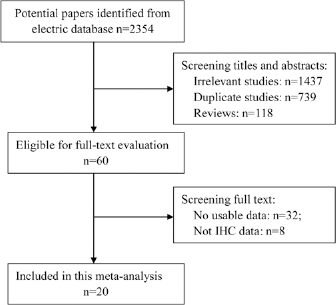
Flowchart for the study selection. IHC = immunohistochemistry.
Characteristics of studies included
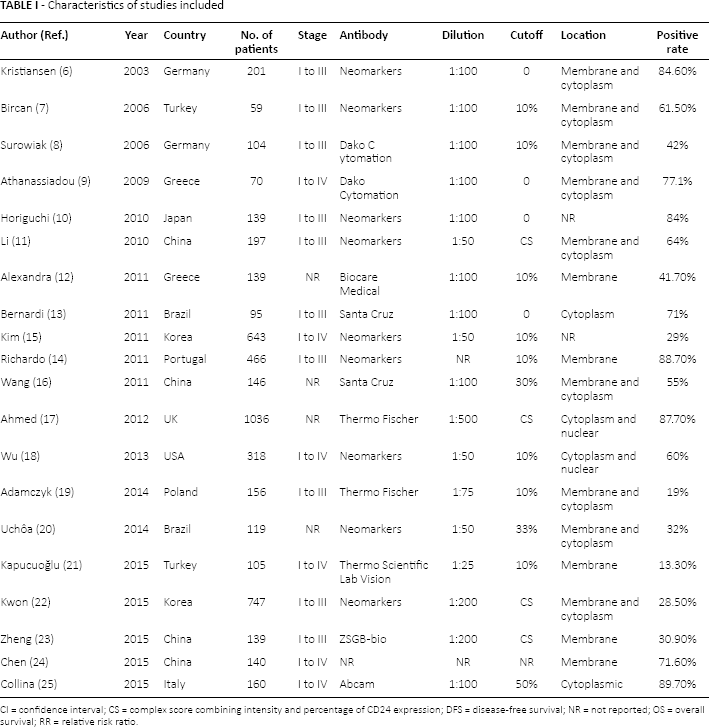
CI = confidence interval; CS = complex score combining intensity and percentage of CD24 expression; DFS = disease-free survival; NR = not reported; OS = overall survival; RR = relative risk ratio.
Data extracted from studies included
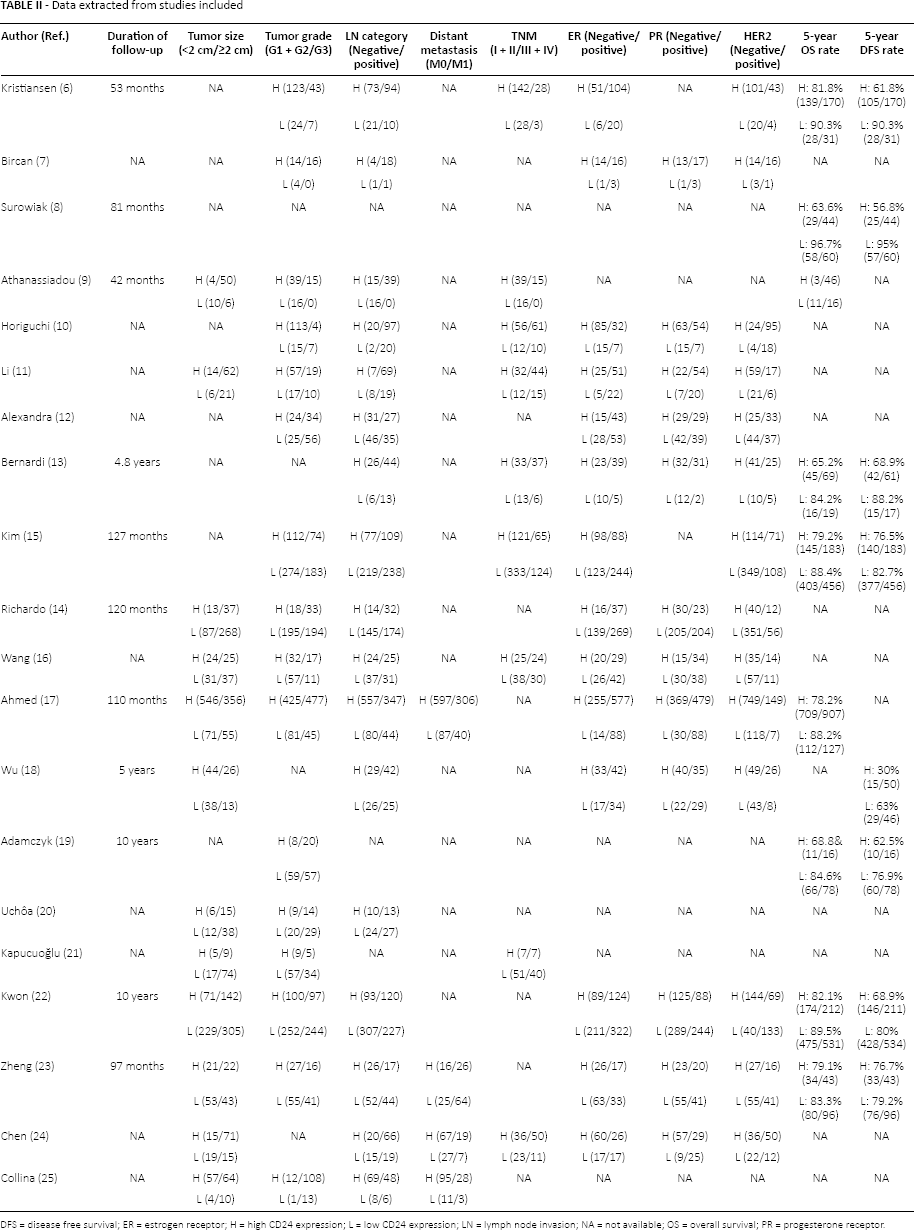
DFS = disease free survival; ER = estrogen receptor; H = high CD24 expression; L = low CD24 expression; LN = lymph node invasion; NA = not available; OS = overall survival; PR = progesterone receptor.
Correlation of CD24 with clinicopathological features
The association between CD24 and several clinicopathological features is illustrated in Table III and Supplementary Figures (available online at www.biological-markers.com). The results of the meta-analysis showed CD24 expression was associated with lymph node invasion (OR = 0.68, for negative vs. positive, 95% CI, 0.53-0.87, p = 0.002; Suppl Fig. S1), and TNM stage (OR = 0.63 for I + II vs. III + IV, 95% CI, 0.49-0.81, p<0.001; Suppl Fig. S2). Heterogeneity was observed in the analysis of CD24 expression with lymph nodes invasion and TNM stage; therefore, a random-effects model was used. However, CD24 was not associated with other clinicopathological features such as tumor size (OR = 0.76, 95% CI, 0.50-1.14; Suppl Fig. S3), tumor grade (OR = 0.89, 95% CI, 0.64-1.24; Suppl Fig. S4), distant metastasis (OR = 0.99, 95% CI, 0.72-1.37; Suppl Fig. S5), ER status (OR = 1.27, 95% CI, 0.99-1.63; Suppl Fig. S6), PR status (OR = 1.32, 95% CI, 0.96-1.84; Suppl Fig. S7) or HER2 status (OR = 0.67, 95% CI, 0.36-1.25; Suppl Fig. S8).
Relationship of CD24 and clinicopathological features of breast cancer
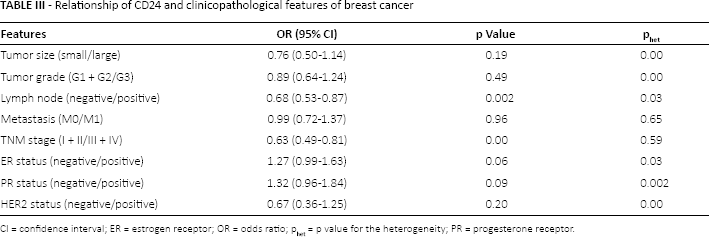
CI = confidence interval; ER = estrogen receptor; OR = odds ratio; phet = p value for the heterogeneity; PR = progesterone receptor.
Impact of CD24 on 5-year OS and DFS rates of breast cancer
Nine studies, including a total of 3,191 patients, reported the association of CD24 and 5-year OS rate, whereas 8 studies, including a total of 2,308 patients, provided data for the correlation of CD24 with 5-year DFS rate (Tab. II). The pooled analysis showed that CD24 overexpression was statistically significantly associated with poor 5-year OS rate (RR = 0.93, 95% CI, 0.86-0.99, p = 0.03; Fig. 2) and 5-year DFS rate (RR = 0.90, 95% CI, 0.83-0.98, p = 0.02; Fig. 3).
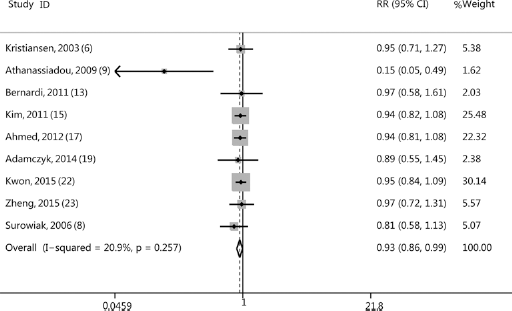
Forest plots of CD24 expression and 5-year overall survival (OS) rate.
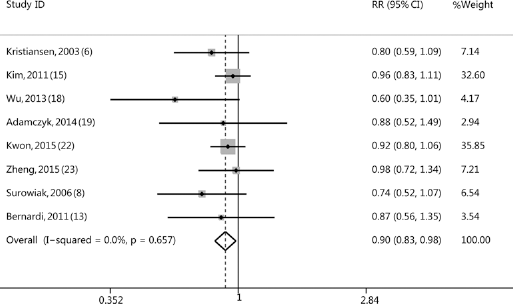
Forest plots of CD24 expression and 5-year disease-free survival (DFS) rate.
Publication bias
Potential publication bias were assessed by Begg's and Egger's tests quantitatively. The shapes of the funnel plots did not indicate any evidence of obvious asymmetry in the analysis of CD24 expression and 5-year OS rate (Fig. 4A) or 5-year DFS rate (Fig. 4B). Furthermore, the p values from the Begg's test and Egger's test were all greater than 0.05, indicating no publication bias among these studies regarding the RRs for OS rate and DFS rate.
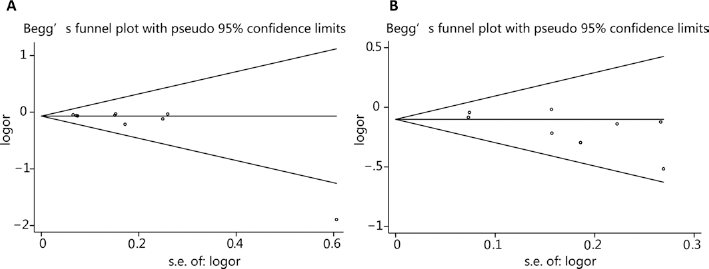
Funnel plot of Begg's test for publication bias: (A) 5-year overall survival (OS) rate; (B) 5-year disease-free survival (DFS) rate; s.e. = standard error.
Discussion and Conclusion
To our knowledge, this is the first meta-analysis that has evaluated the association between CD24 expression and the risk of breast cancer and its clinicopathological parameters. The correlation between CD24 expression and breast cancer has been studied by a number of researchers, and some of them showed overexpression of CD24 in breast cancer to be associated with several clinicopathological parameters and a poor prognosis; however, the clinical relevance of CD24 as a diagnostic and prognostic factor in breast cancer remains controversial. Therefore, we combined 20 eligible studies, including 5,179 cases, to perform this meta-analysis to arrive at a reasonable conclusion.
CD24 is a mucin-like cell surface molecule that plays an important role in the proliferation, migration and adhesion of cells (26). CD24 overexpression has been reported in various types of carcinomas, and was suggested as a useful cancer marker for diagnosis and prognosis (27–29). In basic studies, CD24 was also found to promote tumor cell proliferation, cell motility and invasion in several types of cancer cells (4, 30–32). CD24 was also identified as a ligand to P-selectin, and was revealed as an important metastasis-associated gene (33, 34). Additionally, in breast cancer, CD24 was also demonstrated to increase the proliferation and invasiveness of breast cancer cells, in line with its role in promoting tumor growth and metastasis in vivo (32, 35–37).
Consistent with the important roles of CD24 in breast cancer, we found that CD24 expression was associated with lymph node invasion and TNM stage in this meta-analysis. We also found CD24 overexpression was statistically significantly associated with poor 5-year OS and DFS, which is consistent with the results of a study by Wang et al (38). However, the study by Wang et al (38) reported total OS and DFS, while our meta-analysis assessed the 5-year OS and DFS. Furthermore, more studies were included in our meta-analysis; therefore, the results from our meta-analysis are more instructive.
Although our primary results of this meta-analysis are suggestive, some limitations need to be acknowledged. First, there was heterogeneity between studies in most of the analysis, which may be due to the different antibodies and different concentrations of antibodies, different cutoff values and variable definitions of CD24 expression used in the studies. Second, it was clear that different types of breast cancer might show different biological behaviors; however, our meta-analysis did not estimate the relationship between CD24 and clinicopathological parameters in different types of breast cancer, due to the insufficient information, and more efforts are needed on this in the future. Third, publication bias may have occurred, even though the funnel plots did not show any, since negative findings were likely to be underreported.
In summary, our meta-analysis indicated that CD24 overexpression in breast cancer was not only associated with lymph node metastasis and advanced TNM stage, but was also a biomarker for poor OS and DFS. Therefore, our meta-analysis suggested that CD24 is an efficient prognostic factor in breast cancer. However, further, larger clinical studies are needed to confirm our findings.
Footnotes
Financial support: No grants or fundings have been received for this study.
Conflict of interest: None of the authors has any financial interest related to this study to disclose.