




Abstract
Background
The protein encoded by ZBTB20 is a member of the POK family, whose members function as transcriptional repressors through interactions mediated by their conserved C2H2 Krüppel-type zinc finger and BTB/POZ domains. Polymorphisms in ZBTB20 appeared to be associated with gastric and esophageal cancer susceptibility in biological models, but the results of these studies were inconclusive. Therefore, we conducted a meta-analysis by pooling all available data to assess the exact association between the ZBTB20 rs9841504 polymorphism and gastric and esophageal cancer susceptibility.
Method
The meta-analysis was performed for homozygote comparison, heterozygote comparison, and dominant and recessive models by applying a fixed- or random-effects model. The pooled odds ratios (ORs) with the corresponding confidence intervals (CIs) were calculated. Moreover, the data were analyzed using the Stata 12.0 software(StataCorp).
Result
A total of 8 independent case-control studies comprising 9,994 cases and 10,258 controls were included. We found a significant association between the rs9841504 polymorphism and decreased gastric cancer susceptibility in the allelic, homozygous, dominant and recessive models (B vs. A:OR = 0.797, 95% CI 0.644-0.986, p = 0.036; BB vs. AA:OR = 0.601, 95% CI 0.366-0.988, p = 0.045; BA + BB vs. AA:OR = 0.789, 95% CI 0.627-0.992, p = 0.043; BB vs. BA + AA:OR = 0.635, 95% CI 0.405-0.997, p = 0.049). Conversely, no association between the rs9841504 polymorphism and esophageal cancer susceptibility was found. In subgroup analysis by ethnicity, we observed a significantly decreased susceptibility to gastric cancer in Asian populations in the allele contrast, homozygous and recessive models (B vs. A:OR = 0.791, 95% CI 0.628-0.996, p = 0.046; BB vs. AA:OR = 0.559, 95% CI 0.323-0.966, p = 0.037; BB vs. BA + AA:OR = 0.593, 95% CI 0.361-0.972, p = 0.038).
Conclusions
In summary, our work suggests that the ZBTB20 rs9841504 polymorphism is a protective factor for gastric cancer rather than esophageal cancer.
Introduction
Gastric cancer is known as the fourth most frequent malignancy and the second leading cause of cancer death around the world. About 22,000 patients are diagnosed with gastric cancer annually in the United states, with a projected mortality of 10,990 cases (1). Gastric cancer patients have a poor prognosis, with a 5-year survival rate of less than 30% in most regions (2). The best-established risk factor for gastric cancer is Helicobacter pylori infection, which is by far the strongest established risk factor for distal gastric cancer. In addition, male sex, drinking and smoking status, and a family history are also known risk factors for gastric cancer (3). As one of the major upper gastrointestinal tract cancers, esophageal cancer shares several known risk factors with gastric cancer, including alcohol consumption, high temperature of food and beverages, and even Helicobacter pylori infection (4). This could indicate that esophageal and gastric cancer have common genetic determinants influencing the effect of exposure to risk factors. However, gastric and esophageal carcinogenesis is not only multifactorial but also involves multiple steps that need large-scale multicenter studies to elaborate (5).
To date, no agreement on screening and surveillance strategies for gastric and esophageal cancer has been reached, primarily due to the incidence variations between countries. Therefore, the imperative issue is to develop an effective strategy for identifying high-risk factors for individuals in the general population. As a new BTB/POZ-domain gene, zinc finger and BTB domain-containing 20 (ZBTB20) is a member of the POK family of transcriptional repressors (6). ZBTB20 participates in various cellular functions including transcriptional regulation, cellular proliferation, tumorigenesis, ion channel assembly, and chromatin remodeling (7, 8). Increasing evidence points to aberrant expression of ZBTB20 playing a role in carcinogenesis (9). ZBTB20 expression was found to be increased in hepatocellular carcinoma (HCC) (10) and reported to be a key repressor of alpha-fetoprotein gene transcription in the liver (11). In addition, recent studies revealed that polymorphisms in ZBTB20 were associated with gastric cancer susceptibility (12–15). The results, however, remain inconclusive, in part because the pertinent case-control studies often comprise small sample sizes. We therefore carried out a meta-analysis to probe into this particular candidate polymorphism and investigate its relationship with gastric and esophageal cancer risk.
Material and methods
Literature search
We performed a systematic literature search in PubMed, Google Scholar and Web of Science to identify all eligible publications on the relationship between ZBTB20 polymorphism and susceptibility to gastric and esophageal cancer. The search results were restricted to English. The last search was updated on July 1, 2016. We applied the search terms as follows: “ZBTB20 OR (zinc finger and BTB domain-containing 20)”, AND “polymorphism OR variant OR SNP OR variant OR mutation”, AND “cancer OR carcinoma OR tumor OR malignancy OR neoplasm”. In order to identify additional eligible studies, a manual search of each reference in the included publications was performed.
Inclusion and exclusion criteria
Publications satisfying the following inclusion criteria were enrolled: 1) case-control or cohort studies that evaluated the associations between ZBTB20 polymorphisms and the susceptibility to gastric and esophageal cancer; 2) sufficient genotype data to assess the odds ratio (OR) and corresponding 95% confidence interval (CI); 3) the control subjects were in Hardy-Weinberg equilibrium (HWE). The major exclusion criteria were: 1) case-only studies, case reports, or review articles; 2) studies without raw data for the ZBTB20 genotype: 3) studies that compared the ZBTB20 variants in precancerous lesions and other cancers.
Data extraction
Two authors retrieved the data from each study. All of the case-control studies satisfied the inclusion criteria and consensus was reached for any controversy. The following details were collected from the publications: name of first author, year of publication, ethnicity, genotype and allele frequency, cancer type, source of control, and genotyping methods.
Statistical analysis
The data were analyzed using the Stata 12.0 software (StataCorp). The strength of the association between ZBTB20 polymorphism and susceptibility to gastric and esophageal cancer was assessed by OR and 95% CI. The pooled ORs were calculated for allelic, homozygous, heterozygous, dominant and recessive models. Subgroup analyses were conducted based on ethnicity, genotyping methods and source of control. In addition, if the pertinent data were available, we could also conduct subgroup analyses based on the levels of CEA, TPA, CA72-4, CA19-9 and tumor stage, referring to the work by Chang et al (16).
I2 and p values were calculated to quantify the heterogeneity between studies. I2<50% and p>0.10 imply that no significant heterogeneity exists, so a fixed-effects model should be used; otherwise, a random-effects model is appropriate (17). Moreover, HWE was calculated by using the goodness-of-fit test, and deviation was considered when P<0.01 for the control group (18). A p value >0.05 suggested that the control group conformed to the HWE. We performed sensitivity analysis to assess the stability of these data by sequentially exluding each study, which reveals the potential influence of separate datasets on the pooled ORs. Begger's funnel plots and Egger's regression test were conducted to assess publication bias in our meta-analysis.
Results
Main characteristics of the enrolled studies
The procedure for selecting eligible studies is presented in Figure 1. A total of 45 publications were retrieved during initial retrieval. Thirty-one of these publications were removed after review of their titles and abstracts. In the remaining 14 full-text papers, 10 publications did not investigate the association of the ZBTB20 rs9841504 polymorphism with the susceptibility to gastric and esophageal cancer. Five publications comprising 8 case-control studies met our selection criteria (Tab. I) (12-15, 19). Of the 8 case-control studies, 6 investigated the relation between the rs9841504 polymorphism and gastric cancer susceptibility, while the remaining 2 focused on esophageal cancer. Seven studies were performed in Asian populations, and the remaining one was based on mixed ethnic groups (including at least 1 ethnicity). However, no study was performed in African populations. All enrolled studies were case-control studies and their source of control was hospital-based. In addition, we applied the Newcastle-Ottawa Scale (NOS) to assess the quality of these enrolled studies, as shown in Table II.
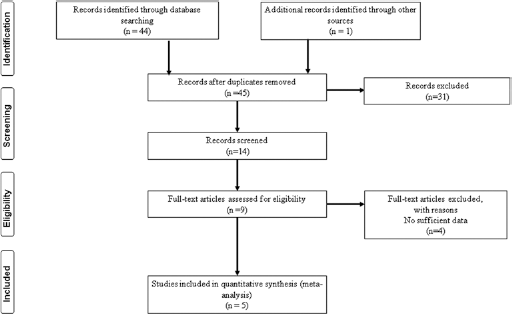
Flow diagram of article selection in the meta-analysis.
Characteristics of eligible case-control studies enrolled in the meta-analysis
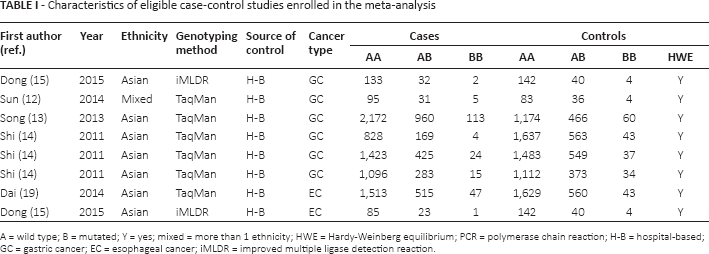
A = wild type; B = mutated; Y = yes; mixed = more than 1 ethnicity; HWE = Hardy-Weinberg equilibrium; PCR = polymerase chain reaction; H-B = hospital-based; GC = gastric cancer; EC = esophageal cancer; iMLDR = improved multiple ligase detection reaction.
Methodological quality of the included studies according to the Newcastle-Ottawa scale
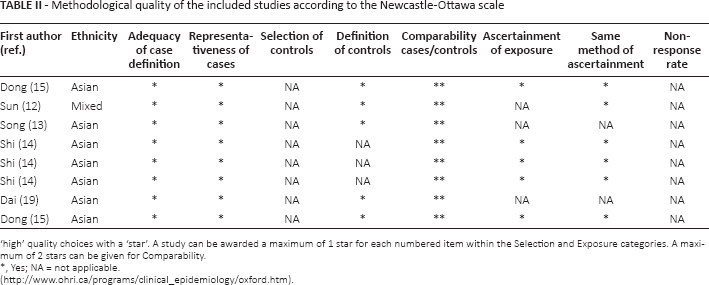
‘high’ quality choices with a ‘star’. A study can be awarded a maximum of 1 star for each numbered item within the Selection and Exposure categories. A maximum of 2 stars can be given for Comparability.
, Yes; NA = not applicable.
(http://www.ohri.ca/programs/clinical_epidemiology/oxford.htm).
Quantitative synthesis
A summary of the meta-analysis of the ZBTB20rs 9841504 polymorphism and gastric and esophageal cancer susceptibility is presented in Table III. A significantly decreased susceptibility to gastric cancer was observed in all genetic models apart from the heterozygous model (B vs. A:OR = 0.797, 95% CI 0.644-0.986, p = 0.036, Fig. 2; BB vs. AA:OR = 0.601, 95% CI 0.366-0.988, p = 0.045, Fig. 3; BA + BB vs. AA:OR = 0.789, 95% CI 0.627-0.992, p = 0.043; BB vs. BA + AA:OR = 0.635, 95% CI 0.405-0.997, p = 0.049). In the subgroup analysis by ethnicity, we found a significantly decreased susceptibility to gastric cancer in Asian populations in the allele contrast, homozygous and recessive models (B vs. A:OR = 0.791, 95% CI 0.628-0.996, p = 0.046; BB vs. AA:OR = 0.559, 95% CI 0.323-0.966, p = 0.037; BB vs. BA + AA:OR = 0.593, 95% CI 0.361-0.972, p = 0.038). However, no significant association was observed for the ZBTB20 rs9841504 polymorphism and esophageal cancer susceptibility (Tab. III).
Results of the meta-analysis
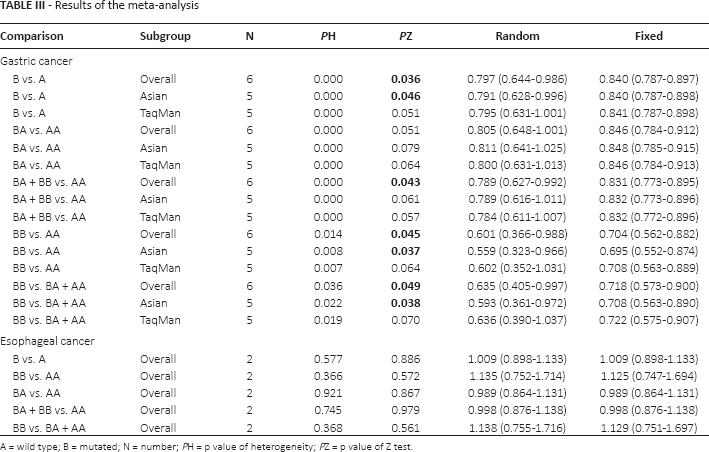
A = wild type; B = mutated; N = number; PH = p value of heterogeneity; PZ = p value of Z test.
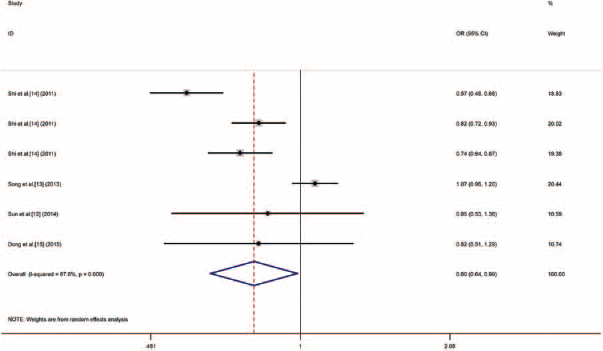
Forest plots of the association between the ZBTB20 rs9841504 polymorphism and gastric cancer risk in allelic comparison (B vs. A). Each square indicates a study, and the area of the squares is proportional to the weight of the study. The diamond represents the summary OR, and the transverse line the 95% CI. OR = odds ratio; CI = confidence interval.
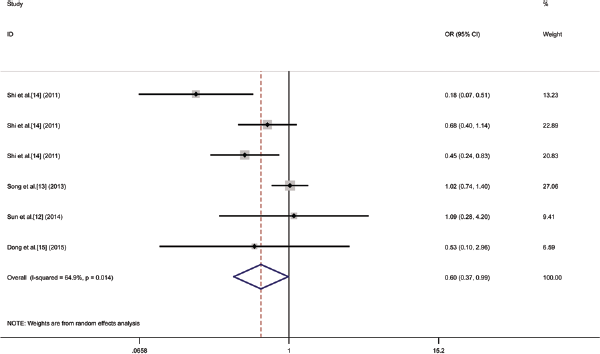
Forest plots of the association between the ZBTB20 rs9841504 polymorphism and gastric cancer risk in homozygous comparison (BB vs. AA).
Sensitivity analysis and publication bias
Sensitivity analysis was conducted to evaluate the influence of separate case-control studies on the integrated data by removing one study at a time from the pooled analysis, and no significant influence was observed. Additionally, we assessed the publication bias by Begg's funnel plot and Egger's regression tests. Neither of the tests indicated a significant publication bias, and the shape of the funnel plot was symmetrical (B vs. A for gastric cancer, Fig. 4 and p>|t| = 0.505).
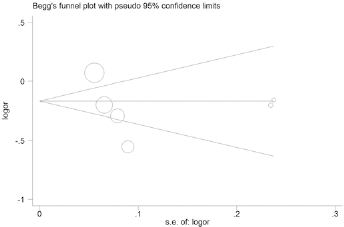
Begg's funnel plot for publication bias of ZBTB20 rs9841504 in allelic comparison (B vs. A) for gastric cancer. The x-axis represents the log (OR) and the y-axis the natural logarithm of OR. The horizontal line in the figure means the overall estimated log (OR). The 2 diagonal lines indicate the pseudo 95% confidence limits of the effect estimate. Log (OR) = log-transformed odds ratio.
Discussion
As an endogenous cause and a fundamental factor for cancer risk, genetic polymorphisms are crucial (15). The rs9841504 polymorphism in the ZBTB20 gene is inferred to have a relation to cancer. By imputation, it may be closely homologous to BCL-6 as a transcription factor, and be involved in hematopoiesis, oncogenesis and immune response (20). Previous studies have demonstrated a significant association between ZBTB20 polymorphisms and the risk of several human diseases including HCC (10), Primrose syndrome (21) and others. However, when the relationships between the rs9841504 polymorphism and gastric or esophageal cancer susceptibility were explored in several case-control studies, the results were inconclusive and ontradictory.
A study showed that the rs9841504 polymorphism in ZBTB20 was statistically susceptible to gastric cancer with 2 replication stages comprising 3,288 cases and 3,609 controls (14), while a GWAS study involving 3,245 cases and 1,700 controls conducted by Song et al (13) reported no significant correlation between the rs9841504 polymorphism and gastric cancer susceptibility in a Korean population. Sun et al (12) confirmed their results in a study of Hispanic Americans that enrolled 132 cases and 125 controls. Likewise, no statistical difference was found between the rs9841504 polymorphism and gastric cancer risk in Dong et al's report (15). With regard to esophageal cancer, both Dai et al (19) and Dong et al (15) reckoned that the ZBTB20 polymorphism was not closely linked to esophageal cancer risk.
It is likely that the contradictory results were due to the relatively small sample sizes and different genetic backgrounds. Meta-analysis appears to be a pragmatic statistical analysis method which can surmount the drawbacks of small sample size and inadequate statistical power among studies. In our present work, we evaluated the association between the ZBTB20 rs9841504 polymorphism and gastric and esophageal cancer susceptibility individually. We observed that the rs9841504 polymorphism played a significant protective role in gastric cancer in all genetic models except the heterozygous model, while for esophageal cancer no significant association was identified. In subgroup analysis by ethnicity, we found a significantly decreased susceptibility to gastric cancer in the allele contrast, homozygous and recessive models.
Although we performed a comprehensive literature retrieval and identified all the eligible studies for the present meta-analysis, there are several limitations to our work. First, we adopted unadjusted ORs because we could not get sufficient information to calculate adjusted ORs with reference to potential confounders such as duration, quantity and frequency of smoking or drinking. Second, all included studies were published in English, and some studies in other languages may therefore have been missed. Third, since the participants in each case-control study were enrolled from a single hospital, a selection bias could not be excluded. Besides, modest to high heterogeneity was found in several comparisons, which demonstrated the inconsistency of analyzed independent objects may have come from different populations. Finally, our study did not analyze gene-gene and gene-environment interactions because of insufficient data.
In conclusion, our work suggests that the ZBTB20 rs9841504 polymorphism is a protective factor for gastric cancer, especially in Asian populations. Conversely, no significant association was identified between the ZBTB20 polymorphism and esophageal cancer susceptibility. Further well-designed large-scale studies are warranted to validate our findings.
Footnotes
Financial support: None.
Conflict of interest: The authors declare that they have no competing financial interests.