




Abstract
Background:
Paper is one of the important inputs for the printing industry, and the most important leading parameter in the printing process is its brightness. Brightness can be brought to paper using coatings and sizing. Desired surface properties and, most importantly, surface roughness can be achieved by changing the contents of the coating and sizing of the materials it contains. The use of biomaterials is becoming more important in the paper industry, as they represent substances with a lower carbon footprint. Fish scales are already used as a filling material, cosmetic material and fish food, as well as for determining the age of fish.
Methods:
Fish scales were brought to different sizes by a milling process. Paper formulations including different amounts of fish scales were prepared with fish scales, and coatings on raw paper were subjected to test printings in IGT-C1, with formulations and physical characteristics of coatings such as brightness, lightfastness, strength, adhesion etc. being determined.
Results:
Regarding the value of yellowness, mixtures of 2.5%-10% can be used. The maximum value of brightness was obtained from a mixture of 10%. Aging visibly changed the colors.
Conclusions:
The coatings obtained were brighter than the initial coating compositions. The top quality formulation was the coating with 5% medium-sized fish scale particles.
Introduction
Printing industry has 2 important inputs: paper and ink. To produce quality printing, these 2 inputs need to have particular properties. The properties of paper as a print base material are determined according to Technical Association of the Pulp and Paper Industry (TAPPI) standards. The surface structure of the paper is the parameter affecting the quality of printing the most (1).
Two methods can be used to regulate surface structure: coating and sizing processes (2). In the sizing process, the surface is coated with surface coating resin, and gaps are covered. Thus expansion of ink is prevented, and brightness is increased, but there is a loss of color. In the coating process, a filling material is added to the surface coating resin, and the surface is sized, gaps are filled and the color can be adjusted to the desired characteristics (3, 4). Inorganic natural substances like calcium carbonate are generally used as filling material due to price and quality factors (5, 6). However, because these are structurally hydrophilic, some problems occur. Thus there is a need to search for new filling materials. In order to perform good quality printing, the ink isn't penetrate too much to paper because of quality printing. In addition, penetration is important for brightness, which is enhancing the attractiveness of printing. Filling the gaps between fibers of paper prevents to penetration of inks. If the grain size of the filling material used for this process is too big, a roughening occurs on the surface, and this decreases the brightness and reduces the surface energy. Thus, it results in consequences such as not enough ink is adsorbed, and brightness may be reduced. Therefore, the amount, structure and size of the material used for the sizing process of paper all play a very important role. When the coating material transferred from paper substrate with pressure, surface are stabilized. (7).
Due to its location, Turkey is rich in aquacultural products. The fish grown in Turkey are caught only for their meat. Other unserviceable parts are discarded as waste. The use of these waste products would both contribute to the economy and reduce Turkey’s carbon footprint. Fish scales are naturally available and are a bright material by structure with a collagenous structure (8). Collagen is widely used for biomedical and pharmaceutical purposes (9). Fish scales are used in textile and cosmetics and as fish feed (10, 11). But a great amount of fish scales is wasted. The brightness of fish scales has led to the suggestion that they could be used in paper coatings.
In addition to collagen, fish scales include inorganic substances such as calcium carbonate. This increases its usability as filling material (12). Particle size is crucial when determining the brightness of a coating filling material. Wang et al tried to improve the physical and optical properties of paper by coating it with nanoparticle pigments (13). Quality of papering in terms of printing performance depends on surface roughness, microcapillary formation and improving the properties of the coating layer to absorb filling materials. Coating has a significant effect on printing density (14, 15). Opacity, brightness and printability properties can be brought to the paper by coating. A change of particle size and the amount of its variation can play an important role in the determination of a coating formulation.
As a result of a literature review it is observed that fish scale hasn't usage in printing industry and paper coating. Usage areas of this material are considerably limited. Use of this material will both provide waste to be utilized and make the coating material used on the paper surface more natural. Therefore, the use of fish scales is important in terms of several aspects. In addition, it was planned that the usage of fish scale improves the quality of paper.
In this study, scales, which give brightness to fish and are a waste product, were produced in different sizes by the milling process, and papering formulations including different amounts of scale were prepared using the scales obtained. Coatings on raw paper were subjected to background test printings in IGT C1, with the formulations and physical properties of these coatings such as brightness, lightfastness, strength, adhesion etc. being determined.
Methods
Fish scales to be used in the experiment were collected, cleaned and reduced with liquid nitrogen. Carboxymethyl cellulose solutions were prepared using a mechanical mixer. After mixing for 30 minutes, the pH and percentage of dry solid contents of carboxymethyl cellulose were measured. The dry solid contents of carboxymethyl cellulose solution was 10% at pH 5.5 (16).
To determine the printing performances of the varnish on 115 g/m2 matt-coated papers (17, 18), coating formulations were prepared using fish flakes of 3 different sizes (small, medium and large) at ratios of 2.5%, 5% and 10%. Coating formulations were combined in 3 roll millings to provide a homogenous and stabile distribution ( 3Roll mill Input Voltage:110 V, Roll diameter 65 mm, Poll working lenght h 128 mm; Torrey Hills Technologies).
Paper with a weight of 115 g/m2 was conditioned at 23°C ± 1°C and 50% ± 3% relative humidity for 24 hours in the printing room and coated with an IGT C1 offset printing simulation device under optimum parameters of printing room conditions, with 300 N of printing pressure and at a printing speed of 0.3 m/s, in accordance with the ISO 12647-2 standard for use of coating formulations. Standards T452 for optical characteristics (white) of coating, T480 for brightness, ISO 2471 procedure for opacity D65, and BS 4321 for lightfastness were also applied (19).
The properties of the coatings and also color and density were measured by a Gretag Macbeth Spectro Eye Spectrophotometer device using a D50 standard light source and 2° standard observation angle, with 0°/45° geometry, on a white background. Brightness changes between printings were measured by a BYK Gardner glossmeter (Sheen Instruments, UK) at a measuring angle of 60° and in accordance with the TAPPI T480 standard. Printed samples was exposed to light fastness test whit solar box device under 1,500 W/m2 xenon light and evaluated based on a Blue Woll Scale.
The coatings obtained were gold-platinum coated under different magnifications using an FEI Sirion scanning electron microscope (SEM), and these coatings were viewed using SEM.
Results
When the gloss results of the coatings were examined, and the lightfastness test was applied to coatings based on BS 4321, the results were as shown in Table I.
Changes of printing gloss and printing gloss after lightfastness
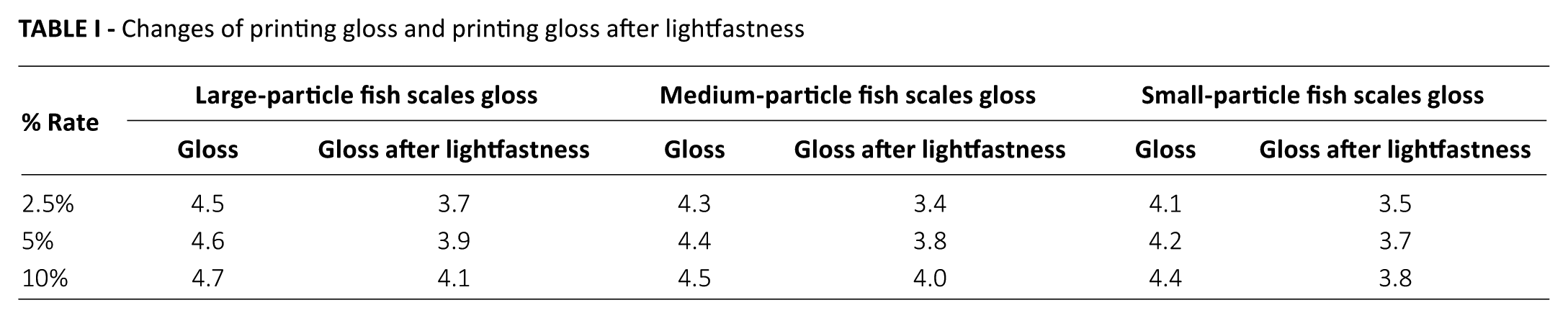
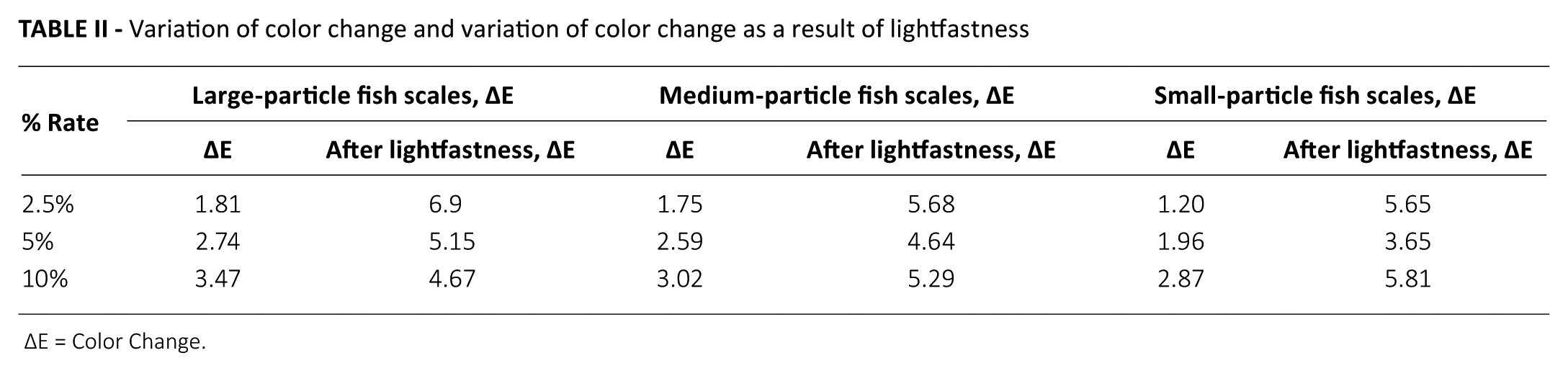
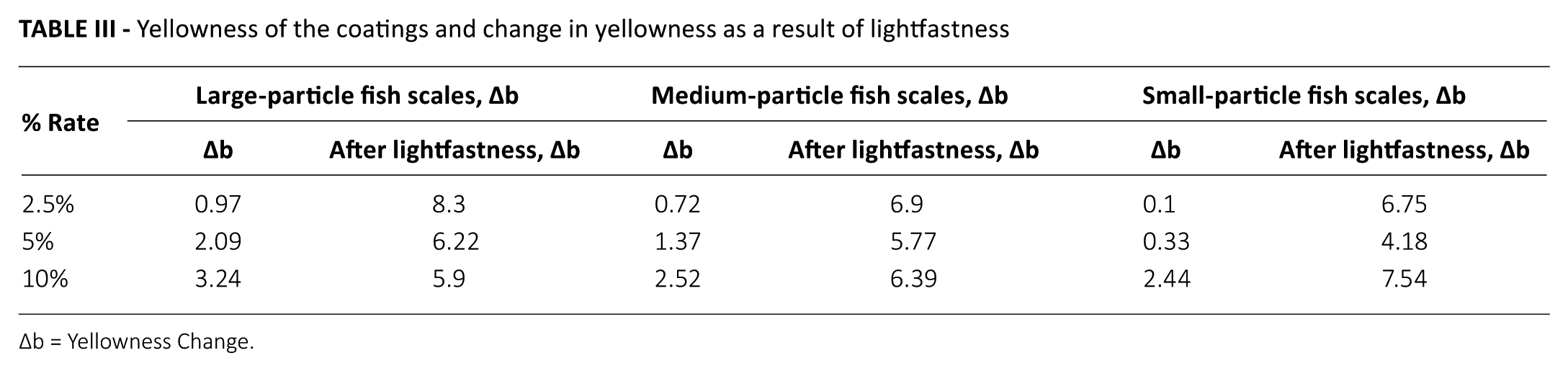
Table II shows the data regarding color change and yellowness difference of the coatings obtained. The color changes of the coatings were examined after lightfastness. Yellowness change and yellowness change of coatings after lightfastness test are shown Table III.
Variation of color change and variation of color change as a result of lightfastness
ΔE = Color Change.
Yellowness of the coatings and change in yellowness as a result of lightfastness
Δb = Yellowness Change.
When SEM images of coatings were examined, Figure 1 showed that SEM Images of small sized Fish Scales with ×1000 and ×15000 magnifications. Figure 2 showed that SEM Images of medium sized Fish Scales with ×1000 and ×7500 magnifications. Figure 2 showed that SEM Images of Large sized Fish Scales with ×1000 and ×10000 magnifications.
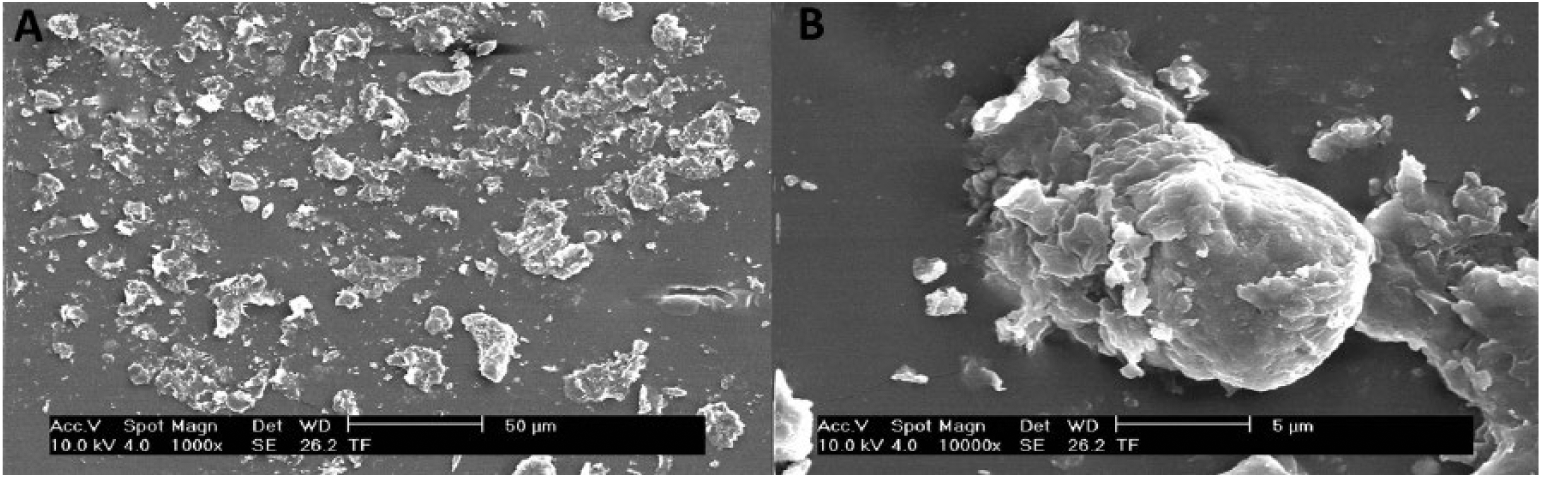
Scanning electron microscope (SEM) images of a coating with small-sized fish scales, at magnifications of ×1,000 (
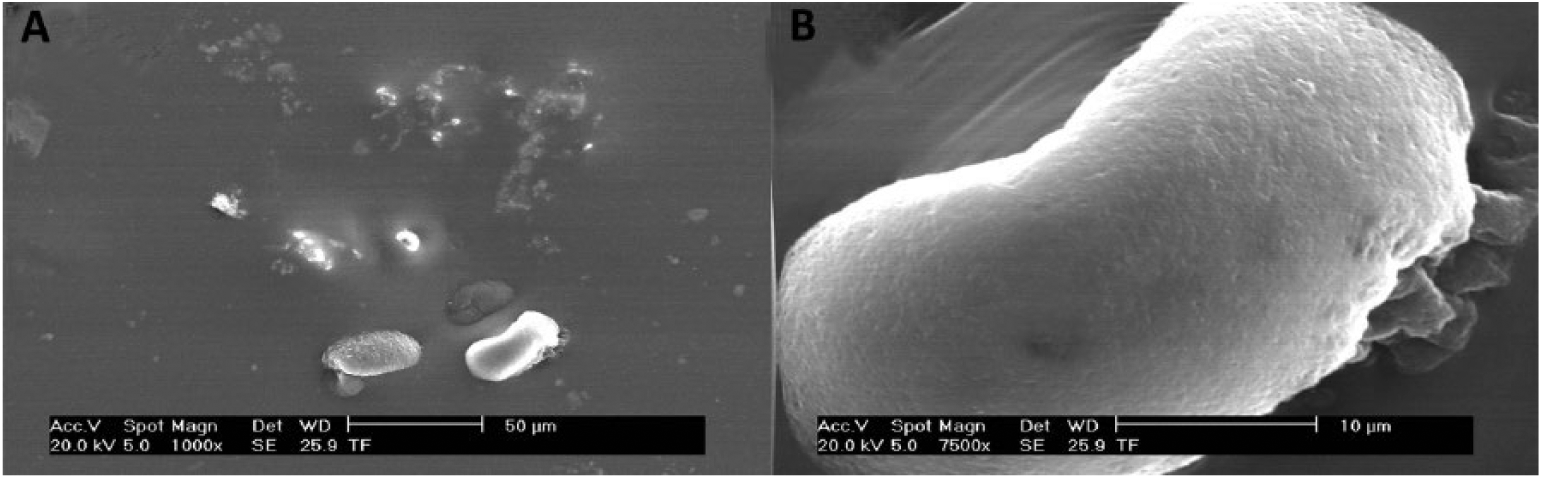
Scanning electron microscope (SEM) images of a coating with medium-sized fish scales, at magnifications of ×1,000 (
Discussion
When Table I was examined, it was observed that as particle size increased, brightness increased, and as the amount of fish scales in the formulation increased, brightness increased. High bright and high visual coatings obtained with Fish Scales. Consequently Fish Scales used in to paper coatings.
When Table II was examined, it was observed that color differences increased with increasing particle size and increasing amounts of fish scales in the formulation. According to this result, it was concluded that because the use of fish scales in large amounts caused unwanted changes in color, the amount of fish scales used should not exceed certain rates and magnitudes. It was determined that even color difference in formulations including 10% fish scale of coatings with medium- and large-sized particle size were above Color Change (ΔE) 3, and this was an unwanted result in printing because it creates a visible color difference.
When Table III was examined, the color was observed to become yellow as particle size and the amount of particles in the formulation increased. The use of coating with 10% large-sized fish scales, which is the most yellow one, was concluded to be undesirable, as it can be perceived by human eye.
When Table I was examined, gloss was seen to decrease prominently as a result of aging, but the rate of this decrease was less than the one observed in untreated varnish. In other words, addition of fish scales slowed down the decrease of printing brightness value. As was expected, the highest brightness value was obtained from a formulation with 10% large-sized particles.
When Table II was examined, colors were seen to differ considerably as a result of the lightfastness test, with all of the values obtained being lower than 7.23, which is the ΔE value of untreated varnish; in other words, addition of fish scales decreased color changes. The minimum color change value was obtained from a composition including 5% of fish scales prepared with small-sized particles. Color differentiation increased when particle size is decreased the color differences as increased. It is about the aggregation of high concentrate fish scale; except for this, color differentiation decreased as the amount of particles increased, and the size decreased in all formulations.
The change in value of yellowness as a result of lightfastness can be seen in Table III. All values obtained were lower than 8.75 which was the Δb value of untreated varnish; in other words, addition of fish scales decreased the tendency of the color to become yellow. The minimum yellowness value was obtained from a composition including 5% of fish scales prepared with small-sized particles. When size of practical is larger the fish scales aggregate 10% concentration, this decreased the color change, decolorization decreased; except for this, the amount of yellowness decreased as the amount of particles increased, and the size decreased in all formulations.
When the SEM images were examined, it was found to be difficult to take images from formulations with large- and medium-sized particles (Figs. 2 and 3), and small particles were determined to fill in the gaps. In addition, increasing amounts of fish scales caused aggregation on the surface of the coating and led to problems. It was concluded that surface properties were negatively influenced as the size and the amount of particles increased. Based on this, it was concluded that regarding the value of yellowness, mixtures of 2.5%-5% can be used; mixtures of 10% are not appropriate in terms of color; mixtures of 10% were not appropriate in terms of yellowness; the maximum value of brightness was obtained from a mixture of 10%; and as particle size increased, brightness and also yellowness and color difference increased. When fish scale percentage is increased, brightness, yellowness and color difference increase. Aging affects the colors visible. The best results obtained with 5% fisc scale. The yellowness to change after aging.
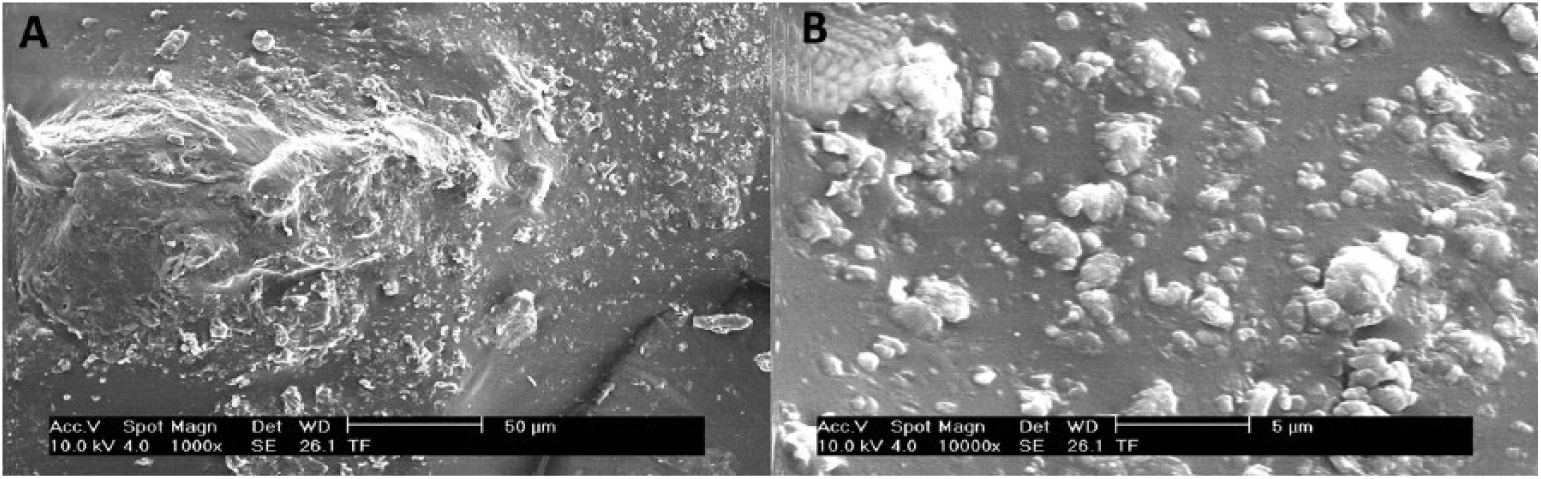
Scanning electron microscope (SEM) images of a coating with large-sized fish scales, at magnifications of ×1,000 (A) and ×10,000 (B).
In the light of these data, the top quality formulation was the coating with 5% medium-sized particles, in terms of printability using fish scales. According to these results, fish scales can be used as a filling material in coatings for the surface of paper. Without using any other filling material but only fish scales, the carbon footprint is reduced, quality coatings are produced and a natural material used as a waste product is brought into use.
Footnotes
Disclosures
Financial support: This work was supported by the Commission of Scientific Research Projects (M.U.BAPKO), Marmara University (grant no. FEN-A-100615-0270).
Conflict of interest: None of the authors has any financial interest related to this study to disclose.