




Abstract
Purpose
Bacterial cellulose (BC) is an interesting biomaterial found application in various fields due to its novel characteristics like purity, water holding capacity, degree of polymerization and mechanical strength. BC as wound dressing material has limitation because it has no antimicrobial activity. To circumvent this problem, the present study was carried out by impregnation of silver on bacterial cellulose surface.
Methods
Bacterial cellulose was produced by Gluconoacetobacter hansenii (strain NCIM 2529) by shaking culture method. The sodium borohydride and classical Tollens reaction was used for silver nanoparticle synthesis.
Results
The effectiveness of sodium borohydride method compared with Tollens reaction was evaluated on the basis of silver nanoparticle formation and its impregnation on BC as evidenced by UV-Vis spectrum analysis, FE-SEM-EDS analysis and FT-IR spectrum. The potential of nano silver impregnated BC was determined for sustained release antimicrobial wound dressing material by swelling ratio, mechanical properties and antimicrobial activity against Staphylococcus aureus.
Conclusions
Thus the nanosilver impregnated bacterial cellulose as promising antimicrobial wound dressing material was evidenced.
Introduction
The nanocomposites of polymer have fascinated the entire polymer industry, due to their distinctive ocular, electrical, catalytic properties (1) and biomedical device (2). Among the polymers, cellulose is the second major polymer on earth. Bacterial cellulose (BC) is an interesting biopolymer produced by Acetobacter xylinum, an acetic bacterium. BC is the fibrous constitution of a three-dimensional, non-woven network of microfibrils, with analogous chemical structure of plant cellulose (3), which is linked by inter- and intra-fibrilar hydrogen bonding as a consequence of which never–dried state or hydrogel BC with high strength resulted.
BC is quite different from wood cellulose with important structural features and properties like high purity water content up to 99%, degrees of polymerization (up to 8000), crystallinity (about 70% to 80%), and mechanical stability (4). The outcome of the special properties of BC resulted in diverse applications in the industry of textiles and paper, electroacoustic transducer diaphragms, additives and coatings for paint, pharmaceuticals and cosmetics, composites of an optically transparent nature, organic light-emitting diode (OLED) substrates, e-paper, and as biomaterials medicine (3, 5, 6).
BC is also applicable in biomedical field as wound dressings, artificial skins, artificial blood vessels and biomembranes. BC can work as ideal wound dressing material because it controls the wound exudates and also provides a moist environment, which results in better wound healing. However, BC does not have its own antimicrobial activity to prevent wound infection. To circumvent this limitation, a great deal of efforts has been devoted to the development of antimicrobial silver particles containing BC membranes (7-8-9). Silver is known for strong cytotoxic effects against a broad range of micro-organisms, based on its oligodynamic effect by causing a bacteriostatic (growth inhibition) or even a bactericidal (antibacterial) impact (10). It has been reported that BC membranes present antimicrobial activity after immersion in silver nitrate solution and after treatment with different reducing agents as sodium borohydride (11, 12), ascorbic acid (13), triethanolamine (14) or Tollens reagent (15).
The aim of this present work is to prepare and characterize the nanosilver-impregnated BC synthesized by sodium borohydride and Tollens method. Nanosilver-impregnated BC was evidenced on the basis of characterization of composite with FE-SEM EDS, FT ITR, UV-Vis Spectra, and its potential as antimicrobial dressing was tested.
Methods
Material
Gluconoacetobacter hansenii (strain NCIM 2529) and Staphylococcus aureus were purchased from National Chemical Laboratory, Pune, India. The chemicals used to prepare the modified Hestrin-Schramm medium (16) were of analytical grade from Himedia India Limited. Tollens reagent was prepared in the laboratory using AgNO3 and NH3. Analytical grade sodium borohydride (NaBH4) was purchased from Sigma Aldrich.
Production and purification of BC
The modified Hestrin-Schramm medium was used to produce the BC consisted of (% w/v): sucrose 2.0, KNO3 0.5, disodium phosphate 0.01, magnesium sulfate 0.06, CaCl3 0.4, pH 5.0. The inoculated medium was incubated at 25°C at 170 rpm for 120 h. Flasks were observed for growth and BC beads formation. After 5-6 days of incubation, BC beads were separated by filtration, washed with distilled water for the removal of excess media components, and finally treated at 90°C for 30 min with 0.1 M NaOH to kill the bound bacterial cells. After boiling, the BC beads were further purified by extensive washing with distilled water so the pH of the water became neutral (17).
In situ synthesis and impregnation of silver nanoparticles on BC
Silver nanoparticles were synthesized by using the classical Tollens reaction and by reduction of AgNO3 with NaBH4.
NaBH4 method by AgNO3 reduction
BC fiber was impregnated with silver nanoparticles by immersing BC beads in AgNO3 (0.001 M aqueous) for 1 h and further by rinsing with ethanol for 30 s. Silver ion-saturated BC beads were reduced in 0.1 M of the aqueous NaBH4 for 10 min and rinsed with a ultra-pure water for 10 min to remove excess chemical. The silver-impregnated BC samples were frozen at -40°C and vacuum dried at -52°C (7).
Classical Tollens reaction
BC beads were immersed in glucose solution (10%) for 38 h, then into Tollens reagent for 4 h and further rinsed with abundance of ultra-pure water for 10 min to remove the excess chemical. The silver-impregnated BC samples were frozen at -40°C and vacuum dried at -52°C (15).
Characterization of silver-impregnated BC
The morphology of BC was observed by using HITACHI S-4800 (New Jersey, USA) scanning electron microscope with an acceleration voltage of 5 kV and a 10,000 × magnification. The development of silver nanoparticles and silver elemental distribution on BC membrane were determined using Brucker Energy dispersive X-ray spectroscopy (SEM-EDS). Silver element was quantitatively confirmed by SEM-EDS spectrum. The silver nanoparticle synthesis was confirmed by measuring optical absorption using a Shimadzu UV Visible spectrometer. The interface between BC and silver nanoparticles was evaluated by Fourier Transform infrared (FTIR) analysis in order to detect any peak shift or changes. Perklin Elmer instrument was used in the range of 400 to 4000 cm−1 at a resolution of 4 cm−1 for FTIR spectrum recording of the the dried sample.
Mechanical analysis
The mechanical properties of the BC and silver-impregnated BC were investigated by the uniaxial tensile tests, using a testing machine Shimadzu AG-100KN, equipped with a biobath system containing distilled water, and a temperature-controlling system. Two samples were cut per pellicle, and three pellicles were used in each experimental session and average value was calculated of the three samples. Using the Winsoft Tensile and Compression testing, connected to the Shimadzu machine, it was sufficient to insert the dimensions of the samples before the beginning of the experiments, and the software automatically calculated the values of stress and strain during the test.
Swelling
Freeze-dried samples of silver nanoparticle-impregnated BC and pure biocellulose, were dried to constant weight, cut into a 1.5 cm diameter disc shape and deep in the deionized water at room temperature. Swelling was calculated by the following formula:
Swelling = (Gs,t-Gi)/Gi
Where Gi is the dried sample's initial weight and Gs,t is the swollen state sample's weight (7).
Antimicrobial activity and sustainable release
Antimicrobial activity of silver nanoparticle-impregnated BC has been investigated against the model Gram-positive bacteria; S. aureus. The Ag-loaded BC was cut into 5 mm discs, sterilized by UV radiation for 1 h and checked for antimicrobial activity using the modified agar diffusion assay (18). Untreated BC and filter paper disc dipped in silver nitrate solution were kept as control (5 mm size). The plates were examined for a possible clear zone of growth inhibition by subtracting disc size after incubation at 37°C for 24 h. In order to show sustainable antibacterial activity by silver-impregnated BC, these discs were lifted from agar plates after incubation (after observation of zone of inhibition by first-time placing) and put for a second time on fresh inoculated medium. The plates were incubated in the same manner and observed.
Statistical analyses
Statistical analyses of data was executed by one-way analysis of variance (ANOVA) presuming the confidence level of 95% (p>0.05) for statistical significance. All the data were presented as means ± standard deviation (SD).
Results
Morphology of BC
The bacterial cellulose has ultra-fine cellulose fibrils with reticulated structure (see supplementary Figure 1, available online as supplementary material at www.jab-fm.com). The bacterial cellulose microfibrils were curved and entangled forming a denser reticulated structure as a consequence of agitated conditions.
Structure of silver-impregnated BC
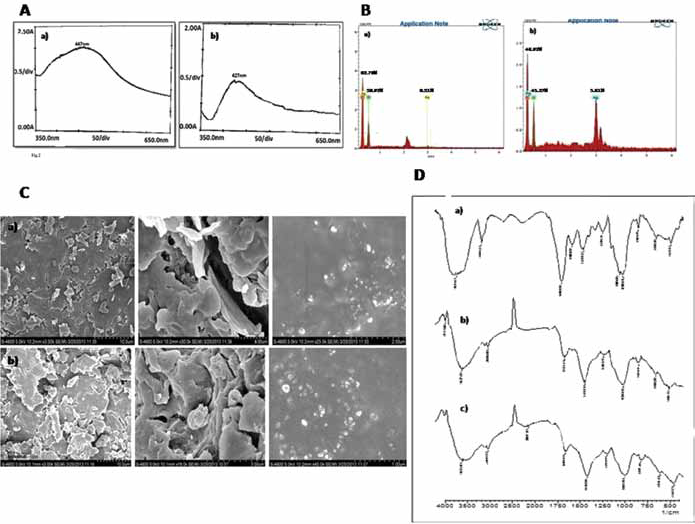
The optical absorption spectra of silver nanoparticles (Fig. 1A) show the characteristic absorption of metallic silver nanoparticles. NaBH4: AgNO3 (100:1) show a fine absorption band at 427 nm (Fig. 1A-b). There was no absorption beyond 500 nm wavelengths. This signifies the formation of small silver nanoparticles with the narrow size distribution.
(
Silver nanoparticles impregnated by classical Tollens reaction undergo a red-shift to 447 nm and turn into a much broadened peak (Fig. 1A-a). The red-shift and broadening of absorption bands were an indication of the increased particle size and size distribution (19).
The SEM studies revealed the morphology of BC membranes impregnated with silver nanoparticles. The SEM images of BC membrane impregnated with silver by NaBH4 method and Tollens reaction was observed at different magnifications (Fig. 1C), which show deposition of the silver nanoparticles on the BC membrane surface. The particles were ranged in size from 20 nm to 100 nm with 50 nm average size. Figure 1B shows the energy dispersive X-ray spectroscopy (EDS) spectrum for elemental silver. The EDS spectrum presented the elemental peak for C and O along with Ag, which confirms the purity of BC and impregnation of silver. The percent distribution of nanosilver element indicated that Tollens reaction was found to be more efficient for silver particle impregnation on BC.
A comparative depiction of FTIR spectra of pure BC, compared with Ag-loaded BC by Tollens reagent and NaBH4 treatment was studied (Fig. 1D). The characteristic bands of BC was observed in the range of 3600-3200 cm−1 for the hydroxyl group stretching vibration, at 2886 cm−1 for C-H stretching vibration, and at 1437 cm−1 for C-H bending vibration. The band at 1068 cm−1 could be related to ether C-O-C functionalities as investigated earlier by Wonga et al (20). The band at 1653 cm−1 is as a result of deformation vibration of the absorbed water molecules. The intensity of this peak is lower in silver nanocomposites because of higher opacity compared with pure BC probably due to interaction between Ag nanoparticles with water molecule.
Mechanical properties
Tensile tests provide important information regarding the mechanical properties of a material, which can be useful for the analyses of new materials and their composite for engineering applications (21). The maximum stress and strain applied for BC and silver-impregnated BC did not differ greatly (Tab. I).
Mechanical properties of bacterial cellulose (BC) and silver-nanoparticle-impregnated BC

Swelling
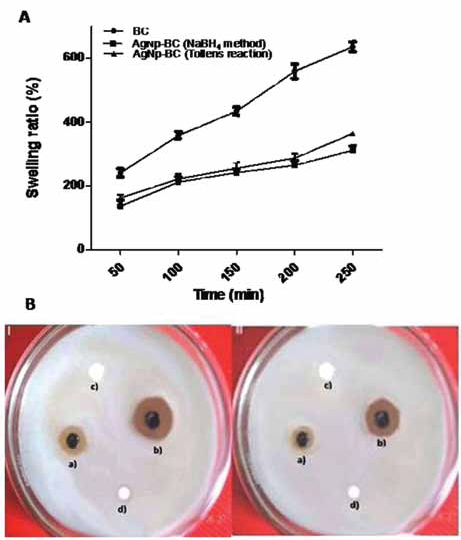
The nanocomposite materials absorbed up to 360% of their dry weight for NaBH4 reduction method while 300% for Tollens and glucose reaction (Fig. 2A). The silver nanocomposite had lower swelling ability than pure BC.
(
The rate of swelling was very fast as more than 100% weight gain was attained in about 30 minutes of the test for both treatments. This characteristic property of nanocomposite justify its potential as antimicrobial wound dressing, which can enable an antimicrobial solution very quickly and keep the wound environment moist, which helps to heal the wound rapidly.
Antimicrobial effect and sustainable release
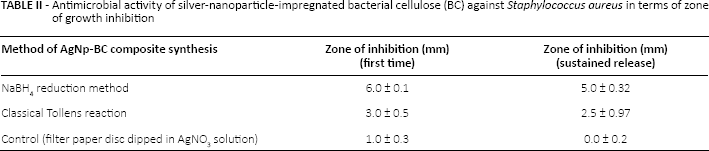
The antimicrobial activity of silver-impregnated BC was evaluated against S. aureus (Fig. 2B). The growth of tested microorganisms was inhibited in the presence of elemental silver in comparison with untreated BC membrane. The composite prepared by NaBH4 reduction method shows a larger zone of inhibition compared with silver-impregnated BC by Tollens reaction. The filter paper disc dipped in silver nitrate solution showed a smaller antimicrobial zone compared with nanosilver-impregnated BC as control. In a similar way, growth inhibition was observed for a second time by placing the same BC composite discs on fresh media but with a decrease in growth inhibition diameter in comparison with no growth inhibition by control of silver nitrate solution (Tab. II). Thus, sustainable antimicrobial activity of nanosilver BC composite was confirmed.
Antimicrobial activity of silver-nanoparticle-impregnated bacterial cellulose (BC) against Staphylococcus aureus in terms of zone of growth inhibition
Discussion
The distinct nano-fibrous morphology of BC is the basis of a large surface area to hold a large amount of water (up to 200 times of its dry mass) and altogether displays high wet strength, great elasticity and conformability (3).
The silver nanoparticles synthesis was confirmed primarily by absorption spectrum determination. The surface plasmon resonance (SPR) of conducting electron (or free electron) on the surface of silver nanoparticles resulted into the red-shift effect (22). The percentage of silver ions impregnated on BC was more with the classical Tollens reaction. The SEM-EDS spectra of AgNp-BC composite confirmed the presence of silver on BC membranes and showed a relative uniform distribution of impregnated particles.
AgNP-BC nanocomposites show lower stress, strain, elongation and load than that of pure BC because of rigid structure of composites compared with pure BC which is highly crystalline material (23). Thus, with the spectroscopic absorption spectrum, SEM, EDS and FTIR analysis confirmed the impregnation of nanosilver on BC surface.
The significance of silver-impregnated BC as antimicrobial wound dressing was established by swelling ratio measurement and gradual release of antimicrobial agent. Swelling ability of BC is high because of its three-dimensional non-oven network with huge quantity of pores which was retained by freeze-drying method. This arrangement of BC microfibrils was anticipated to generate the capillary force within network of BC to suck the water molecules (24). The low swelling ratio of nanocomposites is defended by the rigid structure of these materials, owing to metallic silver particles, which does not permit water molecules to diffuse through the membrane and to form intermolecular hydrogen bonds (15). The lower swelling ratio may also be due to unavailable hydrophilic groups (hydroxyl/aldehyde) which had reduced the silver so that it was no longer available to bind to water.
The S. aureus strain was selected for the antimicrobial study due to its drug-resistant nature. The sustainable release of antimicrobial compound is due to high porosity of BC, which can hold the silver ions and release them gradually. This slow-release property of BC helps to maintain the moisture and set aside the microbial dominance at the wound site, which eventually assists rapid wound healing. This attractive property of BC holds promise as modern antimicrobial wound dressing material.
Conclusions
The BC and silver nanocomposites were developed with sodium borohydride and Tollens reaction. The surface morphology of BC membrane with silver nanoparticles was characterized using FE SEM images. The FTIR spectra revealed the characteristic groups which interact with silver and which remains unchanged. Among the two ways of silver synthesis, NaBH4 method of silver reduction was comparatively efficient to deposit a greater quantity of silver on bacterial cellulose as confirmed by EDS, which results into larger growth inhibition against S. aureus showing MDR. The sustainable release of silver ions confirmed the slow and gradual release such that silver ions will not be so high to damage normal human cells, but can prolong the antimicrobial effect. The swelling ability of the BC and silver composite was comparatively high for Tollens reagent than the sodium borohydride method but in both cases the swelling ratio was significant to apply it as antimicrobial wound dressing material. Thus bacterial cellulose containing silver could be a promising wound dressing material. The development of the silver-containing BC composite material, optical properties and its biodegradation, could be future problems to investigate.
Footnotes
Acknowledgment
The Fellowship to author (BVM) under UGC BSR RSSMS scheme, New Delhi is greatly acknowledged.
Financial support: Author (BVM) is thankful to UGC BSR (F.4-1/2006 (BSR)/7-137/2007), New Delhi, India for financial assistance for the work. Authors are grateful to UGC and DST for making the research facilities available under the UGC-SAP and DST-FIST programmes sanctioned to the School of Life Sciences.
Conflict of interest: The authors have no conflicts of interest to declare.