






Abstract
Encapsulation of structurally sensitive compounds within a solid lipid matrix provides a barrier to prooxidant compounds and effectively limits the extent of oxidative degradation. This offers a simple approach to preserve the bioactivity of labile structures. The technology was developed for cosmetic and pharmaceutical products but may be applied to additives used in food and feed formulations. The encapsulation of docosahexaenoic acid (DHA) and α-linolenic acid (ALA) was examined as model compounds of current interest in functional foods and feeds. Solid lipid particles were prepared from triglycerides containing saturated and unsaturated fatty acids and evaluated by differential scanning calorimetry. The thermal characteristics of the lipids used to form the particle were related to molecular structure and could be adjusted by selection of the appropriate component fatty acids. Encapsulation by solid lipid particles provides a method to inhibit oxidation and improve shelf life of products formulated with DHA and ALA.
Introduction
The health benefits associated with the polyunsaturated acids such as α-linolenic acid (ALA) and docosahexaenoic acid (DHA) have generated interest in formulating foods and dietary supplements with these compounds. However, the highly unsaturated structure of these compounds is prone to oxidation and loss of bioactivity. Encapsulation techniques can inhibit degradation and preserve the quality of products formulated with these compounds.1,2 The capsule or coating acts as a barrier to prevent reaction of the encapsulated compound. The capsule may also be designed with additional chemical functionality that provides binding sites for cellular recognition, response to changes in pH conditions, or additional protective groups.3,4
Solid lipid particles consist of a solid lipid matrix with the bioactive component dispersed throughout the solid phase. There are a variety of techniques used to manufacture these materials including high pressure homogenization and solvent diffusion.5–9 The first method requires more mechanical energy input than the second method but does not depend on the use of an organic solvent which can be a limitation for certain products or markets. Solid lipid particles found initial applications for the delivery of therapeutic agents and represented an alternative to the use of liposomes for the encapsulation of bioactives. Pharmaceutical applications for solid lipid particles include oral, parenteral, and topical drug delivery.7,10–18 Advantages include improved bioavailability, controlled release, and stabilization. Limitations include drug loading capacity and reports of drug expulsion during storage. However, these properties are related to compatibility between the solid lipid matrix and the bioactive compound which can be controlled by careful selection of the lipid matrix.
The current study is motivated by the development of solid lipid particles for food and feed applications. The primary benefit expected from the use of these materials is the increased stability of the encapsulated compound leading to extended shelf life of formulated products. The selection of triglycerides for such application is determined by melting point range which may be adjusted by blending the appropriate structures to provide the desired property for the specific application. A secondary benefit can be realized in terms of sensory properties where adverse flavour attributes of the encapsulated compound may be masked by the lipid matrix. This report describes how lipid particles were prepared from binary mixtures of saturated and unsaturated triglycerides and used to encapsulate omega 3 fatty acid esters. Thermal properties of the lipid particles were characterized by differential scanning calorimetry. The physical stability of the particles was examined by particle size analysis and the chemical stability of encapsulated material was monitored by infrared spectroscopy while heating to induce degradation.
Materials and Methods
Preparation
Lipid standards used in this investigation were at least 99% pure and included docohexaenoic acid methyl ester, linolenic acid methyl ester, palmitic acid methyl ester, stearic acid methyl ester, trimyristin, triolein, tripalmitin, and tristearin (Nu-Check Prep, Inc., Elysian, MN USA). Tween 80 (Fisher Scientific, Fair Lawn, NJ, USA) was used as the surfactant. Encapsulated materials were prepared by heating a mixture of the selected lipids together and generating the corresponding oil-in-water emulsion. A typical experiment combined 50 mg tripalmitin and 50 mg tristearin with 10 mg docohexaenoic acid methyl ester. The lipids were heated at 75 °C for 2 minutes. A 4 mL volume of aqueous Tween 80 (0.5 wt%) was quickly added to the melted lipids and homogenized for 90 seconds at 20 K RPM with a tissue homogenizer (Omni, Waterbury, CT, USA). This emulsion was further processed by a laboratory microfluidizer (Microfluidics, Newton, MA, USA).
Characterization
Particle size distributions were measured with a Nicomp model 380 ZLS particle size system (Nicomp PSS, Santa Barbara, CA, USA). Measurements were taken at 23 °C using a 635 nm source and a scattering angle of 90°. Samples were prepared for measurement by dilution in deionized water. Calorimetry data were collected with a TA Instruments model Q20 differential scanning calorimeter (TA Instruments, New Castle, DE, USA). The instrument was calibrated with an Indium standard. Aluminium sample pans were used and samples were scanned at 5 °C/min over the temperature range of 25 °C to 90 °C.
Oxidative Stability Degradation of encapsulated DHA was monitored by mid infrared (MIR) spectroscopy using attenuated total reflectance (ATR). Spectra were collected with a Tensor 27 FT-IR system (Bruker Optics, Billerica, MA) equipped with a Model 300 Golden Gate diamond ATR and temperature controller (Specac, Ltd., London, England). A sample was placed on the ATR crystal and heated from 25 °C to 120 °C at 5 C°/min while spectra were collected at 5 minute intervals. Samples were scanned over the range 4000–600 cm−1 at a resolution of 4 cm−1. The spectrum was the result of 128 co-added scans. The instrument was controlled by OPUS v 5.0 software and spectra were processed using Grams/AI v 8.0 (Thermo Fisher Corp., Waltham, MA, USA).
Results and Discussion
Lipid particles generated from fluidized mixtures of saturated lipids such as tripalmitin and tristearin or trimyristin and tripalmitin exhibited unimodal particle size distributions with mean diameters of 277.6 ± 15.6 nm or 270.2 ± 13.8 nm, respectively. Particles prepared from mixtures of saturated and unsaturated lipids such as tripalmitin and triolein exhibited slightly smaller mean diameters of 220.1 ± 13.1 nm. The particle size distributions were unchanged over 6 months storage at ambient conditions which demonstrates the physical stability of the lipid particles.
Thermal properties of these lipid particles were measured by differential scanning calorimetry Figure 1 compares results obtained for lipid particles prepared from binary mixtures of the triglycerides. The melting points of the individual components measured 59.6 °C, 68.0 °C, and 74.5 °C for tristearin, tripalmitin, and trimyristin, respectively. The melting points of the solid lipid particles prepared from binary mixtures were lowered approximately 5 °C by blending a saturated lipid with the unsaturated lipid triolein. The melting point of the lipid matrix used for encapsulation may be changed in a predictable manner through selection of the appropriate mixture of lipid components. The performance of the lipid particle used to form the matrix can be related to structure and readily described in terms of melting point. This offers a simple approach for product developers or formulators to exploit the melting properties of solid fats and vegetable oil blends.
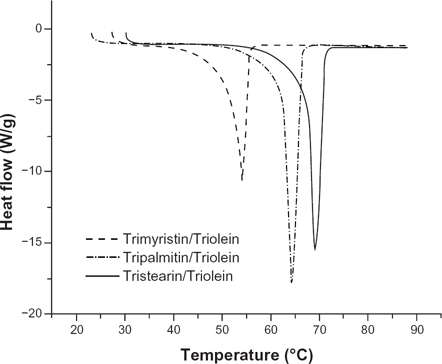
Melting behaviour of binary mixtures of triglycerides used in particle matrix.
The influence of triglyceride structure on melting point is clearly demonstrated in Figure 2 which shows the variation in melting point for blends of tristearin and soybean oil. 19 Modification of tristearin by the introduction of an unsaturated fatty acid ester at the second carbon of glycerol reduces the melting points for all blend ratios. As the degree of unsaturation is increased from one double bond in oleic to three in linolenic the melting point is further reduced. Comparable results are observed with tripalmitin (Fig. 3) but over a lower temperature range. 20 Such structured triglycerides are typically prepared in small quantities for research purposes and are not economical for low cost applications. 21 However, commodity oils such as coconut and palm that contain a high level of saturation and offer similar opportunities to control the melting point of mixtures. Figure 4 presents results obtained for blends of these oils with soybean oil. These curves provide guidance for product design and development. The use of commercially available edible oils will facilitate the adoption of this technology and avoid potential delays associated with the regulatory process.
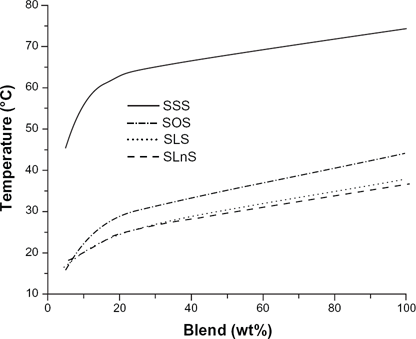
Mixtures of soybean oil with symmetrical triglyceride isomers derived from tristearin (SSS) by substitution with oleic (O; 9cis-18:1), linoleic (L; 9cis, 12cis-18:2), or linolenic (Ln; 9cis, 12cis, 15cis-18:3).
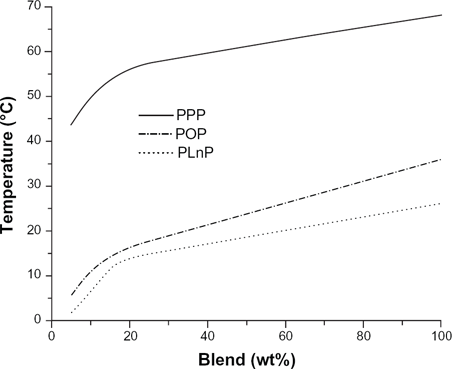
Mixtures of soybean oil with symmetrical triglyceride isomers derived from tripalmitin (PPP) by substitution with oleic (O; 9cis-18:1) or linolenic (Ln; 9cis, 12cis, 15cis-18:3).
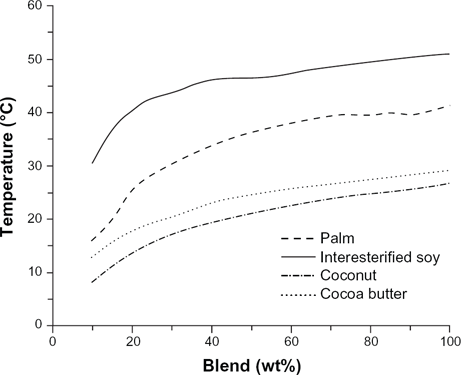
Mixtures of soybean oil with other commodity oils.
The oxidative stability of the encapsulated material was investigated by heating samples of the lipid particles while collecting infrared spectra that would reveal changes associated with degradation of the unsaturated fatty acid esters. These investigations were conducted on lipid particles composed of fully saturated triglycerides such as myristin and palmitin used to encapsulate DHA. This combination provided the most sensitive and highly unsaturated lipid to be tested with minimal interference from the capsule lipids. Figure 5 displays the spectra of the DHA standard before and after heating. Prior to the heat treatment the characteristic carbonyl stretching band is observed at 1740 cm−1. Additional strong absorbances were evident at 703.6 cm−1, 1160 cm−1, 1436 cm−1, 2964 cm−1, and 3013 cm−1. After heating to 120 °C the spectra showed several spectral changes associated with oxidative degradation. The carbonyl stretch has shifted to a lower wavenumber, from 1740 cm−1 to near 1730 cm−1, which is typical of an aldehyde rather than an ester and a broad absorbance has appeared near 3500 cm−1 which is characteristic of an alcohol group. Both of these changes are consistent with the expected oxidation products and provide a useful measure of degradation. This development occurred within 20 minutes of heating DHA that was not encapsulated while encapsulated DHA did not show these changes.
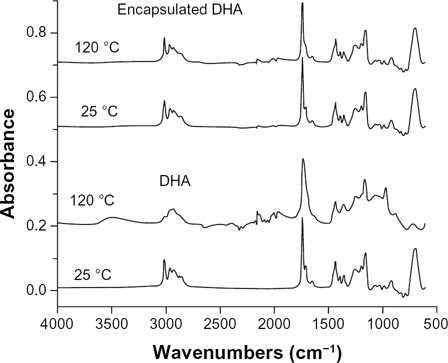
Spectra of docosahexaenoic acid methyl ester (DHA) at 25 °C and after heating to 120 °C compared to the corresponding spectra of encapsulated DHA. (Spectra separated for clarity.)
The preparation of lipid particles is technically straightforward and follows established procedures used to manufacture cosmetic and pharmaceutical products. Application of this technology to food and feed products is expected to improve the stability of additives and extend shelf life. The concern has been expressed regarding the fate of nanoparticles in food and feed formulations however the biodegradability of lipids is well known and should not be an issue for these triglycerides. Furthermore, formulating mixtures of edible fats and oils will appeal to such industries that have experience in processing lipid ingredients. Additional topics to be explored include the sensory properties of products containing lipid particles. Although with the low additive levels projected for commercial products there would be minimal adverse effect expected and the potential benefit of the particle to mask the flavour of the encapsulated compound.
Summary
Solid lipid particles were prepared from binary triglyceride mixtures. The melting points of the mixtures were lowered by blending a saturated lipid with triolein. The thermal behaviour of the lipid particle was related to the triglyceride structure which offers a simple approach for product design and development. The biodegradability of these lipids and their ability to stabilize bioactive compounds presents significant advantages to the food and feed industry.
Footnotes
Acknowledgements
The author acknowledges Dr. Gary List for providing data on structured triglycerides.
Disclosures
Author(s) have provided signed confirmations to the publisher of their compliance with all applicable legal and ethical obligations in respect to declaration of conflicts of interest, funding, authorship and contributorship, and compliance with ethical requirements in respect to treatment of human and animal test subjects. If this article contains identifiable human subject(s) author(s) were required to supply signed patient consent prior to publication. Author(s) have confirmed that the published article is unique and not under consideration nor published by any other publication and that they have consent to reproduce any copyrighted material. The peer reviewers declared no conflicts of interest.