






Abstract
Population dynamics of the Mediterranean fruit fly was studied along Montenegro seacoast. Tephri traps baited with 3 component female-biased attractants were used in 11 different localities to monitor the fruit fly population in commercial citrus orchards, mixed-fruit orchards, and in backyards. From 2008–2010, the earliest captures were recorded no earlier than July. In 2011, the first adult fly was detected in mid-June. Low captures rates were recorded in July and August (below 0.5 flies per trap per day; FTD) and peaked from mid-September to the end of October of each year. Our results indicate fluctuation of fly per trap per day depending on dates of inspection and locality, with significant differences in the adult population density. A maximum population was always reached in the area of Budva-Herceg Novi with an FTD of 66.5, 89.5, 71.63, and 24.64 (from 2008–2011 respectively). Fly activity lasts from mid-June/early-July to end December, with distinct seasonal variation in the population.
Introduction
The Mediterranean fruit fly,
Regarding tephritid fruit flies, Bateman
6
indicated that temperature has the dominant role in determining development rates and is responsible for the timing of the population processes and their synchronization with changes in the environment. In temperate climates, fruit flies are seasonal in abundance and multivoltine species, such as
The phenology and population dynamics of
Although first monitoring of the Mediterranean fruit fly in Montenegro was in 1959, there is no precise data about its presence from that time. There were sporadic detections during 1980s and 1990s, and some recorded damage to mandarins (
The main objective of this study was to monitor the occurrence and population dynamics of
Materials and Methods
Study area
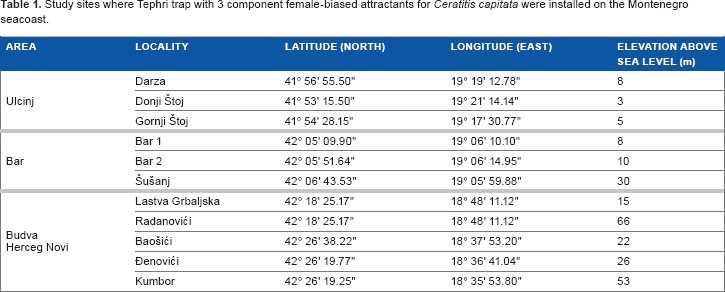
The population dynamics of
Study sites where Tephri trap with 3 component female-biased attractants for
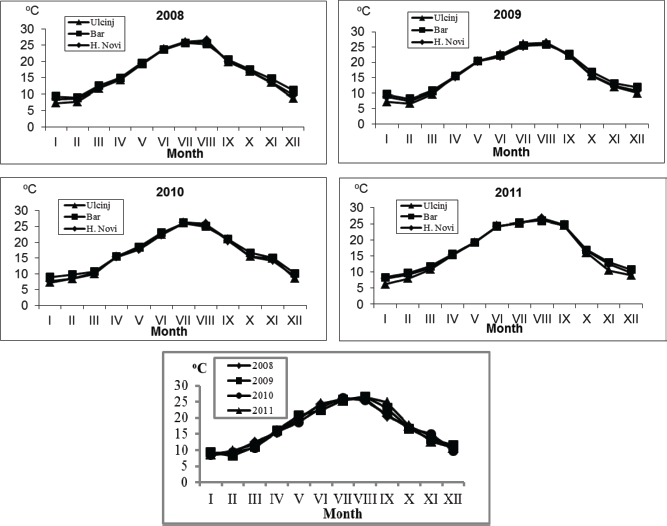
Average monthly temperature in the three areas of Montenegro seacoast (Ulcinj, Bar, and Budva-Herceg Novi) for the period of the study (2008–2011). The graph at the bottom of the figure shows the temperature for the period of the study in one of the areas (Budva-Herceg Novi).
Fruit fly monitoring
For our study, Tephri Traps® (Sorygar SL, Las Rozas, Madrid, Spain) baited with 3 component female-biased attractant (ammonium acetate, trimethylamine, and putrescine)
14
from Suterra (Bend, OR, USA) and insecticide dichlorvos (DDVP strips) from AgriSense-BCS. Ltd. (Pontypridd, South Wales, UK) were used to monitor the population dynamics of
Statistical analyses
Trap captures were expressed as the number of flies per trap per day (FTD). Total trap captures in different localities were tested using analysis of variance (MANOVA) for a completely randomized design, with two-factorial arrangement (trap captures expressed as FTD and dates of inspection). Means were separated according to the Tukey's honestly significant difference (HSD) test (
Results
The average temperatures were similar for the three areas where the study was conducted for the four years (Fig. 1). A minimum of average temperature of about 5°C was measured in January–February and the highest average temperature of about 25°C was measured in July–August.
When analyzing the temperature for the four years of the study (Fig. 1), low variation was observed from year to year for area of Budva-Herceg Novi. The same is true for the other two areas.
In Figure 2, a diagram with the most important host plants of

Seasonal
Trap captures are presented in Figure 3. During the monitoring period (2008–2011) adults of
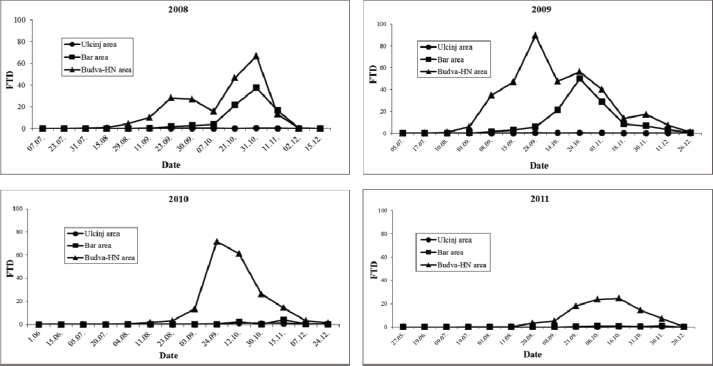
Captures in fly per trap per day (FTD) of
Our results show that during 2008–2010 the earliest captures of adults (a single female in 2008 and 2010, and four females in 2009) were recorded in July in the localities of ðenovići, Kumbor, and Baošići (all in the area of Budva-Herceg Novi). The earliest adult captures (one female) during the entire monitoring period were recorded on June 19, 2011 in Kumbor. First records were always obtained in mixed orchards or backyards of private houses. In other localities, particularly in the areas of Bar and Ulcinj, where commercial citrus orchards dominated, the first captures were recorded later, in August, September, and even October.
Data for the four years of study, shown in Figure 3, indicate that after low adult capture rates in July and August each year, population density began increasing at the end of August and the beginning of September. A population peak was observed in the period from mid-September to the end of October in each year of the study. A maximum FTD value reached was of 66.5, 89.5, 71.63, and 24.64 in 2008, 2009, 2010, and 2011, respectively, in the area of Budva-Herceg Novi. Overall, the adult population began decreasing in November and the last flies were captured during the second half through the end of December.
Statistical analysis for a total of four years of trapping showed fluctuation of FTD values depending on locality, with statistical significant differences (HSD0.05 = 11.28) in adult population density (Fig. 4). Comparison of FTD means (Tukey's test) showed significant differences between Baošići and all other localities. Overall, a clear statistic difference can be observed between the localities of the area of Ulcinj (with low total captures) and the other areas.
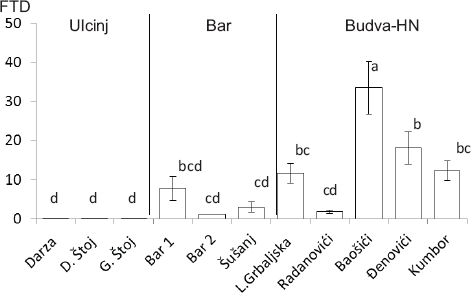
Average captures in fly per trap per day (FTD) of
Discussion
The results of our study show that in Montenegro seacoast
Our data showed that over the entire study period, population peaked within the average monthly temperature of 21.9°C in September and 16.2°C in October (averages for 2008–2011), which is similar to data presented by Papadopoulos et al 7 for Thessaloniki, Greece (40° 38’ 25” north latitude).
Nevertheless, it can be also concluded that population dynamics of
The seasonal occurrence of
Regarding the Montenegro seacoast, the absence of spring and early summer host plants, together with decreasing of the average monthly temperature in December and particularly in January, could be considered as determining parameters for the
Over the period of the present study, the area of Budva-Herceg Novi was ranked as the point of the earliest and highest adult captures every year. The main reason which could explain this population abundance is the absence of commercial fruit producing areas and the existence of abundant mixed orchards, and backyards with several host trees, so growers usually do not apply control measures, either cultural or chemical. As it is a residential and tourist area, growers avoid using chemical control. Moreover, growers traditionally do not spray figs and persimmons along the whole seacoast and these hosts are particularly important in summer and early autunm for breeding of the fly, and consequently large population build-up in September and October.
Later appearence of the fly in areas of Bar and Ulcinj, followed by lower capture rates, could be explained by the fact that those are the most important mandarin producing areas in Montenegro where the biggest commercial orchards are placed and producers regulary apply control measures. Those control measures include some sanitation and insecticide cover spray and can contribute to the maintenance of the population at low levels during the summer period.
Conclusion
The results obtained in this four-year study suggest that along Montenegro seacoast, which is located close to the northern limits of
We also observed that population dynamics of
Our results also indicated fluctuation in FTD depending on date and locality, with significant differences in adult population density.
Preliminary results of the present study, together with data from other studies obtained from places within the northern limit of
Author Contributions
Conceived and designed the experiments: SR. Analyzed the data: SR, MČ, RP. Wrote the first draft of the manuscript: SR. Contributed to the writing of the manuscript: RP. Agree with manuscript results and conclusions: SR, MČ, RP. Jointly developed the structure and arguments for the paper: SR, MČ, RP. Made critical revisions and approved final version: RP. All authors reviewed and approved of the final manuscript.
Footnotes
Acknowledgements
We thank the technician Branislav Vučković for his help in the field and laboratory work, and especially the fruit producers and growers that allowed us to set up traps in their orchards and sample mature fruits during the whole period of this study.
As a requirement of publication the authors have provided signed confirmation of their compliance with ethical and legal obligations including but not limited to compliance with ICMJE authorship and competing interests guidelines, that the article is neither under consideration for publication nor published elsewhere, of their compliance with legal and ethical guidelines concerning human and animal research participants (if applicable), and that permission has been obtained for reproduction of any copyrighted material. This article was subject to blind, independent, expert peer review. The reviewers reported no competing interests.