






Abstract
The aim of this study was to determine the median lethal concentration (LC50) of the commercial products Boveril WP® (Beauveria bassiana) and Metarril WP® (Metarhizium anisopliae) on the larvae and pupae of the fruit fly, Ceratitis capitata. Insects used in this study came from a laboratory colony. The evaluated product concentrations were 10.00, 15.00, 20.00 and 25.00 g/L of water, which correspond, respectively, to 5.00×10⁹, 7.50×10⁹, 10.00×10⁹ and 12.50×10⁹ viable conidia/L of water for the two products, and in the control only water was applied. Third instar larvae and pupae of C. capitata were used in this study. Results showed an overall mortality of larvae with all conidial concentrations of M. anisopliae. The LC50 values for larvae were 2.99 and 2.97 g/L for Boveril® and Metarril®, respectively, while for pupae they were 3.12 and 4.74 g/L for Boveril® and Metarril®, respectively. The high pathogenicity demonstrated by lower conidial concentrations of the tested products may mean greater efficiency from both economic and environmental points of view.
Introduction
The fruit cultivation has stood out as an excellent agricultural activity in the irrigated areas from northeastern Brazil. The fruit cultivation for export has shown promise, but the occur-rence of fruit flies is one of the limiting factors for achieving success in this activity (Carvalho and Nascimento 2002), in addition, it has been verified a growing increase in the fre-quency of these insects, as a result of the natural dispersion processes or the unintentional transport of infested fruit from one region to another.
The mediterranean fruit fly, Ceratitis capitata (Wiede-mann, 1824) (Diptera: Tephritidae), is considered cosmopoli-tan, infesting more than 250 host plant species widely distri-buted in South America (Gallo et al. 2002). The indiscrimi-nate use of pesticides to control fruit flies causes a serious ecological imbalance and triggers the emergence of other pest populations by eliminating natural enemies, and lead to human and environmental infection. The biological control of fruit flies interacts with a set of integrated management strategies meeting the demands of consumer markets (Oliveira 2010). Biological control can serve as a tool available to the producer to control this pest, resulting in fruit with lower levels of pesticide residues and lesser impact on the environment (Oliveira et al. 2010a).
The entomopathogenic fungi Beauveria bassiana (Balsamo) Vuill and Metarhizium anisopliae (Metsch) Sorok. are well-known and being used worldwide as biocontrol agents of many agricultural pests, they have potential to control several insects of different orders (Bridge et al. 1990; Alves 1992; Pereira et al. 1993; Silva 2001). The use of entomopathogenic fungi for pest control can be alternative candidates to solve the problems of resistance (Omoto et al. 1994). The microbial control of fruit flies can be a process that can partially replace other control methods in integrated management programs for these insects, especially the use of agrochemicals, presenting economic and environmental advantages for tropical fruit (Oliveira et al. 2010b).
Information about effects of different concentrations of commercial products produced by these entomophatogenic micro-organisms in the mortality of immature stages of Tephritidae are still very incipient, this way, this study aims at determining the mean lethal concentration (LC50) of the fungal commercial products Boveril WP® (Beauveria bassiana) and Metarril WP® (Metarhizium anisopliae), on the larvae and pupae of Ceratitis capitata (Diptera: Tephritidae) as a first step towards effective mycoinsecticidal control of this destructive pest.
Materials and Methods
Larvae were kept on artificial diet in Petri dishes, while pupae were subjected to substrate containing washed sand. Fungal suspensions of each concentration from either fungal product were topically applied with the deposition of 5 μl of the suspensions of the fungi on the whole larvae or pupae using micro-spray, later the insects were transferred to Petri dishes lined with filter paper, at 25 ± 2°C, 12 h of photophase and relative humidity of 80 ± 10%. To ensure fungal effect, mortality of treated larvae or pupae was verified eight days post-fungal application in each concentration of either fungi. The mortality was confirmed by sporulation. Mortality was then calculated and compared to a control (un-treated) group using the suitable statistical analysis.
Results and Discussion
The entomopathogenic fungi have affected the mortality of C. capitata. A high mortality of larvae and pupae at all concentrations of conidia of M. anisopliae and B. bassiana was recorded (Fig. 1). None of the concentrations of conidia of both products adopted in this study provided a lower mortality LC50 (Fig. 1, Table 1).
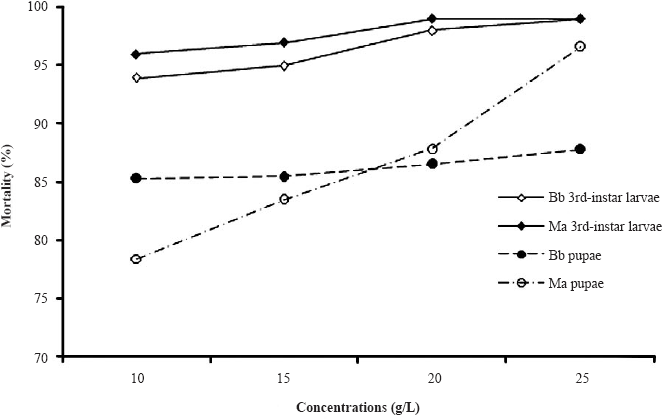
Average mortality of 3rd-instar larvae and pupae of Ceratitis capitata treated topically (n = 100) with Beauveria bassiana (Bb) and Metarhizium anisopliae (Ma).
Pathogenicity of Beauveria bassiana and Metarhizium anisopliae to third instar larvae and pupae of Ceratitis capitata (Diptera: Tephritidae) via topical exposure at 25 ± 2°C, 12h of photophase and relative humidity of 80 ± 10%. The value of each χ2 refers the probability of the angular coefficient > 0.LC - values and slopes (in g/L) were estimated by probit procedure (SAS Institute Inc., 2003).Values followed by the same letter within row are not significantly different if their 95% CL overlap.
The values of LC50 for larvae were 2.99 g/L and 2.97 g/L products Boveril® and Metarril®, respectively, while the pupae were 3.12 g/L and 4.74 g/L products Boveril® and Metarril®, respectively (Table 1). The lower concentrations needed to obtain the LC50 for larvae perhaps are associated with an increased exposure route of infection, in case, coat and digestive tract of the insect fungal spores contained in the fungal solution. The results shown in this study are similar to those reported by Loureiro and Moino Jr. (2006) about the total mortality caused by B. bassiana in aphids, Aphis gossypii Glover, 1877 (Hemiptera: Aphididae) and Myzus persicae (Sulzer, 1776) (Hemiptera: Aphidae) and to these of Almeida et al. (2007) on Brevicoryne brassicae (L., 1758) (Hemiptera: Aphidae). In fact, we reported in this study high levels of mortality in all concentrations applied both for specimens that received conidia of B. bassiana and M. anisopliae (Fig. 1). The value found by Loureiro and Moino Jr. (2006) of LC50 of Boveril® (B. bassiana) in aphids was 0.233 g/L.
Entomopathogenic fungi can be used in programs to control C. capitata through the application in the soil against their larvae and pupae, offering great advantages because it allows the multiplication of pathogens in agroecosystems. Mochi et al. (2006) found that the application of conidial suspension of M. anisopliae on the soil surface has provided a decrease in the survival of the pupal and adult phase of C. capitata. According to Onofre et al. (2002) this is a promising alternative for controlling fruit flies, as they are known to be pathogenic to Diptera like African fly tsé-tsé Glossina morsitans morsitans Westwood, 1851 (Diptera: Glossinidae) (Kaaya and Munyinyi 1995), C. capitata (Castillo et al. 2000; Ekesi et al. 2002; Dimbi et al. 2003; Alves et al. 2004; Mochi et al. 2006) and Musca domestica L. (Diptera: Muscidae) (Steinkraus et al. 1990).
The results of this study encourage the use of B. bassiana and M. anisopliae as a further measure of C. capitata control, because the larvae present in infested fruits lying on the ground represent a great advantage in the multiplication of entomopathogenic microorganisms and in preventing the spread of these insects in the field. Results obtained by Reys (2003) on the effect of the M. anisopliae on the larvae of Mexican fly, Anastrepha ludens (Loew, 1873) (Diptera: Tephritidae), revealed high levels of pathogenicity of the M. anisopliae to larvae of this insect pest. Quesada-Moraga et al. (2006) observed lethal suspensions of B. bassiana and M. anisopliae in C. capitata, causing mortality in adult C. capitata, ranging from 30 to 100%. Dimbi et al. (2003), reported an overall mortality of adult C. capitata, C. rosa variety fasciventris Karsch and C. cosyra (Walker, 1849) (Diptera: Tephritidae) submitted applications with low concentrations of conidia of B. bassiana and M. anisopliae.
The high pathogenicity levels demonstrated in lower conidial concentrations of the tested products, means a better efficiency from the point of economy and environment. The alternate application of spray products mycoinsecticides increases the possibility of success, because the entomopathogenic fungi are more susceptible to the action of adverse environmental factors such as high temperature, low humidity and high incidence of UV that can occur after each spraying, thus jeopardizing its survival in the environment (Ignoffo 1992; Grijalba et al. 2009). Moreover the efficiency spraying as it allows lower costs to the products and also through the use of low conidia concentrations of B. bassiana and M. anisopliae can enhance the selectivity of these organisms to the complex of natural enemies involved in agroecosystems.
Footnotes
Acknowledgements
The authors thank the Brazilian agency Coordenadoria de Aperfeiçoamento de Pessoal de Nível Superior (CAPES) for support. They also express their appreciation to two anonymous experts for reviews of the manuscript.