






Abstract
Robust stabilization and environmental disturbance attenuation are ubiquitous systematic properties observed in biological systems at different levels. The underlying principles for robust stabilization and environmental disturbance attenuation are universal to both complex biological systems and sophisticated engineering systems. In many biological networks, network robustness should be enough to confer intrinsic robustness in order to tolerate intrinsic parameter fluctuations, genetic robustness for buffering genetic variations, and environmental robustness for resisting environmental disturbances. With this, the phenotypic stability of biological network can be maintained, thus guaranteeing phenotype robustness. This paper presents a survey on biological systems and then develops a unifying mathematical framework for investigating the principles of both robust stabilization and environmental disturbance attenuation in systems and evolutionary biology. Further, from the unifying mathematical framework, it was discovered that the phenotype robustness criterion for biological networks at different levels relies upon intrinsic robustness + genetic robustness + environmental robustness ≤ network robustness. When this is true, the phenotype robustness can be maintained in spite of intrinsic parameter fluctuations, genetic variations, and environmental disturbances. Therefore, the trade-offs between intrinsic robustness, genetic robustness, environmental robustness, and network robustness in systems and evolutionary biology can also be investigated through their corresponding phenotype robustness criterion from the systematic point of view.
Keywords
Introduction
Inherently, real physical and biological systems suffer from intrinsic perturbations and extrinsic disturbances. In the last two decades, robust stabilization and noise-filtering theories have been developed by control engineers to achieve the robust stability for tolerating intrinsic perturbations as well as to obtain noise-filtering ability against extrinsic disturbances for improving the reliability and performance of control systems.1–5 Their applications are also extended from control systems1–4 to signal processing systems, 5 communication systems, 6 and biological systems.7,8 Since both engineering systems and biological systems need robust stabilization and noise-filtering abilities to tolerate intrinsic perturbations and resist extrinsic disturbances (or noises) so as to maintain their desired function or performance, there should exist some common schemes for robust stabilization and disturbance attenuation for these two kinds of systems.
At the molecular level, a gene regulatory network or protein interaction network is inherent with intrinsic parameter fluctuations due to random molecular fluctuations (or gene expression noises) and environmental disturbances. Since the study and design of gene regulatory networks and protein interaction networks have become important topics in systems biology, synthetic biology, and evolutionary biology,9–13 the robust stabilization and noise-filtering properties of biochemical or genetic regulatory networks have attracted much attention of engineers and molecular biologists. Robust stabilization and noise-filtering ability of gene networks under intrinsic parameter fluctuations and environmental disturbances have recently been discussed from the nonlinear stochastic stabilization and noise-filtering point of view. Robustness and evolvability are found to be internal properties of biological systems. 12 They determine a biological system's persistence and potentiality for future evolutionary changes. The biological system is evolvable if mutations in it are able to produce heritable phenotypic variations. In general, the more robust a system is, the less phenotypic variation a given number of mutations can generate, and hence the less evolvable the system is.9,10
Further, the interplay between robustness and sensitivity in the gene regulatory network is also discussed from the nonlinear stochastic system point of view. It was found that if the sum of genetic robustness and environmental robustness is less than network robustness, ie, network robustness can confer both genetic robustness to tolerate genetic variations and environmental robustness to resist environmental disturbances, and then the phenotype of the gene regulatory network is robust under genetic variations and environmental disturbances. The trade-off between genetic robustness and environmental robustness in evolution is discussed from the viewpoint of stochastic stability robustness and noise sensitivity of the nonlinear stochastic gene network. This may be relevant to the statistical trade-off between bias and variance, the so-called bias/variance dilemma. 11 Further the trade-off could be considered as an antagonistic pleiotropic action of a gene regulatory network from the systems biology perspective.
In the real evolutionary process of a population of biological networks, the random transmission and mutation of genes provide biological diversities for natural selection. In order to preserve functional phenotypes between generations, gene networks need to evolve robustly under discontinuous genetic mutations and environmental disturbances. In this study, a population of evolutionary gene networks is represented by nonlinear stochastic dynamic system with random genetic variations accumulated in evolution. Therefore, the robust stabilization of the natural favorite phenotype exerts a selection force on a population of gene networks to maintain network function. However, gene networks in population are generally adjusted by random genetic variations to generate phenotypes for new challenges in the network's evolution, ie, the evolvability. Hence, there should be some interplay between network evolvability and robust stabilization in evolutionary gene networks. The interplay between network evolvability and network robustness of biological networks has been discussed from the nonlinear stochastic point of view. 14
It was found that if network robustness can provide genetic robustness for buffering genetic variations while environmental robustness allows for resistance of environmental disturbances, then the phenotype of a biological network is robust in evolution. The trade-off between genetic robustness and environmental robustness in evolution is discussed according to the robust stochastic stabilization and noise-filtering analysis of a nonlinear stochastic gene network. The balance between network evolvability and network robustness, ie, between resisting and allowing changes in their own internal states (phenotypes) of stochastic gene networks, 15 sheds light from the systematic perspective on the mechanisms that govern the exploitation and toleration of the messiness of genetic variations and environmental disturbances in the evolutionary process. 14 In the evolutionary scenario, network robustness is an intrinsic property of evolvability and might, in the long run, improve the evolution of biological networks at all levels. This is because the accumulation of neutral mutations can result in neutral networks that provides evolutionary paths to new adaptations for the network population by random drift. 16 In this situation, network robustness and network evolvability might again be positively correlated. 17 In this study, the balance between network evolvability and network robustness in the evolutionary process will be explicitly revealed by the phenotype robustness criterion of evolutionary biological networks.
In this study, a unifying mathematical model is proposed for biological systems at different levels. According to this unifying mathematical model, the framework of phenotype robustness criteria is constructed for systems and evolutionary biology. We found that if network robustness can grant the intrinsic robustness for tolerating intrinsic parameter fluctuations, genetic robustness for buffering genetic variations, and environmental robustness for resisting environmental stimuli, then the phenotypes of these biological networks will be maintained under intrinsic parameter fluctuations, genetic variations and environmental stimuli. Moreover, the trade-off between intrinsic robustness, genetic robustness, environmental robustness, and network robustness can be revealed by the phenotype robustness criteria for biological networks at different levels. In the following sections, the aforementioned types of robustness, as well as their trade-off on phenotype robustness in systems and evolutionary biology, are discussed in sequence.
Trade-off between Intrinsic Robustness, Environmental Robustness and Network Robustness in Systems Biology
Linear gene regulatory network
Initially, for the convenience of illustration, we will consider only the following linear biochemical dynamics of a 
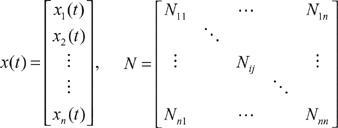
Suppose the linear gene regulatory network suffers intrinsic parameter fluctuations mainly due to random molecular fluctuations (or gene expression noises) so that stoichiometric interaction matrix

In the conventional notation of engineering and system science, the stochastic dynamic equation (2) for the gene regulatory network in vivo could be represented by the following Ito stochastic system3,4

Before further analysis of Ito stochastic system of gene regulatory network in (3), some definitions are given below.
Definition 1: The stochastic system in (3) with
Definition 2: Intrinsic robustness: The ability to tolerate intrinsic parameter fluctuations without violating the stochastic stability of gene regulatory network in (3) is called intrinsic robustness.
Since 
The physical meaning of disturbance sensitivity level
Definition 3: the ability to resist the effect of environmental disturbance on the network state
Definition 4: The phenotype of the stochastic gene regulatory network in (3) is called robust stabilization (ie, phenotype robustness) if the gene regulatory network has enough network robustness to tolerate the intrinsic parameter fluctuations
In the linear stochastic gene regulatory network (3), let us denote the Lyapunov function of gene regulatory network in (2) as
Proposition 1 : The phenotype of the linear gene regulatory network with intrinsic parameter fluctuations and environmental disturbances is robustly stable if there exists some symmetric positive definite matrix 
According to the Proposition 1, the network sensitivity 
This could be solved by decreasing 
For the gene regulatory network (2) with intrinsic parameter fluctuations and environmental disturbances, if the Eigenvalues of interaction matrix 
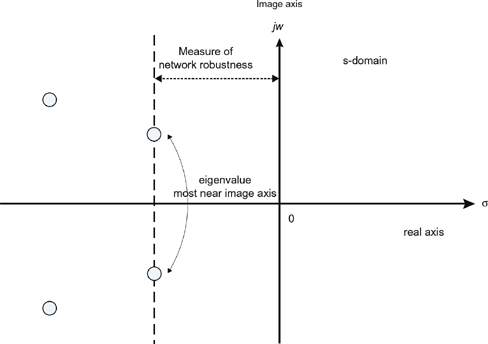
The smaller distance between the locations of Eigenvalues of
The physical meaning of phenotype robustness criterion in (8) is that if the network robustness can confer enough intrinsic robustness for tolerating intrinsic parameter fluctuations and environmental robustness for resisting environmental disturbances, then the phenotype of the gene network is maintained. In general, feedback loop could shift the Eigenvalues of
If the phenotype robustness criterion is violated, then network robustness cannot simultaneously provide enough intrinsic robustness for tolerating intrinsic parameter fluctuations or enough environmental robustness for resisting environmental disturbances simultaneously. In this situation, the phenotype of a gene network may change. In this case, we could improve network robustness by the gene circuit design method as follows7,20


That is, the robust gene circuit designed in (9) is meant to specify
Remark 1: If the engineered circuit is also perturbed by 
Nonlinear gene regulatory network
In real biological systems, the gene regulatory networks are always nonlinear. In this situation, the 
Consider the nonlinear stochastic system in (12). There exist many equilibrium points (phenotypes). Suppose a phenotype near a stable equilibrium point 

The stochastic nonlinear gene network has many local stable equilibrium points (phenotypes).
Proposition 2: The phenotype 
That is, if the HJI in (14) holds for some
The network sensitivity 
Substituting 
From the phenotype robustness criterion in (16), it can be seen that if 
The phenotype robustness criterion in (17) for the nonlinear stochastic gene regulatory network in (12) can be denoted as “intrinsic robustness + environmental robustness ≤ network robustness.” In other words, if the sum of intrinsic robustness and environmental robustness is still less than the network robustness, then the phenotype of the nonlinear gene network remains robust under the influence of intrinsic parameter fluctuations and environmental disturbances.
In order to maintain phenotype robustness in (17), the network structure needs to make the term
If the gene regulatory network in (12) does not have sufficient network robustness such that the phenotype robustness in (17) cannot be guaranteed, then robust stabilization cannot be maintained at the equilibrium point 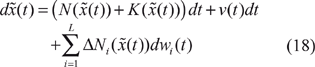
After the gene circuit is designed as (18), the phenotype robustness criterion in (17) should be modified as

That is, the robust gene network design in (18) is to specify the designed gene circuit
In general, it is very difficult to solve the HJI in (14) or (17) for the phenotype robustness criterion of the nonlinear stochastic gene network in (12) so as to gain more insight into the trade-off between intrinsic robustness, environmental robustness, and network robustness from the systematic point of view, such as the linear stochastic gene network. At present there is no good method for solving the nonlinear partial differential HJI either analytically or numerically. In this situation, some interpolation methods like global linearization
26
and fuzzy techniques
2
are employed to interpolate several local linearized gene networks in order to approximate the nonlinear stochastic gene regulatory network and to simplify the systematic analysis of phenotype robustness criterion in (14) or (17). When using the global linearization technique, all the global linearizations of the nonlinear stochastic gene regulatory network in (12) are bounded by a polytope consisting of 

Remark 2: If we considered only the linearization at the origin
According to the global linearization theory,
26
if (20) holds, then every trajectory of the nonlinear stochastic gene network in (12) or (13) can be represented by a convex combination of 
After the nonlinear stochastic gene network in (12) or (13) is represented by the interpolation of
Proposition 3: If the following quadratic inequality holds with 
Similarly, the network sensitivity of the global linearized gene network in (22) can be obtained by solving the following constrained optimization problem

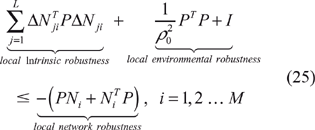
From the phenotype robust criterion in (25), it is seen that if the local network robustness is large enough for every local linearized gene network to simultaneously provide enough local intrinsic robustness for tolerating local random parameter fluctuations and enough local environmental robustness for resisting local environmental disturbances, then the equilibrium point
In the case of gene network design for engineering some gene circuits to improve the network robustness in (18), it can also be approximated by the global linearization representation as follows
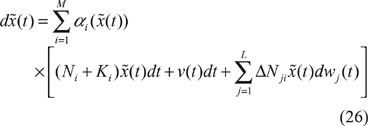
In this situation, the phenotype robustness criterion in (25) should be modified as follows

The gene circuit design is then able to specify adequate
Trade-off between Genetic Robustness, Environmental Robustness and Network Robustness in Evolutionary Biology
Linear stochastic evolutionary gene regulatory network
In the evolutionary process, a gene regulatory network will suffer from genetic variations and environmental changes or stresses such as temperature or salinity, which may perturb its phenotype. Consider the following stochastic gene regulatory network in the evolutionary process

Remark 3: Unlike the parameter variations in (3), which are mainly due to random molecular fluctuations in the conventional gene regulatory network, that are always modeled as continuous Brownian motion (Wiener process), the parameter variations of the gene regulatory network in the evolutionary process are mainly due to discontinuous genetic mutations. These mutations are hereditable and will be accumulated to affect the phenotype of offspring in the evolutionary process. Therefore, phenotype variations due to genetic mutations are more likely random point processes described by the weighted Poisson processes. 29 Additionally, the time scale of stochastic Poisson point process of evolutionary biology in (28) is much longer than the stochastic Wiener process of systems biology in (3).
Remark 4: From the population point of view, the stochastic gene evolutionary network in (28) with weighted Poisson point process can be considered as a population of gene networks over all possible random genetic variations
Let us denote the phenotype variation of the evolutionary gene regulatory network as 

From (30), it is seen that a gene regulatory network with less evolution level to environmental stimuli exhibits more fitness function to the phenotype 
Let us denote the network fitness 
Remark 5: The fitness function in (30) is chosen according to the robust stabilization of phenotype
However, it is still very difficult to solve the problem of network fitness
Proposition 4: For the stochastic gene regulatory network in (28) with genetic variations and environmental stimuli in the evolutionary process, if the following phenotype robustness criterion holds for
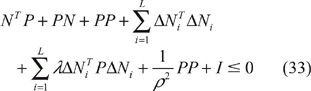
where
Proof: see appendix A
Remark 6: The genetic variations of the evolutionary gene regulatory network used by Chen and Lin 14 are considered with the Wiener process. In this study, the random genetic variations of the gene regulatory network are considered with Poisson point process to mimic discontinuous genetic mutations, which are heritable in the evolutionary process.
Since the evolution level 
The network evolvability 
Therefore, the network evolvability problem in (34) is equivalent to solving the following constrained optimization problem

From the analysis above, the network evolvability
After obtaining the network evolvability 
For the stochastic gene network in (28) with genetic variations and environmental stimuli, if the network robustness in the right-hand side of phenotype robustness criterion in (37) is fixed, the sum of genetic robustness and the environmental robustness should be also fixed. That is, large genetic robustness will lead to small environmental robustness, and vice versa. This relationship implies that a genetic gene network cannot tolerate a large amount of genetic variations and resist a large amount of environmental stimuli simultaneously. There should be a trade-off between genetic robustness and environmental robustness in the evolutionary process. In Lenski et al's study,
30
the evolutionary cases of genetic robustness were discussed using different evolutionary scenarios. The correlation with environmental robustness is considered to be the most probable cause of genetic robustness in evolution. According to the congruence scenario, the genetic robustness of the gene regulatory network in evolution is a by-product of environmental robustness of the gene regulatory network to resist environmental disturbances in the evolutionary process. This is caused by the fact that environmental disturbances are more frequent than genetic perturbations in evolution, which have been confirmed in RNA folding and heat-shock protein.
30
However, this correlation between genetic robustness and environmental robustness is obvious in the phenotype robustness criterion in (37). In order to provide a buffer against environmental disturbances (ie, the term
Nonlinear stochastic evolutionary gene regulatory network
In the real nonlinear stochastic gene regulatory network in evolution, the stochastic dynamic model in (28) should be modified as

Let us consider the nonlinear stochastic gene regulatory network in evolution. Many equilibrium points (phenotypes) exist (see Fig. 2). Suppose the phenotype of the nonlinear stochastic gene regulatory network is near the equilibrium point 
Proposition 5: For a nonlinear stochastic evolutionary gene network in (39), if the following phenotype robustness criterion holds for some positive function 
Proof: see appendix B
Remark 7: (i) If the nonlinear stochastic evolutionary gene network in (38) or (39) is free of environmental disturbance
In the case of phenotype robustness criterion in (40) for the nonlinear stochastic gene regulatory network in (38) or (39) in evolution, the network evolvability can be measured as follows

After solving the constrained optimization problem in (41) for the network evolvability of the nonlinear stochastic gene regulatory network in (38) or (39), the phenotype robustness criterion in (40) be modified with network fitness 
In (42), the network robustness should be large enough when the nonlinear stochastic evolutionary gene network in (38) or (39) suffers from simultaneous genetic variations and environmental stimuli in evolution. That is,
The phenotype robustness criterion in (42) for the nonlinear stochastic evolutionary gene regulatory network in (38) or (39) can be denoted as “genetic robustness + environmental robustness ≤ network robustness.” In other words, if the sum of genetic robustness and environmental robustness is still less than the network robustness in evolution, then the phenotype of the evolutionary gene regulatory network can be maintained under genetic variations and environmental disturbances in the evolutionary process. The phenotype robustness criterion of the nonlinear stochastic evolutionary gene network in (38) or (39) shows that if greater network robustness is evolved to allow the gene network to provide a buffer against more environmental disturbances in evolution, it can also provide a buffer against heritable genetic variations. Obviously, the correlation between genetic robustness and environmental robustness affects the network robustness of gene network in the evolutionary process. 14
As the phenotype robustness criterion in (42) holds, the accumulated genetic variations
In general, the cost of evolutionary strategy to resist environmental disturbances and to tolerate genetic variations is much higher.
31
In this case, if stress-avoidance strategy is imposed in the evolutionary process,
31
the basin of equilibrium point
Generally, it is still difficult to solve HJI in (40) for the phenotype robustness criterion of the nonlinear stochastic evolutionary gene regulatory network in (38) or (39). In order to determine the extent to which Poisson genetic variations can be tolerated by the nonlinear stochastic evolutionary gene network, or to solve the HJI-constrained optimization in (41) (so as to measure the network evolvability of the nonlinear stochastic gene network so as to gain greater insight into the systematic molecular mechanism of the nonlinear stochastic gene regulatory network in the evolutionary process) the global linearization techniques in (20)–(22) are employed to interpolate several local linear stochastic evolutionary gene networks in (38) or (39) as follows

After the nonlinear stochastic evolutionary gene regulatory network in (39) is represented by the interpolation of
Proposition 6: If the following phenotype robustness criterion holds for some
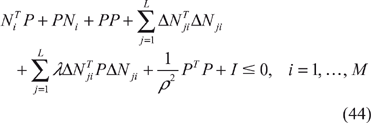
Proof: see appendix C
Similarly, the network evolvability of nonlinear stochastic evolutionary gene network can also be measured by solving the following constrained optimization problem

The network evolvability 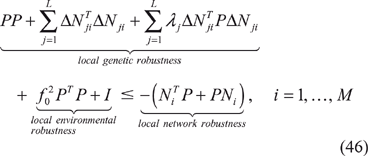
From the phenotype robustness criterion of the nonlinear stochastic evolutionary gene regulatory network in (46), it can be seen that the phenotype of the nonlinear stochastic evolutionary gene network can be maintained if each local network robustness can confer each local genetic robustness and local environmental robustness so that genetic variations can be tolerated and the environmental disturbances can be resisted in evolution. If the local stochastic evolutionary gene networks in (43) are more robust, ie, the Eigenvalues of local evolutionary gene regulatory networks are farther in the left-half complex s-domain as shown in Figure 1, the nonlinear stochastic evolutionary gene network can provide more network robustness so that it can also provide more genetic robustness and environmental robustness in the evolutionary process. However, the trade-off between local genetic robustness and local environmental robustness is that their total sum cannot be more than the local network robustness. If the phenotype robustness criterion in (46) is violated, the network robustness may not provide enough genetic robustness to simultaneously tolerate genetic variations as well as enough environmental robustness to resist environmental stimuli. Large network evolvability with significant response to environmental disturbances will impel phenotype transition from the basin of equilibrium point
Computer Simulation Example
To confirm the validity of the stability robustness and the noise attenuation schemes in gene regulatory network, a computational example in systems biology is shown in the following section. Consider a typical genetic regulatory network, as shown in Figure 3.18,21,33 This is a typical gene interaction system describing the gene, mRNA, and protein interactions. 

A typical genetic regulatory network describing the gene, mRNA and protein interactions. 21
In order to discuss the robust stability of the stochastic regulatory network at the equilibrium point 
Since we are interested in the robust stability of the equilibrium
By solving the constrained optimization in (24), we can find the network sensitivity 

This means that the effect of environmental disturbance on the gene regulatory network cannot exceed this value. We can compute the energy ratio of 
In this genetic regulatory network we found that the network sensitivity of gene regulatory network can be estimated by the proposed systems biology method and validated by system simulation.
Discussion
One of the most important features of biology is the ability of organisms to persist in face of changing conditions. To achieve this consistently, organisms must have a balance between robustness and evolvability, that is, between resisting and allowing change in their own internal states. 31 Moreover, they must achieve this balance on multiple time scales, such as physiological responses to changes over an individual life span as well as evolutionary responses, in which a population of genomes continually update its encoded information about past environments and how future generations should respond given that record. 31 There are many examples of robust biological systems found at many scales, from biochemical to ecological. At each scale, robustness may reflect the properties of individual elements or, alternatively, the dynamic feedbacks between interacting elements. The expression of some metabolic functions may be robust in face of temperature changes. For example, an enzyme maintains its shape and specificity across a range of temperatures or because an interconnected network of reactions sustains the supply of product, even when some enzymes fail. A genome may be robust, on the other hand, because it encodes proofreading and repairs systems that reduce replication errors or because it is organized such that many mutations have little effect on its phenotype.
One important question is whether there exists a unifying mathematical framework that can encompass such diverse examples of biological robustness under intrinsic perturbations and extrinsic disturbances. Might new insights come from such conceptual and mathematical unification, or will future understanding require detailed analyses of specific cases? Across the different biological system scales, recurring mechanisms for achieving robustness, which include redundancy, modularity and feedback, might serve as organizing principles of robust biological networks. Yet, similar robust mechanism could mask important differences in the evolutionary origins of those robust mechanisms. At the level of genes in genomes or of cells in multicellular organisms, it is reasonable to suggest that redundancy evolved by natural selection in order to maintain some functional capacity in face of intrinsic perturbations and extrinsic disturbances. However, while species redundancy could also be critical for robustness of ecosystem functions, differences in redundancy might be an emergent property rather than an ecosystem-level adaptation as selection generally acts at lower levels. 31 If robustness has evolved to maintain performance, what would prevent biological networks from becoming ever more robust? To answer these questions, in this study we have focused on genetic, environmental, and network robustness, and the interplay between them to discuss the phenotype robustness of biological networks at different scales from a unifying nonlinear stochastic system perspective. We found that if a biological network becomes more robust in the evolutionary process, a robust phenotype of biological network will harbor a large amount of neutral genetic variations, which might show increased rather than decreased evolutionary potential in the long run. This is the reason why network robustness is essential to the evolution of biological network and why it can improve the network evolution in biological systems.
In this study, we have developed a single unifying mathematical framework for encompassing diverse examples of stochastic biological networks to discuss intrinsic, genetic, environmental, and network robustness, and their trade-offs in systems and evolutionary biology.
According to our analyses, the phenotype robustness criteria of stochastic biological networks in systems and evolutionary biology have a similar mathematical framework. The biological networks in systems and evolutionary biology can be modeled as nonlinear stochastic systems with intrinsic parameter fluctuations, genetic variations and environmental disturbances, in which intrinsic parameter fluctuations are described by the Wiener (Brownian) process, environmental disturbances are described by the Gaussian white noise, and genetic variations are described by the Poisson point process. The interplay between these four different areas of robustness can therefore be analyzed by the nonlinear stochastic system theory. The linear stochastic system theory can then be applied when the global linearization technique is employed to interpolate several local linear stochastic systems to approximate the nonlinear stochastic system.
From the system theory perspective, the phenotype robustness of nonlinear stochastic gene networks in systems and evolutionary biology need to obey a similar phenotype robustness criterion. In order words, “intrinsic robustness + genetic robustness + environmental robustness ≤ network robustness.” This means network robustness needs to be strong enough to tolerate either heritable perturbations (genetic variations) or non-heritable perturbations (ie, random molecular fluctuations and environmental disturbances) in order for the phenotype of gene networks to be maintained in systems and evolutionary biology with a similar mathematical framework. The phenotype robustness of the stochastic gene network is completely consistent with the idea of canalization of development and inheritance of acquired characters as described by Waddington. 35 According to these phenotype robustness criteria, the correlation among intrinsic, genetic, environmental, and network robustness by recent genomic experiments in yeast (genes conferring similar intrinsic, genetic and environmental robustness to maintain phenotypic robustness) can be rationally explained from the systematic perspective. 36 In other words, if the network robustness of gene network is large enough, genetic perturbations or environmental disturbances can then be taken over respectively or simultaneously to maintain the functional phenotype in systems and evolutionary biology.
Genetic, environmental and phenotypic random variations are inevitably noisy processes in systems and evolutionary biology rather than desirable features of biological networks.37,38 These stochastic processes arise from the complexity of the evolutionary process of biological gene networks. However, there is numerous evidence of high fidelity and minimal noise, including the proof editing of DNA replication and protein translation in systems and evolutionary biology. Enzymes have also evolved toward high specificity thereby increasing fidelity. Gene expression is also regulated by elaborate mechanisms, and random variations seem to have been minimized in systems, synthetic, and evolutionary biology. However, chemophysical constraints on the specificity and fidelity of biological networks are costly and there are generally trade-offs. If biological networks want to retain enough network robustness to give intrinsic robustness for tolerating intrinsic parameter fluctuations, genetic robustness for buffering genetic variations and environmental robustness for resisting environmental disturbances, so as to keep their proper function (ie, phenotype robustness), much effort has to be taken and a high cost must be paid.
In general, random genetic variations, phenotype perturbations, and heterogeneity are neither desired nor deliberate outcomes of systems and evolutionary biology. However, heterogeneity and diversity form the very basis of evolutionary biology, not only within genetically diverse populations but also within the same allele or genome. Thus, random genetic variations, environmental disturbances, and phenotypic perturbations are inherent features of biological systems and networks. Random perturbative biological networks may contain more connected and interconnected systems and may provide multifunctionality of the biological network. This multifunctionality may result in increased robustness and a capacity to cope with diverse challenges. However, multifunctionality also increases the complexity and the variations in the biological network, which may increase adaptive potential. Thus, behind the façade of perfection and optimality of systems and evolutionary biology lies the messy biology that originates from the genetic variations and environmental disturbances in evolution. 39 There exist the trade-off among intrinsic, genetic, environmental, and network robustness in the phenotype robustness of stochastic biological networks. That is, if intrinsic robustness + genetic robustness + environmental robust ≤ network robustness, then the phenotype of biological network is maintained. This sheds light on the mechanisms that govern the exploitation and toleration of the messiness of biological networks in systems and evolutionary biology, from the systematic perspective. Obviously, network robustness needs to be strong enough to tolerate either heritable perturbations (genetic variations) or non-heritable perturbations (random molecular fluctuations and environmental disturbances) so that the phenotype can be maintained in biological network at different levels.
The interplay between evolvability and network robustness in evolutionary network has been discussed by Chen and Lin. 14 However, in this study, the Wiener (or Brownian) processes for modeling genetic variations in evolutionary gene networks have been replaced by the Poisson point processes to better mimic the discontinuous genetic mutations of gene networks in the evolutionary process. Further, some genetic algorithms (GAs) based on genetic mutations and natural selection in the evolutionary process have been widely applied to both control engineering design to select the most adequate controller40,41 and genetic circuit designs in synthetic biology to select the most adequate circuit components42,43 to satisfy the prescribed design specification respectively.
In general, it is very difficult to solve the HJI in (14), (40) for the phenotype robustness criteria in biological networks at different levels. With the global linearization technique, the HJI problem for robust stabilization of nonlinear stochastic biological network is reduced to solving an equivalent set of Riccati-like inequalities in (23), (44) for the robust stabilization of each local linearized biological network. We also found that if the network robustness of each local linearized biological network can take on the local intrinsic robustness, genetic robustness and environmental robustness of each local linearized biological network, then the phenotype of the nonlinear stochastic biological network could also be maintained.
For biological networks at different levels, two favored strategies can improve phenotype robustness in the evolutionary process. One is to improve network robustness to provide enough intrinsic robustness for tolerating intrinsic parameter fluctuations, genetic robustness for buffering genetic variations, and environmental robustness for resisting environmental disturbances so that phenotype robustness of the biological network can be maintained under these uncertain perturbations and environmental disturbances. Negative feedback is a mechanism that can improve network robustness (ie, it can make right-hand sides of (17), (19), (25), (27), (42) or (46) larger) and is favored by natural selection in biological networks at different levels in the evolutionary process. Another strategy is to reduce the effect of intrinsic parameter fluctuations, genetic variations and environmental disturbances on different biological networks (ie, it can make the left-side of (17), (19), (25), (27), (42) or (46) smaller). Redundancies and repairs are the mechanisms of this strategy and are favored by natural selection in evolution. This is the reason why there are so many redundancies from duplicated genes in networks and redundant pathways in biochemical networks.
Conclusion
This paper presents a unifying mathematical framework to describe different levels of stochastic biological networks under intrinsic parameter fluctuations, genetic variations, and environmental disturbances. The phenotype robustness criteria of biological networks in systems and evolutionary biology were also investigated, according to the unifying stochastic biological systems, from the robust stabilization and disturbance sensitivity perspective. It was found that if intrinsic robustness + genetic robustness + environmental robustness ≤ network robustness (ie, network robustness can confer intrinsic robustness for tolerating intrinsic parameter fluctuations, genetic robustness for buffering genetic variations and environmental robustness for resisting the environmental disturbances) then the phenotype will be robust in biological networks at different levels in systems and evolutionary biology. Using the global linearization method, we also found that if the network robustness of each local linearized system is greater than the total sum of intrinsic robustness, genetic robustness, and environmental robustness of each local linear system, then the phenotype of the biological network is also maintained despite intrinsic parameter fluctuations, genetic variations, and environmental disturbances. Finally, an example in silico is given to estimate the network sensitivity of a gene regulatory network, which can be also validated by Monte Carlo simulation.
Footnotes
Author Contributions
Conceived and designed the experiments: BSC. Analysed the data: BSC. Wrote the first draft of the manuscript: BSC. Contributed to the writing of the manuscript: BSC, YPL. Agree with manuscript results and conclusions: BSC. Jointly developed the structure and arguments for the paper: BSC, YPL. Made critical revisions and approved final version: BSC, YPL. All authors reviewed and approved of the final manuscript.
Funding
The work was supported by the National Science Council of Taiwan under grant NSC 100-2745-E-007-001-ASP.
Competing Interests
Author(s) disclose no potential conflicts of interest.
Disclosures and Ethics
As a requirement of publication author(s) have provided to the publisher signed confirmation of compliance with legal and ethical obligations including but not limited to the following: authorship and contributorship, conflicts of interest, privacy and confidentiality and (where applicable) protection of human and animal research subjects. The authors have read and confirmed their agreement with the ICMJE authorship and conflict of interest criteria. The authors have also confirmed that this article is unique and not under consideration or published in any other publication, and that they have permission from rights holders to reproduce any copyrighted material. Any disclosures are made in this section. The external blind peer reviewers report no conflicts of interest.