






Abstract
Stevioside is a natural sweetener from Stevia leaf, which is 300 times sweeter than sugar. It helps to reduce blood sugar levels dramatically and thus can be of benefit to diabetic people. Tissue culture is a very potential modern technology that can be used in large-scale disease-free stevia production throughout the year. We successfully produced stevia plant through in vitro culture for identification of stevioside in this experiment. The present study describes a potential method for identification of stevioside from tissue culture-derived stevia leaf. Stevioside in the sample was identified using HPLC by measuring the retention time. The percentage of stevioside content in the leaf samples was found to be 9.6%. This identification method can be used for commercial production and industrialization of stevia through in vitro culture across the world.
Introduction
Stevia, a God-gifted plant having medicinal and commercial importance, is being used all over the world. It is a perennial herb that belongs to the Asteraceae family and native to Paraguay. The leaves of stevia are the source of stevioside and rebaudioside, which is 300 times sweeter than cane sugar.1,2 Stevioside is regenerated as a valuable natural sweetening agent because of its relatively good taste and chemical stability. 3 Today, stevia is being cultivated in China, Japan, Korea, Taiwan, India, Bangladesh, Philippines, Hawaii, Malaysia, and overall South America for food and pharmaceutical products. 4 These products can be added to tea and coffee, cooked or baked goods, processed foods and beverages, fruit juices, tobacco products, pastries, chewing gum, and sherbets. 5
The increasing consumption of sugar (sucrose) has resulted in several nutritional and medical problems such as obesity.2,6 According to some research reports, stevioside plays an important role in reducing the blood sugar levels.7–9 It has a special importance to diabetic persons and diet-conscious people. The consumption of stevioside may have a beneficial effect on human health. 10 It has been proved that regular consumption of this compound reduces glucose and cholesterol concentrations, 11 enhances the regeneration of cells and blood clotting, inhibits tumor cell growth, and strengthens blood vessels.12,13 Several studies have also reported the antihyperglycemic, insulinotropic, glucagonos-tatic, and antihypertensive effects of stevia.14,15
Coca-Cola is using stevia in more than two dozen products globally, including Sprite and Fanta sodas in parts of Europe, to reduce calories by 30%. In Japan alone, 150 tons of stevioside are used annually. About 30% of sweet things are produced in Japan using stevia, and people have been using it for more than 40 years.1,16
For the potential commercial value of stevia, private and public biotechnology companies are producing stevia in huge quantity and marketing its products. Demand and different uses of stevia are increasing day by day not only in Japan but also throughout the world. On the other hand, production of stevia is not satisfactory. Stevia seeds show a very low germination rate. 17 In addition, vegetative propagation is not easy. Therefore, the conventional propagation method is not suitable for stevia production.
Plant tissue culture can play an important role in the commercial production of stevia. A large amount of disease-free stevia plants can be produced throughout the year using tissue culture technique. The plant and tissue cultures have enabled us to increase our knowledge in many areas including differentiation, cell division, cell nutrition, and cell preservation, but today, cells are cultivated in vitro in bulk or as clone from single cells to grow whole plants from isolated meristem, then induce callus, and develop complete plantlets by organogenesis or by embryogenesis.
18
Tissue culture is the only rapid process for the mass propagation of stevia. Some studies have been published regarding tissue culture of stevia in different countries. Das et al
19
reported micropropagation of
Therefore, the present research was conducted to establish a suitable protocol for identification of stevioside from tissue culture-derived stevia leaf.
Material and Methods
Plant Regeneration from in Vitro Culture
Induction and Culture of Callus
Leaves of stevia were collected from mature plants growing in Okayama City, Japan. After washing with running tap water, they were cut into small pieces of 2 cm in length. They were surface sterilized with 70% ethanol for 30 seconds, further sterilized with a 3% sodium hypochlorite, and rinsed three times in sterilized distilled water. The explants were placed in Murashige and Skoog (MS) 21 medium solidified with 0.8% agar with the pH adjusted to 5.7. To examine the effects of PGRs on callus induction, different types of auxin (2,4-D, NAA, and IBA) were used.
Cultures were maintained in an air-conditioned culture room at a 16-hour photoperiod with 70%–80% humidity. Room temperature was maintained at about 25°C. After seven days of culture, callus initiation started and matured after four weeks of culture.
Shoot Formation from Callus
Callus was transferred into MS media supplemented with different concentrations of BAP for shoot induction. Shoot initiation started after one week of culture. Multiple shoot was found after four weeks of culture.
Root Induction from Shoot
After 10–l2 weeks of culture initiation, the usable shoots were collected from proliferated multiple shoots. Then, individual shoots were placed in rooting media supplemented with different auxins such as NAA, IBA, and IAA. After four weeks of culture, mature root was found.
Acclimatization for Commercial Application
Rooted plantlets were transferred into a small pot for acclimatization. For the first 7–l5 days, transferred potted plants were kept covered with transparent plastic to maintain high humidity. The potted plants were watered regularly. After one month of transfer, plantlets were transferred into the field, and the survival rate was found to be 95%. In this way, the potted plantlets were successfully acclimatized to natural conditions through a gradual increase in their exposure time to sunlight. Rooted shoot was transferred to soil for establishment in ex vitro condition. After one week, rooted shoot was transferred to the field for leaf production. After two months, mature leaves were collected for chemical analysis. Collected leaf was dried and ground using. A total of 10 g of dried powder was used for HPLC analysis.
Standard Preparation
The standard solution was prepared by accurately weighing 5 mg of stevioside, transferring it to a 5 mL volumetric flask, and making up the volume using methanol in order to make 1 mg/mL solution.
Extraction of Sample
The sample was prepared by accurately weighing 10 g of stevia leaf and extracting it with methanol by sonication. The extracts were filtered through filter paper and evaporated. Finally, the extracted leaf solution was used for HPLC analysis.
HPLC Analysis
HPLC was performed using Jasco Co. Ltd. Solvent ratio was CH3CN:H2O = 90:10 and column: CrestPak C18S (150 × 4.6 mm). The flow rate was 1 mL/minute, and the detector was set at 210 nm. The injection volumes were 5 µL throughout the experiment. Stevioside in the samples was identified using HPLC by measuring the retention time.
Results and Discussion
Identification of stevioside has been carried out from tissue culture-derived stevia leaf in this experiment. Leaf explant was used for callus induction. Different concentrations of auxins such as 2,4–D, IBA, and NAA (0, 1, 2, 4, and 6 mg/L) were tested for callus induction. Best callus formation was achieved in MS medium supplemented with 2 mg/L 2,4-D. Callus was friable and greenish in color. Lowest callus was found in 6 mg/L 2,4–D in MS medium. No callus was found in MS medium without 2,4–D. IBA showed effective result, but NAA showed low result for callus induction from stevia leaf. Taware et al 22 also reported that the best callus induction was found in MS medium with 2,4–D. On the other hand, Gupta et al 18 reported good callus induction in MS medium with IBA from stevia leaf explant. Pande and Gupta 23 examined the effects of explant like leaf, root, and node for callus induction, and it was found that the callus obtained from leaf and root explants were shiny green, while with nodal explants it was hard and brown. Also, in our observation, it has been seen that leaf explants could serve as a best planting material for callus production. Friable callus was cultured for shoot induction in MS medium with different concentrations of BAP (0, 0.2, 0.5, 1.0, 2.0, and 4.0 mg/L). Among the different concentrations of BAP, 1 mg/L showed good result for shoot formation from callus. Healthy and highest number of shoots were observed in MS medium with 1 mg/L BAP. Lowest shoot formation was found in MS medium with 8 mg/L BAP. Shoot was cultured for root induction in the MS medium with different concentrations of IBA, NAA, and IAA (0, 0.5, 1.0, 2.0, 4.0, and 8.0 mg/L). Best root induction was observed in the MS medium supplemented with 2 mg/L IBA. NAA showed an effective result but IAA showed the lowest performance for root induction from shoot. After acclimatization, 95% of plantlets survived in the field. All plants were healthy and disease free and in very good condition. Any chemical fertilizer was not used for cultivation, and the organic stevia is good for our health. Using our method, numerous stevia plants can be produced throughout the year, which can be used for commercial production of stevioside (Fig. 1).
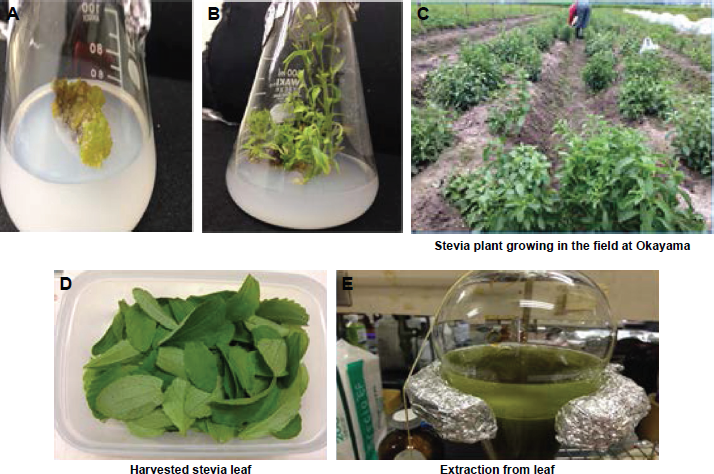
Plant regeneration and extraction of harvested leaf.
Mature leaves were harvested from the field for analysis of stevioside by HPLC. Standard stevioside and leaf extract were used for identification. The identification of stevioside content in the samples was done by comparing the retention time and peak area of sample with that of the standard (Fig. 2).
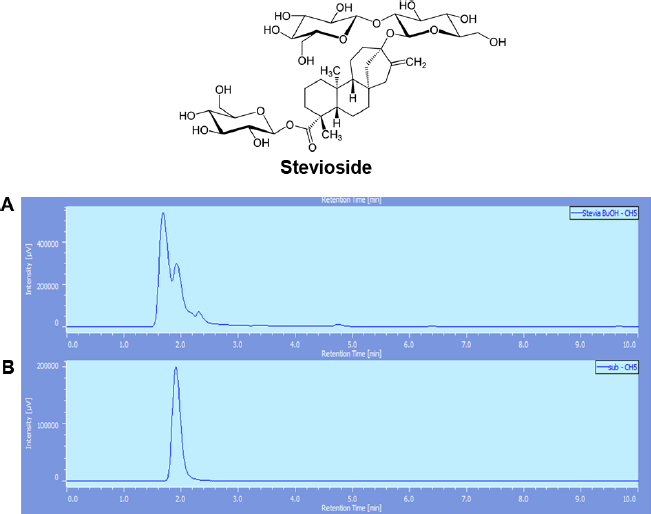
HPLC chromatogram of stevioside in in vitro raised leaf and standard.
The percentage of stevioside in the samples was found to be 9.6%. According to Kumari and Chandra,
5
stevioside content in leaf was found to vary from 3.17% to 9.94%. The stevioside content of the leaf sample was found to be 12.19%.
24
Kour
25
developed an HPLC method for determination of stevioside from leafy parts of in vitro and in vivo regenerated plants of
Conclusion
The number of diabetic people is increasing dramatically day by day in the world. We should avoid or reduce the uses of sugar as it is harmful to health. We can replace stevia as it is proved to be a natural sweetener with zero calorie and very much effective against diabetes. On the other hand, biotechnology is the modern technology that can be used for commercial stevia production, which will be helpful for public health.
The present study describes a potential method for identification of stevioside from tissue culture-derived stevia leaf. Stevioside in the sample was identified using HPLC by measuring the retention time. We have found 9.6% stevioside from our experiment by HPLC. Findings obtained from our research experiment may help for establishment of a stevia-based industry, which will play an important role for diabetic patients in Japan as well as throughout the world. We intend to continue this research for further new findings.
Author Contributions
Wrote the first draft of the manuscript: MZK. Helped with data analysis: DU and NN. Agreed with manuscript results and conclusions: MZK, DU, NN, MMH, KI and HH. Jointly developed the structure and arguments for the paper: MZK, DU, NN, MMH, KI and HH. Made critical revisions and approved final version: MMH, KI and HH. All authors reviewed and approved of the final manuscript.