






Abstract
Cholest-4-en-3-one has positive uses against obesity, liver disease, and keratinization. It can be applied in the synthesis of steroid drugs as well. Most related studies are focused on preparation of cholest-4-en-3-one by using whole cells as catalysts, but production of high-quality cholest-4-en-3-one directly from cholesterol oxidase (COD) using an aqueous/organic two-phase system has been rarely explored. This study set up an enzymatic reaction system to produce cholest-4-en-3-one. We developed and optimized the enzymatic reaction system using COD from COX5-6 (a strain of Rhodococcus) instead of whole-cell biocatalyst. This not only simplifies and accelerates the production but also benefits the subsequent separation and purification process. Through extraction, washing, evaporation, column chromatography, and recrystallization, we got cholest-4-en-3-one with purity of 99.78%, which was identified by nuclear magnetic resonance, mass spectroscopy, and infrared spectroscopy. In addition, this optimized process of cholest-4-en-3-one production and purification can be easily scaled up for industrial production, which can largely decrease the cost and guarantee the purity of the product.
Introduction
Cholest-4-en-3-one is an important synthetic intermediate in many steroid transformations. Previous studies have shown that it is effective against obesity, liver disease, and keratinization. Recently, Neuvonen et al 1 assessed the functional effect of cholest-4-en-3-one in human cells and found cholest-4-en-3-one generated by cholesterol oxidation restrained cell migration. Moreover, cholest-4-en-3-one can serve as precursor for the synthesis of other drug intermediates, such as androst-4-ene-3,17-dione and androsta-1,4-diene-3,17-dione, which are major starting materials for the synthesis of anabolic drugs and contraceptive hormones. 2 Its derivative, a developing new drug Olesoxime (cholest-4-en-3-one, oxime), displays neuroprotective properties and medicinal properties in the treatment of spinal muscular atrophy.3,4
Cholest-4-en-3-one can be synthesized by chemical methods, such as Oppenauer oxidation of cholesterol, acid-catalyzed isomerization of cholest-5-en-3-one, and by using pyridinium chlorochromate to convert cholesterol.5–7 However, these methods involve very harmful solvents, such as chloroform, methanol, and benzene. Meanwhile, some of these methods need multistep reactions to yield cholest-4-en-3-one and the processes take a long time. Alternatively, cholest-4-en-3-one can be prepared using microbial sources in one reaction. It has been reported that many microorganisms, including the genera Arthrobacter, Enterobacter, Gordonia, and Mycobacterium, are capable of transforming cholesterol to cholest-4-en-3-one.8–11 The preparation by bioconversion was commonly achieved by using whole cells as biocatalysts.
Although some methods, such as adding metal ions or surfactants to increase enzyme activity, optimization of transformation condition, and heterologous expression of the cholesterol oxidase (COD) gene, were applied to enhance steroid bioconversion, these methods have a positive effect only in terms of improving the enzyme's performance. They cannot solve the substrate accessibility issue because of the extremely low water solubility (10–3 to 10–2 g/L) of most steroid compounds. 12 An aqueous/organic biphasic system can solve this issue effectively because the solubility of steroids is much greater in organic solvents. However, most organic solvents are toxic to the microorganism's cell, which could poison the whole-cell bioconversion. On the other side, regardless of whether whole cell or enzyme solution is used to catalyze the bioconversion, the real activator is the enzyme itself, and the cell's only role is that of a carrier. Meanwhile, a previous report suggested that the bioconversion most likely takes place at the interface of the aqueous/organic biphasic system. 13 By using whole cells as catalysts, the cell body would occupy more of the interface compared to that of the enzyme molecule, thereby reducing the effective catalytic area, which would lead to slower bioconversion and, probably, lower bioconversion rate and yield. On the basis of the facts and presumptions presented, we conceived that the use of an enzyme solution, instead of whole cells, to convert cholesterol to cholest-4-en-3-one is more promising. Moreover, to our knowledge, directly using COD as a bio-catalyst to study enzymatic production of cholest-4-en-3-one in two-phase systems has not yet been reported.
In our previous report, 13 bacterial strains that express inducible extracellular COD were isolated from fresh carnivore feces, and one of them was named as COX5-6; it is highly tolerant to organic solvents and can thrive in solvents such as cyclohexane. 9 In this study, COD from COX5-6 was used to convert cholesterol to cholest-4-en-3-one in an aqueous/organic biphasic system. Then, creation and optimization of the biphasic enzymatic reaction system was investigated. Meanwhile, simplified but highly effective large-scale purification techniques were also included with the perspective of producing high-quality cholest-4-en-3-one at an industrial level.
Materials and Methods
Chemicals and Reagents
Cholesterol, cholest-4-en-3-one, and Tween 80 were purchased from Sigma (USA), and yeast extract was supplied by Oxoid. Horseradish peroxidase was obtained from Sinopharm Chemical Reagent. Inorganic salts and other chemicals were commercial products of analytical grade.
Organism Cultivation and Preparation of Enzyme Solution
Strain COX5-6 (Rhodococcus), isolated from the feces of Panthera pardus, was cultivated in 5 L shake flasks containing 1.5 L of fermentation medium at 30°C, 150 rpm for 48 hours. The fermentation medium contained 0.1% NH4NO3, 0.025% KH2PO4, 0.025% MgSO4·7H2O, 0.0001% FeSO4, 0.5% yeast extract, 0.2% cholesterol, and 0.3% (v/v) Tween 80. The cells were eliminated by centrifugation at 4°C, and the supernatant was used as enzyme solution for the further bioconversion reaction.
Determination of COD Activity
COD activity was assayed by measuring H2O2 generation accompanying the conversion of cholesterol to cholest-4-en-3-one. 14 The conversion scheme is shown in Figure 1. A coupled reaction was introduced to quantify the H2O2. The activity analysis reaction mixture composed of 3 mL of 1 mM 4-aminoantipyrine, 6 mM phenol, 25 mM potassium phosphate buffer (pH 7.5), 0.02% sodium azide, 7000 U/L of horseradish peroxidase, and 150 µL 0.826% cholesterol–isopropanol solution containing 4.26% Triton X-100. The reaction was started by the addition of 50 µL of enzyme solution to 3 mL of reaction mixture. The enzyme reaction was carried out at 37°C for 5 minutes, followed by measurement of the increase of absorbance at 500 nm. One unit of enzymatic activity was defined as the formation of 1 µM of H2O2 per minute.

The scheme of conversion reaction and coupled chromogenic reaction.
Enzymatic Conversion Conditions
The enzymatic conversion from cholesterol to cholest-4-en-3-one by COD solution was performed in an aqueous/organic biphasic system in a 0.5 L rotary shaking flask or 5 L fermenter. In this study, unless otherwise specified, the condition was as follows: 1 g cholesterol, 130 mL aqueous/organic solvent mixture (10:3, v/v), 0.5 L flask, 250 rpm, 30°C, 3 hours. The small-scale experiments were conducted with a 0.5 L rotary shaking flask at 250 rpm, and a silicone tube was inserted into the flask to provide air or oxygen if needed. The medium-scale experiments were carried out in a 5 L fermenter (BIOF-2000; Shanghai Gaoji Co, Ltd, PR China); air was provided by a pump (QW45-A; Shanghai Yicheng Co, Ltd, China) and oxygen was supplied directly from a pressurized cylinder. The conversion rate of cholesterol to cholest-4-en-3-one was calculated on the basis of the concentration ratio of accumulated cholest-4-en-3-one to initial cholesterol. 8
Extraction, Isolation, and Purification of Cholesterol Derivatives
When the bioconversion reaction was finished, cholest-4-en-3-one and other cholesterol derivatives were extracted with equal volumes of ethyl acetate. The extract was washed with water adequately to remove potential water-soluble substances, such as Tween 80 and enzyme. Then the organic layer was recovered and evaporated under vacuum. Subsequently, the crude product was loaded onto a column of silica gel (300-400 mesh) equilibrated with petroleum ether. Using a mixture of ethyl acetate-petroleum ether (from 1:40 to 1:20, v/v) to carry out gradient elution, the eluent was collected into a batch of 10 mL tubes and then the tubes were put together and concentrated in a rotary evaporator to get the cholest-4-en-3-one. In the end, the crude cholest-4-en-3-one was recrystallized from anhydrous alcohol.
Analytical Methods
The end products were analyzed by high-performance liquid chromatography (HPLC) using an HPLC column equipped with a Waters pump system (Waters 515 pump; Waters Corp, USA). 15 Cholesterol, cholest-4-en-3-one, and other substances were detected by an evaporative light scattering detector (Alltech ELSD 2000; Alltech, USA).16,17 The infrared (IR) spectrum was recorded in KBr on a Nicolet Fourier transform infrared (FT-IR) spectrometer (Nicolet MX-1E; Nicolet Instruments Corp, USA). The ultraviolet absorption (UV) was tested using Shimadzu UV-1700 spectrophotometer (Shimadzu Corp, Japan) with anhydrous alcohol as solvent. The 1 H-nuclear magnetic resonance (NMR) and 13 C-NMR spectra were recorded using a Bruker spectrometer (AV 600; Bruker, Germany) in chloroform deuteride (CDCl3) as a solvent and tetramethylsilane (TMS) as internal standard. The electrospray ionization mass spectra (ESI-MS) data were recorded by a high-resolution mass spectrometer (BioTOF Q, Bruker, Germany) in positive mode. 18
Results
Comparison of Reaction System on the Conversion of Cholesterol
Effects of various water-immiscible organic solvents on the conversion of cholesterol to cholest-4-en-3-one were investigated in an organic-aqueous biphasic system using a 0.5 L rotary shaking flask. As shown in Table 1, taking into account the toxicity of organics, largely toxic materials such as benzene, carbon tetrachloride, diethyl ether, and so on have not been selected. It was found that long-chain hydrocarbons such as hexane, decane, and hep-tadecane gave higher conversions than short-chain organics such as glycerin and ethyl acetate. Generally, the higher the bioconversion rate, the less the residual enzyme activity was. Petroleum ether was finally chosen for further studies because of the lower price corresponding to the same productivity and lower toxicity.
Comparison of bioconversion performance using different organic solvents.
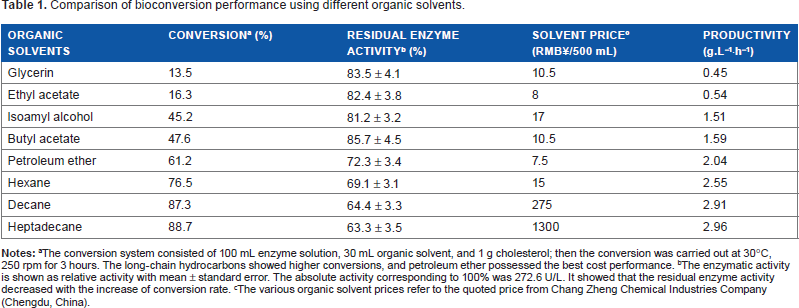
The conversion system consisted of 100 mL enzyme solution, 30 mL organic solvent, and 1 g cholesterol; then the conversion was carried out at 30°C, 250 rpm for 3 hours. The long-chain hydrocarbons showed higher conversions, and petroleum ether possessed the best cost performance.
The enzymatic activity is shown as relative activity with mean ± standard error. The absolute activity corresponding to 100% was 272.6 U/L. It showed that the residual enzyme activity decreased with the increase of conversion rate.
The various organic solvent prices refer to the quoted price from Chang Zheng Chemical Industries Company (Chengdu, China).
It was found that the conversion was more efficient in the biphasic system than in the aqueous or cosolvent system (Fig. 2A and B). After 48 hours of reaction, the conversion rate reached 94.2% in the biphasic system, but only 42.3% conversion was achieved in the aqueous system.
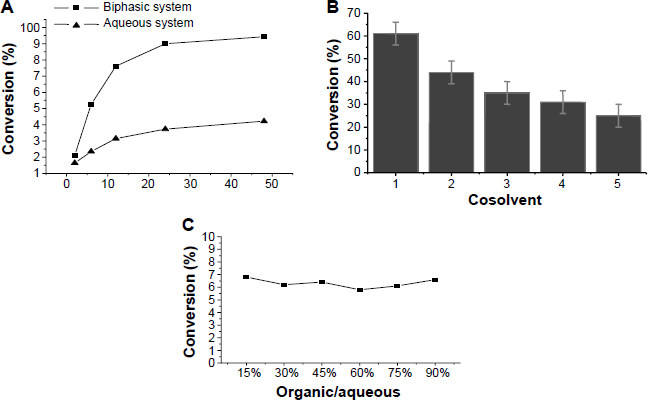
(
The effects of phase ratio on the yield were investigated at six different ratios. As shown in Figure 2C, the difference in conversion rate was not very evident. On the basis of the volatilization of petroleum ether and its cost, the ratio of 3:10 (organic phase: aqueous phase) was chosen for further study.
Influence of the Experimental Conditions
The effect of initial cholesterol concentration on the enzymatic conversion was tested in a 0.5 L rotary shaking flask, which included 30 mL petroleum ether, 100 mL enzyme solution, and initial cholesterol content ranging from 0.5 to 4.0 g. The reaction was performed at 250 rpm and 30°C for 5 hours. As shown in Figure 3, when the concentration was <20 g/L, the conversion rate of cholesterol is >90%. Maximum productivity reached approximately 4 g L–1 h–1 in these conversions, while the cholesterol content increased. The conversion rate declined due to the deactivation of the enzyme and increase in viscosity of the reaction system. Therefore, initial high concentration of cholesterol was unfavorable.
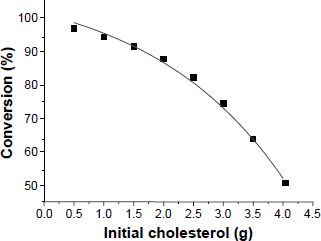
Effect of initial cholesterol concentration on conversion. Reaction system consisted of 100 mL enzyme solution, 30 mL petroleum ether, differing amounts of cholesterol ranging from 0.5 g to 4.0 g. Reaction was carried out at 30°C, 250 rpm for 5 hours. It can be seen that where the initial cholesterol concentration was higher, the conversion rate was lower.
The effect of ventilation is shown in Table 2. Oxygen could improve the conversion obviously. Meanwhile, COD was tending to denaturation due to the more violent reaction. When the reaction was conducted in 5 L fermentation tank using the experimental conditions of cholesterol 40 g, supernatant liquid 2 L, oxygen supply 100 mL/minute, 30°C, 600 rpm, and reaction time 3 hours, the conversion rate reached 95.3% and productivity reached 6.35 g L–1 h–1.
Effect of ventilation on bioconversion and COD activity.
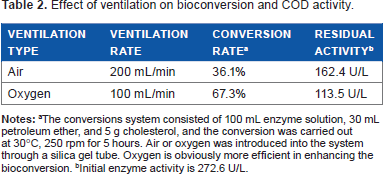
The conversions system consisted of 100 mL enzyme solution, 30 mL petroleum ether, and 5 g cholesterol, and the conversion was carried out at 30°C, 250 rpm for 5 hours. Air or oxygen was introduced into the system through a silica gel tube. Oxygen is obviously more efficient in enhancing the bioconversion.
Initial enzyme activity is 272.6 U/L.
Stability of COD for Reuse
Reutilization of the enzyme is very important, especially when the enzyme is used to manufacture valuable products. Its reutilization capability will matter when it comes to the cost of production. To evaluate the capability of reutilization of COD, the reaction system was extracted with equal amounts of ethyl acetate after completion of bioconversion, and then the aqueous phase containing the enzyme was recovered by centrifugation. Subsequently, cholesterol and petroleum ether were added to the aqueous phase for the next round of bioconversion. In this process, the conversions were performed six times using the same enzyme solution. After each conversion, the enzyme activity and conversion rate were determined. As shown in Figure 4, the enzyme activity decreased to 32.7% of the original activity after using the enzyme six times, and the conversion rate dropped to 31.3% accordingly, Specifically, the enzyme retained 70%, 56%, 49%, 44%, 39%, and 33% activity and the conversion rate reached 98%, 68%, 51%, 43%, 38%, and 31% corresponding to each conversion. It was revealed that the conversion efficiency gradually declined when the enzyme activity decreased. Even so, the conversion rate still remained approximately 50% after three usages. In addition, petroleum ether can be recovered by condensation.
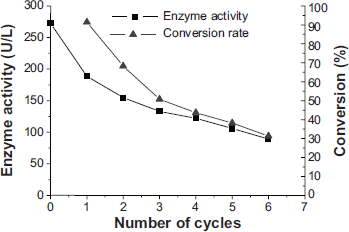
Reutilization of enzyme solution. Reaction conditions: 1.5 g cholesterol, 100 mL enzyme solution, 30 mL petroleum ether, 30°C, 250 rpm, 5 hours. The enzyme solution was separated by centrifugation after each reutilization, and then it was reused for the next round of conversion. The COD solution was used for six runs in total. The result showed that the enzyme activity decreased when it was used repeatedly. But even after three runs and 15 hours of operation, the enzyme activity still remained approximately half.
Purification of the Cholesterol Derivatives
Cholest-4-en-3-one was purified through five steps: extraction, washing, evaporation, column chromatography separation, and recrystallization. During the processes, 4% product was lost in extraction, 2% in column chromatography, and 2% in recrystallization; 92% cholest-4-en-3-one was recovered in the end. Normally, after column chromatography, the purity can reach 98%. The recrystallization process made it >99%. A white crystalline end product was obtained, with purity of 99.78%, after a series of purification processes (Fig. 5).
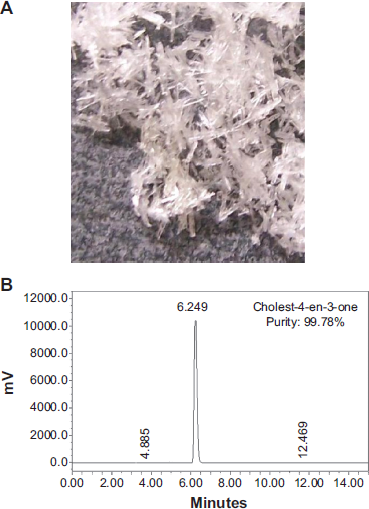
End product and purity analysis (
Identification of the Purified Product
The purified product was subjected to thin-layer chromatography, HPLC, melting point analysis, and UV, IR, 1 H-NMR, 13 C-NMR, and mass spectroscopy analysis. ESI-MS data of the product showed that the molecular mass was 384.4. The UV ŀmax of 241 nm and FT-IR Vmax of 1672.3 cm–1 suggested the presence of a conjugated double bond and a C=O structure, respectively. The IR spectrum is shown in Figure 6; it matches the standard IR spectrum of 4-cholesten-3-one in the Sadtler Standard Infrared Grating Spectra (number 28840K). 19 The 13 C-NMR spectrum data (Table 3) were identical with the data for cholest-4-en-3-one in the spectral database for organic compounds (SDBS number 15235) and in the previous literature. 10 The 1 H-NMR spectra were also identical with those of cholest-4-en-3-one reported by Chiang et al 20 (Fig. 7). The melting point 79.3–80.2°C was consistent with that of authentic 4-cholesten-3-one. All the data indicated that the purified product was 4-cholesten-3-one (C27H44O).
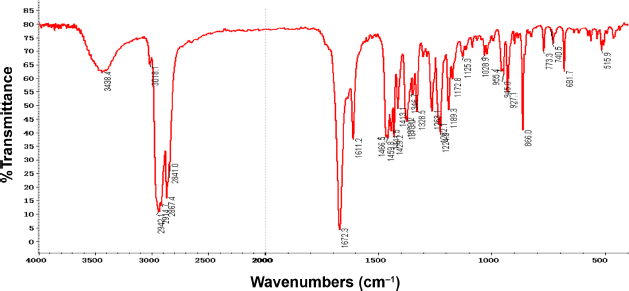
IR spectrum of the synthesized product (KBr disk). It was recorded on an FT-IR spectrometer. The spectrum is identical with the standard IR spectrum of cholest-4-en-3-one in the Sadtler Standard Infrared Grating Spectra database.
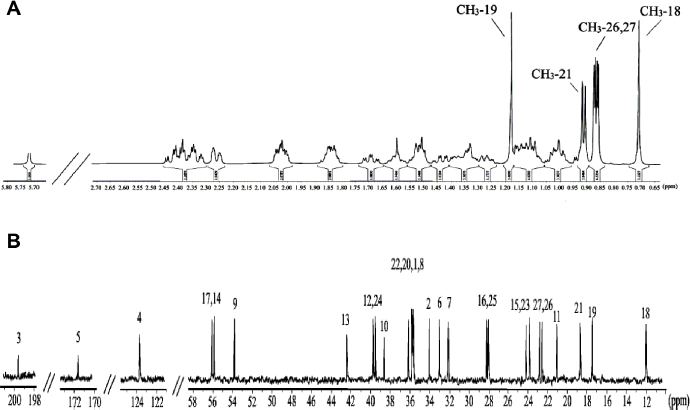
1
H-NMR (
The 13 C chemical signals for the product (δ in ppm downfield from tetramethylsilane, in chloroform deuteride).
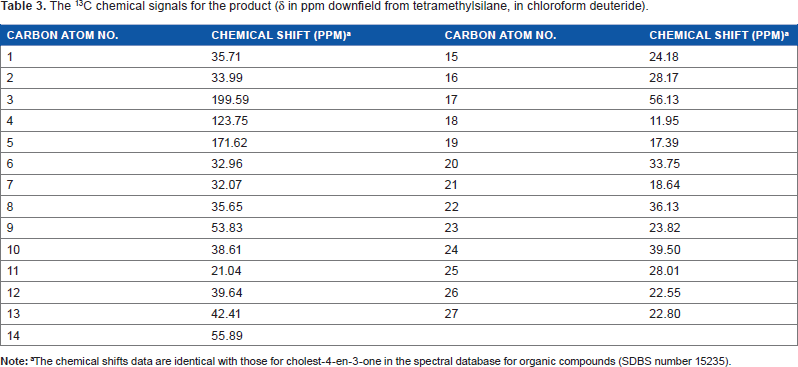
The chemical shifts data are identical with those for cholest-4-en-3-one in the spectral database for organic compounds (SDBS number 15235).
Discussion
Steroid pharmaceuticals are widely used in clinical application. Preparation or production of valuable steroids is a significant theme in the pharmaceutical industry. A favored way is the use of aqueous/organic biphasic system. Unlike previous reports that focused on the theoretical study of steroid bioconversion, which care more about high and effective bioconversion without considering the adaptability to industrial production, this study selected petroleum ether as the organic phase instead of harmful carbon tetrachloride or phthalate, which is usually used as the organic phase.8,21,22 The advantage of aqueous/organic biphasic system is very obvious: the enzyme solution/petroleum ether system gave more than twice the conversion rate than the simple aqueous phase in our study. Moreover, long-chain hydrocarbons showed higher conversions than short-chain organics and oxygen was a positive factor in boosting conversion. These findings are consistent with previous reports. 8 The study also showed that conversion rate declined with increased substrate concentration, the reason being that the higher concentration leads to increased viscosity in the system, which then decreases the rate of mass transfer. 23
The reuse of enzyme is very important to save cost in industrial production. On the one side, the contact of the enzyme molecules with the bulk organic liquid at the phase interface results in inactivation of the enzyme; on the other side, in order to increase the interfacial area and enhance the mass-transfer rate across the interface, the system has to be physically stirred, but stirring can also cause the denaturation and inactivation of enzyme molecules absorbed at the interface, as a result of interfacial tension.23–25 In addition, the conversion of cholesterol to cholest-4-en-3-one generates H2O2, which is a typical strong oxidant and could cause the denaturation of COD protein. The phenomenon shown in both Table 1 and Figure 4 expresses that higher conversion rate is always accompanied by a lower residual enzyme activity. This is partly because the higher conversion rate produces more H2O2 molecules. In our study, the enzyme activity was close to 50% when reused three times. Even after six usages, it still retained 33% activity, which suggests that the enzyme is relatively resistant to the impact of organic solvents, interfacial tension, and H2O2.
Previous studies of bioconversion of cholesterol to cholest-4-en-3-one focused on the mechanism of enzyme catalysis, metabolic pathway, and optimization of enzyme activity. In a recent report, Shao M et al 26 obtained 0.61 g L–1 and 0.75 g L–1 cholest-4-en-3-one, with conversion rates of 67% and 83%, by genetically modified whole-cell bioconversion for 21 hours. The cells were transformed into recombinant plasmids containing the gene encoding Mycobacterium COD, which improved the enzyme activity significantly. However, the enzyme was mainly intracellular and the conversion system was an aqueous phase system, which restricted the highly efficient synthesis of cholest-4-en-3-one. In our study, we directly used the enzyme solution to conduct the conversion in the aqueous/organic biphasic system. The productivity and conversion rate reached 4 g L–1 h–1 and 90%, respectively. It suggested that the enzyme solution/petroleum ether system is more suitable for conversion of the hydrophobic substrate cholesterol.
The advantage of using enzyme solution instead of whole cells is also seen in the purification procedure. Because the conversion system does not contain microorganism cells, it would not generate any unexpected metabolite during the conversion process. In the present study, to compare the effect of different systems, both enzyme solution and whole cells were used as biocatalysts to transform cholesterol to cholest-4-en-3-one. The product analysis showed that the whole-cell system contained 11 unexpected substances, while the enzyme solution system only contained four (Fig. 8). The more the impurities, the more complicated is the purification technique required. Our aim is to seek a simplified but highly efficient production method of cholest-4-en-3-one. In addition, whole cells can further catabolize cholest-4-en-3-one to use it as their nutritional hydrocarbon source, which would hamper the accumulation of the target product, resulting in low yields of cholest-4-en-3-one. 26 Therefore, in some studies, chelating agents have to be added to the transformation medium to inhibit the whole cells from degrading the target product and thus ensure a greater yield. 10
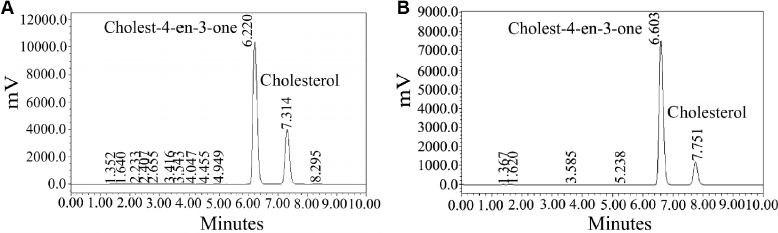
Impurity analysis of crude product. (
This study also standardized an effective purification method. The end product with 99.78% purity proved most successful. This is the first study to report that cholest-4-en-3-one with purity >99% can be obtained by the bioconversion method. Meanwhile, the study also provided a model system for the enzymatic bioconversion and production of sterols and steroids.
Conclusion
The study revealed that an aqueous/organic biphasic system is a more efficient cholesterol biotransformation system than an aqueous or cosolvent system. Petroleum ether is an ideal organic phase considering toxicity, cost, and conversion rate; oxygen can enhance the conversion reaction evidently, but it also caused the activity of COD to decline faster. The enzyme activity remained approximately 50% even after the reuse of the enzyme three times. By optimization of the conversion condition and establishment of an efficient purification method, this study obtained crystalline cholest-4-en-3-one with purity of 99.78%, product yield of 92%, and productivity of 4 g L–1 h–1. All the processes and techniques discussed in this article are very simple and easy to realize in today's industrial environment. It is feasible to produce high-quality cholest-4-en-3-one on an industrial scale. The whole production scheme consists of two major phases: enzymatic bioconversion, and extraction and purification. This study thus outlines a path for the production of steroid drugs, which will benefit pharmaceutical research and product development.
Author Contributions
Conceived and designed the experiments: KW, WL, JS. Analyzed the data: KW, WL, TL. Wrote the first draft of the manuscript: KW. Contributed to the writing of the manuscript: KW. Agree with manuscript results and conclusions: KW, WL, JS, TL. Jointly developed the structure and arguments for the paper: KW, WL, JS, TL. Made critical revisions and approved final version: WL, JS, TL. All authors reviewed and approved of the final manuscript.
Footnotes
Acknowledgments
The authors thank Xiang Huang of the Sichuan Institute of Fine Chemical Industry Research and Design, China, for her support and assistance with this project.