






Abstract
Background
There are major health benefits of physical activity (PA) during pregnancy, yet there is scant data about a woman's knowledge and understanding of these benefits globally.
Design and Methods
We aimed to evaluate the knowledge, attitude, and practice of pregnant women in the United Arab Emirates concerning exercise. We wanted to investigate why some women exercise while others do not exercise during pregnancy. We used a cross-sectional study using a paper-based questionnaire involving pregnant women at antenatal clinics in the Dubai health Authority. The Modified form of Pregnancy Physical Activity Questionnaire (PPAQ) was adapted in both Arabic and English and used in this study.
Results
Women aging 25-35 that had a higher educational level, were employed, having 1 or 2 previous pregnancies, and having better knowledge on the benefits of Physical Activity (PA) during pregnancy had better exercise profiles.
Conclusions
Our results demonstrate that the majority of the women that participated in our study were shown to have low PA during pregnancy. Better education and communication of the benefits of PA during pregnancy are needed to improve exercise among pregnant women in the UAE population. We found that improved education of women specific to PA with involvement of a healthcare provider were associated with an increase in PA during pregnancy.
Introduction
During pregnancy, the benefits of exercise are well documented, and studies have demonstrated a reduced risk of pre-eclampsia, gestational diabetes mellitus, and gestational hypertension. 1 Psychological benefits of physical activity during pregnancy include less fatigue, stress, anxiety, and depression, as well as improved well-being. 2
Most exercises are safe to perform during pregnancy, as long as they are done with limitations 3 that generally have less intense, less frequent, and shorter physical activity than general exercise in the non pregnant population.4,5 Women that obtain the recommended 150 min of moderate physical activity per week during pregnancy are found to experience an improved delivery course and a protective effect against low birth weight and prematurity of delivery of their babies.6,7 Furthermore, exercise may play a crucial role in preventing maternal obesity, excessive gestational weight gain, and infant obesity. 8 The evidence indicating the influence of physical activity during pregnancy on mother-child outcomes is increasingly gaining the attention of researchers and public health managers because, among other reasons, these factors are potentially modifiable. 9
Despite growing public health concerns addressing exercise in pregnancy in the United Arab Emirates (UAE), there is scant data on women's knowledge and beliefs around physical activity (PA) during pregnancy in this part of the world. Literature from other countries indicated low maternal knowledge levels in general pregnant populations, with a significant number of women not being offered information on PA. 10
Understanding the social, cognitive, and behavioral factors that predict and describe PA becomes essential for understanding and intervening in this potentially vulnerable population group. Hence, this study aimed to assess pregnant women's knowledge, attitude, and practice concerning exercise and investigate why some women do not exercise during pregnancy.
Significance for public health
Our findings show a tremendous need for educating women on Physical Activity (PA) during pregnancy in primary health care and maternity clinics. These efforts have to be part of an organizational strategic plan. We recommend more campaigns on the benefits of PA for pregnant women. More efforts are needed to assess the barriers that could be solved and corrected within our health care for pregnant women. Promoting a cost-effective intervention in our antenatal care clinics could decrease maternal-fetal complications that are associated with a sedentary lifestyle.
Methods
Study design
This descriptive cross-sectional study was conducted among pregnant women (aged 18-49) of all nationalities that attended the antenatal clinics in Dubai Health Authority (DHA) from October 2018 until September 2019.
Study participants and procedure
Participants for the study were recruited by a simple random sampling method in which the researchers randomly selected the participants from the general population. Pregnant participants older than 18 years, living in UAE, and willing to provide a written informed consent were selected for the study. The participants were assured of the confidentiality of the information provided and protection of their privacy rights that are mandated by the human research ethics committees’ research ethics guidelines. Pregnant women who were willing to participate in the survey and sign informed consent, having appropriate cognitive skills, reading and understanding in English or Arabic (e.g., the local language) were included. Both UAE citizens (nationals) and expatriates were involved in the study. Participants that were unable to meet any of the above criteria were excluded from the study. The sample size was calculated using epidemiological information for a population of 30,000 (total number of pregnant women in Dubai), with an alpha of 0.05 and power of 80%. We needed a minimum required sample size of 380. 11
Survey design (Evaluation tools)
A structured questionnaire was designed and developed by a multidisciplinary team after a review of the literature from relevant studies that used the Pregnancy Physical Activity Questionnaire (PPAQ) modified according to DHA guidelines.12-14 The evaluation tool was then pre-tested among 20 pregnant women to assess the ease of understanding and time required for completion. Our Bilingual questionnaire in Arabic and English is represented in APPX I & II. The survey instrument consisted of 51 items. The first part of the questionnaire collected socio-demographic data, including age, nationality, marital status, educational level, occupation, family's monthly income, number of pregnancies or miscarriages, and medical conditions (if present). The remaining sections of the questionnaire focused on knowledge, attitude, and exercise practice during the current pregnancy.
The PPAQ is a validated semi-quantitative questionnaire that asks respondents to report the time spent participating in 32 activities, including household/caregiving (13 activities), occupational (5 activities), sports/exercise (8 activities), transportation (3 activities), and inactivity (3 activities).
For each activity, respondents are asked to select the category that best approximates the amount of time spent in that activity per day or week during the current trimester.
Possible durations range from 0 to 6 or more hours per day and 0 to 3 or more hours per week. To determine the category cut points, we examined the frequency distribution of time spent in each questionnaire activity reported on the 24-hour recalls. Categories were selected such that single categories did not encompass substantial variation in participation to increase the discriminatory capacity of questionnaire items further. Classification into groups according to exercise intensity and its correspondence to metabolic equivalents (METs) was performed. The average energy expended was also calculated according to each domain of activity and each intensity level (sedentary [<1.5 METs], light [1.5-3.0 METs], moderate [3.0-6.0 METs] or vigorous [>6.0 METs], where 1 MET is the metabolic equivalent of the energy expended at rest. 14
Data analysis and statistics
All collected data were entered into STATA version 15 (StataCorp, 2017. Stata Statistical Software: Release 15, StataCorp LLC., College Station, TX, USA) for statistical analysis. Descriptive statistics were computed for the socio-demographic variables. The overall responses to each item of the survey were recorded as a percentage of the total. The percentage differences in the total responses were determined using the Chi-square test and ANOVA, and statistical significance was recorded for data. When normality assumption was not met, Mann Whitney test was used. For variables with three or more than three groups, Kruskal Wallis (or one-way ANOVA) was used. For all analyses, alpha (α) was set at 0.05.
Ethics statement
The study was approved by the institutional review boards of Dubai Health Authority Dubai (Approval # DSREC-SR-11/2018-01). All participants gave written informed consent before participation. Aggregate reporting of data assured to enhance confidentiality and accurate reporting by the respondents. The completed survey's return also guaranteed the anonymity of participation constructs to an administrator, independent and blinded to the study hypothesis. A code linking respondents to their surveys was kept isolated from the investigators.
Results
Out of 823 individuals approached, 651 accepted to participate in the study (response rate of 79%). The majority of our participants were within the 25-35 age group (428, 66%); UAE nationals (458, 70%); had university or higher degrees (430, 70%); and were housewives (317, 49%). Most of the pregnant women who participated in this study were in their 7-9 months of pregnancy (481, 74%), had a singleton pregnancy (610, 94%), had 1-2 previous pregnancies (414, 64%); had normal Body Mass Index (BMI) (245, 38%); had no medical conditions (488, 75%); were within the middle class of financial status (363, 56%); were not exercising before their pregnancy (403, 62%); but have heard of antenatal exercise (553, 85%). Cronbach's alpha coefficient for the scale's reliability or internal consistency was calculated as 0.775 from 36 items. The descriptive values of the total score and subdimension scores of all subjects are shown in Table 1. The comparison results of the categories of the demographic characteristics were also analyzed. The total activity during pregnancy was higher in women aged 25-35 years (p<0.01), those with higher education (p<0.001), employed (p<0.001), and those who heard on antenatal exercise (p<0.006). Also, the total activity was higher in women who believed exercise has benefits in preventing excessive weight gain (p<0.03), strengthening pelvic floor muscles (p<0.02), increases energy during pregnancy (p<0.04), decreases back pain (p<0.002), and those who had good knowledge of contradictions of exercise during pregnancy (p<0.02).
Light intensity activity was higher in pregnant women aging 25-35 years (p<0.02), those with higher education (p<0.001), employed (p<0.001), those who heard on antenatal exercise (p<0.001), pregnant women who believed exercise would reduce the risk of back pain during pregnancy (p<0.001) and had good knowledge on contradictions of exercise in pregnancy (p< 0.01). Furthermore, household activity was also higher in women aging 25-35 years (p< 0.02), non-UAE nationals (p<0.001), housewives (p<0.03), those who were on their first or second pregnancies (p<0.001), women with lower financial status (p<0.02), and those who were exercising before pregnancy (p<0.001). When evaluating the sedentary activity, we have found that women with university or higher education (p<0.002), those who are employed (p< 0.04), had better financial status (p<0.006), and those who believe exercise prevents excessive weight gain (p<0.04) had a better sedentary type of activities.
Mean, median, 25th and 75th percentile values (MET-h/week) for total activity and subscales of activity in PPAQ of the all subjects (n=651).

SD, standard deviation.
The occupational activity was higher in pregnant women aging 25-35 (p<0.01), with university or higher education (p<0.001), employed (p<0.001), and those who heard of antenatal exercise (p<0.003). Pregnant women who believed that exercise: reduces the risk of back pain (p<0.001), strengthens pelvic floor muscles (p<0.007), provides them with better ability to cope with labor and delivery (p<0.02), and bounces more rapid post-natal recovery (p<0.005) had higher occupational activities. Sports activity was higher in women during their 7-9 months of pregnancy (p<0.001), those who had a regular habit of exercising (p<0.001), women who believed exercise strengthens pelvic floor muscles (p<0.02) and reduces the risk of back pain during pregnancy (p<0.02). Transportation activity was significantly higher in UAE nationals (p<0.001), women with university or higher education (p<0.02), employed women (p<0.001), women with higher income (p<0.001), those who heard of antenatal exercise (p<0.003), and those with knowledge on benefits of antenatal exercise (p<0.005). Tables 2 to 5 show the light, moderate, and vigorous activity categories with the demographic characteristics.
Descriptive values of total activity of light intensity and above score in different categories. Only significant results are presented.
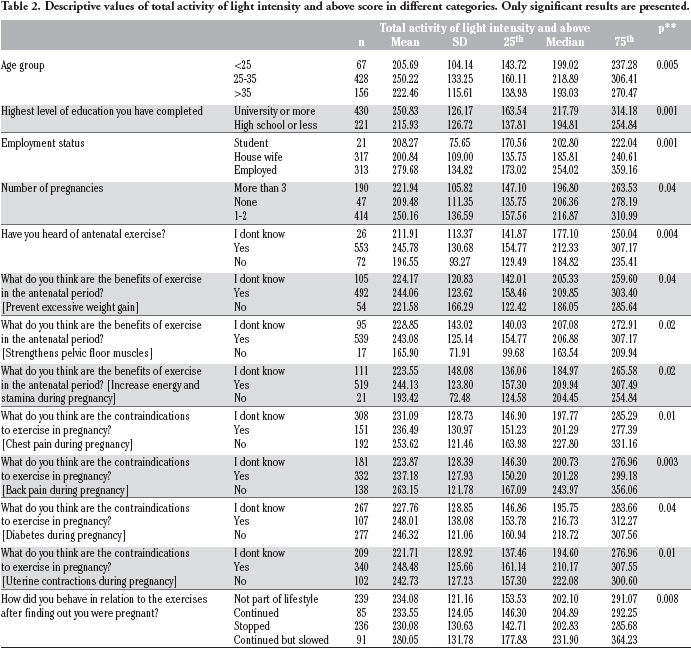
p-values in last column smaller than 0.05.
Descriptive values of moderate intensity activity score in different categories. Only significant results are presented.

p-values in last column smaller than 0.05.
Descriptive values of vigorous intensity activity score in different categories. Only significant results are presented.

Descriptive values of inactivity score in different categories. Only significant results are presented.

p-values in last column smaller than 0.05.
Discussion
Pregnancy is a biologically relevant period during which adverse outcomes, such as excessive gestational weight gain, gestational hypertension, and gestational diabetes can manifest. 15 Though regular physical activity during pregnancy can protect against these outcomes, 14 most pregnant women do not achieve recommended levels. 13 Preliminary data suggest that pregnant women also engage in high sedentary behavior levels 16 independent of engagement in moderate-to-vigorous intensity PA. Thus, sedentary behavior reduction may be a distinct and potentially feasible behavioral target to improve pregnancy health.
As a result of recent recommendations,17,18 the assessment of PA during pregnancy has become a widely discussed topic. To the best of the authors’ knowledge, the presented study is the first attempt to adapt a tool for PA assessment during pregnancy in the UAE population. The PPAQ was translated from English into Arabic, and its reliability was tested. Our study showed that most of our participant pregnant women had sedentary activity (572/651, 87.9%). Moreover, our assessment shows that age, education level, occupation status, and parity play an essential role in knowledge and prenatal exercise and its practice. Women in the age group of 25-35, having a university degree or more, employed, having 1 or 2 previous pregnancies are more active than their peers. The preferred type of activity among pregnant women was sitting at work or in class followed by Watching TV or a video, thus classified as sedentary to light.
Interestingly, the month of pregnancy was not related to the type of PA and energy expenditure. Nevertheless, the number of previous pregnancies was significantly associated with PA type, with women who had only 1 or 2 previous pregnancies having more activities. A study conducted in Saudi Arabia has shown that participants’ mean knowledge score was strongly associated with education and occupation. 19 Their results showed that the most prevalent physical activity was walking in contrast to our observations of sitting at work or in class followed by watching TV. Although 92% (601/651) of participants declared the importance of exercise during pregnancy, we identified that the practice of PA remains low.
However, we noted that the majority of our participants were not practicing any physical activities before pregnancy with 62% (403/651) responding negatively to PA. Traditionally, the widespread opinion was that pregnant women should avoid every type of PA. In the newly developing Middle East society, the overall PA of women is low and pregnancy is not an exception. In general women believe that PA reduces placental circulation and, therefore, increases the risk for preterm delivery, growth retardation, and miscarriages. 20 This is alarming as The American College of Obstetricians and Gynecologists (ACOG) has recommended PA during pregnancy since 1994, 21 with continued evidence of the benefits of PA during pregnancy to the present. 13
Our findings show a tremendous need for educating women on PA during pregnancy in our primary health care and maternity clinics. These efforts have to be part of an organizational strategic plan in the Emirate of Dubai. We recommend more campaigns on the benefits of PA for pregnant women. More efforts are needed to assess the barriers that could be solved and corrected within our health care for pregnant women. Promoting a cost-effective intervention in our antenatal care clinics could decrease maternal-fetal complications that are associated with a sedentary lifestyle.
Limitation of study
This study's results are limited due to the cross-sectional study design; hence, any association found from the results cannot infer a causal relationship. However, future research should be focused on a larger sample and qualitative studies such as focus group interviews to identify barriers to promote PA among pregnant women in the UAE. Further, perceptions of health care providers towards PA and energy expenditure may provide a greater understanding of maternal and child health care practices’ social and cultural beliefs. However, despite these limitations, the present study findings may help health policymakers, health educators, clinicians, and nursing professionals design interventions to promote PA practices.
Conclusions
All pregnant women should be informed about the positive effects of staying active and encouraged to engage in or continue moderately intensive activities like walking, biking, or swimming. Our findings concerning the predictors of PA reduction can be used to develop an evidence-based intervention aimed at encouraging healthy PA during pregnancy.
Footnotes
Acknowledgements
Special thanks to all women who approved sharing their time, standpoints, and experiences.