




Abstract
BACKGROUND:
Reactive performance is an important component of rhythmic gymnastics. So far, it is unclear whether additional plyometric training in female gymnasts shows an increase in performance.
OBJECTIVE:
The aim of the study was to examine the effect of additional plyometric training in rhythmic gymnastics on the reactive jumping performance and strength of the lower leg muscles.
METHODS:
Fifteen rhythmic gymnasts (age: 12.3
RESULTS:
In contrast to the CG, in the EG the jump height (pre: 24.8; post: 27.25 cm;
CONCLUSION:
Both reactive strength and dynamic force can be efficiently increased by plyometric training. It may be recommended to include plyometric exercises in the training regime of rhythmic gymnasts.

Introduction
Rhythmic gymnastics (RG) consists of an artistic manifestation of exercises with musical accompaniment. High demands on coordination, agility, bounce, balance, and control of sports equipment are required [1]. The elements are categorized into jumps, leaps, balance, rotations and working with the handset [2]. For many of these elements, the bounce is performance-determining [3]. In addition to stands and turns, jumps represent the basic requirement of the elements in an exercise [3]. The most frequently chosen techniques during the flight phase in the jump are splits, ring, and “deer” [4]. The jump combinations can consist of jump series and require rapid reactive jumps. Thus, plyometric jump loads in training are of great importance [5]. These jump variants are among the most difficult movements within the basic techniques and require a high degree of coordination, flexibility and strength [6]. The number of different jumps with acyclic technique, are in principle unlimited in the choreography. They involve a long phase of jumping flight, which is realized exclusively by a powerful impression of the legs by utilizing the reactive force [7]. Due to these requirements in the performance structure of the RG, it is necessary to integrate exercises in training that improve the plyometric performance. Various studies investigated the effect of plyometric exercises on athletic performance using different exercise programs. Bogdanis et al. [8] showed a significant increase in sprint performance and agility during 6 weeks of additional plyometric training in gymnastics. Furthermore, Hall et al. [9] found that a 6 week additional plyometric training of specific muscles used within the handspring vault significantly improved hand jump performance in gymnasts. Marina and Jemni [10] investigated a block-wise combined plyometric training with resistance training over 2 training periods on female gymnasts. They observed significant improvements of flight time and mechanical power during a drop jump. Similarly, Nitzsche et al. [11] found increased jumping height, reactive-strength-index, and increased muscle work during isokinetic plantarflexions in rock’n’roll dancers after 6 weeks of plyometric training.
Plyometric training can include e.g. stretch- shortening cycles in an isokinetic dynamometer [12, 13] or plyometric jumps. Plyometric jumps are a quick combination of eccentric and concentric muscle actions. This is called the stretch-shortening cycle (SSC). In SSC, the power and work during the shortening phase are greater than without previous eccentric contraction [14, 15]. Plyometric training increases maximum strength [16] and reactive power [17], thus contributing to increased jumping performance [11]. As mechanisms for this performance enhancement, “force enhancement” [18], activation dynamics, contribution of stretch reflexes and storage and release of elastic energy [19, 20] are discussed. During the eccentric phase, the monosynaptic stretching reflex leads to muscular activation [21]. The size of the muscular activation in the eccentric phase and the speed of movement at the reversal point are decisive for the performance of the SSC [22]. Various studies have shown the effect of plyometric training (also called reactive strength training) on jumping height and strength [23, 17]. Other but inconsistent findings are available on the influence of plyometric training on the H-reflex [24]. Overall, it can be assumed that plyometric training effects adaptations of the muscle as well as neuromuscular adaptations [25, 26, 27, 28] and thus sport performance in RG.
Thus, the aim of the study was to examine the effect of additional plyometric training in rhythmic gymnastics on the reactive jumping performance and performance of the lower leg muscles. It is hypothesised that integrating a plyometric program to the training of gymnasts leads to improvements of leg power and strength. We expect, that the plyometric training increases reactive jumping performance as well as maximal strength and power during isokinetic tests of the lower leg muscles.
Descriptions of the anthropometric data (mean
standard deviation) of the experimental (EG) and control group (CG)
Descriptions of the anthropometric data (mean
BMI: body mass index.
Participants
Eighteen female rhythmic gymnasts (age: 12.3
Experimental design
Both training groups trained three times a week. There was a day pause between every training day. At the weekend there was always a competition. The experimental group performed a plyometric training over six weeks in addition to the normal training regime in rhythmic gymnastics. Each training session started with a general warming up. This involved short runs, static and dynamic stretching of the trunk and leg muscles. Then, jumps with low intensity (no maximum jump height) were performed.
The additional training program of the experimental group included various plyometric jumping exercises. These were increased progressively in their level of difficulty and repetitions of jumps (Table 2). The plyometric training program included squat jumps, lateral jumps, tuck jumps, and hurdle jumps (Fig. 1). In the first training week, the athletes completed 42 additional jumps per training session. By the sixth week of training, the number increased to 81 additional jumps per training session [29].
The additional training program performed by the experimental group
The additional training program performed by the experimental group
Illustration of the four plyometric jump exercises. A: counter movement jump. B: tuck jump. C: lateral jump. D: drop jump. Starting form an athletic position, the participants initiate the tuck jump with a slight crouch downward while extending their arms behind them. Then they swing their arms forward as they simultaneously jump straight up and pull their knees up as high as possible. At the highest point of the jump, the athletes are in the air with thighs parallel to the ground [51]. During lateral jumps participants performed double leg jumps over a pole (height 30 cm) with both hands on their hips. For the description of counter movement jump (CMJ) and drop jump (DJ), please see the text.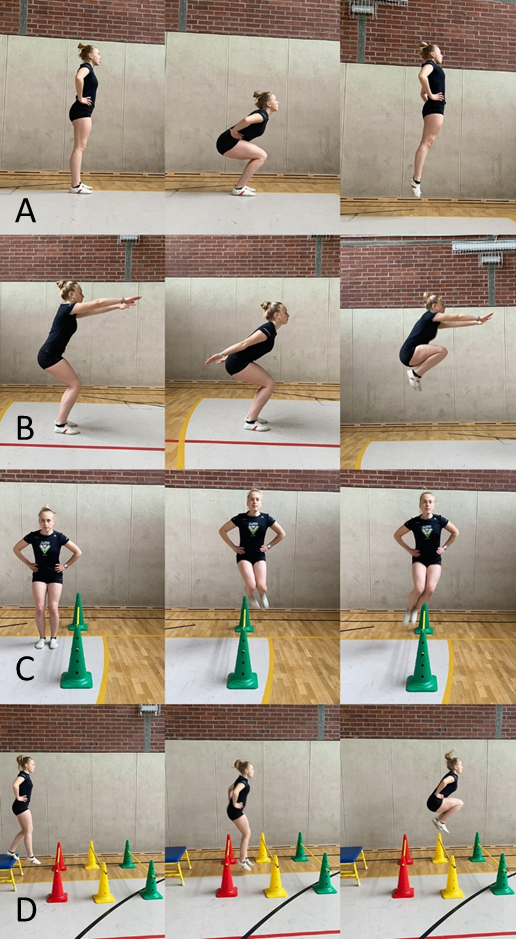
All participants were tested before and after the end of the training intervention. After a standardized warm-up three different jump tests were performed. First, the double rope jump test (DRJ) was performed as a sport specific performance test. It was conducted in order to assess the effect of training on the maximal number of double rope jumps which can be performed within one minute (suppl. material DRJ_video.mp4). This sport specific motor test is a main criterion for D/E-squad norm for gymnastics in Germany. A double punch consists of a vertical jump upwards with two turns of the rope. The subjects should do as many jumps as possible with double punches without a break. The second jump test measured the bilateral counter-movement jump (CMJ) height. The starting position is an upright position. After a quick pull-out movement by a slight squat (knee angle up to 45
where
where
The strength of dorsiflexors and plantarflexors muscles of the ankle joint was measured using an isokinetic diagnostic system (Physiomed CON-TREX MJ System, Schnaittach, Germany). Participants lyed supine. The foot was attached to a pedal. The hip and knee angle were completely straight and fixed with straps. Ankle motion during plantarflexion started at 20
The calculation of the sample size (G*Power 3.1.9.7) resulted in 20 subjects. This was based on an effect size of 0.6 on the jump height, which was slightly lower than in a similar plyometric strength training study (Nitzsche et al. 2015). The assumed power is 0.8 with an error probability of 5%. All results are presented as mean
Results
Fifteen out of the 18 originally recruited athletes were ultimately included in the analysis. One athlete from the experimental group and two athletes from the control group were excluded from the study due to injuries, which were not related to the training. A total of 1080 plyometric jumps were performed in the EG in addition to the regular training.
Jumping tests
The analysis of the drop jump data revealed significant improvements in jump height (
The control group revealed no significant changes in these drop jump parameters (RSI:
| DJ | CMJ | DRJ | ||||||||
|---|---|---|---|---|---|---|---|---|---|---|
| Jump height (cm) | Contact time CT (ms) | RSI | Jump height (cm) | Counts (n/minute) | ||||||
| Pre | Post | Pre | Post | Pre | Post | Pre | Post | Pre | Post | |
| EG ( |
||||||||||
| Mean |
25.3 |
27.7 |
263.2 |
237.3 |
1.01 |
1.20 |
27.5 |
31.80 |
23.7 |
29.1 |
| CI 95% Median (IQR) | 22.68–27.75 24.80 (5.80) | 23.65–31.83 27.25 (8.58) |
220.40–305.99 257.3 (80.4) | 220.50–254.05 241.7 (41.2) | 0.81–1.25 1.01 (0.47) | 1.00–1.38 1.19 (0.40) |
24.73–30.26 27.0 (5.25) | 27.43–36.17 31.50 (8.25) |
14.53–32.68 18.00 (25.0) | 20.55–37.64 23.00 (22.7) |
| CG ( |
||||||||||
| Mean |
27.9 |
26.4 |
261.1 |
236.4 |
1.10 |
1.14 |
30.00 |
29.8 |
14.6 |
13.40 |
| CI 95% Median (IQR) | 22.61–33.30 27.50 (6.85) | 20.76–32.16 24.80 (7.45) | 211.09–311.15 254.4 (69.4) | 198.66–274.06 222.2 (51.8) | 0.73–1.48 1.04 (0.43) | 0.81–1.48 1.11 (0.42) | 24.65–35.34 30.00 (8.0) | 24.88–34.71 29.00 (7.0) |
|
|
Results of the ankle isokinetic strength test
The experimental group showed a significant increase in plantarflexion work in the right leg (
The control group showed no significant changes in plantarflexion work (left leg:
The isokinetic ankle test revealed no significant group*time effect for the work of dorsi-flexors (left leg:
Discussion
The aim of the study was to determine whether changes in jumping performance and ankle strength could be observed in female gymnasts as a result of this plyometric training program. We observed changes of voluntary performance parameters during a six week plyometric training intervention. In general the jump performance, work and mean power during maximal isokinetic plantarflexion increased significantly in the experimental group but not in the control group. The small effect sizes between the training groups are comparable to Agostini et al. [38]. Agostini et al. [38] showed only small differences in jump height between the groups in the first 12 weeks of training. However, they reported very high effects between the training groups after 6 months of training.
Brown et al. [39] investigated the effects of a 6 week lasting plyometric training in dancers and found increased jump height and force of the lower body. According to Brown et al. [39], it was concluded that a specific plyometric training installed in a regularly RG training improves the voluntary strength and power. Based on improved sport-specific jump performance higher technical skills can be trained in RG.
In the present study the jump height of the drop jump increased while the ground contact time remained unchanged. This finding is in agreement with data reported in literature [28]. The results might be based on changes of the muscle-tendon complex (e.g. muscle fiber type, tendon, muscle architecture) or changes of the muscle coordination. The calf muscles contain different muscle fiber types [40, 41]. With a physiological view, after a 6 week sprint training the portion of type IIa fibers did increase while the portion of type I fibers decreased [42]. However, Kyröläinen et al. [28] did not find any changes in muscle fiber types after 15 week of plyometric training. Type II fibers have higher propagation velocities, more Ca
Adaptations of the Achilles tendon properties were discussed in literature in response to plyometric training. Komi suggested that during the stretch shortening cycle (SSC) the tendon has spring-like properties. i.e. elastic energy will be stored during the stretch phase and will be subsequently recoiled [43]. Thus, mechanical properties like muscle stiffness and energy dissipation might change. However, the results reported in the literature are ambiguous. After 12 week plyometric training Kubo et al. [26] observed no increase in tendon stiffness, while Fouré et al. [44] demonstrated a significant increase after 14 weeks of plyometric training. Furthermore, Fouré et al. [44] observed a decreased dissipation of the Achilles tendon. It seems that adaptations of the Achilles tendon properties need longer than 12 weeks of plyometric training. The present study lasted only 6 weeks. Thus, other adaptation mechanism occurred. It was also suggested that muscle activation might change due to plyometric training [34]. Kyröläinen et al. [28] reported increased muscle activity of the M. soleus and M. gastrocnemius within 10 weeks of plyometric training. This increase was highly correlated to MVC force increase of the plantar flexors. In the present study the work and power of the plantar flexors during maximal isokinetic plantarflexions increased, too.
Furthermore, it has been speculated that force and thus performance during the SSC is in part associated with mechanism of force enhancement [14, 15]. Force enhancement has been described firstly by Abbott et al. [18] and means that the muscle force after a stretch is higher than the isometric force at the same muscle length. Underlying mechanism of force-enhancement are not completely understood so far [45]. However, interaction of the giant muscle protein titin [46] with actin during muscle activation is suggested to contribute to enhanced forces during muscle stretch [47, 48]. Titin-actin interaction and thus eccentric muscle performance might be adjustable by eccentric training [49, 47, 13]. Similar as in the present study, vertical jump height was increased in a group of basketball players performing a 6 week high-force eccentric cycle ergometry training [49]. Increased performance was attributed to the higher leg stiffness and an increased storage and release of elastic energy [50]. It was speculated that titin may significantly contribute to the force production during muscle stretch and that titin may function as an adaptable muscle spring [50, 49]. Hence, training induced adaptations in the specific titin isoform might contribute to the observed increases of jumping performance of rhythmic gymnasts after six weeks of plyometric training. Compared to other plyometric training protocols used on female gymnasts, this protocol with only four different exercises showed an increase in performance [8, 9]. This is important in practice, as such training content must be integrated economically into the existing training. Therefore, it remains to be examined in the future how extensively this content should be placed in the training.
As low and unequal sample size may limit this study, conservative statistical tests were used to circumvent a possible
Because of his low sample size, the influence of the girls’ age on performance changes cannot be examined. The effectiveness of plyometric training in addition to conventional training can only be related to the test methods and the training program (training exercise and intensity, number of repetitions) used here.
Conclusion
Improvement in jump height is a specific athletic requirement which needs to be incorporated and learned in RG. Both reactive strength and maximal dynamic force output are important factors influencing jump height. Plyometric training improves jump performance and isokinetic strength of youth RG athletes. We propose that this training program should be integrated in the traditional training regime in order to improve the competition performance of youth RG athletes.
Author contributions
CONCEPTION: Nico Nitzsche and Norman Stutzig.
PERFORMANCE OF WORK: Nico Nitzsche.
INTERPRETATION OR ANALYSIS OF DATA: Nico Nitzsche, Norman Stutzig and Tobias Siebert.
PREPARATION OF THE MANUSCRIPT: Nico Nitzsche, Norman Stutzig and Tobias Siebert.
REVISION FOR IMPORTANT INTELLECTUAL CONTENT: Henry Schulz and Tobias Siebert.
SUPERVISION: Henry Schulz and Tobias Siebert.
Ethical considerations
All athletes were informed together with their parents about the goals and risks of the study and agreed to participate. The study (V-267-17-HS-RSG-2404202018) was approved by the ethics committee of the University of Chemnitz and was conducted according to the Declaration of Helsinki (latest version).
Funding
The authors report no funding.
Footnotes
Acknowledgments
The authors would like to thank Anastasya Lobanova and Steffen Gro
Conflict of interest
The authors have no conflicts of interest to report.