




Abstract
BACKGROUND:
The use of post-activation potentiation (PAP) exercises at the end of the warm-up may increase muscles nerve conduction speed and per consequent improve speed, strength and explosive power performances.
OBJECTIVE:
To assess the effect of PAP during warm-up using vertical or horizontal drop jumps on repeated sprints performance combined with countermovement jump in young handball players.
METHODS:
12 young handball players participated in this study. Participants realized 3 randomized warm-up protocols: a warm-up without PAP, a warm-up with PAP using vertical drop jumps, and a warm-up with PAP using horizontal drop jumps. After the assigned PAP protocol, the subject realized a counter movement jump as a reference value (CMJ
RESULTS:
Horizontal drop jump during warm-up showed larger improvements in repeated sprints performance with and without change of direction for the parameters best time and mean time, compared with warm up without drop jumps (
CONCLUSION:
PAP during warm-up using horizontal drop jump improves repeated sprints performance with and without changing of direction while PAP using vertical drop jump improves CMJ reference value.
Introduction
Handball is a team sport that requires specific abilities, such as technical, tactical and physical ones [1, 2]. Physical achievement in this intermittent sport is based on the ability to repeat sprints, jumps, throws, blocks and hits [3, 4]. The importance of warm-up in improving physical performances and in preventing musculoskeletal injuries in sport is well established [5]. Several studies showed that the use of post activation potentiation (PAP) exercises at the end of the warm-up may increase muscles nerve conduction speed and per consequent improve speed, strength and explosive power performances [6, 7, 8, 9, 10]. However, positive PAP effects depend on many factors, such as the exercise type, intensity, and time recovery [11].
In this context, some studies pointed out the major role of using plyometric exercises during the PAP to enhance muscle performance [12, 13, 14]. Drop Jumps induce the activation of the stretch/shortening cycle, enhancing muscles ability to produce high power and/or speed [15, 16].
In a recent study, Iacono et al. [13] showed that Horizontal drop jump (HDJ) induced greater improvement of sprint performance with change of direction (COD) than vertical drop jump (VDJ), whereas, VDJ caused larger increase in the CMJ score. Benefits of PAP on neuromuscular adaptations are well known. However, evidence on the effects of exclusively PAP using horizontal or vertical drop jumps on specific tasks in handball is lacking. In Iacono et al. [13] design, the authors assessed CMJ and sprints in different days.
From a practical point of view, the shoot in handball is related to two combined skills, the sprint followed by a jump to shoot. Indeed, it appears more accurate to assess the effect of PAP using vertical or horizontal jumps on the entire action in handball, which consists of the combination of a sprint followed by a jump. In addition, plyometric exercises, such as horizontal or vertical jumps and also sprints with change of direction are various muscle actions relating to muscle activation and the length of the stretch-shortening cycle (SSC). These actions are often used in handball to train either the latter movements (
Therefore, the aim was to assess the effect of PAP during a warm-up protocol using vertical or horizontal drop jumps on repeated sprints (with or without change of direction) combined with vertical jump performances in young hand ball players.
Methods
Participants
Twelve young handball players with training experience of 3.9
Where LL is the leg length (cm) obtained by the difference between height (STA) in centimeters and cephalic trunk height (CT), SH is the sitting height (cm), decimal age measured in years and BW is body weight (kg).
Stages of puberty have been checked by the development of pubic hair, according to Tanner method cited by Beunen et al. [19]. Players who were not classified as Tanner stage 3–5 for pubic hair growth and genital development were excluded. Subjects were examined by the same investigator. Both players and their parents were informed by the procedure and the risks involved and gave their written consent. The study was approved by the Institutional Ethics Committee (Approval number: EDU/PHEDS42031/18; January 08, 2018) and performed in accordance with the ethical standards of the Declaration of Helsinki.
Schematic diagram of experiment. PAP; Postactivation potentiation; VDJ: Vertical drop jumps; HDJ: Horizontal drop jumps; CMJ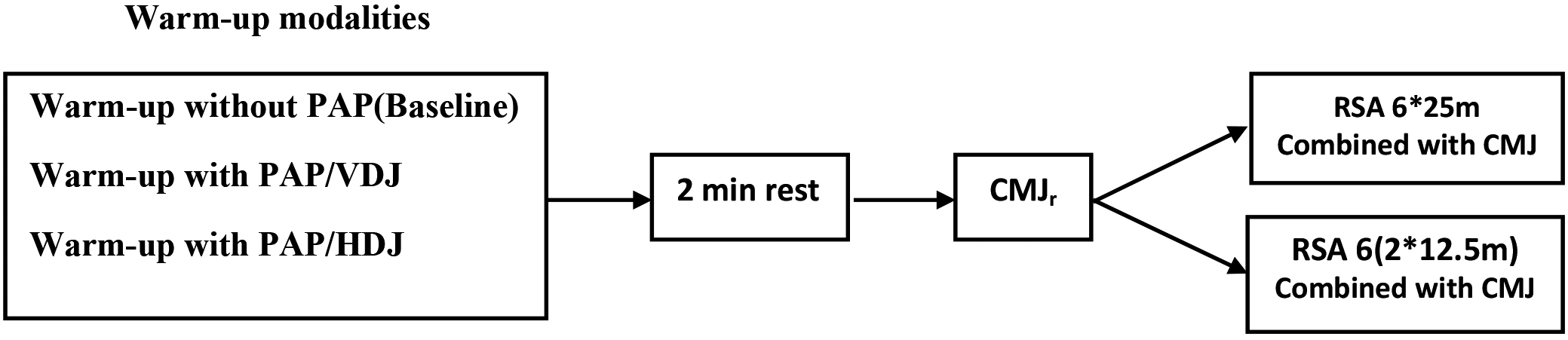
Participants were familiarized with both study protocol and testing procedures a week before conducting the study. Anthropometric measurements of body height and body mass were realized. All tests were performed in the same regular indoor court and all participants were instructed to wear suitable sport wear to limit possible variability within the testing procedure. All trials were completed by each participant at the same time of day (04:00 pm–06:00 pm) in similar ambient conditions of temperature (20–23
Participants visited the court 10 times. The first four visits were reserved for anthropometric measurements, familiarization and testing the reliability of sprint exercises. During the remaining visits, three of warm-up modalities were tested: i) Standardized warm-up without PAP (Baseline Situation); ii) Warm-up with PAP using vertical drop jumps; iii) Warm-up with PAP using horizontal drop jumps. The passage of all subjects for the three modalities of warm-up was randomized.
The standardized warm-up was composed of 4 min of jogging, 4 min of dynamic stretching exercises, 2 sprints of 20 m, and two jumping drills. The total duration of the warm-up was 10 min [13].
Post activation potentiation protocols
The PAP protocol was based on the realization of 5 repetitions of vertical and horizontal drop jumps (DJ) from a 30 cm height having feet together [13]. A 10 s rest between each repetition was allowed. During the DJ, players were instructed to place their hands on their hips and step off the platforms with the support of their legs to avoid any hands support or movements.
Participants were required to jump for maximal vertical height distance for the vertical jump drop (VDJ) and maximal horizontal distance in horizontal drop jump (HDJ) and minimize their contact time with the ground in all drop jumps to maximize their reactive strength. All PAP exercises were supervised by a researcher and were carried out by verbal encouragement.
Anthropometric characteristics of the subjects
Anthropometric characteristics of the subjects
BMI: Body mass index; PHV: Peak height velocity.
Variation coefficients and intra class correlation coefficients with confidence limits of repeated sprint tests with and without change of direction combined with vertical jumping
RSA: repeated sprint ability; COD; change of direction; ICC: intra class correlation coefficient; CI 95%: confidence interval at 95%; CV: variation coefficient expressed as a percentage. Data are expressed as means
The RST tests with or without COD consisted of six maximal 2
Before the RST, the subject had to perform a CMJ which constitutes the reference measure of jumping ability (CMJr) after each warm-up modality tested. During the CMJ test, participants were asked to keep their hands on their hips. All players were verbally encouraged throughout the test to jump as high as possible.
Three minutes after the end of each repeated sprints and jumps sequence, a fingertip blood sample (5
The best sprint time and jump height, the mean sprint time and jump height, the deceleration percentage of sprint time (fatigue index) and jump height were calculated according to the formulas proposed by Buchheit et al. [20]. Sprinting times were recorded with photoelectric cells (Brower timing system, Colorado, USA). Jumps heights were measured using the Optojump device (Microgate Next, Bolzano, Italy).
Data analysis
All data are presented as mean
Results
The anthropometric characteristics of the subjects are summarized in Table 1. Relative and absolute reliability parameters of RST combined with CMJ are presented in Table 2.
Performances of repeated sprints ability with and without change of direction after the three modes of warm up
Performances of repeated sprints ability with and without change of direction after the three modes of warm up
F: ANOVA values; NS: not significant; *:
Performances of repeated vertical jumping, references vertical jumping and blood lactate concentration after the three modalities of warm up
CMJr: references CMJ; [La]
The results showed no significant differences between best time, mean time, best jump, and mean jump values in first and second trial. All coefficients of variation were under 5% for best and mean times and under 10% for best and mean vertical jump. Intra class correlation values were high for all parameters (Table 2). In addition, a CI at 95% showed that the proportion is between 0.69 and 0.97 (Table 2).
Performances during RST with and without change of direction are presented in Table 3. ANOVA values indicated a differences in the effects of the three warm-up modalities tested on performance in repeated sprints with and without change of direction for best time (
Performances in jumps and blood lactate concentrations during recovery are presented in Table 4. ANOVA values indicated no effect of PAP protocols on vertical jumping during the RST with and without change of direction. However, the ANOVA values comparing the performance of CMJr (CMJ of reference measured just after the warm up) after the three modalities of warm-up were significant (
The aim of the current study was to investigate the effect of PAP during warm up using vertical or horizontal drop jump on repeated sprints performance with and without change of direction combined with vertical jumping in young handball players.
Regarding the reliability of RST protocols (with and without change of direction) combined with vertical jumping used in our study, the results showed no significant differences between best time, mean time, best jump and mean jump values in first and second trial. All coefficients of variation were under 5% for best and mean times and under 10% for best and mean vertical Jump. Intra class correlation values were high for all parameters (Table 2). In addition, a CI at 95% showed that the proportion was between 0.69 and 0.97. These results are in agreement with those of Buchheit et al. [20] who have reported a good reliability of RST combined with vertical jumping expressed as an ICC higher than 0.90 and CV lower than 10% for best and mean sprint time and vertical jumping height. Conversely, percent sprint and jump decrements displayed very high CV values (
The main findings were that Warm-up with PAP using HDJ showed larger improvements of the best and mean time during the repeated sprints test with and without change of direction, compared with Warm-up with PAP using VDJ or Warm-up without PAP (baseline situation). Warm-up with PAP using VDJ was more efficient in improving CMJ reference value, compared with warm-up with PAP using HDJ or warm-up without PAP.
Our study may be the first to assess the effects of PAP using VDJ or HDJ on a test combining sprints and jumps, which is similar and specific to the real motor task. We found that HDJ potentiation induced greater improvements of the best and mean time during the repeated sprint tests with and without change of direction in comparison with PAP using VDJ or PAP without drop jumps.
From a practical point of view our results provide evidence that performing drop jump exercises prior to the main activity elicit a state of potentiation that would improve repeated sprints or vertical jumps height performances. More specifically, HDJ potentiation is more efficient than VDJ for repeated sprints performances, whereas VDJ potentiation is more efficient for CMJ score.
The present results are in part in accordance with Iacono et al. [13] study. We showed the importance of specific warm-up to enhance the subsequent physical performance. Specific PAP induce specific neuromuscular adaptations. PAP using vertical drop jumps induced improvement only in CMJ, whereas, PAP using horizontal drop jumps has beneficial effects on the test combining sprints and jumps.
From a biomechanical point of view, this approach is more efficient for scoring in handball. The use of specific PAP induces the enhancement of the subsequent specific performance. In this context, Iacono et al. [13] also suggested the use of specific PAP to improve physiological and per consequent physical performances. PAP using horizontal jumps permits the contribution of lower limbs, trunk and upper limbs muscles. These muscles allow multi joint movements involving efficient decelerations and accelerations. PAP during warm up using HDJ enables players to reduce the ground contact time and per consequent improvements in sprint times (best and mean time). In addition, transference effects should be implicated to enhance the horizontal acceleration of the body’s centre of mass during the sprint. Furthermore, the RST with change of direction solicites the strech-shortening cycle. The PAP using horizontal drop jump seems to be quiet similar to the RST, inducing improvements in RST performances (best and mean time). This type of PAP enhance the overall muscle function. The mechanisms implicated are mainly related to neuromuscular adaptations, including the neural drive and enhancements of the mechanical proprieties of the involved muscles
Bomfim et al. [15] found that drop jumps potentiation protocol increased the sprint performance of high-performance athletes. According to the authors the main mechanism involved is the SSC. In a recent review, Borba and colleagues [7] pointed out that PAP based on jump or throw exercises prior to the main activity induced improvements in sprint and throw performances. For these types of exercise, the SSC is well solicited. In a recent study, Iacono et al. [14] assessed the effect of vertical vs horizontal training on explosive performances in elite handball athletes. They found that HDJ induced larger improvement of the sprint time and COD performance in comparison with the VDJ, whereas the VDJ caused higher improvement in the vertical jump compared with the HDJ. The authors pointed out also the major role of specificity when using PAP during warm-up.
In addition, we found that warm-up with PAP using VDJ used during warm-up improved CMJ performance (CMJ of reference measured just after the warm up), compared with warm up without PAP (
In another study, the authors suggested the major role of enhancements in neuromuscular activity after training twice a week using this type of PAP [14]. Neuromuscular adaptations after training are associated with increases in neural drive, intra and inter muscular coordination, enhancement in muscle size and stiffness, and overall mechanical properties of muscles. Furthermore, Bomfim et al. [15] found that drop jump potentiation protocol increased performance in the vertical jump by 2.7% and 6% after 10 and 15 min respectively in well-trained athletes; suggesting that drop jump potentiation depends on the effect of time and the exercise type used. Although, Chen et al. [12] found that using 10 repetitions of drop jumps followed by a short recovery time of 2 min only have a positive effect on Counter Movement Jump performance in volleyball players.
In terms of the study limitations, the Post-PAP fatigue for each tested protocol was not assessed. This can be considered as a potential limitation of the study. Such assessment can be useful to quantify the fatigue generated by PAP protocols which can differ between subjects. In addition, the time to recovery between PAP and main physical exercise need to be individualized because players can differ in muscle power level, muscle fiber structure and training experience and this element was not incorporated.
Conclusion
PAP during warm-up using horizontal drop jump improves repeated sprints performance with and without changing of direction. While PAP using vertical drop jump improves CMJ reference value. Our results suggest the use of PAP quiet similar to the main activity, this could optimize its positive effect.
Author contributions
CONCEPTION: Nabil Gmada and Mahfoodha Al Kitani.
PERFORMANCE OF WORK: Ahmed Ambussaidi and Radhouane Haj Sassi.
INTERPRETATION OR ANALYSIS OF DATA: Mahfoodha Al Kitani and Ahmed Ambussaidi.
PREPARATION OF THE MANUSCRIPT: Mahfoodha Al Kitani and Ahmed Ambussaidi.
REVISION FOR IMPORTANT INTELLECTUAL CONTENT: Majid Al Busafi and Badriya Al-Hadabi.
SUPERVISION: Nabil Gmada and Ezdine Bouhlel.
Ethical considerations
Both players and their parents were informed about the procedure and the risks involved and gave their written consent. The study was approved by the Institutional Ethics Committee (Approval number: EDU/PHEDS42031/18; January 08, 2018) and performed in accordance with the ethical standards of the Declaration of Helsinki.
Funding
The authors report no funding.
Footnotes
Acknowledgments
The authors thank Mr. Hassan Ibrahim, Head coach of Handball youth training center, and Mr. Koussay Al-Kalbani for their support during the experimentations. We also gratefully thank all players who participated in this research protocol.
Conflict of interest
Authors declare that they have no competing interest.