




Abstract
BACKGROUND:
Cluster set plyometrics (CSP) promise greater muscular performance than traditional set plyometrics (TSP).
OBJECTIVE:
The purpose of this study was to compare the influence of TSP and CSP warm-ups via bounce drop jump (BDJ) on reactive strength index (RSI), leg stiffness (K
METHODS:
Thirteen male rugby players (age, 20.92
RESULTS:
Statistically significant changes were not found between pre- and post-values of RSI, K
CONCLUSIONS:
Set configurations, jump volume, and intensity applied in this study may be too low to change muscle-tendon complex (MTC) stiffness and produce a post-activation potentiation (PAP) effect. Further research, with larger samples, is needed to determine which set configurations, jump volume (
Introduction
Several minutes of low-intensity aerobic exercise followed by static stretching (SS) is generally recommended for athletes to enhance body temperature, muscle temperature, nerve conduction velocity, enzymatic cycling, and muscle compliance [1, 2]. Although SS has been considered an essential component of a warm-up [1, 2], several studies showed that sustained SS could impair subsequent explosive performance due to mechanical (e.g., alterations in muscle tendon unit stiffness) and neural alterations such as changes in reflex sensitivity and decreased motor unit activation [3, 4, 5].
Due to the possible detrimental effects of SS, dynamic warm-up (DW) such as high-intensity skip, hop and throw, complex training (heavy-resistance exercise with a plyometric exercise), and plyometrics have replaced SS in modern athletic warm-up [6, 7, 8, 9, 10, 11, 12, 13]. The positive effect of DS on explosiveness of the muscle is explained by post-activation potentiation (PAP) [6, 8, 14]. PAP is an acute and temporary enhancement of muscle performance as a result of its contractile history [14] via an increase in phosphorylation of myosin regulatory light chains [6].
Plyometrics is a dynamic warm-up type [9, 12]. Plyometric training is commonly used to develop the efficiency of an athlete’s stretch-shortening cycle (SSC) [15]. SSC is described as the successive combination of eccentric and concentric action, which is used in most sports movement such as throwing, sprinting, agility motion, and jumping as in rugby [15, 16]. Plyometrics enhances athlete’s SSC efficiency via increased muscle-tendon complex (MTC) stiffness and PAP of the muscle when applied acutely or chronically [6, 17, 18, 19]. Kubo et al. [20] reported that plyometric training significantly increased maximal Achilles tendon elongation and the amount of stored elastic energy, which led to improved SSC jumping performance.
Leg stiffness (K
Another indicator of the SSC function of the MTC is the reactive strength index (RSI). RSI is described as an individual’s ability to change quickly from an eccentric to concentric contraction and can be considered as a measure of explosiveness [25]. The RSI also has been described as a simple tool to monitor stress on the MTC [26]. RSI and K
In traditional set plyometrics (TSP), athletes should perform each repetition in a continuous fashion without rest between each repetition [28]. However, several researchers argued that in the traditional set configuration, power output decreases significantly during the last 5 of 10 repetitions [29, 30, 31]. A decreased power output after several repetitions is explained by the fatigue-induced alterations in the muscle depending on decreased adenosine triphospate (ATP) and phosphocreatine (PCr) and increased lactic acid production [15, 28, 29].
Recently, a new set configuration termed “cluster set” (CS), or inter-rep, rest training. This training structure involves the manipulation of work and rest periods, breaking sets into small clusters of repetitions, which may alter the training stimulus associated with a given resisted strength training session [32]. In this type of set configuration, an inter-repetition rest interval of 10–30 s is employed between repetitions [15]. This inter-repetition rest interval allows for some replenishment of PCr, which is vital for increasing muscle power and strength [15, 28, 32].
There seems to be a lack of information on the effects of cluster set configurations (CS) on plyometrics. Therefore, the purpose of this study was to compare the influence of TSP and cluster set plyometric (CSP) warm-ups via bounce drop jump (BDJ) on RSI, K
Experimental design flowchart.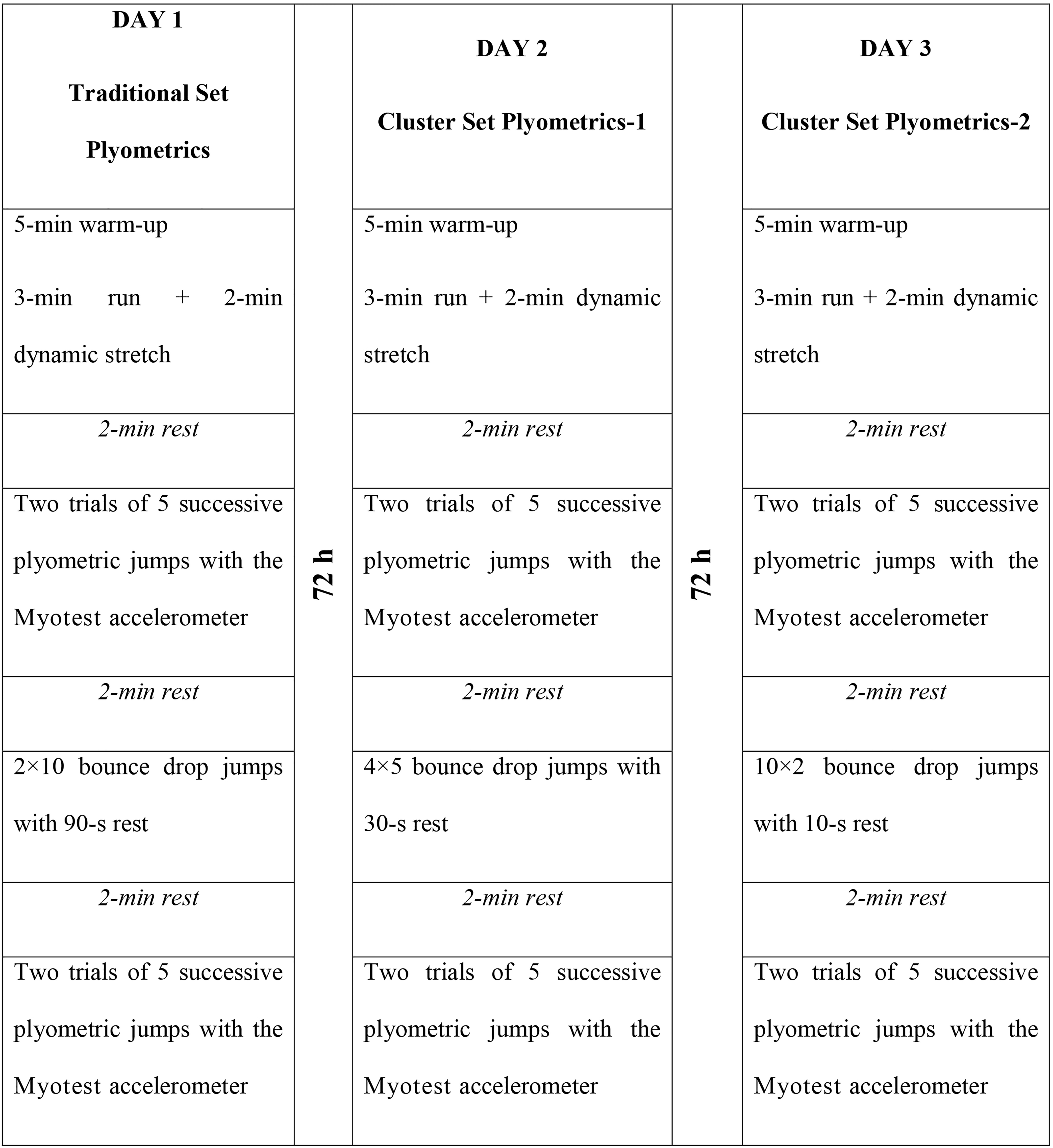
Subjects
Thirteen male rugby players (age: 20.92
Procedure
The study consisted of 3 sessions with a 72-h interval in-between. All tests were performed by the same researcher at the same time of the day (11:00–13:00) to avoid the effect of circadian rhythms on the study results. Subjects performed one of 3 different exercise protocols called TSP, CSP-1, and CSP-2 for an equal duration in each session in a randomized, balanced order. The experimental design flowchart is presented in Fig. 1.
Warm-up
Each session started with a 5-min warm-up consisting of 3-min running on a motor-driven treadmill (SportsArt T630, USA) at 7 km/h speed and 1% slope and a series of 2-min dynamic stretching consisting of straight leg kicks, high knees, and butt kicks as fast as possible.
Devices
Reactive strength index (RSI), K
Jump box
Traditional set plyometric or cluster set plyometric bounce drop jump was executed using a box 30 cm in height. This height was determined according to Marshall and Moran [34]. Lees and Fahmi [35] argued that if optimal drop heights were to exist, they would be less, not greater, than 36 cm. For the bounce drop jump, subjects with hands on the hips were instructed to step from a box (30 cm) and, as quickly as possible, after touching the ground, jump for the maximal height [34].
Traditional set plyometric (TSP), Cluster set plyometric-1 (CSP-1), and Cluster set plyometric-2 (CSP-2) set configurations
Traditional set plyometric consisted of 2
Statistical analysis
The statistical analysis was performed using the SPSS version 22.0 (IBM for OS X), initially using the Shapiro-Wilk normality and homoscedasticity tests. All the variables presented normal distribution and homoscedasticity. Statistical differences between pre- and post-values of the variables were examined paired
Results
Pre and post values of RSI, K
Pre and post values of the variables and statistical differences among the set configurations
Pre and post values of the variables and statistical differences among the set configurations
The aim of this study was to compare the influence of traditional set plyometric (TSP) and cluster set plyometric (CSP) warm-ups via bounce drop jump on RSI, K
It is common practice to perform a warm-up before any athletic activity since it has been shown to improve performance [36]. Static stretching (SS) is also commonly performed prior to exercise and athletic events [37]. It is believed that SS increases flexibility (by increasing range of motion of joints), promotes better performance, and reduces the risk of injury during strenuous exercise [37]. However, due to the possible detrimental effects of SS [36, 37, 38], dynamic warm-up (DW) is nowadays recommended as a pre-event routine because of demonstrated acute increase in power, sprint, or jump performance [39, 40, 41].
Two primary hypotheses have been developed to explain the possible detrimental effects of SS [37, 42]: (i) mechanical factors, such as changes in muscle stiffness, and (ii) neuromuscular factors, such as altered motor control strategies and/or reflex sensitivity. On the other hand, several mechanisms have been proposed to explain the acute enhancement in performance following DW, including [41](i) PAP, (ii) increased heart rate, (iii) increased core and muscle temperature, (iv) and rehearsal of movement.
Recently, there has been a renewed interest in what is termed as DW procedures that involve the performance of low-to-moderate, and high-intensity dynamic movements that are designed to elevate core body temperature, enhance motor unit excitability, improve kinesthetic awareness, and maximize active ranges of motion [2].
High-intensity skips, hops, jumps, throws, calisthenics, various movement-based exercises for upper and lower body, complex training (heavy-resistance exercise with a plyometric exercise), and plyometrics are known as DW exercises [6, 9, 12, 13, 43]. Recently, several studies argued that pre-event warm-up treatments that include TSP have been shown to positively influence explosive jump performance [43, 44], maximum squat performance [45], tennis serve performance [9], vertical jump, long jump [2, 13], and shuttle run performance [2].
Performance enhancement after the acute TSP warm-up is explained via PAP response by a majority of the researchers [6, 9, 13, 43, 44]. PAP consisted of two main mechanisms: fatigue and potentiation. Fatigue tends to diminish the contractile response and potentiation; however, potentiation tends to enhance contractile response. The effectiveness of the plyometrics depends on the balance between these two opposing effects [10]. Hilfiker et al. [43] argued that total muscle contraction time should be less than 10 seconds in order to avoid fatigue, which would reduce the positive effect of PAP. Masamoto et al. [45] also argued that potentiation was partially suppressed by fatigue in muscle contractions that are over 10 seconds in duration, which may explain why shorter duration plyometric exercises have previously improved performance.
Long-term plyometric exercises have been used widely as a training method to improve the efficiency of SSC as well as the muscle-tendon unit’s ability to tolerate stretch loads [46]. Improvement in RSI, K
As mentioned previously in traditional plyometrics, each repetition is applied without rest in between. However, some researchers argued that TSP might lead to muscle fatigue after the fifth repetition, depending on depletion of adenosine triphosphate (ATP) and PCr concentrations [8, 15, 28]. Moreno et al. [15] argued that a cluster set, specifically 10 sets of 2, allowed for greater maintenance of muscular power output (PW), take-off velocity (TOV), and JH than the traditional 2 sets of 10 when performing repeated body-weight plyometric squat jumps. According to Moreno et al. [15], this result may be caused by CSP, allowing for some replenishment of PCr, which is vital for muscular strength and power between intra-set rest intervals. Meanwhile, Boullosa et al. [8] reported that cluster set training seems to allow a more rapid improvement of jump height and a greater potentiation of various force-time parameters than a traditional set, probably as a consequence of the better fatigue-potentiation in the cluster condition.
To our knowledge, no other study has investigated the acute effects of plyometric exercise, designed in cluster set configuration, on RSI, K
The results of this study differ from studies of Moreno et al. [15] and Boullosa et al. [8]. Conflicting results may be caused by several factors including types of jumps (BDJ, countermovement drop jump, squat jump, etc.), jump volume (jumps/session), and jump intensity (box height) and subject characteristics (age, sex, fitness level, sport practice, etc.). Conversely, set configurations (TSP, CSP-1, and CSP-2), jump volume, and intensity, applied in this study, may be too low to change MTC stiffness and produce a PAP effect. The volume of plyometric exercise used in this study was kept low on purpose to prevent exercise-induced fatigue, which could lead to deterioration in neuromuscular performance.
There is no consensus about optimal box height to be used in plyometrics (15–100 cm) [21, 47, 49]. Struzik et al. [47] reported that a jump from 15 cm is relatively low to improve RSI. In contrast, if drop height is increased and jump technique is not controlled, subjects are likely to make a larger downward movement upon landing [47]. Marina et al. [48] reported the optimal height for drop jump to be between 40 and 60 cm. Matic et al. [49] suggested that drop height should be adjusted based on the subject’s neuromuscular capacity to produce maximal muscle strength.
Another contradictory issue among the studies is the jump volume that is to be applied in a session [17, 21, 50]. De Villarreal et al. [44] argued that a plyometric volume of 25–40 jumps is an effective stimulus to produce an acute enhancement in countermovement jump performance. However, Booth and Orr [17] suggested plyometric training volumes involving contacts higher than 50 feet per session. Eighty-foot contacts are recommended for track and field sports [17]. Braizer et al. [21] suggested that jumps to be added to high-intensity exercise are at least
This study has some limitations: a) although power analyses show that 15 subjects are needed to explain our aim and hypotheses, we only recruited 13 subjects; b) the box height was not adjusted based on the subject’s neuromuscular capacity; and c) we assumed that 30-cm box height, BDJ, and 20 jumps/session were suitable.
Conclusions
Further research, with larger samples, is needed to determine which set configurations, higher box height (
Footnotes
Conflict of interest
The authors have no conflicts of interest to declare.