




Abstract
BACKGROUND:
Pedalling asymmetries are a topic of interest to cycling coaches and athletes due to a potential link with performance and injury prevention.
OBJECTIVES:
The aim of this study is to describe the bilateral asymmetry of professional cyclists during two editions of a Grand Tour.
METHODS:
Here we set out to determine the power balance (power produced by each lower limb) between stronger and weaker leg (dominant vs. non-dominant) of 12 UCI professional cyclists competing at two Giro d’Italia editions. Power data were recorded during competition stages. Further analysis considered power data clustered into individual intensity zones (from Z1 to Z7).
RESULTS:
Higher intensity elicited better power balance (lower asymmetry) regardless of the stage profile. Intensity distribution analysed according to the role of the cyclist was lower for climbers in Z2 (
CONCLUSIONS:
Increase in power output improves power balance, especially in team helpers, and the lower power balance at lower exercise intensities, which are most of the race time, may elicit significant cumulative loading on a given leg of the cyclists, which requires further attention regarding risks of overuse injury.
Introduction
From a biomechanics perspective, road cycling is characterized by cyclic actions (pedalling) repeated by the lower limbs during training and racing. Professional road cyclists cover around 3000 km (up to 25000 km including training) and up to 90 days of competition per season [1]. Therefore, with a preferred pedalling cadence between 80 and 100 rpm [2], cyclists executed an extremely large number of pedal revolutions within a season while exercise at a wide range of intensities. To monitor performance, power output, defined by the product between crank angular velocity and torque [3], has been proposed as an excellent variable to measure external training load, but can also be useful in preventing injury and analysing pedalling technique [4].
Power meters are devices that can be attached to the bike to provide power output measurement during training and racing. With a large increase in popularity among professional and amateur athletes, the technological development of these devices resulted in highly accurate measurements during actual cycling conditions [5]. Among professional cycling teams the use of these devices to measure training load is part of the daily routine, and derived from power output, some important biomechanics variables are obtained. One of these is the power balance, defined as the percentage of power produced by each limb. Although this metric is present in the field of cycling and accessible to any cyclist using a power meter that measure or estimate asymmetry, to the best of our knowledge, there is a lack of information in the literature concerning the patterns of power balance in professional cycling.
Most of available information on pedalling asymmetry considers amateur and/or well-trained cyclists evaluated during stationary cycling. These laboratory studies described asymmetries in force production between limbs in cycling [6], translating into asymmetric peak torque [7], effective force [8] and average power [9]. Regarding work output, early studies reported asymmetries varying from 5–20% [10]. In general, pedalling asymmetries seems to be independent of pedalling cadence [9, 11], which suggest a main role for force production rather than angular velocity of the crank arm. One study suggested that there is an inverse relationship between peak torque asymmetry and exercise intensity elicited by different power output levels [7, 10, 12, 13]. Although one study reported larger asymmetries in effective force related to better time trial performance [8], results were obtained from a mix of cyclist and triathletes performing a short time trial (4 km) on a stationary bike. Therefore, regarding the effect on performance during actual cycling training or competitions, there is no evidences in the literature to support or refute a relationship between pedalling power/torque asymmetries and performance [6]. Additionally, the field condition may reflect changes in pattern of pedalling such as observed for sprint tests under laboratory and actual cycling conditions, most likely due to bicycle oscillation [14].
These inconclusive findings reveal the need to observe the patterns in real cycling conditions with larger amount of data. In this regard, there are no studies describing power balance in a competitive situation. Most of previous studies took part in laboratory conditions, which could differ from outdoor cycling conditions due to the stochastic nature of cycling [5], but rather than differentiate from the laboratory, it is important to know how these behaviours come up during racing. Furthermore, asymmetry has not been investigated during competition in professional cyclists yet. Showing this situation, a wide variety of circumstances that can influence power balance like the influence of stage type, rider role in the race, or the accumulation of fatigue due to several days of competition are just some of the factors affecting power balance that can be addressed.
Considering data from an UCI World-Tour professional cycling team, the main purpose of the study was to describe the power balance of top-level cyclists according to the individualised intensity zones measured through power output recorded during competition (three-week stage race). In addition, power balance was compared according to the role of the cyclists in the race, and the stage type, conditions that are known to influence power output. We hypothesized that the power balance will decrease as the power output increase. However, this will be influenced by the numerous factors that occur in a three-week stage race.
Material and methods
Subjects
Twelve professional cyclists took part in this study. The (mean
Design
This study took part during the same three-week stage race, the Giro d’Italia, in two consecutive editions (years of 2015 and 2016). Participants were 6, 4 and 2 cyclists that competed in the 2015 Giro d’Italia, the 2016 Giro d’Italia, and in both races, respectively. Data collection included finish time, power output, and intensity distribution for each stage of the races.
Intensity distribution according with the stage category
Intensity distribution according with the stage category
*Different of SEMO (
The Giro d’Italia is a race that consists in 21 stages divided in three weeks with two rest days between weeks. For this study, only mass-start stages were analysed, excluding individual time-trials and team time-trials.
The mass-start stages were divided according to the distance cycled uphill, the total altitude change, and the location of the climbs within the stage [15]. According with these criteria, the stages were classified as flat stages (FLAT), in which the total distance riding uphill was shorter than 13 km, the total elevation gain was lower than 800 m, and the hills were scattered along the stage, but never at the end of it; semi-mountainous stages (SEMO), with a total uphill distance between 13 and 35 km, and a total elevation gain ranging between 800 and 2000 m; and high-mountain stages (HIMO), in which the total elevation gain was higher than 2000 m. Stages finishing with more than 12 km uphill and an altitude change of more than 800 m were also included in the HIMO category. A total of 37 mass-start stages were analysed, including 9 FLAT, 6 SEMO and 22 HIMO stages.
Data were recorded during the race using the same device model and configuration for all the cyclists (Garmin 510, Garmin Inc., Kansas, United States). Volume and power output data were uploaded to a cloud service (TrainingPeaks, Boulder, United States) after finishing each stage. Cyclists’ bicycles were equipped with a mobile power meter measurement device (Power2Max type S, Zossen, Ge many) that measured power output every 1 s with an accuracy of 2% [16]. Power2Max is a crank-based device that measures the mechanical power considering torque data obtained from a crankset instrumented with strain-gages and the cadence data. Considering power data estimated for each pedalling cycle for right and left crank arms, we determined the power balance (POdiff) between cyclists’ stronger and weaker leg as describes the Eq. (1).
To analyse intensity distribution and the derived power balance, seven exercise intensity zones were determined based on the functional threshold power (FTP) [17]: Zone 1 (Z1;
Power balance between the intensity zones. 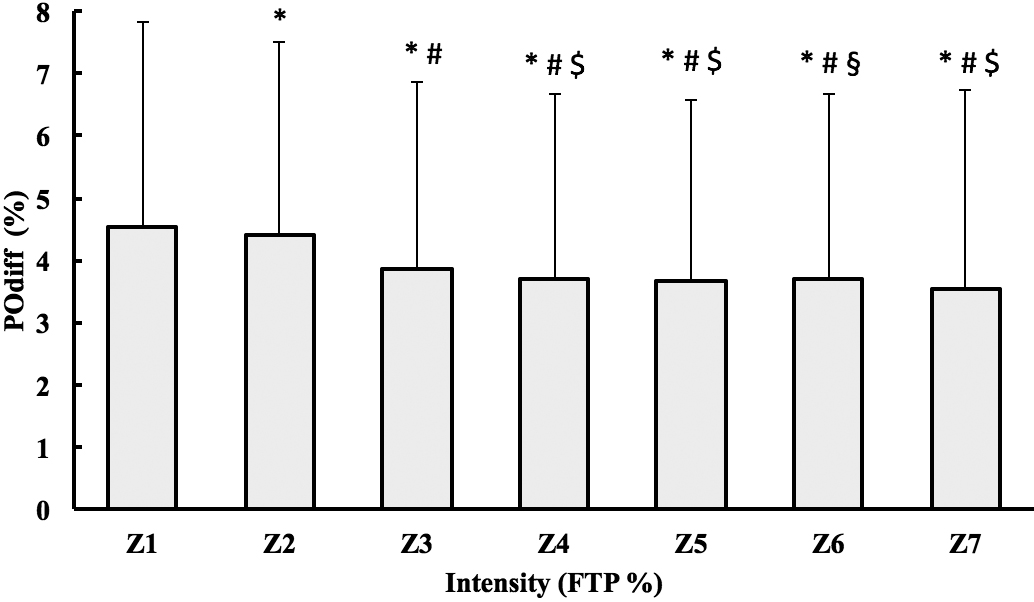
Descriptive results are expressed as the mean
Results
A total of 203 recordings were analysed, being 38 FLAT, 39 SEMO, and 126 HIMO. There were 109 records from team helpers and 94 from climbers.
The time spent (expressed as a percentage of stage duration) at the different intensities was 28
Intensity distribution analysed according to the role of the cyclist was lower for climbers in Z2 (
Figure 1 shows the difference in POdiff between the intensity zones. There was a reduction in POdiff when intensity increased.
The power balance did not differ between the stages types. The POdiff Eq. (1) for the different stage categories for the range of intensity from Z1 to Z7 was: (1). FLAT: 4.21
Figure 2 depicts the differences in POdiff according to the role of the cyclists.
Power balance according to training intensity between and within-cyclists. 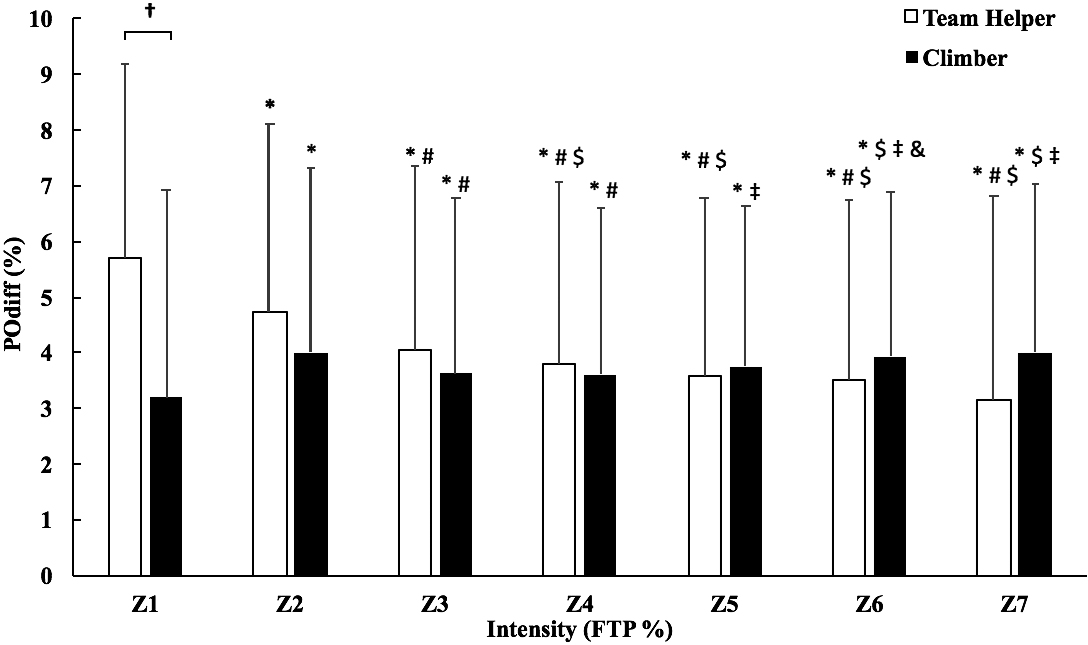
The present study describes the power balance of top-level cyclists during a professional competition. The power balance was described according with training intensity, role of the cyclists, and stage type. The main finding was that power balance decreases when intensity increases, regardless of the stage type. Furthermore, the response of power balance to the intensity observed in climbers differed from the team helpers. To the best of our knowledge, this is the first study to report power balance during actual cycling competition and to describe its relationship not only with intensity but also with role of the cyclist in the race.
Three-week races are highly demanding competitions performed in a great variety of terrains, with incremental physiological demands every year [19]. The stage type is determined according to the distance cycled uphill, the total altitude change, and the location of the climbs within the stage [15]. The competitive situations with a major impact on the result of mass-start stages are the mountain passes. The mountain passes are performed near to the individual anaerobic threshold [11]. The Z4 is the intensity range where in general the FTP is found [17]. We found that POdiff did not differ among stage types, suggesting that the change in altitude within a stage did not affect the difference in power production between the limbs. It makes sense that stage profile is not the determinant because power output can significantly vary within the same stage.
We found the lowest percentage of time was spent at Z4 for FLAT, followed by SEMO and HIMO stages, respectively. In addition, there were differences among the stage types in the other intensity ranges. At least 60% of the race time was performed at intensities below Z4. When working at intensities near or above Z4 there we found no effect of intensity on power balance, which reinforces the concept that at higher power rates cyclists can be more symmetric, while lower intensities can elicit larger asymmetries [6, 7, 9].
Regarding the effect of cyclist role on POdiff, the analysis of this variable in the team helpers followed the same pattern of the overall analysis (Fig. 1). However, the pattern observed differed between the different types of the cyclists (Fig. 2): while team helpers showed POdiff decreased when the power output increased, the climbers showed a POdiff that remained stable at the highest intensities (Fig. 2). Although we cannot ensure, we must consider that the role of team helpers may elicit higher rates of fatigue during moments of higher power output when the cyclist will be working to clear time or control the peloton before or between climbers’ attacks. It is known that when submitted to all-out efforts pedalling technique can deteriorate with significant impacts on pedalling cadence and resultant forces [20], as well the drop of cadence below the preferred cadence will also negatively impact pedalling technique, i.e. pedalling effectiveness [21].
At the lowest intensity (Z1) there were differences in POdiff between the climbers and team helpers, whereas there were no differences in the time expended by these two riders’ groups in this range of intensity (Fig. 2). The presence of asymmetries at lower intensities was previously described [6, 7]. Although the impact of these asymmetries on performance is most likely irrelevant, we cannot exclude its importance regarding overuse injuries [22]. It is known that a large time of cycling training, and also competition as shown here, is performed at lower intensities. It results of many factors, but especially drag effects while riding within a peloton and also during downhill sections. Such influence of pedalling asymmetries on injury risk still claims for research, especially considering that low back pain, which is among the most common overuse injuries reported in professional cyclists, can be related to lower limbs strength unbalances [23]. Finally, it is possible that differences between helpers and climbers may rely on differences in pedalling technique between these athletes, and differences in the preferred pedalling cadence adopted during mountain passes in specialized cyclists [24].
The generalisability of these results is subject to certain limitations. First, Power2max is a commercial power meter device, which was shown to report a good accuracy according to the manufacturer, but does not permit to determine the effective force during pedalling commonly determined in laboratory-based studies. It estimates the asymmetry between limbs by measuring the power applied during the time when the crank arm is forward of the bottom bracket. It is important to keep in mind that with no direct measures of each limb, the data must be affected by the pedalling technique. Second, data were collected during actual professional races. Before and during the race all the athletes received individualized nutrition and hydration, as well as periodized and individualized training loads. The cumulative volume and intensity during the race stages results in fatigue that varies between the different athletes, and we cannot exclude its effect on our data.
The practical applications of our data are twofold. The patterns of power balance during actual race are similar to the observed in laboratory tests, therefore, laboratory screening for pedalling asymmetries can be easily implemented in the training routine. The lower power balance at lower exercise intensities, which are most of the race time, may elicit significant cumulative loading on a given leg of the cyclists, ant the role of this condition for overuse injuries requires further attention.
Conclusions
While higher intensity leads to symmetry in power output, it seems that lower intensity as experienced during endurance periods may elicit asymmetries, especially in team helpers. Laboratory tests at different intensity zones can be useful for screening of pedalling asymmetries. The results provided support previous literature regarding asymmetry during cycling. In addition, this study due to the ecological data acquisition, showed data in the power balance with data obtained during a great lap in professional cyclists, which increases the impact of the work due to the obtaining of data with an ecological experimental design that allows to replicate laboratory conditions
Author contribution
CONCEPTION: Alejandro Javaloyes, Manuel Mateo-March, Manuel Moya-Ramon.
PERFORMANCE OF WORK: Alejandro Javaloyes, Manuel Mateo-March, Manuel Moya-Ramon, Raul Lopez-Grueso, Mikel Zabala, Felipe Carpes.
INTERPRETATION OR ANALYSIS OF DATA: Alejandro Javaloyes, Manuel Mateo-March, Manuel Moya-Ramon, Mikel Zabala.
PREPARATION OF THE MANUSCRIPT: Alejandro Javaloyes, Manuel Mateo-March, Manuel Moya-Ramon, Raul Lopez-Grueso, Mikel Zabala.
REVISION FOR IMPORTANT INTELLECTUAL CONTENT: Manuel Mateo-March, Manuel Moya-Ramon, Raul Lopez-Grueso, Mikel Zabala, Felipe Carpes.
SUPERVISION: Mikel Zabala, Manuel Moya-Ramon.
Ethical considerations
Institutional ethical approval was granted (ref. number: DPS.JSM.02.18; 2018) and the study followed the principles of the declaration of Helsinki. All participants gave their informed consent to participate in this study.
Funding
The authors report no funding.
Footnotes
Acknowledgments
The authors wish to acknowledge the cyclists for their contribution in this study.
Conflict of interest
The authors declare that they do not have any potential conflict of interest.