




Abstract
BACKGROUND:
The volume in resistance training (RT) perhaps improve the autonomic modulation cardiac in untrained adults.
OBJECTIVE:
The aim was to analyze the effect of RT volume on heart rate variability (HRV) in young adults.
METHODS:
The intervention order was randomized and counterbalanced. Participants (
RESULTS:
An interaction was identified between time and condition for RMSSD (
CONCLUSION:
The study concluded that 5 set conditions improved HRV in young untrained adults.
Introduction
Heart rate variability (HRV) refers to consecutive variations in heart rate [1]. It provides information concerning sympathetic and parasympathetic heart autonomic modulation. Noteworthy, increased HRV is inversely associated with cardiovascular diseases [2]. Moreover, HRV is considered an indicator of cardiovascular fitness, that is, it is possible to evaluate how well-trained the subject is [3]. Moreover, HRV distinguishes the competitive levels of professional athletes [3] and indicates enhanced neuromuscular recovery between training sessions [4].
Exercise modalities that increase HRV long term are important to indicate the performance levels of the athletes as well as prevent from cardiovascular disease. Resistance training (RT), a type of physical exercise, uses resistance generated by equipment, free weights, body mass, and/or elastic bands against the movement of specific muscle groups [5]. The main variables of RT are volume (frequency
In fact, scientific literature is controversial about the effects of RT intensity on HRV. A study showed HRV improvement with high-intensity RT (8RM) in healthy male adults [9], whereas some other studies do not indicate any difference independently of what intensity (60 to 80% with one repetition maximum) is adopted in healthy male adults [10, 11]. According to rest intervals, two minutes or more between sets and exercises presented the best results [9], indicating that before the next stimulus the sympathovagal system might need to return baseline or next to baseline levels to reach out long-term improvements. Considering the RT volume, HRV changes were not observed after six [12] or eight weeks [13] in the studies that adopted three sets or less of RT, with eight to twelve repetitions. However, the complexity of the prior studies designs that lacks of washouts periods might have compromised the results, additionally, there is not any evidence regarding the effect of greater RT volume (
In fact, past studies have suggested that RT volume is the most important RT variable for neuromuscular adaptations [14, 15]. Evidence showed RT volume positively affected strength [16] and muscular hypertrophy [14, 15]. Chen et al. [17] demonstrated reductions in strength performance following a decrease in HRV index in seven weightlifters following a RT session. Strength and HRV remained reduced until 72 h after training, that is, HRV might have an influence in strength and consequently in performance. Considering the fact that RT volume induces improvement in muscular strength [14], it is possible that RT volume could also increase HRV. Thereby, assuming that higher RT volume induces greater autonomic cardiovascular stress (higher reductions in HRV) after a single RT session [18], it is reasonable to postulate that higher RT volume might stimulate superior adaptations on HRV in healthy male adults. To confirm this hypothesis, investigations should be performed to determine the influence of RT volume on HRV.
From a practical point of view, the present study might reveal the effect of RT volume on HRV in young untrained adults. Once the previous studies have revealed inconsistence of showing similar results, a strong and controlled design as a long-term crossover might assist to understand the effect of RT volume on HRV. Wheter the findings of this study reveal a positive effect of the higher RT volume on HRV indicators, both strength and conditioning professionals might consider the increment of greater RT volume for healthy untrained adults given the prospect of increasing HRV might indicate an improvement of the performance and reduce cardiovascular disease risks. Therefore, the findings could be extremely important for strength and conditioning professionals. Thus, the study aimed to analyse RT volume effect on HRV in young untrained adults. The study hypothesized that a high RT volume during eight weeks improves HRV.
Materials and methods
Participants
The study recruited participants using a non- probabilistic sampling method. A total of thirty-one male volunteers aged from 18 to 30 years old (23.5
Experimental design of investigation. Note. HRV 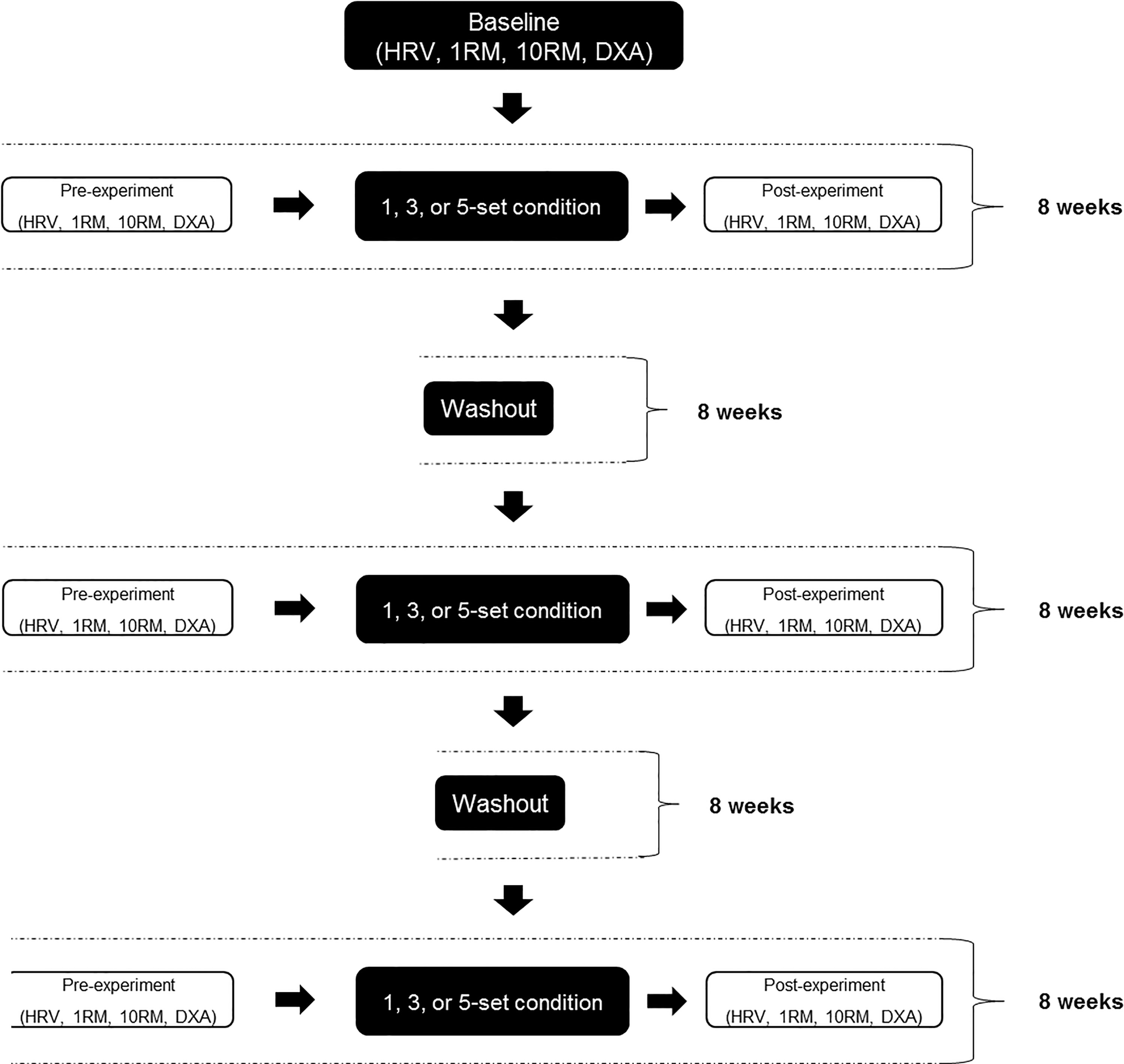
The procedures of this study were approved by the Institutional Review Board at the Federal University of Pernambuco (59787716.9.0000.5208) in compliance with the Brazilian National Research Ethics System Guidelines and Helsinki Declaration. Written informed consent was obtained from each participant before they participated in the study.
This is a controlled, randomized, and cross-over investigation that lasted forty-weeks (
The participants performed 1, 3, or 5 sets of the same exercises (bench press, leg press 45
Resistance training program
Resistance training program
One repetition maximum (1RM) test in the bench press and leg press (45
HRV was assessed by cardiac monitoring seventy-two hours before (pre-conditions) and after (post-conditions) each experimental RT condition (1 vs. 3 vs. 5 sets). Moreover, the participants were instructed to not perform any physical exercise forty-eight hours before the HRV baseline and the condition evaluations.
For the training program, the study followed recommendations for RT in healthy untrained adults [5]. The program consisted of four popular exercises in RT programs (bench press, leg press 45
Table 1 shows the RT procedure for each condition (1 vs. 3 vs. 5 sets). Warm-ups [1
Measures
Heart rate variability
All the evaluations were performed under the same conditions. The participants remained in the sitting position for ten minutes before initiating the resting HRV [1]. The R-R intervals were obtained using a portable heart rate monitor (Polar
Maximum muscular strength (1RM)
Maximum muscular strength was determined using the 1RM test in the bench press and leg press 45
Additionally, warm-ups (1
10 repetitions maximum (10RM)
After the 10RM test, the researchers determined the intensity zone for 10RM. The exercises performed were bench press, leg press 45
Accordingly, warm-ups (2
Body composition
Body mass (kg – portable scale PL 200, Filizola S.A., Sao Paulo, Brazil, an accuracy of 0.1 kg) and height (professional stadiometer Sanny, Sao Paulo, Brazil, an accuracy of 0.1 cm) were measured. Corporal density was measured using the technique of body scanning by the Dual X-ray Absorptiometry (DXA) (Hologic, Waltham, MA, USA). Participants were recommended to not perform any physical exercise for at least forty-eight hours and to add libitum hydration the day before. The participants remained in the supine position with arms beside the body and hands in neutral position. Feet and knees 10 cm away tied with a Velcro band for avoiding any movement that might interfere with the image visualization during the procedure. The analyzed variables were: free fat mass, fat mass, and body mass. DXA calibration followed the manufacturer recommendations as well as the measurements were performed for an experienced and blind for the experiment evaluator.
Data analysis
The researchers conducted the Shapiro-Wilk test to analyze the data distribution. Levene’s test was used to assess the homoscedascity of the groups. All the data are described as the mean and standard deviation. Factorial repeated measures ANOVA 2
Results
In our study, 27 out of 31 participants finished the forty-week experiment (Fig. 2). Four participants dropped out of the study because personal reasons before the start of the investigation. The descriptive data of age, HRV indexes (RMSSD, SDNN, pNN50), maximum muscular strength, and body mass are in Table 2.
Descriptive values (mean and standard deviation) of research variables in baseline
Descriptive values (mean and standard deviation) of research variables in baseline
Note. RM
Mean and standard deviation of HRV (RMSSD, SDNN and pNN50) and maximum muscular strength according to intervention (1 vs. 3 vs. 5 sets) and time (pre-vs. post)
Note. HRV
Flowchart of evaluated participants.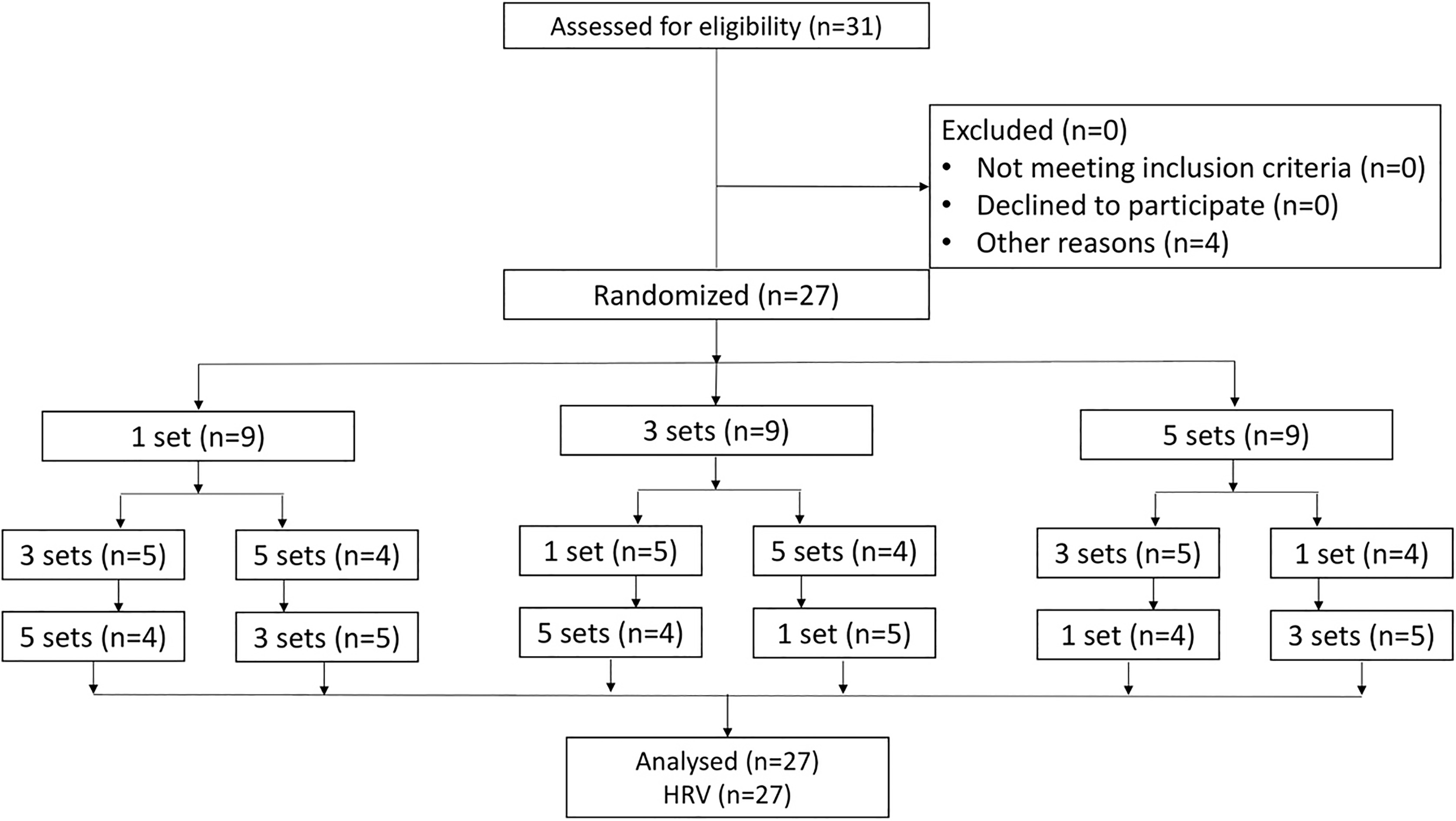
According to maximum muscular strength, results did not show differences for bench press (
The findings indicated interaction between time and intervention for bench press (
HRV
The results did not show differences for RMSSD (
The analyses showed an interaction between time and intervention for RMSSD (
Discussion
From a practical point of view, the present study points out the effect of RT volume on HRV in young untrained adults. Once the findings of this study reveal a positive effect of the higher RT volume on HRV indicators, strength and conditioning professionals could prescribe greater RT volume for healthy untrained adults increasing the HRV, consequently, improving performance as well as reducing the risk of cardiovascular disease. The main finding of this study was that the 5 sets condition yielded greater improvement in HRV indicators when compared to 3 and 1 sets conditions in healthy untrained male adults. This seems to be the first study showing the effect of different RT volumes on HRV.
According to maximum muscular strength, the results revealed a dose-response effect for RT volume. 5 sets condition yielded greater improvement in maximum muscular strength when compared to 3 and 1 sets. Similarly, 3 sets condition produced an enhancement in maximum muscular strength when compared to 1 set. Those results corroborate a systematic review with a meta-analysis conducted by Grgic et al. [16], that showed an increase in RT volume is associated with an enhancement of muscular strength.
The results of the present study revealed improvements on HRV (increase on HRV indicators in the time domain) for 5 sets condition when compared to 1 and 3 sets. RT volume positively affects the autonomic nervous system, although there appears to be a volume threshold for HRV improvement in untrained adults, since 3 and 1 sets conditions did not change HRV indicators. An increase in plasma volume and in baroreflex sensitivity, as well as lower metaboreflex activation [11], may help to explain the present results in the 5 sets experimental condition; however, it should be further investigated. Although the mechanisms underlying these effects were not assessed, previous studies showed that higher RT volume reduces catabolic hormones (cortisol) and increases anti-inflammatory cytokines (interleucyine-6 and interleucybe-10) [21], which are associated with HRV enhancement. The reduction in cortisol’s concentration shows a relation to the decreased adrenaline and norepinephrine, which reduce the activation of the sympathetic nervous system, causing improvement of resting HRV [22]. The increase in the concentration of the anti-inflammatory cytokines seems to increase the vagus nerve activity, which also improves resting HRV [8]. Unfortunately, the study did not measure blood sample and therefore could not confirm this hypothesis. At the level of the cardiac structure, RT induces left ventricle hypertrophy. Thereby, the ventricle eccentric hypertrophy, which seems common in participants of the RT program, is characterized by an increase in ventricle wall thickness that does not reduce the size of the chamber. Moreover, the increase in the left ventricle thickness relates to the reduction of systolic blood pressure [23]. Thus, once the blood pressure is controlled, it might indicate a better autonomic nervous system functioning and an improvement in HRV which could explain the findings of the 5 sets experimental condition.
The findings of this study on HRV contradict other scientific investigations [10, 11]. Collectively, these studies suggest that RT might not improve resting HRV in healthy young adults because they already have a normal cardiac autonomic function. However, it is important to highlight that these studies [10, 11] adopted RT volume equal to or lower than 3 sets per exercise. Iglesias-Soler et al. [24] compared an RT protocol that led to muscular failure with another one with rests between repetitions. However, they did not find differences in the HRV. This similarity to the findings of the present investigation for 1 and 3 sets conditions might be due to the reduced RT volume (10 to 30 repetitions to each exercise).
The results of this study for a higher volume training session (i.e., 5 sets) do not support previous findings that indicated that RT induces a reduction in cardiac vagal modulation [11, 25]. However, differences in protocols deserve to be noted. The respective studies [11, 25] analyzed the effect of RT on HRV after a single session. Additionally, a common characteristic of those investigations [10, 11, 25] was to adopt rest between sets below three minutes. The previous studies analyzed the effect of intensity on HRV, whereas the present study focused on the effect of volume on HRV. Thereby, the differences in protocols might explain dissimilarity in the findings. On the other hand, Fortes et al. [9], despite adopting a lower RT volume than the present study (3 sets per exercise), revealed an HRV improvement after eight weeks of RT in male healthy adults.
Although the present study reveals interesting results that might elucidate some questions in the literature, it presents some limitations that ought to be mentioned. In fact, an echocardiogram was not used for assessing images of the heart which could explain improvements of the heart in the 5 sets condition. Also, inflammatory and hormone markers were not analyzed [26]. Therefore, the present study’s findings must be handled with caution. However, this study used the repeated measures crossover design with washout intervals, that might suppress some cited limitations.
Conclusion
The results showed that higher RT volume (5 sets condition) improvement on HRV in young untrained adults. Performing 600RM weekly (200RM 3 times a week, with 5 sets of 10RM to each exercise), adopting large muscle groups (bench press, leg press 45
Nevertheless, it is noteworthy that 3 (360RM weekly) and 1 sets (120RM weekly) produced similar findings (without changes to HRV). Thereby, practically, if the aim is to improve HRV in young healthy untrained adults, the best strategy seems to perform 5 sets per exercise in each RT session within an eight-week period.
In summary, RT volume improves cardiac autonomic modulation and strength in healthy untrained adults. Therefore, a higher RT volume should be considered to enhance the above-mentioned parameters in this population.
Footnotes
Conflict of interest
The authors declare no conflict of interest.