




Abstract
BACKGROUND:
Supervised strength training has been shown to promote physiological adaptations in children and youth that can be beneficial to the process of physical growth and developed, and general health status.
METHODS:
Sixty-three children (9.2
RESULTS:
After 8 weeks of training, statistically significant changes were found in all study variables for all groups, but with different effect sizes. In the ABK jump, the largest effect size was observed in UR (1.40, 0.97–1.85), while in ST and MJ it was medium (0.67, 0.44–0.98 and 0.48, 0.17–0.82, respectively). Similarly, the effect size in the SJ jump was large for the UR and ST groups (1.10, 0.78–1.51 and 1.30, 0.98–1.64, respectively) and medium in MJ (0.56, 0.24–0.97). However, the magnitude of the effect registered in SBJ was large in MJ (0.80, 0.55–1.15) and medium in UR and ST (0.56, 0.32–0.86 and 0.64, 0.42–1.013, respectively).
CONCLUSIONS:
All three training programs improve jumping and velocity/agility performance but based on clinical significance, UR and ST methods can be considered more efficient to improve physical performance in children.
Introduction
Differentiation along the lines of physical function specialization reflects the changes that occur at the morphological and neural levels during growth and development, which have an influence over motor performance. The scientific evidence in the last years has shown that properly prescribed and supervised strength training is an optimal tool to promote positive adaptations in children and youth during the development and maturation process [1]. Similar to other populations, strength training may not only optimize the expected increase in strength but also improve power, speed and motor performance in children [2]. These effects on physical performance are mainly attributed to neural adaptation mechanisms, such as improvements in unit motor recruitment and synchronization, stimuli frequency or neural myelination [3, 4].
Knowledge of mechanical and physiological aspects related to the training load, in addition to applied training stimuli during child development, are essential factors for effective training programming and for improving neuromuscular performance in school age. Thus, neurophysiological variables as hormonal parameters, neuroplasticity, inter and intramuscular coordination, and the maturation status play a central role in the ability to adapt to a specific training stimulus [5]. In this sense, the neuromuscular adaptation depends on the characteristics of the stimuli and the speed of growth before or after the peak height velocity (PHV) [6] which constitute a critical period for training in these ages dominated by “accelerated adaptation windows for training” or “training capacity windows” [7]. These are associated with the accelerated natural development of specific motor skill [7] and can also be benefited and enhanced with the application of strength training [1]. All these arguments demonstrate the importance of strength training in childhood.
Strength training favors motor performance, a fact that implies benefits in physical fitness and functionality in scholar children. In this way, the stimulation of motor performance at school age encompasses a dynamical and complex process that integrates the central nervous system and the muscular system, which benefits the quality in the execution of basic and complex motor skills that are reflected in the physical fitness. In fact, it has been shown that different strength training methods lead to improvements in various strength components such as strength performance [3], muscular power production [8], sprint [9], agility [10], and general motor performance [3], which are directly associated with regular physical activity at school age. However, current scientific literature presents new training methods [11, 12, 13] that have not been yet explored in school populations and that are potentially applicable in this population due to the practicality of their implementation.
Methods such as multi jumps (MJ), sled towing (ST) and uphill running (UR) have been shown to be efficient in improving strength in the athletic population. In fact, MS has been a widely studied method in the sports context and in children’s populations [14, 15], proving to be efficient for improving motor performance in variables such as travel speed [16] and jump height [17]. Likewise, the ST method has demonstrated its effectiveness for the stimulation of running speed in sprint athletes [11]. On the other hand, UR is a potentially effective intervention strategy to improve muscle power [18]. However, these exercise interventions have not been explored in the school population. In addition, it is not clear which strength training method turns out to be more efficient in order to improve motor performance, highlighting the need for further studies [1]. Thus, the aim of the present study is to identify the effects of three methods of strength training (MJ, ST and UR) during an eight-week training program on speed, vertical jump height, and velocity/agility variables in prepubertal schoolchildren.
Methods
Participants
Sixty-three boys in prepubertal stage (9.2
Procedure
All tests were performed during school hours. The participants and their parents received the following instructions: a) to have a good night’s sleep before each test day, b) to have a good breakfast and being well hydrated before evaluations, and c) to wear the same athletic shoes during pre- and post-intervention tests. For the measurement of performance variables, the participants attended four practice sessions (familiarization) of the test procedures. Researchers spent twenty minutes of technical training for each test. Evaluations were applied at baseline and at the end of the intervention (pre- and posttest, respectively).
The motor performance tests started with the jumps and were followed by evaluations of speed and agility. The execution of the jumps was performed in the following order: first vertical jumps (Abalakov (ABK)), Counter Movement Jump (CMJ) and Squat Jump (SJ) and, secondly, the standing Long Jump Test or Broad Jump (SBJ). On the other hand, the assessment of velocity/agility was carried out through the 4
ABK jump height (ABK)
The ABK test was performed using an electronic contact platform system (Axón Jump, Bioingeniería Argentina). For the ABK jump, all schoolchildren started from an upright position with the weight evenly distributed on both feet and performed a vertical jump (arms swung back and forth in this boost phase). During the flight phase, the legs were fully extended [19]. Three attempts were completed with a 10–15 seconds rest in-between. Jump height was recorded in cm and the best performance attempt was used for the subsequent statistical analysis.
CMJ jump height (CMJ)
The CMJ test was performed using an electronic contact platform system (Axón Jump, Bioingeniería Argentina). All participants started from an upright position with their hands on the hips and performed a vertical jump. During the flight phase, the legs were fully extended [19]. Three attempts were completed, with a 10–15 seconds rest between them. Jump height was recorded in cm and the best performance attempt was used for the subsequent statistical analysis.
SJ jump height (SJ)
The SJ test was performed using an electronic contact platform system (Axón Jump, Bioingeniería Argentina). The participants were instructed to rest their hands on the hips, to put their feet shoulder-width apart, and to adopt a flexed knee position (90 degrees) for 3 seconds. After this, with the verbal command “set … Go!”, the subjects performed a maximum vertical jump without making any additional movement and without releasing their hands from the hips. Researchers ensured that legs were fully extended during the flight phase [19]. Three attempts were completed with a 10–15 seconds rest between them. Jump height was recorded in cm and the best performance attempt was used for the subsequent statistical analysis.
Standing broad jump (SBJ)
All participants stood behind the jump line, with their feet parallel and shoulder-width apart. They were instructed to bend their knees with arms in front of the body and parallel to the ground. From that starting position, they had to swing their arms, push hard and jump as far as possible. The children were explained to land with both feet and remain upright. Jump distance was measured from the take-off line to the point where the back of the heel closest to the take-off line landed [19]. Three attempts were completed with a 10–15 seconds rest between them. The length was recorded in cm and the best performance attempt was used for the subsequent statistical analysis.
4
10 m shuttle run test (4
10 m)
Two parallel lines separated by 10 meters were prepared. Three foams were placed (one at the start line [Sponge B, EB] and two in the second line [Sponges A, EA, and C, EC]). All subjects stood behind the starting line and the test began after a sound instruction. In the first displacement, the participant ran to the other line. In order to catch EA, the subjects had to pass both feet over the lines marked on the ground to start the next journey. Then they moved to the start line and changed EA for EB, then ran back to the opposite line, where they changed the EB sponge for the EC. Finally, the subjects went back to the starting line without slowing down until they crossed it [20]. An evaluator registered time in seconds with a chronometer.
20 m sprint test
A flat and straight field of 28 meters long was chosen. The running time was measured with an accuracy of 0.01 seconds using red infrared photoelectric cells (Globus Ergo System
Characteristic of interventions
Characteristic of interventions
BJ, Box jump; %BW, body weight; R, Repetitions; S, sets; TW, training week.
The eight-week intervention for the three groups had a frequency of three training sessions per week with a recovery period between sessions of 36 hours. All training sessions were held at the facilities of the Emilio Valenzuela School (Bogotá D.C., Colombia) during the physical education classes (one hour each class). The methodology of the MJ intervention was based on previous studies [22, 23]. The intensity of the training load was monitored using the session perceived effort rate (session-RPE) [24], for which the children were previously familiarized. The ST group towed a load between 2% to 8% of the body mass, the number of sprints ranged from 15 to 33 repetitions and the distance traveled varied between 5 to 15 meters per session, according to Rumpf et al. [25]. The UR group performed the uphill running on a route with two continuous ramps, 11
Statistical analysis
The change from baseline (
Consort flow diagram of the three study groups.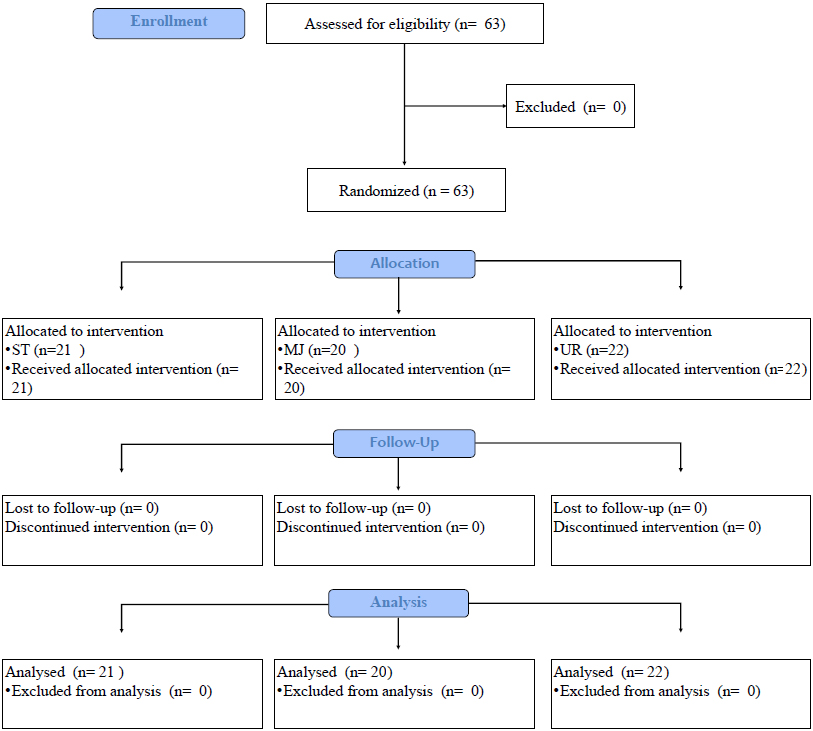
All sixty-three schoolchildren completed the intervention and met the minimum attendance at supervised training sessions (80%) (Fig. 1).
Baseline data
The comparison of the variables at the baseline showed differences in ABK between the groups, specifically between ST and UR (
Baseline of study participants
Baseline of study participants
BMI, body mass index; ABK, Abalakov; CMJ, countermovement jump; SJ, squat jump; SBJ, standing broad jump; 4
Results of the study variables after 8 weeks of intervention
BMI, body mass index; ABK, Abalakov; CMJ, countermovement jump; SJ, squat jump; SBJ, standing broad jump; 4
The paired Hedges’g for the three groups is shown on the Cumming estimation plot. ABK (A), CMJ (B), SJ (C), SBJ (D), 4 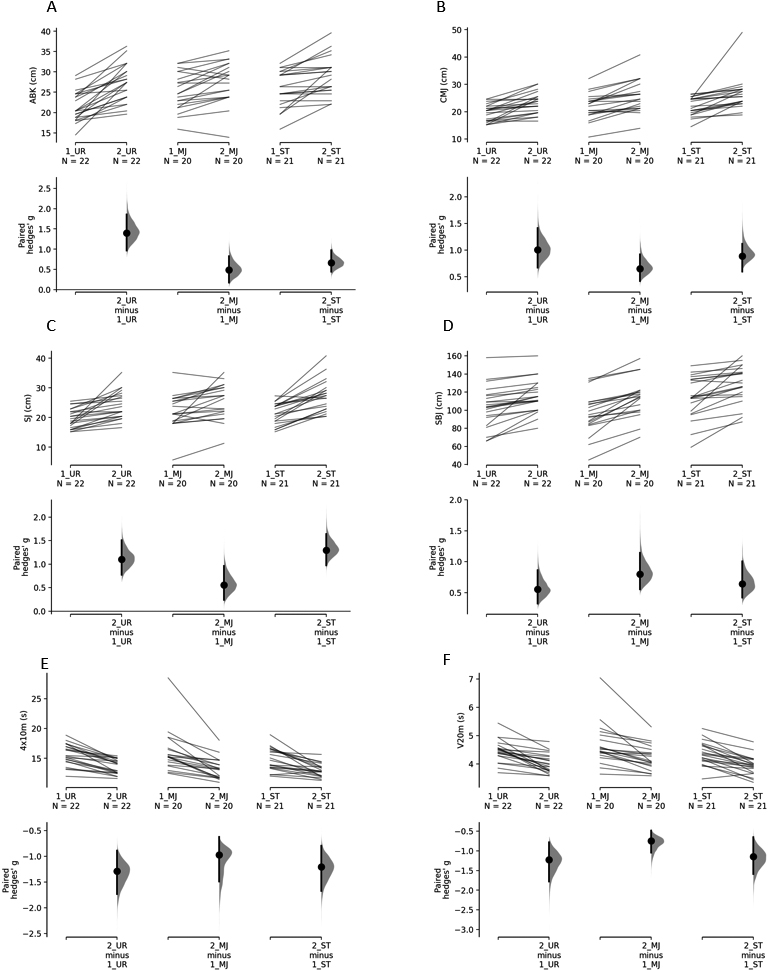
After 8 weeks of training, statistically significant changes were found in all study variables for all groups (Table 3), but with different effect sizes (Fig. 2). In the ABK jump, the largest effect size was observed in UR (1.40, 0.97–1.85), while in ST and MJ it was medium (0.67, 0.44–0.98 and 0.48, 0.17–0.82, respectively). Similarly, the effect size in the SJ jump was large for the UR and ST groups (1.10, 0.78–1.51 and 1.30, 0.98–1.64, respectively) and medium in MJ (0.56, 0.24–0.97). However, the magnitude of the effect registered in SBJ was large in MJ (0.80, 0.55–1.15) and medium in UR and ST (0.56, 0.32–0.86 and 0.64, 0.42–1.013, respectively).
In relation to speed/agility capacity, the changes observed in the 4
Discussion
The aim of this investigation was to evaluate the effects of three methods of strength training (MJ, ST and UR) on variables of performance jump and velocity/agility in prepubescent schoolchildren. The results indicate that all three strength training methods were effective for developing improvements in physical performance (
On the other hand, our results also indicated that ST was a very effective method to improve jump performance, The potential explanations can be extrapolated from the evidence presented in studies developed in the adult population which has demonstrated an enhancement in the neuromuscular adaptations related to intramuscular coordination [32, 33]. In fact, our results are in line with the evidence presented by Harrison et al. [33], who established significant improvements in SJ due to the increase of muscular strength in the initial phase after a six-week intervention of ST training in rugby players. Moreover, the results presented by Gil et al. [32] support our assumption, since the evidence showed by these authors revealed significant improvements in SJ after a six-week intervention of ST in elite soccer players (percentage of change in SJ
In relation to MJ, improvements were also found in the study variables. These results coincide with the findings of other studies that have reported that plyometric training, combined with strength training or as a complement to the training session, improves strength indicators such as jumping performance [40, 41, 42, 43]. Other studies have also shown that plyometric training improves strength in lower limbs, such as the long jump, in prepubertal schoolchildren [44]. The results evidenced in this study can also be related to the fact that MJ training improves jump performance by increasing the stretch-shortening cycle [45], relegating neuromuscular effects to the background. However, these results must be analyzed under two considerations that have important practical implications. First, it should be considered that most of these studies are plyometric interventions that do not include only jumping, but a combination of plyometric exercises or are complements to a training session; second, the effects the level of physical fitness of the children must be taken into account, as reported by Kotzamanidis [46], who demonstrated a minor plyometric training effect in children without previous training, in comparison to other studies developed with athletic children [35, 43, 47].
After the post-intervention assessment, our study revealed that the sprint speed was benefited no matter the training method. One possible reason for this was evidenced by Moran et al. [5], who reported greater neuronal and motor development and better quality and coordination of movement. Hence, our data is in line with the observations of Philippaerts et al. [6], where it was concluded that the sensitive phase for the development of velocity (
Conclusion
Our results suggest that the three training methods improved jump performance and velocity/agility in prepubescent schoolchildren, without finding significant differences between the groups. However, in terms of the magnitude of the effect, the greatest changes were found in the order UR, ST, and UM. Based on this, we recommend these training strategies under professional supervision to improve motor performance in prepubertal schoolchildren.
Author contributions
CONCEPTION: Diego A.R. Jaimes and Dennis Contreras.
PERFORMANCE OF WORK: Johanny G. Cárdenas.
INTERPRETATION OR ANALYSIS OF DATA: Diego A.R. Jaimes, Jorge L. Petro, Diego A. Bonilla and Dennis Contreras.
PREPARATION OF THE MANUSCRIPT: Diego A.R. Jaimes, Jorge L. Petro, Diego A. Bonilla, Ailin O. Duarte and Dennis Contreras.
REVISION FOR IMPORTANT INTELLECTUAL CONTENT: Diego A.R. Jaimes, Jorge L. Petro, Diego A. Bonilla and Dennis Contreras.
SUPERVISION: All authors.
Ethical considerations
The research protocol was approved by the Ethics and Environmental Impact Committee of the University of Pamplona (Minutes No. 004 of the session of May 21, 2018). Parents of all participants provided written informed consent.
Funding
The authors report no funding.
Footnotes
Acknowledgments
The authors would like to thank the Manuel Samper Alum (principal) and Juan Carlos Bello (vice-principal) at the Fundación Colegio Emilio Valenzuela (Bogotá, Colombia) for their support on this research by providing the instruments of intervention, measurement and infrastructure. We also express our sincere thanks to all the children who participated in this study and we thank the teachers who assist in the intervention.
Conflict of interest
The authors declare that they have no competing interests.