




Abstract
BACKGROUND:
During the first two decades of life, athletes pass through intense changes in body size, which can directly influence physical fitness, especially anaerobic tasks.
OBJECTIVE:
We examined which body size variables can discriminate the level of anaerobic performance in young soccer players.
METHODS:
The sample was composed of 102 regional players (14.5
RESULTS:
Results indicated that 7 sprints performance is related to chronological age (
DISCUSSION:
Body size is related to 7 sprints performance in U-14 youth players, while biological maturation seems to influence physical fitness.
Introduction
During a soccer game, a series of physiological demands related to the aerobic and anaerobic metabolis-ms work together to produce energy [1]. Both are intrinsically associated with adenosine triphosphate (ATP) production, which allows players to perform high intensity intermittent exercises in the game [2].
During the game, players use various intensities: walking, jogging and sprinting, however the most decisive tactical and technical actions tend to occur in the center of the game [3], requiring mainly anaerobic fitness of the players, given the quick and intense characteristics of these movements [4].
Recognizing the importance of the anaerobic pathway to supply important management of game space as well as technical skills, some protocols have been proposed in the literature with the aim of evaluating this capacity in soccer players. The maximum accumulated oxygen deficit [5], Wingate test [6], maximal anaerobic running test [7], Margaria staircase running test [8, 9], and Repeated sprint ability [10], are examples of protocols used to estimate anaerobic fitness of ATP production.
The repeated sprint ability protocol presents a valuable contribution to the soccer training process, as it reproduces a pattern motion within the game, e.g., the use of ATP during a sprint, its re-synthesis thanks to the phosphocreatine molecule during the breaks, the increase in glycolysis activation to maintain ATP turnover rates, and the progressive contribution of the aerobic metabolism during sprints [11]. In addition, a study conducted by Rampinini et al. [12] found a significant association between performance in repeated sprint ability and distances covered in a match.
When considering young elite soccer players, some scientific evidence suggests that physical performance improves with age [13, 14, 15] as well as being related to biological maturation [16, 17]. However, this information should be tested in regional and local players. Coelho-e-Silva et al. [18] identified that regional players were taller, heavier, and advanced in somatic maturity compared to local players, suggesting that local players might also present lower physical performance. Thus, it is necessary to verify how age, body size, and maturation contribute to discriminating the level of anaerobic performance in young soccer regional players. Therefore, the purpose of this study was to identify which body size variables can discriminate the level of anaerobic fitness in young soccer regional players.
Methods
Participants
The sample consisted of 102 male young soccer players (14.5
Research design
Anthropometry
To assess weight and height, a digital scale (Uranus, Brazil, model PS180A) with an accuracy of 0.1 Kg and a portable stadiometer, with an accuracy of 0.1 cm (Harpenden, UK) were used, respectively. All procedures followed standard procedures [19].
Bone age
The evaluation of bone age was achieved through X-ray of the left hand and wrist. The palm faced downwards, in contact with the cassette, with the axis of the middle finger in direct line with the axis of the forearm, both in the same horizontal plane. The radiographs were evaluated using Greulich and Pyle’s method [20]. The examination was performed in a private clinic by a radiologist. Players were classified into three maturational groups: late – when bone age was less than chronological age by more than 1 year, on time – when bone age was within plus/minus 1 year of chronological age and early – when bone age was advanced by more than 1 year in comparison with chronological age [21].
Repeated sprints protocol
To estimate anaerobic fitness, the 7-sprints test protocol was used [22]. This test requires seven consecutive sprints of 35 meters, with a change of direction during the sprints and an active period of recovery of 25 seconds between each sprint. A digital timer in a photocell (Photocell Multisprint Full – Hidrofit, Brazil) was used to record the time of each sprint. For analysis of the results, the sum of the seven sprints was considered.
Statistical analysis
The Kolmogorov-Smirnov test was used to assess the normality of data. The comparison between the U-14 and U-17 groups was performed through the independent t test. To analyze the relationship between the anaerobic indicator (7 sprints test) and variables related to body size and maturation, the Pearson Correlation Coefficient was applied. Subsequently, a multivariate method known as Non-hierarchical k-means cluster analysis was used, with the aim of classifying players into three groups according to level of anaerobic performance. This method allows classification of subjects with similar anaerobic performance in the same group [23]. Thus, players were grouped into 3 clusters: high (
Results
Table 1 presents the descriptive statistics of the subjects. In total, 102 young soccer players were evaluated. Except for the difference between chronological and bone age, all other variables presented significant differences across the ages.
Comparison of anthropometric, maturational, and anaerobic performance between U-14 and U-17 soccer players
Comparison of anthropometric, maturational, and anaerobic performance between U-14 and U-17 soccer players
Note: CA – BA
Regarding Table 2, a significant association was observed between the maturity status and level of anaerobic fitness, indicating that the players advanced in the maturational process (66.7%) tended to present greater frequency in high anaerobic level of performance.
No significant correlations were observed between these variables in U-17 soccer players. In the U-14 players, significant correlations between the 7 sprints test and chronological age (
Association between maturity status and anaerobic classification in young soccer players
Table 3 presents the power of body size variables to discriminate the level of anaerobic fitness. According to function, only height can be used to discriminate the anaerobic fitness of youth athletes U-14 (
Correlations between 7 sprints test and some variables related to body size and maturation in U-14 soccer players.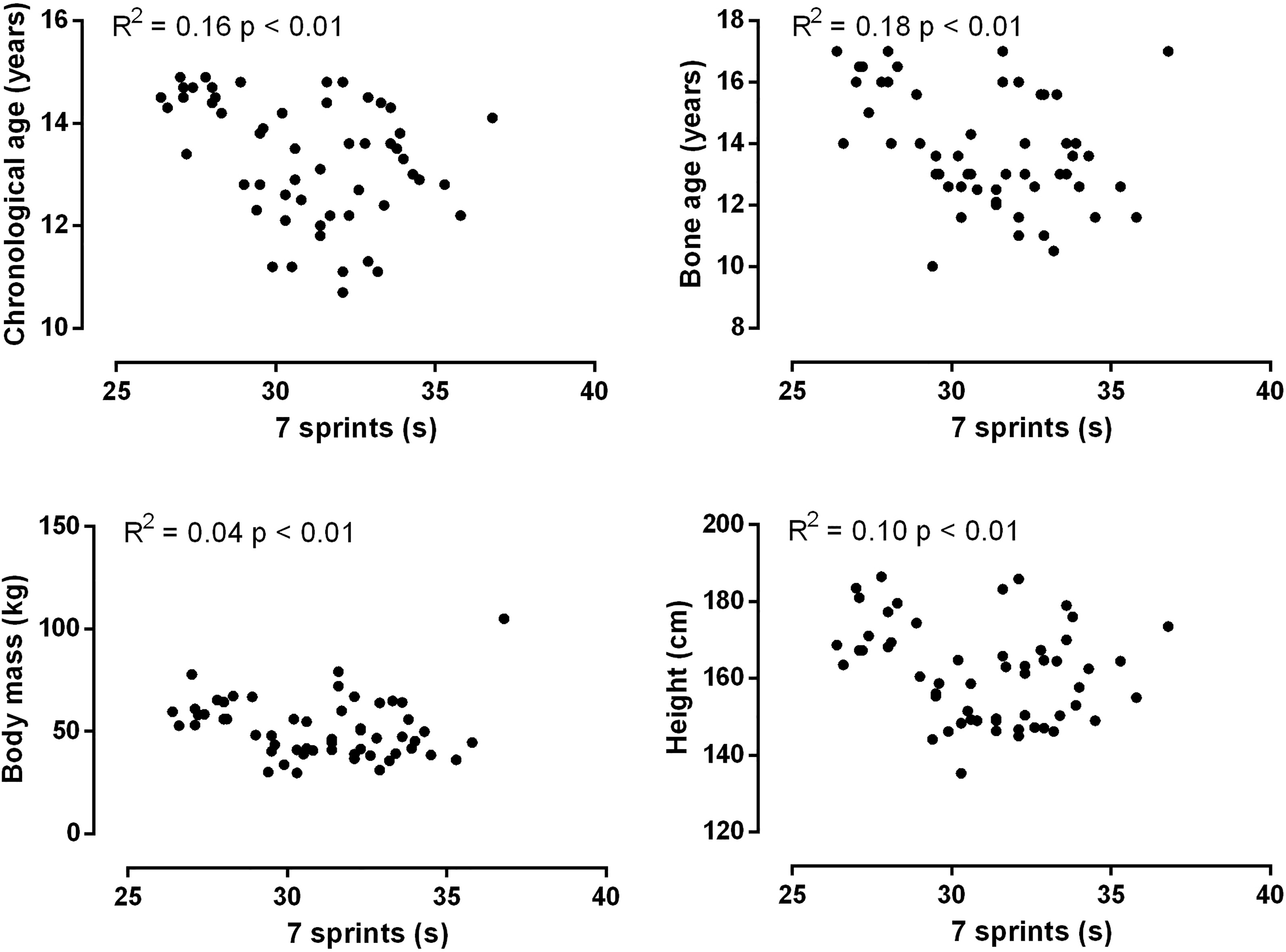
Discriminant analysis model by level of anaerobic performance (high level, average level, and low level) in U-14 soccer players
The aim of this study was to identify which of the body anthropometric variables could help in differentiating the level of anaerobic fitness in young soccer regional players. The main findings indicate that height can be used to discriminate the level of anaerobic performance in U-14 soccer players. In addition, an increase in the 7 sprints test was identified across chronological and bone age, indicating that the increase in anaerobic performance is associated with the advance in age and biological maturation.
Negative correlations between body size variables and the 7 sprints test were observed in U-14 soccer players, meaning that the decrease in body mass and height causes an increase in the time spent in the 7 sprints test. In this sense, some studies have shown that body size variables are directly influenced by the maturity process in youth players, which influences physical performance [24, 25].
Moreover, maturity status was also demonstrated to be related to anaerobic performance in the current study (Table 2). Our results showed that 66.7% of the players with high anaerobic fitness level were classified as early in the maturational process. This tends to occur because the advance in biological age causes changes in tissues and organs, increasing the energy power production, quantity of cells in the body, and enzymatic efficiency [14], which also contributes to the increase in anaerobic fitness. A study conducted by Falk and Bar-Or [26] also found that boys early in the maturational process tend to present greater performance in anaerobic exercises. In addition, Gouvea et al. [27] identified better physical performance in players advanced in the maturation process.
A study conducted by Valente dos Santos et al. [28] has shown that total sprint time improves progressively with age and several other factors contribute to this performance, such as skeletal maturity status, body mass, height, and annual training volume. At the same time, the authors report that each unit increase in fat-free mass (in kg) corresponds to an improvement of 0.25 seconds in predicted total sprint time.
Although some scientific evidence suggested the importance of growth variables on physical fitness in young players [29, 30], no significant predictors of anaerobic fitness were identified in U-17 soccer players. This can possibly be explained since individuals above 15 years, in general, have already passed peak height velocity age and thus, body growth tends to stabilize, as, consequently, does its impact on physical fitness. Besides this, the type of muscle fiber, ATP availability, and acidity caused by hydrogen ions generated by the accumulation of muscle lactate, among others also help to explain this result [14].
However, the discriminant analysis (Table 3) revealed that anaerobic fitness level in U-14 soccer players can be discriminated by height. In addition, Wong et al. [31], also observed a significant relationship between body height and 10 m and 30 m sprint times in U-14 soccer.
In this sense, the literature suggests two theoretical pathways to explain the relationship between biological maturation and anaerobic fitness. Carvalho et al. [24] and De Ste Croix et al. [32] state that the effect of maturation on the anaerobic metabolism is dependent on body size, where high anaerobic fitness is dependent on height, body mass, and free-fat mass. The second theoretical explanation is more linked to physiological and neural factors. Besides the impact of body size, neural factors and oxidative stress could help to explain anaerobic performance in youth athletes [14, 33, 34, 35].
In summary, our results confirm that body size variables are related to 7 sprints performance in youth regional athletes, where biological maturation seems to influence the physical fitness of the players, while height appears as a significant variable to be used to discriminate the level of anaerobic fitness – especially in the U-14 category. The understanding of these relations is potentially relevant to youth soccer regional players, where coaches must work with physical, tactical-technical, and psychological variables during a period of time marked by intense physical changes directly related to body growth processes.
Conclusions
Anaerobic metabolism is required to succeed in soccer. However, players advanced in the maturational process and taller tend to present higher levels of anaerobic performance, especially in the U-14 categories. This information may implicate on sport selection, as during ages related to body growth, clubs tend to exclude later maturing boys due to their disadvantage in physical-physiological indicators. Thus, it is suggested that clubs involved in selection and sporting formation assess the level of biological maturation and structure practice loads and games according to the maturity of the players, focusing not only on functional capabilities, but also on tactical, technical, and cognitive qualities.
Footnotes
Acknowledgments
We would like to express thanks to all participants for their engagement in this study, the Coordination of Improvement of Higher Education Personnel (CAPES/Brazil) for the Master scholarships conferred to J.C.C. and P.H.B., the Foundation for the Support of Scientific and Technological Development of Paraná (FAADCT/Brazil) who conceded a scientific initiation scholarship to L.F.R.S., and the National Council of Technological and Scientific Development (CNPq/Brazil) for the grants conceded to E.R.V.R. This study was partially supported by the National Council of Technological and Scientific Development (CNPq/Brazil-485176/2012-2).
Conflict of interest
The authors certify that there is no conflict of interest with any financial organization regarding the material discussed in the manuscript.