Despite the fact that there is considerable research in gender related differences in athletic performance, limited studies have been found related with the gender differences in repeated sprint ability (RSA).
OBJECTIVE:
The purpose of this study was to evaluate the gender related differences in RSA.
METHODS:
Forty team sport athletes participated in this study voluntarily and RSA was determined by a 5 6 s cycling RSA test with 24 s recovery. Participants’ peak power (PP), mean power (MP) and performance decrement (PD%) were determined as performance variables. Maximal blood lactate (La, heart rate (HR and ratings of perceived exertion (RPE were determined as physiological responses.
RESULTS:
Results indicated higher relative PP and MP for men ( 0.05) while no significant gender differences was observed in PD% ( 0.05). Men had higher La ( 0.05), while there were no gender differences in HR and RPE ( 0.05). In addition, the highest values was observed in the first sprint for both relative PP and MP regardless of gender and men performed higher than women in each cycle repetitions.
CONCLUSIONS:
In conclusion gender related differences were observed in RSA except for PD%, HR and RPE which indicated that men and women were not different in terms of fatigue resistance and experienced the same physiological strain during the RSA test.
Gender differences in athletic performance have been of great interest to researchers for many decades. Studies indicated significant differences in anaerobic power and capacity [1], muscular strength [2] and sprint time [3, 4] in favour of men. On the other hand women were found to have less fatigue then men during sprinting exercises [5] and to sustain better during continuous and intermittent muscle contractions at low to moderate intensities [2]. For the above mentioned gender differences in athletic performance several mechanisms have been attributed in terms of muscle mass, substrate utilization and muscle morphology [1, 5, 6].
For recent years repeated sprint ability (RSA) is believed to be an important fitness component for many team sports like soccer, basketball and rugby because during a game, team sport athletes perform a number of short sprints interspersed with short recovery intervals. For instance it was found that during a football game a football player performs a sprint bout approximately every 90 seconds and each of these sprints lasts about 2–4 seconds [7] and Castagna et al. [8] stated that during a game, a basketball player performs about 100–105 repeated sprints for about 2–6 seconds. Hence RSA has become one of the most important fitness requirement for team sport athletes [7, 9].
Despite the fact that there is considerable research in gender related differences in athletic performance, limited studies have been found related with the gender differences in RSA. For instance Brooks et al. [10] indicated higher power output and total work for men during 10 6 s running sprints while women had lower fatigue index compared with men. Billaut et al. [6] evaluated the potential gender differences in recovery of power output during repeated all-out cycling exercise and found that women have lower power output and greater fatigability during sprints when compared to men. Recently Laurent et al. [3] reported that men had higher absolute power outputs than women, while women fatigued less than men after 8 30 m sprints with three bouts and Esbjörnsson-Liljedahl et al. [11] found that women recovered faster following repeated bouts of maximal 30 s cycling sprints. Additionally Billaut and Smith [12] investigated the gender related changes during 20 5 s cycling repeated sprints with 25 s rest intervals and found that although men had higher mechanical work, women showed less sprint induced work decrement which indicated greater fatigue resistance for women.
Taken into account the limited research related with gender differences in RSA, this study was designed to determine gender related differences in repeated sprint performance. Gender related differences were taken as differences in: performance variables, physiological responses and performance variables across repetitions during a 5 6 s cycling RSA test. It was hypothesized that women would have lower performance values and higher physiological responses then men and men would exhibit higher rate of fatigue than women during the RSA test.
Materials and methods
Participants
Forty team sport athletes (20 women, 20 men), involved in university teams participated in this study voluntarily. Participants were informed about the aims of the study, possible risks and procedures to be used and sign a written informed consent to participate in this study. This study was approved by Baskent University Institutional Review Board and Ethics Committee (Project no KA10/183) and supported by Baskent University Research Fund. Participants were asked to refrain from any intense physical activity 24 h before the testing days.
Procedures
During a preliminary visit, participants’ physical characteristics as anthropometric measurements were taken. After these measurements, participants were familiarised with the RSA test that will be used in the study. They performed sprint cycling until they could produce an all-out effort from a stationary start. On the testing day, after a standardised 5 min of warm-up, participants performed a 5 6 s cycling RSA test with 24 s rest intervals on a mechanically braked cycle ergometer (Monark 894 E Pike Bike, Sweden). Participants’ heart rate were monitored continuously before, during and after the test and blood lactate measurements were taken before and immediately after the RSA test and during the recovery period. Ratings of perceived exertion (RPE) measurement were taken after each repetition of the RSA test. To prevent any circadian rhythm effect, all tests were performed during the same time period between 13:00 and 16:00 p.m. Tests were performed at 20–22C room temperatures with a range of 38–40% humidity. For women participants menstruation was not considered, since it has been found that repeated sprint and anaerobic performance were not affected from the menstrual cycle [13]. Participants were asked to maintain their normal diet throughout the study and not to participate in training the day before the testing day. They were also informed not to consume alcohol and caffeine the day before and during the testing days and to have their meal at least two hours prior to the test.
Anthropometrical measurements
Participants height and body weight measurements were performed with standardised methods [14]. For body composition assessment, skinfold callipers(Holtain, UK) were used to assess four anatomical sites for women (triceps, abdominal, suprailiac, thigh) and seven anatomical sites for men (chest, midaxillary, triceps, subscapula, suprailiac, abdominal, thigh). For body density Jackson and Pollock formula and for body fat percentage Siri formula was used [14].
Cycle RSA test
As indicated before, for determination of repeated sprint performance, participants participated in a 5 6 s cycle RSA test with 24 s of passive recovery duration. The repeated sprint test was performed against a load of 10% of body weight without pedal acceleration (initial speed was zero). During the RSA test inertial momentum of the pedal was not taken into consideration in calculation of the measured power outputs. It has been recommended to use higher resistive loads without acceleration in conditions where there is no chance of correcting inertia [15]. Therefore in the present study resistive load of 10% of body weight was used during the RSA test without inertia correction.
Before each 5 6 s cycle RSA test, each participant had a warm-up at 50–70 W for 5 minutes. At the 2 and 4 minute of the warm-up period each participant performed an all-out sprint cycling for 5 s as a preparatory condition. After the warm-up, participants were given a 5-minutes of recovery before starting the 5 6 s cycle RSA test. The test consisted of five 6 s maximal cycle sprints with 24 s of recovery period. Toe strips and heel straps were used to secure the feet of the pedals and each sprint was performed in the sitting position. The test was initiated with the dominant leg and the crank arm was located 45–60 forward to the vertical axis. During the 24 s recovery period, participants performed a passive rest. About 5 s before starting the next sprint, participants were asked to assume ready position and await the start signal. Strong verbal encouragement was provided to each participant during all sprints.
The calculated performance variables of the 5 6 s cycle RSA test were as follows:
Peak power output (PP): The highest power output reached in each sprint cycle.
Mean power output (MP): The average power output reached in each sprint cycle.
Performance of decrement (PD%): The decrement percentage in the power output was calculated with the following formula [16].
PD% 100 (total peak power/ideal peak power 1)
Ideal peak power: Peak power output 5.
Blood lactate measurements
Participants’ blood lactate levels were determined before (La), immediately after each sprint cycle and after the RSA test with 3 minutes intervals until the highest value was achieved. Blood samples were taken from the earlobe and analysed with an YSI Sport 1500 L-Lactate Analyser with a cell-lysing agent (Yellow Springs Instruments, Yellow Springs, OH, USA). The lactate analyser was calibrated as indicated in its manual on each testing day to ensure the accuracy of the measurements. The highest lactate value was accepted as maximal lactate value (La).
Heart rate measurements
Participants’ beat-to-beat heart rate was measured by polar heart rate monitors (Polar 810i, Polar Electro, Kempele, Finland). Heart rate was measured at rest and during the RSA test. All R-R interval series were extracted (Polar Protrainer 5.1, Polar Electro, Kempele, Finland) and occasional ectopic beats were visually identified and manually replaced with interpolated adjacent R-R interval values. Before warm-up participants rested in sitting position for about 3 minutes and resting heart rate (HR) was recorded when the heart rate was stabilised. From the recorded heart rates, on the other hand the highest value was accepted as maximum heart rate (HR).
Descriptive characteristics of men and women athletes
Variables
Men ( 20)
Women ( 20)
Age (yrs.)
22.15 3.32
20.00 1.83
2.529
Experience (yrs.)
9.35 4.31
6.00 4.01
2.541
Height (cm)
181.52 7.08
166.24 5.76
7.477
Body weight (kg)
81.46 8.92
61.36 5.88
8.402
Body fat (%)
11.40 4.02
23.52 4.11
9.423
La (mmol/L)
1.06 0.27
1.04 0.33
0.149
HR (bpm)
64.65 7.22
76.73 17.88
2.794
0.001, 0.05.
Ratings of perceived exertion measurements
Each participant’s RPE was recorded immediately after each repetition of the RSA test by using the Borg 6–20 RPE scale. As known, this scale consists of numbered categories, from 6 to 20, and verbal cues from “very very light” to “very very hard”. A large copy of the scale was displayed in front of the participants immediately after each cycle sprints and the participants were asked how hard they felt when they were performing each cycle sprint of the RSA test. The highest RPE value was accepted as the maximum RPE score (RPE).
Statistical analyses
All values are reported as the mean standard deviation. Tests for homogeneity of variances (Shapiro-Wilk Test) were performed to ensure the normality of the population for every dependent variable. With the assumption of normality confirmed, independent samples t-test was used to compare performance and physiological variables between women and men. 5 2 two-way repeated measures ANOVA (sprint number gender) were used to compare the following dependent variables across each cycle sprints: PP, MP, PD%. Bonferroni post hoc analyses were used to determine differences among pairs of means when ANOVAs revealed a significant F ratio for main or interactive effects. Analyses were performed by using SPSS 16.0 for Windows and the level of significance was set at 0.05.
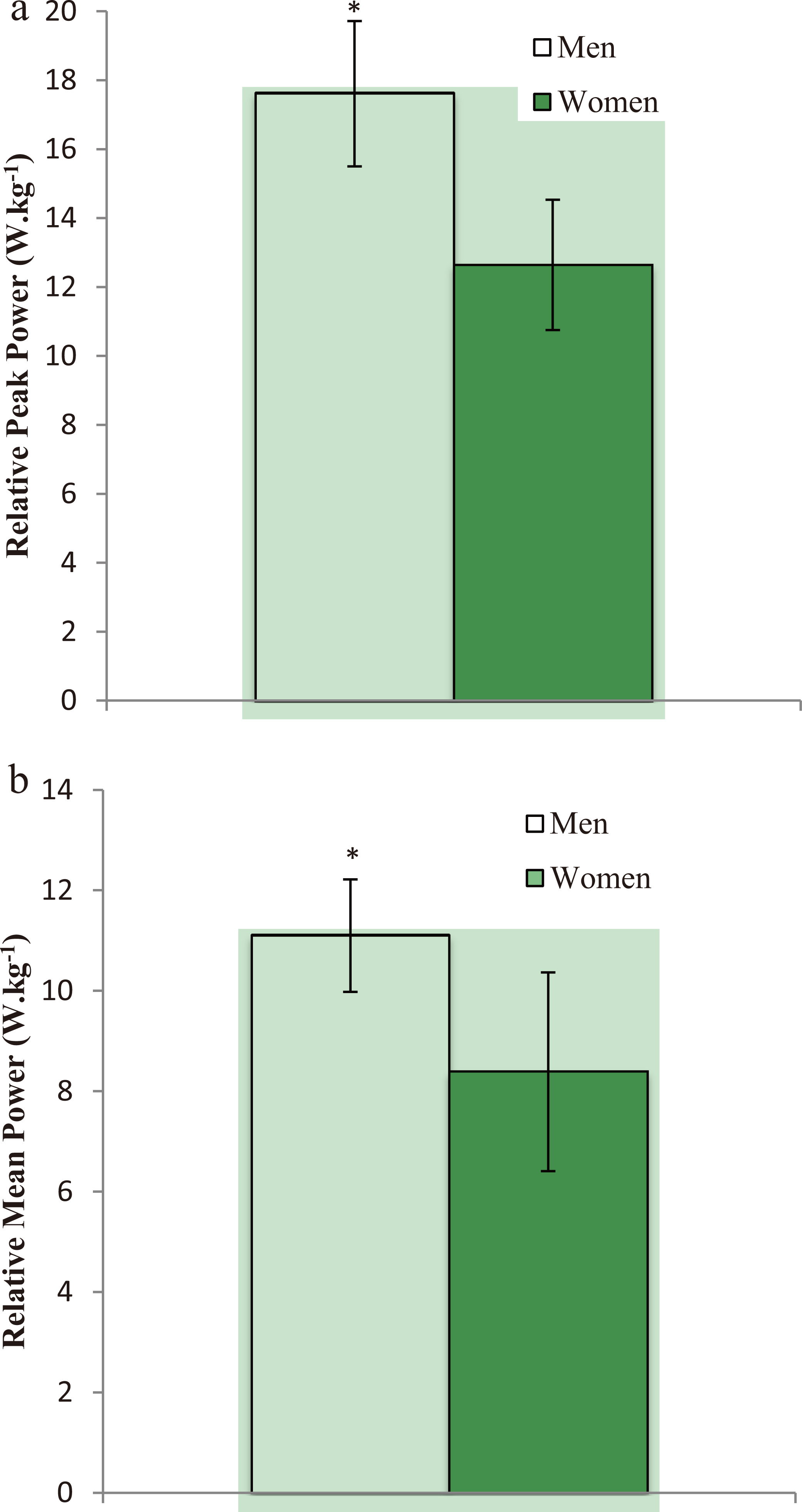
(a) Relative PP and (b) relative MP during the 5 6 s cycle test of men and women athletes. *Significantly higher than women athletes ( 0.001).
Results
Descriptive data
Descriptive data of men and women athletes are presented in Table 1. As can be seen from Table 1, significant differences were observed between men and women in all of the descriptive variables except La. Men were significantly older ( 0.016), taller ( 0.000) and heavier ( 0.000) than women athletes. On the other hand women athletes had significantly higher body fat % ( 0.000) and HR ( 0.008) than men athletes. In addition men had higher sport experience than women ( 0.015).
Performance variables
Results of the independent samples t-test indicated significant differences in relative PP (PP: 17.61 2.11 Wkg, PP: 12.64 1.89 Wkg; 7.825; 0.000) and relative MP (MP: 11.09 1.12 Wkg, MP: 8.39 1.98 Wkg: 7.394; 0.000) between men and women (Fig. 1a and b respectively). On the other hand no significant gender differences were observed in PD% (PD%: 9.86 4.80%, PD%: 8.46 4.15%; 0.982; 0.05).
Physiological variables
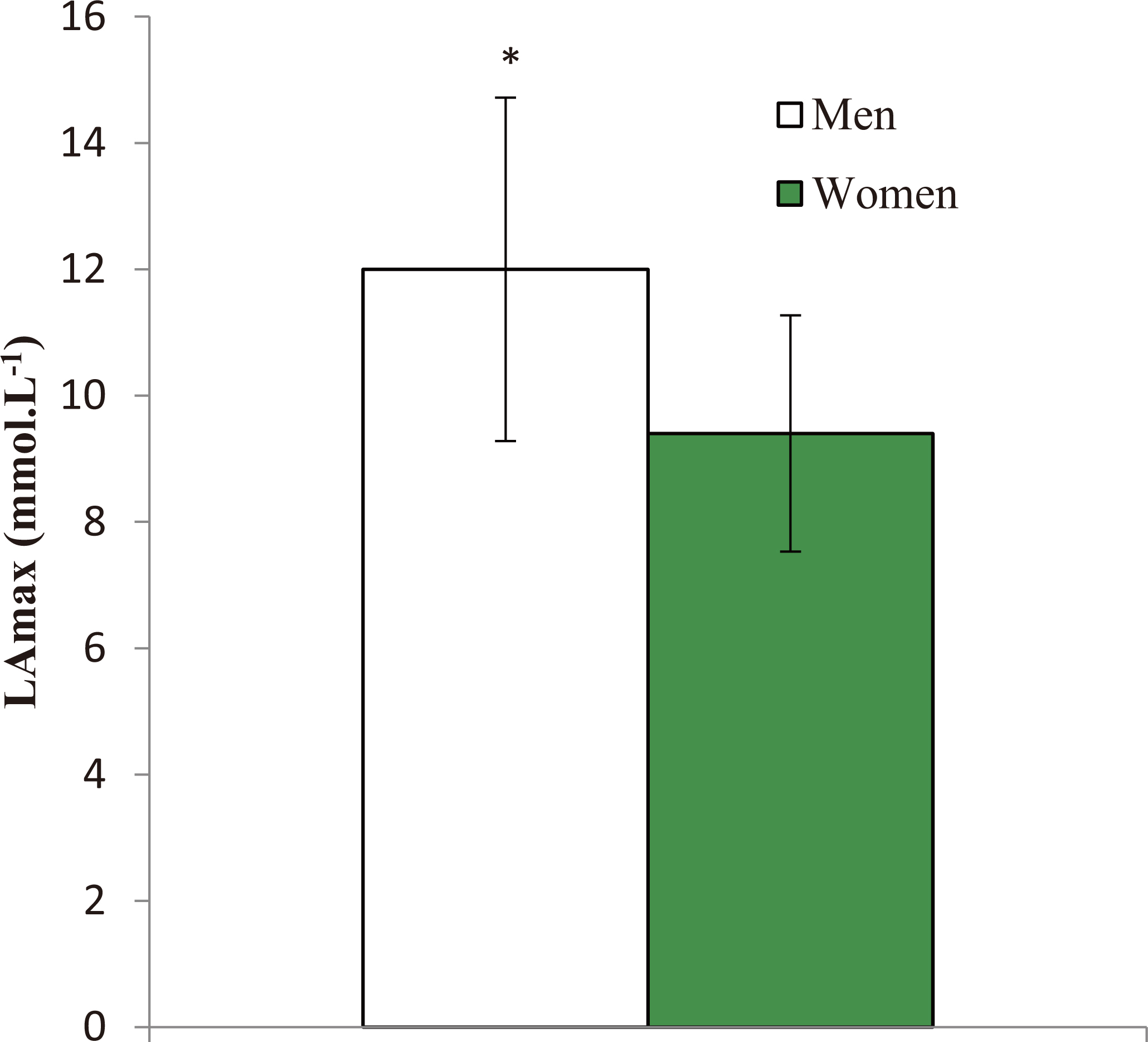
Results indicated significant differences in La values (M: 12.00 2.72 mmolL, M: 9.4 1.97 mmolL; 3.509; 0.001) between men and women (Fig. 2) while no significant differences were observed in HR (M: 178.15 14.65 beats min, M: 180.68 15.11 beats min; 0.301; 0.05) and RPE values (M: 16.60 2.18, M: 16.80 2.01; 0.532; 0.05). Men participants had significantly higher La values than women participants.
Performance variables across repetitions
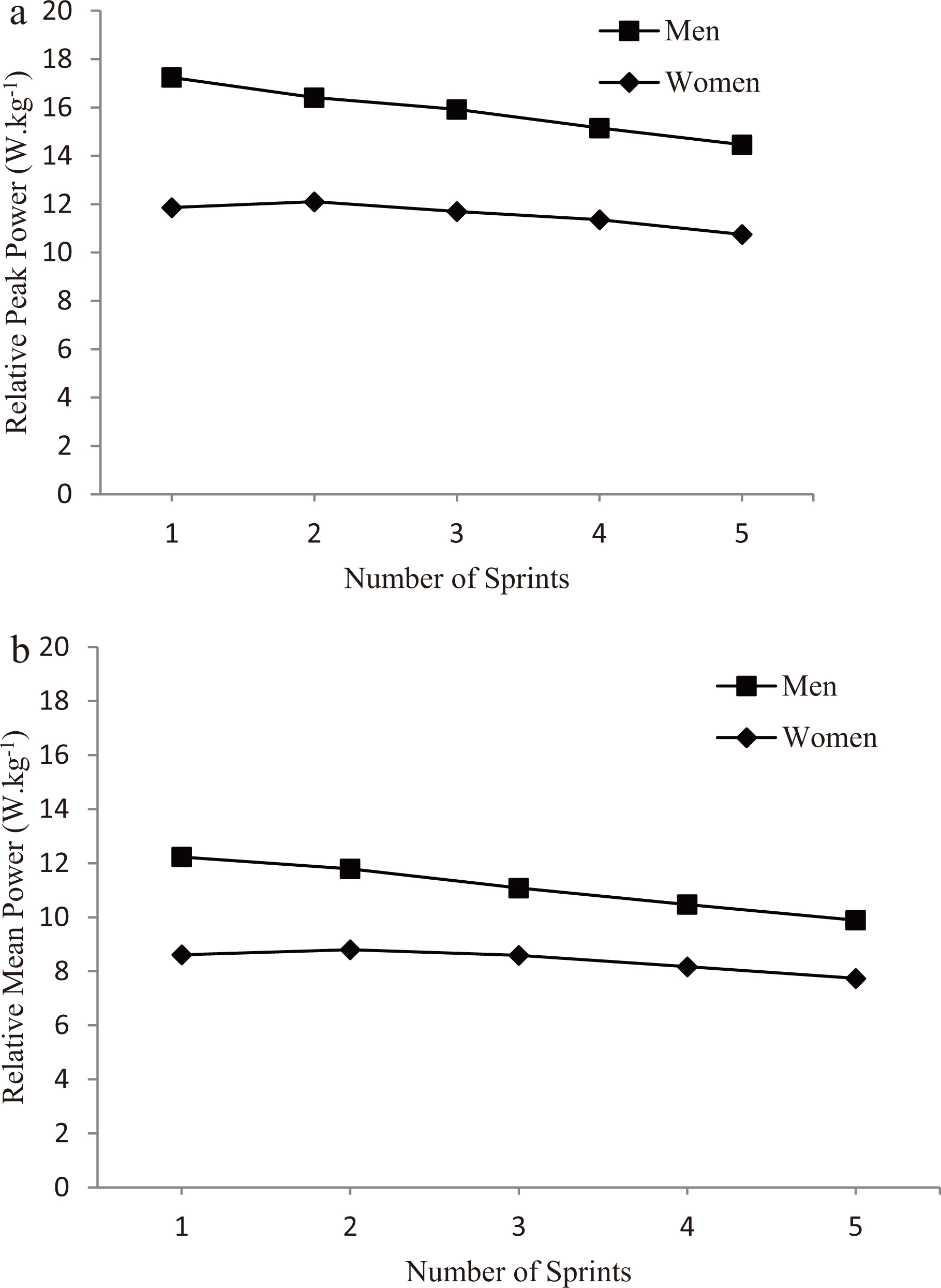
The relative PP and MP values recorded during each sprint of the RSA test are given in Fig. 3a and b respectively. For the relative PP, the highest value was recorded during the first sprint in men (17.24 2.35 Wkg) and during the second sprint in women (12.10 2.10 Wkg). A significant main effect for the number of sprints were observed in all participants regardless of gender ( 10.68; 0.000) and bonferroni post hoc analysis indicated that this difference was due to the first cycle sprint. All participants performed the highest relative PP during the first sprint of the 5 6 s cycle RSA test. In addition we also noted a significant main effect of gender on relative PP ( 62.08; 0.000) and post hoc analysis indicated that relative PP of men were higher than women (Fig. 3a). No significant interaction effect of sprint number and gender was observed in relative PP ( 0.05).
For the relative MP, the highest value was observed during the first sprint in men (12.23 1.61 Wkg) and during the second sprint in women (8.80 1.54 Wkg). A significant main effect for number of sprints were determined in all participants regardless of gender ( 13.41; 0.000) and post hoc analysis indicated that this difference resulted from the first cycle sprint. All participants performed the highest relative MP during the first sprint of the RSA test. A significant main effect of gender on relative MP ( 54.67; 0.000) was also observed and post hoc analysis indicated that men had higher relative MP than women (Fig. 3b). In addition no significant interaction effect of sprint number and gender was observed in relative MP ( 0.05).
La values of men and women participants during the 5 6 s cycle test. *Significantly higher than women athletes ( 0.001).
(a) Relative PP and (b) relative MP across the sprints in men and women athletes. For both relative PP and MP, first sprint was significantly higher than the rest of the sprints in both genders ( 0.05). For both relative PP and MP men performed significantly higher than women in each sprint ( 0.05). For both relative PP and MP interaction effect for sprint number x gender was not significant ( 0.05).
Discussion
This study investigated the gender related differences in RSA. Consistent with previous research we found a higher relative PP and MP in men than in women. For example Billaut and Smith [12] indicated higher absolute and relative work in men than in women during twenty, 5 s cycle sprints separated by 25 s rest periods. In another study Laurent et al. [3] observed that men produced higher absolute power outputs than women during three bouts of 8 30 m running repeated sprints. Hence the observed significant difference in power output between men and women were not surprising. It is known that men have higher lower extremity muscle mass [4], muscle cross sectional area of type II fibres [1, 17] and higher glycolytic enzyme activities than women [18] which all explain the higher power output values in men than in women during repeated sprints as in the present study.
Another finding of the present study is the nonsignificant difference in performance decrement between men and women during 5 6 s cycle RSA test. Although men had higher performance decrement than women this difference was not significant (9.86% in men vs 8.46% in women). This finding is very interesting because most of the studies in the literature have found that women had lower performance decrement than men. For instance Laurent et al. [3] indicated that women had significantly lower performance decrement than men during 3 bouts of 8 30 m running RSA test and Billaut and Bishop [19] observed lower performance decrement in women than in men during 20 5 s cycling RSA test with 25 s rest periods. In addition Billaut and Smith [12] observed lower performance decrement in women than in men during twenty, 5 s cycle sprints interspersed with 25 s recovery durations. Despite the fact that there is limited research related with gender differences in performance decrement during repeated sprints, most of the studies indicated that men experience greater decrements in performance during repeated sprints. Most of the researchers stated that greater fatigue resistance in women may be explained by women having a greater aerobic contribution to energy supply [1, 20, 21], lower accumulation of by-products issued from anaerobic glycolysis [1, 22], a lower depletion rate of phosphocreatine stores [23], smaller muscle ATP reduction in women than in men during repeated sprints [11] and a lower attenuation in skeletal muscle recruitment [5, 12]. One of the reasons for not finding a significant difference in performance decrement in the present study may be related to the type of the RSA test. In the above mentioned studies that found higher performance decrement in men, the RSA tests were 3 bouts of 8 30 m running and 20 5 s cycle RSA tests interspersed with 25 s. In the present study we used 5 6 s cycle RSA test with 24 s of rest periods. It may be that the repeated sprint test used in the present study could not drive enough fatigue to reach a significant gender difference in performance decrement.
Findings related to the gender differences in physiological responses to RSA indicated that men had higher La values than women while no significant differences was observed in HR and RPE. Lower lactate responses can be explained by differences in muscle mass, cross-sectional area and muscle fibre distribution and the adrenergic responses to supramaximal exercise between men and women [18, 22, 23, 24]. As known men have higher muscle mass, cross-sectional area and concentration and activation rate of Type II muscle fibres that lead to higher power output compared to women [6, 17, 18, 19, 20, 21, 22, 23, 24] which in turn may lead to higher lactate concentrations after the RSA test in the present study. The differences in muscle fibre type will impact the substrate utilization and time to fatigue as Type II fibres rely mostly on phosphagen system and glycolytic pathways. Finding higher La values in men might suggest that men have higher level of Type II muscle fibre activation and higher glycolytic rate compared to women. This notion was also supported by previous research. In a study by Simoneau and Bouchard [18] which determined the extent of the variation in some of the common characteristics of human skeletal muscle, men was found to have higher levels of glycolytic enzyme markers than women. In addition men were also found to have larger Type II fibre areas than women in vastus lateralis [24]. Similarly finding higher La responses in men was supported by the study of Laurent et al. [3] which reported that women had lower blood lactate concentrations than men after 3 bouts of 8 30 m RSA tests.
Findings indicated no significant differences in terms
of HR and RPE responses to the 5 6 s RSA test. The result related with HR is similar to the findings of the previous research. For instance Fomin et al. [25] determined sex-differences in response to maximal exercise in trained adolescents and found no significant sex-differences in HR and Kappus et al. [26] investigated sex-differences following maximal exercise and no significant differences were observed between men and women following a maximal exercise bout. Finally Laurent et al. [3] have found no significant gender differences in HR following maximal intensity repeated sprint performance. For the results related with RPE, it can be said that findings are consistent with the study of Winborn et al. [27]. They reported no significant differences in RPE between men and women subjects of low and high athletic experience during submaximal exercise intensities equivalent to 30, 50 and 70% of cycle ergometer VO. Finally Billaut and Smith [12] reported no significant gender differences in RPE scores during 20 5 s repeated sprint test. These findings together with the findings of the present study indicated that women and men do not differ in their perception of physical exertion during exercise with different intensities (aerobic and anaerobic) and during RSA tests. Findings of the present study related with HR and RPE responses showed that men and women athletes experienced the same physiological strain during the 5 6 s RSA test.
Findings related to the performance variables across repetitions of 5 6 s RSA test indicated that for all participants regardless of gender, the highest relative PP and MP values were obtained in the first cycle sprint and men performed higher than women in each cycle repetition. Having significantly higher PP and MP outputs in the first cycle sprint is not surprising since in most of the RSA studies the highest power outputs were observed in the first cycle sprint [28, 29]. For instance Gaitanos et al. [28] and Mendez-Villanueva et al. [29] indicated significantly higher PP and MP in the first cycle sprints after 10 6 s with 30 s recovery durations. Gaitanos et al. [28] indicated that within a 6 s cycling sprints, muscle PCr and ATP concentrations were found to drop 57 and 13% respectively compared with resting values. Hence we can say that muscle phosphagen stores in the present study might be fully used in the first cycle sprint and 24 s of recovery durations might not be sufficient to replenish PCr stores and for the maintenance of PP and MP outputs during the consecutive cycle sprints. The average difference in relative PP and MP between genders was 39.32% and 32.18% respectively. Our data are in agreement with the previous research showing consistent higher performance in men than in women during RSA [6, 12, 13, 14, 15, 16, 17, 18, 19]. It is known that during maximal cycling sprint Type II muscle fibres are mostly activated [30]. As stated before, gender differences in PP and MP across each RSA repetitions may be related to smaller percentage of Type II fibres and smaller cross-sectional area of Type II fibres in women than in men [17, 24]. In addition greater contribution of anaerobic glycolytic pathway in men might be another reason for higher PP and MP in men than in women [1, 20, 21, 22, 23, 24, 25, 26, 27, 28, 29, 30, 31].
Limitations of the study
This study has some limitations. One of these is the omission of the inertia correction. Although high resistive load (10% BW) was used without inertia correction in the present study, it is known that when inertia correction is omitted both power output and the fatigue profile are underestimated by an amount dependent on the resistive load [15]. Moreover Falgairette et al. [32] also indicated that there was no change in gender differences whether inertia correction was included or excluded. Therefore when comparing power outputs of women and men athletes with similar characteristics in the present study the results should be interpreted carefully with the notion that the RSA test was performed without inertia correction. Another limitation of the present study is the task dependent nature of the RSA. It has been stated that power output and fatigue during RSA test is task dependent and cycling RSA tests results in higher power outputs and more fatigue than running RSA tests [33]. Since the participants of the present study were team sport athletes who use running as an exercise mode, the power output and fatigue results should be interpreted carefully by considering the task dependency of the RSA tests.
Conclusion
This study supports the notion that men have higher PP and MP output during RSA test than women while failing to indicate gender differences in terms of performance decrement. In addition for physiological responses to RSA test men had higher La values than women while no gender differences were observed in HR and RPE responses. Taken into account the performance variables across the repetitions, all participants produced the highest PP and MP output during the first sprint cycle of the RSA test and women yielded significantly lower values across all repetitions. These data show that gender related differences are obtained in repeated sprint performance except for PD%, HR and RPE which indicates that men and women are not different in terms of fatigue resistance and experience the same physiological strain during the 5 6 s RSA test.
Footnotes
Conflict of interest
The authors declare no conflict of interest.
References
1.
Esbjörnsson-LiljedahlMSundbergCJNormanBJanssonE. Metabolic response in type I and type II muscle fibers during a 30-s cycle sprint in men and women. J Appl Physiol1999; 87(4): 1326-32.
2.
WüstRCMorseCIDe HaanAJonesDADegen,H. Sex differences in contractile properties and fatigue resistance of human skeletal muscle. Exp Physiol2008; 93(7): 843-50. doi: 10.1113/expphysiol.2007.041764. Epub 2008 Feb 22.
3.
LaurentCMGreenJMBishopPASjökvistJSchumackerRERichardsonMT, et al. Effect of gender on fatigue and recovery following maximal intensity repeated sprint performance. J Sports Med Phys Fitn2010; 50(3): 243-53.
4.
Perez-GomezJRodriguezGVAraIOlmedillasHChavarrenJGonzález-HenriquezJJ, et al. Role of muscle mass on sprint performance: gender differences? Eur J Appl Physiol2008; 102: 685-94. doi: 10.1007/s00421-008-0710-1.
5.
BillautFBishopD. Muscle fatigue in males and females during multiple-sprint exercise. Sports Med2009; 39(4): 257-78. doi: 10.2165/00007256-200939040-00001.
6.
BillautFGiacomoniMFalgairetteG. Maximal intermittent cycling exercise: Effects of recovery duration and gender. J Appl Physiol2003; 95(4): 1632-7.
7.
StølenTChamariKCastagnaCWisløffU. Physiology of soccer: An update. Sports Med2005; 35(6): 501-36.
8.
CastagnaCManziVD’ottavoSAnninoGPaduaEBishopD. Relation between maximal aerobic power and the ability to repeat sprints in young basketball players. J Strength Cond Res2007; 21(4): 1172-6.
BrooksSNevillMEMeleagrosLLakomyHKAHallGMBloomSR, et al. The hormonal responses to repetitive brief maximal exercise in humans. Eur J Appl Physiol1990; 60(2): 144-8.
11.
Esbjörnsson-LiljedahlMBodinKJanssonE. Smaller muscle ATP reduction in women than in men by repeated bouts of sprint exercise. J Appl Physiol2002; 93(3): 1075-83.
12.
BillautFSmithK. Sex alters impact of repeated bouts of sprint exercise on neuromuscular activity in trained athletes. Appl Physiol Nutr Metab2009; 34(4): 689-99. doi: 10.1139/H09-058.
13.
WiecekMSzymuraJMaciejczykMCemplaJSzygulaZ. Effect of sex and menstrual cycle in women on starting speed, anaerobic endurance and muscle power. Acta Physiol Hung2016; 103(1): 127-32. doi: 10.1556/036.103.2016.1.13.
14.
HeywardVStolarczykLM. Applied Body Composition Assessment. Champaign: Human Kinetics1996; 76-85.
15.
BogdanisGPapaspyrouALakomyHNevillM. Effects of inertia correction and resistive load on fatigue during repeated sprints on a friction-loaded cycle ergometer. J Sports Sci2008; 26(13): 1437-45. doi: 10.1080/02640410802209000.
16.
OliverJLArmstrongNWilliamsCA. Relationship between brief and prolonged repeated sprint ability. J Sci Med Sport2009; 12(1): 238-43.
17.
GlenmarkBHedbergGJanssonE. Changes in muscle fibre type from adolescence to adulthood in women and men. Acta Physiol Scand1992; 146(2): 251-9.
18.
SimoneauJABouchardC. Human variation in skeletal muscle fiber-type proportion and enzyme activities. Am J Physiol Endocrinol Metab1989; 257(4): 567-72.
19.
BillautFBishopD. Mechanical work accounts for sex differences in fatigue during repeated sprints. Eur J Appl Physiol2012; 112(4): 1429-36. doi: 10.1007/s00421-011-2110-1. Epub 2011 Aug 10.
20.
BulbulianRJeongJWMurphyM. Comparison of anaerobic components of the Wingate and Critical Power tests in males and females. Med Sci Sports Exerc1996; 28(10): 1336-41.
21.
HillDWSmithJC. Gender difference in anaerobic capacity: Role of aerobic contribution. Br J Sports Med1993; 27(1): 45-8.
22.
Gratas-DelamarcheALe CamRDelamarchePMonnierMKoubiH. Lactate and catecholamine responses in male and female sprinters during a Wingate test. Eur J Appl Physiol1994; 68(4): 362-6.
23.
DrissTVandewalleH. The measurement of maximal (anaerobic) power output on a cycle ergometer: A critical review. Biomed Res Int2013; 2013: 1-40. doi: 10.1155/2013/589361. Epub 2013 Aug 29.
24.
MillerAEJMacDougallJDTarnopolskyMASaleDG. Gender differences in strength and muscle fiber characteristics. Eur J Appl Physiol1993; 66(3): 254-62.
25.
FominÅAhlstrandMSchillHGLundLHStåhlbergMManourasA, et al. Sex differences in response to maximal exercise stress test in trained adolescents. BMC Pediatr2012; 12: 127. doi: 10.1186/1471-2431-12-127.
26.
KappusRMRanadiveSMYanHLane-CordovaADCookMDSunP, et al. Sex differences in autonomic function following maximal exercise. Biol Sex Differ2015; 6: 1-28. doi: 10.1186/s13293-015-0046-6. eCollection 2015.
27.
WinbornMDMeyersAWMullingC. The effects of gender and experience on perceived exertion. J Sport Exerc Psychol1988; 10(1): 22-31.
28.
GaitanosGCWilliamsCBoobisLHBrooksS. Human muscle metabolism during intermittent maximal exercise. J Appl Physiol1993; 75(2): 712-9.
29.
Mendez-VillanuevaAHamerPBishopDJ. Fatigue in repeated-sprint exercise is related to muscle power factors and reduced neuromuscular activity. Eur J Appl Physiol2008; 103(4): 411-9. doi: 10.1007/s00421-008-0723-9.
30.
CaseyAConstantin-TeodosiuDHowellSHultmanEGreenhaffPL. Metabolic response of type I and II muscle fibers during repeated bouts of maximal exercise in humans. Am J Physiol Endocrinol Metab1996; 271(1): 38-43.
31.
WeyandPGCuretonKJConleyDSHigbieEJ. Peak oxygen deficit during one- and two-legged cycling in men and women. Med Sci Sports Exerc1993; 25(5): 584-91.
32.
FalgairetteGBillautFGiacomoniMRamdaniSBoyadjianA. Effect of inertia on performance and fatigue pattern during repeated cycle sprints in males and females. Int J Sports Med2004; 25(3): 235-40.
33.
BishopDJ. Fatigue during intermittent-sprint exercise. Proc Aus Physiol Soc2012; 43: 9-15.