



Abstract
BACKGROUND:
As a novel class of endogenous ncRNAs, Circular RNAs (circRNAs) have been verified to be involved in the carcinogenesis and tumor progression.
OBJECTIVE:
This study aimed to investigate the potential function of a candidate circRNA hsa_circ_0036988 in oral squamous cell carcinoma (OSCC).
METHODS:
The altered expression of hsa_circ_0036988 was validated by quantitative real-time polymerase chain reaction (qRT-PCR) in OSCC samples and OSCC cell lines. The associations between the levels of hsa_circ_0036988 and the clinicopathological features were statistically analysed. The function of hsa_circ_0036988 in OSCC were evaluated via a series of in vitro experiments by using constructed plasmids or siRNA. Western blotting assays were conducted to evaluate changes in protein expression levels.
RESULTS:
Hsa_circ_0036988 was significantly downregulated in OSCC tissues compared with adjacent normal tissues. While low expression of hsa_circ_0036988 was highly correlated with lymph nodes metastasis. Overexpression or knockdown of hsa_circ_0036988 significantly affected the proliferation, migration and invasion of OSCC cells. Furthermore, the altered expression of hsa_circ_0036988 have an impact on the epithelial-to-mesenchymal transition (EMT)-related protein expression levels.
CONCLUSIONS:
Our findings indicated that hsa_circ_0036988 may affect cell proliferation, migration and invasion by regulating EMT progress, which might provide a therapeutic strategy for the treatment of OSCC.
Introduction
As one of most common malignant tumors in the head and neck region, oral squamous cell carcinoma (OSCC) accounts for roughly 2% of all cancers [1]. Despite advances in diagnosis and clinical therapy, most of patients with OSCC are diagnosed at an advanced stage. As the progress of cancer from early stage to the late, the survival rate decreases dramatically with an overall 5-year relative survival rate for OSCC for approximately 60% [2], and the rate is even lower in the case of patients with lymph node metastasis or regional recurrence [3, 4]. Therefore, there is a compelling need to identify novel biomarkers for OSCC diagnosis and to uncover the underlying molecular mechanisms of OSCC.
Due to the rapid development of sequencing technology, numerous of functional circular RNAs (circRNAs) were identified to be related to physiological or pathological processes, playing crucial roles in tumorigenesis and cancer progression [5]. Unlike traditional linear RNAs, circRNAs are formed from closed loop RNAs by back splicing and covalent binding, without 5
Previously, through high-throughput RNA sequencing, 8 pairs of OSCC and adjacent normal tissues were analyzed to screen for differentially expressed circRNAs [12]. We found that a novel circRNA hsa_circ_0036988 is a significantly down-regulated gene in OSCC tissues. Hsa_circ_0036988, a transcription product of the CHD2 gene, is located at chromosome15 (chr15:93521463-93522513). In the present study, we verified that hsa_circ_0036988 was remarkable down-regulated in OSCC samples and cell lines, and associated with lymph node metastasis. A series of vitro experiment demonstrated that hsa_circ_0036988 could affect cell proliferation, migration, invasion and EMT in OSCC. These findings endow hsa_circ_0036988 the promising potential as a novel diagnostic and therapeutic marker for OSCC.
Materials and methods
Clinical specimens
A total of 42 pairs of cancer tissues and matched adjacent normal tissues were obtained from OSCC patients who had surgical resection of the primary tumor at Department of Oral and Maxillofacial Surgery, Peking University Shenzhen Hospital from May 2018 to December 2019. All patients did not receive radiotherapy and chemotherapy before surgery. Informed consent was obtained from patients and that the study was performed in accordance with The Code of Ethics of the World Medical Association (Declaration of Helsinki), printed in the British Medical Journal (18 July 1964). This study was approved by Ethics Committee of Peking University Health Science Center (IRB0000105308043).
Cell culture and transfection
Human oral epithelial keratinocyte (HOK) cells were purchased from the Cell Bank of the Chinese Academy of Sciences (Shanghai, China). The human OSCC cell lines SCC15, SCC25, and CAL27 were donated from the College of Stomatology, Wuhan University (Wuhan, China). All cell lines were cultured in Dulbecco’s modified Eagle medium (DMEM; Gibco, USA) containing 10% fetal bovine serum (FBS; Gibco). And the cells were incubated in a humidified atmosphere with 5% CO
Small interfering RNA (siRNA) was designed and synthesized by RiboBio (Guangzhou, China). The sequences of hsa_circ_0036988 were cloned into the pcDNA3.1 vector by Genepharma (Suzhou, China). Plasmids and siRNA transfections were conducted using Lipofectamine 3000 (Invitrogen, USA).
RNA extraction and qRT-PCR
Total RNA was extracted using Trizol reagent (Takara, Japan) according to the manufacturer’s protocol. Subsequently, cDNA was synthesized through RNA reverse transcription using PrimeScript
Cell Counting Kit-8 (CCK-8) assay
The transfected cells were seeded into a 96-well plate at a density of 1.5
5-ethynyl-2
-deoxyuridine (EdU) incorporation assay
Cells were seeded into 24-well plates with 2
Transwell assay
Migration and invasion experiments were performed using 24 well Transwell chamber (8-
Western blot analysis
Total protein was extracted by RIPA lysis buffer (Millipore, Billerica MA, USA). BCA Protein Assay Kit (Beyotime, Shanghai) was used to measure the protein concentration according to its protocol. Total protein was boiled at 100
Online prediction
CircRNA/miRNA interaction was predicted with miRNA target prediction software CircInteractome (
Statistical analysis
Statistical analyses were performed by using SPSS 17.0 software (IBM, USA) and Graphpad Prism version 6.0 (GraphPad Software, USA). Results in graphs were shown as the Mean
Correlation between clinicopathological features and hsa_circ_ 0036988 expression in OSCC patients
Correlation between clinicopathological features and hsa_circ_ 0036988 expression in OSCC patients
SD: Standard Deviation.
Downregulation of hsa_circ_0036988 in OSCC tissues and cell lines
Hsa_circ_0036988 is encoded from chromosomal re-gion 15q26, formed by two exons. Clinical OSCC tissues (42 pairs) and adjacent normal tissues were analyzed by qRT-PCR. The expression of hsa_circ_0036988 was significantly lower in OSCC samples than that of the adjacent normal tissues (Fig. 1A). Moreover, low expression of hsa_circ_0036988 accounted for 90% (38/42) of OSCC specimens (Fig. 1B). Furthermore, the expression of hsa_circ_0036988 was significantly downregulated in the human OSCC cell lines (SCC15, SCC25, and CAL27) compared to HOK (Fig. 1C).
Expression of hsa_circ_0036988 in cancer tissues and cell lines. (A) Hsa_circ_0036988 was significantly downregulated in tumor tissues compared to adjacent normal tissues, as detected using qRT-PCR. (B) The relative expression of hsa_circ_0036988 was down-regulated in 90% (38/42) OSCC patients. (C) Relative expression of hsa_circ_0036988 in OSCC cell lines and HOK were detected using qRT-PCR. Student’s 
The potential relationship between hsa_circ_0036988 expression and the clinical characteristics of patients with OSCC was analyzed. As presented in Table 1, the expression level of hsa_circ_0036988 was correlated with lymph node metastasis. The ROC is a comprehensive index used to reflect the sensitivity and specificity of continuous variables. When the area under the curve is larger, the diagnostic value of the variable is higher. Therefore, a ROC curve was constructed to estimate the diagnostic value of hsa_circ_0036988 in OSCC. The area under the ROC curve (AUC) was 0.7783 (Fig. 2), suggesting that hsa_circ_0036988 had diagnostic value as an indicator of OSCC.
ROC curve was used to evaluate the diagnostic value of hsa_circ_0036988 in OSCC. The area under the ROC curve was 0.7783.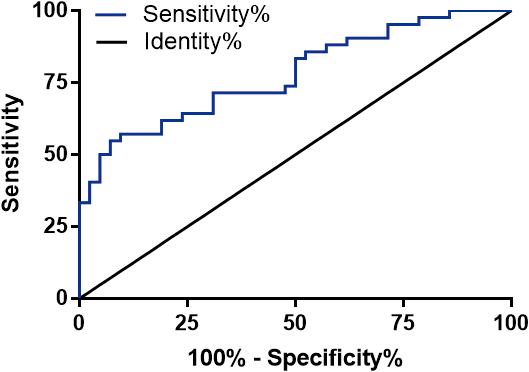
Hsa_circ_0036988 inhibits the proliferation ability in OSCC cells. (A) The efficiency of hsa_circ_0036988 overexpression in SCC15 cells and knockdown in CAL27 cells was measured. (B) CCK8 assay was performed when overexpressing or knockdown hsa_circ_0036988 in OSCC cells. (C, D) The EdU incorporation assay was performed to measure the proliferation ratio in SCC15 with the overexpression of hsa_circ_0036988 (C) and in CAL27 with the knockdown of hsa_circ_0036988 (D). Student’s 
Transwell assay was performed to compare cell migration and invasion after transfected with plasmids or siRNA. Changes in migration and invasion ability of SCC15 after plasmids transfection (A) and CAL27 after siRNA transfection (B). Student’s 
We further evaluated the expression and biological functions of hsa_circ_0036988 in OSCC cell lines. qRT-PCR was used to verify the expression levels of hsa_circ_0036988 in OSCC cell lines (SCC15, SCC25, CAL27) and HOK. The lowest expression of hsa_circ_0036988 were observed in SCC15 cells and the highest expression was in CAL27 cells. Thus, we overexpressed hsa_circ_0036988 in SCC15 cells, while knockdown hsa_circ_0036988 in CAL27 cells and confirmed the transfection efficiency by qRT-PCR (Fig. 3A). After overexpressed of hsa_circ_0036988, we performed the CCK-8 assay and EdU to identify the role of hsa_circ_0036988 in cell proliferation. CCK-8 results showed that upregulation of hsa_circ_0036988 inhibit cell proliferation ability in SCC15 while blocking the hsa_circ_0036988 promoted cell proliferation in CAL27 (Fig. 3B). Meanwhile, the same trend was observed in the EdU assay (Fig. 3C and D).
The altered expression of hsa_circ_0036988 affects the levels of key proteins involved in cell proliferation and the EMT process. Protein expression levels of Bcl-2, CyclinD1, E-cadherin and Vimentin were detected by Western blot after hsa_circ_0036988 overexpression or knockdown in OSCC cells.
Transwell assay was performed to study the migration and invasion ability of OSCC cells when overexpressing or knocking down hsa_ circ_0036988. After incubation for 24 h, cell migration ability was reduced in response to the high expression of hsa_circ_0036988 in SCC15, while it was increased after treatment with siRNA in CAL27 (Fig. 4A and B). Findings from Transwell invasion assay showed the same tendency. These results suggested that hsa_circ_0036988 could regulate cell migration and invasion of OSCC.
Up or downregulation of hsa_circ_0036988 alters epithelial–mesenchymal transition process in OSCC cells
As one of the most important signaling pathways, EMT plays a critical role in tumor metastasis. EMT is a cellular process in which cells lose their epithelial features and acquire mesenchymal features [13]. To investigate the molecular basis of hsa_circ_0036988 in the regulation of OSCC cells, we measured the expression of several proteins by western blot analysis. The result shows that high expression of hsa_circ_0036988 in SCC15 resulted in the downregulation expression of Bcl-2, Cyclin D1and Vimentin, while upregulated the expression of E-cadherin. The opposite result was obtained after knockdown of hsa_circ_0036988 in CAL27 (Fig. 5). These findings indicated that hsa_circ_ 0036988 could regulates EMT process in OSCC cells.
Discussion
Oral cancer is the sixth most common malignancy worldwide, and OSCC accounting for over 90% of all oral cancers [14, 15]. OSCC is always characterized by malignant biological behavior and prone to lymph node metastasis, leading to poor prognosis and low survival rates [16]. It is rather distressed that the majority of OSCC patients are diagnosed at advanced stages, which means already existed lymph node metastasis or distant metastases, often missing the opportunity for effective treatment. Increasing researches have focus on elucidating the mechanisms that affect the progression of OSCC, which may provide new insights for the development of clinical treatment strategies.
Although circRNAs were identified some decades ago, their novel functions still remain largely unknown. CircRNAs is extensively expressed in eukaryotes cells with stable and conserved structure, tissue specificity, and RNA exonucleases resistance, making it a potential diagnostic biomarker and therapeutic target for cancer [17, 18]. The dysregulated of circRNAs expression has been validated in various human cancers. For example, song et al. reported that hsa_circ_0000337 promotes the progression of esophageal squamous cell carcinoma by regulating the malignant biological behavior of tumor cells, suggesting that it could be a promising diagnostic biomarker and potential therapeutic target [19]. Lu et al. showed that circ-CEP85L regulate expression of NFKBIA by sponging miR-942-5p, suggesting that circ-CEP85L could be a potential therapeutic target for gastric cancer treatment [20]. In recent years, circRNAs are gradually showing their potential as cancer biomarkers and molecular therapeutic targets.
The predicted binding sites of hsa_circ_0036988 with hsa- miR-1200, hsa-miR-492 and hsa-miR-665.
In the current study, we revealed that hsa_circ_00369 88 could suppress the proliferation, migration and invasion ability of OSCC cells. Such results suggest that abnormal expression of hsa_circ_0036988 could affect the malignant biological behavior of OSCC. EMT is a significant biological process that is often involved in embryonic development or diseases, it is an unintentional behavior of cells during cancer progression [21, 22]. During this transition process, the epithelial cells alter their shape and then transformed into the mesenchymal cell with enhanced migratory and invasive properties [23, 24]. It is characterized by the loss of E-cadherin expression and the concomitant upregulation expression of N-cadherin [25]. Zhou et al. indicated that hsa_circ_0023642 serves as a metastasis activator by promoting EMT and may provide a novel molecular therapeutic target for gastric carcinoma [26]. Therefore, the potential interaction between the EMT process and hsa_circ_0036988 was investigated. We observed that overexpression of hsa_circ_0036988 resulted in the increased E-cadherin, while decreased the expression of Vimentin. Meanwhile, the knockdown experiment lead to the opposite direction. Above data suggesting that the low expression of hsa_circ_0036988 is associate with the activation of EMT process in OSCC.
Competing endogenous RNAs (ceRNAs) are transcripts that can regulate each other at post-transcription level by competing for binding to shared miRNAs [27]. Protein-coding messenger RNAs and non-coding RNAs such as lncRNAs, pseudogenes and circRNAs, could act as competing ceRNAs or miRNA sponges to regulate the expression of target genes by interacting with miRNAs [28, 29]. Growing number of evidence suggests that some circRNAs act as miRNA sponges to modulate miRNA target gene expression in various cancers. Therefore, we conducted bioinformatics analysis (
In conclusion, our study suggests that the downregulation of hsa_ circ_0036988 is associated with lymph node metastasis. Hsa_circ_0036988 could inhibits cell migration and invasion of OSCC by regulating the EMT process. These findings indicated that hsa_ circ_0036988 might serve as a prospective diagnostic biomarker and a potential therapeutic target for OSCC.
Footnotes
Acknowledgments
This study was supported by the National Natural Science Foundation of Guangdong Province (2019A151 5011911), the Basic Research Program of the Shenzhen Innovation Council of China (JCYJ201802281755111 41), and the Sanming Project of Medicine in Shenzhen (SZSM 201512036, Oral and Maxillofacial Surgery Team, Professor Yu Guangyan, Stomatology Hospital Peking University) to the Department of Oral and Maxillofacial Surgery, Peking University Shenzhen Hospital, Shenzhen, Guangdong, China.
Conflict of interest
No potential conflict of interest was reported by the authors.
Author contributions
Conception: Hanyu Zhang
Interpretation or analysis of data: Hanyu Zhang, Biru Zhang, Yuling Chen, Ying Zhang, Min Qian, Lin Yuan
Preparation of the manuscript: Hanyu Zhang
Revision for important intelectual content: Yuehong Shen
Supervision: Yuehong Shen, Hongyu Yang