




Abstract
OBJECTIVE:
The aim of this study was to evaluate the correlation of circular RNA itchy E3 ubiquitin protein ligase (Circ-ITCH) expression with clinicopathological features and survival in patients with epithelial ovarian cancer (EOC), and to explore its effect on cells proliferation as well as apoptosis in EOC cells.
METHODS:
Seventy-seven EOC patients underwent surgery were retrospectively reviewed. Tumor tissues and paired adjacent tissues samples were collected, and Circ-ITCH expression was evaluated by quantitative polymerase chain reaction (qPCR). Blank mimic, Circ-ITCH mimic, blank inhibitor and Circ-ITCH inhibitor plasmids were transfected into SKOV3 cells and OVCAR-3 cells, and Counting Kit-8 (CCK-8) was performed to assess cells proliferation and Annexin V (AV)/propidium iodide (PI) was conducted to detect cells apoptosis.
RESULTS:
Median value of Circ-ITCH relative expression was 0.697 (0.367–1.106) in tumor tissues, which was lower compared with paired adjacent tissues (1.690 (0.867–2.813)) (
CONCLUSIONS:
Circ-ITCH correlates with small tumor size, decreased FIGO stage and prolonged OS, and it inhibits cells proliferation while promotes cells apoptosis in EOC.
Introduction
Ovarian cancer, considered as one of the most fatal gynaecological cancer, affects more than 200,000 individuals and causes approximately 150,000 deaths worldwide each year [1]. Epithelial ovarian cancer (EOC) is the most common subtype of ovarian cancer, accounting for nearly 90% of all ovarian cancers cases [2]. Although current standard treatments including the debulking surgery and neoadjuvant or adjuvant therapies have been broadly applied in EOC patients, the prognosis of EOC is still unsatisfactory with 5-year survival only 46% [3, 4, 5]. Thus, it is urgent to explore novel prognostic marker to improve prognosis in EOC patients.
Circular RNAs (circRNAs), a unique type of endogenous non-coding RNAs with a covalently closed continuous loop, serves as microRNAs (miRNAs) sponges to regulate genes expressions and further affect cells activities, signal transduction or epigenetic modulations [6, 7, 8, 9]. Circular RNA itchy E3 ubiquitin protein ligase (Circ-ITCH), as a frequently investigated circRNAs in recent years, is discovered to be sponges of several oncogenic miRNAs to present with inhibitory effect on carcinogenesis in many cancers (such as hepatocellular carcinoma, pancreatic cancer and esophageal squamous cell carcinoma), whereas little is known about the role of Circ-ITCH in EOC [6, 8, 10, 11, 12, 13].
Thus, we conducted this study to evaluate the correlation of Circ-ITCH expression with clinicopathological features and survival in EOC patients, and to explore its effect on cells proliferation as well as apoptosis in EOC cells.
Methods
Patients
Seventy-seven EOC patients underwent surgery between 2014/1/1 and 2017/12/31 in hospital were retrospectively reviewed in this study. The inclusion criteria of EOC patients consisted of: (1) Diagnosed with primary EOC according to clinical, imaging and pathological examinations. (2) Age above 18 years. (3) Received EOC surgery. (4) Data of tumor features were available to retrieve from Electronic Medical Record System of The Third Xiangya Hospital of Central South University, which at least included histological subtype, pathological grade, tumor size and International Federation of Gynecology and Obstetrics (FIGO) stage. (5) Regularly follow up with completed overall survival (OS) data. (6) Corresponding fresh tumor tissues and paired adjacent tissues stored in liquid nitrogen were available to obtain from Specimen Storehouse of The Third Xiangya Hospital of Central South University. Patients with the following issues were excluded from our study: (1) Secondary EOC. (2) History of other solid tumors or hematological malignancies. (3) Received neoadjuvant therapies. This study was approved by the Ethics Review Board of The Third Xiangya Hospital of Central South University, and all patients or their guardians provided written informed consents or orally agreed with the informed consents by telephone with tape recording.
Detection of Circ-ITCH expression in tissues
After acquisition of fresh tumor tissues and paired adjacent tissues in included EOC patients, which were stored in liquid nitrogen from Specimen Storehouse of The Third Xiangya Hospital of Central South University, the total RNA was extracted and Circ-ITCH relative expression was detected by quantitative polymerase chain reaction (qPCR), the process of qPCR assay was listed in “qPCR assay” subsection.
Data collection and OS calculation
Clinicopathological data of EOC patients were retrieved from the Electronic Medical Record System of The Third Xiangya Hospital of Central South University, which included: age, histological subtype, pathological grade, peritoneal cytology, tumor size, volume of ascites, FIGO stage and carbohydrate antigen 125 (CA125). OS was calculated from the time of surgery to the date of death from any cause, and the median follow-up time was 28 months with the last follow-up date was 2017/12/31.
Cells culture
Human EOC cell lines including SKOV3, A-2780, OVCAR-3 and HO-8910 and human normal ovarian epithelial cell line IOSE80 were obtained from Cell Bank of the Chinese Academy of Sciences (Shanghai, China). SKOV3 cells were cultured in 90% McCOY’s 5A medium (Sigma-Aldrich, USA) supplemented with 10% fetal bovine serum (FBS) (Gibco, USA); A-2780 and HO-8910 cells were cultured in 90% RPMI 1640 medium (Sigma-Aldrich, USA) supplemented with 10% FBS (Gibco, USA); OVCAR-3 cells were cultured in 80% RPMI 1640 medium (Sigma-Aldrich, USA) supplemented with 20% FBS (Gibco, USA) and 0.01 mg/ml bovine insulin; IOSE80 cells were cultured in 89% RPMI 1640 medium (Sigma-Aldrich, USA), supplemented with 10% FBS (Gibco, USA) and 1% penicillin and streptomycin. All the cells were incubated in a humidified incubator under 95% air and 5% CO
Circ-ITCH expression in EOC cell lines and normal ovarian epithelial cell line
Total RNA was extracted from each cell line and qPCR assay was performed to determine the expression of Circ-ITCH in SKOV3, A-2780, OVCAR-3, HO-8910 and IOSE80 cell lines. The process of qPCR assay was presented in “qPCR assay” subsection.
Transfection of Circ-ITCH mimic and inhibitor plasmids into SKOV3 cells
Blank mimic, Circ-ITCH mimic, blank inhibitor and Circ-ITCH inhibitor plasmids were constructed by a bio-tech company (Shanghai Qeejen Bio-tech Institution, China) and then transfected into SKOV3 cells as NC(
Validation of the effect of Circ-ITCH on cells proliferation and apoptosis in OVCAR-3 cells
In order to further validate the effect of Circ-ITCH on EOC cells proliferation and apoptosis, we transferred blank mimic, Circ-ITCH mimic, blank inhibitor and Circ-ITCH inhibitor plasmids into another human EOC cells (OVCAR-3 cells). And qPCR assay was performed to assess the Circ-ITCH expression at 24 h; CCK-8 assay was performed to detect the cells proliferation ability at 0 h, 24 h, 48 h and 72 h; AV/PI assay was performed to measure the cells apoptosis rate at 72 h in each group.
qPCR assay
The expression of Circ-ITCH was evaluated by qPCR. First, total RNA was extracted from tissues or cells using TRIzol reagent (Invitrogen, USA), and then 1
CCK8 assay
Ten
AV/PI assay
Cells in each group were digested by pancreatin and washed by phosphate buffer solution (PBS) and then suspended in 100
Statistics
Statistical analysis was performed by SPSS 22.0 software (IBM, USA) and statistical images were made by Graphpad Prism 6.01 software (GraphPad Software Inc, USA). Data were mainly presented as mean
Baseline characteristics of EOC patients
Baseline characteristics of EOC patients
Data were presented as mean
Baseline characteristics
As listed in Table 1, the mean age of EOC patients was 54.4
Circ-ITCH expression in tumor tissues and paired adjacent tissues. Circ-ITCH expression was remarkably lower in tumor tissues than that in paired adjacent tissues of EOC patients. Wilcoxon signed-rank sum test was used to determine the comparison of Circ-ITCH relative expression between tumor tissues and adjacent tissues. EOC, epithelial ovarian cancer. 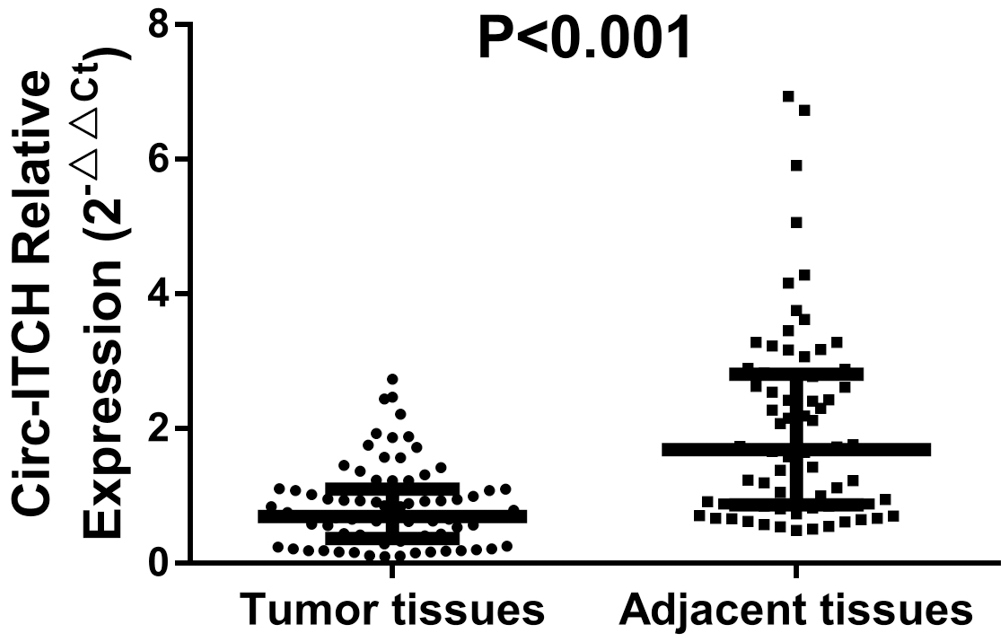
Wilcoxon signed-rank sum test was applied to determine the comparison of Circ-ITCH relative expression between tumor tissues and paired adjacent tissues in EOC patients (Fig. 1). We found the median value of Circ-ITCH relative expression was 0.697 (0.367–1.106) in tumor tissues, which was decreased than that in adjacent tissues (1.690 (0.867–2.813)) (
Correlation of Circ-ITCH expression with clinicopathologic features. Circ-ITCH expression in patients with tumor size 
Circ-ITCH relative expression in EOC patients with tumor size
Comparison of OS between a patient with Circ-ITCH high expression and Circ-ITCH low expression
As displayed in Fig. 3, mean value of OS in patients with Circ-ITCH high expression was 39.1(95% CI 37.2–40.9) months, which was longer compared to patients with Circ-ITCH low expression (32.0 (95% CI 28.2–35.9) months) (
Analysis of factors affecting OS
Univariate Cox’s proportional hazards regression model analysis disclosed that tumor Circ-ITCH expression (high vs. low) was associated with prolonged OS (Table 1,
Cox’s proportional hazards regression model analysis of factors affecting OS
Cox’s proportional hazards regression model analysis of factors affecting OS
Data were presented as P value, HR (hazards ratio) and 95% CI (confidence interval). Factors affecting OS (overall survival) were determined by univariate Cox’s proportional hazards regression model analysis, while the factors with P value no more than 0.1 were further detected by multivariate Cox’s proportional hazards regression analysis.
Correlation of Circ-ITCH expression with OS. High expression of Circ-ITCH was associated with better OS compared to low expression of Circ-ITCH. Kaplan-Meier curves were used to display OS, and Log-rank test was applied to evaluate the difference of OS between two groups. OS, overall survival. 
As disclosed in Fig. 4, Circ-ITCH expression was decreased in SKOV3 (
Circ-ITCH inhibited cells proliferation and promoted cells apoptosis in SKOV3 cells
Comparison of Circ-ITCH expression between various cell lines and IOSE cell line. Compared with IOSE 80 cell line, Circ-ITCH expression was lower in SKOV3, A-2780, OVCAR-3 and HO-8910 cell lines. Comparison between two groups was determined by T test. 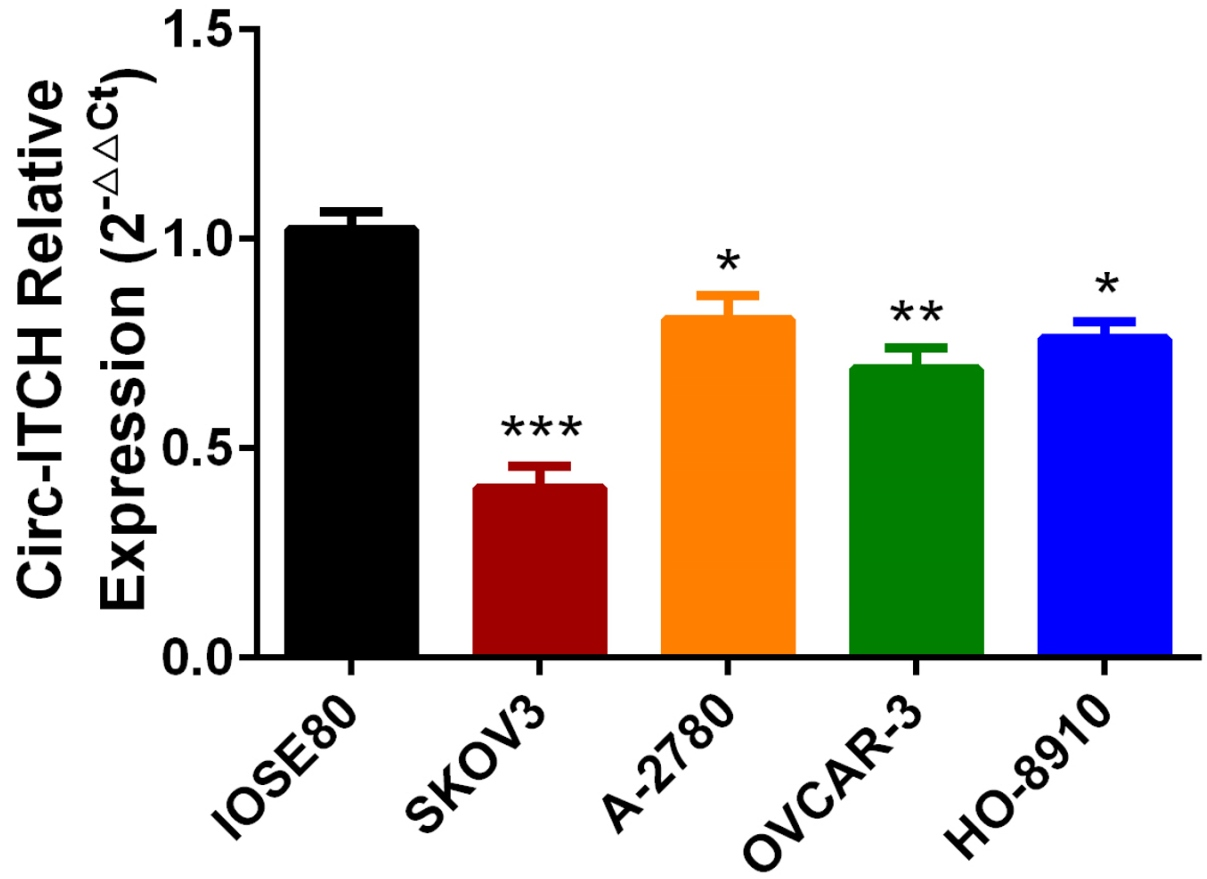
Circ-ITCH expression after transfection in SKOV3 cells. After transfection for 24 h, Circ-ITCH expression in Circ-ITCH (
CCK8 assay after transfection in SKOV3 cells. At 72 h after transfection, OD value by CCK8 in Circ-ITCH (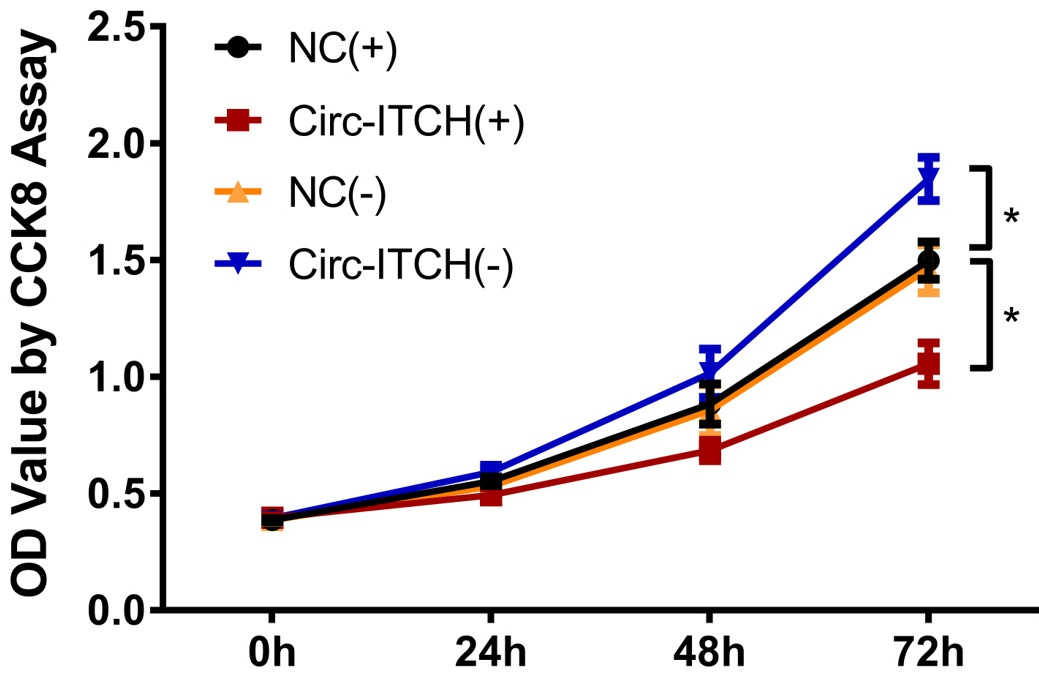
AV/PI assay after transfection in SKOV3 cells. Cells apoptosis was performed by AV /PI assay at 72 h and analyzed by FCM (A). Cells apoptosis rate in Circ-ITCH (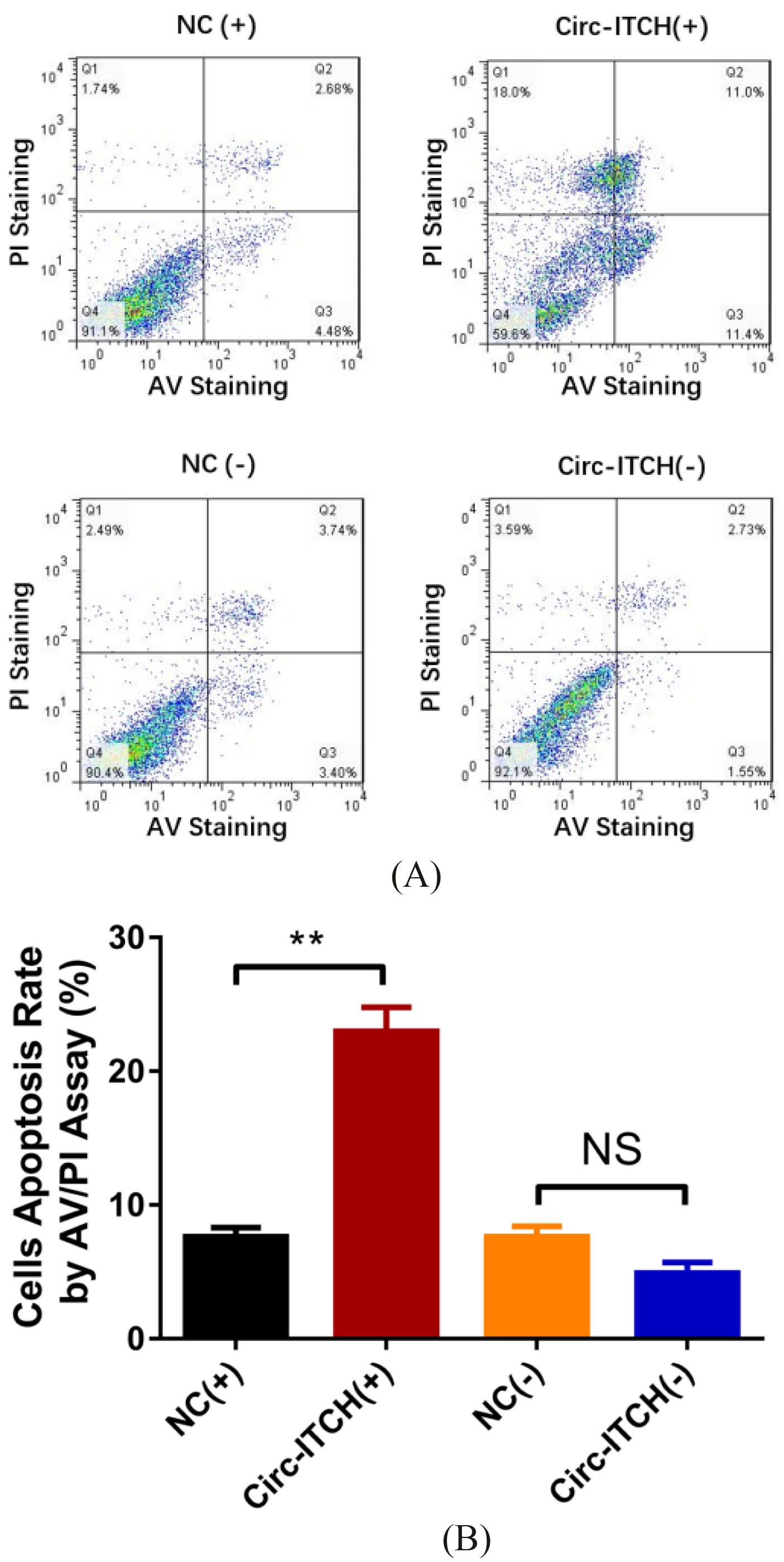
After transfection of blank mimic, Circ-ITCH mimic, blank inhibitor and Circ-ITCH inhibitor plasmids in SKOV3 cells for 24 h, Circ-ITCH expression was detected by qPCR (Fig. 5), which revealed that Circ-ITCH expression was increased in Circ-ITCH (
In order to validate the effect of Circ-ITCH on cells proliferation and cell apoptosis, qPCR, CCK-8 and AV/PI assays were performed again in OVCAR3 cells. As shown in Supplementary Fig. 1, Circ-ITCH expression was elevated in Circ-ITCH (
Discussion
In this study, we found that: (1) Circ-ITCH expression in tumor tissues was declined than that in paired adjacent tissues, and it was negatively correlated with tumor size and FIGO stage in EOC patients; (2) Circ-ITCH high expression was an independent predictive factor for favorable OS in EOC patients (3) Circ-ITCH inhibited cells proliferation while promoted cells apoptosis in EOC cells.
Circ-ITCH, located on chromosome 20q11.22, has been indicated to mediate multiple genes or signaling pathways and subsequent affects cells proliferation, apoptosis, differentiation as well as invasion, playing a key role in tumor development and progression in several carcinomas [12, 14, 15, 16]. For instance, Circ-ITCH increases the level of itchy E3 ubiquitin protein ligase that promotes the ubiquitination as well as degradation of phosphorylated Dvl2, further suppressing Wnt signaling, thereby inhibits cells proliferation and tumorigenesis in several cancers such as breast cancer, esophageal squamous cell carcinoma and hepatocellular carcinoma (HCC) [12, 15, 16]. Additionally, Circ-ITCH acts as a sponge for several oncogenic miRNAs (including miR-7 and miR-214), thereby weakening the carcinogenesis of these miRNAs and inhibiting tumor progression [17, 18]. Hence, these previous studies suggest that Circ-ITCH serves as a tumor repressor in malignant tumors.
In clinical studies, Circ-ITCH is discovered to be insufficiently expressed in several carcinomas, including breast cancer, bladder cancer, HCC and so on [12, 14, 15, 16, 19]. According to the previous studies, Circ-ITCH expression is dramatically reduced in hepatocellular carcinoma (HCC) tissues or esophageal squamous cell carcinoma tissues compared with the matched adjacent tissues [19, 20]. Moreover, an interesting study discloses that the downregulated expression of Circ-ITCH is associated with high histological grade in bladder cancer patients [14]. In line with these previous studies of other cancers, our study discovered that Circ-ITCH expression in tumor tissues was lower than that in paired adjacent tissues, and it was negatively correlated with tumor size and FIGO stage in EOC patients. The possible explanations were that Circ-ITCH might suppress EOC proliferation and invasion through regulating multiple molecules (sponging miRNAs or direct interact with mRNAs) or signaling pathways such as phosphorylated Dvl2, p63, Notch1 and Wnt/
As for the predictive value of Circ-ITCH for prognosis of cancers, several studies have also been performed [14, 19]. For example, Yang et al. discover that bladder cancer patients with elevated Circ-ITCH expression have longer OS compared to patients with reduced Circ-ITCH expression [14]. Also, raised Circ-ITCH expression is observed to be associated with favorable OS in HCC patients [19]. Therefore, these previous studies indicate that Circ-ITCH high expression might serve as a marker for favorable OS in cancer patients. In accordance with these previous data focusing on other cancers, we found that Circ-ITCH high expression was an independent factor for predicting better OS in EOC patients. The possible explanations might be as follows: (1) Circ-ITCH represses tumor progression through mediating multiple genes or pathways, such as miR-7, phosphorylated Dvl2 or Wnt/
In order to investigate the underlying mechanism of Circ-ITCH in mediating the development and progression of cancers, some in vitro and in vivo experiments have been conducted. For instance, an interesting experiment reveals that overexpressed Circ-ITCH decreases cells proliferation in human esophageal carcinoma cells (Eca-109 and TE-1), and compared to mice with lower Circ-ITCH xenografts, tumor growth is repressed in mice with up-regulated Circ-ITCH xenografts [20]. Moreover, Yang et al.’s study shows that Circ-ITCH inhibits cells viability, impairs the migration ability and enhances cells apoptosis in bladder cancer cells (EJ and T24 cell lines) [14]. In the present study, to further explore the function of Circ-ITCH in EOC, we further determined the Circ-ITCH expression in several EOC cell lines and normal ovarian epithelial cell line, and Circ-ITCH expression was disclosed to be greatly decreased in EOC cell lines than that in the normal ovarian epithelial cell line. Most importantly, we subsequently investigated the effect of Circ-ITCH on EOC cells proliferation and apoptosis by transferring Circ-ITCH mimic and inhibitor plasmids into SKOV3 cells, which revealed that Circ-ITCH inhibited cells proliferation and promoted cells apoptosis in SKOV3 cells, this result might shed light on application of Circ-ITCH as a potential prognostic marker in EOC.
In conclusion, Circ-ITCH correlates with small tumor size, decreased FIGO stage and prolonged OS, and it inhibits cells proliferation while promotes cells apoptosis in EOC.
Footnotes
Acknowledgments
This study was supported by the National Natural Science Foundation of China (No. 81774362 and 81303004).
Conflict of interest
The authors declare that they have no conflict of interest.
Supplementary data
The supplementary files are available to download from