




Abstract
BACKGROUND:
Peripheral blood absolute monocyte count (AMC) and lymphocyte to monocyte ratio (LMR) have strong prognostic value in various forms of lymphomas. It was found that higher AMC and lower LMR were associated with poor prognosis in B cell lymphoma. However, their prognostic significance in systemic anaplastic large cell lymphoma (sALCL) remained to be determined.
OBJECTIVE:
This study was aimed at investigating the prognostic significance of AMC and LMR in sALCL.
METHODS:
A total of 29 newly diagnosed patients with sALCL were retrospectively included in study, prognostic significance of AMC, LMR, performance status (PS), international prognostic index (IPI), prognostic index for T-cell lymphomas (PIT) and other indicators were analyzed.
RESULTS:
Univariate analysis showed high AMC, LMR
CONCLUSIONS:
AMC was an independent prognostic factor for PFS in sALCL, and LMR
Keywords
Introduction
Anaplastic large cell lymphoma (ALCL) is a relatively rare type of non-Hodgkin lymphoma (NHL), a Chinese report showed that ALCL was the third most common type of mature T cell lymphoma [1]. Clinically, ALCL can be classified into systemic type and skin type according to the location and manifestation of the disease. Anaplastic lymphoma kinase (ALK) protein was derived from t(2;5) chromosomal abnormality. According to the expression of ALK, ALCL was divided into ALK-positive group and ALK-negative group [2]. 2008 WHO classification established ALK-positive ALCL as an independent type. It is generally believed that the prognosis of ALK-positive ALCL is better than that of ALK-negative ones. Because of the low incidence, there are few reports on ALCL. The disease is highly invasive, with frequent extranodal invasion and poor prognosis. Until now, there is no recognized clinical prognosis criterion.
The prognostic significance of peripheral blood absolute lymphocyte count (ALC) reduction in Hodgkin’s lymphoma (HL) has been well established, and was incorporated into the International Prognostic Score (IPS) scoring system [3]. In recent years, a series of studies have shown that peripheral blood monocyte had prognostic significance in patients with lymphoma. It was found that high absolute monocyte count (AMC) and low lymphocyte to monocyte ratio (LMR) were associated with decreased progression-free survival (PFS) and overall survival (OS) in patients with newly diagnosed diffuse large B cell lymphoma(DLBCL) and HL, suggesting that AMC might be of prognostic value [4, 5, 6]. These results further confirmed the earlier study that the monocytes involved in the tumor microenvironment and host immunity [5]. However, the prognostic significance of peripheral blood AMC, LMR and ALC in patients with sALCL remained to be determined. The aim of this study was to analyze the prognostic impact of AMC, LMR, ALC on PFS and OS in patients with sALCL.
Material and methods
Study population
Totally 29 patients with newly diagnosed sALCL from February 2008 to November 2015 at the First Affiliated Hospital of Nanjing Medical University consisting of 19 males and 10 females were retrospectively included in this study; the median age was 40 years, with 28% of cases older than 60 years. All the diagnoses were based on the criteria of WHO 2016 Classifications of Tumors of Hematopoietic and Lymphoid Tissues [7]. All the cases received dose-adjusted (DA)-EPOCH (etoposide, prednisone, vincristine, cyclophosphamide, doxorubicin) or CHOP (cyclophosphamide, doxorubicin, vincristine, prednisone)/CHOP-like regimen as the first-line treatment, and median cycles were 6 (range, 1–12). Responded to the therapy including complete remission (CR) or complete remission unconfirmed (CRu) and partial remission (PR), no response to treatment including stable disease (SD) and progressive disease (PD). Clinical data including gender, age, Ann-Arbor stage, B symptoms, ALK expression, Eastern Cooperative Oncology Group performance status (ECOG PS), the international prognostic index (IPI) score, the prognostic index for T-cell lymphomas (PIT) score, bone marrow involvement and extranodal lesions, ALC, AMC, LMR and serum lactate dehydrogenase (LDH), beta 2 microglobulin (
Statistical methods
PFS was defined as the period from the date of diagnosis to the date of disease progression or the last follow-up date; OS was defined as the period from the date of diagnosis to death due to any reason or last follow-up time. The continuous variables were compared by Mann-Whitney U test. The survival curves were plotted by Kaplan-Meier method and log-rank test was used for comparison. Multivariate survival analysis was performed by Cox regression analysis. All statistical analyses were performed using SPSS (version 19.0) software (IBM Corporation, Armonk, NY, USA). The optimal value of cutoff was obtained using X-tile software.
Comparison of AMC among groups
Comparison of AMC among groups
Notes: ALC, absolute lymphocyte count; ALK, Anaplastic lymphoma kinase; AMC, absolute monocyte count;
Clinical characteristics of patients
In 29 patients with sALCL, 40% of patients had a PS
The relationship between AMC, ALC and other clinical indicators
AMC in cases with ESI
The progression-free survival (PFS) and overall survival (OS) curves of 29 patients with systemic anaplastic large cell lymphoma (sALCL).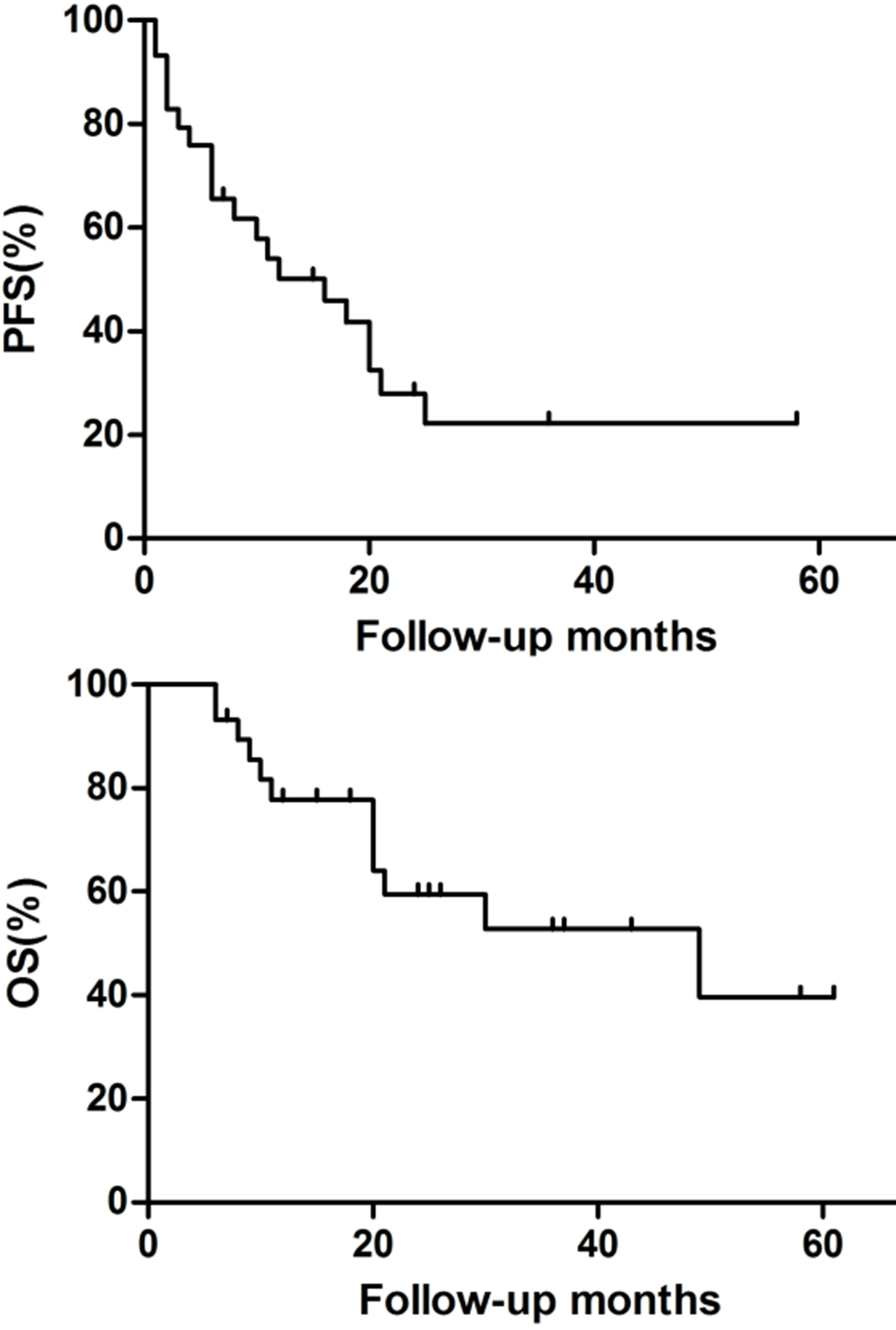
The progression-free survival (PFS) curves of the two groups after absolute monocyte count (AMC) grouping with the cutoff value of 0.6 
The progression-free survival (PFS) and overall survival (OS) curves of the two groups after lymphocyte to monocyte ratio (LMR) grouping with the cutoff value of 2.5.
The median follow-up was 20 months (6–61 months), the median PFS was 11 months (1–58 months), and the median OS was 49 months (10–88 months) (Fig. 1). Univariate and multivariate survival analyses were performed for each clinical index with PFS and OS. First, using X-tile analysis software, we selected 0.6
Clinical features such as gender, age
Results of univariate and multivariate survival analyses of PFS in patients with sALCL
Results of univariate and multivariate survival analyses of PFS in patients with sALCL
Notes: AMC, absolute monocyte count; ECOG PS, Eastern Cooperative Oncology Group performance status; ESI, extranodal sites involvement; LMR, lymphocyte to monocyte ratio; sALCL, systemic Anaplastic large cell lymphoma.
Results of univariate and multivariate survival analyses of OS in patients with sALCL
Notes: ECOG PS, Eastern Cooperative Oncology Group performance status; IPI, international prognostic index; LDH, lactate dehydrogenase level; LMR, lymphocyte to monocyte ratio; PIT, prognostic index for T-cell lymphomas; sALCL, systemic Anaplastic large cell lymphoma; ULN, upper limit of normal.
In recent years, some studies have shown that the abnormal levels of AMC and ALC in peripheral blood have prognostic values for lymphoma, and the increase of AMC and the decrease of ALC are often associated with poor prognosis. However, the prognostic significance of ALC and AMC in sALCL has not been explored. Our study found that AMC levels were significantly elevated in sALCL patients with ESI
Studies on monocytes and prognosis of lymphoma found that the monocytes are closely related to the tumor microenvironment. Increased monocytes in tumor microenvironment were involved in the pathogenesis of lymphoma, and further lead to inferior clinical outcomes. Studies have shown that malignant T cells remained viable when cultured with autologous monocytes, but cell death increased after monocytes depletion. Monocytes are recruited to the tumor microenvironment by CCL5, and help malignant T cells survive [12]. Further studies found that tumor derived interleukin (IL)-10 blocks the differentiation of monocytes to mature dendritic cells (DC), and immature DCs stimulate lymphoma growth by contact-dependent manner [13]. In addition to DC, monocytes are involved in the pathogenesis of lymphoma by tumor-associated macrophages (TAM). TAM produce matrix metalloproteinase 9 to cleave IL-2 receptor alpha, further activating regulatory T cells which lead to suppression of anti-lymphoma response [14]. TAM can also induce anti-apoptotic gene transcription by releasing B-cell activating factor (BAFF), which thereby reduce the apoptosis of lymphoma cells and cause drug resistance [15, 16]. Studies found that in lymphoma tissues from cases with poor prognosis, CD163 positive macrophages, vascular endothelial growth factor (VEGF) and microvessel density (MVD) were increased [17]. Further functional studies found that TAM secrete angiogenic factors to promote angiogenesis [18], indicating that TAM is involved in angiogenesis of lymphoma. These results suggest that monocytes and their derived cells play an important role in the pathogenesis of lymphoma.
By multivariate analysis, we also found that ECOG PS
Conclusion
We found AMC, which is simple and easy to get, had its prognostic significance for sALCL patients. The higher AMC (
Footnotes
Acknowledgments
This study was supported by National Natural Science Foundation of China (81470328, 81600130, 8177 0166, 81720108002), Jiangsu Province’s Medical Elite Programme (ZDRCA2016022), Project of National Key Clinical Specialty, National Science and Technology Pillar Program (2014BAI09B12), Jiangsu Provincial Special Program of Medical Science (BL2014086 and BE2017751) and National Science and Technology Major Project (2017ZX09304032).
Conflict of interest
The authors declare no conflict of interest.