




Abstract
BACKGROUND:
Long noncoding RNA ultraconserved element 338 (uc.338) is a long non-coding RNA reported to function as a promoter in non-small cell lung cancer (NSCLC). However, the function and potential mechanism of uc.338 in NSCLC is still unclear.
OBJECTIVE:
The aim of the present study was to assess the effect of uc.338 on the prognosis of patients with NSCLC.
METHODS:
The expression levels of uc.338 in NSCLC tissues and matched normal lung tissues were examined by real-time quantitative PCR. Then the association between uc.338 levels with clinical variables as well as survival time was investigated.
RESULTS:
We found that uc.338 expression levels were significantly upregulated in NSCLC compared with the matched noncancerous lung tissues (
CONCLUSIONS:
Our results show that uc.338 may play an important role in tumorigenesis and progression and could serve as a potential independent prognostic biomarker for patients with NSCLC.
Introduction
Lung cancer is the main reason of cancer-related death both in men and women all over the world and approximately 80% to 85% of lung cancers are non–small-cell lung cancer (NSCLC) [1, 2]. Although new methods for NSCLC diagnosis and treatment have continuously emerged, the overall survival rate of NSCLC patients remains low [3, 4]. The poor prognosis of NSCLC is mainly due to late diagnosis, leading to a high recurrence rate [5]. Therefore, it is particularly urgent to identify novel biomarkers for the early diagnosis or predicting the clinical prognosis in patients with NSCLC.
Recent studies have showed that a large part of the human genome can be transcribed into many short or long noncoding RNAs (lncRNAs) [6]. LncRNAs are defined as transcripts containing more than 200 nucleotides with no or little protein coding function [7]. Growing studies have reported that lncRNAs are involved in a wide range of biological processes, such as embryonic development, proliferation, apoptosis, and differentiation [8, 9]. Emerging data has shown that abnormal lncRNA expression is observed in human tumors, including those in the liver, lung, breast and colon [10, 11, 12, 13]. Up to date, several lncRNAs have been well studied in various tumors, including NSCLC. For instance, Zhou et al. reported that lncRNA SPRY4-IT1 contributed to progression of hepatocellular carcinoma by activating EZH2 [14]. Zhu et al. found that lncRNA H19-miR-675 axis served as a tumor suppressor by targeting TGFBI [15]. Zhang et al. showed that inhibition of lncRNA NEAT1 could suppress proliferation and metastasis of breast cancer cells, and high lncRNA NEAT1 was associated with poor prognosis in patients with breast cancer [16]. Those data indicated the important role of lncRNAs in progression of tumors. However, the function of lncRNAs in NSCLC has only recently been explored and remains largely unknown.
In the present study, we focused on a novel lncRNA named ultraconserved element 338 (uc.338), which has been reported to be abnormally expressed in lung cancer and hepatocellular carcinoma [17, 18]. Although previous study indicated that the expression of uc.338 was associated with the ability of lung cancer migration and invasion, the clinical significance of uc.338 has not yet been studied. The aim of our present study was to explore the prognostic value of uc.338 in patients with NSCLC.
Materials and methods
Patients and samples
A total of 185 primary NSCLC and matched noncancerous lung tissue samples were collected from the Qilu Hospital of Shandong University for RT-qPCR analysis between 2007 and 2011. The diagnosis of all samples was confirmed by two pathologists. None of NSCLC patients received neoadjuvant or adjuvant chemotherapy before operation. The age of the NSCLC patients ranged from 38 to 79 years old, with a mean age of 55 years. The tissue samples were immediately snap-frozen in liquid nitrogen and stored at
RNA isolation and qRT-PCR
Total RNA was isolated from tissue samples by using an RNA isolation kit (TaKaRa, Otsu, Shiga, Japan). The isolated RNA was reverse-transcribed into cDNA using ReverTra Ace qPCR RT kit (Toyobo, Puding, Shanghai, China). Real-time PCR detection of lncRNAs was performed using SYBR Green Master Mix (Applied Biosystems, Foster City, USA). All reactions were run in triplicate. GAPDH were employed as reference gene to normalized the expression of uc.338. Primers used in present study were shown in Table 1.
PCR primer sequences
PCR primer sequences
Associations between uc.338 expression and clinicopathological characteristics in NSCLC
Higher uc.338 expression was observed in NSCLC tissues compared with the paired normal lung tissue (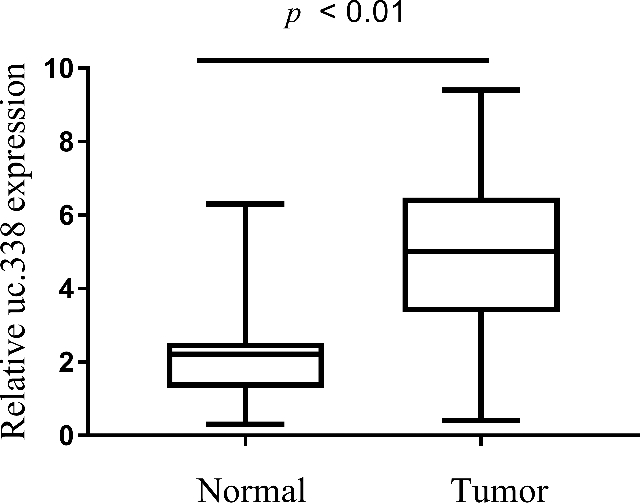
Cox proportional hazard model analysis of OS and DFS in NSCLC patients
Survival analysis of 185 NSCLC patients by Kaplan-Meier method. (A) High expressions of uc.338 were correlated with the reduced OS of NSCLC patients (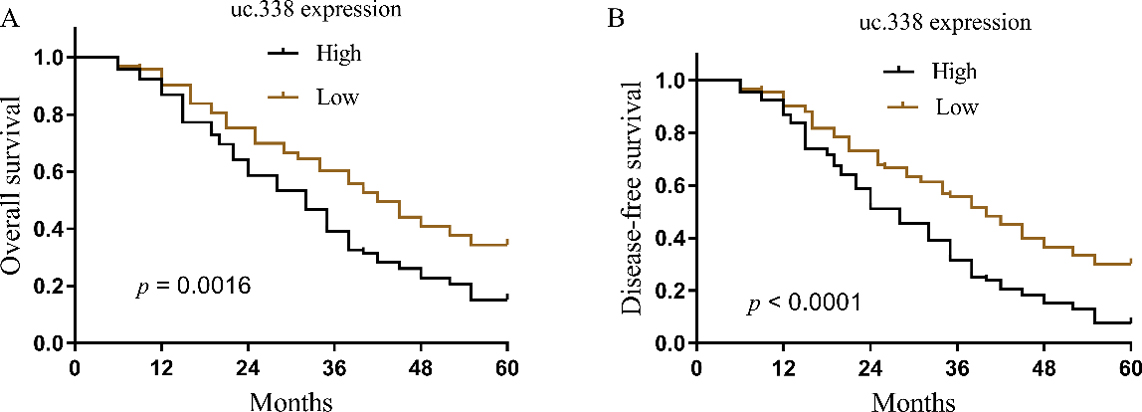
Data was analyzed using SPSS 13.0 (SPSS Inc., Chicago, IL, USA). Differences between groups were analyzed using Student’s
Results
Overexpression of uc.338 in NSCLC tissues
We first examined the expression of uc.338 in 185 pairs of NSCLC specimens and adjacent non-tumorous lung tissues. Our real-time PCR results showed that uc.338 was significantly increased in NSCLC tissues compared with adjacent non-tumor tissues (
uc.338 expression and correlation with clinicopathological parameters in NSCLC
To assess the association between uc.338 expression and clinicopathologic features of NSCLC patients, uc.338 expression levels in NSCLC tissues were categorized as low or high in relation to the median value of relative uc.338 expression (3.55-fold, tumors/ noncancerous). As shown in Table 2, the levels of uc.338 expression was associated with TNM stage (
uc.338 expression is associated with the prognosis of NSCLC patients
Using the Kaplan-Meier method and log-rank test, we observed that the OS of patients with high uc.338 expression was significantly shorter than those with high uc.338 expression (
Discussion
In China, the prevalence and mortality of NSCLC have been increasing dramatically in recent years [19]. About 600000 peoples die of lung cancer each year. The invasiveness and metastasis of tumor cells are critical challenges in the clinical management ofNSCLC [20]. For some patients diagnosed at early stage have a favorable prognosis. Unfortunately,NSCLC is often diagnosed at an advanced clinical stage [21, 22]. Up to date, traditional treatment methods based on TNM stage and tumor differentiation cannot meet the requirement of individual patients [23]. Thus, there is an urgent need to identify valuable and prognostic markers to guide the treatment of NSCLC patients.
More and more lncRNAs were reported to be associated with prognosis of NSCLC patients. For instance, Chen et al. reported that that higher expression of lncRNA DGCR5 was associated with longer survival in lung cancer patients [24]. Moreover, mechanism assay indicated that forced expression of lncRNA DGCR5 could promote proliferation, migration and invasion of lung cancer by targeting miR-1180. Wang et al. found that lncRNA TUSC7 was able to suppress the proliferation of NSCLC cells and could be used to predict the prognosis of NSCLC patients [25]. Another study by Ma et al. indicated that lncRNA HNF1A-AS1 was up-regulated in NSCLC tissues and correlated with unfavorable survival [26]. Those results implied the important effect of lncRNAs as a potential biomarker for prognosis of NSCLC patients. Recently, Bo et al. reported that the expression levels of uc.338 were up-regulated in hepatocellular carcinoma tissues and its knockdown could suppress cell proliferation through association with BMI1 [18]. Another finding by Gao et al. revealed that the expression of uc.338 in lung cancer was remarkably increased. Further functional assay suggested that uc.338 inhibition could suppress migration and invasion of lung cancer cells [17]. However, the clinical research about the effect of uc.338 remains largely unknown.
In the present study, on line with previous study [17], our results also showed the up-regulation of uc.338 in NSCLC tissues. By the clinical reports from our hospital, we summarized the patient information and found that the levels of uc.338 expression were significantly associated with TNM stage, lymph node metastasis and distant metastasis. Those results indicated a tumor-promotive role of uc.338 in NSCLC. Then, we analyzed the prognostic significance of uc.338 in NSCLC patients. It revealed that NSCLC patients with high levels of uc.338 expression have a shorter survival. Finally, univariate and multivariate analysis indicated that the over-expression of uc.338 was independently associated with both OS and DFS in patients with NSCLC.
In conclusion, this study provides the first evidence that uc.338 can be used as an independent prognostic marker to predict the prognosis of NSCLC. However, little is known about the uc.338-related signaling pathway, which needed further investigation. Besides, more deeply and larger-scale studies should be conducted to further confirm our results.
Footnotes
Acknowledgments
The authors thank all the donors whose names we not included in the author list, but who participated in this program.
Conflict of interest
The Authors declare that there are no conflicts of interest.