




Abstract
Background:
Long noncoding RNAs have been demonstrated to play important roles in different kinds of human malignancy. The purpose of this study was to evaluate the diagnostic and prognostic value of long intergenic non-protein coding RNA 1232 (LINC01232) in patients with pancreatic adenocarcinoma (PAAD) and further explore the clinical significance of the potential miRNAs that might be sponged by LINC01232.
Methods:
The potential target miRNAs that might be sponged by LINC01232 were analyzed using bioinformatics analysis. The Real-Time quantitative PCR was adopted to measure the relative expression of LINC01232 and target miRNAs in PAAD serum and tissue samples. The diagnostic and prognostic value of LINC01232 was evaluated using the receiver operating characteristic analysis and Kaplan-Meier survival analysis, respectively.
Results:
LINC01232 expression was upregulated in PAAD serum and tissues and associated with patients’ TNM stage. Serum LINC01232 expression had diagnostic value, and the high levels of LINC01232 could predict unfavorable prognosis in PAAD patients. miR-204-5p, miR-370-5p and miR-654-3p were proposed as 3 targets of LINC01232 in PAAD, and their decreased expression levels in PAAD patients showed certain clinical significance in diagnosis and prognosis.
Conclusion:
The data of this study revealed that LINC01232 expression is upregulated in PAAD serum and tissue samples with considerable diagnostic and prognostic significance. In addition, miR-204-5p, miR-370-5p and miR-654-3p may be sponged by LINC01232 in PAAD, which also show potencies in PAAD diagnosis and prognosis.
Introduction
Pancreatic cancer is a frequent malignancy occurred in digestive system with high mortality rate, which results in more than 227,000 deaths annually worldwide. 1 Pancreatic adenocarcinoma (PAAD) is the most common type of pancreatic cancer, accounting for about 90% of all pancreatic cancer cases. 2 Some risk factors accelerate the onset of PAAD, such as smoking, diabetes, obesity and some rare genetic conditions. 3 PAAD patients show several common clinical manifestations, including yellow skin, back or abdominal pain, weight loss, dark urine, light-colored stools and an inappetence. 4 However, most of patients are diagnosed with advanced stage tumors at the initial diagnosis, leading to the poor prognosis and high mortality. 5 The diagnosis of PAAD mainly relies on the combination of medical imaging techniques, which results in economic burden for the patients. 2 Thus, there are urgent needs for novel biomarkers to diagnose and predict prognosis easily and economically for the treatment of PAAD.
Long noncoding RNAs (lncRNAs) are a group of RNAs longer than 200 nucleotides without protein coding abilities. 6 Previous evidence indicates that some lncRNAs have important biological function, thereby involving in diverse biological processes, such as mRNA degradation, RNA transcription and epigenetic regulation. 7 They can regulate cellular activities, such as cell proliferation, differentiation, migration, invasion and apoptosis, by acting as sponges of microRNAs (miRNAs). 8 In addition, lncRNAs with aberrant expression patterns in human malignancies have been documented to participate disease initiation and development, contributing to the molecular indicator development for diagnosis, prognosis and therapy in human cancers. 9,10 For example, serum lncRNA PCSK2-2:1 has been found to be downregulated in gastric cancer patients and serve as a candidate diagnostic biomarker. 11 The decreased expression of lncRNA DILC in colorectal carcinoma tissues has been determined as a biomarker for disease diagnosis and prognosis. 12 These studies provide evidence for the critical clinical significance of the dysregulation of lncRNAs. In our previous study, long intergenic non-protein coding RNA 1232 (LINC01232) was found to serve as an oncogenic lncRNA in the progression of PAAD, which could promote PAAD cell proliferation, migration and invasion but inhibit cell apoptosis by regulating transmembrane 9 superfamily member 2 (TM9SF2), 13 but the clinical performance of LINC01232 in PAAD diagnosis and prognosis remains unclear.
In this study, we evaluated the clinical significance of LINC01232 in PAAD diagnosis and prognosis by analyzing the expression of LINC01232 in serum and tissue samples collected from PAAD patients. In addition, the putative miRNAs that might be sponged by LINC01232 were predicted and the diagnostic and prognostic value of miR-204-5p, miR-370-5p and miR-654-3p was further evaluated. The results of this study may provide novel non-invasive biomarkers for patients with PAAD.
Materials and Methods
Patients and Sample Collection
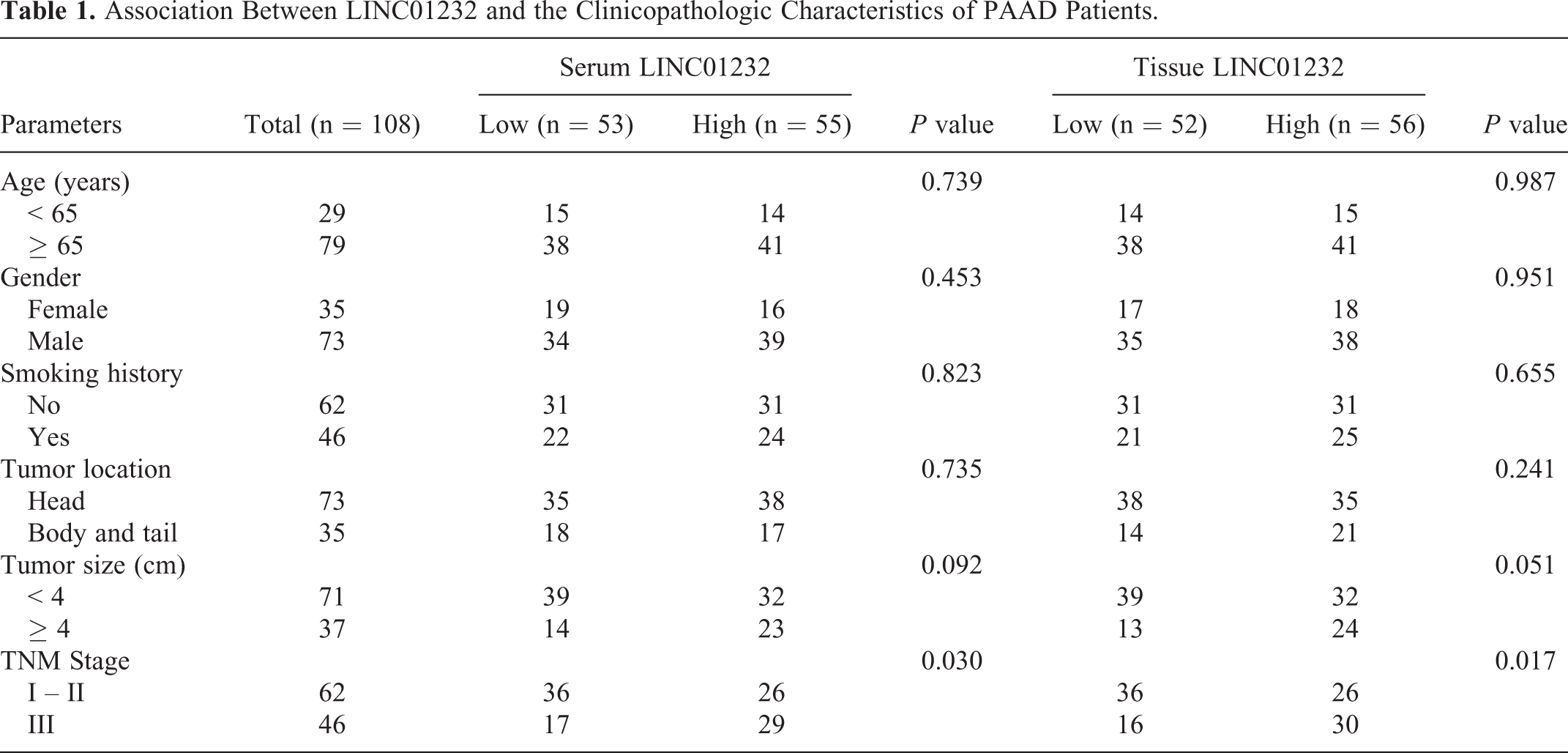
A total of 108 patients were enrolled in this study, who were histopathologically diagnosed with PAAD and underwent pancreatectomy at Zibo Central Hospital during 2010 to 2016. The patients included in this study received no chemotherapy or radiotherapy before surgery. Venous blood samples were collected from the patients at admission, and serum was isolated from the blood samples and stored at -80°C for subsequent analysis. During the surgery, tumor tissues were collected, and the corresponding adjacent normal tissues were also collected as normal controls, and all the collected tissues were immediately frozen by liquid nitrogen for further use. In addition, another set of serum was obtained from 60 healthy volunteers, who had no history of malignancies. The demographic and clinicopathological features of the patients were summarized in Table 1 . The survival time of patients was recorded from the data of surgery to the data of death or last follow-up, and the survival information was obtained by telephone calls. The investigation and experimental protocols were approved by the Ethics Committee of Zibo Central Hospital (No. 010019), and the informed consent was obtained from each participant for the use and analysis of clinical samples.
Association Between LINC01232 and the Clinicopathologic Characteristics of PAAD Patients.
Bioinformatics Analysis for LINC01232 Expression and Its Related miRNAs
The expression of LINC01232 and its relationship with overall survival in patient with PAAD was assessed using The Cancer Gnome Atlas Program (TCGA) data by the GEPIA (http://gepia.cancer-pku.cn/index.html). 14 The putative miRNAs that might be sponged by LINC01232 were predicted by starBase v3.0 (http://starbase.sysu.edu.cn/index.php), 15 and a total of 21 miRNAs were predicted with binding site of LINC01232. Furthermore, the miRNAs that correlated with LINC01232 in PAAD was predicted also using starBase v3.0.
RNA Extraction
The collected serum and tissue samples were prepared for the extraction of total RNA using TRIzol reagent (Invitrogen, Carlsbad, CA, USA) following the manufacturer’s protocols. A NanoDrop 2000 (Thermo Fisher Scientific, Waltham, MA, USA) was used to evaluate the quality of RNA. Only the RNA with an absorbance ratio (OD260/OD280) of 1.8 - 2.0 was used for the subsequent analysis.
Real-Time Quantitative PCR (RT-qPCR)
The single stranded cDNA was synthesized from RNA using the M-MLV Reverse Transcription kit (Thermo Fisher Scientific, Waltham, MA, USA) according to the instruction of manufacturer. The relative expression levels of LINC01232 and miRNAs sponged by LINC01232, including miR-204-5p, miR-370-5p and miR-654-3p, were examined using qPCR on a 7500 Real-Time PCR System (Applied Biosystems, USA) with SYBR green I Master Mix kit (Invitrogen, Carlsbad, CA, USA). GAPDH was employed as an internal control for the quantification of LINC01232. For the quantification of miRNAs, U6 small nuclear RNA was used as an endogenous control. The relative expression values were calculated using the 2−ΔΔCt method.
Statistical Analysis
Data analyzed in this study was displayed as mean ± SD and assessed with SPSS 22.0 (SPSS Inc., Chicago, IL) and GraphPad Prism 7.0 software (GraphPad Software, Inc., USA). Student’s t test was applied for difference analysis between groups. The expression of LINC01232 in serum and tissue samples was firstly divided into low and high expression based on the median value, the its relationship with clinicopathological characteristics of the patients was analyzed by Chi-square test. A receiver operating characteristic (ROC) analysis was adopted to evaluate the diagnostic performance of serum LINC01232 and the putative miRNAs in patients with PAAD. An area under the curve (AUC) value was calculated to reflect the diagnostic accuracy of each indicator. The prognostic value of tissue expression of LINC01232 and the related miRNAs was evaluated using Kaplan-Meier method and multiple Cox regression analysis. A P value of less than 0.05 was set as statistically significant.
Results
Expression and Prognostic Value of LINC01232 in PAAD According to TCGA Database
By using GEPIA, the expression data of LINC01232 in TCGA database was analyzed. A total of 178 PAAD samples and paired 171 normal samples were included, and the expression of LINC01232 showed significantly upregulated in PAAD samples compared with the normal controls (P < 0.05,
Figure 1A
). Furthermore, the survival curves were conducted using the data from TCGA

Expression of LINC01232 and its relationship with overall survival in PAAD patients analyzed by TCGA data. A. LINC01232 expression was higher in tumor samples compared with normal controls (* P < 0.05). B. The survival curves for PAAD patients with different levels of LINC01232 (log-rank P = 0.0021).
LINC01232 Expression Is Upregulated in PAAD Clinical Specimens
To validate the results from TCGA database, the expression of LINC01232 was examined in serum and tissue samples collected from 108 PAAD patients. Consistently, as shown in Figure 2A , the serum expression of LINC01232 was elevated in PAAD patients compared with healthy individuals (P < 0.001). Similarly, a higher expression of LINC01232 was observed in PAAD tissues than the paired normal tissues (P < 0.001, Figure 2B ). In addition, a positively correlation was presented between serum and tissue LINC01232 in patients with PAAD (r = 0.896, P < 0.001, Figure 2C ).

Expression of LINC01232 in serum and tissues samples collected from 108 PAAD patients. A. Serum LINC01232 was elevated in PAAD patients compared with healthy controls (***P < 0.001). B. LINC01232 expression was upregulated in PAAD tumor tissues compared with the adjacent normal tissues (***P < 0.001). C. There was a positive correlation between serum and tissue expression of LINC01232 in PAAD patients (r = 0.896, P < 0.001).
Association of LINC01232 With Clinicopathological Characteristics of PAAD Patients
This study recorded the demographic and clinicopathological features of PAAD patients, including age, gender, history of smoking, tumor location, tumor size and TNM stage. To facilitate the relationship analysis between LINC01232 and clinical data of PAAD patients, LINC01232 expression was divided into low and high expression groups based on its median value. The Chi-square test results listed in Table 1 indicated that the serum expression levels of LINC01232 were associated with TNM stage of the patients (P = 0.030). Similarly, the relationship between LINC1232 and TNM stage was also observed based on the tissues expression results (both P = 0.017). These findings indicate that LINC01232 may be involved in the development of PAAD.
Diagnostic and Prognostic Value of LINC01232 in Patients With PAAD
The diagnostic performance of LINC01232 to distinguish PAAD patients from healthy controls was evaluated by constructing a ROC curve based on serum LINC01232 in patients and healthy volunteers. As shown in Figure 3A , the area under the curve (AUC) was 0.927, implying the diagnostic accuracy of serum LINC01232 in PAAD patients. At the optimal cutoff value of 1.325, the sensitivity was 96.3% and the specificity was 80.0%.
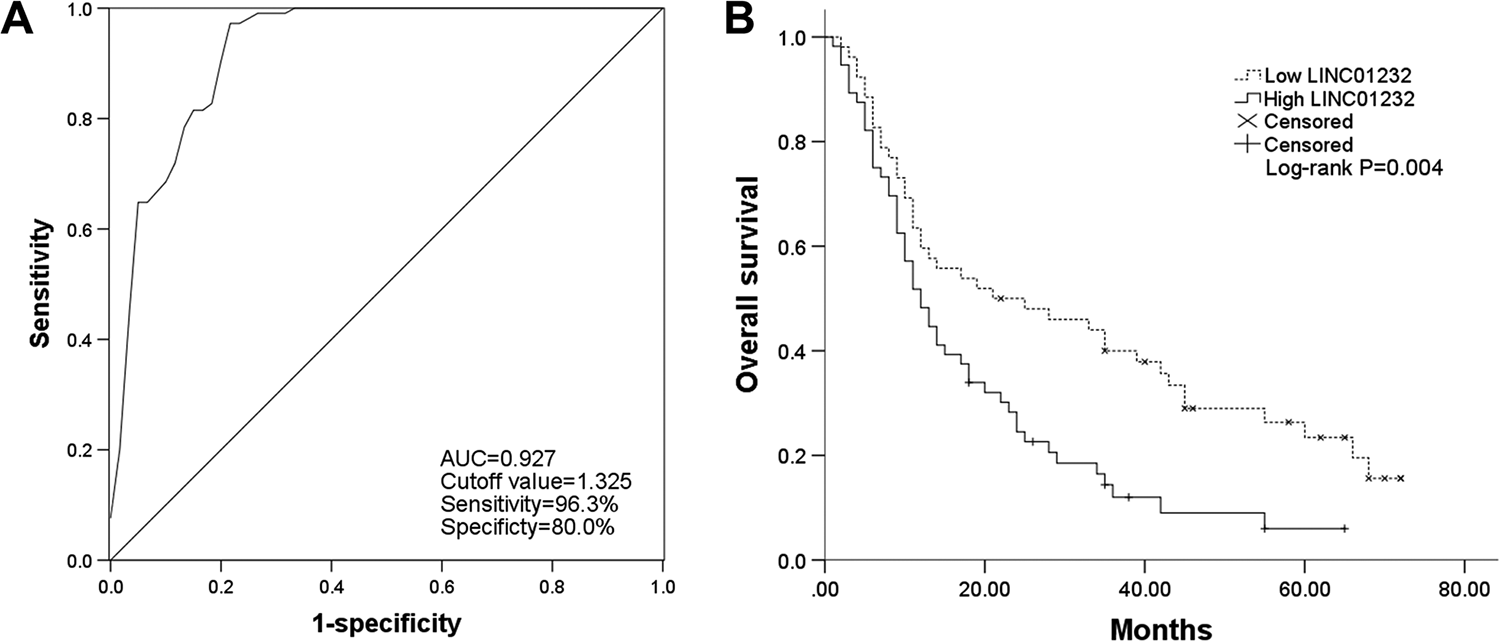
Diagnostic and prognostic value of LINC01232 in PAAD patients. A. A ROC curve based on serum LINC01232 in PAAD patients (AUC, area under the curve). B. Kaplan-Meier survival curves for PAAD patients with high and low LINC01232 expression levels (log-rank P = 0.004).
The follow-up survival information of the PAAD patients was analyzed using Kaplan-Meier methods, and the survival curves presented in Figure 3B indicated that the patients with high LINC01232 levels had a poor overall survival than those with low LINC01232 levels (log-rank P = 0.004), which was consistent with the survival analysis results using TCGA data. A multivariate Cox regression analysis further investigated the independence of LINC01232 for the prediction of overall survival in PAAD patients, and the results listed in Table 2 revealed that LINC01232 was an independent prognostic factor in patients with PAAD (HR = 1.876, 95% CI = 1.197- 2.941, P = 0.006).
Multivariate Cox Regression Analysis in Patients With PAAD.

Potential miRNAs Sponged by LINC01232 in PAAD
According to the prediction via starBase, there are 21 miRNAs possess putative binding sites with LINC01232 (

Correlation of LINC01232 with miR-204-5p, miR-370-5p and miR-654-3p in PAAD patients using TCGA data. A. LINC01232 expression was negatively correlated with miR-204-5p (r = −0.325, P < 0.001). B. LINC01232 expression was negatively correlated with miR-370-5p (r = −0.291, P < 0.001). C. LINC01232 expression was negatively correlated with miR-654-3p (r = −0.236, P = 0.002).
Expression of Candidate miRNAs in Patients With PAAD
The 3 miRNAs that might be sponged by LINC01232 were analyzed in the serum and tissue samples from PAAD patients. As expected, PAAD patients had significantly downregulated serum expression of miR-204-5p, miR-370-5p and miR-654-3p compared with the healthy individuals (all P < 0.01,
Figure 5A

Expression of miRNAs that might be sponged by LINC01232 in PAAD patients. A - C. miR-204-5p, miR-370-5p and miR-654-3p expression was decreased in serum samples of PAAD patients compared with the healthy controls (**P < 0.01, ***P < 0.001). D - F. miR-204-5p, miR-370-5p and miR-654-3p expression was downregulated in PAAD tissues compared with the normal controls (**P < 0.01, ***P < 0.001).
Diagnostic and Prognostic Significance of the Candidate miRNAs in PAAD Patients
This study further evaluated the diagnostic and prognostic performance of the 3 putative miRNAs. The ROC curves for serum miR-204-5p, miR-370-5p and miR-654-3p were shown in Figure 6A

Diagnostic and prognostic value of miR-204-5p, miR-370-5p and miR-654-3p in PAAD patients. A - C. ROC curves based on serum miR-204-5p, miR-370-5p and miR-654-3p levels for patients with PAAD (AUC, area under the curve). D - E. Kaplan-Meier survival curves for PAAD patients with different levels of miR-204-5p, miR-370-5p and miR-654-3p).
Discussion
PAAD remains a fatal malignancy with an increasing incidence rate worldwide. Early diagnosis and prognosis prediction are important to improve the treatment of PAAD. 16 Our previous study has demonstrated the functional role of LINC01232 in PAAD by in vivo and in vitro analyses. 13 This study further confirmed the expression of LINC01232 in PAAD serum and tissues samples and explore its clinical significance in PAAD diagnosis and prognosis. The results of this study showed that both serum and tissue expression levels of LINC01232 were elevated in PAAD samples compared with normal controls, and were associated with the TNM stage of the patients. The increased levels of LINC01232 had diagnostic accuracy to distinguish PAAD patients from healthy individuals, and predicted unfavorable prognosis in patients with PAAD. In addition, this study predicted the potential miRNAs that might be sponged by LINC01232 using bioinformatics analysis, and found that miR-204-5p, miR-370-5p and miR-654-3p were correlated with LINC01232 in PAAD patients according to the TCGA database. Moreover, the downregulated expression of the 3 miRNAs was found in PAAD serum and tissue samples, which also possessed certain clinical significance in PAAD diagnosis and prognosis.
Accumulating studies have highlighted the pivotal role of lncRNAs in human malignancies, contributing to the development of novel cancer therapeutic targets. 17 -19 For example, Zhang et al. found the significantly upregulated lncRNA AFAP1-AS1 in triple breast cancer patients, and knockdown of AFAP1-AS1 could lead to the inhibition in tumor cell proliferation and invasion by targeting miR-145. 20 The increased expression of lncRNA NEAT1 in hepatocellular carcinoma has been documented to be involved in the regulation of tumor cell viability. 21 Cervical cancer tissues have elevated lncRNA UCA1 compared to normal tissues, and the downregulation of UCA1 could suppress tumor progression by inhibiting tumor cell proliferation, migration and invasion. 22 In pancreatic cancer, several lncRNAs with aberrant expression have also been investigated and reported to be involved in tumor progression, such as lncRNA DNAH17-AS1 23 and lncRNA PVT1, 24 but the number of functional lncRNAs investigated in PAAD remains limited, which impedes the understanding of PAAD pathogenesis and the development of disease treatment. In our previous study, we explored the biological function of LINC01232 in PAAD progression, and found that LINC01232 expression was upregulated in PAAD cell lines and could facilitate tumor cell proliferation, migration, invasion but inhibit cell apoptosis, 13 which indicated the potency of LINC01232 as a potential therapeutic target for PAAD treatment.
The deregulated lncRNAs in tumor samples have attracted increasing attention for their diagnostic and prognostic value in different kinds of human cancer. 25 Li et al. documented that the decreased lncRNA DILC in colorectal carcinoma tissues serves as a candidate diagnostic and prognostic biomarker. 12 The upregulated expression of lncRNA PVT1 could predict poor prognosis in esophageal adenocarcinoma. 26 In pancreatic cancer, lncRNA PCTST expression was reduced and associated with the survival outcomes of cancer patients. 27 In this study, we further evaluated the clinical significance of LINC01232 in PAAD diagnosis and prognosis, looking forward to explore novel non-invasive biomarkers for this malignancy. The expression of LINC01232 was significantly upregulated in both serum and tissue samples of PAAD, which was consistent with the expression analysis results according to TCGA data. In addition, the increased LINC01232 was associated with advanced TNM stage, suggesting that LINC01232 might be involved in the development of PAAD. By analyzing the expression data of LINC01232 in serum samples from PAAD patients, this study demonstrated that LINC01232 had diagnostic accuracy for screening PAAD patients from healthy individuals. The survival analysis results according to patients’ follow-up survival information in this study revealed that high LINC01232 expression was associated with poor overall survival and determined as an independent prognostic indicator in patients with PAAD. These findings provided evidence for LINC01232 as a candidate diagnostic and prognostic biomarker of PAAD. Our previous study demonstrated that LINC01232 played an oncogenic role by promoting PAAD cell proliferation, migration, invasion and inhibiting tumor cell apoptosis through upregulating TM9SF2. 13 Future studied can use GO functional enrichment and KEGG pathway analyses to further explore the underlying mechanisms of the oncogenic role of LINC01232.
In the mechanisms underlying the biological function of lncRNAs, miRNAs, as a series of mediators, have been found to be sponged by lncRNAs in different biological processes. 28 For example, the promoting effect of lncRNA FTX on gastric cancer cell growth and cell cycle was exerted by sponging miR-215. 29 miR-218 was negatively correlated with lncRNA CCAT1 in colorectal carcinoma, which mediated the regulatory effect of CCAT1 on tumor cell migration and invasion. 30 This study used bioinformatics analysis to predict the putative miRNAs that might be regulated by LINC01232, and found 21 miRNAs with complementary sequences of LINC01232. Among them, miR-204-5p, miR-370-5p and miR-654-3p were negatively correlated with LINC01232 in PAAD according to the TCGA database, and their expression levels in PAAD patients were downregulated in both serum and tissue samples, which suggested that the 3 miRNAs might be sponged by LINC01232 in PAAD. However, the relationship between LINC01232 and the predicted 3 miRNAs needs to be confirmed in further studies using a larger study cohort. The clinical significance of miRNAs in human cancer diagnosis and prognosis has received a huge attention recently decades. miR-204-5p has been determined as a prognostic indicator in breast cancer 31 and lung cancer. 32 The diagnostic and prognostic value of miR-370-5p has been reported in hepatocellular carcinoma 33 and acute myeloid leukemia. 34 miR-654-3p combined with other 6 miRNAs has been described as a prognostic model to predict the overall survival of head and neck squamous cell carcinoma. 35 In the present study, we also demonstrated that miR-204-5p, miR-370-5p and miR-654-3p had certain clinical significance in PAAD diagnosis and prognosis. The ectopic expression of miR-204-5p has been reported in pancreatic ductal adenocarcinoma, 36 and the overexpression of miR-204-5p could significantly inhibit tumor cell migration and invasion. 37 However, the relationship between miR-370-5p and miR-654-3p and PAAD has not been studied. Therefore, future studies with a larger study population are needed to confirm the clinical and functional role of the 3 proposed miRNAs in PAAD.
In conclusion, at the basics of our previous functional analysis of LINC01232 in PAAD, this study further demonstrated that the expression of LINC01232 in serum and tissue samples of PAAD is upregulated and associated with patients’ TNM stage. The deregulated LINC01232 in PAAD patients serves as a potential non-invasive diagnostic and prognostic biomarker. In addition, LINC01232 may sponge miR-204-5p, miR-370-5p and miR-654-3p, and the 3 miRNAs also have certain diagnostic and prognostic value in patients with PAAD. Although this study proposed 3 miRNAs that might be sponged by LINC01232 in PAAD, the regulatory effects of LINC01232 on miR-204-5p, miR-370-5p and miR-654-3p remain uncertain, and the precise roles of the 3 miRNAs in the mechanisms of LINC01232 in PAAD progression warrant further investigations.
Supplemental Material
Supplemental Material, sj-xls-1-tct-10.1177_1533033820988525 - LINC01232 Sponges Multiple miRNAs and Its Clinical Significance in Pancreatic Adenocarcinoma Diagnosis and Prognosis
Supplemental Material, sj-xls-1-tct-10.1177_1533033820988525 for LINC01232 Sponges Multiple miRNAs and Its Clinical Significance in Pancreatic Adenocarcinoma Diagnosis and Prognosis by Wenyan Du, Chengbin Lei, Yanzhen Wang, Yiwen Ding and Peng Tian in Technology in Cancer Research & Treatment
Footnotes
Authors’ Note
WD and PT designed the study, contributed to the bioinformatics analysis, data interpretation, and manuscript writing. CL contributed to the methodology and expression data analysis. YW and YD collected clinical samples and data and performed the expression examination. All data generated or analyzed during this study are included in this published article. Written informed consent for publication was obtained from each participant. A signed written informed consent was obtained from each patient and the experimental procedures were all in accordance with the guideline of the Ethics Committee of Zibo Central Hospital.
Declaration of Conflicting Interests
The author(s) declared no potential conflicts of interest with respect to the research, authorship, and/or publication of this article.
Funding
The author(s) disclosed receipt of the following financial support for the research, authorship, and/or publication of this article: A Project of Shandong Medical and Health Science and Technology Development Program (2019WS307).

Supplemental Material
Supplemental material for this article is available online.
References
Supplementary Material
Please find the following supplemental material available below.
For Open Access articles published under a Creative Commons License, all supplemental material carries the same license as the article it is associated with.
For non-Open Access articles published, all supplemental material carries a non-exclusive license, and permission requests for re-use of supplemental material or any part of supplemental material shall be sent directly to the copyright owner as specified in the copyright notice associated with the article.
