




Abstract
BACKGROUND:
Hepatocellular carcinoma (HCC) is the most common solid tumor in global range, with high degree of malignancy and poor prognosis. But the relationship between the expression of GAS5-AS1 and HCC is not documented. This study aimed to profile GAS5-AS1 expression signature and then to explore its clinical significance in HCC.
METHODS:
Quantitative real-time PCR (RT-qPCR) was performed to detect the expression of GAS5-AS1 in 83 pairs of HCC surgical tissues and adjacent normal liver tissues. We also performed RT-qPCR on plasma samples of 156 patients and 58 healthy controls.
RESULTS:
We found that GAS5-AS1 was down-regulated in HCC tissues (
CONCLUSIONS:
GAS5-AS1 could be considered as a potential prognostic and diagnostic marker in HCC. However, the potential clinical application value of GAS5-AS1 still needs to be further illustrated.
Introduction
Hepatocellular carcinoma (HCC) is one of the most common and aggressive malignancies, and ranks as the third leading cause of cancer-related death worldwide [1, 2]. As one of the most malignant cancers, HCC occupies 85%–90% of primary liver cancer [3]. It causes nearly 695,900 deaths per year, half of which occur in China, as a result of the high chronic hepatitis B virus (HBV) infection incidence [4]. Surgical resection and liver transplantation are the first-line treatment for HCC [5]. Even after surgical resection, the 5-year survival rate of HCC patients remains poor [6]. Invasion, metastasis and recurrence are the primary factors that affect clinical treatment and prognosis [7, 8]. The serum AFP level has long been used as a prognostic marker for HCC, but even in the advanced stage, 15%–30% of their AFP levels remain normal [9]. Therefore, a good prognostic and diagnostic marker for patients with HCC is urgently needed.
Recently, advanced techniques discovered that more than 90% of the mammalian genome can be transcribed into non-coding RNAs [10]. According to the transcript size, non-coding RNAs are divided into small non-coding RNAs and long non-coding RNAs (lncRNAs) [11]. In 1992, Brockdorff et al. [12] indicated that lncRNAs are molecules with a length of longer than 200 bps that cannot code protein products. Emerging evidences have indicated that lncRNAs play critical roles in biological processes, such as cell proliferation, differentiation, apoptosis, and cell cycle progression [13]. Meanwhile, researchers find that lncRNAs can participate in the process of the occurrence and development of cancers [14]. For example, HOX transcript antisense RNA (HOTAIR) played an oncogenic role in HCC development, and could be a candidate biomarker for predicting tumor recurrence in HCC patients who have undergone liver transplant therapy [15]. In 2016, Jia et al. [16] elaborated that lincRNA-p21, down-regulated in HCC, contributed to the inhibition of tumor metastasis through Notch signaling when overexpressed in vivo. In HCC, prostate cancer-associated transcript 1 (PCAT-1) played an oncogenic effect and silencing PCAT-1 might be a potential novel therapeutic strategy for HCC [17]. Accumulating studies have been explored potential diagnostic and prognostic roles of lncRNAs for HCC.
The antisense RNA of growth arrest-specific transcript 5 (GAS5-AS1) is a novel lncRNA transcript which maps on chromosome 1q25.1. In 2016, Wu et al. [18] suggested GAS5-AS1 could be as a tumor suppressor in non-small cell lung cancer (NSCLC), correlated with tumor size, tumor-node-metastasis (TNM) stage, and lymph node metastasis. Overexpression of GAS5-AS1 in NSCLC cells could reduce those molecules that played critical roles for epithelial-mesenchymal transition (EMT). GAS5, sense RNA of GAS5-AS1, was found significantly down-regulated in HCC tissues, and overexpression of GAS5 could decrease the hepatoma cell proliferation and invasion [19]. However, the prognostic or diagnostic feature of GAS5-AS1 in HCC need to be elucidated.
In the present study, we investigated the levels of GAS5-AS1 in HCC patients, analyzed the association between expression level of GAS5-AS1 and clinical characteristics, and then evaluated the prognostic and diagnostic value of GAS5-AS1. In conclusion, our aim was to explore potential biomarker for prognosis and diagnosis in HCC patients.
Materials and methods
Specimens
Surgical specimens were obtained from 83 HCC patients (76 men and 7 women, mean age 55
Whole blood samples of 156 patients were obtained from Zhongnan Hospital of Wuhan University during 2016, and separated them into three groups: 63 patients with HCC (54 males and 9 females, mean age 56
Ethical approval
All subjects gave their informed consent for inclusion before they participated in the study. The study was conducted in accordance with the Declaration of Helsinki, and the protocol was approved by the Ethics Committee of Zhongnan Hospital of Wuhan University (Ethical Approval No. 2013059). All the experiments were conducted according to the institutional ethical guidelines.
GAS5-AS1 expression in HCC tissues. 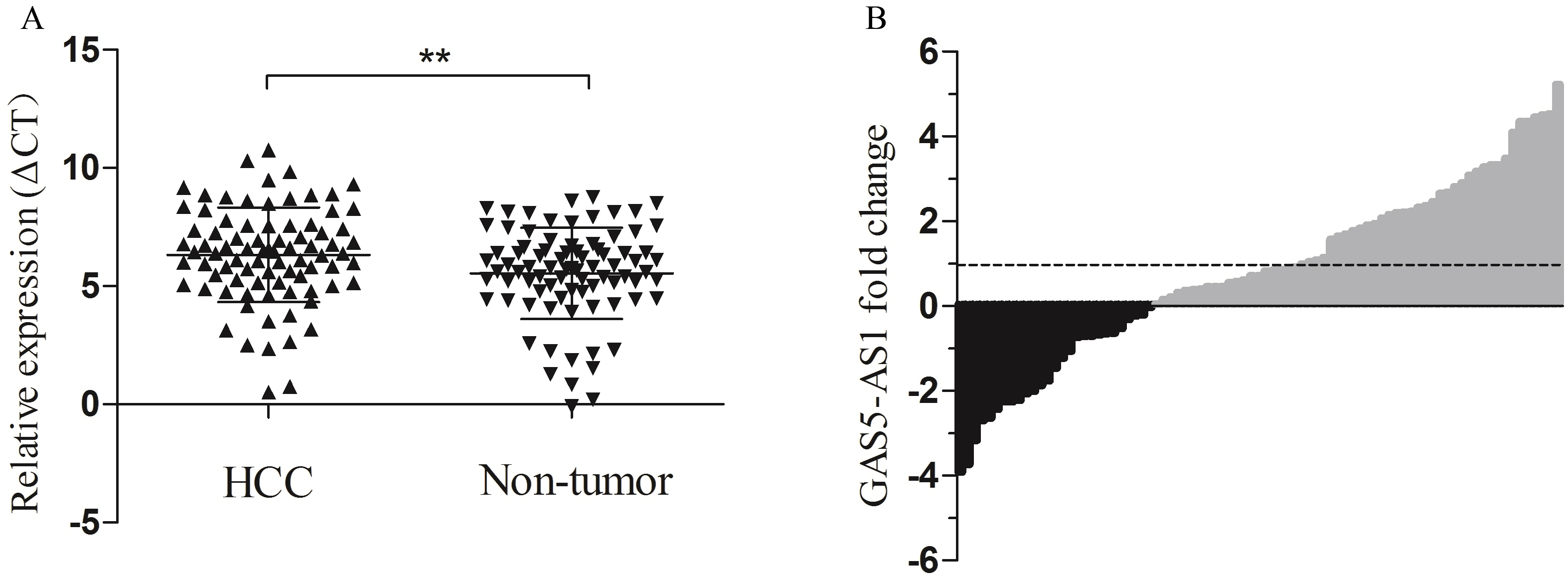
Total RNA from tissues were extracted using Trizol reagent (Invitrogen, CA, USA), and Total RNA Seperate Extraction Kit (Bioteke, Beijing, China) was used to extract total RNA from plasma according to manufacturer’s instruction. The concentration and purity of RNA were quantified by NanoDrop ND2000 (Thermo Fisher Scientific, CA, USA). Then RNA was reverse transcribed to cDNA by using PrimeScriptTM RT reagent Kit with gDNA Eraser (Takara, Japan), following: 42
Real-time PCR analysis
According to manufacturer’s instructions, the expressions of GAS5-AS1 were performed on the Bio-Rad CFX96 (Bio-Rad Laboratories, Inc., Hercules, CA, USA) using SYBR Premix Ex Taq Kit (TaKaRa, Japan). The reactions started at 95
Statistical analysis
All statistical analysis was carried out using the SPSS version 17.0 (SPSS, Inc. Chicago, IL, USA) and GraphPad Prism 5.0 (GraphPad Software, La Jolla, CA, USA). All
Results
GAS5-AS1 level was significantly lower in HCC tissues
We detected the expression levels of GAS5-AS1 in 83 pairs of HCC surgical tissues and adjacent normal liver tissues by RT-qPCR. Expression of GAS5-AS1 relative to GAPDH in tumor tissues was obviously lower than that in non-tumor tissues (
Association of GAS5-AS1 expression with clinical parameters in HCC
Association of GAS5-AS1 expression with clinical parameters in HCC
Abbreviation: *
Univariate and multivariate analysis of overall survival in HCC patients
Abbreviation:
According to the median expression levels (median
Association between down-regulation of GAS5-AS1 and prognosis in HCC.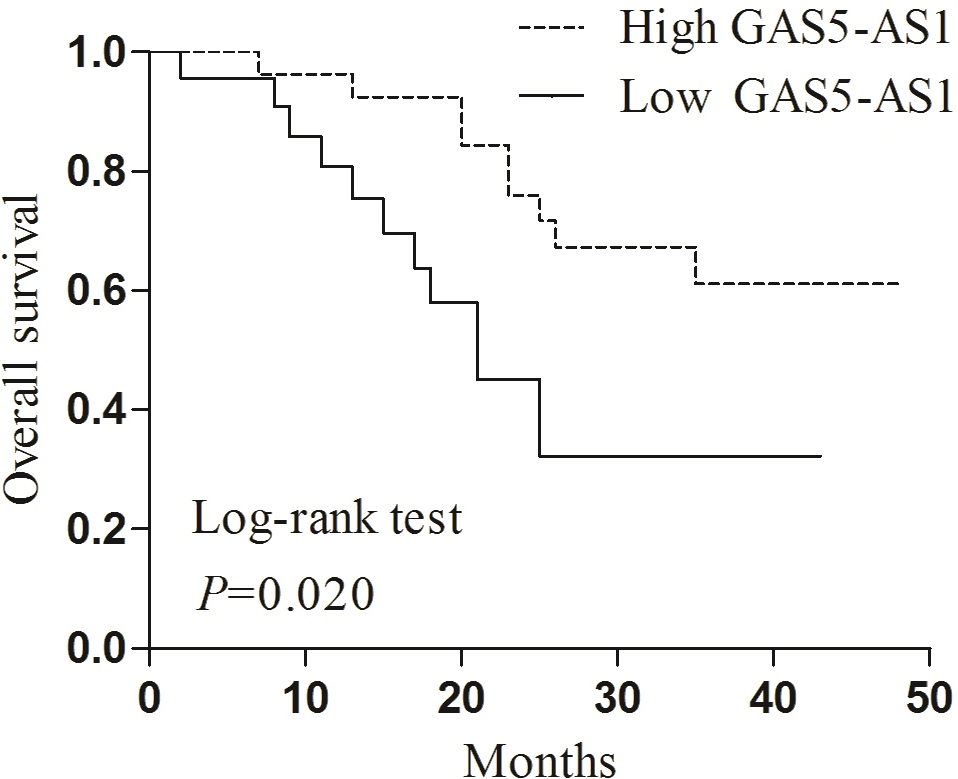
In order to explore the prognostic value of GAS5-AS1 in HCC, we assessed the relationship between the GAS5-AS1 expression and overall survival (OS) by using the Kaplan-Meier method. The survival signatures were analyzed in 51 patients, and 28 of them were in the high-GAS5-AS1 group, 23 patients were in the low group. Comparing with high-GAS5-AS1 group, low GAS5-AS1 expression levels were significantly associated with a shorter survival time (median OS: 21 month) (
Then univariate and multivariate analysis were conducted to explore the prognostic factors in HCC patients. Univariate analysis showed that differentiation (
GAS5-AS1 in plasma among subgroups. 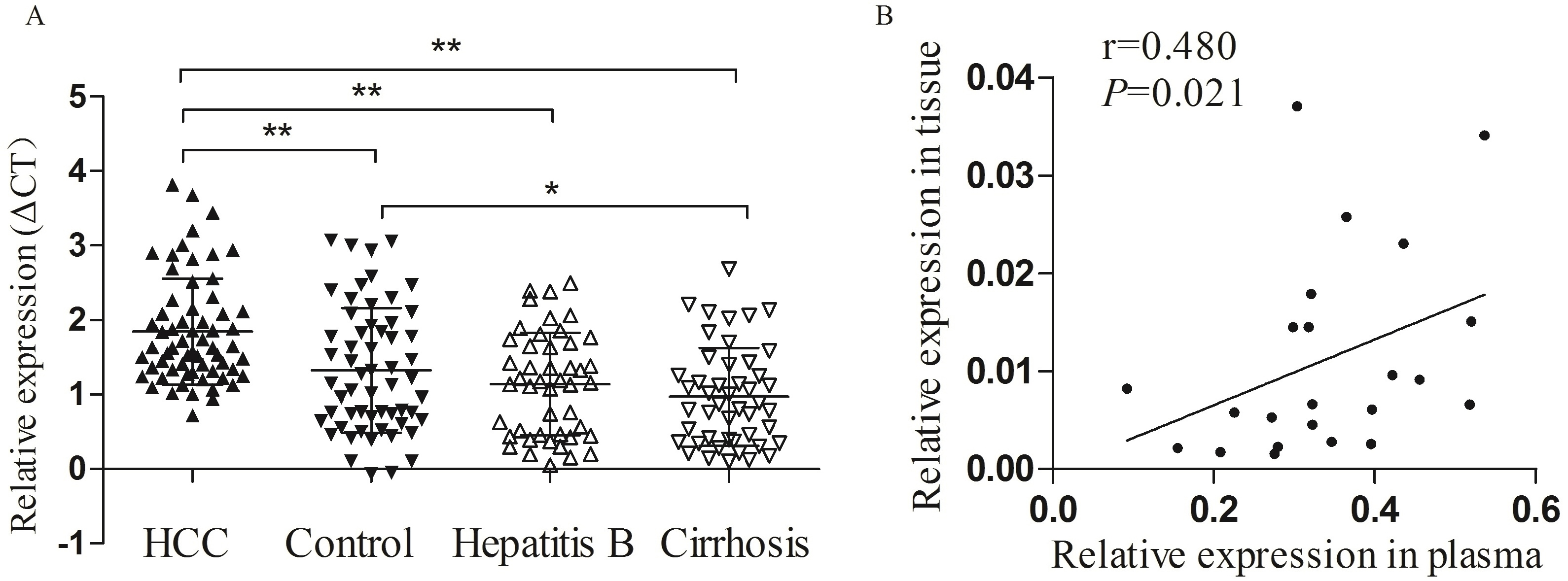
Receiver operating characteristic (ROC) curves. The ROC curves of the expression of GAS5-AS1 for 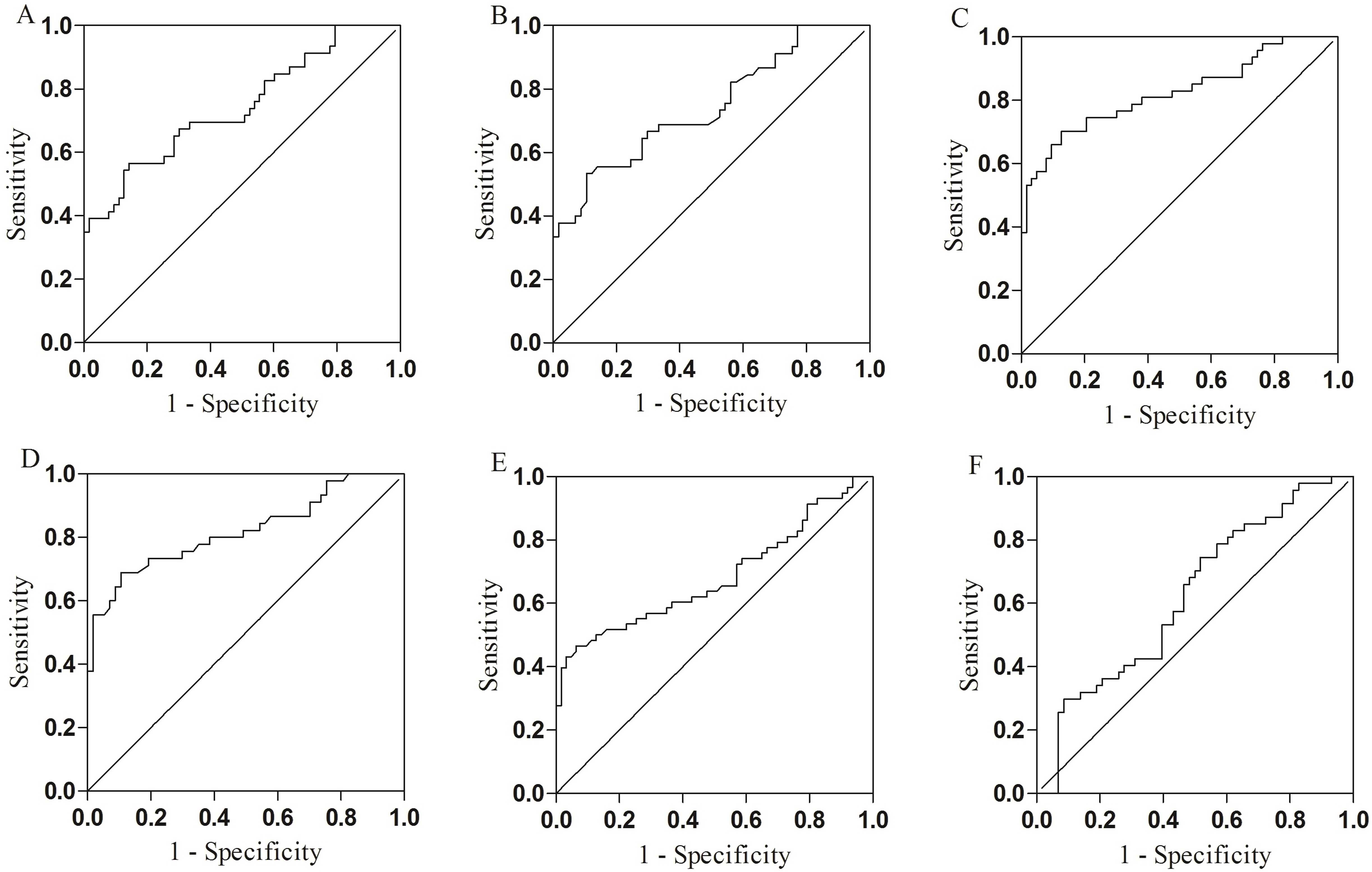
In addition to evaluate GAS5-AS1 expression in HCC tissues, we also tested its expression in plasma in 63 HCC patients, 46 hepatitis B patients, 47 cirrhosis patients, and 58 control cases. The main demographic and clinical characteristics of studied subjects were illustrated in Table 3. No difference was observed in important risk factors including gender, age, smoking, and alcoholism (
The levels of GAS5-AS1 expression in subgroups were measured by RT-qPCR. The result elaborated that the GAS5-AS1 expression level in HCC was lower than that in hepatitis B, cirrhosis and control groups (HCC vs hepatitis B:
Among 63 HCC plasma, 23 samples were from the patients whose tissues were also collected. Then we analyzed the association between tissues and plasma by detecting GAS5-AS1 expression in the 23 paired samples. There was a positive relationship between tissues and plasma in the expression of GAS5-AS1. Spearman correlation analysis showed that the correlation coefficient was 0.480 (
Diagnostic value of GAS5-AS1 in circulation
To test whether GAS5-AS1 could be used as a marker for HCC patients, we performed ROC, which has been established as a standard to determine the value of biomarker. ROC was conducted in 4 groups: HCC vs the controls, HCC vs hepatitis B, HCC vs cirrhosis, and cirrhosis vs controls (Table 4). The AUC
Characteristics of the studied subjects
Characteristics of the studied subjects
Comparisons of the AUC of the expression of GAS5-AS1 for subgroups
Abbreviation: Se: Sensitivity; Sp: Specificity; #1 HCC with AFP levels below 200 ng/ml and Hepatitis B whose AFP levels also below 200 ng/ml; #2 HCC with AFP levels below 200 ng/ml and Cirrhosis whose AFP levels also below 200 ng/ml.
HCC is a prevalent liver malignancy with poor prognosis, despite the therapeutic advances in HCC treatment recently [20, 21]. The pathogenesis of HCC is concealed, its progress is rapid, and the mortality rate is high [22]. Thus, novel biomarkers for HCC are intensively desired in clinic. Researches showed that HCC cells could express some fetal liver specific transcript factors and signal molecules [23]. Recently, mounting evidence has pointed to a relationship between lncRNAs and cancers, including metastasis, migration, apoptosis and clinical outcome [24]. Several lncRNAs have been implicated in human liver diseases [25]. In 2013, Xie et al. [26] indicated that highly up-regulated in liver cancer (HULC) is a specific gene which was markedly up-regulated both in HCC tissue and plasma. Metastasis Associated Lung Adenocarcinoma Transcript 1 (MALAT1) was up-regulated in HCC and acted as a proto-oncogene through Wnt pathway activation and induction of the oncogenic splicing factor serine/arginine-Rich Splicing Factor 1 (SRSF1) [27]. In 2016, Lv et al. [28] demonstrated that Unigene56159 significantly promoted cell migration and invasion through EMT in HCC. It is believed that lncRNAs play important regulatory roles in cancer progression [29]. Hence, it is particularly prospective to explore diagnostic and prognostic of lncRNAs for HCC.
For the first time, we investigated the expression pattern and clinical value of GAS5-AS1 in HCC patients. We found that the GAS5-AS1 expression level was lower in HCC tissues than in the paired adjacent normal tissues and its level was significantly associated with differentiation, TNM stage and glucose level. Comparing to the low-GAS5-AS1 group, the high group had a better prognosis and a longer survival time. The Cox hazards model elaborated that poorer differentiation and lower expression level of GAS5-AS1 were risk factors for HCC patients. Meanwhile, we detected the expression of GAS5-AS1 in plasma. The results suggested that GAS5-AS1 expressions in HCC were significantly lower than those in the controls, the hepatitis B and the cirrhosis. Remarkably, the levels of GAS5-AS1 expression in cirrhosis were higher than in controls. The possible reason might be that GAS5-AS1 was released when the normal tissues developed premalignant lesion. Unfortunately, the exact mechanisms was still undiscovered, needing further studies to explain. Moreover, we detected the relationship between the circulating RNA and the RNA in tissues. We found that there was a positive correction between them. In 2014, Kumarswamy et al. [30] indicated that circulating lncRNAs were from the tissues, which were confirmed by our result. Based on these results, it is believed that GAS5-AS1 could be used as a candidate prognostic and non-invasive biomarker for HCC.
Isolation of nucleic acids from plasma might be an ideal method for screening patients at an early stage and prefiguring their prognosis [31]. Meantime, circulating RNA has been an emerging field for non-invasive diagnostic applications in HCC [32]. Therefore, we evaluated the diagnostic value of GAS5-AS1 in HCC plasma. The results demonstrated that GAS5-AS1 could be helpful for distinguishing HCC patients from the healthy, with AUC of 0.683 and a good sensitivity of 93.7%. Additionally, the AUC
Epithelial-mesenchymal transition (EMT) is not only a mechanism that forms fibroblast-like cells, it can result in cancer cell migration, invasion, metastasis and therapeutic resistance, which plays a key role in step toward cancer metastasis [33, 34, 35]. In addition, cells lose their adhesive properties and undergo alterations in polarity and reorganization of the cytoskeleton during the process of EMT [36]. Accumulating studies have revealed that the involvement of several transcription factors, known as key EMT regulators, including the Snai family and the
In summary, our study investigated the expression levels of GAS5-AS1 in HCC patients for the first time. We found that GAS5-AS1 expression levels were down-regulated in HCC tissues and correlated with differentiation, TNM stage and glucose levels. Furthermore, the survival analysis indicated that GAS5-AS1 was an independent prognostic factor for HCC patients. Comparing with the high GAS5-AS1 group, the low group had a poor prognosis and a shorter survival time. Although our data supported that plasma GAS5-AS1 could be a potential diagnostic biomarker for HCC patients, it still needed further vitro and vivo trial to validate the precise role of GAS5-AS1 in HCC.
Footnotes
Acknowledgments
This study was supported by the National Basic Research Program of China (973 Program) (2012CB720 605).
Conflict of interest
The authors have declared that no conflict of interest.