




Abstract
BACKGROUND:
The most important anti-tumor immune response is mediated by T lymphocytes. The interaction of programmed death-1 ligand-1 (PD-L1) with its receptor provides an inhibitory signal in T lymphocytes activation and proliferation.
OBJECTIVE:
This study aimed to investigate whether polymorphisms of PD-L1 were associated with the risk and prognosis of esophageal squamous cell carcinoma (ESCC) in a high-incidence population from Northern China.
METHODS:
PD-L1 rs2890658 A/C and rs4143815 C/G single nucleotide polymorphisms (SNPs) were genotyped by polymerase chain reaction ligase detection reaction (PCR-LDR) method in 575 ESCC patients and 577 healthy controls.
RESULTS:
There was no significant difference in the genotype frequencies of these two SNPs between the ESCC patients and the healthy controls. However, for rs2890658 A/C SNP, compared with the C/C genotype, the A/C genotype increased the risk of ESCC for the smokers (OR
CONCLUSIONS:
PD-L1 rs2890658 A/C SNP might be used as risk marker of the susceptibility to ESCC for the Han nationality in a high-incidence population from Northern China.
Introduction
Esophageal cancer was the sixth leading cause of cancer-related deaths worldwide in 2012 [1]. Cixian of Hebei Province is one of the high-incidence regions for esophageal cancer in China. With the development of surgical techniques, radiotherapy, chemotherapy and immunotherapy, incidence and mortality rate of esophageal cancer has declined during the past forty years in this region [2]. However, esophageal cancer remains a major public health burden. Thereby, it is urgent to identify the risk factors and prognostic markers of esophageal cancer for the population in this high-incidence region.
Primer sequences and probe sequences in PCR-LDR reactions
Primer sequences and probe sequences in PCR-LDR reactions
Human immune system plays a critical role in the development and progression of various tumors. The most important anti-tumor immune response is mediated by T lymphocytes. Programmed death-1 ligand-1 (PD-L1, also known as CD274 or B7-H1) is located on the chromosome 9p24.2 and encodes a type I transmembrane protein with 290 amino acids. PD-L1 is expressed on activated T lymphocytes, B lymphocytes, dendritic cells, macrophages and some immune-privileged non-hematopoietic tissues [3, 4]. The interaction of PD-L1 with its receptor, PD-1, provides an inhibitory signal in T lymphocytes activation and proliferation, suppresses cytokine secretion, induces T lymphocytes apoptosis and maintains peripheral tolerance [5, 6, 7]. The expression of PD-L1 has also been reported in most human cancers including esophageal cancer [8, 9, 10, 11, 12]. Cancer-cell associated PD-L1 may contribute to tumor evasion from host immune [13, 14]. Increasing evidences showed that the expression of PD-L1 could be used as an indicator of poor prognosis for cancer patients [8, 9, 10, 11, 12]. Considering the important role of PD-L1 in immune regulation and tumor pathogenesis, we genotyped two single nucleotide polymorphisms (SNPs) (rs2890658 and rs4143815) in PD-L1 to explore the association of these two SNPs with the risk and prognosis of esophageal squamous cell carcinoma (ESCC) in a high-incidence population from Northern China.
Study subjects
The study consisted of 575 ESCC patients and 577 healthy controls. All of the study subjects were ethnically homogeneous (of Han descent) and permanent residents of Cixian. All of the patients and healthy controls were recruited during an endoscopic screening campaign between 2009 and 2014. The patients had histologically confirmed ESCC; self-reported, cancer-free subjects who were confirmed to be without upper gastrointestinal cancer (UGIC) by endoscopy were selected as healthy controls. Information on the sex, age, smoking habits and family history of UGIC from the cancer patients and healthy controls was obtained by two professional interviewers directly after blood sampling. Smokers were defined as those who formerly or currently smoked no less than five cigarettes per day for at least 2 years. Individuals who had at least one first-degree relative or at least two second-degree relatives who had esophageal/cardiac/gastric cancer were defined as having a family history of UGIC. In addition, the ESCC patients were followed based on survival information. Two hundred and two ESCC patients with survival information were included in the survival analysis. The study was approved by the Ethics Committee of the Fourth Hospital of Hebei Medical University. The written informed consent forms were obtained from all recruited subjects.
Distribution of selected characteristics in ESCC patients and healthy controls
Distribution of selected characteristics in ESCC patients and healthy controls
Association between PD-L1 gene SNPs and susceptibility to ESCC
*: Adjusted for sex, age, smoking status and UGIC family history (the stratified factor in each stratum excluded).
ESCC patients’ characteristics and survival of ESCC patients
*: mean survival time.
Five milliliters of venous blood was drawn from each subject in Vacutainer tubes containing ethylene diamine tetra acetic acid and stored at 4
Polymorphism genotyping
The genotypes of PD-L1 polymorphisms were determined by the Shanghai Generay Biotech Co., Ltd. (Shanghai, China) using the polymerase chain reaction ligase detection reaction (PCR-LDR) method. The primers for amplification and the probes for LDR were shown in Table 1.
Statistical analysis
PD-L1 gene SNPs and survival of ESCC patients
PD-L1 gene SNPs and survival of ESCC patients
*: Adjusted for sex, age, smoking status and UGIC family history.
Statistical analysis was performed using the SPSS ver. 22.0 software package (SPSS, Chicago, IL, USA).
Kaplan-Meier survival curves for ESCC patients by the genotypes of PD-L1 gene SNPs.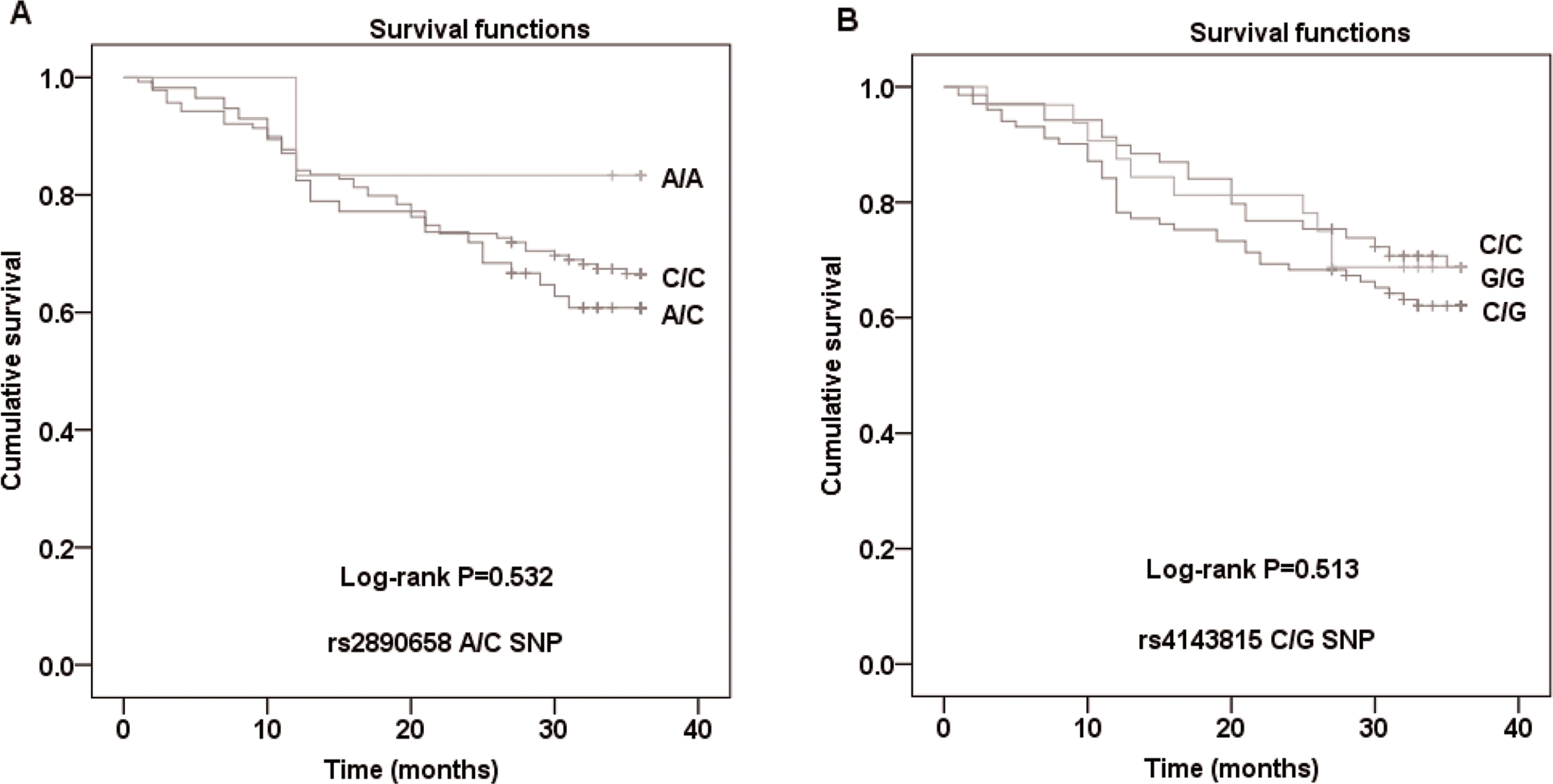
The mean age of the ESCC patients and the healthy controls were 60.3
The genotype distributions of PD-L1 rs2890658 A/C and rs4143815 C/G SNPs in the healthy controls were consistent with Hardy–Weinberg equilibrium (
Association between PD-L1 polymorphisms and the survival of ESCC patients
The mean age of the 202 ESCC patients with survival information was 60.4
Discussion
In this molecular epidemiological study, for the first time, we investigated whether PD-L1 polymorphisms contribute to susceptibility to ESCC and to the prognosis of ESCC patients. We found that UGIC family history increased the risk of ESCC, which suggested that genetic background played an important role in the development of ESCC. Compared with PD-L1 rs2890658 A/C SNP C/C genotype, A/C genotype elevated the risk of ESCC for the smokers. PD-L1 rs4143815 C/G SNP had no effect on susceptibility to ESCC. In addition, neither rs2890658 A/C SNP nor rs4143815 C/G SNP was associated with the prognosis of ESCC patients.
PD-L1 rs2890658 A/C SNP is situated within the third intron. The function of introns seems to less important. In fact, some studies identified transcription regulation element on the introns of the human gene [16, 17, 18, 19] and found intronic variants might affect disease susceptibility [20, 21]. PD-L1 rs2890658 A/C SNP has been reported to be associated with the risk of non-small cell lung cancer and Graves’ disease [22, 23, 24, 25]. Similarly, this SNP also influenced the susceptibility to ESCC. To date, there is no report about functional study of rs2890658 A/C SNP. The observed association with rs2890658 A/C SNP suggested that this SNP being directly functional or being in linkage disequilibrium with another functional variant [26]. However, rs2890658 A/C SNP was not related to the risk of some autoimmune diseases [27, 28] and the prognosis of ESCC patients.
The rs4143815 C/G SNP is located on the 3
In this population-based case-control study, all of the participants were of ethnically homogeneous Han nationality, which might exclude selection bias and avoid introducing ethnicity-driven bias. However, there were some limitations. Firstly, only two SNPs were involved in present study. Secondly, partial results, although adjusted by sex, age, smoking status and UGIC family history, were acquired based on stratified analyses with a limited sample size. Therefore, the relation between other SNPs of PD-L1 and ESCC should be investigated in additional studies with a larger sample size in a population from Cixian high-incidence region or other regions.
In conclusion, this study for the first time assessed the association of PD-L1 polymorphisms with the development and prognosis of ESCC in a high-incidence population from Northern China. The results indicated that PD-L1 rs2890658 A/C SNP was associated with the risk of ESCC for smokers. Therefore, the smokers with rs2890658 A/C SNP A/C genotype should receive regular upper gastrointestinal fiber tests, which help to facilitate early diagnosis and early treatment of ESCC.
Footnotes
Acknowledgments
We would like to thank Zhi-feng Chen for help with sample collection. We gratefully acknowledge Guo-hui Song and Lei Wang for help with data collection. This study was funded by grants from the Financial Department of Hebei Province [No. (2012)2056].
Conflict of interest
The authors declare no conflicts of interest.