




Abstract
Background:
Programmed death-ligand 1 (PD-L1) is a programmed death 1 (PD-1) ligand that plays a pivotal role in the inhibition of the T-cell-mediated immune response. The expression of PD-L1 is associated with the prognosis and clinical outcomes of multiple tumors. However, the prognostic value of PD-L1 overexpression in colorectal cancer is still controversial. In this study, we sought to clarify this by presenting a meta-analysis of relevant studies.
Methods:
Databases including PubMed, Web of Science, and EMBASE were systematically searched for studies concerning the expression of PD-L1 and survival in colorectal cancer. The reported hazard ratios (HR) with 95% confidence intervals (CI) of overall survival, disease-free survival, and recurrence-free survival in the included studies were analyzed by fixed effects/random effects models.
Results:
Fifteen studies involving 3078 patients with colorectal cancer were included in our meta-analysis. Overexpression of PD-L1 was found to be associated with poor overall survival (HR 1.83; 95% CI 1.21, 2.79; P = 0.005) and poor recurrence-free survival (HR 2.78; 95% CI 1.43, 5.42; P = 0.003). However, no correlation was found between PD-L1 overexpression and poor disease-free survival (HR 1.23; 95% CI 0.83, 1.82; P = 0.305). Overexpression of PD-L1 indicating poor survival held true across different geographical areas, sample sizes, analysis types, sources of HRs, and cell types.
Conclusion:
Overexpression of PD-L1 is associated with worse prognosis in patients with colorectal cancer and can guide physicians in the application of PD-1/PD-L1 immune checkpoint-targeted therapy.
Introduction
Co-stimulatory and co-inhibitory receptors play a crucial role in T-cell biology because they determine the functional outcome of T-cell receptor signaling.1,2 Antigen-dependent and antigen-independent signal transduction pathways participate in regulating classic T-cell activation. 3 Programmed death 1 (PD-1) and cytotoxic T lymphocyte-associated antigen-4 are two immune checkpoint molecules involved in cancer immunoediting, which suppress T-cell-mediated immune responses, leading to the development of cancers. Programmed death-ligand 1 (PD-L1, also known as B7-H1 and CD274), is a PD-1 ligand that plays a pivotal role in the inhibition of the T-cell-mediated immune response. The expression of this ligand is associated with prognosis and clinical outcomes of multiple tumors.4-7
Colorectal cancer (CRC) is the third most common cancer and the second leading cause of cancer-related deaths worldwide.8,9 Considerable advances have been achieved in the treatment of CRC, 10 but the 5-year survival rate remains poor, 11 and there is still some question regarding the independent predictors of poor CRC prognosis. Recently, researchers have begun to explore the prognostic value of PD-L1 overexpression in different solid tumors. Unlike its clear role in gastric cancer,12-14 the prognostic value of PD-L1 overexpression in CRC is still controversial. Here we present a meta-analysis evaluating the prognostic value of PD-L1 overexpression in CRC. The purpose of this study was to estimate the correlation of PD-L1 with prognosis in CRC and to provide further direction for research into PD-1/PD-L1 immune checkpoint-targeted therapy and prognostic prediction.
Methods
Literature search strategies
PubMed, Web of Science, and EMBASE were searched for studies evaluating the expression of PD-L1 and survival in CRC. The search items included “CRC”, “colorectal cancer”, “colorectal tumor”, “colorectal neoplasms”, “colon cancer” or “rectal cancer”, “survival”, “prognostic”, “prognosis” or “outcome” and “PD-L1”, “Programmed death-ligand 1”, “cluster of differentiation 274”, “CD274”, “B7H1” or “B7 homolog 1”. All entries satisfying these criteria were manually retrieved.
Study inclusion and exclusion criteria
Eligible studies were included when meeting the following criteria: (a) the diagnosis of CRC was confirmed pathologically; (b) data on overall survival (OS), disease-free-survival (DFS), and recurrence-free survival (RFS) were available for evaluating the correlation of CRC prognosis with PD-L1 expression; and (c) hazard ratio (HR) and 95% confidence interval (CI) values were directly provided or could be calculated. Animal studies, reviews, editorials, comments, meetings, or case reports were excluded.
Data extraction
A standard protocol was adopted to extract data. The following data were extracted from each eligible study: (a) study characteristics including the first author, year of publication, country of origin, number of patients, duration of follow-up, and method of analysis; (b) patient characteristics including geographical area, age, gender, cell type, tumor stage, and cut-off value; and (c) statistical data including HRs of OS, DFS, and RFS and their 95% CIs. The HRs were extracted directly from univariate and multivariate analyses or calculated from Kaplan–Meier survival curves. 15 This investigation was approved by the institutional ethics committee of the Third Affiliated Hospital of Soochow University.
Quality assessment
The Newcastle-Ottawa Scale 16 was used for assessing the quality of each included study. The study was considered to be of high quality when the score was more than 6.
Statistical analysis
Data were extracted from the primary studies and analyzed using the Stata 12 Edition (Stata, College Station, TX, USA). Statistical heterogeneity was examined using the chi-square-based Q-test, in which the I2 value indicates the degree of heterogeneity. A random-effects model (DerSimonian-Laird method) was applied in cases of significant heterogeneity (I2 ⩾ 50% and P < 0.1), while a fixed-effects model (Mantel–Haenszel method) was used in the absence of heterogeneity. Subgroup analyses were conducted based on geographical area, sample size, analysis type, source of HR, and cell type. Sensitivity analyses were carried out to investigate the robustness of the findings. Publication bias was estimated by funnel plot and Egger’s linear regression test. All statistical tests in the meta-analysis were two-tailed and a P value ⩽ 0.05 was considered statistically significant.
Results
Search results
The systematic database search retrieved 955 articles.
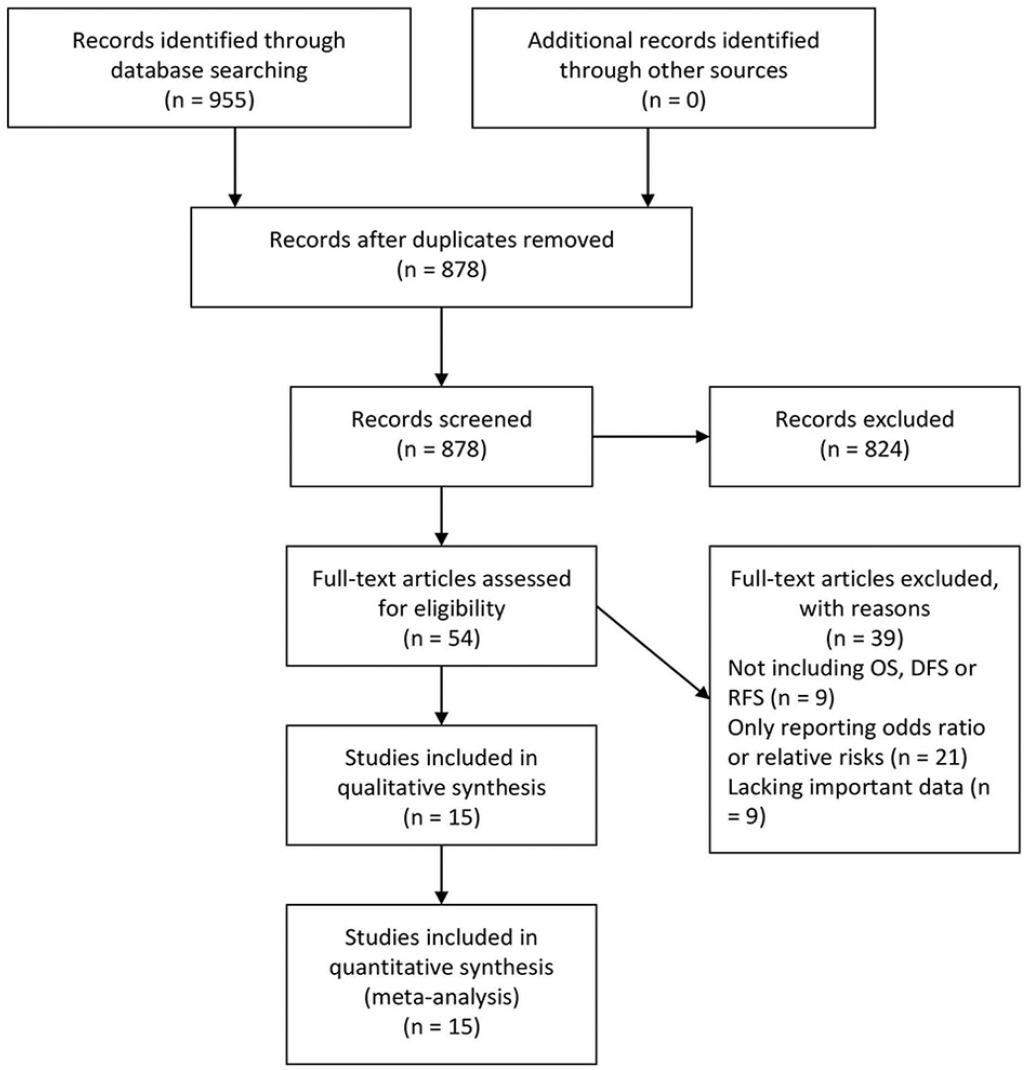
Flow chart of the study selection process. The systematic database search retrieved 955 articles. Based on the inclusion criteria, 15 articles were eventually selected for the meta-analysis.
The characteristics of all included studies are shown in Table 1. Among the included articles, there were 21 sets of data in total examining the association between PD-L1 expression and prognosis, including 8 sets that analyzed OS, 7 DFS, and 6 RFS.
Major characteristics of the included studies.
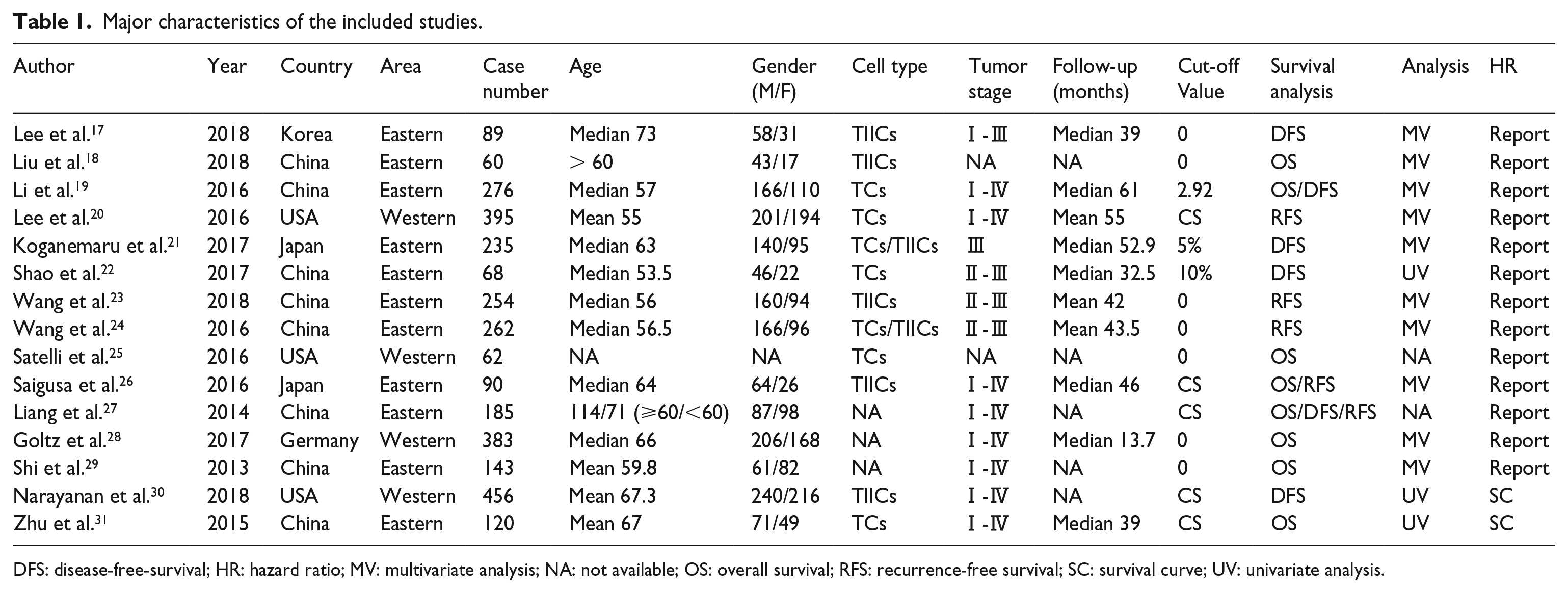
DFS: disease-free-survival; HR: hazard ratio; MV: multivariate analysis; NA: not available; OS: overall survival; RFS: recurrence-free survival; SC: survival curve; UV: univariate analysis.
Meta-analysis
Overall survival
Data on OS were collected from 1319 patients with CRC. Overexpression of PD-L1 was found to be associated with poor OS (HR 1.83; 95% CI 1.21, 2.79; P = 0.005). Significant heterogeneity was observed in these studies (P = 0.004; I2 = 66.7%; Figure 2(a)).
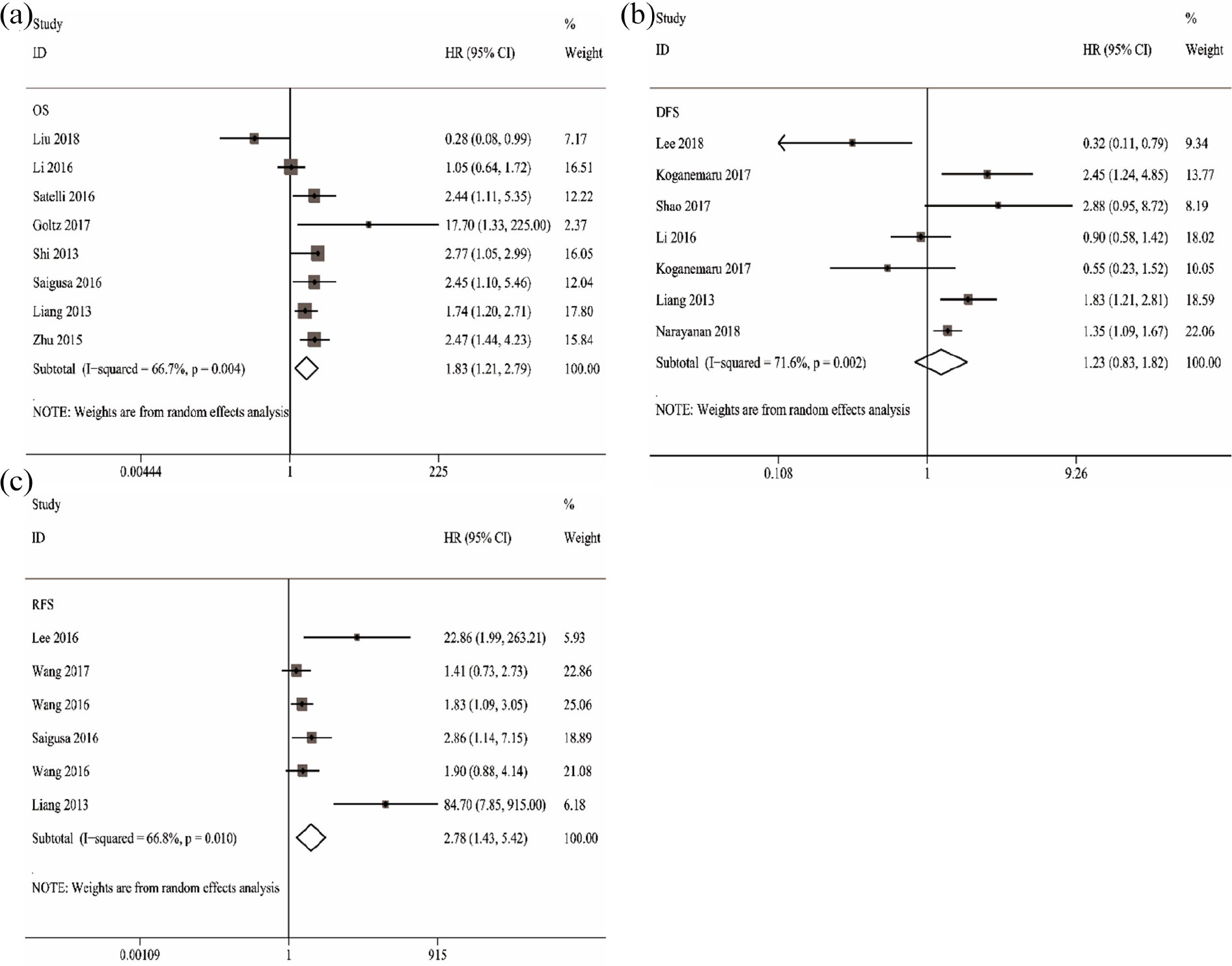
Forest plots of studies evaluating the HR of programmed death-ligand 1 (PD-L1) in patients with CRC. (a) Overexpression of PD-L1 was found to be associated with poor OS (HR 1.83; 95% CI 1.21, 2.79; P = 0.005). (b) No correlation was found between PD-L1 overexpression and poor DFS (HR 1.23; 95% CI 0.83, 1.82; P = 0.305). (c) Overexpression of PD-L1 was found to be associated with poor RFS (HR 2.78; 95% CI 1.43, 5.42; P = 0.003).
Disease-free-survival
Data on DFS were provided by 1309 patients with CRC and indicated no correlation between PD-L1 overexpression and poor DFS (HR 1.23; 95% CI 0.83, 1.82; P = 0.305). Significant heterogeneity was observed in these studies (P = 0.002; I2 = 71.6%; Figure 2(b)).
Recurrence-free survival
Data on RFS were extracted from 1186 CRC patients and indicated a correlation between PD-L1 overexpression and poor RFS (HR 2.78; 95% CI 1.43, 5.42; P = 0.003). Significant heterogeneity was observed in these studies as well (P = 0.010; I2 = 66.8%; Figure 2(c)).
Subgroup analysis
Subgroup analysis was performed based on geographical area, sample size, analysis type, source of HRs, and cell type. Heterogeneity occurred in each subgroup (Table 2).
Subgroup analyses based on different categories.
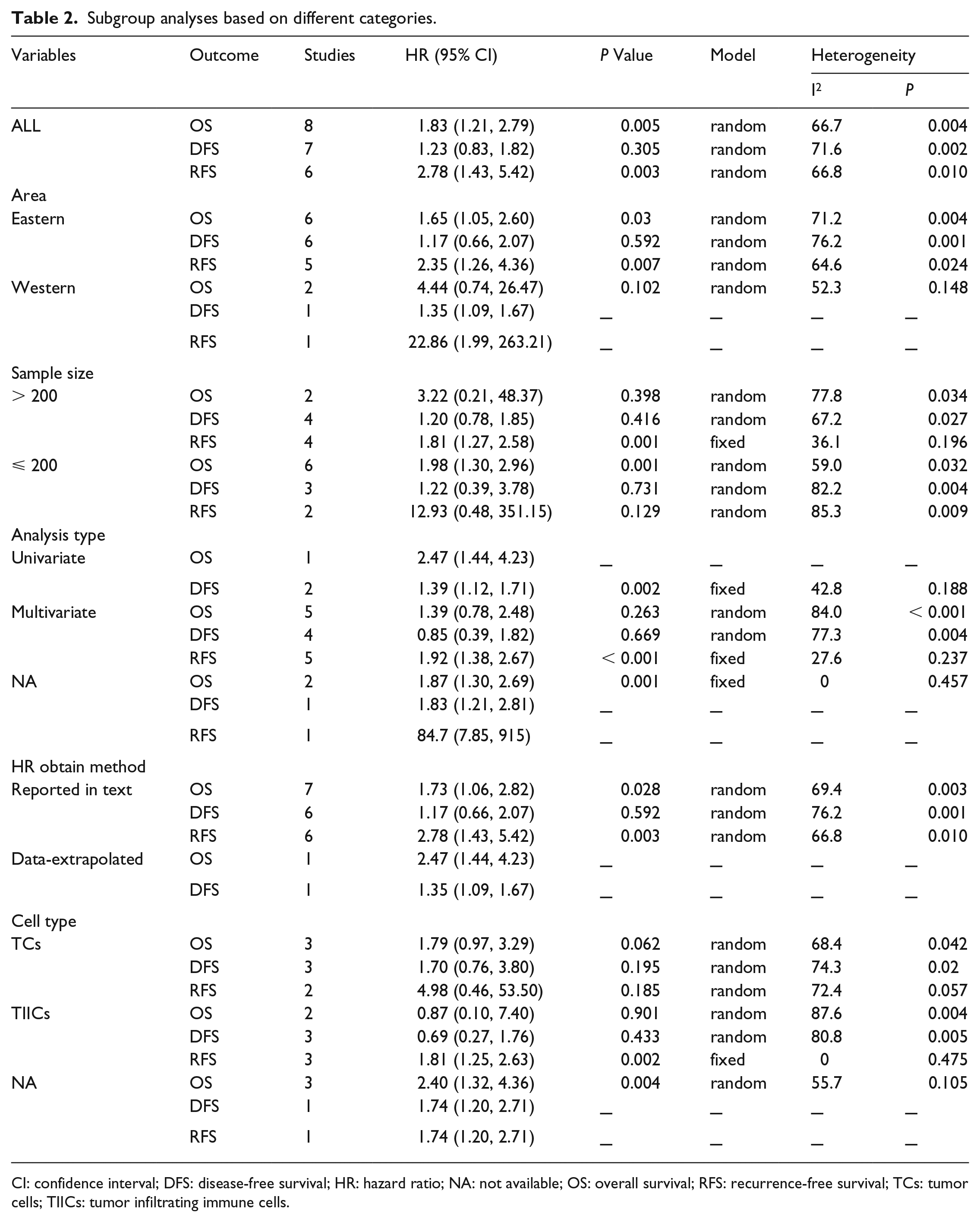
CI: confidence interval; DFS: disease-free survival; HR: hazard ratio; NA: not available; OS: overall survival; RFS: recurrence-free survival; TCs: tumor cells; TIICs: tumor infiltrating immune cells.
Sensitivity analysis
Sensitivity analysis was performed for OS (Figure 3(a)), DFS (Figure 3(b)), and RFS (Figure 3(c)) through the sequential omission of each study. As a result, no single study was able to change the overall results, which demonstrated the robustness of the results in our meta-analysis.
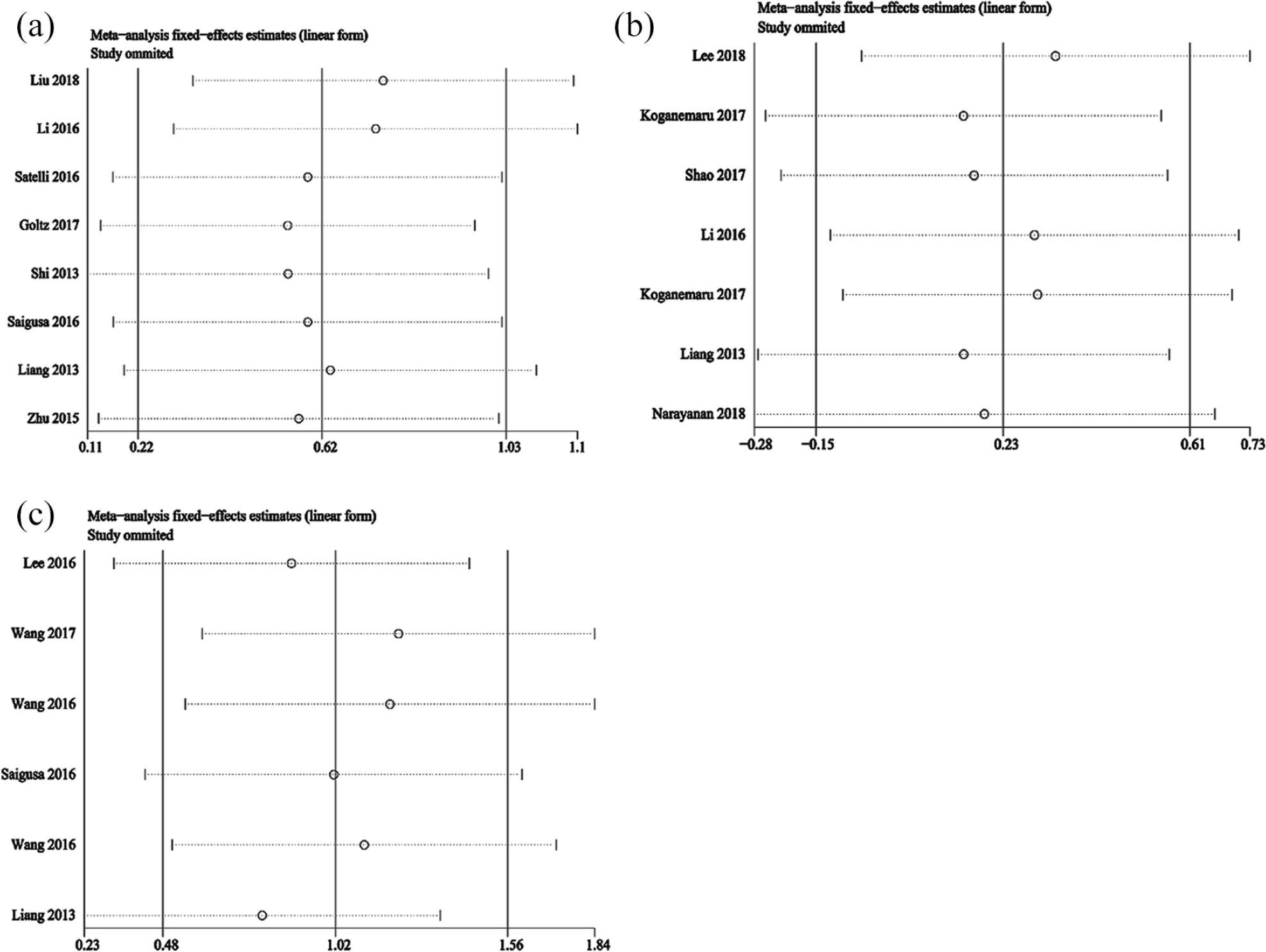
Sensitivity analyses confirming the robustness of OS (a), DFS (b), and RFS (c) through the sequential omission of each study. No single study was able to change the overall results, which demonstrated the stability of the results in our meta-analysis.
Publication bias
The publication bias of all enrolled studies was evaluated using funnel plots and Egger’s linear regression test. The results showed no significant publication bias in OS (P = 0.863, Supplementary material 1(a)) and DFS (P = 0.649, Supplementary material 1(b)). However, visual inspection of the funnel plot (Supplementary material 1(c)) revealed evidence of publication bias for RFS, which was confirmed by Egger’s tests (P = 0.009). Using the “Trim and Fill” method to adjust for publication bias under the random-effects model, the corrected pooled multivariable-adjusted HR for RFS was 1.67 (95% CI 1.25, 2.11).
Discussion
PD-L1 is primarily expressed on the surface of tumor cells (TCs) and other tumor-promoting cells in various solid tumors, including melanoma,32,33 colorectal cancer, 29 lung cancer,34-36 pancreatic carcinoma, 37 and hepatocellular carcinoma. 38 The PD-1/PD-L1 pathway plays an important role in immune regulation. Blocking the interaction between PD-1 and PD-L1 has been shown to exert an antitumor effect. 39 Therapeutics targeting the PD-1/PD-L1 pathway are currently undergoing clinical trials, and recent clinical trials have demonstrated that multiple cancer patients can achieve benefit from immune check-point targeted therapy. 40 However, the prognostic value of PD-L1 overexpression in CRC patients has not been fully addressed to date. This meta-analysis was designed to investigate the relationship between the PD-L1 overexpression and prognosis in 15 studies involving 3078 patients with CRC. The results showed that overexpression of PD-L1 was associated with worse OS and RFS. No relationship was found between PD-L1 overexpression and DFS. Furthermore, subgroup analysis revealed that overexpression of PD-L1 was associated with poor survival, but no significant difference was found among different subgroups, which was consistent with the results derived from the overall analysis.
Some studies have reported that PD-L1 overexpression was associated with worse 5-year survival of patients with digestive tract-derived cancers including esophageal cancer, 41 gastric cancer, 42 and colorectal cancer,29,43 which is consistent with our results. Similar conclusions were drawn in two other studies,26,27 showing that PD-L1 overexpression was an independent predictor of poor CRC survival. Although we found no relationship between PD-L1 overexpression and DFS in this meta-analysis, on the whole our analyses revealed that PD-L1 overexpression was associated with poor prognosis.
Despite a host of studies supporting our results, there have been some differing observations. The status of DNA mismatch repair (MMR) described as MMR-proficient or MMR-deficient was also reported to be significant in predicting prognosis upon PD-L1 expression on TCs. 44 Droeser et al. 44 concluded that PD-L1 expression was associated with better survival in MMR-proficient CRCs, which may have resulted from the increase in infiltrating CD8+ T cells. Another study illustrated that PD-L1 expression in tumor-infiltrating immune cells (TIICs) was associated with a better prognosis for patients with microsatellite instability-high (MSI-H) colon cancer. 17 MSI-H is a hypermutable phenotype caused by impaired DNA MMR. A similar conclusion was drawn by Ogino et al., 45 who found that MSI-H tumors have a better prognosis than microsatellite-stable CRCs. In our opinion, the correlation of MMR-proficient and MSI-H phenotypes with better prognosis in CRC requires further research and exploration.
As is well known, PD-L1 is not only expressed in TCs, but also upregulated in TIICs. 3 Where PD-L1 is expressed may produce different findings. Although previous studies have confirmed that high expression of PD-L1 on TCs was linked with worse survival in CRC patients,22,31 only a few studies have examined the association between PD-L1 expression on TIICs and prognosis in CRC patients. Recently, two studies revealed that high PD-L1 expression on TIICs was associated with a favorable prognosis in CRC patients.17,21 Different mechanisms regulating PD-L1 expression on TCs and TIICs may explain these different results. PD-L1 expression on TIICs was found to play a role in tumor immune escape and to affect tumor progression, which accounted for its relationship with a favorable prognosis. 46
Although we performed an exhaustive meta-analysis,
Conclusion
In summary, this meta-analysis revealed that overexpression of PD-L1 was associated with worse prognosis in patients with CRC, which suggests that the development of PD-L1/PD-1 immune checkpoint-targeted therapy may be a promising approach, which will offer more options for the treatment of patients with CRC.
Supplemental Material
Supplementary_material_1 – Supplemental material for Programmed death-ligand 1 and survival in colorectal cancers: A meta-analysis
Supplemental material, Supplementary_material_1 for Programmed death-ligand 1 and survival in colorectal cancers: A meta-analysis by Huihua Cao, Qing Wang, Zhenyan Gao, Zhan Yu, Yugang Wu and Qicheng Lu in The International Journal of Biological Markers
Supplemental Material
Supplementary_material_2 – Supplemental material for Programmed death-ligand 1 and survival in colorectal cancers: A meta-analysis
Supplemental material, Supplementary_material_2 for Programmed death-ligand 1 and survival in colorectal cancers: A meta-analysis by Huihua Cao, Qing Wang, Zhenyan Gao, Zhan Yu, Yugang Wu and Qicheng Lu in The International Journal of Biological Markers
Footnotes
Ethics approval and consent to participate
The study was approved by the Ethics Committee of the Third Affiliated Hospital of Soochow University.
Author contributions
HC and QW wrote the manuscript, analyzed collected data, and contributed equally to this study. ZG and ZY carried out the database search and collected data. YW and QL assisted HC and QW to complete the work. YW funded the study.
Declaration of conflicting interest
The author(s) declared no potential conflicts of interest with respect to the research, authorship, and/or publication of this article.
Funding
The author(s) disclosed receipt of the following financial support for the research, authorship, and/or publication of this article: The present study was supported by the Changzhou Municipal Scientific Research grant (grant no. CE20125020).

Supplemental material
Supplemental material for this article is available online.
References
Supplementary Material
Please find the following supplemental material available below.
For Open Access articles published under a Creative Commons License, all supplemental material carries the same license as the article it is associated with.
For non-Open Access articles published, all supplemental material carries a non-exclusive license, and permission requests for re-use of supplemental material or any part of supplemental material shall be sent directly to the copyright owner as specified in the copyright notice associated with the article.
