




Abstract
BACKGROUND:
Breast cancer is the most common type of cancer of women across the world, which can affect the quality of life in patients due to complications caused by the disease and related treatments. Various treatments have been designed for these patients to improve their life quality. This study aimed to estimate the mean score of health-related quality of life patients with breast cancer in Iran.
METHODS:
In this study, we searched the national and international databases of SID, MagIran, Google Scholar, ISI/Web of Science, PubMed and Scopus with no time limits using the keywords of “health-related quality of life”, “health related quality of life”, “quality of life”, “breast neoplasm”, “breast cancer”, and “breast tumors”. Data analysis was performed in STATA version 14 based on the heterogeneity state using random effects model.
RESULTS:
In this study, 15 articles with a sample size of 1883 were evaluated, and the mean global quality of life in patients was reported at 72.48 (95% CI: 64.94–79.82). In addition, the worst performance and symptoms were related to emotional functioning (56.70) (95% CI: 49.84–63.55) and financial difficulties (43.57) (95% CI: 31.47–55.67).
CONCLUSION:
According to the results of the present study, the Iranian patients with breast cancer had a moderate quality of life in most dimensions.
Introduction
Breast cancer is one of the most common cancers worldwide with a prevalence of 8–10% in different countries and 17.8% in Iran [1,2]. Although current treatments can increase patient survival, their side effects may affect patients’ quality of life [3]. Patients with breast cancer experience changes in their appearance due to mastectomy, surgical scars, skin discoloration, and changes in body weight [4]. Chemotherapy leads to unfavorable side effects, such as nausea and vomiting, reduced appetite, hair loss, recurrent infections, fever, pain, diarrhea, constipation, and fatigue [5]. These patients also psychologically suffer from depression and anxiety and experience the feeling that their life is over after the diagnosis [6,7].
In general, quality of life is defined as the level of physical, psychological and social welfare perceived by a person and demonstrates the level of satisfaction with life blessings [8]. Quality of life is a subjective and dynamic concept [9]. By measuring the quality of life, the effects of various therapeutic and palliative therapies and patients’ performance can be evaluated [10]. The European Organization for the Research and Treatment of Cancer Quality of Life Questionnaire (EORTC QLQ-C30) is a standard instrument that specifically measures the quality of life of patients with breast cancer [11]. Various studies conducted in Iran with the EORTC QLQ-C30 have reported different results.
The first step in solving any problem is to identify it. Quality of life is important for both healthy and sick people. Women with breast cancer may have a poor quality of life due to the disease, the consequences of treatment and other underlying problems. Different studies conducted in Iran have reported different results and it was necessary to analyze and report the pooled mean score of quality of life in all dimensions. Based on these results, health authorities can gain a more complete understanding of the situation and plan specific actions based on it.
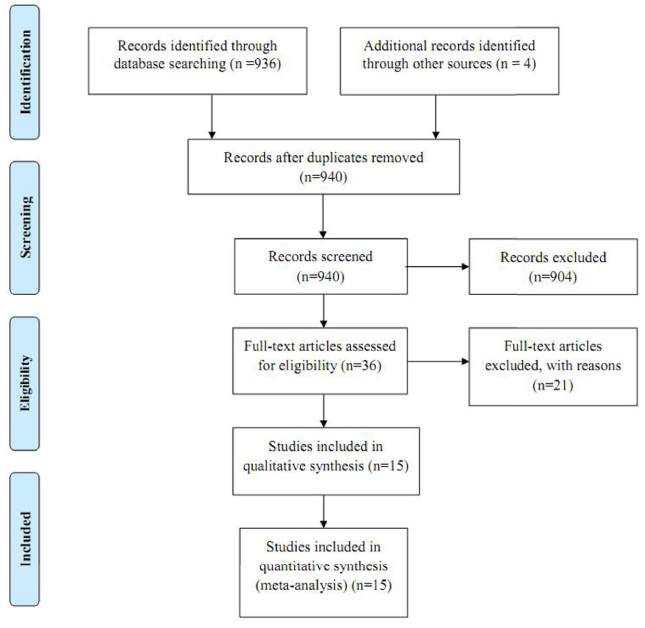
Process of selecting and screening the studies based on the PRISMA statement.
The characteristics of selected papers
In this systematic review and meta-analysis, we assessed the life quality in Iranian women with breast cancer based on PRIMSA statements. To find relevant articles, two researchers independently searched the national and international databases of Scientific Information Data (SID), MagIran, ISI/Web of Science, PubMed and Scopus with no time limitations. In addition, the references of the evaluated articles were assessed to have access to other studies. The terms searched included “health related quality of life”, “health-related quality of life”, “breast neoplasm”, “breast cancer”, “breast tumors”, “quality of life”, “life quality” and “Iran”.
Article selection and data extraction
At first, we collected all articles related to the evaluation of life quality in patients with breast cancer. Inclusion criteria were observational study (non-interventional), evaluation of life quality using a standard questionnaire of EORTC QLQ-C30, and presenting sufficient information related to research objectives. EORTC QLQ-C30 is one of the most widely used tools for measuring the quality of life of breast cancer patients, encompassing five functional areas (physical, role playing, cognitive, emotional and social), nine symptoms (fatigue, nausea and vomiting, shortness of breath, reduced appetite, diarrhea, constipation, insomnia, and financial problems), and one global quality of life. A higher score indicates a better quality of life [11]. On the other hand, exclusion criteria were lack of relevance to the topic, repeated articles, and lack of access to the full text of articles. To extract data from selected articles, we used a checklist that included the variables of the corresponding author of the article, year of publication, research setting, sample size and score of life quality in each nine dimensions. Each article was assessed by two researchers independently, and lack of consensus over an article would lead to the evaluation of the work by another author, who was an expert in the meta-analysis field.
In the initial search, 940 articles were found, 915 of which were excluded due to lack of relevance to the subject, and 15 Persian and English articles related to the subject were analyzed. However, mean scores of some subscales were not reported by some of the articles, which led to just analyzing articles with sufficient and suitable information. In addition, the methodological quality of articles was evaluated based on ten items selected from STROBE checklist (title and abstract, objectives and hypotheses, research setting, inclusion criteria, sample size, statistical methods, descriptive data, interpretation of results, research limitations and funding) [12].
Statistical analysis
Given the normal distribution of life quality score, the variance of each research was estimated using normal distribution variance (
Results
In this study, all Farsi and English articles conducted to evaluate the life quality in patients with breast cancer in Iran were analyzed with no time limitations. On the initial search, the national and international databases were evaluated up to March 2019, which led to the extraction and assessment of 15 articles in 18 groups (Fig. 1). This number of articles was obtained since the national databases were not sensitive to Boolean operators, which led to a single-word search on databases (Fig. 1).
The final studies selected were related to 2008–2018 years (a 10-year interval), and the total sample size was 1883, with a mean of 105 individuals per study. In this regard, the smallest and largest sample sizes were related to the studies by Bastani & Hatam (32 subjects) [13,14] and Montazeri (167 subjects) [15]. In addition, most studies were performed in Tehran (N = 6) and Shiraz (N = 5). The study by Hatam and Bastani [13,14] was performed on two groups of patients treated with TAC (docetaxel, adriamicine, cyclophosphamide) and FAC (5-FU, adriamicine–cyclophosphamide), whereas the research by Hadi [16] was conducted on two groups treated with modified radical mastectomy (MRM) and breast-conserving surgery (BCS). In this respect, the mean score of various dimensions of life quality was reported based on groups, and the total score was not presented in the texts of articles. Therefore, each treated group was regarded as a separate study. Other specifications of the articles assessed are presented in Table 1.
According to the results, the mean score of the global quality of life in these patients was 72.38 (95% CI: 64.94–79.82) (Figure 2).
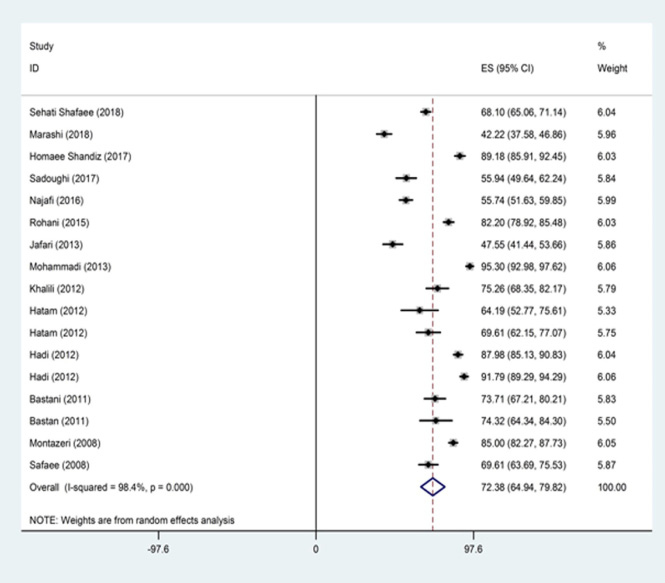
Mean score of life quality in the research. The 95% CI for each study in the form of horizontal lines around the major mean and dotted line in the middle represents the total mean score, and the rhizome shape represents the confidence range of the mean global score of quality of life.
In this questionnaire, while obtaining a higher score in the functional dimension was more favorable, receiving a lower score in the symptom dimensions was unfavorable. The results demonstrated that the highest and lowest scores were related to the dimensions of cognitive functioning and emotional functioning. In other words, the best and worst performance of Iranian patients with breast cancer was related to cognitive and emotional dimensions. On the other hand, the highest and lowest scores in the symptom dimension were related to economic problems and diarrhea, respectively. More details regarding the scores of functional and symptoms dimensions are presented in the table below. According to the results of the multivariate meta-regression, there was no association between the year of publication of articles (P = 0.338) and volume of sample articles (P = 0.074) with the global quality of life. However, a significant relationship was observed between the age of patients and the global quality of life (P = 0.005).
This systematic review and meta-analysis was performed with the goal of pooled estimation of symptoms and functional dimensions of Iranian patients with breast cancer using EORTC QLQ-C30. According to the results, the mean score of global quality of life in these patients was 72.38, which was higher compared to studies on similar patients in Morocco [25], Pakistan [26], and Kuwait [27] and lower compared to studies in Korea [28], England [29], and Germany [30]. This lack of consistency between the results might be due to the fact that life quality is a more dynamic and wider concept, compared to health, which is assessed and described by the person himself. Therefore, it is a relative concept and depends on the attitude of the individual toward his life [8].
In addition, studies have shown that the highest and lowest scores of the functional dimension were related to aspects of cognitive functioning and emotional functioning. In other words, the best and worst performance of Iranian patients with breast cancer was related to cognitive and emotional dimensions. Consistent with our findings, Van Esch marked that the lowest functional score of patients was related to the emotional dimension [31]. In another research on patients with breast cancer in Morocco, the lowest functional score in the first month of entering the study was related to the emotional dimension. Assessments during one year after the start of the study demonstrated that the worst performance was related to this dimension [25].
Disruptions in patients’ emotional functioning are due to the fact that most patients consider cancer as the death and end of life, and they experience a lot of frustration due to an impending disease and a sense of death. On the other hand, mastectomy causes a change in the body image of the patients, in a way that it creates a sense of defect after surgery and lack of good appearance, compared to before the surgery. It is believed that people are constantly concerned with how they are viewed by others and how to deal with stigmas in life [32]. It seems that breast cancer imposes the most negative impact on the emotional dimension of patients. In a cross-sectional research, Chui et al. [33] evaluated the life quality in 700 patients with recently diagnosed breast cancer, who referred to two outpatient chemotherapy centers in Malaysia. According to the results, the best and worst performance was related to cognitive functioning and social functioning, respectively [33]. It is notable that the subjects of the mentioned study were all female, recently diagnosed with breast cancer and may have been isolated from society due to physical changes resulting from chemotherapy and surgery.
In contrast to the mentioned results, Alawadi et al. [27] reported in a research on 348 Kuwaiti patients with breast cancer that the best and worst performance was related to social functioning and physical functioning. Furthermore, the highest and lowest symptoms were related to pain and economic problems [27]. This lack of consistency between the results might be due to the features of the subjects assessed and the socioeconomic conditions of Iran and Kuwait. In the present research, economic problems were the most issues observed, whereas they were the least problems in the study in Kuwait.
The results of this study for the first time present the status of quality of life and its various dimensions in Iranian women with breast cancer (based on standard and specific tools) that can be considered by health researchers and readers. One of the strengths of the present research was its comprehensiveness and new nature. In a research by Bouya et al., only the score of global quality of life was reported and the functional and symptoms dimensions of patients were not evaluated [34]. It seems that a comprehensive view of this problem cannot be obtained without an accurate examination of the details (dimensions of the questionnaire). One of the major drawbacks of the study was an incomplete report of some of the selected studies. In some studies, some of the dimensions of quality of life were not reported or only the functional or symptoms dimensions of patients were evaluated.
Conclusion
In sum, a review of the selected studies demonstrated that Iranian patients with breast cancer had a moderate quality of life. Cancer had the most adverse effects on the emotional function and economic problems caused by the disease, which could be related to impaired body image and economic problems and decreased value of the national currency of Iran. It is recommended that training classes be held on dealing with emotional problems to improve the emotional function of patients.
Footnotes
Ethics approval
Not applicable.
Consent to participate
Not applicable.
Consent for publication
Not applicable.
Conflicts of interest
The authors have no conflicts of interest to declare.
Availability of data and material
All data generated or analysed during this study are included in this published article.
Funding
This research did not receive any specific grant from funding agencies in the public, commercial, or not-for-profit sectors.
Code availability
Stata 10.0 (StataCorp, College Station, TX, USA).
Author contributions
RGG designed the study; EM and AHD were responsible for data collection. SD carried out statistical analysis and drafted the manuscript. All authors contributed to interpretation of results during drafting and revision, and read and approved the final manuscript.