




Abstract
BACKGROUND:
The YouTube platform has great potential of serving as a healthcare resource due to its easy accessibility, navigability and wide audience reach. Breast cancer screening is an important preventative measure that can reduce breast cancer mortality by 40%. Therefore, platforms being used as a healthcare resources, such as YouTube, can and should be used to advocate for essential preventative measures such as breast cancer screening.
METHODS:
In this study, the usefulness of videos related to breast cancer and breast cancer screening were analyzed. Videos were first screened for inclusion and then were categorized into very useful, moderately useful, somewhat useful, and not useful categories according to a 10-point criteria scale developed by medical professionals based on existing breast cancer screening guidelines. Two reviewers independently assessed each video using the scale.
RESULTS:
200 videos were identified in the preliminary analysis (100 for the search phrase ‘breast cancer’ and 100 for the search phrase ‘breast cancer screening’). After exclusion of duplicates and non-relevant videos, 162 videos were included in the final analysis. We found the following distribution of videos: 4.3% very useful, 17.9% moderately useful, 39.5% somewhat useful, and 38.3% not useful videos. There was a significant association between each of the following and the video’s level of usefulness: video length, the number of likes, and the uploading source. Longer videos were very useful, somewhat useful videos were the most liked, personally produced videos were the most not useful, and advertisements produced the highest ratio of very useful to not useful videos.
CONCLUSION:
It is necessary to create more reliable and useful healthcare resources for the general population as well as to monitor health information on easily accessible social platforms such as YouTube.
Introduction
Breast cancer is the most common cancer among women and the second most common cancer worldwide [1,2]. In 2018 alone, there were an estimated 2.1 million female breast cancer cases and 627 000 deaths resulting from breast cancer [2,3]. Similar rates of breast cancer prevalence and mortality are reported in Canada; 1 in 8 Canadian women are expected to develop breast cancer in their lifetime and 1 in 33 Canadian women are expected to die from breast cancer [4].
Regular breast cancer screening reduces breast cancer mortality by 40% [5]. However, nearly a quarter of Canadian women fail to meet the cancer screening guidelines as many perceive it unnecessary to be screened more than once [5–7]. It is imperative that women are appropriately being screened as it allows for early diagnosis and treatment of cancer [8,9]. There is a need to encourage breast cancer screening practices in the community to ultimately increase health literacy rates which will sequentially promote improved health outcomes and reduce cancer mortality.
With an increasingly technology-dependent world, platforms such as YouTube are actively used by consumers/patients to obtain healthcare-related information; an active method of increasing one’s health literacy [10]. Multimedia platforms allow for users to increase their health learning capacity in a relatively simple manner and thus easily increase their health knowledge, improve their health behavior and ultimately contribute to improved health outcomes [11]. Further, social media platforms have been shown to positively influence one’s public health knowledge and behavioural choices [12]. YouTube can be harnessed as a resource to educate and inform the public about the necessity of breast cancer screening, though existing literature indicates that the quality and accuracy of the audio-visual information presented on YouTube can vary, and is ultimately inaccurate [10–14].
Currently, there are limited studies that explore the breadth and depth of YouTube resources, in terms of breast cancer screening, and the usefulness of these videos as health literacy resources. A similar study (Basch et al., 2014) that analyzed YouTube videos on mammogram in 2015 concluded that much of the information conveyed through YouTube videos can be unreliable and can also present conflicting messages with other YouTube videos on the same topic [15]. The aim of this study was to analyze and evaluate the usefulness of the currently available videos related to all types of breast cancer screening on YouTube, as additional videos have been uploaded since 2015.
Methods
On August 1st, 2019, we conducted a search for breast cancer and breast cancer screening on YouTube. These terms were selected based on the understanding that they are general terms a consumer may search for when seeking information about breast cancer and screening. 200 videos were included in the preliminary analysis; the first 100 videos included were the first 100 video results when the phrase ‘breast cancer’ was searched, and the next 100 videos included were the first 100 video results when the phrase ‘breast cancer screening’ was searched. Only the first 100 videos of each search were included in the sample being analyzed because it is unlikely for viewers to search for breast cancer information to go farther than 100 videos. Other studies that analyze the contents of YouTube videos follow a similar method of sampling only the first 5 pages (100 videos) of video results [14,16,17]. We also noticed that after the first 100 videos, many videos were either repeats, posted on different channels or under different names and thus did not find it beneficial to analyze more videos.
Usefulness criteria and compliance proportions
Usefulness criteria and compliance proportions
Two reviewers (JB and MF) independently assessed each video. The disagreement between reviewers were solved by discussion. The default ‘relevance’ setting of YouTube was implemented when conducting this search. Each search was conducted at a single, continuous time. The URLs and time-specific characteristics (views, likes, dislikes and number of comments) were saved in a spreadsheet to control for the influence of YouTube’s algorithm on the suggestion of certain videos, as well as to control for the constantly added/deleted videos and increased views, likes, dislikes, and comments. Videos that were not in English, unrelated to breast cancer, or were repeat videos under a different name/from a different source were excluded. After exclusion, 162 videos remained and were included in the final analysis.
Each video was analyzed and evaluated based on a 10-point criteria scale of usefulness (Table 1). The scale was derived from available literature and the opinions of healthcare professionals [15]. Depending on how many of the usefulness criteria each video fulfilled, it was given a ranking of usefulness; for each usefulness question answered, one point was assigned to the video and a higher content coverage resulted in a higher assigned usefulness score (Table 2). The descending order of usefulness was as follows: very useful, moderately useful, somewhat useful and not useful (Table 2). The level of usefulness of each video was also analyzed in relation to the number of likes, dislikes, comments, and views, to evaluate if there was a connection between usefulness and viewer engagement. The level of usefulness was additionally analyzed in terms of video length to evaluate if shorter/longer videos were more/less useful (Table 3).
Usefulness scale
Descriptive statistics by level of usefulness
The name, uploading source, and content category for each video were also collected. The uploading source was categorized into four groups (organization, medical professional, personal or advertisements) and was analyzed in relation to the level of usefulness, to evaluate differences in usefulness between the uploading groups.
Descriptive statistics were given for all variables. The Kruskal-Wallis test was used to identify differences in continuous variables among groups. Categorical variables were tested using Chi-square test statistics. A p value of less than 0.05 was considered significant in all analyses. SPSS 20 (IBM corporation) was used for conducting all analyses.
200 videos were identified in the preliminary analysis – the first 100 search results on YouTube pertaining to the search phrase ‘breast cancer’ and similarly the first 100 search results for the phrase ‘breast cancer screening’. YouTube videos not about breast cancer (n = 10), partially or completely not in English (n = 5), or duplicates under different URLs (n = 23) were excluded. Therefore, 162 total videos were included in the final analysis (Fig. 1).
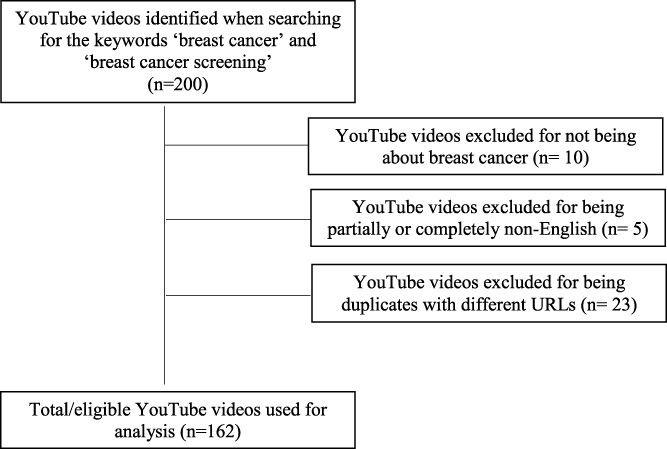
Process of collecting and excluding videos for analysis.
The least covered criteria were: side effects of screening (11.1%, 18/162), pain associated with screening (11.1%), and where an individual can get screened (16.7%, 27/162) (Table 1). The criteria most covered was that of explaining what breast cancer is (43.8%, 71/162) (Table 1).
38.3% (62/162) of the videos were categorized as not useful because they covered one or none of the usefulness criteria (Table 3). There was a significant relationship between the length of the video and level of usefulness; very useful videos had a mean length of 06:31 ± 05:17 minutes, whereas somewhat useful videos, the shortest videos, had a mean length of 03.58 ± 03:47 minutes (p = 0.047) (Table 3). There was also a significant association between the number of likes a video got and the level of usefulness (p = 0.012), with somewhat useful videos receiving the highest number of likes (Table 3). There was no significant association between the 4 groups of usefulness in terms of the number of views, dislikes, and number of comments (Table 3). Table 3 does, however, indicate the trend that somewhat useful videos were the most viewed, liked, commented on, and least disliked and shortest in length.
Medical professionals produced the highest number of videos (n = 66) in this sample, whereas advertisements were the least common video source (n = 12) (Table 4). Organizations produced nearly the same number of videos as medical professionals (n = 62), but had more videos that covered the criteria of: defining breast cancer, the age to start screening, how often too screen, possible pain associated with screening and resources to contact for additional questions (Table 4). Personal videos had the third-highest proportion of videos but eight of the ten criteria were minimally covered or not included entirely in personally produced videos (Table 4).
Frequencies and percentages* of usefulness criteria of breast cancer screening YouTube videos according to their source
*Percentages indicate the percent of total videos that cover that specific criteria e.g. 17.3% of the total videos were uploaded by organizations that included a description of What is breast cancer?. The total column indicates how many of all the videos covered that criteria e.g. 43.8% of the videos included a description of what is breast cancer?
There was a significant association between the uploading source and the level of usefulness of the videos (p = 0.004) (Fig. 2). Advertisements, videos produced by medical professionals, and videos produced by organizations ranged all 4 levels of usefulness, whereas personally produced videos were either only not useful or somewhat useful (Fig. 2). Medical professionals uploaded the highest number of videos and likewise uploaded the greatest amount of very useful and not useful videos. In comparison, advertisements produced nearly the same amount of very useful videos as medical professionals and organizations but had significantly less not useful videos (Fig. 2).
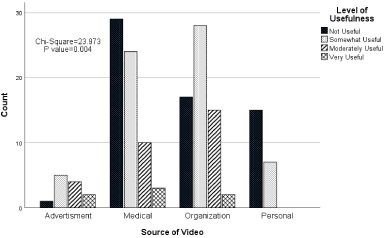
Level of usefulness of videos with regards to production source.
Only one fifth of the YouTube videos were identified as useful. There was a significant association between each of the following and the video’s level of usefulness: video length, the number of likes, and the uploading source. Longer videos in length were very useful, somewhat useful videos were the most liked, and personally produced videos were the most not useful. Advertisements uploaded the highest proportion of very useful and somewhat useful videos in comparison to medical professionals, organizations, and personal videos which all uploaded a majority of not useful videos. Less useful videos had more views and greater viewer engagement than more useful videos. The results of our study indicate that the majority of videos on YouTube pertaining to breast cancer screening are somewhat useful or not useful.
This is the first study to analyze YouTube videos related to all types of breast cancer screening. One prior study conducted by Basch et al. in 2014 analyzed YouTube videos specific to mammograms [15]. The results of this study indicated that consumer-created videos had significantly more comments than professionally created videos though professionally created videos more often contained general mammography information [15]. With comparison to our study, we similarly found ‘professionally created videos’, advertisements, were more likely to present more useful information in terms of breast cancer screening. It is expected that content on YouTube has changed since the publishing of Basch et al.’s study in 2014.
An increased video length likely contributes to increased usefulness as the video has additional time to cover content. However, very useful videos tended to have fewer views, likes and comments and this could be due to increased video length; longer videos may seem overwhelming/unappealing and thus decrease viewer engagement. Very useful videos were also the least liked videos among the four categories. This could be due to the trend of useful videos having fewer views and thus fewer opportunities for positive viewer engagement via “likes”.
Uploading source (advertisement, medical professionals, organizations, or personal) and level of usefulness are significantly related. As the advertisement videos were primarily campaigns shown first on televisions and then posted on YouTube, it is likely that there was a higher level of consideration for content usefulness as compared to the videos posted directly on YouTube. The major plausible reason that many of the videos made by medical professionals or credible organizations were not useful in delivering breast cancer screening content may be because many of their videos focus on specific physiological mechanisms that may not necessarily be useful for the general population and/or relevant to breast cancer screening advocacy. These videos may be overwhelming in information and hard to understand. From a consumer standpoint, useful videos seem to be more technical and paternalistic which can hinder general public appeal in comparison to not useful videos which are shorter and more understandable, though may not be as useful in terms of education about and motivating towards breast cancer screening. Current literature indicates that usage of a subjective language style may be more relatable and thus increase consumer engagement [18]. It may be more effective for videos to follow an advertisement format: short, consisting of simple facts, motivating for breast cancer screening, and easily understandable by the general population as that population most frequents sites such as YouTube.
Limitations of the study include subjectivity, time sensitivity, and language usage. Subjectivity is possibly present in the curated criteria of usefulness, though the 10-point criteria scale was largely influenced by current and recommended screening guidelines (Table 1). The videos examined were limited to the time of collection as likes, dislikes and introduction of new videos are subject to change over time. Only English videos were examined and therefore videos in Hindi, Spanish, or other languages were not analyzed in this study.
It is important to acknowledge that this study focuses on the inclusion of useful information in YouTube videos rather than evaluate the presence of misinformation which can be rampant on social platforms [19]. We also did not explicitly evaluate for undue bias in commercially sponsored posts or include determinants such as family history which can factor into consumer decisions of partaking in breast cancer screening. It will be important for future research to focus on the presence of misinformation and undue bias on social media platforms as well as how one’s personal history can influence understanding and interaction with such platforms.
Earlier breast cancer screening can reduce the mortality of 1 in 8 Canadian women who develop breast cancer by 40% [4,5]. The public needs to be better informed and motivated to partake in breast cancer screening as a preventative healthcare practice. To increase breast cancer screening, effective resources that provide reliable and useful information need to be introduced on online/social platforms like YouTube as they can effectively reduce barriers to knowledge disseminations [20].
YouTube provides a platform for audiovisual resources to be posted on the Internet and easily accessed by billions of people internationally. Thus, it has the potential and reach to provide valuable healthcare information online; online information and resources can contribute to an individual’s health literacy and their understanding of valuable healthy practices. Online resources provide an opportunity to educate patients and increase one’s health literacy however, the lack of content restriction can allow for unreliable information to be disseminated [21]. This study concludes that the current videos being posted on YouTube, specifically about breast cancer screening, are not useful resources. Consequently, the current videos are negatively impacting viewers’ health literacy – specifically in terms of breast cancer screening.
Footnotes
Summary table
The importance of Internet information in population level health promotion is growing. The current quality and readability of YouTube videos on breast cancer screening information are low. Health professionals can use social media platforms, like Youtube, to promote useful information online.
Conflicts of interest
This research did not receive any specific grant from funding agencies in the public, commercial, or not-for-profit sectors. All authors have no conflicts of interest to declare.
Authors’ contribution
TCT and JB came up with the conception and design of the study. JB and MF did the acquisition of data. TA did the analysis. TCT, JB, AK, MF and TA did the interpretation of data. JB and MF drafted the article. All authors intellectually contributed to the draft and provided final approval of the version to be submitted.