




Abstract
BACKGROUND:
Paget’s disease of the breast is rare. The National Cancer Database (NCDB) is one of the largest tumor databases in the United States.
METHODS:
We queried the NCDB to identify male and female patients with Paget’s disease of the breast who were treated from January 1, 2004, through December 31, 2015. No age limitations were applied. Descriptive statistical analysis and survival analysis were performed.
RESULTS:
We analyzed the demographic, disease, and treatment characteristics of 7,191 patients with Paget’s disease of the breast. The median (range) age was 64 (20–90) years. Only 2.1% of patients were men, and 85.4% were white. The most common treatment was complete mastectomy (65.3%), followed by partial mastectomy (30.3%). Tumor destruction was performed in 0.1% of patients, and 4.3% of patients did not undergo any surgery. We examined survival in the subset of 6,864 patients who were treated surgically with complete mastectomy or partial mastectomy. The 5-year survival rate after surgery was 82.5% (95% CI, 81.1%–83.9%). Factors associated with shorter survival were older age, black race/ethnicity, higher tumor grade, regional lymph node metastasis, higher cancer stage, metastatic cancer, and larger tumor size.
CONCLUSIONS:
Paget’s disease of the breast usually affects patients older than 60 years, and the most common treatment is complete mastectomy. The 5-year overall survival rate of patients with Paget’s disease of the breast is greater than 80% but is lower among older and black people.
Introduction
Paget’s disease of the breast is a rare malignant tumor that represents 1% to 3% of all cases of breast carcinoma [1]. It presents with erythema, desquamation, and ulceration localized to the nipple [2,3]. Patients often report pain or itching [3]. Paget’s disease is associated with underlying cancer such as ductal carcinoma in situ (DCIS) and infiltrating ductal carcinoma (IDC) in more than 90% of cases [4].
If Paget’s disease is clinically suspected, mammography and biopsy are recommended [1]. Mammography may have negative findings in as many as 50% of cases [1], and surgical biopsy is the diagnostic standard. Ultrasonography and nuclear magnetic resonance imaging also may be useful for precisely identifying the extent and location of the disease. The treatment of choice is mastectomy, even though partial mastectomy followed by radiotherapy has shown good results [5]. Treatment with cryosurgery has been proposed when surgery is contraindicated or the patient does not give consent for surgery [6]. Prognosis of Paget’s disease according with the type of surgery seemed to have no effect in survival [7]. Yao et al. [8] analyzed data from 1973 to 2014 from the Surveillance, Epidemiology, and End Results (SEER) database reporting similar 10-year OS rates for breast conservative surgery and mastectomy. However, mastectomy continues being performed in certain patients. In this article, we present an analysis of all patients with Paget’s disease of the breast who were treated from 2004 to 2015 and included in the National Cancer Database (NCDB). Our primary aim was to evaluate survival of patients with Paget’s disease of the breast who were treated with partial or complete mastectomy.
Methods
Study population
We queried the NCDB to identify patients with Paget’s disease of the breast who were treated from January 1, 2004, through December 31, 2015. No age limitation was applied.
Outcomes
Our primary outcome was survival after surgical treatment (complete or partial mastectomy). We calculated the number of days from surgery to death or last contact by using 2 variables collected from the NCDB: time from diagnosis to death or last contact, and time from diagnosis to surgery.
Predictor variables
Demographic characteristics included age at diagnosis, sex, and race/ethnicity. Year of diagnosis was included as a categorical variable (2004–2006, 2007–2009, 2010–2012, or 2013–2015). Clinical factors included laterality (left or right breast), histology (Paget’s disease alone, with IDC, or with DCIS), tumor grade (I, II, III, and IV), regional lymph node metastasis (yes or no), cancer stage (0, I–II, and III–IV), metastatic cancer (yes or no), tumor size (≤2.0 cm. 2.1–5.0 cm, >5.0 cm), type of surgery (partial mastectomy or complete mastectomy), number of days from diagnosis to first surgery (0–30, 31–60, or ≥61 days), and radiotherapy started before surgery or through 30 days after surgery (yes or no). The International Classification of Diseases for Oncology, third edition (ICD-O-3), was used for tumor grade coding. Tumor grade describes the tumor’s resemblance to normal tissue: well differentiated (grade I) is the most like normal tissue, and undifferentiated (grade IV) is the least like normal tissue. Cancer stage was defined according to the AJCC (American Joint Committee on Cancer) Cancer Staging Manual, 7th edition [9].
Statistical analysis
Age variable was summarized as median (range). Categorical variables were summarized as number (percentage) of patients.
Probability of 5-year overall survival (OS) after surgery was estimated with the Kaplan-Meier method. Five-years OS was obtained for treatment type and cancer stage. Univariable associations with survival were evaluated with the log-rank test. Cox proportional hazard regression analysis was used to evaluate multivariable associations with survival. We report hazard ratios (HRs) and 95% CIs, as well as P values determined with the likelihood ratio test. The Bonferroni method of correcting for multiple testing was used to account for the 13 tests performed, in which a 2-sided P value ≤ .038 was used to determine statistical significance. Statistical analyses were performed with SAS software version 9.4 (SAS Institute Inc, Cary, North Carolina).
Results
The demographic, disease, and treatment characteristics of 7,191 patients with Paget’s disease of the breast are summarized in Table 1. The median (range) age was 64 (20–90) years. Only 2.1% of patients were men, and 85.4% were white. The most common treatment was complete mastectomy (65.3%), followed by partial mastectomy (30.3%). Tumor destruction was performed in 0.1% of patients, and 4.3% of patients did not have any surgery.
Demographics, clinical characteristics, and treatment of patients diagnosed with Paget disease of the breast from 2004–2015
Demographics, clinical characteristics, and treatment of patients diagnosed with Paget disease of the breast from 2004–2015
PD, Paget’s disease; IDC, infiltrating ductal carcinoma; DCIS, intraductal carcinoma in situ. The number of cases with available data is given for those variables with missing data for 1 or more cases.
We examined survival in the subset of 6,864 patients who were treated surgically with complete mastectomy or partial mastectomy (Table 2). The 5-year survival rate after surgery was 82.5% (95% CI, 81.1%–83.9%). After adjustment for multiple testing (at P ≤ .0038), univariable analysis showed that female sex, race/ethnicity other than black or white, surgery performed 31 to 60 days after diagnosis, and partial mastectomy without radiotherapy were associated with improved survival, whereas older age (age ≥60 years), infiltrating ductal carcinoma, higher tumor grade (grade III or greater), regional lymph node metastasis, higher cancer stage (stage III–IV), metastatic cancer, larger tumor size “(≥2.1 cm)”, and partial mastectomy plus radiotherapy were associated with worse survival (all P ≤ .0019) (Table 2). Notably, the median age of patients who underwent partial mastectomy plus radiotherapy was 10 years older than that of the entire cohort (median, 74 versus 64 years); this may at least partially explain their shorter survival in univariate analysis. Moreover, 38% of the patients included in the survival analysis were diagnosed of Paget’s disease and infiltrative ductal carcinoma whereas 16% had positive regional lymph nodes. Five-years OS was 88.8% for patients with negative lymph nodes, 69% for patients with positive lymph nodes and 78% for those with unknown lymph node status. Kaplan-Meier estimates of survival according to treatment are displayed in Fig. 1, and those according to cancer stage are displayed in Fig. 2.
Survival after partial or complete mastectomy for treatment of Paget disease of the breast
CI, confidence interval; HR, hazard ratio; LR, likelihood ratio. 5-year survival estimates were estimated using the Kaplan-Meier method. Hazard ratios were estimated from a multivariable Cox regression model.1The longest amount of follow-up for those diagnosed from 2013 to 2015 was 4 years.
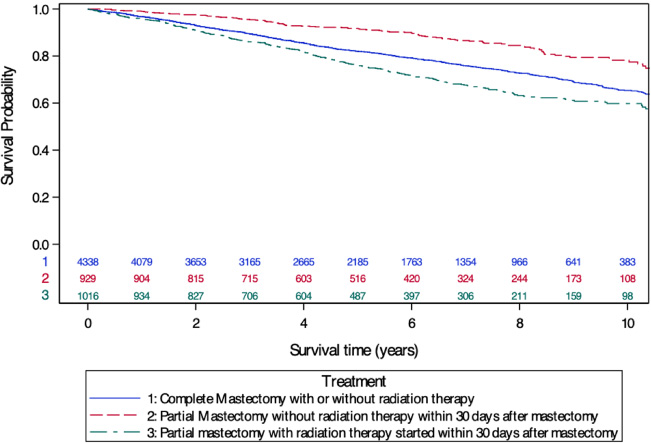
Survival probability according to treatment type.
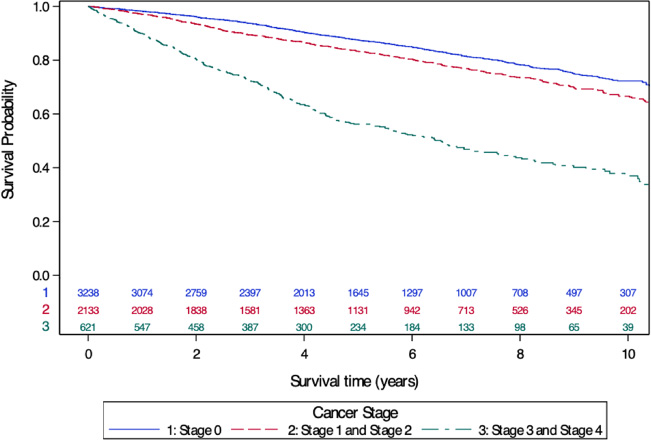
Survival probability according to cancer stage.
In multivariable analysis, several factors were associated with longer survival: female sex (HR, 0.51; 95% CI, 0.38–0.70), race/ethnicity other than white or black (HR, 0.61; 95% CI, 0.42–0.89 versus white), and partial mastectomy compared with complete mastectomy (partial mastectomy plus radiotherapy: HR, 0.84; 95% CI, 0.71–0.98; partial mastectomy without radiotherapy: HR, 0.57; 95% CI, 0.46–0.70; partial mastectomy plus unknown radiotherapy: HR, 0.38; 95% CI, 0.16–0.93). Factors associated with shorter survival included older age (HR, 3.86; 95% CI, 0.96–15.60 [60–69 years versus <30 years]), black race/ethnicity (HR, 1.32; 95% CI, 1.10–1.58 versus white), higher tumor grade (HR, 1.64; 95% CI, 1.19–2.26 [grade III versus grade I]), regional lymph node metastasis (HR, 1.43; 95% CI, 1.20–1.72); higher cancer stage (HR, 1.48; 95% CI, 1.23–1.78 [stage I–II versus stage 0]; HR, 2.70; 95% CI, 2.12–3.45 [stage III–IV versus stage 0]), metastatic cancer (HR, 1.91; 95% CI, 1.39–2.61), and larger tumor size (HR, 1.22; 95% CI, 1.05–1.42 [2.1–5.0 cm versus ≤2.0 cm]; HR, 1.95; 95% CI, 1.56–2.44 [>5.0 cm versus ≤2.0 cm]). In multivariable analysis, survival was not associated with histologic characteristics (eg, infiltrating ductal carcinoma) and number of days from diagnosis to surgery.
Our study is the largest report identifying 7,191 patients with Paget’s disease of the breast. The European Institute of Oncology in Milan, Italy, studied 114 patients who underwent surgery after presenting with Paget’s disease of the nipple from 1996 to 2003. From these, 6% were reported to have only Paget’s disease, 34% with DCIS and 60% with IDC. In contrast, our study identified a higher incidence of Paget’s disease alone (23.3%) and a lower incidence of Paget’s disease and IDC (37.4%). Incidence of patients with Paget’s disease and DCIS were similar to this study (39.3%).
The Data from the Surveillance, Epidemiology, and End Results (SEER) database were previously used to study Paget’s disease [4,7,8,10,11]. Our findings are in accordance with those of Zhao et al. [7], who analyzed SEER data from 2000 through 2013 and described the clinicopathologic characteristics and survival outcomes of women with Paget’s disease (n = 469), Paget’s disease with concomitant infiltrating duct carcinoma (PD-IDC; n = 1,832), and Paget’s disease with concomitant intraductal carcinoma in situ (PD-DCIS; n = 1,130). The 5-year survival rate ranged from 84.1% for patients with PD-IDC to 97.5% for patients with PD-DCIS [7]. We calculated a 5-year postoperative survival rate of 82.5% (95% CI, 81.1%–83.9%) among 7,191 patients with Paget’s disease included in the NCDB.
For all patients included in the study by Zhao et al. [7], the significant indicators of prognosis were age at diagnosis, tumor size, and lymph node status. Furthermore, among patients with Paget’s disease, those who were married had better prognosis than those who were not [7]. We determined that patients who underwent partial mastectomy had better prognosis than patients who underwent complete mastectomy. These data are in accordance with the findings by Yao et al. [8], who analyzed SEER data from 1973 through 2014. That study cohort included 5,398 patients with Paget’s disease. The authors observed that breast-conserving therapy plus lumpectomy and radiotherapy is an effective local treatment strategy, compared with mastectomy [8]. A systematic review by Helme et al. [12] of studies on breast-conserving surgery for patients with Paget’s disease supported these findings. In our study, partial mastectomy with radiotherapy seemed to have worse survival than partial mastectomy without radiotherapy. This finding could have been related with the presence of some characteristics: a higher number of cases were diagnosed with PG and DCIS (41%) and had negative regional lymph nodes (56%).
Zurrida and Veronesi [13] established that patients who undergo complete mastectomy have equivalent survival outcomes to patients treated with breast-conserving surgery (eg, quadrantectomy) plus complete axillary dissection and radiotherapy to the residual breast. Furthermore, patients who underwent quadrantectomy had superior aesthetic outcomes. In general, the number of patients who undergo total mastectomy has declined considerably.
Zheng et al. [14] performed a nationwide, retrospective, multicenter study of patients with Paget’s disease in China. Of all included breast cancer patients (N = 4,211), 68 (1.6%) had Paget’s disease (mean age at diagnosis, 48.1 years), and of these, 43 (63.2%) were premenopausal. In our study of the NCDB, median age at diagnosis was much higher (64 years). In general, Paget’s disease in the Western world is more common among postmenopausal women.
Regarding the other factors that influenced survival in Paget’s disease, we found that African–American patients had a worse survival compared with white people. This finding can be explained due to African–American patients had higher proportion of patients with stage 2 or more of the disease compared with white people. Moreover, Paget’s disease lesions in these people may be confused with other dermatologic conditions that may delay the diagnosis [15].
We also found that the 5-year OS for patients on stage 0 was 87.5%. It has been reported that the approximately 8-year OS for patients with DCIS was 97% [16]. The difference between OS can be explained given that in our sample size OS could be affected by the presence of the patients’ comorbidities, besides that more than 80% of patients considered in the analysis were 60 or more years old.
To our knowledge, this is the first comprehensive analysis of the NCDB to provide descriptive characteristics and survival outcomes of patients with Paget’s disease in the United States. Indeed, most studies of Paget’s disease are limited because of the rarity of this condition [17]. Furthermore, NCDB database does not include all the tumors, but captures only approximately 70% of all patients newly diagnosed with cancer and registered in the US.
Conclusions
Paget’s disease of the breast usually affects patients older than 60 years. The most common treatment was complete mastectomy, even though partial mastectomy followed by radiotherapy has shown better survival. The 5-year survival rate of patients with Paget’s disease of the breast is greater than 80% but is lower among older and black people.
Footnotes
Acknowledgements
The authors do not have acknowledgements.
Conflict of interest
None.
Funding source
This study was supported in part by the Mayo Clinic Center for Individualized Medicine and the Plastic Surgery Foundation.