




Abstract
Alzheimer’s disease (AD) is an incurable disease and a type of dementia. About 55 million people around the world have AD. However, technologies have been used to assist in the healthcare of AD, supporting physicians in the palliative care of patients. This article presents a systematic mapping study (SMS) to identify articles that use technologies to monitor patients with AD in order to show an overview of the literature, identifying gaps and research opportunities in this field. The scientific contribution of this work is to identify monitoring technologies related to AD and highlight current trends on the subject. The paper uses the term technologies as hardware infrastructure and devices or systems without considering software technologies. In addition, this article proposes a taxonomy for the domain of technologies applied to AD patients. The SMS study was conducted in six databases, including articles from 1997 to 2021. An initial search resulted in 7,781 articles. After applying filter criteria, throwing automatic selection on databases, and manual assortment, 171 articles were selected. Subsequently, a second search was performed to reduce the list of articles and filter by the specific search objective of articles focused on technologies for monitoring with tracking, resulting in 74 works. The main results obtained are: (1) a relevant number of articles (43.42%) reported solutions used in sensor-based devices; (2) several works (33.33%) have the interaction focus on Position/Distance/Proximity/Location sensor type; (3) another group of articles has a secondary focus on Emergency help (18.97%). The results indicated the need for technologies to help caregivers monitor patients, in addition to evidence of research opportunities in palliative care and support for the daily activities of AD patients.
Introduction
According to the World Health Organization (WHO) [85], about 55 million people around the world have Alzheimer’s disease (AD) or another type of dementia. As reported by the Pan American Health Organization [55], Alzheimer’s is one of the top ten death-causing diseases in the world and one of the most prevalent diseases of dementia. AD is characterized as a syndrome – usually of a chronic or progressive nature – for which there is no cure or treatment, with deterioration of cognitive function (ability to process thoughts), which can be expected from normal aging. AD can affect memory, thinking, orientation, understanding, calculation, learning ability, language, and judgment, but consciousness is not affected.
The impairment of cognitive function is usually followed and sometimes preceded by the deterioration of emotional control, social behavior, or motivation. Although dementia mainly affects elderly people, the symptoms can start earlier, which influences the fact that there are almost 10 million new cases each year around the world [3]. AD is the most common form of dementia and may be considered for 60–70% of cases [4].
The total number of people with dementia is expected to reach 78 million in 2030 and 139 million in 2050. Much of this increment is attributable to the growing number of people with dementia living in low and middle-income countries [4]. The WHO has developed a global action plan proposed by 2025, in which the global production of dementia research should double the number of scientific publications, 50% of countries should routinely collect data on the leading indicators of dementia, and 75% of countries should have support for dementia care providers [84]. The alarming prevalence of Alzheimer’s disease and the absence of any effective treatment made this disease an important issue; it has been highlighted as a priority by the nations of the G8 for setting an ambition to identify a cure or a disease-modifying therapy for dementia by 2025 [21].
Dementia causes physical, psychological, social, and economic impacts, not only on patients but also on their caregivers, families, and society in general, as it is one of the main causes of disability and dependency among the elderly worldwide [85]. There is often a lack of awareness and understanding of dementia, resulting in stigmatization and barriers to diagnosis and care. The impact of the disease on caregivers, the family, and society, in general, can be physical, psychological, social, and economic [85]. Caregivers who assist individuals with dementia often feel stressed, frustrated with the amount of time required to support them, and emotionally challenged. In addition, cognitive function may progressively decrease over time in patients, in variations that fluctuate throughout the day or over the long term, as the neurological system is used [12]. Carer support and services should focus on preventing a decline in mental and physical health and improving social well-being in line with carers’ needs. Most people with dementia are cared for by family members or other unpaid carers without any additional support. Carers often face numerous financial, social, and psychological stressors. Contributing to increasing the cost of care for patients. In 2019, the global cost of dementia was estimated to be 1.3 trillion US$, and 61% of patients live in low and middle-income countries [26].
Alzheimer’s disease can only be detected currently after symptoms start to appear, but monitoring solutions are emerging with the use of electronic devices to care for these patients in the most diverse stages of the disease, therefore, technology presents possibilities for palliative care support AD patients. According to [12], research works on information and communication technologies1
Systematic reviews developed in the past years show a list of technologies that can be used to monitor people with Alzheimer’s disease. Some of them describe solutions for use in assisting people with Alzheimer’s and other dementias [32,77]. Others describe technologies used in practice for care [71]. The SMS found were developed between 2017 and 2019. There are few systematic reviews focused on technologies for Alzheimer’s disease that are recent and up-to-date.
The scientific contribution of this article is to classify how technologies are used to monitor patients with Alzheimer’s disease. The knowledge produced by this research was systematized in a taxonomy of technologies for monitoring patients with AD. The study was conducted from six search databases, including articles from 1997 to 2021. The paper uses the term technologies as hardware infrastructure and devices or systems (e.g., smart homes) without considering software technologies, such as mobile apps and machine learning algorithms. The article is divided into four sections. The first section introduces the theme, followed by Section 2, which defines the research methodology. Section 3 comments on the results for each research question. Finally, Section 4 assesses the article’s contributions and research gaps.
This work applies the systematic mapping study (SMS) proposed by [58] as a methodology for conducting a literature review about technologies for monitoring patients with AD. The execution consists of four steps:
Research questions
Table 1 shows the research questions, which consist of one General Question (GQ), two Research Questions (RQ), one Focal Question (FQ), and one Statistical question (SQ). The General Question addresses what kind of technologies are used. The Research Questions focus on the interaction of technologies and patients. The Statistical Question evaluates the distribution of articles’ publications per country. Finally, the Focal Questions focus on perceived trends.
Research questions
Research questions
The study of terms for the definition of the search string was based on: Alzheimer’s disease and technologies for patient care. The boolean search expression presented in Table 2 is divided into two sets of interest generating a search string base. These sets undergo disjunction and then are unified by boolean conjunctions. Synonyms and words are derived from a radical in order to obtain the most faithful results possible, respecting the relevance of variations in medical language. Singular and plural variations were used only when the database does not automatically consider them.
Search terms
Search terms
Table 3 shows databases selected for the research. PubMed and Journal of Medical Internet Research (JMIR) stand out as literature bases in the area of health and natural sciences, while the other bases are references in computer science.
Databases used in the SMS
Search string used in each database
In order to perform the most comprehensive research, the search string was adapted to be used in each database with their respective specifications. Table 4 presents the specific search string applied in each repository, respectively.
The first search was performed in the ACM Digital Library repository with the string relating to the term Alzheimer and its variations and terms related to articles that contain technological solutions. The second search was in the IEEE Xplore Digital Library repository with the string relating the term Alzheimer and its variations, adding terms related to articles that contain technological solutions and removing terms related to Alzheimer’s in health and also specifying the fields in which the keywords should be found, which were “Publication Title” and “Abstract”. The string applied to perform the third search in the Journal of Medical Internet Research (JMIR) included Alzheimer’s and its variations, adding the terms related to technological solutions. The string applied to perform the fourth search in the PubMed Central repository included the term Alzheimer and its variations, terms related to articles that contain technological solutions, and keywords for removal of terms related to Alzheimer’s in the field of health. The search also specified the fields in which the keywords should be found: “Title” and “Abstract”. The fifth search in the Science Digital Library repository was carried out with the string relating to the term Alzheimer not including its variations, and terms related to technological solutions. Finally, the last search was performed in the Springer Library repository and was carried out with the string relating the term Alzheimer and its variations and terms related to technological solutions.
The selected articles were stored in the Mendeley2
Figure 1 presents the filtering process. The process search applied the string in databases for title, abstract, and keywords fields (when available, according to Table 4). The search resulted in articles from 1997 to 2021.
After querying the databases, the articles passed by a filter, considering exclusion criteria (EC). This review considered as a selected paper the studies that satisfied all EC. The EC allowed the elimination of any noise generated in the research. Table 5 shows the exclusion criteria.
EC1 excludes articles the string search does not match, as represented by Table 4. EC2 removes articles that are unavailable for a full reading. EC3 excludes articles not published in conferences, journals, or workshops. EC4 removes articles that are not in English. EC5 excludes works that are reviews or not articles. EC6 excludes studies that match the search string but do not investigate technologies for monitoring AD as the target objective. EC7 removes duplicated articles.
According to [44], there are different types of interaction focus that an application for AD can have: Health monitoring, Emergency help, Cognitive support, Therapy support, Training, ADL monitoring, Learning content and Mobility. The demand for applying EC8 and EC9 emerged in the last phase of this study based on interaction focus.
In addition, according to [44], Health monitoring interaction focus has two sub focuses which are tracking and study. Tracking uses data collected through monitoring to perform tasks with the analyzed data. In contrast, study only stores this data for further analysis. Filter EC9 was created based on EC8, with one more refinement, removing technologies aimed at monitoring that were not intended for tracking.
Initially, EC1, EC2, EC3, EC4, EC5, EC6, and EC7 were applied, resulting in 171 articles. The reading of the articles was performed based on the first two steps of [38]: 1) title reading, abstract, and introduction, followed by the titles of the sections and subsections, going through mathematical elements (if any) and conclusions; 2) analysis of figures, diagrams, and other illustrations. Secondly, the process search applied EC8 and EC9, resulting in 74 articles. Finally, the third step of [38] was applied, that is, the complete reading of the article, not generating exclusions, resulting in 74 articles.
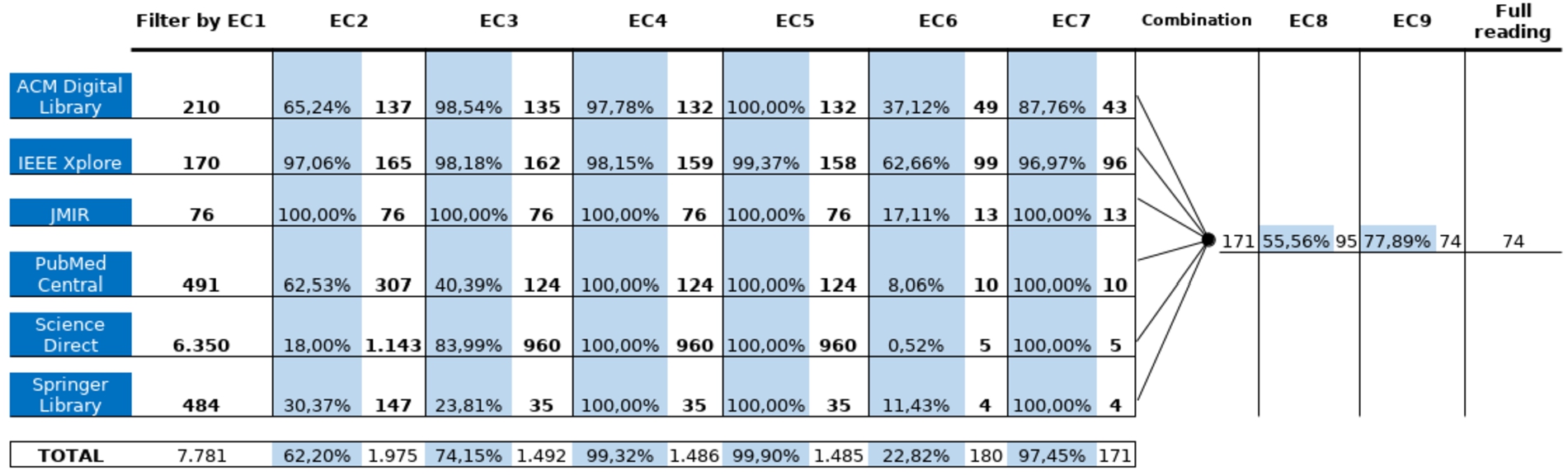
Filtering process steps.
SMS exclusion criteria
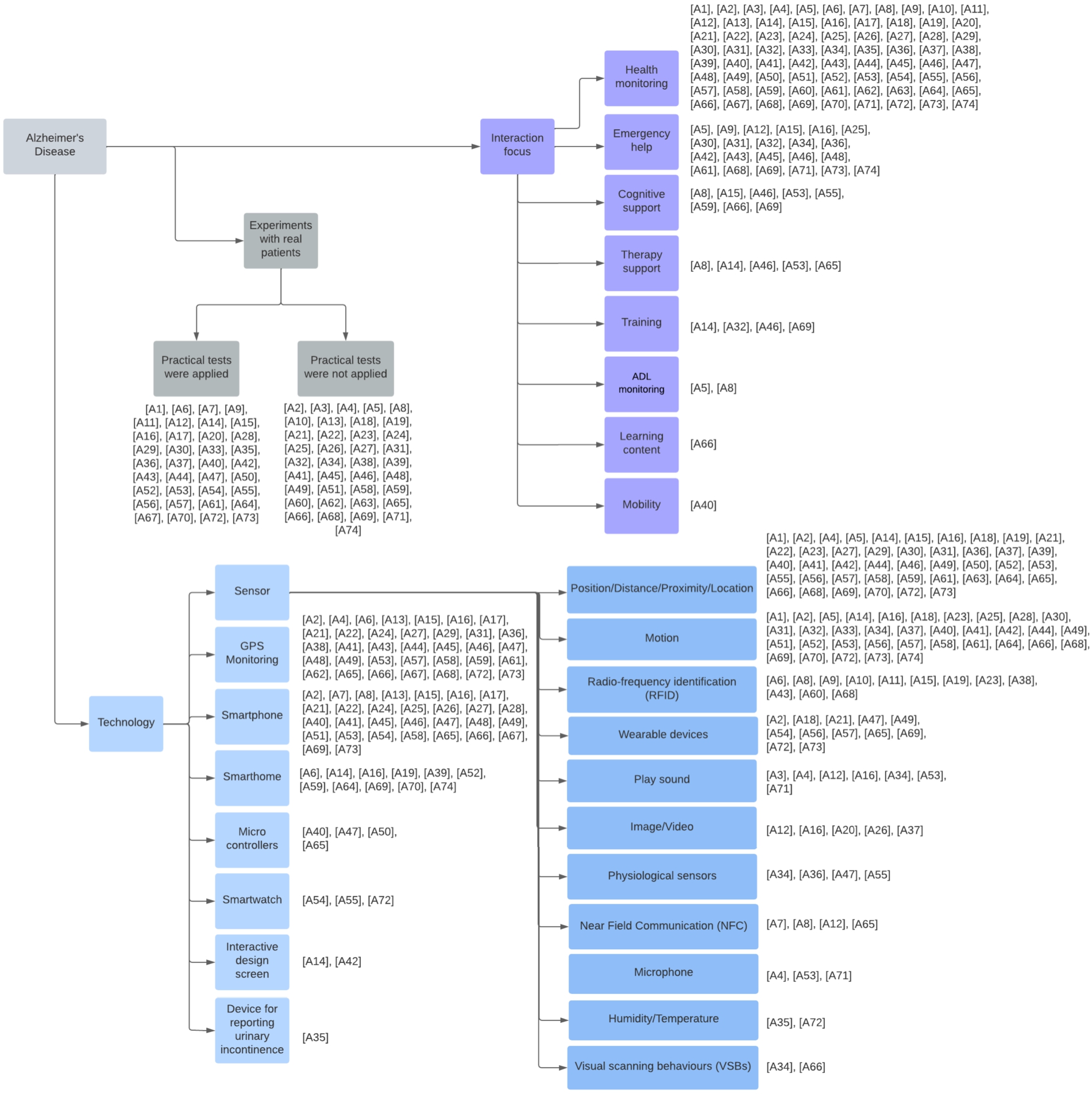
Taxonomy for technologies, tests, and approaches applied to Alzheimer’s patients. (Numbers represent ID field of Table 6.)
This mapping used the 74 selected articles to elaborate a taxonomy (Fig. 2) that organizes topics related to monitoring technologies for AD. The taxonomy organizes how the articles were filtered through three topics: Interaction Focus, Technology, and Experiments with real patients. The Interaction Focus topic shows the purpose of the interaction between the technological solution and the patient with AD. The Technology topic shows which type of technology is used. Finally, the topic Experiments with real patients shows whether the experiments to validate the use of technology were carried out with real patients with AD or using data created for testing. The topics were chosen according to the objective of this work to filter the types of technology interaction with patients, looking for articles that have as objective the interaction of the Health monitoring type. As articles can have more than one type of Interaction Focus and belong to more than one type of Technology, if necessary, works are cited in more than one type in the topics.
Table 6 shows the final articles selected after the execution of all steps of the search process, where the ID field is the identification of the article used in the figures with data analysis in Section 3.
This section presents results about SMS obtained through analysis of General Question, Research Questions, Focal Question, and Specific Question.
GQ – What technologies are being used in the care of patients with Alzheimer’s disease?
SMS filters took into consideration only the physical resources to search for technologies, as they all had as a secondary resource software for device orchestration and data validation. The technologies filtered by reading the articles were: Sensor, GPS Monitoring, Smartphone, Smarthome, Micro controllers, Smartwatch, Interactive design screen, and Device for reporting urinary incontinence. Table 7 shows the technology categories of each article.
More than one type of technology category is used in the majority of articles, such as the application developed by [76], based on the patient’s behavior and movement patterns using sensors and smartwatch, and an application developed by [1] in which they use sensors and smart home technologies to monitoring the environment and the patient’s movements.
According to [43], the devices utilized in the experiments were used in the least invasive way possible, so patients would not feel uncomfortable or intimidated, as a way to ensure greater acceptance and use by them.
List of selected papers (sorted by year)
List of selected papers (sorted by year)
A relevant number of articles use solutions with Sensors, that is 43.42%, while 23.03% use GPS monitoring, and 33.55% others (Smartphone, Smart home, Micro controllers, Smartwatch, Interactive design screen, Device for reporting urinary incontinence).
Table 8 shows that most sensors belong to the category of the Position/Distance/ Proximity/Location (33.33%), followed by the detection categories Movement/ Presence/Agitation (27,13%), Radio-frequency identification (RFID) (9.30%) and with the same percentage Wearable devices (9.30%).
The second category of technology most used in the works is GPS monitoring (23.03%) to assist caregivers in the monitoring of patients. The objective of the authors in the development of this type of resource was to track the patient to help the caregivers and parents in daily care.
Categories of technologies used in the articles
Categories of sensors used
The interaction between patient and technology can be classified according to the application focus: Health monitoring, Emergency help, Cognitive support, Therapy support, Training, ADL monitoring, Learning content, and Mobility. Health monitoring focuses on the monitoring of vital signs. Emergency help emphasizes warning caregivers of imminent danger. Cognitive support focuses on technology for patients to remember old memories, such as photos, videos, and music. Therapy support emphasizes the technology of exercise therapy to decrease memory loss. Training focuses on teaching how to do everyday tasks, as patients forget to do specific daily actions, i.e., tying shoelaces. ADL monitoring emphasizes the tracking of the patient’s activities. Learning content focuses on teaching new content to the patient. Mobility focuses on instigating physical movement.
Patients and their caregivers interact with the application. In this way, caregivers are considered family members or an employee of the nursing home the patient attends. Table 9 shows the results obtained, where Health monitoring is the main focus of the articles (63.79%), the secondary focus among the works is Emergency help (18.97%), and the third one is Cognitive support (6.03%) contributing to help with the main difficulties according to how the disease progresses over time, which is loss of memory.
Evaluation of the usage models between patient and technology
Evaluation of the usage models between patient and technology
In 6.96% of the selected papers, the focus of the devices is Cognitive support [17,22,37,37,41,42,45,51]. Therapy support is considered in 4.35% of the articles [2,40,45,45,74].
In 51.35% of the articles, practical tests were not applied with patients, and 48.65% of the articles presented the prototype development and tests with fictitious data or data obtained from other scientific research. Table 10 shows types of article tests. Practical tests are considered essential, that is, without proper observation of sampling or statistical variables. However, performing a controlled and random test is one of the future works listed in several articles.
Classification of the articles about experiments with real patients
Classification of the articles about experiments with real patients
In turn, 74.32% of the articles realized tests had the support of health professionals during the execution of the experiments. The works in which tests were carried out with patients were mostly attended in nursing homes or care homes for people with disabilities.
To identify the countries where the works were developed, all authors’ institutions of origin were considered in the classification. Table 11 shows the countries with the greatest contribution to the theme: the United States with 10 publications (11.63%), Canada with 9 publications (10.47%), and both Japan (8.14%) and United Kingdom (8.14%) with 7 publications. Of the 27 countries involved in the subject, 10 are on the list of the 20 countries with the highest Human Development Index (HDI) [63]. Therefore, the countries with the greatest scientific contribution to the subject are those with the greatest chances of prevention and better care for the disease [85].
Participation of countries in publications
Participation of countries in publications
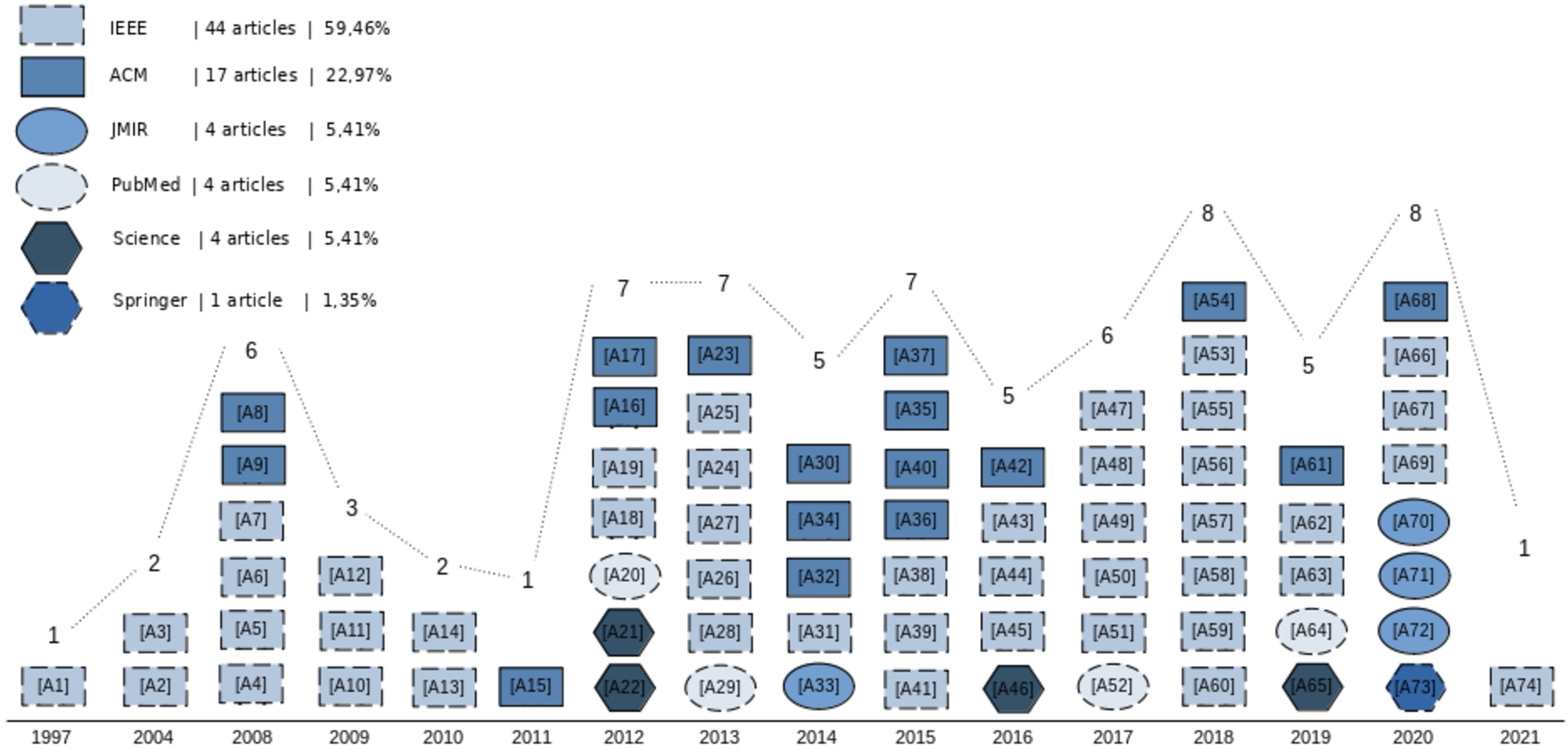
Annual papers’ distribution according to the database.
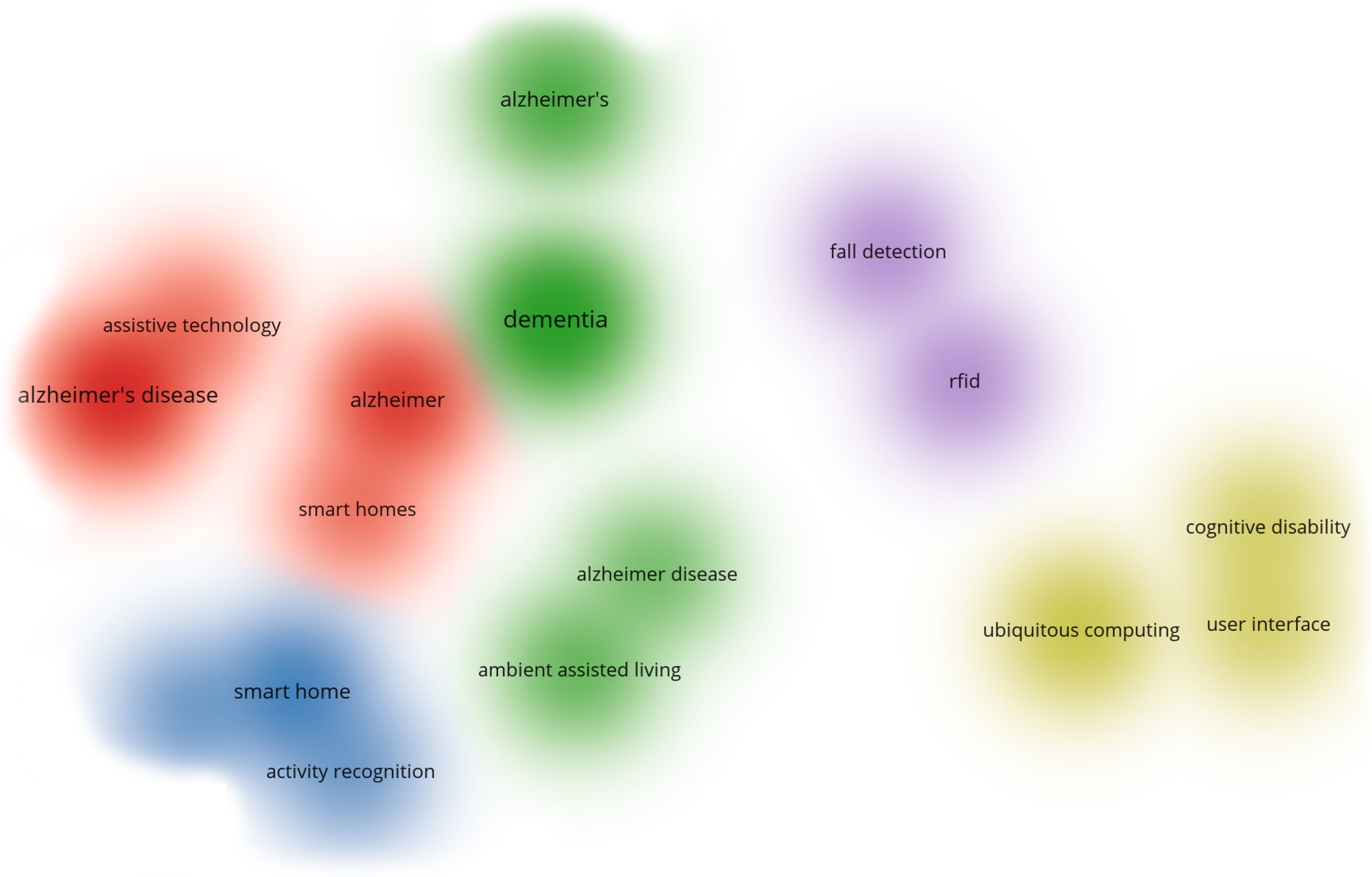
Cluster density map.
Figure 3 presents the frequency of publications on the subject, which shows that the research theme began to be explored in 1997, ending the last article in 2021. The majority of the selected papers (59.46% 44/74) were provided by the IEEE Xplore Digital Library, validating the efficiency of this database in the subject. Springer Library had just one article identified in the search process. Literary bases in the field of computing returned more relevant results than reference bases in the healthcare field.
Description of identified clusters
Description of identified clusters
The frequency of “terms” was collected with the VOSViewer tool, containing the most found terms among the articles. Figure 4 represents the density of terms and the generation of clusters of interest, grouped by colors according to the proximity of the terms. The identified clusters are presented and characterized in Table 12. Five different clusters were identified. Red cluster represents the utilization of smart home devices with assisting technologies (4 terms). Blue cluster shows the utilization of smart home devices for activity recognition (2 terms). Cluster green represents ambient assisted living for the care of patients with AD (3 terms). Purple cluster represents RFID devices used in solutions for patients’ fall detection (2 terms). Yellow cluster shows solutions that utilize a user interface to interact with patients (2 terms). The more terms the cluster has, the more diverse and comprehensive the topic is among the articles.
Figure 5 presents an overview of the characteristics between terms of the same cluster or different clusters. The pairs and strength of connection in these networks are determined by factors such as the occurrence of the terms in all imported documents and the number of documents with the same data source or authorship [79]. This model represents an overlap of the chronological incidence of terms on the map of clusters. The characteristics of the research terms of this study are grouped in a cluster to the left of the image, represented by a green and yellow color, illustrating a recent scenario referring to the advance of studies in the area.
The tool detected that the most recent technologies being used for the solutions in this area are smart homes in ambient assisted living, represented by light green color, standing out in articles developed between 2018 and 2020. In contrast, technologies developed with user interfaces were used in articles belong 2010 and 2012, represented by the purple color. The trend is that technologies such as smart homes in ambient assisted living are increasingly being developed in new articles.
From 2012 to 2020 was the period with more publications of works on the subject of monitoring technologies for AD. However, there is a decrease from 2021 in the development of papers on the subject, resulting in one article demonstrating the trend of exchanging topics related to monitoring/tracking technologies for the use of technologies such as smart homes.
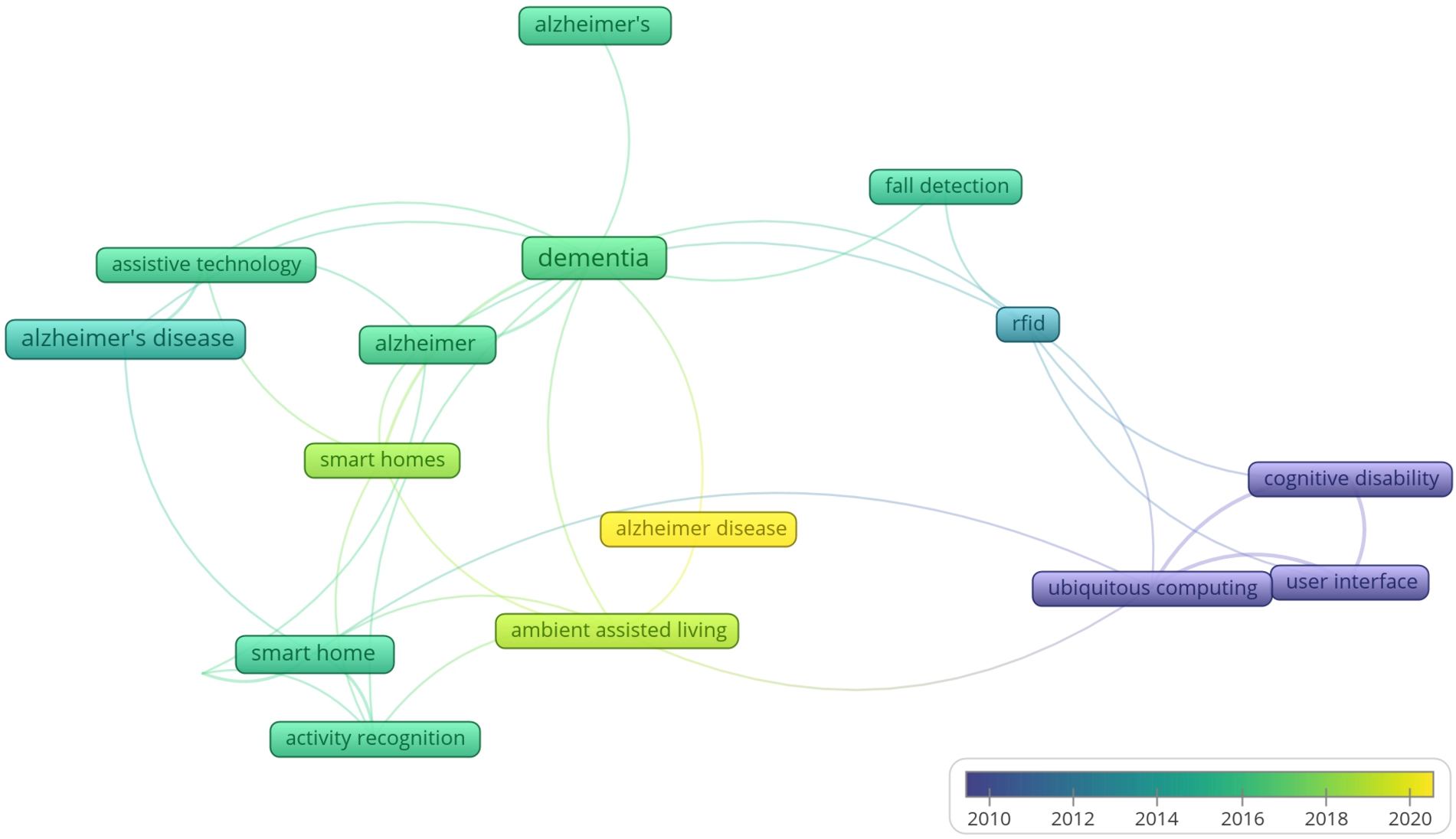
Overview of the relationship between terms.
This work identified the current scenario in research regarding the use of monitoring technologies for AD. The SMS demonstrated and analyzed the articles selected in this study. The paper uses the term technologies as hardware infrastructure and devices or systems without considering software technologies.
The research identified Sensors as the most used technology category for project development, being related to 43.42% of the articles, followed by the use of GPS monitoring (23.03%), and others (33.55%).
The main focus of interaction between patients and technologies was Health monitoring (63.79%), the secondary focus among the works is Emergency help (18.97%), and the third one is Cognitive support (6.03%) contributing to help with the main difficulties according to how the disease progresses over time, which is loss of memory.
In those countries that promote studies in the area, they have greater chances of prevention and better care for the disease than in other countries. Simultaneously, it is necessary to encourage the adoption of more reliable applicability tests with more comprehensive and secure validations.
The results obtained through the VOSviewer tool corroborate the perception of current research and trends, in which the propensity is the more significant development of smart home devices.
Finally, despite attempts to mitigate risks, certain choices may have affected the outcome of this systematic mapping. The selection of databases is a risk factor. To seek better results, six databases were selected. However, the results presented that specific databases were ineffective, while the IEEE Xplore Digital Library was predominant. The search process, and exclusion criteria, in addition to the author’s assessment of relevance, also delimited the results, possibly excluding relevant articles. Therefore, we sought to minimize these risks following the methodologies of [38] and [58].
As a future work, it is intended to expand the study to compare the characteristics of the applications, mainly highlighting which patients’ needs have not yet been covered by current devices.
Footnotes
Acknowledgements
The authors would like to thank the Foundation for Research Support of the State of Rio Grande do Sul (FAPERGS), the Coordination for Improvement of Higher Education Personnel (CAPES) – Financing Code 001, the National Council for Scientific and Technological Development (CNPq), and the University of Vale do Rio dos Sinos (Unisinos), Brazil, for the support of the development of this work. The authors especially acknowledge the support of the Applied Computing Graduate Program (PPGCA), and the Mobile Computing Laboratory (Mobilab) of Unisinos.
Conflict of interest
None to report.