




Abstract
In the current paper we re-examine the concepts of attack semantics and collective attacks in abstract argumentation, and examine how these concepts interact with each other. For this, we systematically map the space of possibilities. Starting with standard argumentation frameworks (which consist of a directed graph with nodes and arrows) we briefly state both node semantics and arrow semantics (the latter a.k.a. attack semantics) in both their extensions-based form and labellings-based form. We then proceed with SETAFs (which consist of a directed hypergraph of nodes and arrows, to take into account the notion of collective attacks) and state both node semantics and arrow semantics, in both their extensions-based and labellings-based form. We then show equivalence between the extensions-based and labellings-based form, for node semantics and arrow semantics of AFs, as well as for node semantics and arrow semantics of SETAFs. Moreover, we show equivalence between node semantics and arrow semantics for AFs, and equivalence between node semantics and arrow semantics for SETAFs (with the notable exception of semi-stable). We also provide a novel way of converting a SETAF to an AF such that semantics are preserved, without the use of any “meta arguments”.
Although the main part of our work is on the level of abstract argumentation, we do provide an application of our theory on the instantiated level. More specifically, we show that the classical characterisation of Assumption-Based Argumentation (ABA) can be seen as an instantiation based on a SETAF, whereas the contemporary characterisation of ABA can be seen as an instantiation based on a standard AF. Our theory of how to convert a SETAF to an AF can then be used to account for both the similarities and the differences between the classical and contemporary characterisations of ABA. Most prominently, our theory is able to explain the semantic mismatch for semi-stable semantics that arises in the ABA instantiation process.
.Introduction
The 1990s saw some of the foundational work in argumentation theory. This includes the work of Simari and Loui [48] that later evolved into Defeasible Logic Programming (DeLP) [37] as well as the ground-breaking work of Vreeswijk [53] whose way of constructing arguments has subsequently been applied in the various versions of the ASPIC formalism [13,40,41,44]. Two approaches, however, stand out for their ability to model a wide range of existing formalisms for non-monotonic inference. First of all, there is the abstract argumentation approach of Dung [20], which is shown to be able to model formalisms such as Default Logic, logic programming under stable and well-founded model semantics [20], as well as Nute’s Defeasible Logic [38] and logic programming under 3-valued stable model semantics [54] and regular semantics [16]. Secondly, there is the assumption-based argumentation (ABA) approach of Bondarenko, Dung, Kowalski and Toni [10], which is shown to model formalisms like Default Logic, logic programming under stable model semantics, auto epistemic logic and circumscription [10].
One of the essential differences between these two approaches is that abstract argumentation is argument-based. The idea is to use the information in the knowledge base to construct arguments and to examine how these arguments attack each other. Semantics are then defined on the resulting argumentation framework (AF), i.e., the directed graph in which the nodes represent arguments and the arrows represent the attack relation. In assumption-based argumentation, on the other hand, semantics are defined on sets of assumptions that attack each other based on their possible inferences.
To some extent, assumption-based argumentation can be regarded as applying a directed hypergraph of which the nodes contain assumptions and the arrows coincide with ABA-arguments that each attack an assumption. This is different from the ABA-AA instantiation [21], which applies a normal (binary) graph of which the nodes (not the arrows) contain ABA-arguments. In the current work, we investigate this hypergraph on the abstract level and refer to it as a SETAF. The hyperedges of such a SETAF can be interpreted as collective attacks, which have first been investigated by Nielsen and Parsons [42].
Even though SETAFs extend the limits of AFs by allowing for collective attacks, it has been shown that many semantics properties and principles still apply in this more general setting [8,27,32,35]. This holds even though SETAFs are more expressive than AFs [24]. Recent work examines the computational complexity of reasoning and the underlying hypergraph structure of SETAFs [26,28–30]. We will use the theory developed in this paper to show the semantic correspondence between ABA and its SETAF instantiation.
One particular claim in the literature is that assumption-based argumentation and abstract argumentation are equivalent to some extent [21,49]. That is, the outcome (in terms of conclusions) of assumption-based argumentation would be the same as the outcome of its abstract argumentation interpretation (the ABA-AA instantiation of [21]). In the current paper, we re-examine this claim, by carefully analysing what happens on the abstract level. After all, if a SETAF is an abstraction of ABA, and an AF is an abstraction of the ABA-AA instantiation, then examining equivalence between ABA and the ABA-AA instantiation boils down to examining equivalence between SETAFs and AFs.
To carry out our inquiry, we need to borrow a number of concepts from the argumentation literature. The first concept is that of SETAF labellings [35]. Through our theory it becomes clear that these essentially coincide with the assumption labellings of [47]. The second concept is that of attack-semantics [52], which turns out to play an important role in the conversion process from SETAFs to AFs.
We want to highlight that our approach differs from existing conversions from SETAFs to AFs [35,43]. These approaches can be seen as an instance of flattening [9], i.e., the additional meaning of collective attacks is modelled by the introduction of additional arguments to the “flat” AF. The semantics then coincide under projection. However, in our approach the original SETAF is turned “inside-out”, i.e., we construct an AF where the arguments correspond to the attacks of the SETAFs. We then show the semantic correspondence via attack semantics.
In our current work, we systematically fill the gaps in the space of collective attacks and attack semantics via extensions and labellings. This orthogonal approach is summarised in Fig. 1. Using the thus developed theory, connecting SETAFs and AFs, we then re-examine the often claimed equivalence between assumption-based argumentation and abstract argumentation. We find that some of the already observed equivalences (under complete [17], preferred [17], stable [49] and grounded semantics [22]) are special cases of our theory. In addition, for a particular non-equivalence (under semi-stable semantics [17]) our theory is able to explain why assumption-based argumentation is not equivalent to the ABA-AA instantiation. As we will see, this is due to the fact that on the abstract level the translation process from SETAFs to AFs does not preserve equivalence under semi-stable semantics.
The remaining part of this paper is structured as follows. First, in Section 2 (Argumentation Frameworks and their Semantics) we briefly summarise some key concepts from the formal argumentation literature, including that of an AF, extension-based semantics, labelling-based semantics, and the notion of attack-semantics. Then, in Section 3 (SETAFs and their Semantics) we recall the concept of SETAFs and how the semantics generalise to this setting. We then broaden the notion of attack-semantics to operate on SETAFs. The results of Section 2 and 3 form the theoretical underpinning of our theory; the obtained relationships between the semantics are summarised in Fig. 1. In Section 4 (Relating SETAFs to AFs) we provide a translation procedure to convert SETAFs into AFs, based on the concept of attack-semantics. In Section 5 (Instantiating AFs and SETAFs using ABA) we examine the consequences of the thus obtained theory on AFs and SETAFs in the specific context of ABA, and what this means for the perceived equivalence between ABA and AA. 1 We round off with a discussion in Section 6.
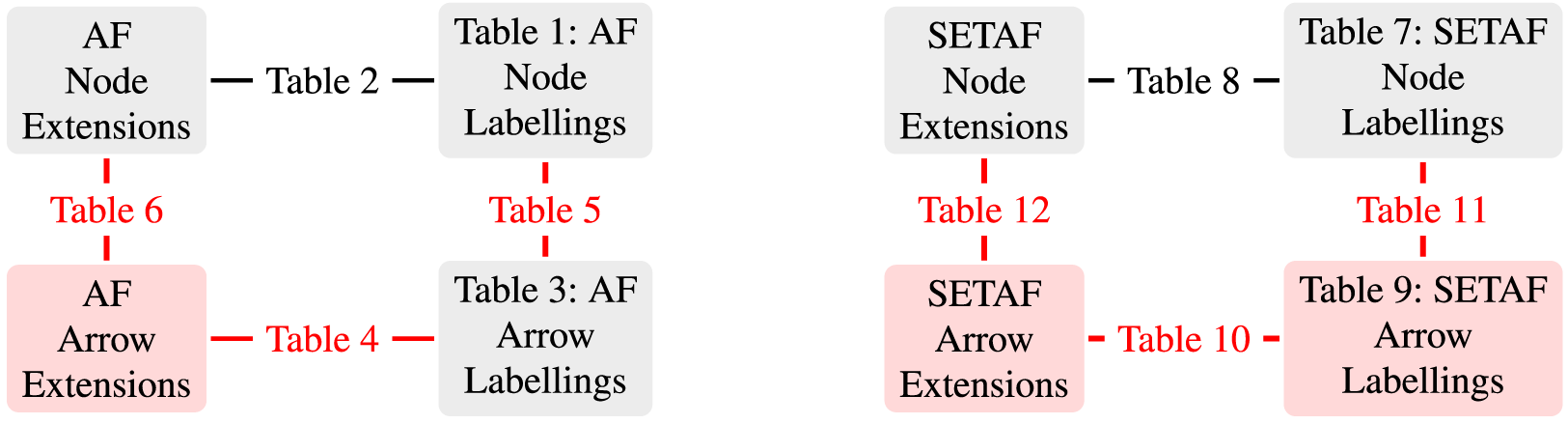
Illustration of the contents of Section 2 and Section 3. The contributions of this paper are highlighted in red colour.
In order to improve readability, we have moved the proofs to the appendices of the paper. A reader who is only interested in our main findings could decide only to read Section 1 to Section 6.
In the current section, we provide a summary of some of the existing theory in formal argumentation that we will build on. We start with the concept of an argumentation framework, which is essentially a graph consisting of nodes (N) and arrows (
An argumentation framework is a pair
We will commonly refer to the elements of
Semantics for argumentation frameworks were originally defined in terms of its nodes [20].
Let
Let an admissible set iff M is conflict-free and a complete extension iff M is conflict-free and a grounded extension iff M is minimal (w.r.t. ⊆) among all complete extensions a preferred extension iff M is a maximal (w.r.t. ⊆) complete extension a semi-stable extension iff M is a complete extension where a stable extension iff M is a complete extension with
Although Definition 3 defines the common node semantics in a slightly different way than for instance in [20], equivalence can be observed [11].
An alternative way of defining node semantics is by applying labellings, as is done in the following definition based on [11,14].
Let if if if grounded iff preferred iff semi-stable iff stable iff
A node labelling
As a convention, we write
As a node labelling essentially defines a partition, we sometimes write it as a triple
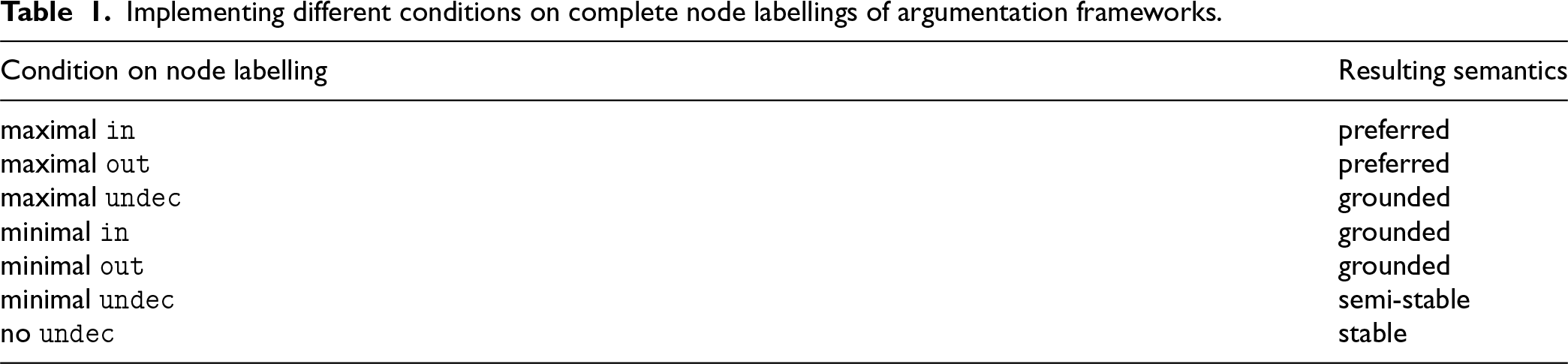
It has been shown that the complete node labellings with maximal
Implementing different conditions on complete node labellings of argumentation frameworks.
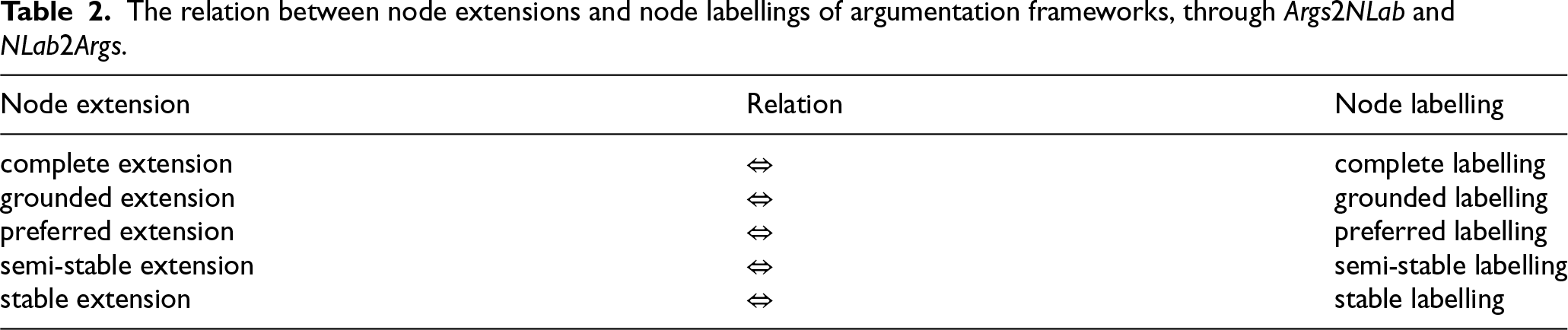
As was pointed out in [14], for the semantics we consider labellings and extensions are one-to-one related through the functions 
That is, if
The relation between node extensions and node labellings of argumentation frameworks, through
As an alternative to defining semantics based on the nodes of an argumentation framework, it is also possible to define semantics based on the arrows of the argumentation framework. This idea of “attack semantics” was first introduced in [52] – however, these semantics have not yet been defined in terms of extensions, as we introduce them in Definition 5.
Let
Let an admissible set iff a is conflict-free and a complete extension iff a is conflict-free and a grounded extension iff a is minimal (w.r.t. ⊆) among all complete extensions a preferred extension iff a is a maximal (w.r.t. ⊆) complete extension a semi-stable extension iff a is a complete extension where a stable extension iff a is a complete extension with
An alternative way of defining arrow semantics is by applying labellings, as is done in the following definition.3
Let if if if grounded iff preferred iff semi-stable iff stable iff
An arrow labelling
As a convention, we write
As an arrow labelling essentially defines a partition, we sometimes write it as a triple
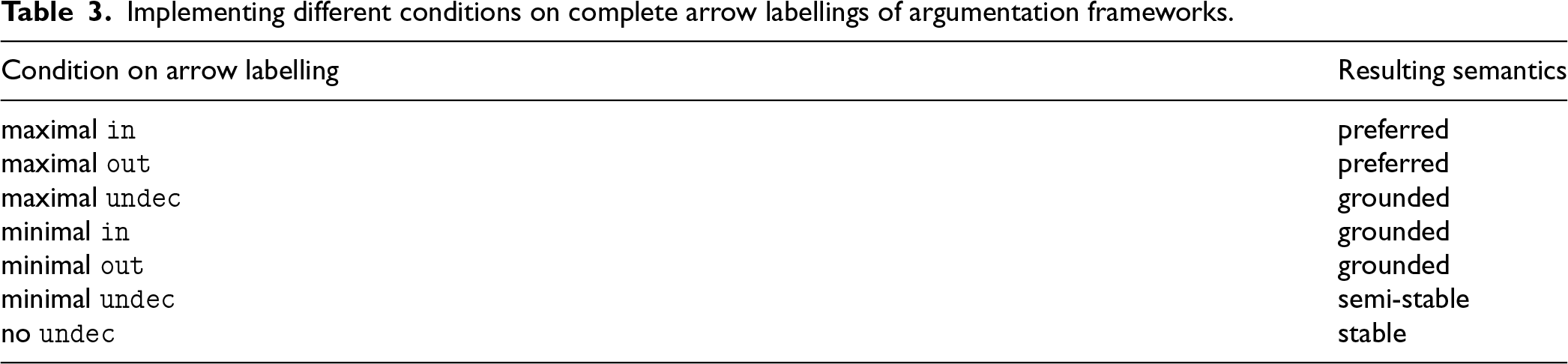
It can be shown that the complete arrow labellings with maximal
Implementing different conditions on complete arrow labellings of argumentation frameworks.
It can be shown that arrow extensions and arrow labellings are one-to-one related through the functions 
If
The relation between arrow extensions and arrow labellings of argumentation frameworks, through

It turns out that arrow labellings and node labellings are one-to-one related through the functions 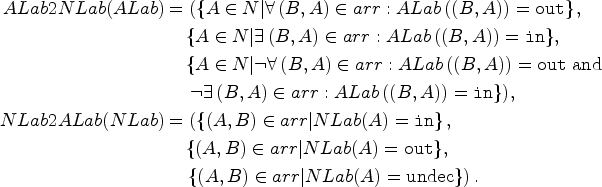
It can be shown that if
The relation between node labellings and arrow labellings of argumentation frameworks, through
and
.
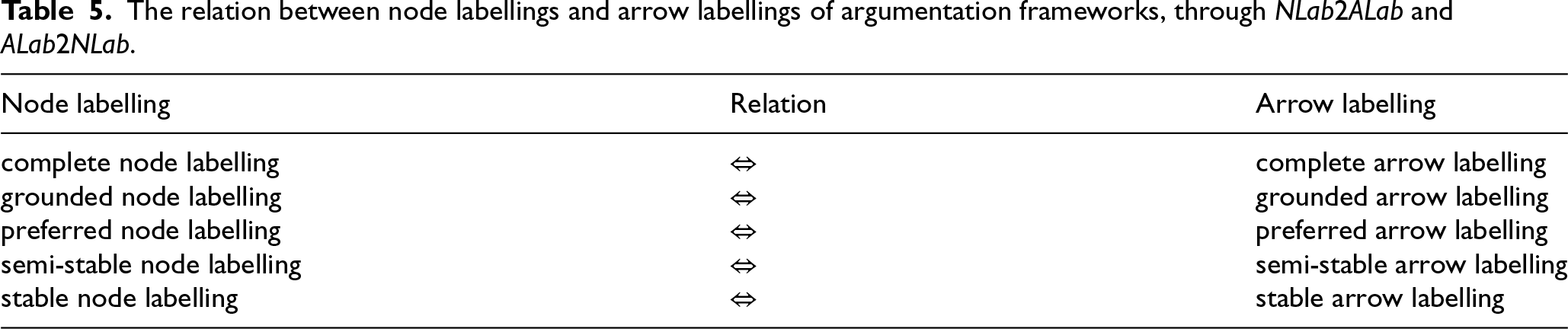
The relation between node labellings and arrow labellings of argumentation frameworks, through
Let
If
If
When restricted to complete node labellings and complete arrow labellings, the functions
If
If
If
If
If
If
Note that this implication does not hold for semi-stable semantics (in neither direction), as the following counter-examples illustrate. Intuitively, the problem are nodes that have no outgoing arrows, which means in arrow semantics we cannot distinguish the cases
Let
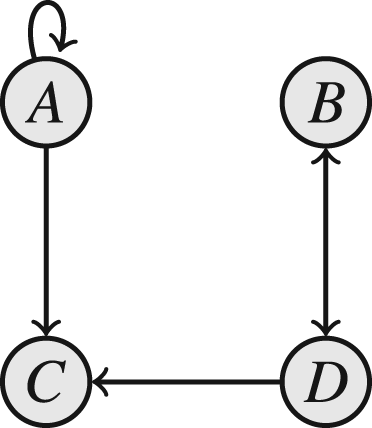
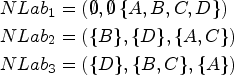

Let
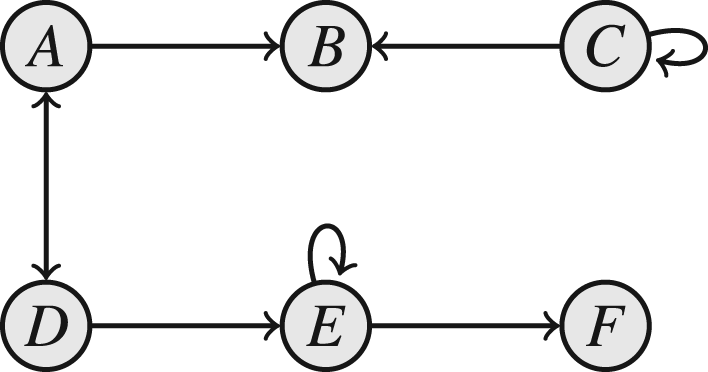
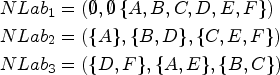

These node labellings and arrow labellings correspond to each other through the functions
Node extensions and arrow extensions are one-to-one related via the functions

The relation between node extensions and arrow extensions of argumentation frameworks.

Apart from defining argumentation semantics based on a normal (binary) directed graph, one can also define argumentation semantics that take collective attacks into account. The idea is that instead of one node attacking another node, there is a set of nodes attacking another node. We note that these frameworks are a special case of directed hypergraphs where the target element is a singleton. For current purposes, we restrict ourselves to hypergraphs that are finite.
An argumentation framework with set attacks (SETAF) is a tuple
As for AFs, we refer to the elements of
Consider the following SETAF 
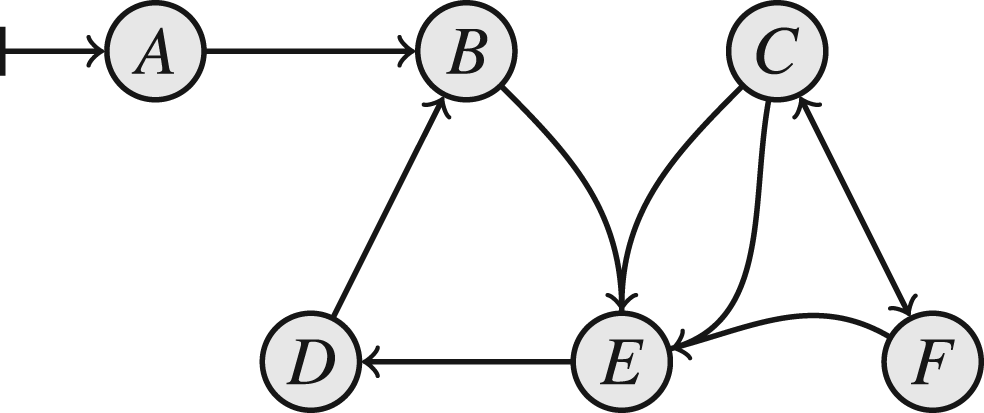
Originally, set attacks have been introduced without allowing for the empty set attacking an argument [42]: an argumentation framework with collective attacks is a pair
Note that (with a slight abuse of notation) every AF can be seen as a SETAF (cf. [42]): let
Just as is the case for AFs, semantics of SETAFs can be defined in terms of nodes [35,42] and in terms of arrows (which is a novel contribution of this paper). We will now discuss each of these approaches.
Semantics for SETAFs were originally defined in terms of its nodes [42].
Let
Let an admissible set iff a complete extension iff a grounded extension iff a preferred extension iff a semi-stable extension iff a stable extension iff
If one interprets an arrow
An alternative way of defining SETAF semantics is by applying node labellings as done in [35].
Let if if if grounded iff preferred iff semi-stable iff stable iff
A SETAF node labelling
As a convention, we write
As a SETAF node labelling essentially defines a partition, we sometimes write it as a triple
It can been shown that the complete SETAF node labellings with maximal
Implementing different conditions on complete node labellings of SETAFs.
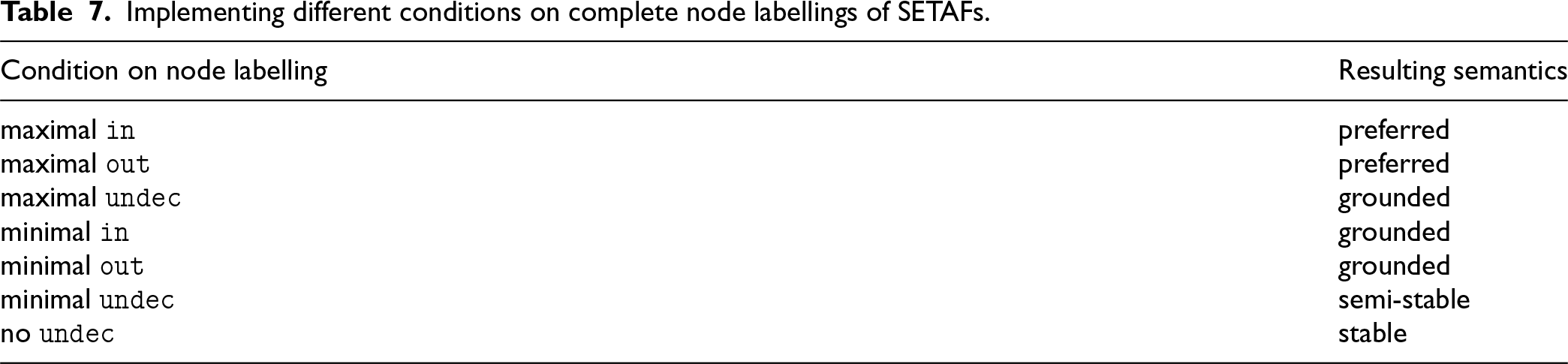
As shown in [35, Theorem 5.10, Theorem 5.11], it holds that SETAF node labellings and SETAF extensions are one-to-one related through the functions 
If
The relation between node extensions and node labellings of SETAFs, through

As an alternative to defining semantics based on the nodes of a SETAF, it is also possible to define semantics based on the arrows of the SETAF. This can be done using either arrow extensions or arrow labellings. We start with arrow extensions.
Let
Let an admissible set iff a complete extension iff a grounded extension iff a preferred extension iff a semi-stable extension iff a stable extension iff
An alternative way of defining arrow semantics for SETAF is by applying labellings, as is done in the following definition.
Let if if if grounded iff preferred iff semi-stable iff stable iff
A SETAF arrow labelling
As a convention, we write
As a SETAF arrow labelling essentially defines a partition, we sometimes write it as a triple
It can be shown that the complete arrow labellings with maximal
It can be shown that arrow extensions and arrow labellings are one-to-one related through the functions 
Implementing different conditions on complete arrow labellings of SETAF.
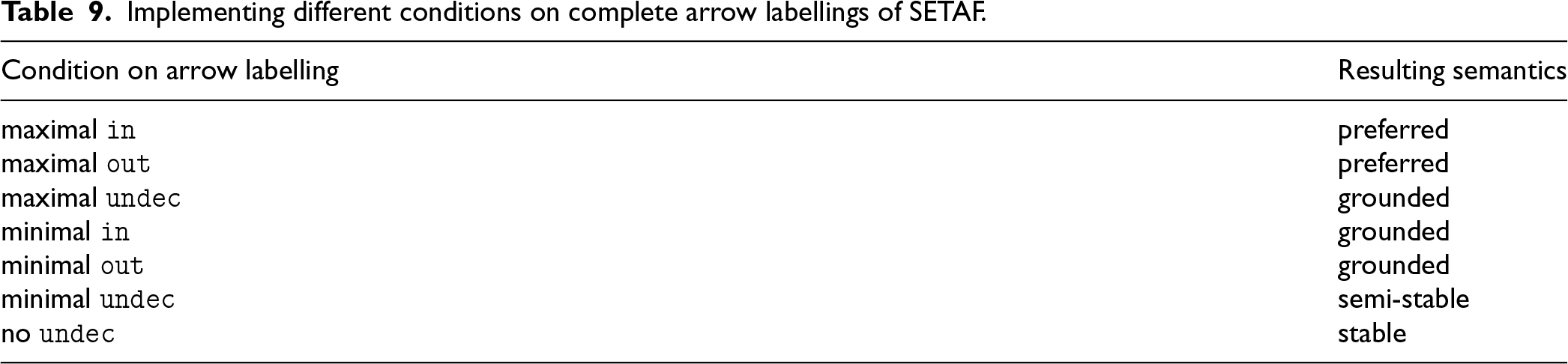
If
The relation between arrow extensions and arrow labellings of SETAF, through

It can be shown that SETAF arrow labellings and SETAF node labellings are one-to-one related through the functions 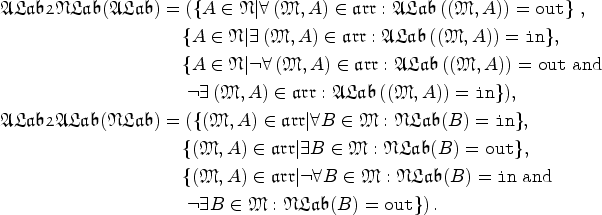
It can be shown that if
However, the relation between SETAF arrow labellings and SETAF node labellings does not hold under semi-stable semantics (due to Remark 14, the same counter example as in AFs applies, i.e., Example 9 and Example 10). This is despite the fact that, under complete semantics (as well as under grounded, preferred, semi-stable and stable semantics)
Let
If
If
When restricted to complete node labellings and complete arrow labellings, the functions
If
If
If
If
If
If
The relation between node labellings and arrow labellings of SETAFs, through

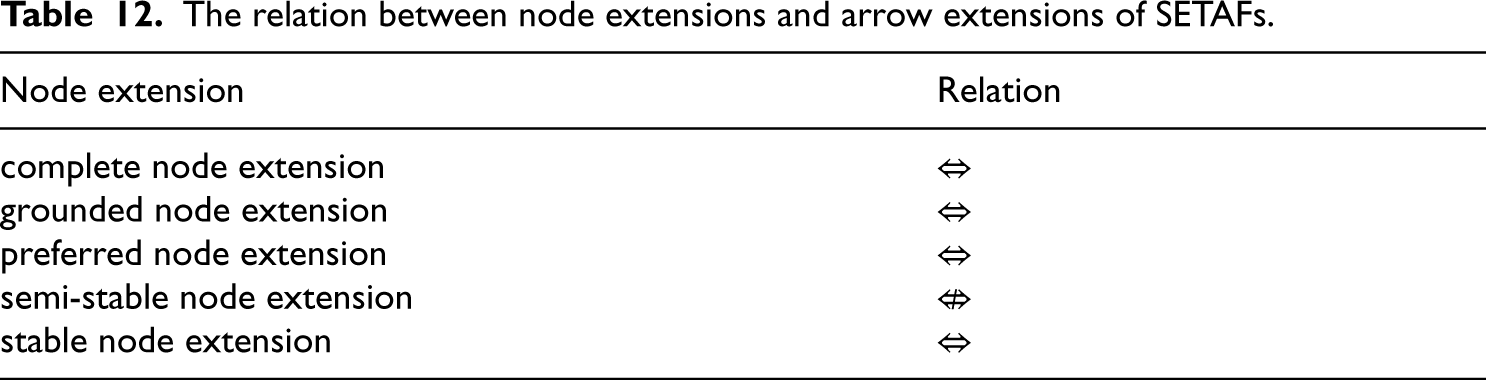
Conflict-free node extensions and arrow extensions are one-to-one related via the functions

Table 12 provides an overview (see Appendix K for proofs).
The relation between node extensions and arrow extensions of SETAFs.
It is possible to translate a SETAF to an AF, and in the current section we will provide one particular way of doing so (other methods are presented, e.g., in [43]). The idea is that the arrows of the SETAF become the nodes of the AF.7 As the arrows of the original framework become the nodes of the associated framework we say we turn the framework “inside-out”. The proofs of this section can be found in Appendix L.
Let
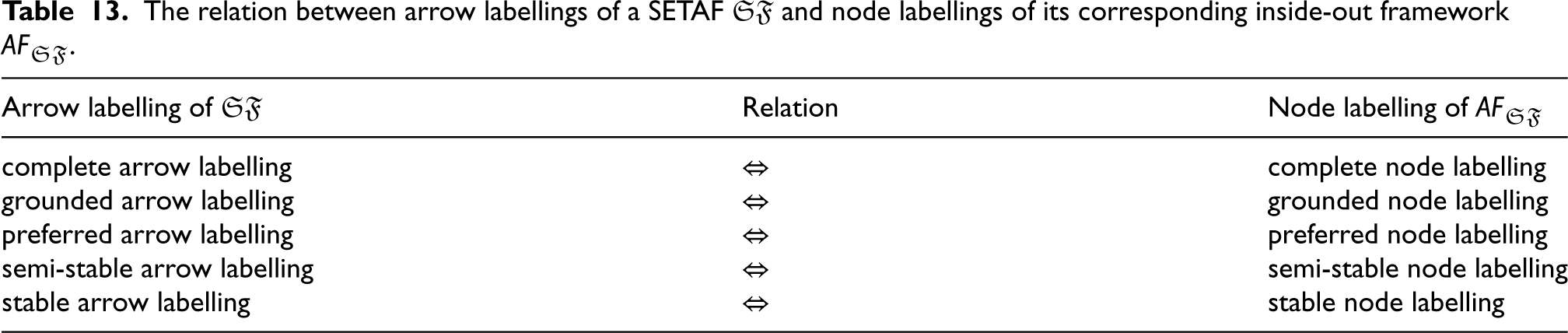
As a side effect of this translation, the arrow labellings of the SETAF become the node labellings of the associated argumentation framework.
Let
The relation described in Theorem 23 is summarised in Table 13. The fact that SETAF arrow labellings are equivalent to the associated argumentation framework node labellings (Theorem 23), together with the earlier observed equivalence between SETAF node labellings and SETAF arrow labellings (Theorem 21) allows for the connection between the node labellings of a SETAF and the node labellings of the associated argumentation framework. These are one-to-one related through the functions
The relation between arrow labellings of a SETAF
Recall the SETAF 
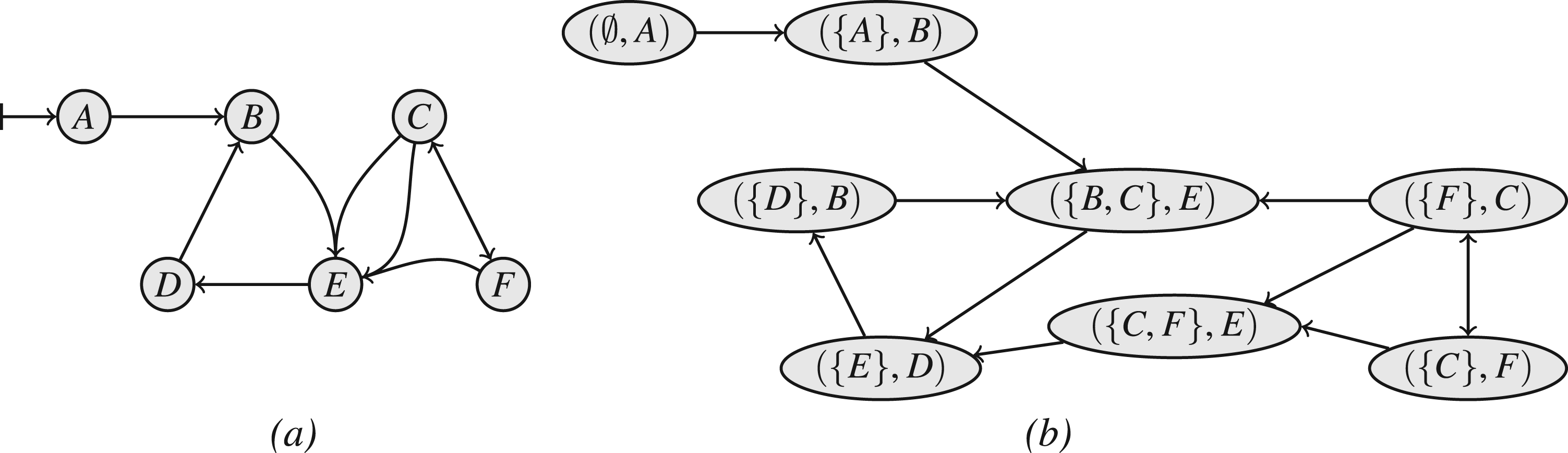
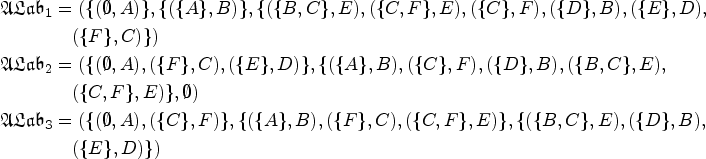
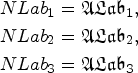
In the current section, we show how assumption-based argumentation (ABA) can be used to instantiate both a standard AF and a SETAF. The common instantiation procedure translates a given ABA framework (ABAF) into a standard AF [19]. However, it turns out that the concepts underlying ABA are actually much closer in spirit to SETAFs. Here we discuss both instantiations and examine to what extent they can be considered equal to each other. Thereby, we will build upon our previously established results showing a close correspondence between the formalisms. We start with introducing ABAFs.
[21]
An ABAF is a tuple
For current purposes we only consider ABAFs that are flat in the sense of [10], which amounts to no assumption being the head of an inference rule.
[21]
Given an ABAF the root is labelled c for every node N if N is a leaf then N is labelled either by an assumption or by ⊤ if N is not a leaf and b is the label of N, then there exists an inference rule
We denote by
Note that for each assumption
Now that the notions of an ABAF and a derivation tree have been defined, we proceed with defining the ABA semantics [10,19]. Historically, they have been defined in two different ways: using extensions of assumptions or using extensions of arguments [10,19,21]. We start with the more contemporary argument-based notion.
Given an ABAF
Our notion of an ABA-argument (Definition 27) is in line with the notation in the ABA literature [22], where a derivation tree is often denoted as
Using the notion of ABA-arguments and their attacks, it is straightforward to define the associated AF.
Given an ABAF
The semantics of the ABAF D can now be determined by the semantics of the associated AF
We consider the ABAF 
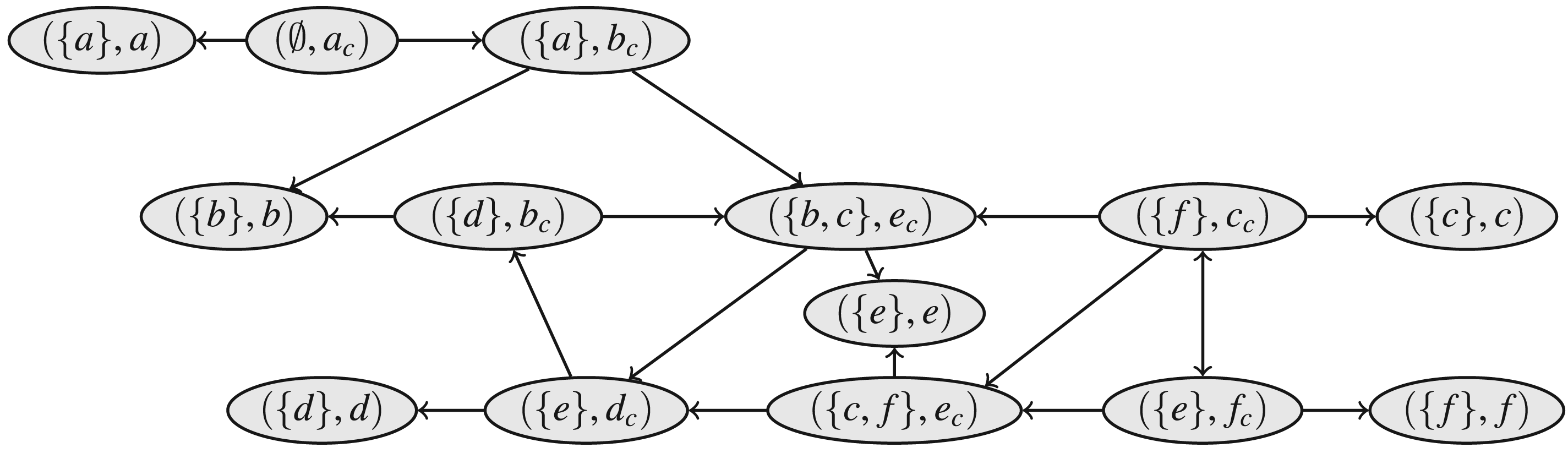
Note the structural similarity to the inside-out AF from Example 24 when ignoring the trivial ABA-arguments of the form
Now that we have provided the contemporary definition of ABA semantics which is based on extensions (resp. labellings) of arguments, we shift our attention to the more classical definition of ABA semantics which is based on extensions (resp. labellings) of assumptions. While the former can be captured by constructing an AF, the latter can be captured by a SETAF, which we are going to demonstrate subsequently. First, we define the semantics directly on the ABAF, without any kind of instantiation.
Let
Let an admissible assumption set iff a complete assumption extension iff a grounded assumption extension iff a preferred assumption extension iff a semi-stable assumption extension iff a stable assumption extension iff
Since the notion of ABA-arguments (Definition 27) influences the attack and defense relations between arguments (Definition 30), it also affects the definition of semantics of an ABAF as compared to [10,22]. However, the semantics of an ABAF are the same no matter whether our definition of arguments or the one in [22] is used. It should also be noticed that description of preferred and stable semantics in Definition 31 is slightly different from [10,22]. We prove equivalence in Appendix M.
Let
The set
The set
We next consider the SETAF instantiation of an ABAF. The SETAF is close to the original ABAF as for instance stated in [10,22]. Instead of computing all derivation trees to construct an AF, the SETAF we instantiate only contains the set
Given an ABAF
Recall the previous ABAF 
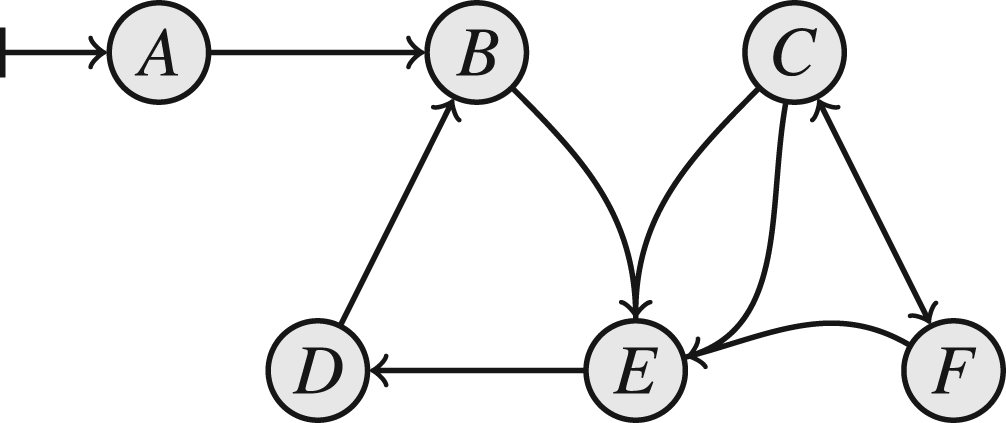
Again, note the structural similarity to the SETAF from Example 24.
It is not difficult to see that the extensions of the thus constructed SETAF correspond to the traditional ABA extensions of assumptions.
Let
Hence, the essential difference between the classical ABA definitions (in which semantics are defined in terms of assumptions [10,22]) and the more contemporary ABA-AF instantiation (in which semantics are defined in terms of arguments [21]) is that the classical ABA definititions are based on a SETAF, in which the ABA-arguments form the arrows, whereas the ABA-AF instantiation is based on an AF, in which the ABA-arguments form the nodes.8
Now that the difference between the classical ABA definitions and the ABA-AF instantiation has been made clear, we can shed new light on the issue of whether these are actually equivalent. The idea is to apply the abstract theory on AF labellings and SETAF labellings in the particular context of ABA. This is done using the following steps:
Start with the SETAF generated by the ABA SETAF instantiation. The complete (resp. grounded, preferred, semi-stable or stable) assumption extensions of the ABA-framework correspond one-to-one with the complete (resp. grounded, preferred, semi-stable and stable) node labellings of the SETAF. Convert the SETAF node labellings to the associated SETAF arrow labellings (that is, apply the concept of arrow-semantics to the SETAF). Since each arrow of the SETAF is associated with an ABA-argument, this will essentially define a labelling of ABA-arguments. Convert the SETAF into an AF (the associate inside-out AF, cf. Definition 22). The arrows of the SETAF become the nodes of the AF. The arrow labellings of the SETAF become the node labellings of the AF. The thus obtained AF is almost equivalent to the ABA-AF instantiation. However, two things still need to be taken care of. First, we should restore the contrary signs in the conclusions of the ABA-arguments, which were lost when generating the SETAF at step 1. Secondly, it can be observed that the resulting graph only contains the attacking ABA-arguments (arguments whose conclusion is the contrary of an assumption) whereas the ABA-AF instantiation also contains the non-attacking ABA-arguments (arguments whose conclusion is not the contrary of an assumption). These need to be added to the graph. The thus added nodes might have in-going arrows, but do not have any out-going arrows. Consequently, the node labellings can be extended in a straightforward way. Thereby, the overall set of accepted assumptions is preserved. The result will be the ABA-AF instantiation, with associated labellings.
At step 4, the effect of adding the non-attacking ABA-arguments basically means going from an AF 

Let
If
If

It can be observed that the thus defined conversion functions between node labellings of
We now formalise that the relation between the inside-out AF associated to
Let D be an ABAF. Let
The equivalences observed in the ABA-literature between extensions of assumptions (using the classical definition of ABA) and extensions of arguments (using the ABA-AF instantiation) follow from the above described theory on AFs and SETAFs. Let 

We are now ready to give an alternative proof for the (known) result that an ABAF D can be evaluated by computing the semantics of the associated AF
Let
If
If M is a complete (resp. grounded, preferred or stable) extension of
When restricted to complete (resp. grounded, preferred and stable) assumption extensions of D and complete (resp. grounded, preferred and stable) extensions of
We only do the case of complete semantics (the other semantics can be handled in a similar way).
Let (i) By Theorem 35, the set (ii) Now let (iii) In the next step, let (iv) Let (v) Now let (vi) Let M be the associated complete extension. It holds that M consists of precisely those ABA-arguments whose assumptions are in Let M be a complete extension of remove suitable nodes from move from the node labelling of move from the arrow labelling of move from the node labelling of In each step of the above proof, the applied mappings are bijective and each other’s inverses. Consequently, this also applies to the whole process altogether. Note in particular that, as we pointed out, the auxiliary nodes added to move from the inside-out SETAF to the associated AF do not impact the accepted assumptions.

By the same chain of reasoning, the thus obtained set
An interesting observation is that this proof can be used to explain at which step the transformation fails for semi-stable semantics: While most of the steps would actually also work for semi-stable semantics (applying Theorem 35, Theorem 23, Table 8, and Proposition 37), the problem arises in step (iii) where we apply Theorem 21 moving from node labellings to arrow labellings in the SETAF under consideration.
In this paper we thoroughly investigated abstract argumentation semantics in several dimensions: we studied extension-based and labelling-based node and arrow semantics for standard argumentation frameworks and for argumentation frameworks with collective attacks (SETAFs), and investigated the relation between these semantics. We mapped out the entire space of possibilities, also regarding what happens when minimising or maximising a particular label. We systematically filled the gaps in the literature and introduced arrow extensions for AFs as well as arrow extensions and labellings for SETAFs (cf. red coloured elements in Fig. 2). We studied the relation to the already established semantics and compared the obtained results for SETAFs with the results for AFs. We showed that each SETAF can be “turned inside-out” and efficiently transformed into a semantically corresponding AF (cf. red coloured arc in Fig. 2). Note that arrow semantics for SETAFs can be defined in various ways (for example, preferred extensions can be defined in terms of ⊆-maximal admissible or ⊆-maximal complete extensions). We immediately obtain the same flexibility for these definitions that we are used to from AF semantics by applying Theorem 23.
Finally, we applied our findings in the realm of structured argumentation. We pointed out that for ABA frameworks our inside-out frameworks capture the instantiation process: while traditionally the semantics on the abstract level are evaluated via AFs, the original definitions are closer to the semantics of SETAFs. If this obtained SETAF is turned “inside-out”, then we obtain the traditional instantiated AF.
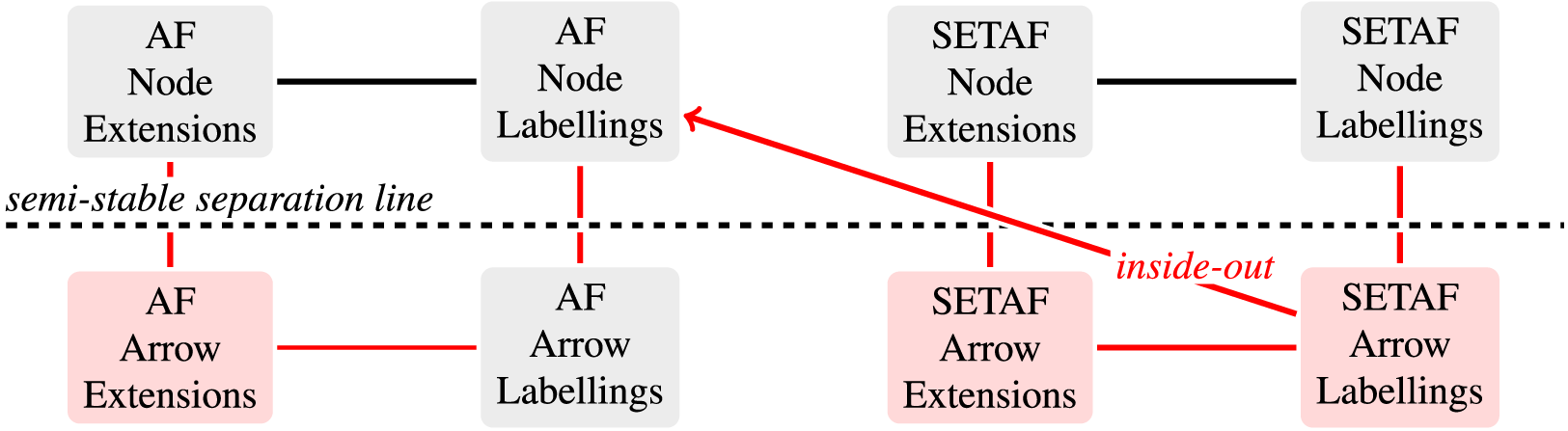
The separation line for semi-stable semantics (dashed) indicates transformations for which semi-stable semantics is not preserved. The arc (red coloured, inside-out labelled) between SETAF arrow labellings and AF node labellings visualises the result from Theorem 23: each SETAF arrow labelling corresponds to the node labelling of the corresponding inside-out AF. Notably, semi-stable semantics are preserved in this translation. The contributions of this paper are highlighted in red colour.
The subtle difference of semi-stable semantics. We want to highlight that the semantics correspondence holds for some of the established semantics, with the notable exception of semi-stable semantics. As indicated in Fig. 2, semi-stable semantics does not survive each transformation step. The parting line lies between node and arrow semantics for both AFs and SETAFs. Figure2 shows that our transformations preserve all considered semantics on the horizontal axis, i.e., transforming node extensions to node labellings (arrow extensions and arrow labellings, respectively) and vice versa; but they fail to preserve semi-stable semantics vertically, i.e., for switching from node extensions to arrow extensions (node labellings to arrow labellings, respectively) and vice versa. Interestingly, when moving from SETAFs to AFs via the inside-out transformation, we switch levels: as shown in Section 4, semi-stable SETAF arrow semantics correspond to semi-stable AF node semantics of the resulting AF and vice versa.
The heterogeneous behaviour of semi-stable semantics has been already observed in several different settings, e.g., when comparing logic programs and AFs [16], in the context of ABA and AFs [17], and for different variants of claim semantics [33,34,45]. In our present work, we show that these differences can be found even within the same formalism, when comparing node and arrow semantics. Utilising our novel transformation from SETAFs to AFs, we furthermore reveal that AF node semantics and SETAF arrow semantics lie in the same category (with respect to semi-stable semantics).
An alternative view on attack semantics. Arrow semantics on AFs have been initially introduced as “attack semantics” [52]. However, our intuition differs slightly from the initial definition: in [52] the arrows (i.e., attacks) are partitioned into “successful” and “unsuccessful”; these correspond to the
We furthermore note that labellings for SETAFs that assign both arrows and nodes
A radically new approach to flattening. Whether the simplicity of AFs is an advantage or a disadvantage has not yet been conclusively clarified; in any case, recent years have witnessed numerous generalisations of standard argumentation frameworks, e.g., generalisations that allow for preferences [1], values [7], collective attacks [42], as discussed in the present work, or a support relation [18], just to name a few. Regardless of other potential shortcomings, a unified model has its advantages; and in response to any generalisations, methods have been developed to reintegrate the generalisations into standard argumentation frameworks. The flattening technique [9] is the task to translate generalised argumentation frameworks into AFs. Usually, additional arguments are introduced to compensate the increased expressiveness of the generalised model [36,43]. Moreover, while translations from SETAFs to AFs exist (cf. [43]) these methods usually capture the semantic correspondence in the arguments (under projection).
Our approach is radically different: each arrow in the SETAF becomes a node in the AF. Instead of handling the increased expressiveness with additional arguments, we exploit the close correspondence of arrow labellings of SETAFs to node labellings of AFs. That is, starting from a given SETAF,
we exploit the connection between node extensions and node labellings (for SETAFs); we switch from node labellings to arrow labellings (for SETAFs); we turn the framework inside-out – now, each arrow in the SETAF becomes a node in the AF; we move from node labellings to node extensions (for AFs).
In this way, we obtain the desired AF without any additional arguments. Due to the correspondence of node labellings of AFs and arrow labellings on SETAFs we can establish a semantic correspondence between the nodes of a SETAF and its inside-out AF. This method is successful for all except semi-stable semantics when comparing the node semantics of the original SETAF instance with the node semantics of the obtained AF. As discussed above, semi-stable semantics is not preserved in point (2), i.e., when switching from node labellings to arrow labellings. We note that the proof of Theorem 38 in Section 5 makes use of the close connection of the formalisms we discussed.
Finally, we want to point out that a model that is similar to our inside-out AF has been studied in the context of dynamics in argumentation. For any given SETAF, the resulting inside-out AF resembles a cvAF [46] – an argumentation framework with explicit claims (conclusions) and vulnerabilities. For an arrow
Future work. For future work, we want to investigate further semantics in all of the considered dimensions. In particular, we want to study ideal and eager semantics [12]. We anticipate that eager semantics admit a behaviour that is similar to semi-stable semantics. Ideal semantics, on the other hand, are expected to behave in line with the classical Dung semantics. Furthermore, the investigation of more involved semantics like
Abstract argumentation formalisms have been extensively investigated in terms of formal properties, principles [3,27], and the expressive power of standard argumentation frameworks and their generalisations [6,23,33,50]. However, the aforementioned results focus on node extensions in the respective formalism. It would be insightful to explore to which extent our inter-translations can help to study these properties also for e.g. arrow extensions.
Footnotes
Acknowledgements
This research has been supported by the Vienna Science and Technology Fund (WWTF) through project ICT19-065, the Austrian Science Fund (FWF) through project P32830, and by the Federal Ministry of Education and Research of Germany and by Sächsische Staatsministerium für Wissenschaft, Kultur und Tourismus in the programme Center of Excellence for AI-research “Center for Scalable Data Analytics and Artificial IntelligenceDresden/Leipzig”, project identification number: ScaDS.AI.
Properties of arrow labellings for argumentation frameworks
The labelling-based version of complete attack-semantics is defined in a slightly different way in [52]. Instead of characterising a complete arrow labelling using three if-statements, as is done in Definition 7, it is characterised using two iff-statements [52, Theorem 7]. However, it can be proved that these two characterisations are equivalent.
We now proceed to prove a number of lemmas on how arrow labellings relate to each other, and how arrow labellings relate to node labellings.
The following theorem states that minimising (resp. maximising) particular labels sometimes yields the same outcome.
From Theorem 42 it follows that the grounded, preferred and semi-stable arrow labellings cover all possibilities regarding the maximisation and minimisation of a particular label (among the complete arrow labellings).
As an aside, there exists an alternative way of proving the correctness of Theorem 39, Lemma 40, Lemma 41 and Theorem 42. The idea is that where a node labelling is based on nodes attacking each other, an arrow labelling is based on arrows attacking each other. Whereas a node A attacks a node B iff
As arrow labellings are essentially node labellings (of the inside out argumentation framework) they satisfy the standard properties of node labellings described in the literature. Hence, Theorem 39 follows from [14, Definition 5, Definition 6 and Theorem 1], Lemma 40 follows from [14, Lemma 1], Lemma 41 follows from [16, Lemma 2] and Theorem 42 follows from [14, Theorem 6, Theorem 7].
Equivalence of node labellings and arrow labellings for argumentation frameworks
Note that the following similar statements
Notice that the respective missing cases do not hold – analogous to Lemma 49 (the same counter examples apply in this case). In fact, the similarities between Lemma 49 and Lemma 50 are no coincidence, they are a direct consequence of the fact that the functions
To illustrate why these cases do not hold, we recall Example 9 from Section 2 (see below). It holds that
We recall Example 10 from Section 2 (see below). It holds that
We recall the following Theorem 8 from Section 2 that sums up our findings regarding the connections between arrow labellings and node labellings on AFs.
Let
If
If
When restricted to complete node labellings and complete arrow labellings, the functions
If
If
If
If
If
If
This follows from Lemma 45 and Lemma 46. This follows from Lemma 47 and Lemma 48. This follows from Lemma 51. This follows from Lemma 52. This follows from Lemma 53.
Node extensions for SETAFs: Equivalent definitions
In this section, we show that the semantics for AFs with collective attacks defined in [42] coincide with the formulations we present in Section 3.
Recall that AFs with collective attacks and SETAFs differ in their treatment of the empty attack: in AFs with collective attacks, the attack relation is a subset of
Let
The proof is analogous to the proof of the fundamental lemma for AFs [20] and AFs with collective attacks [42].
By definition of admissibility, it suffices to show that (i) First assume (ii) Now assume (iii) Next assume (iv) Finally, suppose By of the characteristic function.
Let
Consider a maximal (w.r.t. ⊆) admissible set Next, we show that Consider a maximal (w.r.t. ⊆) complete set
Let
Consider a conflict-free set We show that By assumption, Moreover, it defends itself: towards a contradiction, assume there is some node We show that By definition, each complete set is conflict-free. Moreover,
Properties of node labellings for SETAFs
Note that the following Lemma 59 and Theorem 60 are a straightforward generalisation of the respective results of AFs [14].
Let
“⇒”: Suppose “⇐”: Suppose This follows directly from point 1. This follows directly from point 1 and point 2.
Let
Let Let Note that this result is mentioned in [8] in the context of extensions. Let Note that this result is mentioned in [8] in the context of extensions. Let Let Let Shown in [35].
The following three statements are also equivalent:
Furthermore, it holds that the complete SETAF node labelling with minimal
Properties of arrow labellings for SETAF
We show that for SETAF arrow labellings the same properties hold as for AF arrow labellings, as shown in Appendix A. In particular, we show that the complete arrow labellings with maximal
We start with an alternative definition for the conditions of complete arrow labellings for SETAF.
We now proceed to prove a number of lemmas on how arrow labellings relate to each other, and how arrow labellings relate to node labellings.
The following theorem states that minimising (resp. maximising) particular labels sometimes yields the same outcome.
From Theorem 64 it follows that the grounded, preferred and semi-stable arrow labellings cover all possibilities regarding the maximisation and minimisation of a particular label (among the complete arrow labellings).
Equivalence of node labellings and arrow labellings for SETAFs
Note that the following similar statements If If If If If If Let
Let
“⇒”: Suppose “⇐”: Suppose This follows directly from point 1. This follows directly from point 1 and point 2. “⇒”: Suppose “⇐”: Suppose This follows directly from point 4. This follows directly from point 4 and point 5.
We recall the following Theorem 21 from Section 3 that sums up our findings regarding the connections between arrow labellings and node labellings on SETAFs.
Let
If
If
When restricted to complete node labellings and complete arrow labellings, the functions
If
If
If
If
If
If
This follows from Lemma 65 and Lemma 66. This follows from Lemma 67 and Lemma 68. This follows from Lemma 72. This follows from Lemma 73. This follows from Lemma 74.
AFs with collective attacks vs. SETAFs
The concept of a SETAF (Definition 11) is very close to that of an Argumentation System in the sense of [42], which allows for collective attacks. However, where the SETAF arrows (
In the following, we show that the difference between AFs with collective attacks and SETAFs is marginal. We show that each SETAF can be represented as AF with collective attacks without affecting the semantics. First, let us recall both definitions.
By definition, each AF with collective attacks is a SETAF.
To map each SETAF to an AF with collective attacks, we simply delete all nodes that are attacked by the empty set (and all attacks they were involved in).
The translation partitions the class of all SETAF into equivalence classes where each corresponds to a single AF with collective attacks.
Each AF with collective attacks
Interestingly, it can be the case that the empty set is stable in a given SETAF
We show that AF with collective attacks and SETAF semantics coincide.
Below, we make use of the following notation. For a SETAF
We obtain the following.
Differently phrased, all SETAFs in the same equivalence class coincide on the semantics.
From the one-to-one correspondence between extension semantics and labellings (cf. Theorem 58) and from Theorem 80, we obtain the following result.
Let
for each SETAF node labelling
for each SETAF node labelling
We provide a proof for complete semantics. The remaining proofs are analogous. First, let By Theorem 58, Analogous to the other direction. Now, let By Theorem 58, Analogous to the first case above (the restriction of a complete node labelling of
Equivalence of arrow extensions and arrow labellings for argumentation frameworks
Equivalence of node extensions and arrow extensions for argumentation frameworks
We define the functions
For semi-stable semantics, we consider the following counter-example:
Let us recall the
The AF has three complete node extensions Let us see the function Hence, we obtain The set
Equivalence of arrow extensions and arrow labellings for SETAFs
Equivalence of node extensions and arrow extensions for SETAFs
In this section, we will provide proofs regarding the equivalence of node and arrow extensions. We recall the functions
We note that the above result does not apply to semi-stable semantics. As a counter-example, we refer to Example 91.
Connection between argumentation frameworks and SETAFs
Recall Definition 22. As with AFs (see Definition 43), we can turn SETAF “inside out” as well. We want to emphasise that the resulting framework is still an AF, even if we turn a SETAF inside out. Moreover, note that the following result subsumes Theorem 44, as every AF can be seen as a SETAF.
The following theorem is a slightly reformulated version of Theorem 23 from Section 4, i.e., the following proof establishes Theorem 23.
Because of Theorem 100 (point 3) the well-behavedness of arrow labellings carries over from argumentation frameworks to SETAF: as arrow labellings are essentially node labellings (of the inside out argumentation framework) they satisfy the standard properties of node labellings described in the literature. Hence, Theorem 61 follows from [14, Definition 5, Definition 6 and Theorem 1], Lemma 62 follows from [14, Lemma 1], Lemma 63 follows from [16, Lemma 2] and Theorem 64 follows from [14, Theorem 6, Theorem 7].
ABA semantics reformulated
The way arguments are defined in Definition 27 is slightly different from the original definition in [22]. This means that even though the definition of a set of assumptions attacking an assumption (Definition 30 is the same as the notion of attack in the ABA literature [22], our definition of attack refers to a different kind of argument and is therefore slightly different. We now show that nevertheless the two notions of attack coincide and that therefore the derived concepts of defence and semantics are equivalent no matter which notion of argument is used.
Since arguments in [22] are derivation trees as given in Definition 26, the equivalence results will be given in terms of arguments and derivations as given in Definitions 27 and 26, respectively.
We now proceed to prove that the semantics in ABA are equivalent no matter whether the notion of ABA arguments or derivation trees is used in the definition.
As mentioned in Section 5, the way preferred and stable semantics in the context of ABAFs were defined in Definition 31 is slightly different from the way these were originally defined in [10,22]. We have chosen to describe all ABA semantics in a uniform way, based on the notion of complete semantics. This has been done to allow for easy conversion between extensions and labellings, as well as to provide uniformity with the rest of the paper.
We will now proceed to show that our description of the ABA semantics in Definition 31 is equivalent to the original description in [10,22]. Since the notion of admissible sets and complete extensions are simply reformulations of the definitions in [10,22] in terms of the function F introduced here, we start with proving equivalence for the preferred semantics.
The next thing to show is that our description of stable semantics (Definition 31) is equivalent with the way stable semantics was originally defined in [10].
Using the lemmas and theorems provided in this section, we will now prove Theorem 32 from Section 5.
In the following, we investigate how the slightly altered notion of ABA-arguments (Definition 27 influences the associated AF as compared to [22]. Since arguments in [22] are equivalent to derivation trees in Definition 26, we will prove the results in terms of derivation trees. However, exactly the same results hold with respect to arguments as defined in [22].
Note that Definition 105 is equivalent to the notion of attack in [22].
Definition 106 is equivalent to the associated AF as defined in [22].