




Abstract
In this paper, we consider argumentation frameworks with sets of attacking arguments (SETAFs) due to Nielsen and Parsons, an extension of Dung’s abstract argumentation frameworks that allow for collective attacks. We first provide a comprehensive analysis of the expressiveness of SETAFs under conflict-free, naive, stable, complete, admissible, preferred, semi-stable, and stage semantics. Our analysis shows that SETAFs are strictly more expressive than Dung AFs. Towards a uniform characterization of SETAFs and Dung AFs we provide general results on expressiveness which take the maximum degree of the collective attacks into account. Our results show that, for each
Introduction
Abstract argumentation frameworks (AFs) as introduced by Dung in his seminal paper [6] are a core formalism in formal argumentation and have been extensively studied in the literature. A popular line of research investigates extensions of Dung AFs that allow for a richer syntax (see, e.g. [3]). In this work we consider frameworks with sets of attacking arguments (SETAFs) as introduced by Nielsen and Parsons [16] which generalize the binary attacks in Dung AFs to collective attacks such that a set of arguments B attacks another argument a but no proper subset of B attacks a. Figure 1 shows an example SETAF with three arguments a, b, and c. Each argument is jointly attacked by the two remaining arguments; in other words, the set
Standard semantics (i.e., admissible, complete, grounded, stable, preferred) for SETAFs have been defined in [16]. The crucial step towards these definitions is to fix the notion of conflict for SETAFs. In our example,
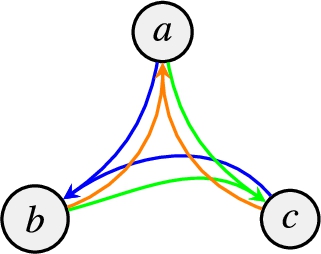
An example SETAF.
As illustrated in [16], there are several scenarios where arguments interact and can constitute an attack on another argument only if these arguments are jointly taken into account. Representing such a situation in Dung AFs often requires additional artificial arguments to “encode” the conjunction of arguments. This is also observed in a recent comprehensive investigation on translations between different abstract argumentation formalisms [17]. There, it is shown that SETAFs allow for more straightforward and compact encodings of support between arguments than AFs do. Also a recent paper [27] observes that for particular instantiations, SETAFs provide a more convenient target formalism than Dung AFs. However, to the best of our knowledge, there has not been a thorough investigation to which extent the concept of collective attacks increases the expressiveness of SETAFs compared to Dung AFs.
Characterizations and comparisons of the expressiveness of argumentation formalisms (and non-monotonic formalisms in general) have been identified as a fundamental basis in order to understand the different capabilities of formalisms [7,8,15,19,20]. A successful notion to compare the expressiveness of argumentation formalisms is the notion of the signature [7] of a formalism w.r.t. a semantics σ, that is the collection of all sets of σ-extensions that can be expressed with at least one argumentation framework. There exist exact characterizations for most of the semantics for Dung AFs [7] and Abstract Dialectical Frameworks (ADFs) [18–20]. As already observed by Polberg [17] collective attacks allow to enforce certain sets of extensions that cannot be obtained with Dung AFs. This is easily illustrated by our example SETAF from Fig. 1 for which we already reported its stable extensions being
Besides such basic observations, no general characterizations of the signatures for SETAFs have been presented so far, and thus the precise differences in expressiveness to Dung AFs and ADFs are still unclear. In particular, we are interested in questions like this: given an arbitrary set
In this work we answer such questions by investigating the signatures of SETAFs for conflict-free, naive, stable, complete, admissible, preferred, semi-stable and stage semantics. Moreover, we investigate whether the maximum degree of joint attacks (throughout the paper, we refer to the cardinality of the set of arguments attacking another argument as the degree of the attack) affects the expressiveness of SETAFs. For this purpose, we also study the classes of k-SETAFs (
The main contributions of our work are as follows.
In Section 3 we provide full characterizations of the extension-based signatures of SETAFs for the semantics under consideration (cf. Main Theorem 1). By that we characterize the exact difference in expressiveness between Dung AFs and SETAFs when considering extension-based semantics.
In Section 4 we provide characterizations of signatures for k-SETAFs (cf. Main Theorem 2). Our results show that the degree of the allowed attacks is crucial for the expressiveness. That is, k-SETAFs form a strict hierarchy of expressiveness when considering different values for k, with
Our results confirm that the notion of collective attacks is indeed quite powerful. In particular, the question mentioned above can be positively answered: each incomparable set can be realized by preferred, naive, stable, semi-stable, and stage semantics, thus showing that the signatures of these five semantics coincide for SETAFs. However, this only holds if we do not bound the maximum degree of collective attacks. Another interesting finding is that – in contrast to Dung AFs – the signature of conflict-free sets is not included in the signature of admissible sets; in other words there exists a set
From a more general perspective, our results clarify the impact of generalizing the concept of attack in terms of the extensions such formalisms can jointly deliver. We also conclude that the concept of collective attack already yields a maximal impact in this sense: preferred and other semantics already are capable of realizing any incomparable set. We believe that results of this kind yield further insight in the inherent nature of argumentation semantics studied and thus contribute to the fundamentals of abstract argumentation.
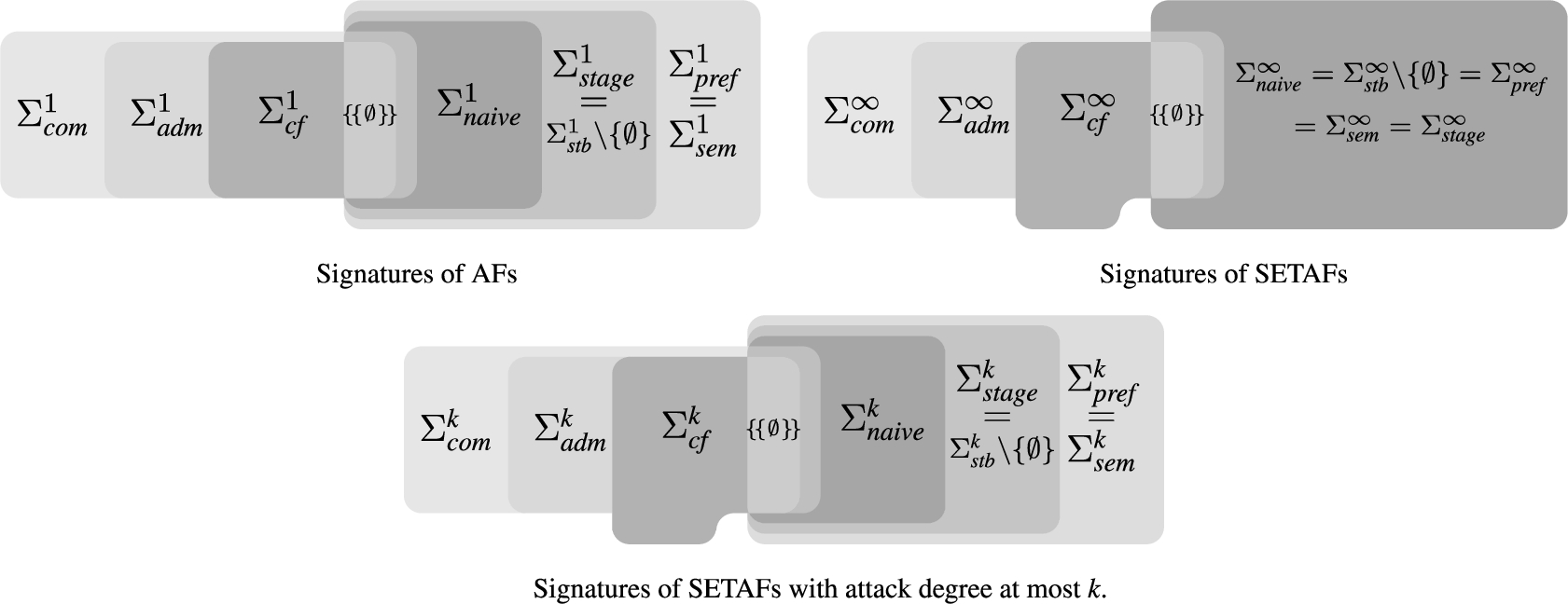
Summary of results: the Venn diagrams illustrate the relations between the signatures of the different semantics in AFs (
A preliminary version of this paper was presented at COMMA 2018 [10]. Beside giving full proofs, detailed discussions and examples, the present paper extends the conference version by extending the results to semi-stable and stage semantics and also incorporates fundamental results on these semantics that where presented in a workshop paper [11]. Another addition concerns results for the signature for k-SETAF under complete semantics.
We first introduce formal definitions of argumentation frameworks following [6,16] and then recall the relevant work on signatures.
Argumentation frameworks with collective attacks
Throughout the paper, we assume a countably infinite domain
A SETAF is a pair
We shall call 1-SETAFs, i.e. SETAFs that only allow for binary attacks, Dung argumentation frameworks (AFs) as they are equivalent to the AFs introduced in [6].
Given a SETAF
This way of lifting attacks to sets of arguments is characteristic for SETAFs and crucial in the definition of the notion of defense. The fact that it suffices to attack one argument to attack a set reflects the conjunctive nature of collective attacks.
Recall the framework from the introduction, with arguments
The notions of conflict and defense naturally generalize to SETAFs.
Given a SETAF
Given a SETAF
The notion of defense can be equivalently characterized as follows: an argument
Next, we introduce the semantics we study in this work. Besides conflict-free and admissible sets, these are the naive, stable, preferred, complete, grounded, stage, and semi-stable semantics, which we will abbreviate by
Given a SETAF
As shown in [16], most of the fundamental properties of Dung AFs extend to SETAFs. In particular, Dung’s fundamental lemma generalizes to SETAFs in the following way.
Given a SETAF
The following result is in the spirit of Dung’s fundamental lemma and is used later.
Given a SETAF
Towards a contradiction assume that
The relationship between stable, preferred, complete, admissible, conflict-free and naive semantics has already been clarified in [16] and matches with the relations between the semantics for Dung AFs, i.e. for any SETAF F,
We quickly clarify the relation of semi-stable and stage semantics to the other semantics; all the proofs are straightforward adaptations of the corresponding proofs in Dung AFs.
Consider a SETAF
Consider a SETAF
Consider a SETAF
Consider a SETAF
We are thus able to complete the picture on the relationship between the semantics as follows. For every SETAF F, we have
Moreover, the following property carries over from Dung AFs.
For any SETAF
Consider a SETAF
The concept of signatures of argumentation semantics was introduced in [7] to characterize the expressiveness of Dung AFs and has been extended to other argumentation frameworks [19,20]. Signatures characterize all possible sets of extensions, argumentation frameworks can provide for a given semantics.
Let
We require some further technical notions.
Given we use call
As only extension-sets can appear in the signature of a semantics we will tacitly assume that all sets
For characterizing the signatures we make frequent use of the following concepts.
Given the downward-closure of the set of potential conflicts in the completion-sets of E in
The downward-closure considers all subsets of sets in the extension-set. The set
Let
Let
downward-closed if
incomparable if all elements
tight if for all
conflict-sensitive if for each
com-closed if for each
Let
If we extend
The main results for Dung AFs are summarized in the following theorem.
Characterizations of the signatures for Dung AFs are as follows:
Note that the result for complete semantics does not yield an exact characterization. We will provide the exact characterization (which is not relevant for the upcoming section) later in Section 4.
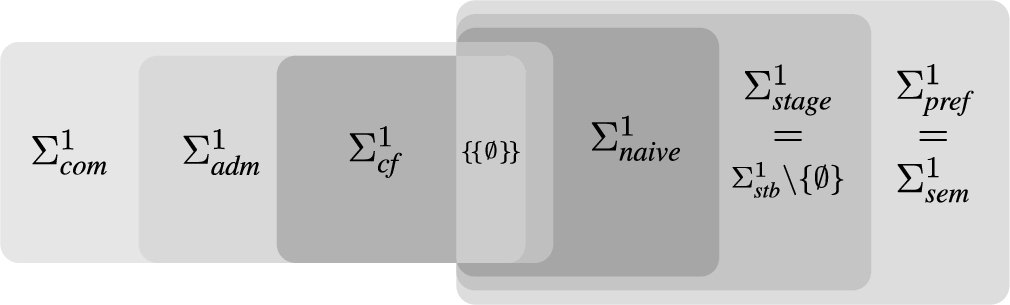
The characterizations of Theorem 1 also allow to investigate the relations between signatures of different semantics. The relations between these signatures are also illustrated in Fig. 3.
The following relations hold
Signatures of SETAFs with unrestricted collective attacks
In this section we give full characterizations of the SETAF signatures for the semantics under consideration. First, we consider grounded semantics. Grounded semantics, in SETAFs as well as in AFs, is a unique status semantics, i.e. it always yields a unique extension. Consequently, grounded semantics can only realize extension-sets that contain exactly one extension.
The grounded semantics always proposes a unique extension. An extension-set
That is for grounded semantics the signatures for AFs and (k-)SETAFs coincide. We continue with the signatures of stable and preferred semantics.
For both semantics we have that an extension cannot be a subset of another extension and thus the extension-sets of these semantics are incomparable. With the following construction we show that, in turn, each incomparable extension-set
Given an incomparable extension-set
We first prove the desired result for stable semantics.
First, as
For
We continue with preferred semantics. By definition the set of preferred extensions is incomparable. We show that being incomparable is also sufficient for an extension-set
First,
For realizing
The following theorem summarizes the results we have obtained so far.
We have
This characterization shows that SETAFs are strictly more expressible than AFs for stable and preferred semantics. While for AFs we require the extension-set Interestingly
We next consider conflict-free and naive semantics. The characteristics of conflict-free sets is that each subset is again conflict-free. We will show that this property which is captured by the notion of downward-closure is also sufficient to realize an extension-set with a SETAF via its conflict-free sets. We again start by defining a SETAF construction, which is a slight refinement of the one from Definition 10.2
We note that for any incomparable extension-set
Given a non-empty extension-set
The conflict-free sets of
For each extension-set
Let us show first that
Let us show now that
By definition, if a set is conflict-free then all its subsets are conflict-free as well. Thus, we have that
For the ⊆-relation of the assertion, recall that, by definition, a set is naive if it is maximal conflict-free. Thus, we have that
For the ⊇-relation, given an incomparable extension-set
The following theorem summarizes the characterizations of this subsection.
We have
In contrast, for realization with AFs and Consider the downward-closed extension-set
Semi-stable and stage semantics are both based on the maximality of the range of their extensions. It thus turns out that we can reuse the construction from Definition 10.
By Lemma 5,
By Lemma 6, for each SETAF F,
The following theorem summarizes these easy results.
We have
Together with the previous results, it turns out that for SETAFs the expressibility of naive, preferred, semi-stable, and stage semantics coincides. Moreover, stable semantics only differs w.r.t. the empty set of extensions. Hence, for all these semantics SETAFs are strictly more expressible than AFs. In fact, they are all maximal expressible if we require incomparability of extensions.
It remains to provide the SETAF signatures for admissible and complete semantics. As we will see, in contrast to AF signatures (where we have
In order the characterize the signature of admissible semantics in SETAFs we first generalize the notion of an extension-set being conflict-sensitive (cf. Definition 9) to SETAFs. That is, instead of requiring that if two sets
A set
Recall that all extension-sets realizable with the admissible semantics with Dung AFs are conflict-sensitive (and contain the empty extensions). The next result generalizes this property to SETAFs.
For any SETAF F,
Let If If
We obtain that
Furthermore, it turns out that
A set
Let
Pick any set-conflict-sensitive
Let
S is conflict-free in
if S is admissible in both
(1) Consider some
(2) First, note that if S is admissible in both
The next two lemmas analyze the SETAF
Let
Consider such a set
Let
Pick any set
Finally, we expand
Given an extension
We next illustrate the construction on an example
Consider the extension-set
With the following lemma we show that
For every extension-set
Let us first show that
It remains to combine the results for the SETAFs
For every extension-set
From Proposition 8, we have that
Let us show that
Now we can give an exact characterization of
Dung AFs require that an extension-set Consider the extension-set On the other hand, the set
Finally, we consider the signature of complete semantics. First, recall that the completion-sets
A set
if
Intuitively the set of complete extensions is set-com-closed because whenever the union of some complete extensions has no conflict, by Lemma 2, then this union is admissible and there is a unique minimal complete extensions containing this admissible set. Moreover, the grounded extensions is the intersection of all complete extensions and complete as well.
For every SETAF F we have that (a) the extension-set
First, notice that If If
In both cases we have an
Our realization for complete semantics is based on the construction for the admissible semantics given in Definition 14. First, given an extension-set
Given an extension-set
We next illustrate the above construction on an example.
Consider the extensions set
One can show that this construction realizes extension-sets with complete semantics whenever possible.
For every extension-set
Consider the SETAF
In order to apply the construction for admissible semantics on
Now consider the new attacks in
Combining both cases we obtain that if
This now gives a complete characterization of the signature for complete semantics.
Notice that when considering AFs not all extension-sets that are com-closed and satisfy Consider the extension-set Whenever Whenever It only remains to consider Consider Consider Consider Consider Consider Consider Consider Consider Consider Consider Consider
For the second condition we are interested in the choices of
This shows that
Our characterizations of the signatures of different semantics in SETAFs (cf. Theorems 3–7) are summarized in the following theorem.
Characterizations of the signatures for general SETAFs are as follows:
Let us now consider the relations between the signatures of the different semantics. First for the semantics possessing incomparable extension-sets we have
It remains to investigate the relations between admissible, complete, and conflict-free semantics. First we show that, as for Dung AFs, every extension-set that is set-conflict-sensitive is also set-com-closed and thus
Every extension-set
Towards a contradiction assume
Next, we give an example of an extension-set
Consider the extension-set
In contrast to Dung AFs we have that
Reconsider the extension-set
Likewise,
Finally, we show that whatever can be realized with
Consider
The relations between the signatures of the different semantics in SETAFs are illustrated in Fig. 4.
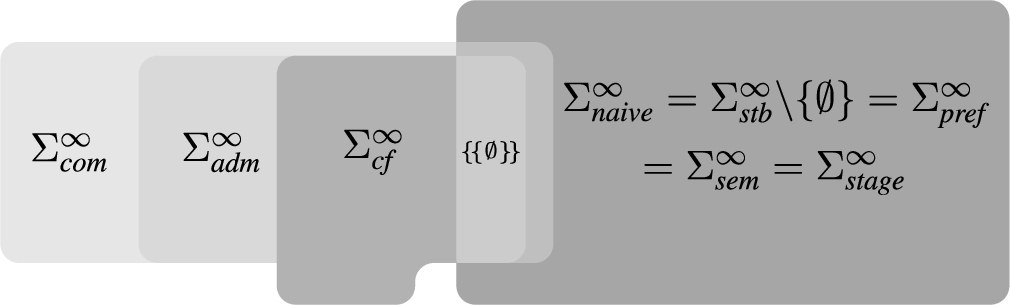
Relations between signatures in SETAFs (cf. Main Theorem 1).
We now investigate how the degree of collective attacks affects the expressiveness, i.e. we study the signatures of k-SETAFs. Notice that in all the constructions of the last section we used attacks of unbounded degree, since the actual degree typically depended on the size of the extensions.
We first generalize the properties used in our signatures by adding a parameter k.
The possible conflicts in a k-SETAF w.r.t. an extension-set
Let
Given an integer
Indeed, for
We start with presenting our results for the signatures for conflict-free and naive semantics. We already know that conflict-free extension-sets must be downward-closed. In k-SETAFs we additionally have that they must be k-tight which reflects that if
Let
Note that, for given
First we show the ⊆-relation, i.e. that
For the ⊇-relation, let
1) Let us show first that
2) To show
Next we show that for each
For any k-SETAF F,
To realize a set
The following theorem summarizes the characterizations of this subsection.
We have that
The following example shows that the expressiveness of conflict-free and naive semantics strictly increases with the degree k of the attacks. Consider the argument set
Next we consider the stable signature for k-SETAFs. Again, the set of stable extensions of a k-SETAF must be k-tight reflecting the fact that each argument which is not in an extension S must be attacked by S via a degree k attack. The following construction expands
Given an extension-set
One can show that for each
To prove the ⊆-relation, let
To prove the ⊇-relation of the assertion, let
1) Let us show first that
2) It remains to show
The above theorem gives a strict hierarchy of signatures
Consider the argument set
Note that, for incomparable
Consider the sets of arguments
As we will see next, for k-SETAFs we also have different signatures for stable and preferred semantics. For the latter, we first need to understand admissible sets in k-SETAFs. This is also the reason why we analyse the semantics here in a slightly different order compared to Section 3.
We first parameterize the notions of conflict-sensitive and set-conflict-sensitive.
Given an integer
It turns out that the above generalization of set-conflict-sensitive is not sufficient to characterize admissible extension-sets in k-SETAFs. We thus introduce the notion of k-defensive, which is tautological for
A set
Notice that the terminology here has changed when compared to the conference version of the paper [11]. What was called k-defensive in [11] is now called k-adm-fortable and further split up in two properties, i.e., k-conflict-sensitivity and k-defensivity. This is due to the new characterization for complete semantics presented in the forthcoming subsection that shares the property of k-defensivity with admissible semantics but not k-conflict-sensitivity.
A set
Given an extension-set
Whenever the union of two admissible sets is not admissible then (i) there must be an attack of degree
For any k-SETAF F we have that
First, notice that the empty set is always admissible. Now we consider a k-SETAF
1) We first show that If If
2) It remains to show that
For
Similarly as done in Section 3 for SETAFs of unbounded attack degree, we build the k-SETAF for the admissible semantics with several modules, starting with the module that exploits conflict-freeness.
When given a extension-set
We are now able to obtain similar results for this module as for the corresponding module in general SETAFs.
Let
Consider a SETAF
Let
Pick any set
Towards our defense module we recall the notion of defense-formulas from [7].
Given an extension-set
The defense formula
([7]).
Given an extension-set
For our defense module we adjust the corresponding parts from the canonical defense-argumentation-framework in [7] to our setting with k-SETAFs.
Given an extension-set
We next show that this defense framework ensures that only sets in
For every extension-set
First notice that there are no conflicts between arguments in
⇒: Let
⇐: Let
When combining the two modules to the SETAF
For every extension-set
We consider the k-SETAF
By Lemma 20 we have that
□
We now can state the exact characterization of the admissible signature for k-SETAFs.
First, by Lemma 16 we have that any
Based on our characterization of admissible semantics we can now also characterize the signature of preferred semantics.
We start with the ⊆-relation. Consider
Now we consider the set
1) Consider arbitrary extensions If If
2) If
We obtain that
To prove the ⊇-relation, consider an extension-set
The results of this subsection are summarized by the following theorem.
We have that
Reconsider the argument set
This section heavily builds on recent work by Linsbichler [14]. Linsbichler provides an exact characterization for the signature of complete semantics in Dung AFs, i.e. of
In a first step we parametrize the notion of being com-closed by (a) a reference k to the arity of the attacks and (b) by reference to a subset
Given an integer
We summarize the necessary conditions for
A set
for each
For any k-SETAF F we have that
First of all, we have
Consider a subset of the complete extensions
□
In order to realize extension-sets with complete semantics, again we first assume that
Let
Consider
We next adapt the idea of defense-formulas, which we used for admissible semantics, to so-called extended-defense-formulas. To this end for each argument
Given an extension-set
The extended-defense-formula
Given an extension-set
Notice that our formula
⇒: If S is a model of
⇐: Assume that S has a subset T with
We next extend the concept of defense-argumentation-framework (cf. Definition 26).
Given an extension-set
We next show that
For every extension-set
To show To show
□
We now can state the exact characterization of the complete signature in k-SETAFs.
The necessity of the conditions is by Lemma 22. To show that the conditions are also sufficient consider
Consider the argument set
Exploiting a translation from [12] we can show that
Consider a set
Next, we give an example of an extension-set
Recall Example 9 showing that
By the Examples 15, 16, & 17 we have that (a) there are extension-sets that are in
Finally, we consider the signatures for semi-stable and stage semantics on SETAFs with attacks of bounded degree. As we will see, it turns out that semi-stable semantics on k-SETAFs is equally expressible to preferred semantics; and stage semantics is equally expressible (modulo the empty set of extensions) to stable semantics. This mirrors the behavior for Dung AFs.
We first exploit our results for preferred semantics to characterize the signature of semi-stable semantics.
Let
Next we argue that
Next we exploit our results for stable semantics to characterize the signature of
First consider
Now consider
The results of this subsection are summarized by the following theorem.
We have that
Our results on signatures of k-SETAFs (cf. Theorems 8–12) are summarized as follows.
The signatures for k-SETAFs can be characterized as follows:
For all semantics
The ⊆-relations follow immediately from the fact that
Next we analyse the relation between signatures of different semantics for fixed k.
Every k-tight incomparable extension-set is also k-adm-fortable.
Consider some k-tight incomparable extension-set
As
Hence, for k-SETAFs, the preferred semantics is more expressible than stable semantics. We next show that preferred semantics is indeed strictly more expressible than stable semantics.
We consider the argument set
Moreover, recall that, for incomparable
We conclude that for any
We finally turn to the relation between conflict-free sets, admissible sets and complete extensions. Recall that Proposition 16 already showed
Finally, we show that the result of Proposition 11 carries over to k-SETAFs for any
Consider
The relation between the different signatures for k-SETAFs is depicted in Fig. 5.
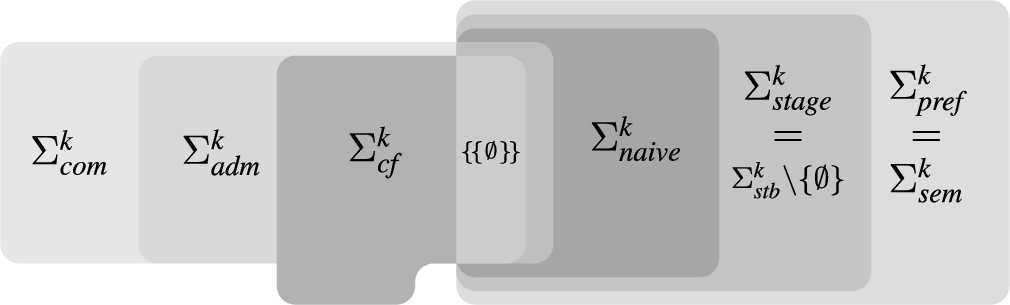
Relations between signatures in k-SETAFs (cf. Main Theorem 2).
In this paper we studied the expressiveness of SETAFs, a generalization of Dung’s abstract argumentation frameworks due to Nielsen and Parsons that extends the notion of (binary) attacks to collective attacks. In order to do so we investigated signatures for seven standard semantics. The signature
Our main results for unrestricted SETAFs (see Main Theorem 1 and Fig. 4) show that SETAF-signatures coincide for preferred, naive, semi-stable, stage, and (modulo the empty set of extensions) stable semantics, i.e. we have proven
Related work on signatures. The investigations of signatures have been initiated in [7], where the first characterization for Dung AFs have been introduced. Further analyses include signatures for compact AFs [1] where, given a semantics σ, one restricts the attention to AFs
Signatures have also been intensively studied for abstract dialectical frameworks (ADFs). ADFs specify the relation between arguments via acceptance conditions which are propositional formulas that are attached to each argument in the framework. In fact, as for instance clarified in [26], SETAFs can be understood as a particular subclass of ADFs where each acceptance conditions is given by a CNF over negative literals. General results on ADF signatures for the 3-valued semantics of ADFs (preferred, complete, admissible) have been provided by Pührer [18]. For the two-valued stable semantics of ADFs, similar results were provided by Strass [19]. Interestingly, for the subclass of bipolar ADFs it turns out that SETAFs and bipolar ADFs are equally expressible under stable semantics, i.e. their signatures coincide. The work closest to ours is by Linsbichler et al. [15] and by Polberg [17]. The former studies SETAFs as a sub-class of ADFs with 3-valued semantics. In order to meet the 3-valued setting the extension-based semantics of SETAFs are redefined as 3-valued semantics and an algorithmic framework is provided that tests whether a given set of 3-valued extensions can be realized as a SETAF. Their results allow to compare the expressiveness of admissible, complete, preferred, and stable semantics in AFs, SETAFs, and ADFs, but do not provide an explicit characterization of the sets that can be realized as SETAFs. Moreover, the setting with 3-valued semantics is more restrictive than the extension-based view and thus these results do not translate to the original definition of Dung AF and SETAF semantics. The work of Polberg [17, Section 4.4.1] studies translations between different abstract argumentation formalisms in the extension-based setting. It already shows that there are certain sets of extensions that can be realized by SETAFs but cannot be realized with AFs, in order to show that certain translations are impossible. However, the exact expressiveness of SETAFs is not investigated any further. Finally, signatures of further ADF subclasses have been investigated in [5]. However, their focus is on particular classes of symmetric ADFs and thus their results are not directly related to our investigations.
Further related work. Another measurement for the expressibility of formalisms is provided via complexity analysis. It is worth to notice that recent results [11] show that reasoning in SETAFs has the same complexity as reasoning in AFs [9]. In fact, this holds for all the semantics we consider here. This shows that studying and comparing the signatures of these formalisms provides a much more fine-grained picture concerning their expressibility.
In a recent paper, Flouris and Bikakis [13] investigate semantics of SETAFs and their relations. They extended semi-stable, stage, ideal and eager semantics to SETAFs, and provide three-valued labeling-based semantics for SETAFs.3
For admissible, complete, preferred and stable semantics their approaches to labeling-based semantics seem to be equivalent to three-valued semantics of SETAFs introduced in [15].
We also would like to mention here some work that considers collective attacks in a different manner than it is done in SETAFs. Bochman [2], for instance, extends Dung AFs such that sets of arguments can attack sets of arguments (i.e., it is not a single argument that is attacked). This however, leads to the development of new semantics and thus a direct application of our results is not possible. Finally, there is the work by Verheij rooted in dialectical argumentation which introduces several frameworks that allow for collective attacks [22–25]. Again, all these systems come with there own semantics, i.e. not generalizing Dung AF semantics, and thus a direct application of our results is not possible.
Future work. One direction of future research is to consider signatures for subclasses of SETAFs. Besides syntactic restrictions (for instance, generalizations of bipartite or symmetric AFs), we would like to study the already mentioned concept of compact SETAFs. This includes an analysis for compact SETAFs for admissible and complete semantics, and moreover, the question whether the relations between signatures for compact AFs as provided by [1] carry over to compact k-SETAFs. Another direction of research is to understand the interplay between semantics in SETAFs. As we have mentioned above, results for Dung AFs in this respect have been provided in [8] via the concept of 2-dimensional signatures. It is an interesting question to which extent these results apply to SETAFs as well.
Footnotes
Acknowledgements
This research has been supported by FWF through projects I2854 and P30168.