




Abstract
Abstract dialectical frameworks have been proposed as a generalization of the abstract argumentation frameworks. The semantics of abstract dialectical frameworks is defined by identifying different classes of models. In this paper, we show that the semantics of abstract dialectical frameworks could naturally be defined based on simple notions of arguments and attacks like in abstract argumentation. This insight allows us to adapt directly the semantical concepts in abstract argumentation to abstract dialectical frameworks that not only capture the standard semantics of abstract dialectical frameworks, but also suggest other new semantics based on the idea of “rejection as assumption” (raa) (similar to the concept of “negation as assumption” in assumption-based argumentation and logic programming) like the well-founded semantics or the raa-preferential semantics.
Introduction
There are many generalizations of the abstract argumentation frameworks [9]. Cayrol and Lagasquie-Schiex [8] presented bipolar argumentation frameworks in which arguments can also support each other. Modgil [16], Baroni, Cerutti, Giacomin and Guida [2], Hanh, Dung, Hung and Thang [14], Gabbay [11] introduced attack on attacks on attacks. Nielsen and Parson [17] studied attacks from sets of arguments. Amgoud and Cayrol [1], Bench-Capon and Atkinson [3] introduced preferences between arguments. A prominent generalization of abstract argumentation is the abstract dialectical frameworks introduced by Brewka and Woltran [7]. There have been very active research on the semantics of ADFs [5–7,20–22]. The semantics of abstract dialectical frameworks are defined by identifying different classes of models that are fixed points of the Brewka and Woltran operator [6,7]. A closer look at the fixed-point-model-semantics of ADFs reveals that they could be characterized by how a justification (or argument) for the acceptance of a statement is viewed.
For illustration, consider the following ADF a is accepted (resp. rejected) if a is accepted (resp. rejected), and b is accepted (resp. rejected) if a is rejected (resp. accepted).
The semantics of
If such condition is considered vacuous (as it is the case according to the stable semantics [6]),
In contrast, according to the semantics based on the fixed points of the Brewka–Woltran operator [6,7], the condition “a is accepted (resp. rejected) if a is accepted (resp. rejected)” is not viewed as vacuous and hence
The above discussion suggests that the semantics of ADFs is characterized by how the notion of a justification (or argument) for a statement is viewed.
In logic programming, stable models [13] arguably represent the most prominent approach to the negation-as-assumption view where negation-as-failure literals are viewed as assumptions [4,9,10]. Other approaches are the partial stable models, the three-valued stable models and the well-founded model [12,18,19]. It is well-known that all the four approaches could be captured by the extensions of argumentation frameworks whose arguments are proof trees constructed from the logic program rules where negation-as-failure literals are considered as assumptions [9,15,23].
As the stable models of ADFs [6] originate from stable models in logic programming, it indeed also adopts a similar view of “rejection as assumption” (raa) where rejected statements are viewed as assumptions. Formally, we will show that semantically, ADFs could be represented by argumentation frameworks referred to as normal argumentation frameworks, whose arguments are support trees for statements in ADFs where rejected statements are viewed as assumptions and the stable models of ADFs are captured by the stable extensions of normal argumentation frameworks. This insight sugests that the other extensions of the normal argumentation frameworks could be viewed as representing new semantics of ADFs where the grounded extension could be viewed as the most skeptical one that we refer to as well-founded semantics of ADFs to distinguish it from the BW-grounded model defined in [6], while the preferred extensions are referred to as “rejection-as-assumption” (raa)-preferential semantics.
It turns out that both the BW-grounded model defined in [7] as well as the BESWW-preferred models introduced in [6] are also naturally captured by the extensions of simple argumentation frameworks whose arguments are supports (or justifications) constructed directly from the acceptance conditions of statements in ADFs.
Consider the ADF
The BW-grounded model [7] is empty while the BESWW-preferred models [6] are
There is no stable model. The well-founded semantics gives
Our results are represented in Fig. 1.
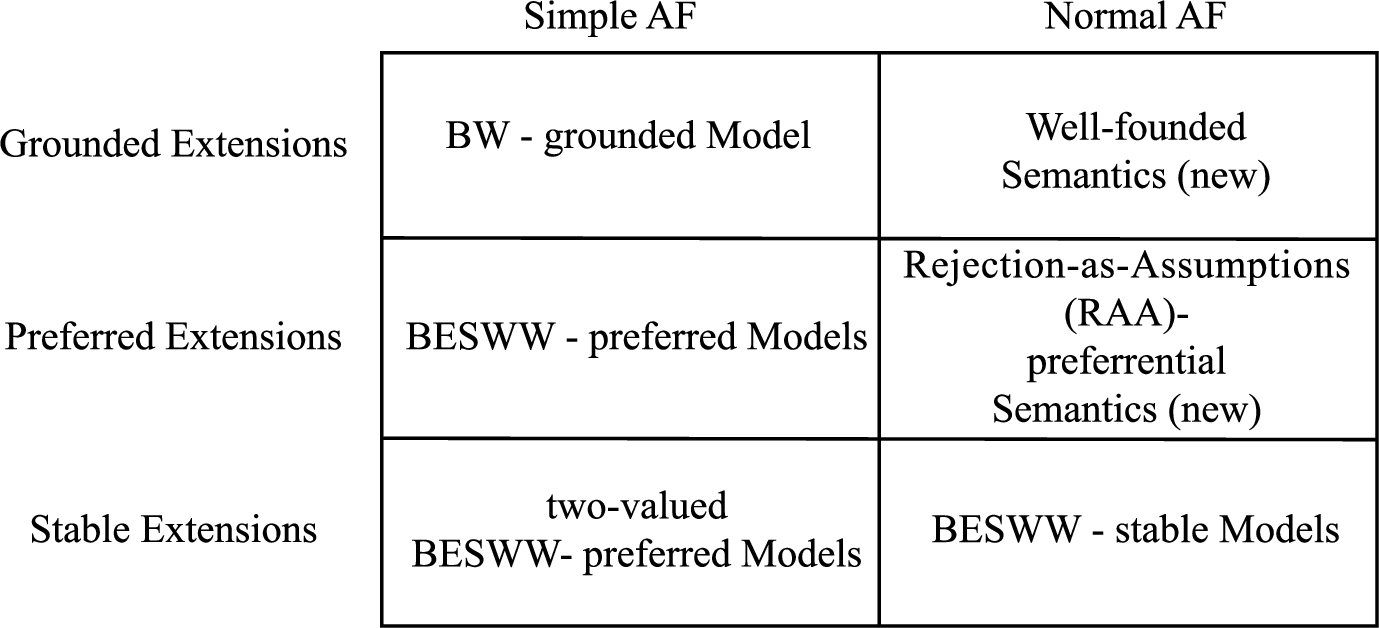
Classification of ADF semantics.
The paper is organized in 7 sections including this introduction. In the next section, we recall the key concepts of the AFs and ADFs. In the following section, we present the simple argumentation frameworks whose extensions capture the classes of BW-grounded and BESWW-complete models of ADFs. In Section 4, we first argue that the stable models of ADFs are based on a view of “rejection as assumption” by giving an equivalent characterization of them that reflect the view of “rejection as assumption” in a more direct way. We then proceed to show that stable models of ADFs are captured by stable extensions of normal argumentation frameworks with arguments being support trees whose leaves are labelled by assumptions represented by rejected statements. As an immediate consequence, we present two new semantics based on the grounded and preferred extensions of normal argumentation frameworks.We conclude in Section 5. We give the detailed proofs of the theorems and lemmas in the Appendix. We acknowledge the supports we got from the reviewers and colleagues in the Acknowledgements section.
Argumentation framework
An abstract argumentation framework (AF) [9] is a pair
A set of arguments
S defends A if S attacks each attacker of A.
S is conflict-free if it does not attack any of its own arguments.
S is admissible if it is conflict-free and defends each of its arguments.
The characteristic function of
Given an
a stable extension of
a preferred extension of
a complete extension of
a grounded extension of
It is well-known that stable extensions are preferred extensions but not vice versa. While stable extensions may not exist, grounded extension and preferred extensions always exist.
Abstract dialectical framework (ADF)
An abstract dialectical framework (ADF) [7] is a triple
S is a finite set of statements (positions, nodes),
The intuition of the acceptance condition
When s is rejected, we often say that the complement of s denoted by
Let X be a set of statements.
A partial interpretation of X is a set of assertions of the form
A full interpretation I of X is a partial interpretation of X such that for each statement
The set of all partial interpretations of X is denoted by
A set
It is obvious that the acceptance function
Often it is convenient to represent the acceptance conditions as propositional formulas. For this reason and from now on, an ADF is represented as a pair
An abstract dialectical framework (ADF) is a pair S is a finite set of statements (positions,nodes),
From now on, whenever we mention an ADF, we refer to the above Definition 1.
We often present an ADF as a collection of expressions of the form
Let
Let
I is said to be a model of D iff for each
The semantics of ADFs are defined by identifying classes of models based on an operator
Let
It is obvious that for each
Hence for each
The following lemma follows immediately from the definition of
Let
As for any ADF D,
The BW-grounded model of D represents the most skeptical semantics of ADFs. More creduluous semantics are represented by the BESWW-complete models of D defined as the fixed points of
Stable semantics of ADFs is defined in [6] and will be recalled later.
We present in this section the simple argumentation frameworks whose extensions capture the classes of BW-grounded and BESWW-complete models of ADFs.
We first introduce the concept of immediate supports of a statement.
(i-supports).
A partial interpretation
M is said to be an
For convenience, we refer to statements or their complements (also often referred to as their negation) as assertions. A positive assertion about a statement s is s itself while a negative assertion about s is the negation of s. The complement of an assertion α is denoted by
Note again that the complement of
It follows immediately that
Let M be an i-support for an assertion α about a statement s. Then any partial interpretation
The following simple lemma explains the interaction between i-supports for a statement and its complement.
Let
M is an i-support for α iff for each i-support N of
The “only-if-direction” is obvious. We only need to prove the other direction.
Suppose for each i-support N of
Let
Let
We can view an i-support J of an assertion α as an “argument”
Let
Consider an ADF
In other words, if each possible “argument” supporting s is “attacked” by accepted “arguments” then
Let Each argument Note that arguments of the form An argument A from
For any argument
For a set
Let The grounded extension of There are two preferred extensions
Let I be a partial interpretation over S. Define
Let us continue Example 4.
Let
Let
Let
The following theorem shows that the BESWW-complete models are captured by the complete extensions of the simple argumentation frameworks.
Let
Let I be a BESWW-complete model of D (and hence a fixed-point of
See Appendix A.3. □
The following theorem shows that the grounded (resp. preferred) extensions of the simple argumentation frameworks capture the BW-grounded model (resp. BESWW-preferred models).
Let D be an ADF.
Let M be the BW-grounded model of D and G be the grounded extension of
Let M be the BESWW-preferred model of D. Then
Let E be a preferred extension of
See Appendix A.3. □
We first argue that the stable models of ADFs are based on a view of “rejection as assumption” by giving an equivalent characterization of them that reflect the view of “rejection as assumption” in a more direct way.
We then proceed to show that stable models of ADFs are captured by stable extensions of normal argumentation frameworks with arguments being support trees whose leaves are labelled by assumptions represented by rejected statements. The insight suggests two new semantics based on the grounded and preferred extensions of normal argumentation frameworks.
Stable models of ADFs
Let
The reduct of D wrt I [6] is the ADF
Note that
I is said to be a stable model of D iff
I is a model of D, and Π is the BW-grounded model of the reduct
Consider the ADF
Looking at Definition 5, one may wonder whether the condition that I is a model of D could be dropped. The following example shows that the answer is no.
Let D be the ADF defined by
The intuition of the stable models is rather simple: An interpretation
This idea can be formalized in two steps:
Construct a revised reduct of the ADF in which the statements in Ω are replaced by
Show that the revised reduct derives exactly the statements in Π.
Let
The Ω-reduct of D is the ADF
Note that in contrast to reducts, the Ω-reducts have the same set of statements like the original ADFs and hence the acceptance function
We next introduce a generalization of a well-known immediate-consequence operator in definite logic programming:
It is clear that
I.e. for
We next present an obvious but helpful lemma.
Let
The following theorem captures the intuition of stable models explained shortly above.
Let
M is a stable model of D iff Π is the least-fixed point of
See Appendix A.1. □
For ease of reference and understanding, from now on, whenever we refer to a stable model of an ADF D, we mean a full interpretation
Consider again the ADF It is not difficult to see that
The intuition of the “rejection-as-assumption” view is captured by considering arguments as support trees where rejected assignments label the leaves of the trees.
(Support trees).
A support tree for an assertion α w.r.t. an ADF the root is labeled by α; every non-leaf node N of τ is labeled by some statement every leaf-node of τ is labeled with some negative assertion
α is often referred to as the conclusion of τ and denoted by
It is easy to see that if the conclusion of a support tree τ is a negative assertion
The set of the conclusions of support trees belonging to a set E of support trees is denoted by
For illustration, Fig. 2 gives all support trees of the ADF
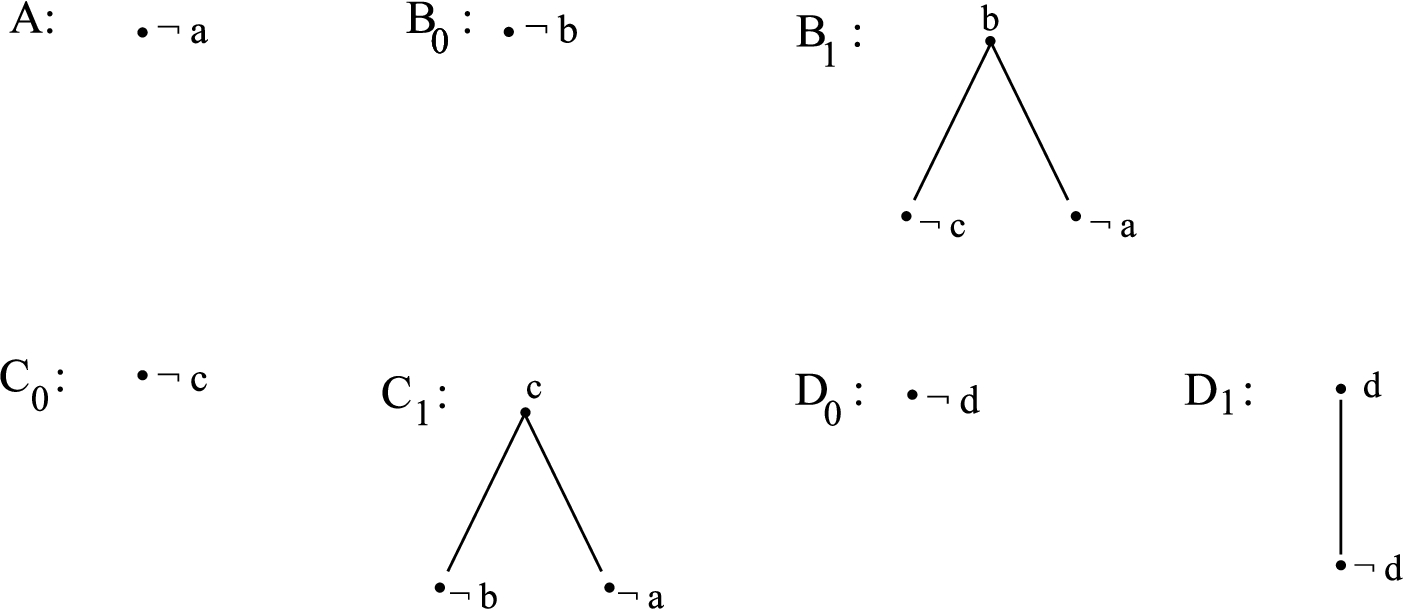
Support trees.
Let
There is a close connection between the least fixed point of
It is obvious to see that
Let
See Appendix A.2. □
(Normal AFs).
Let An argument A from
Note that there are no positive assertions in the base of any argument in
The normal argumentation framework The arguments are given in Fig. 2.
The grounded extension is
There are two preferred extensions:
There is no stable extension.
We will show next that for any ADF D the stable extensions of the normal argumentation frameworks
Let
Let
Let E be a stable extension of
See Appendix A.2. □
As stable models represent a credulous approach to semantics of ADFs based on the intuition of “rejected statements as assumptions”, there are other approaches based on different classes of extensions of the normal argumentation frameworks of the respective ADFs. For example, the set of preferred extensions define a new kind of credulous semantics generalizing the partial stable models in logic programming [15,19] while a new skeptical semantics for ADFs is defined by the grounded extension of their normal argumentation frameworks generalizing the well-founded semantics of logic programming [12]. Let D be an ADF.
The well-founded semantics of D is defined by the grounded extension of the normal argumentation framework The raa-preferential semantics of D is defined by the set of preferred extensions of the normal argumentation framework Let us continue with Example 9. The well-founded semantics is represented by the grounded extension Note that the stable semantics is not defined as there is no stable extension. (New semantics).
We have showed that the semantics of ADFs could naturally be based on arguments and attacks. In other words, semantically, ADFs could be viewed as instances of abstract argumentation. The new insight allows us to adapt the standard concepts of abstract argumentation to ADFs in a straightforward and intuitive way. It also suggests new natural semantics for ADFs like the well-founded semantics or the rejection-as-assumptions (raa)-preferential semantics. This is not unlike the situation in logic programming where the semantical concepts in abstract argumentation help to explain and unify the semantics of logic programming.
Footnotes
Acknowledgements
Many thanks to Gerhard Brewka and Hannes Strass for many very helpful comments, especially for pointing out a mistake in an earlier version of this paper. Many thanks to the anonymous reviewers 1, 2 for the critical and constructive comments and suggestions. Thanks also to Sarah Gaggl for her cooperative spirit.