




Abstract
Abstract dialectical frameworks (ADFs) are generalizations of Dung argumentation frameworks where arbitrary relationships among arguments can be formalized. This additional expressibility comes with the price of higher computational complexity, thus an understanding of potentially easier subclasses is essential. Compared to Dung argumentation frameworks, where several subclasses such as acyclic and symmetric frameworks are well understood, there has been no in-depth analysis for ADFs in such direction yet (with the notable exception of bipolar ADFs). In this work, we introduce certain subclasses of ADFs and investigate their properties. In particular, we show that for acyclic ADFs, the different semantics coincide. On the other hand, we show that the concept of symmetry is less powerful for ADFs and further restrictions are required to achieve results that are similar to the known ones for Dung’s frameworks. A particular such subclass (support-free symmetric ADFs) turns out to be closely related to argumentation frameworks with collective attacks (SETAFs); we investigate this relation in detail and obtain as a by-product that even for SETAFs symmetry is less powerful than for AFs. We also discuss the role of odd-length cycles in the subclasses we have introduced. Finally, we analyse the expressiveness of the ADF subclasses we introduce in terms of signatures.
Keywords
Introduction
Since the landmark paper by Dung [13] has been published in 1995, abstract argumentation frameworks (AFs) have gained more and more significance in the AI domain. First of all, AFs have proven useful to capture the essence of different nonmonotonic formalisms. Moreover, AFs are nowadays an integral concept in several advanced argumentation-based formalisms in the sense that their semantics are defined based on a translation (typically called an instantiation) to Dung AFs. Finally, the relevance of AFs is witnessed by the International Competition on Computational Models of Argumentation (ICCMA), where systems for solving different problems on AFs compete on different tracks.1
The fundamental of Dung is to abstract away from the content of particular arguments and to focus only on conflicts among arguments, where each argument is viewed as an atomic item. Therefore, the only information AFs take into account is whether an argument attacks another one or not. Semantics single out coherent subsets of arguments which “fit” together, according to specific criteria [2]. More formally, an AF semantics takes an argumentation framework as input and produces as output a collection of sets of arguments, called extensions. Complexity of the reasoning problems that can be defined for the several semantics for AFs is well understood [17] and ranges from tractability up to the second level of the polynomial hierarchy. To this end, the analysis of restricted classes of AFs is of importance. In his paper, Dung already showed that the class of acyclic (also known as well-founded) AFs leads to a collapse of the different semantics. Further studies include symmetric AFs [10] and AFs under other graph-driven restrictions [14]. Symmetric AFs have been proven to satisfy the property of coherence (preferred and stable semantics coincide) and relatively-groundedness (the grounded extension is given by the intersection of the preferred extensions). Moreover, these restrictions make decision problems often easier from a complexity perspective. A fact that is particularly useful in connection with backdoor approaches [20] that utilize the distance to an easier fragment. This approach has, for instance, been realised in practice with the cegartix system [19].
Abstract dialectical frameworks (ADFs) are generalizations of Dung argumentation frameworks where arbitrary relationships among arguments can be formalized via propositional formulas which are attached to the arguments [5,8]. This allows to express notions of support, collective attacks, and even more complicated relations. Due to their flexibility in formalizing relations between arguments, ADFs have recently been used in several applications [1,9,26,30]. However, this additional expressibility comes with the price of higher computational complexity [35]. Specifically, reasoning in ADFs spans the first three (rather than the first two, as for AFs) levels of the polynomial hierarchy.
It is thus natural to investigate subclasses of ADFs. Compared to Dung argumentation frameworks, where subclasses like acyclic and symmetric AFs have been thoroughly studied, there has not been a systematic investigation of subclasses of ADFs yet. An exception is the class of bipolar ADFs [8] where the links between arguments are restricted to have either supporting or attacking nature. However, results about structural restrictions on ADFs where different semantics coincide are still lacking.
In this work, we aim to define several subclasses of ADFs and investigate how the restrictions we define influence the semantic evaluation of such ADFs. As a first class, we consider acyclic ADFs (i.e., the link-structure forms an acyclic graph) and show that – analogous to well-founded AFs – the main semantics, namely grounded, complete, preferred, and two-valued model/stable semantics, coincide for this class. We further investigate the concept of symmetric ADFs. In contrast to the case of AFs, we will see that properties as coherence and relatively-groundedness do not carry over and require further restrictions which leads us to the classes of acyclic support symmetric ADFs (ASSADFs) and support-free symmetric ADFs (SFSADFs). For both classes we show that they satisfy a weaker form of coherence. We also show that these two classes differ in the sense that odd-cycle free SFSADFs are coherent while odd-cycle free ASSADFs are not. As a second contribution, following the work of Dunne et al. [16], we investigate the expressiveness of our ADF subclasses in terms of signatures, i.e. the set of possible outcomes which can be achieved by ADFs (of a particular class) under the different semantics. We thus complement here results which have been obtained for general [29,32] and bipolar ADFs [25] and also compare our ADF subclasses to abstract argumentation frameworks in terms of expressibility.
Our results lead to the following implications. Firstly, studying subclasses of ADFs provides us with a better understanding of which structures are required to reveal particular behaviors of the different semantics. We thus further advance the theory of ADFs. Secondly, since other generalizations of Dung AFs can be seen as special case of ADFs, results on ADFs carry over to these special cases. We exemplify this aspect in the paper, by deriving new results for argumentation frameworks with collective attacks (SETAFs) [27] which have received increasing interest recently [18,21]. To the best of our knowledge concepts like symmetric SETAFs have not been investigated yet, and we provide first results in this direction.
The paper is structured as follows: In Section 2, we first recall the relevant background of AFs, SETAFs, and ADFs. Then in Section 3 we introduce subclasses of ADFs and we investigate whether these subclasses fulfill the same properties of the similar subclasses in AFs. We discuss how our results can be related to SETAFs and investigate some properties for symmetric SETAFs. Also the role of odd-length cycles is addressed. In Section 4, expressiveness of the subclasses of ADFs introduced in the current work is studied. In particular, we show that the expressiveness of SFSADFs, ASSADFs and bipolar ADFs is equal for some of the semantics, but different for admissibility-based semantics.
A preliminary version of this article appeared in [11]. This extended version contains new technical results including investigations concerning coherence and relatively-groundedness for SFSADFs and symmetric SETAFs (Theorems 8 and 17); and results on the role of odd-cycles on coherence for subclasses of ADFs (Section 3.4). Also, the results on expressibility for SETAFs and SFSADFs (as well as for a further superclass of SFSADFs we introduce, that of SFADFs) in Section 4 are new.
Let us start by recalling basic notions of Dung’s argumentation frameworks (AFs) and their extension for modelling collective attacks (SETAFs). We then introduce the formalism that is the focus of this work, abstract dialectical frameworks (ADFs), and point out a few elemental relations between ADFs, SETAFs, and AFs.
Abstract argumentation frameworks
([13]).
An abstract argumentation framework (AF) is a pair
Let
In abstract argumentation, diverse criteria that have been formulated for conflict-resolution are encoded into so called semantics. In the case of AFs, semantics identifiy sets of arguments which it is reasonable to accept together (w.r.t. the semantics at hand). One standard way of defining the semantics for a given AF
Let admissible in F iff complete in F iff grounded in F iff S is the ⊆-least fixed-point of preferred in F iff S is ⊆-maximal admissible (resp. complete) in F; a stable model of F iff for all
In order to denote the collection of all conflict-free sets, (admissible sets, complete sets, grounded sets, preferred sets, stable models) of an AF F, we use the notation
We recall that, for each AF, the grounded set is the unique subset-minimal complete set. Moreover, for a given AF a stable model might not exist, while the remaining semantics produce at least one set of arguments for any AF. Note also that we use the notion of a “stable model” rather than “stable extension” simpliciter (as is more common for AFs) just for using terminology compatible with that used for the semantics of ADFs (where stable models are a subclass of two-valued-models) which we introduce later-on in Definition 6.
We now turn to the generalization of AFs introduced by Nielson and Parsons, in which the attack relation is generalised to also include attacks from sets of two or more arguments [27].
A set argumentation framework (SETAF) is an ordered pair
Given a SETAF
Notions of conflict and defense can be defined for SETAFs in analogy to these notions in the context of AFs. Given a SETAF
The semantics of SETAFs can now also be defined similarly to AFs via a characteristic operator. With a slight abuse of notation (because of the use of the same notation for the characteristic operator), we thus define first of all also for a SETAF
Let admissible in F iff complete in F iff grounded in F iff S is the ⊆-least fixed-point of preferred in F iff S is ⊆-maximal admissible (resp. complete) in F; a stable model of F iff for all
We will use the same abbreviations for SETAFs as for AFs for denoting the sets of arguments obtained when applying the semantics on SETAFs. We also recall that several important properties of Dung AFs carry over to SETAFs; we refer to [21,27] for details.
In the following we provide an example of a SETAF and also illustrate the concept of extensions and semantics for SETAFs. The SETAF
The SETAF of example 1.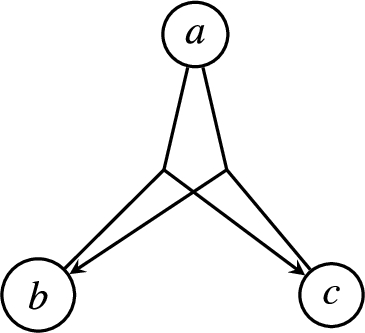
We now proceed to define ADFs:
([8]).
An abstract dialectical framework (ADF) is a tuple S is a finite set of nodes (arguments, statements, positions),
The variables occurring in each acceptance condition
Graphically, ADFs can be depicted as annotated directed graphs where nodes represent arguments, directed edges represent links (tuples of nodes). Acceptance conditions are shown via annotations next to the nodes representing the arguments. See Fig. 2 for an example of the depiction of an ADF (we present later on in Example 2).
Semantics of ADFs are defined in terms of interpretations. Concretely, let
Let
Semantics for ADFs can also be defined via a characteristic operator
The semantics for ADFs, as defined via the characteristic operator, are provided next in Definition 6. The definitions have been introduced in [4,8]; we refer to [6] for an in-depth overview of the semantics of ADFs in terms of approximation fixpoint theory and the connections to the definitions of the semantics for AFs (and SETAFs).
Given an ADF conflict-free in D iff admissible in D iff complete in D iff grounded in D iff v is the least fixed-point of preferred in D iff v is a (two-valued) model of D iff v is two-valued and for all a stable model of D if v is a model of D and
As for AFs and SETAFs, the set of all σ interpretations for D is denoted by
In ADFs links between arguments or statements can be classified into four types, reflecting the relationship of attack and/or support that exists between the statements. These are listed in the following definition.
Let supporting (in D) if for every two-valued interpretation v, attacking (in D) if for every two-valued interpretation v, redundant (in D) if it is both attacking and supporting; dependent (in D) if it is neither attacking nor supporting.
The classification of the types of the links of ADFs is also relevant for classifying ADFs themselves. Thus, one particularly important subclass of ADFs is that of bipolar ADFs or BADFs for short, first defined in [8]. In such an ADF each link is either attacking or supporting (or both; thus, the links can also be redundant). The following example clarifies the role of the acceptance conditions in ADFs and illustrates the functioning of the different semantics in the context of ADFs.
An example of an ADF
The ADF of example 2.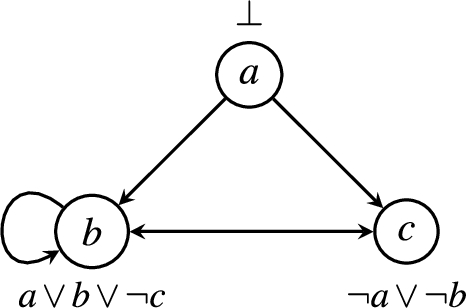
Since in ADFs an argument appears in the acceptance condition of an argument a if and only if it belongs to the set
In D the interpretation
As to the relationship between ADFs and AFs, an ADF
Let
It is shown in [4,8] that the semantics of AFs and associated ADFs coincide. Also note that the associated ADF
An ADF
To conclude the preliminaries to our work we note that, just as AFs, also SETAFs can be represented as ADFs. This is captured in the following definition. Let
We start our investigation of ADF subclasses in terms of their semantics by first introducing the class of acyclic ADFs and showing that, just as is the case for acyclic AFs [13], the different semantics coincide on such ADFs. Then, we consider symmetric ADFs, where we will explore further restrictions that are needed in order to obtain results similar to the ones known for symmetric AFs. In Section 3.3 we discuss implications of our results for SETAFs. We conclude this section with a brief overview on semantic properties of odd-cycle free subclasses of ADFs.
Acyclic ADFs
In this section we show that, as has already been indicated and is the case for acyclic AFs, also for acyclic ADFs several semantics coincide (Theorem 2). We start by defining acyclic ADFs.
An ADF
In order to prove that the different semantics coincide on acyclic ADFs we need the concepts of level and maximum level of arguments. The level of an argument s of an ADF D is the number of links on the longest path from an initial argument to s plus 1. The maximum level of an (acyclic) ADF D then is the level of an argument of D that is at least as large as the level of any other argument of D. It is clear that every acyclic ADF has a maximum level. This is a crucial observation needed for our proof of Proposition 1, which in turn provides the basis to show that most semantics defined for ADFs are indistinguishable when evaluating acyclic ADFs.
In every acyclic ADF D the
Let Base case: Suppose Inductive step: Assuming this property holds for all k with
Since m is the maximum level of any argument in D, we now get that
To show that
In every acyclic ADF D the sets of grounded interpretations, complete interpretations, preferred interpretations, two-valued models, and stable models coincide.
First, the grounded interpretation v of D is also complete in D. Moreover, Proposition 1 implies that v is a two-valued model of D. Since
An immediate consequence of Theorem 2 is that any acyclic ADF D possesses a non-trivial preferred interpretation, which is also a complete interpretation, grounded interpretation, stable interpretation, and a model. We conclude by noting that, on the other hand, if all semantics of an ADF coincide, there is no guarantee that the ADF in question is acyclic. This is shown via Example 3.
Consider the ADF
The ADF of Example 3 in fact represents an AF. Therefore, there is also no guarantee that an AF is acyclic, whenever all semantics yield the same extensions.
We turn now to our study of symmetric ADFs. We consider the properties of coherence (stable and preferred semantics coincide) and relatively-groundedness (grounded extension is the intersection of all preferred extensions) which have been shown to hold for symmetric AFs [10]. Since both the two-valued and stable model semantics for ADFs are proper generalisations of the stable semantics for AFs [4], we consider further forms of coherence (weak coherence and semi-coherence; defined in Definition 12) that are possible in the realm of ADFs.
We will show that, contrary to symmetric AFs, symmetric ADFs do not satisfy any of the forms of coherence for ADFs we define, nor are they relatively-grounded (Theorem 3). We then define a further restricted form of symmetric ADFs, acyclic support symmetric ADFs, or ASSADFs for short (Definition 14), which we show do satisfy a weak form of coherence (each two-valued model is a stable model) (Theorem 5). Nevertheless, we conclude (Theorem 6) by showing that in ASSADFs it is still not the case that every preferred interpretation is a two-valued-model (semi-coherence). We also show that ASSADFs are not relatively-grounded (again, Theorem 6).
We start by giving the definition of symmetric ADFs.
An ADF
The reason why we have to exclude redundant links is that otherwise we are able to add arbitrary links without changing the semantics of the ADF at hand: informally speaking, given an ADF
Next we provide several notions of coherence which are possible for ADFs.
An ADF D is called
coherent if each preferred interpretation of D is a stable model of D; weakly coherent if each two-valued model of D is a stable model of D; semi-coherent if each preferred interpretation of D is a two-valued model of D.
We now turn to define the notion of relatively-groundedness for ADFs.
An ADF D is called relatively grounded if
In what follows, we occasionally say that a class
It turns out that neither of the properties analogous to those holding for symmetric AFs hold for symmetric ADFs.
The class of symmetric ADFs is neither semi-coherent, nor weakly coherent, nor relatively grounded.
Let D be the symmetric ADF depicted in Fig. 3. It holds that
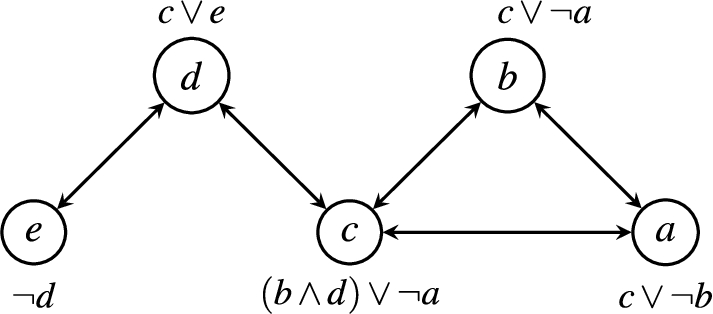
A symmetric ADF which is neither semi-coherent, weakly coherent nor relatively grounded.
Note that the ADF D used as counter-example in the proof of Theorem 3 (Fig. 3), is actually a symmetric BADF since D is a symmetric ADF in which there are no dependent links and all links are either attacking or supporting. This raises the question whether there is a particular subclass of symmetric BADFs which fulfills the properties considered in Theorem 3. One natural candidate is that of acyclic support symmetric ADFs, which we present in Definition 14. For the latter we first need to define the notion of a support cycle.
Given an ADF
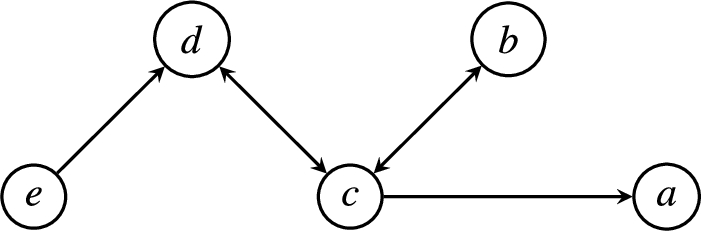
The method of determining whether a given ADF is an ASSADF is clarified in Example 4.
Let
We now show that ASSADFs are weakly coherent, using the following technical lemma.
Let D be an ADF, v a two-valued model of D, and
Every acyclic support symmetric ADF (ASSADF) is weakly coherent.
Let
We conclude this section by showing, on the other hand, that there are ASSADFs which are neither semi-coherent nor relatively grounded.
The class of ASSADFs is neither semi-coherent nor relatively grounded.
Consider the ASSADF D depicted in Fig. 5. D has 4 preferred interpretations, namely
An ASSADF without supporting links that is not semi-coherent.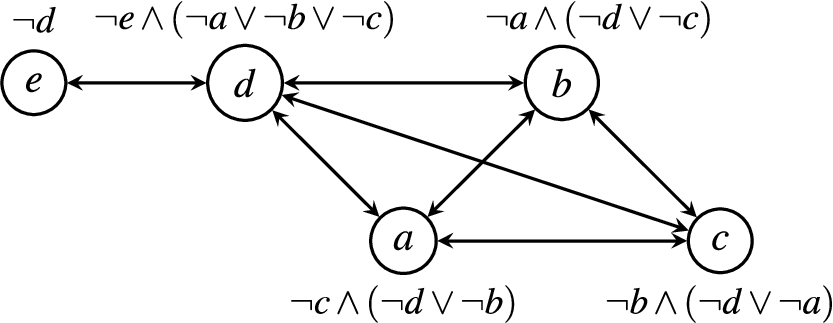
We show now that ASSADFs are not relatively grounded in general. Consider the ASSADF
The ASSADF used in the proof of Theorem 6 to show that ASSADFs are not semi-coherent does not have any supporting links. That is, even ASSADFs without supporting links are not semi-coherent. This leads us, in this section, to consider whether ASSADFs having only attacking links, which we call support free symmetric ADFs or SFSADFs for short (Definition 15), satisfy the other properties considered in Section 3.2: being weakly coherent and relatively grounded. We show that SFSADFs are weakly coherent, but neither semi-coherent nor relatively grounded in Theorem 8.
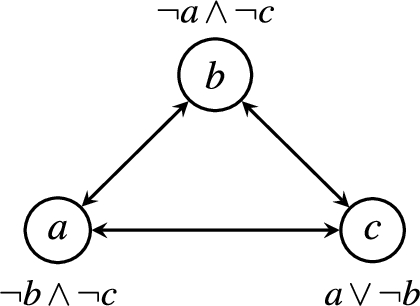
An ASSADF which is not relatively grounded.
Moreover, we derive from Theorem 8 that symmetric SETAFs are neither coherent nor relatively grounded (Theorem 17). The reason is that the SFSADFs we have used in the proof of Theorem 8 correspond to SETAFs. More concretely, the SETAFs in question correspond to a specific class of SFSADFs: those in which the acceptance condition of none of the arguments is unsatisfiable. On the way of proving Theorem 17 we show that, in fact, such SFSADFs exactly correspond to symmetric SETAFs (Theorem 9, Corollary 10, and Theorem 12; Lemmas 13 and 14). Thus, we obtain as a consequence of our investigations of semantic properties in the general settings of ADFs, results that complement those of [27] for SETAFS, where the authors show that the standard semantics are indistinguishable on acyclic SETAFs (a result that is confirmed by our study in Section 3.1).
We start by defining SFSADFs:
Given an ADF
Note that since SFSADFs are BADFs by Definition 15, this means that SFSADFs do not have dependent links. Also, SFSADFs are symmetric by the same definition, which means that they do not have redundant links. Further, since SFSADFs do not have supporting links, they also do not have a support cycle. Thus, the class of SFSADFs is indeed a strict subclass of ASSADFs.
We next show that also SFSADFs, while being weakly coherent, are neither semi-coherent nor relatively grounded. Before doing so, we report a simple observation concerning the grounded interpretation.
Let D be an SFSADF with no isolated argument. The unique grounded interpretation of D is the trivial interpretation,
We show that for any SFSADF
The following are the case for SFSADFs:
every SFSADF is weakly coherent,
the class of SFSADFs is not semi-coherent,
the class of SFSADFs is not relatively grounded.
By Theorem 5, every ASSADF is weakly coherent, and since each SFSADF is an ASSADF, also SFSADFs are weakly coherent.
The ASSADF D, depicted in Fig. 5 to show that the class of ASSADFs is not semi-coherent, does not have any supporting links. That is, D is a SFSADF. Thus, the class of SFSADFs is not semi-coherent either.
It remains to show that the class of SFSADFs is not relatively grounded. Let D be the ADF depicted in Fig. 7. The unique preferred interpretation of D is
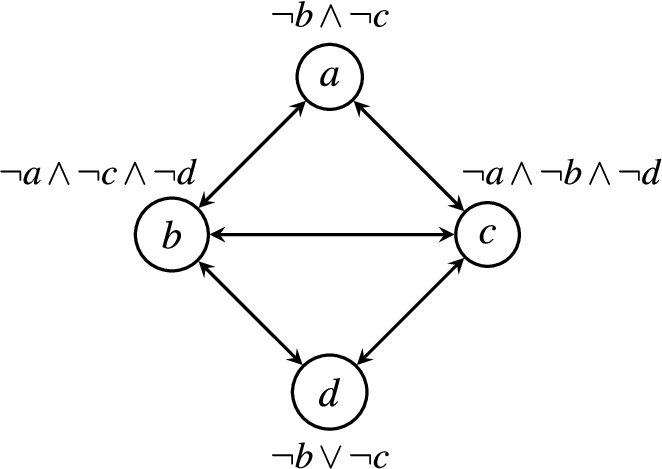
A SFSADF that is not relatively grounded.
It is relatively easy to see that the ADFs used to show that SFSADFs are neither semi-coherent nor relatively grounded in the proof of Theorem 8 (ADFs from Figs 5 and 7) correspond to SETAFs (see Definitions 3 and 9). In fact, we proceed to show now that symmetric SETAFs are captured exactly by a subclass of SFSADFs: those in which the acceptance condition of none of the arguments is unsatisfiable. As already hinted at, apart from showing the link between SETAFs and SFSADFs this will allow us to also formally translate the content of Theorem 8 to the context of SETAFs.
We start by defining symmetric SETAFs.
A SETAF for all for each argument s and for each for each
In Definition 16, the first item indicates that in the associated graph of the symmetric SETAFs all links are symmetric. The second item further means that there are also no reflexive links. Finally, the third item excludes redundant links.
From Definition 9 it follows that each SETAF can be represented as an ADF. Thus, also symmetric SETAFs can be encoded as ADFs. We now show that in fact symmetric SETAFs correspond to SFSADFs.
The ADF associated to a given symmetric SETAF is a SFSADF.
Let Assume that L is not symmetric. This means that there is an argument s which is a parent of t but not visa versa. That is, s appears in the acceptance condition of t but t does not appear in the acceptance condition of s. Since s is a parent of t, by Definition 9 there is Assume now that L is not irreflexive. Therefore, there is an argument s which is contained in
Thus, if F is a symmetric SETAF, then the associated ADF
Let
The SFSADF associated to a given symmetric SETAF does not contain any argument with an unsatisfiable acceptance condition.
Next, we detail how the special group of SFSADFs that do not have any argument with an unsatisfiable acceptance condition can be represented as SETAFs. For this we make use of a fact from [36], namely that ADFs for which the acceptance condition of each argument is either tautological or in CNF having only negative literals can be represented as SETAFs. Note that in symmetric ADFs each initial argument needs to be isolated and thus might have acceptance condition ⊤ or ⊥; the latter is problematic in representing SFSADFs as symmetric AFs and thus needs special treatment.
Let
Since the acceptance condition of each argument in an ADF is indicated by a propositional formula, it can be transformed to CNF. It remains to show that each of the resulting formulas in CNF consists of only negative literals. Toward a contradiction assume that
We now provide the construction associating a SETAF to every SFSADF for which no argument has an unsatisfiable acceptance condition.
Let
Analogously to Theorem 9, we show in Theorem 12 that SFSADFs in which none of the acceptance conditions of the arguments is unsatisfiable can be mapped to symmetric SETAFs.
Let
Assume that D is a SFSADF in which there is no argument with an unsatisfiable acceptance condition. Thus, via Definition 17, D can be written as a SETAF There exists There exists
Both possibilities are in contradiction with the assumption that D is a SFSADF. Therefore, the assumption that
The SFSADF
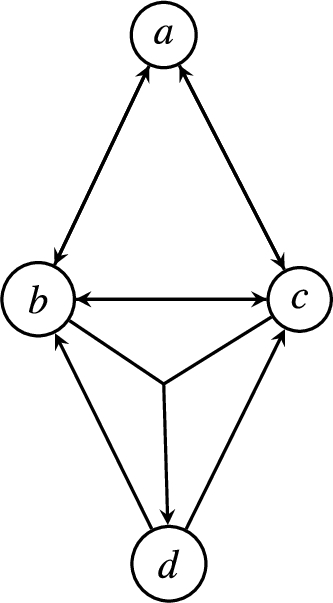
A symmetric SETAF that is not relatively grounded.
Now, in order to be able to relate SFSADFs and symmetric SETAFs on the semantic level, we first make precise the relation between extension-based semantics of AFs and interpretation-based semantics of ADFs. To do so, we start by introducing some terminology. Given a formalism F, the set of all extensions of F are denoted by
Let
An ADF interpretation, on the other hand, can be represented as an extension via the following mapping.
Let
The two subsequent lemmas are adopted from [21].
Let F be a SETAF, and
Let D be a SFSADF in which the acceptance condition of none of the arguments is unsatisfiable,
Note that Lemma 13 does not mention admissible semantics, while Lemma 14 does. The reason is that for a given SETAF F the associated three-valued interpretations obtained via
Let
One can overcome this problem by mapping each admissible set e of a SETAF
The next lemma rephrases Lemma 7 in terms of SETAFs.
Let F be a symmetric SETAF with no isolated argument. The unique grounded extension of F is the empty set.
Let
The following corollary is a direct result of Lemma 15.
A symmetric SETAF F with no isolated argument is relatively grounded if and only if the intersection of all preferred extensions of F is the empty set.
We are now in position to derive that symmetric SETAFs are neither coherent nor relatively grounded from our proof of Theorem 8.
The class of symmetric SETAFs is neither coherent nor relatively grounded.
The ADFs which are used in the proof of Theorem 8, to show that the class of SFSADFs is neither semi-coherent (and thus not coherent) nor relatively grounded, do not consist of any argument with an unsatisfiable acceptance condition. Then, by Theorem 12, the associated AFs to those SFSADFs are symmetric SETAFs.
Now, let D be such an SFSADF that does not satisfy coherence. We show that the SETAF
For relatively groundedness, we already have provided a symmetric SETAF that violates this property in Fig. 8. For that SETAF it can be checked that its complete sets are ∅ and
In [15] it is proven that if an AF is not coherent then it contains a cycle of odd length. This means, on the other hand, that if an AF does not contain any odd-length cycle it is coherent. It is easy to show that this property does not generalise to ADFs because of the possibility of support links. Indeed, consider the ADF
In this section we study whether the property of having only odd-length-cycles implying coherence carries over to any subclasses of ADFs we introduced in our work so far. In Section 3.2 we had shown that ASSADFs are weakly coherent but not semi-coherent. We here show that also ASSADFs not containing any odd-length-cycle are not semi-coherent and, thus, that such ASSADFs are not coherent (Theorem 18). On the other hand, we are able to show that SFSADFs not containing any odd-length-cycle are coherent (Theorem 19). In fact we prove a more general result: bipolar ADFs without supporting links, which we dub SFADFs (Definition 20; note the difference with SFSADFs which have an “S” after the first “F”), that also do not have any odd-length-cycle are coherent (Corollary 20). Moreover, given that SETAFs correspond to a special class of SFSADFs (see Section 3.3), the result also applies to SETAFs.
The subclass of ASSADFs not containing any odd-length cycle is not coherent.
Consider the ADF
Contrarily, we show next that the subclass of SFSADFs in which each ADF does not contain any odd cycle is coherent.
The class of SFSADFs that do not contain any odd-length cycle is coherent.
Let
Let S be the set of all arguments which are assigned the truth value
It is clear that If If If If
Thus, if
Therefore,
As it turns out, the proof of Theorem 19 is independent form the notion of symmetry. Hence, we obtain as a final observation (Corollary 20) in this section that the general class of support-free ADFs which we define next is coherent. Given an ADF
SFADFs and SETAFs without odd-length cycles are coherent.
Following the work of [16] in this section we consider the expressiveness, i.e. the set of possible outcomes which can be achieved under the different semantics, of ASSADFs and SFSADFs. We thus complement here results that have been obtained for general [29,33] and bipolar ADFs [25] and also compare the ADF subclasses we introduced in this work to abstract argumentation frameworks in terms of their expressivity.
Formally, the study of expressivity of a formalism w.r.t. a semantics can be done by considering the outcomes that can be realised by the formalism under the semantics of interest.
Let
The signature of a formalism w.r.t. a semantics is then the set of possible outcomes that can be realised by the formalism under the semantics, this is encoded in Definition 22.
The signature
In what follows we concentrate on studying ASSADFs and SFSADFs from the perspective of realisability. We compare these novel subclasses of ADFs to that of AFs, BADFs, and general ADFs. We build on studies comparing the expressivity of AFs, BADFs and (general) ADFs reported on in [25,32].
We begin by showing that BADFs are strictly more expressive than ASSADFs for the admissible, preferred, complete, and model semantics.
For
Since every ASSADF is, by definition, a BADF,
For
Next, we show that ASSADFs are strictly more expressive than SFSADFs for the admissible, preferred, and complete semantics. In a certain sense, this complements our observation in Section 3.4 that ASSADFs and SFSADFs differ in terms of coherence on odd-cycle free frameworks.
For
Since each support-free symmetric ADF is an acyclic support symmetric ADF, it is clear that
Let If any of the arguments of If there is a symmetric attack relation between a and b, then the interpretation
Thus,
The forthcoming result shows why, on the other hand, AFs and SFSADFs are incomparable, and also AFs and ASSADFs are incomparable, in terms of their expressivity for the admissible, preferred, and complete semantics.
For
To obtain our theorem we show that
∙ To show
∙ To verify that
Our final result on the admissibility-based semantics concerns the class of support-free ADFs (SFADFs). Recall that support-free symmetric ADFs (SFSADFs) have been defined in Section 3.3 in order to investigate subclasses of symmetric ADFs that satisfy certain properties.
For
We separately prove the four relations provided in the theorem.
Each SFSADF is a SFADF, that is, To show Each SFADF does not contain any dependent link; hence it is a BADF. The interpretations that are given in the proof of Theorem 21 work here to show that
Our results comparing the expressivity of ASSADFs, SFSADFs, SFADFs, AFs, BADFs, and general ADFs w.r.t. the admissible, complete, and preferred semantics is summarised in Fig. 9. To complete the picture here we also incorporate results about the relative expressivity of AFs, BADFs, and general ADFs from [25].
The general picture for the stable semantics, which we proceed to investigate now, deviates somewhat from that of the admissibility based semantics. To start we remind the reader that stable models v, w of any ADF are always incomparable, i.e.
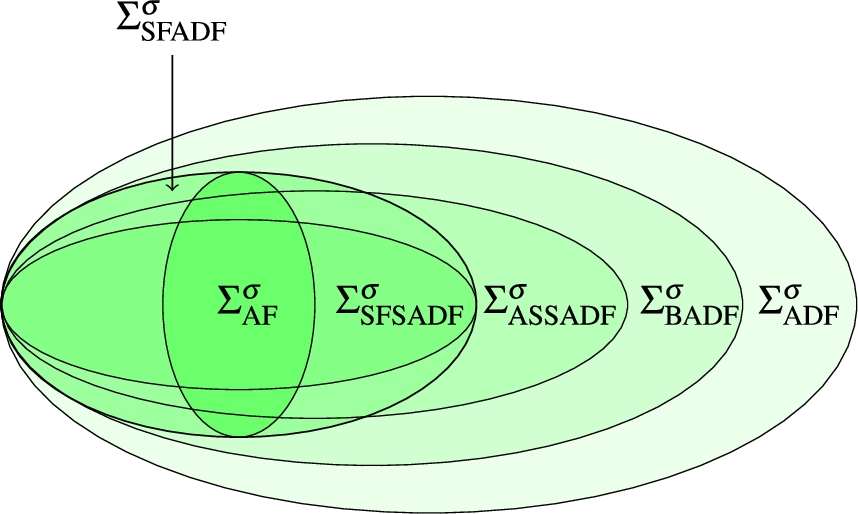
Expressiveness of subclasses of ADFs for
Any incomparable set of two-valued interpretations
(sketch) To show that any incomparable set of two-valued interpretations is
This construction is a slight adaption of a result from [32].
If
If
Otherwise,
By the definition of the acceptance condition of argument s in D,
To prove that
To show
To show that
Note that the incomparability condition for the set of two valued interpretations
In Example 6 we give an example of an interpretation-set that is
Let
The final semantics to investigate is the model-semantics. We only need one technical lemma.
For any SFADF
Toward a contradiction assume that there are
We first argue that
Using these relations and observing that
Figure 10 summarises the results regarding expressivity w.r.t. the model and stable semantics expressed in Theorem 26 and Theorem 28. Again, to complete the picture we make use of results from [32] (
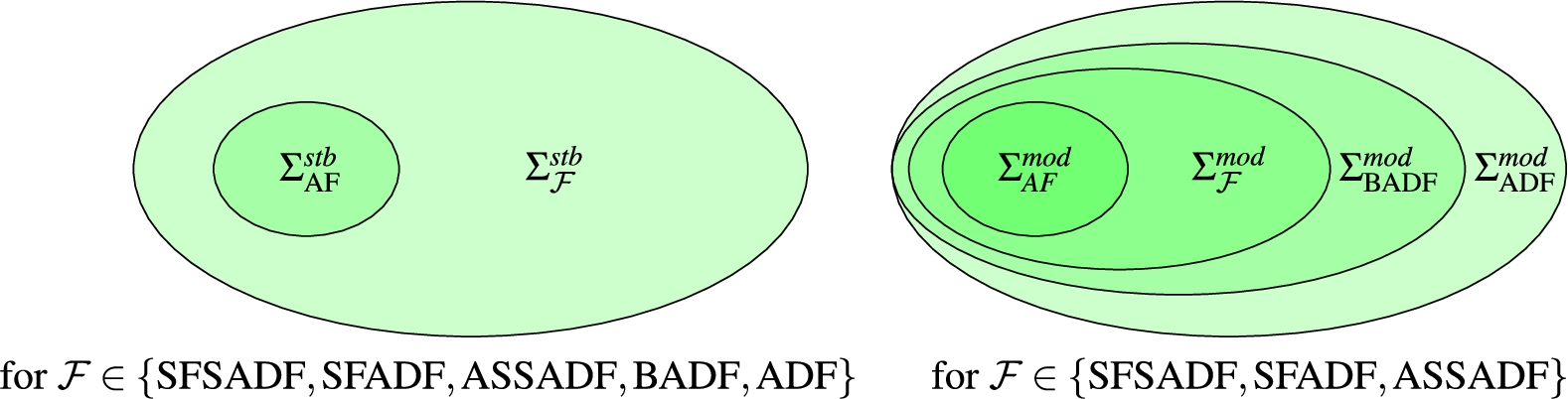
Expressiveness AFs, SFSADFs, SFADFs, ASSADFs, BADFs, ADFs for
We conclude this section by pointing out that the realisability relationships depicted in Fig. 10 change when we restrict the cardinality of the interpretation sets. As it turns out, any set of interpretations of size 2 obtained from an ADF when evaluated using the stable semantics is also realizable in AFs.
Suppose that
Let
Motivated by crucial results on the semantic properties of acyclic (or well founded) [13], symmetric [10], and odd-length-cycle-free [15] AFs, in this work we investigated analogous classes for ADFs and their properties. We showed that for acyclic ADFs, just as is the case for acyclic AFs, the different semantics coincide. On the other hand, we demonstrated that the properties of coherence and relatively-groundedness that hold for symmetric AFs do not carry over to symmetric ADFs. The latter impelled us to go on a quest for an appropriate subclass of symmetric ADFs for which some form of coherence holds. In the process we defined several subclasses, in particular acyclic support symmetric ADFs (ASSADFs) and support-free symmetric ADFs (SFSADFs) which we show satisfy a weaker form of coherence.
Also odd-length-cycle-free ADFs do not satisfy coherence (which is the case for AFs), but here we were able to show that this property does hold for SFSADFs. In fact this is the case for a superclass of SFSADFs (which also contains AFs with collective attacks), which we dubbed SFADFs. This property also allowed us to distinguish ASSADFs from SFSADFs in that odd-length-cycle-free ASSADFs are not coherent in general.
The motivation behind this line of investigation lies in the fact that different semantics show different complexities [35]. It is thus valuable to know under which circumstances higher complexities can be avoided. Acyclicity is a positive example since the coincidence with grounded semantics shows that, for instance, the more complex preferred semantics becomes easier for this class of frameworks. The practical implication is as follows: an ADF solver should check for acyclicity before computing preferred interpretations, since in case the ADF to be treated is acyclic, the easier procedure for grounded semantics suffices to do the job. As we have shown, such a strategy does not carry over to symmetric ADFs. This is in contrast to symmetric AFs where coherence holds, i.e. the (more complex) preferred semantics coincides with the (easier) stable semantics. Nonetheless, there is still a chance that symmetric ADFs are of practical help. In contrast to acyclic ADFs where the complexity drop is immediate, our results underline that dedicated complexity analyses for symmetric ADFs should be considered as future work.
As a further contribution and also following in the footsteps of work for AFs [16], we considered the subclasses of ADFs we introduced (ASSADFs, SFADFs, and SFSADFs) in terms of their expressivity as can be gleaned from their signatures. Here SFSADFs are a strict subset of ASSADFs for the admissibility-based semantics we considered, while SFADFs are incomparable w.r.t. ASSADFs (and a strict superset of SFSADFs). On the other hand the signatures of ASSADFs, SFADFs, and SFSADFs coincide for the model and stable semantics.
We also complemented previous work on expressivity of AFs and ADFs [25,29,33] by comparing the expressivity of ASSADFs, SFADFs, and SFSADFs with that of AFs, bipolar ADFs (BADFs), and ADFs. Here ASSADFs and SFSADFs are incomparable with AFs for the admissibility semantics, while SFADFs are strictly more expressive. ASSADFs, SFADFs, and SFSADFs are strictly more expressive for the model and stable semantics. On the other hand, they are strictly less expressive than BADFs for the model and admissibility based semantics, while they coincide in expressivity with BADFs and general ADFs for the stable semantics.
This work is an elaboration on the more theoretical aspects of our work presented in [11]. There we had also included results on an empirical evaluation of some of the main systems for ADFs (
Finally, also from a theoretical perspective our work leaves open several further avenues to explore. In particular, we consider to extend our studies to other ADF semantics [22,28] as well as generalizations of ADFs [7].
Footnotes
Acknowledgements
This research has been supported by FWF projects I2854, P30168, and W1255, and by DFG project 389792660 – TRR 248. The second researcher is currently embedded in the Center of Data Science & Systems Complexity (DSSC) Doctoral Programme at the University of Groningen.