




Abstract
Empirically, research has shown that students from racial or ethnically minoritized backgrounds have higher educational outcomes when they have a teacher of the same demographic background. While numerous explanations for these results have been posited, few mechanisms have been explored. In this study, we address this important gap by examining when teachers share the same race and ethnicity as their students, as well as when English learner students have teachers with state-certified bilingual teaching authorization. To explore this, we use administrative data from a California school district largely composed of Hispanic and White students and teachers. Our findings suggest that Hispanic students have higher math scores (0.14 SD) and higher English language arts scores (0.07 SD). In math, we find that the effects are largest when Hispanic students have Hispanic teachers who also hold a bilingual teaching authorization from the state (0.37 SD). Implications for policy are discussed.
RESEARCH consistently demonstrates the benefits that students from minoritized racial or ethnic backgrounds derive when taught by teachers of the same race or ethnicity, a phenomenon that has come to be known as ethnoracial matching. These academic benefits include improved achievement scores (Dee, 2004; Egalite et al., 2015; Harbatkin, 2021; Joshi et al., 2018; Morgan & Hu, 2023; Redding, 2019), better attendance (Gottfried et al., 2021; Holt & Gershenson, 2019; Rasheed et al., 2020), and increased rates of high school graduation and college enrollment (Gershenson et al., 2022). Research has also found long-term academic effects—not just an effect in the same year as having that teacher. For instance, Hispanic students in schools with a greater proportion of Black and Hispanic faculty were more likely to take advanced high school courses (Kettler & Hurst, 2017), and ninth-grade Hispanic students with an additional Hispanic teacher enrolled in college at a 1.5 percentage point higher rate (Delhommer, 2022).
There have been numerous explanations as to why ethnoracial matching might benefit Black and Hispanic students academically. Some studies propose that one reason may be adjustments in teacher perceptions. Namely, teachers’ perceptions of their students’ behavioral, social, and academic competencies are typically more favorable when students share their racial or ethnic background. As an example, Black and Hispanic students taught by ethnoracially similar teachers are less likely to be perceived as inattentive or disruptive (Bates & Glick, 2013; Dee, 2005; Downey, 2004). Black and Latinx students in grades four to eight in New York City had a lower likelihood of suspension when assigned ethnoracially matched teachers (Shirrell et al., 2023). Moreover, teachers’ perceptions of students’ academic abilities are higher when there is racial or ethnic alignment (Ouazad, 2014). Morgan and Hu (2023) found that Black teachers rated Black students as having better behavior and executive functioning. As described by Gottfried et al. (2024), when teacher perceptions are higher, students have higher levels of performance.
A second potential explanation is that academic benefits might arise from teachers having higher expectations for or connections with ethnoracially similar students (Gottfried et al., 2021). Research has suggested that teachers’ expectations are higher for ethnoracially similar students (Baron et al., 1985; Downey & Ainsworth-Darnell, 2002; Fox, 2016; Gershenson et al., 2016; Tenenbaum & Ruck, 2007). Furthermore, teachers often form stronger connections with students because of their shared identity (Egalite & Kisida, 2018). For both of these reasons, academic outcomes improve for ethnoracially similar students due to changes in instruction. For instance, Egalite and Kisida (2018) found that teachers of color are perceived as caring for their students of color, motivating them to put forth greater personal effort in class and ensuring greater quality of communication. In this regard, teachers of color can understand or connect with the students and ultimately set them up for academic success (Cherng & Halpin, 2016; Irvine, 1988).
While research has extensively discussed the benefits of shared race or ethnicity between students and teachers, little attention has been paid to how teachers’ language instruction abilities, including their certifications and proficiency, might help to explain the academic benefits of student–teacher matching that the previous literature has shown. In this study, we focus on teacher language credentials for Hispanic students and how it interplays with ethnoracial matching. We ask the following three research questions:
Does having a teacher of the same ethnoracial background improve academic outcomes for Hispanic students?
Do Hispanic students experience greater academic benefits when assigned to a teacher of the same ethnoracial background who also holds a state-certified language authorization?
How do the academic benefits of ethnoracial matching for Hispanic students vary based on the type of state-certified language authorization their teacher holds?
Although the academic benefits of ethnoracial matching for Hispanic students have been well documented in prior work, we contribute an additional focus of teachers’ language skills in this study, which may help advance our understanding of this phenomenon for a unique subgroup. The considerable heterogeneity within the Hispanic community in the United States is a vital component in understanding the varied outcomes of ethnoracial matching for Hispanic students, as this community is comprised of diverse members representing first-generation immigrant families as well as later generations, and representing many different countries of origin (Egalite et al., 2015; Redding, 2019; Seah, 2021). As such, linguistic considerations in school are of paramount importance in the Hispanic context, given the patterns of native language usage, and members identifying as both Spanish and English native speakers (Seah, 2021). Even if both a teacher and an individual student identify as Hispanic, they may not enjoy a shared linguistic understanding. Thus, considering both a dual race/ethnicity and language match may provide a more comprehensive and nuanced reflection of these individuals’ identity.
Benefits of Matched Student–Teacher Language Skills
Only two studies to date have explored the combination of ethnoracial matching and teachers’ language abilities. However, both studies focus on teacher perceptions and their subjective ratings of students, and neither consider students’ academic outcomes. Wright et al. (2017) analyzed how the effects of an ethnoracial match vary by language. The results showed that Latino English learners (ELs) exhibited significantly lower teacher-rated externalizing behaviors when paired with a Spanish-speaking Latino 1 teacher. No significant effect was found for Latino ELs matched with Spanish-speaking non-Latino teachers, suggesting that it was the combined influence of race/ethnicity and language skills that generated benefits for these students (Wright et al., 2017). Similarly, Seah (2021) found that Hispanic students received significantly more positive academic and behavioral evaluations from Hispanic teachers who shared the same native language, compared to Hispanic teachers who spoke a different native language or non-Hispanic teachers. The author argued that previous studies have overlooked the significant linguistic diversity within the Hispanic community, suggesting that more cohesive findings might emerge if studies considered native language when defining ethnoracial matches (Seah, 2021). Our study further explores these issues by looking specifically at academic outcomes.
The effect of the combination of ethnoracial matching in conjunction with the teachers’ certified language skills on Hispanic students’ academic outcomes has not been fully addressed, empirically, prior to this study. However, it has long been theorized that bilingual Hispanic teachers are uniquely well-equipped to address the academic needs of their Hispanic students (Bristol & Martin-Fernandez, 2019; Gonzalez, 1990; Quiocho & Rios, 2000). For instance, research suggests that bilingual Hispanic teachers are more likely to employ culturally responsive teaching practices compared to other teachers (Castro & Calzada, 2021; Quiocho & Rios, 2000; Reese et al., 2014), which connect students’ sociocultural backgrounds to the learning process and address students’ unique needs (Gay, 2018; Ladson-Billings, 1995a, 1995b; Villegas et al., 2012). Drawing on their cultural background, bilingual Hispanic teachers might incorporate their personal background and experiences into instructional interactions in the classroom, and they might integrate students’ out-of-school lives with curricular objectives more frequently than their non-Hispanic counterparts (Castro & Calzada, 2021; Galindo, 2007; Reese et al., 2014). Such efforts not only enhance student engagement and learning (Gay, 2010; Monzó & Rueda, 2001), but also create classroom environments that offer positive support (Lara & Fránquiz, 2015; López, 2016; Reese et al., 2014).
Proficiency in their students’ native tongue may offer teachers an even greater advantage than a shared heritage alone. The ability of bilingual Hispanic teachers to meet the social and emotional needs of their Hispanic students is well-documented, with one significant way being through valuing linguistic diversity in the classroom (Gonzalez, 1990). Many bilingual Hispanic teachers, who themselves may have experienced educational discrimination and isolation as ELs (Morales & Shroyer, 2016), demonstrate increased motivation to incorporate Spanish into their teaching (García-Nevarez et al., 2005; Matthews & López, 2019; Reese et al., 2014). In elementary school, Spanish language helps Hispanic students, irrespective of their EL status, strengthen their socioemotional competencies in a way that promotes school engagement (López, 2016; Reese et al., 2014). For instance, Reese et al. (2014) observed that bilingual Latino teachers were more likely to cultivate supportive and inclusive environments for Latino students than their non-Latino counterparts. This largely resulted from their emphasis on nurturing a classroom culture that encourages students to approach the teacher with concerns or needs and actively participate in their learning journey (Reese et al., 2014). Teachers were also more likely to incorporate Spanish into their instruction, not simply for clarifying concepts, but for establishing mutually respectful and warm interpersonal relationships (Reese et al., 2014). These strong student–teacher relationships, founded on mutual respect for students in their language and experiences, serve as a key factor in developing Hispanic students’ positive academic expectations, fostering a sense of belonging to the classroom environment, and improving subsequent educational outcomes (Antrop-González & De Jesús, 2006).
The benefits of shared language extend beyond the classroom. Limited English-language proficiency is often cited as the largest barrier to the involvement of Latino parents in schools (Good et al., 2010; Turney & Kao, 2009). A lower proficiency in the dominant language can lead to Hispanic parents, particularly Latino immigrant parents, being perceived as less competent (Anderson et al., 2020), often resulting in lower levels of parental involvement (Zhong & Zhou, 2011). Furthermore, studies have shown that Hispanic parents, many of whom received their education in a different country, have views of parental involvement that conform to their cultural backgrounds (Trumbull et al., 2001). Specifically, Hispanic parents tend to participate less visibly by prioritizing home-based involvement (Altschul, 2011; Zarate, 2007), and teachers might misconstrue these attitudes as disinterest in their child’s education, which can further diminish opportunities for meaningful partnerships with parents (Ramirez, 2003; Trueba, 1998). Bilingual Hispanic teachers often excel at engaging Hispanic parents in meaningful ways, given their shared cultural and linguistic backgrounds (Becerra, 2012; Klugman et al., 2012). This is critical, as fostering a strong connection between school and home environments can positively impact a host of academic and behavioral outcomes for Hispanic students (Altschul, 2011; LeFevre & Shaw, 2012).
The Ecology of Ethnoracial Matching Alongside Language Skills
The academic effects of teachers sharing both the same race and ethnicity as their students in addition to holding bilingual authorizations remain largely underexplored in the existing literature, and there is a need for greater research to extend our understanding of this concept beyond subjective teacher evaluations and into quantifiable student outcomes, including academic achievement and attendance. Moreover, there is a lack of a common guiding theoretical framework, which results in many of the findings in this area feeling fragmented and inconsistent. This is partly because many of the aforementioned factors have been investigated in isolation from one another.
To bridge this research gap and provide a comprehensive understanding of the effects of ethnoracial matching on Hispanic students’ academic achievement and attendance—and why shared language might be especially beneficial—we incorporate key theoretical components of Bronfenbrenner’s ecological systems theory (Bronfenbrenner, 1989). This framework emphasizes the interactions of a child with their environments, presenting a nested series of influences that surround the developing child. These influences expand outwards to encompass the child’s immediate contexts (microsystems), intersectional contexts between microsystems (mesosystems), indirect contexts (exosystems), and larger societal forces (macrosystems). In the context of our study, the language match between a student and teacher represents a key dynamic that unfolds across multiple layers of context.
Hispanic children have direct contact with different microsystems, and we focus on the role of two influential microsystems where children spend most of their time: home and school. Hispanic students are more likely than their White, non-Hispanic peers to live in poverty (Hernandez et al., 2007; U.S. Census Bureau, 2018), have parents with low levels of formal schooling (Zarate, 2007), and live in “linguistically isolated” home environments (Hernandez et al., 2007). These characteristics of the home microsystem have been found to negatively affect academic performance (Altschul, 2011; Irizarry, 2015) and school attendance (Sugrue et al., 2016; U.S. Department of Education, 2019) among Hispanic students. When these factors are controlled for in regression models, Hispanic students often still perform lower than their White, non-Hispanic peers in the same classrooms (Hattie, 2010), and it has been suggested that, among all in-school factors, teachers account for the greatest variance in these educational disparities (Hattie, 2010; Moss et al., 2008). As such, the conceptualization of the microsystem as it relates to ethnoracial matching in addition to bilingual teaching skills is more relevant when applied to the school microsystem.
Both race and ethnicity as well as language play a significant role in shaping the classroom environment because of how they affect interactions between teachers and students. These interactions include how teachers and students communicate, collaborate, motivate, and perceive each other’s actions (Rogoff et al., 2007). Both monolingual and bilingual Hispanic teachers can support the academic, social, and emotional development of Hispanic students through culturally responsive teaching practices, incorporating students’ home languages into instruction, and leveraging their shared cultural and linguistic experiences to foster deep connections with their students (Castro & Calzada, 2021; Galindo, 2007; Reese et al., 2014). These practices not only improve subsequent educational outcomes for all Hispanic students (López, 2016; Matthews & López, 2019), but also support students by developing positive school expectations and a sense of school belonging, both of which are critical in influencing whether students attend school (Gubbels et al., 2019; Sugrue et al., 2016).
The mesosystem provides a connection between two or more microsystems, and in our study, we conceptualize the mesosystem as it relates to the relationship between the home and school microsystems. Hispanic teachers often adopt attitudes and culturally responsive practices that strengthen relationships with Hispanic parents, thus facilitating improved communication and increase parental involvement (Becerra, 2012; Klugman et al., 2012). Research suggests that parental involvement is more pronounced when teachers share a common cultural background with the families with whom they interact (Becerra, 2012; Klugman et al., 2012). This connection is particularly relevant for bilingual Hispanic teachers, as they can leverage their shared cultural and linguistic backgrounds to better communicate with Spanish-speaking students and their families. Given the critical role that parents play in promoting good academic and attendance behaviors (Kirksey et al., 2022; Sheldon, 2004), teachers who more effectively engage with Spanish-speaking Hispanic parents and caregivers may be more successful in reinforcing academic expectations and promoting good attendance behaviors.
The exosystem defines a setting in which the child does not directly interact but that does have an indirect impact on the child’s development, and thus exerts influence through other structures in the child’s life. For instance, teachers’ professional developmental experiences can greatly influence the quality of instructional practices and classroom interactions. Teacher training and experience can significantly affect the development of positive relationships between students and teachers and achievement, with larger effects observed for teachers with more years of experience (Roorda et al., 2011). Moreover, López (2016) demonstrated that Latino teachers who held bilingual certifications or endorsements were particularly effective in implementing culturally responsive teaching practices, enhancing their Latino students’ reading outcomes by the end of the school year, even after controlling for prior achievement. The authors argued that bilingual training, which exceeds most programmatic requirements regarding coursework in linguistics, bilingual methodology, diversity, and culture, might provide teachers with the necessary knowledge to implement targeted instruction to Latino students and positively influence academic outcomes, regardless of students’ English-language proficiency (López, 2016). In other words, the indirect influence of teacher experience and training has immediate and direct effects on the learning environment of Hispanic students. This is how we operationalize teacher language, as described in our method section below.
The macrosystem comprises the overarching patterns and influences of society and culture, including societal norms, customs, values, and laws. Teachers often express a sense of unpreparedness in instructing students from diverse ethnic, racial, and linguistic backgrounds due to a lack of familiarity with cultural diversity and community norms (Becerra, 2012; Delpit, 1988; Quiocho & Rios, 2000). When teachers are unfamiliar with students’ cultural backgrounds, they might succumb to unconscious biases stemming from negative stereotypes about the academic and socioemotional abilities of Hispanic students and in turn lower their expectations (Ferguson, 1998). Unfortunately, students often recognize and internalize these negative biases, which can significantly impact their perceptions of the returns to education, leading to lower self-expectations (Cherng, 2017) and further exacerbating academic disparities (Douglas et al., 2008; Milner, 2006). Hispanic teachers who demonstrate knowledge, care, and respect for students’ languages, culture, and values in the learning process can create inclusive classroom environments that reinforce the societal value of diversity in educational settings for both Hispanic students and their peers. Additionally, Hispanic teachers can serve as influential role models and help students reshape their perceptions about the importance of education and subsequently enhance their learning outcomes (Castro & Calzada, 2021). Exposure to role models with similar racial and linguistic backgrounds can reduce instances of stereotype threat and affirm students’ identity as one worthy of success and authority (Steele, 1997; Steele & Aronson, 1995), both of which are critical in helping students navigate a complex and white-dominant education system (Rimm-Kaufman et al., 2000).
In sum, the interplay of factors within Bronfenbrenner’s ecological systems theory demonstrates the substantial impact that ethnoracial matching can have on Hispanic students’ academic achievement and attendance, and the potential added benefits of holding bilingual teaching skills. Racial and linguistic matching operate across multiple layers of a student’s context, connecting immediate environments like home and school to broader societal values. Within the microsystem, Hispanic teachers, through culturally responsive teaching practices and the incorporation of students’ home language, have been found to foster academic and socioemotional development, influencing school attendance and performance. In the mesosystem, these teachers enhance the family–school connection, positively impacting student outcomes through increased parental involvement. At the exosystem level, professional experiences, bilingual certifications, and expertise contribute to the efficacy of teaching practices and enhanced classroom interactions. Lastly, at the macrosystem level, Hispanic teachers serve as role models, reinforcing societal values of diversity, influencing student perceptions, and shaping their learning outcomes. Therefore, from this ecological perspective, the teacher emerges as a powerful influence on Hispanic students’ achievement and attendance, bridging the gap between the immediate and the larger societal context in which education unfolds. This holistic, multilevel understanding underscores the necessity for future research in this area, expanding the focus beyond subjective evaluations to explore the significant role of student–teacher matching in quantifiable student outcomes.
Method
Data and Sample
We use administrative school data from a small, urban district in California to examine whether Hispanic students’ testing performance and absenteeism are related to exposure to teachers who share their race/ethnicity, language, or a combination of both. During the period of data collection, the district had an Academic Performance Index of 807 in the most recent reported year of 2013 (state average: 790, with scores ranging from 200 to 1,000 and 800 serving as an “on-track” benchmark); a racial composition of 58% Hispanic, 32% White, 3% Asian, and 1% Black students; and 31% of students classified as ELs with Spanish as the primary non-English language.
The district provided data on its population of elementary school students from the 2011–2012 to 2013–2014 school years, including anonymized student identification numbers linked to standardized achievement test scores, absences, student demographic information, and classroom and teacher characteristics. Each year of data includes approximately 200 classrooms of students across 13 public elementary schools, with an average class size of 25. Over the 3 years, 264 unique teachers taught in the district in grades kindergarten through five.
Our sample includes Hispanic students in grades kindergarten through five. The focus on Hispanic students is driven by the district’s demographic composition and the specific research questions guiding this study. Hispanic students comprise 68% of our sample, with 76% of these students classified as ever being an EL, making it an ideal context to explore the nuances of ethnoracial matching and teachers’ language teaching authorizations. While our main analyses focus on this subgroup, we also conducted additional analyses on a sample of non-Hispanic students, which are discussed in more detail below.
Due to changes in the state’s standardized testing and accountability systems during this period, our analytic sample varies depending on the outcome of interest. In analyses that examine absenteeism as the outcome variable, we use data from the full span of the 2011–2012 through 2013–2014 school years, representing 8,761 students in kindergarten through grade five. The analyses that examine test scores as the outcome variable are limited to the 2011–2012 and 2012–2013 school years, as the state suspended standardized testing in 2013–2014 to transition to new assessments aligned with the Common Core Standards, resulting in no test score data for that year. Furthermore, the analysis of test scores is restricted to grades two through five, as students in the district were assessed with state exams in these grades, amounting to 2,688 students.
Outcome Variables
Our first set of models focus on state-administered, end-of-year exams in both math and English language arts (ELA), with test scores standardized within each grade and year. Our second set of models focuses on absenteeism as the outcome variable. We examine both the number of days a student is absent as well as chronic absenteeism, which is defined as missing 10% or more of the school year. Data on both test scores and absences are sourced from official school records. Table 1 presents descriptive statistics for these outcomes and all other variables in this study.
Descriptive Statistics for Hispanic Students
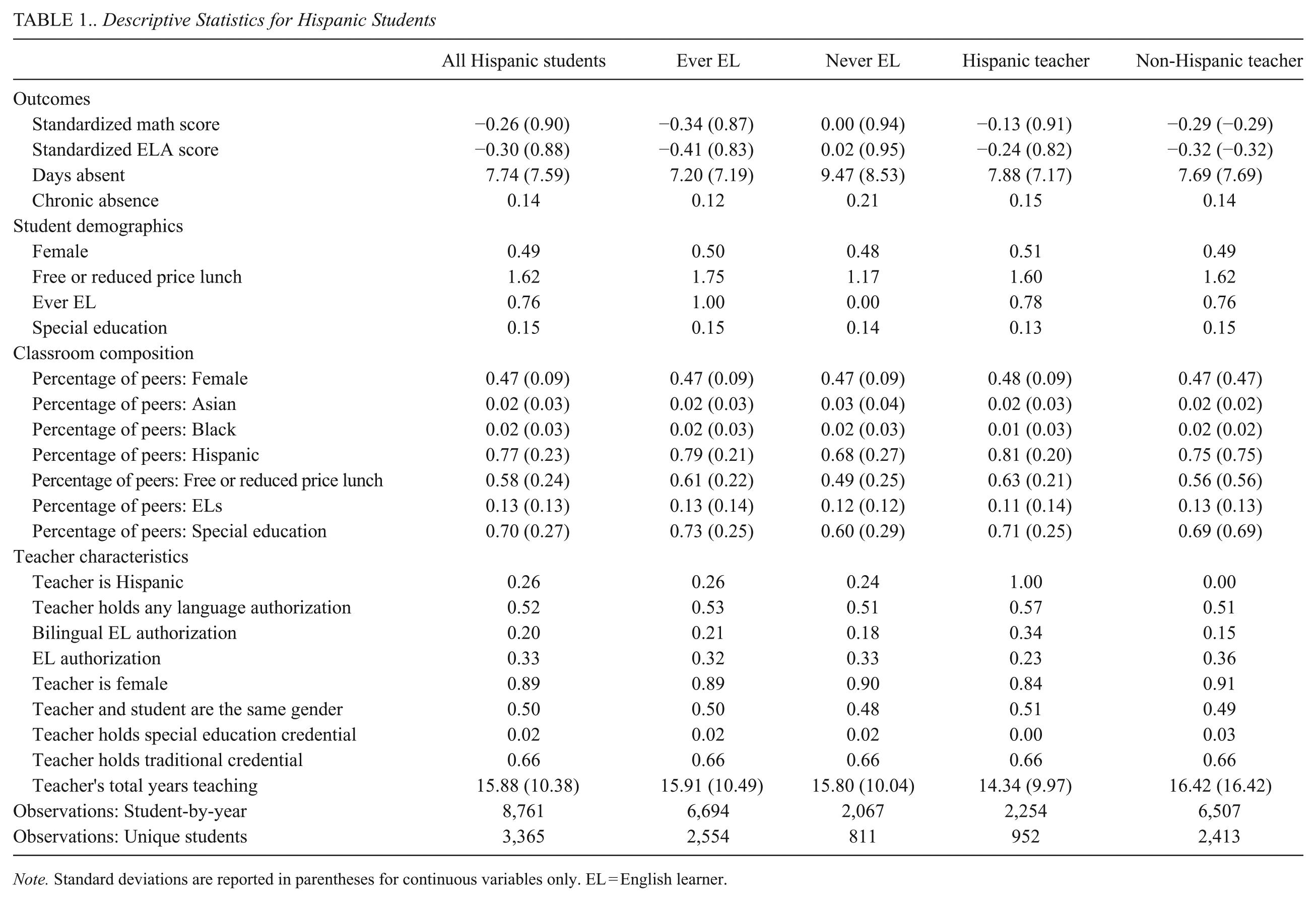
Note. Standard deviations are reported in parentheses for continuous variables only. EL = English learner.
Student–Teacher Matching
Our analysis involves matching students and teachers across multiple metrics, including race/ethnicity and Spanish language proficiency. The dataset includes the race/ethnicity of students and teachers. Additionally, we rely on students’ EL status to determine their Spanish language proficiency, and for teachers, we use information on their authorizations related to EL instruction and bilingual instruction. We first introduce these measures before detailing the specific student–teacher matches used in the analysis.
Student Spanish Language Proficiency
For students, the dataset includes a time-varying indicator for EL status, with nearly 97% of students in this district being Spanish-speaking ELs. Using this information, we created an “ever EL” measure, which identifies students who were classified as an EL at any point during the period of data collection (76% of our sample). We use “Ever EL” status rather than current EL status for several reasons. First, students can enter and exit EL status over time, but they may continue to benefit from having a teacher who shares their primary language even after reclassification. For instance, the ability of Spanish-speaking teachers to communicate with parents in their preferred language remains valuable, regardless of the student’s reclassification status. Moreover, using Ever EL status ensures that the variation in our matching variables comes from differences in teacher characteristics rather than from changes in student classifications. For the remainder of this article, we refer to these students as ELs and non-ELs, based on their Ever EL status.
Teacher Language Authorizations
Our dataset contains indicators for whether teachers have specific authorizations to provide instruction to ELs, such as the Crosscultural, Language, and Academic Development certificate or the Language Development Specialist certification. To obtain these authorizations, teachers must hold a valid teaching credential and meet requirements through pathways like passing the California Teacher of ELs examination or completing specialized coursework during their teacher preparation program. These authorizations allow teachers to provide English Language Development (ELD), which focuses on improving students’ listening, speaking, reading, and writing skills in English, and Specially Designed Academic Instruction Delivered in English (SDAIE), which adapts instruction in content areas like math or social science to improve the comprehensibility of the material for ELs. While EL authorizations enable teachers to support these students, it is important to note that they do not necessarily indicate proficiency in a language other than English. 2
We also observe whether teachers hold bilingual authorizations, such as the Bilingual, Crosscultural, Language, and Academic Development certificate or the Bilingual Certificate of Competence. These authorizations build on the EL authorization but require demonstrated proficiency in the target language, achieved through passing a language proficiency exam or completing a bilingual teacher preparation program. In addition to providing ELD and SDAIE, bilingual authorizations allow teachers to provide instruction in primary language development, which supports literacy in the student’s native language, and subject-specific content instruction in the student’s primary language. 3 Given that 97% of ELs in the district speak Spanish, we assume that most bilingual authorizations are in Spanish.
In our sample, 52% of teachers hold a language authorization, with 32% holding an EL authorization and 20% holding a bilingual authorization. Given the distinction between these two types of authorizations, our analysis distinguishes between teachers who are certified to support ELs in English and those who have the additional qualification to provide bilingual instruction.
Ethnoracial Matching
Ethnoracial matching involves matching Hispanic students with Hispanic teachers. Because the dataset identifies a Hispanic ethnicity for both students and teachers, we can observe when Hispanic students are paired with Hispanic teachers. Approximately 26% of the student sample is matched in this regard.
Teachers’ Language Skills Matched to Students’ Language Skills
We examine whether a Hispanic student is Spanish-speaking (EL) or not (non-EL) and how this interacts with the teacher’s characteristics. We conduct this matching in two steps. First, we categorize teachers based on their race/ethnicity (whether they are Hispanic or not) and whether they hold any language authorization that qualifies them to provide instruction to ELs. Teachers fall into one of four groups: (1) Hispanic teachers with a language authorization, (2) Hispanic teachers with no language authorization, (3) non-Hispanic teachers with a language authorization, and (4) non-Hispanic teachers with no language authorization. Hispanic students are matched to teachers within these categories, with matching conducted separately for ELs and non-ELs.
Next, we refine the matching process by specifying the type of language authorization held by the teachers. Teachers are classified into six categories: (1) Hispanic teachers with a bilingual authorization, (2) Hispanic teachers with an EL authorization, (3) Hispanic teachers with no language authorization, (4) non-Hispanic teachers with a bilingual authorization, (5) non-Hispanic teachers with an EL authorization, and (6) non-Hispanic teachers with no language authorization. Hispanic students are matched to teachers within these categories, with matching conducted separately for ELs and non-ELs.
Figure 1 provides a visual representation of this matching process by illustrating the assignment of Hispanic students to teachers, disaggregated by whether the teacher is Hispanic and the type of language authorization they hold. Note that this information is also presented in Table 1. The figure is divided into three panels: the first shows the distribution for the whole sample of Hispanic students, the second for ELs, and the third for non-ELs. In each panel, the bars represent the percentage of Hispanic students assigned to teachers within different categories. The teachers are categorized as either Hispanic or non-Hispanic and further classified based on whether they hold no language authorization (represented by the teal bars), an EL authorization only (represented by the gold bars), or a bilingual authorization (represented by the orange bars).
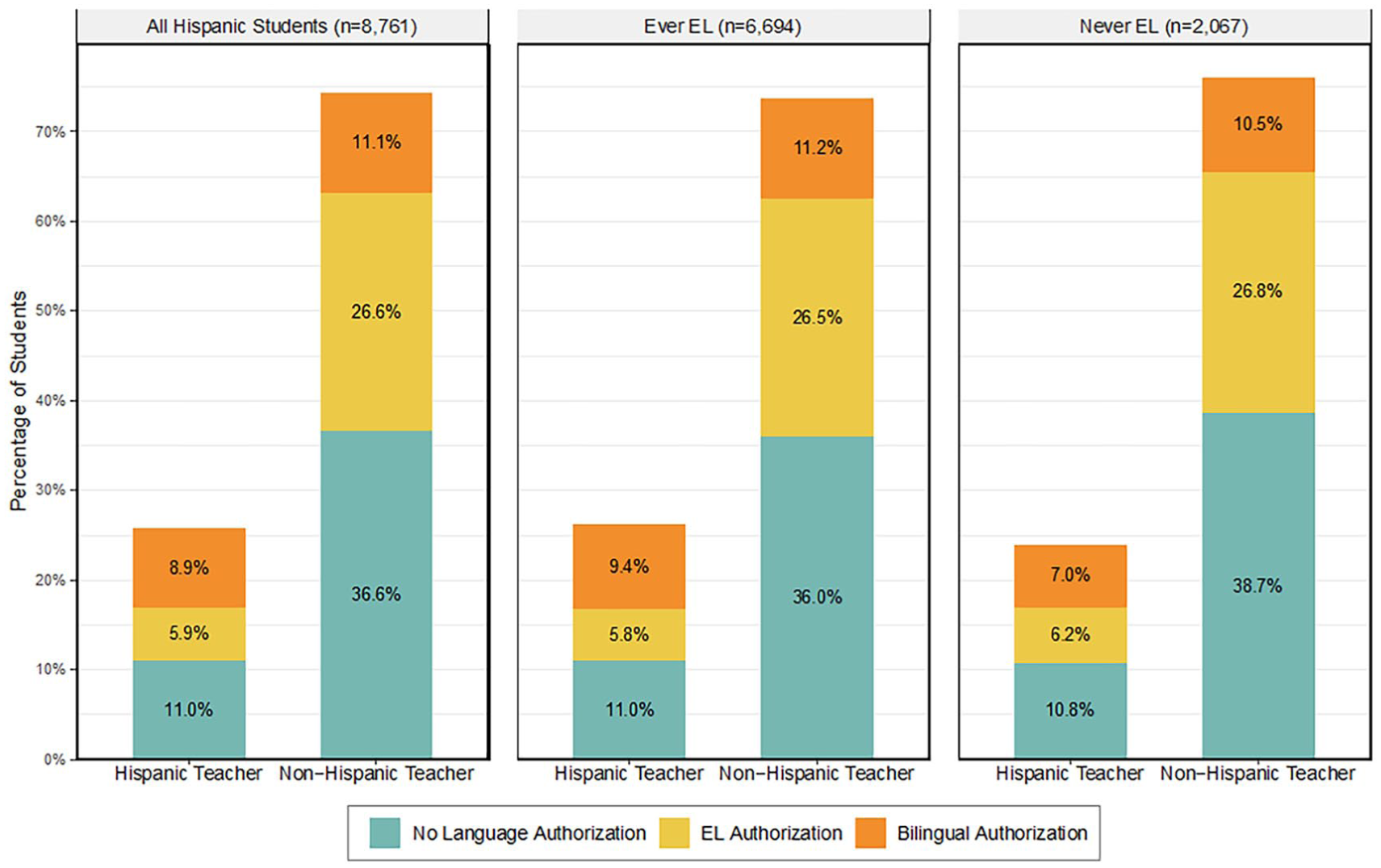
Assignment of Hispanic students to teachers, by teacher ethnicity and type of language authorization.
When comparing ELs and non-ELs, several key trends emerge. A slightly higher percentage of ELs (26.2%) have Hispanic teachers compared to non-ELs (24%). For ELs, 32.3% are taught by teachers with an EL authorization (5.8% Hispanic and 26.5% non-Hispanic), while 20.6% are taught by teachers with a bilingual authorization (9.4% of which are Hispanic and 11.2% non-Hispanic), bringing the total percentage of ELs taught by teachers with any language authorization to 52.9%. In contrast, for non-ELs, 33% have teachers with an EL authorization (6.2% Hispanic and 26.8% non-Hispanic), and 17.5% have bilingual-authorized teachers (7% Hispanic and 10.5% non-Hispanic), resulting in 50.5% of non-EL students being assigned to teachers with any language authorization.
Control Variables
Student Data
In each year of the dataset, the district provided data on students’ demographic characteristics, including gender and race/ethnicity. Additionally, each year, the district provided data on whether students received free or reduced-price meals, were classified as an EL, and were receiving special education services through an individualized education program.
Classroom Data
For each student, there is a deidentified code indicating the assigned teacher, which allows us to identify students who were in the same classroom each year. As such, we aggregated student-level data into classroom-level data and constructed percentages of the classrooms by each student measure found in Table 1: percentage of the students in the classroom who were Black, Hispanic, Asian, female, receiving free or reduced-price meals, ELs, and receiving special education services. Following Gottfried and Kirksey (2017), these measures can serve as a measure of a student’s classroom peers.
Teacher Data
Finally, we include measures on teachers. Given the assigned teacher code that is attached to each students’ record, we can identify every student’s teacher, each year. While the teacher-level data from the district is minimal, we are able to include teacher gender (and controlling for whether teacher and student share the same gender), whether the teacher identifies as Hispanic (the district did not provide other racial/ethnic data about teachers), whether the teacher has a certification in special education, whether the teacher has a traditional state credential (i.e., not emergency permit), total years of teaching experience, and whether the teacher holds a language credential, which, as described previously, is instrumental in helping us create a linguistic match with students.
Analysis Plan
Research Question 1
To address our first research question, we rely on the following model:

where Y represents either test score or absence outcome for student i in classroom j in school k in year t. The term HispanicMatch indicates an ethnoracial match and takes on a value of one if the student and teacher are both Hispanic and zero otherwise. The terms S, C, and T represent vectors of student, classroom, and teacher control variables, which can be found in Table 1. The error term is adjusted for clustering at the school level. All models in this study include school
Note that in this model, we also include student fixed effects
Another benefit of this empirical approach is that principals might systematically sort students within schools to ensure that students and teachers who are both Hispanic end up in the same classroom. Since classroom assignment policies are not observable, relying on repeated observations of the same student to measure the variation between having a Hispanic teacher match versus not allows us to compare outcomes across time in a way that is free of this particular potential source of bias. In studies analyzing the effects of classrooms or teachers, child fixed effects have been consistently supported as the preferred level of fixed effects (e.g., Aizer, 2008; Carbonaro & Maloney, 2019; Cho, 2012; Curran & Kitchin, 2019; Fletcher, 2010; Gottfried et al., 2021).
Research Question 2
To address our second research question, we extend our analysis by exploring the effects of language skills matching between Hispanic students and their teachers, considering both race/ethnicity and language authorizations. The analytic approach is similar to that of Research Question 1, but we substitute the key independent variable from Equation 1,

In this model, the coefficients of interest are β1, β2, and β3, representing the associations between each type of student–teacher match and the outcome of interest. Specifically, the term
While this approach allows us to explore the general relationship between shared race/ethnicity and language teaching skills, it is important to recognize that being authorized to teach ELs does not necessarily mean that teachers are proficient in Spanish. To address this concern, we refine our analysis by disaggregating the type of language authorization a teacher holds. This allows us to understand how specific qualifications interact with shared race/ethnicity to influence outcomes for Hispanic students.
Research Question 3
To address our third research question, we explore these dynamics using the following model:

In this model, the coefficients of interest represent the associations between different types of matches for Hispanic students and the outcomes of interest. Specifically, the terms
Because we conduct multiple group comparisons in our analyses for research questions 2 and 3, there is an increased probability of Type I error. To account for multiple comparisons, we calculate p-values using a Bonferroni correction. Results presented in the tables reflect these adjustments.
Sorting Tests
A key concern in studies of student–teacher matching is the possibility of sorting, where the probability of a match between a Hispanic student and a Hispanic or language-authorized teacher could be influenced by preexisting student or teacher characteristics. Such sorting could confound the observed relationship between these matches and student outcomes, leading to biased estimates. To address this concern, we conducted a sorting test by regressing various lagged student outcomes on our matching variables to determine if preexisting differences are driving the observed associations.
Table 2 presents the results of our sorting tests. In Panel A, we examine whether being matched with a Hispanic teacher predicts prior academic performance or attendance outcomes for Hispanic ELs. In Panel B, we extend this analysis to consider whether matching with a teacher who holds any language authorization is associated with prior outcomes for Hispanic ELs. Finally, in Panel C, we disaggregate the language authorizations to assess whether the type of authorization influences the sorting process. Across all three panels, the absence of significant interaction terms suggests that the observed relationships between student–teacher matching and student outcomes in our primary analysis are unlikely to be confounded by unobserved sorting criteria.
Sorting Test Estimates for Hispanic Students
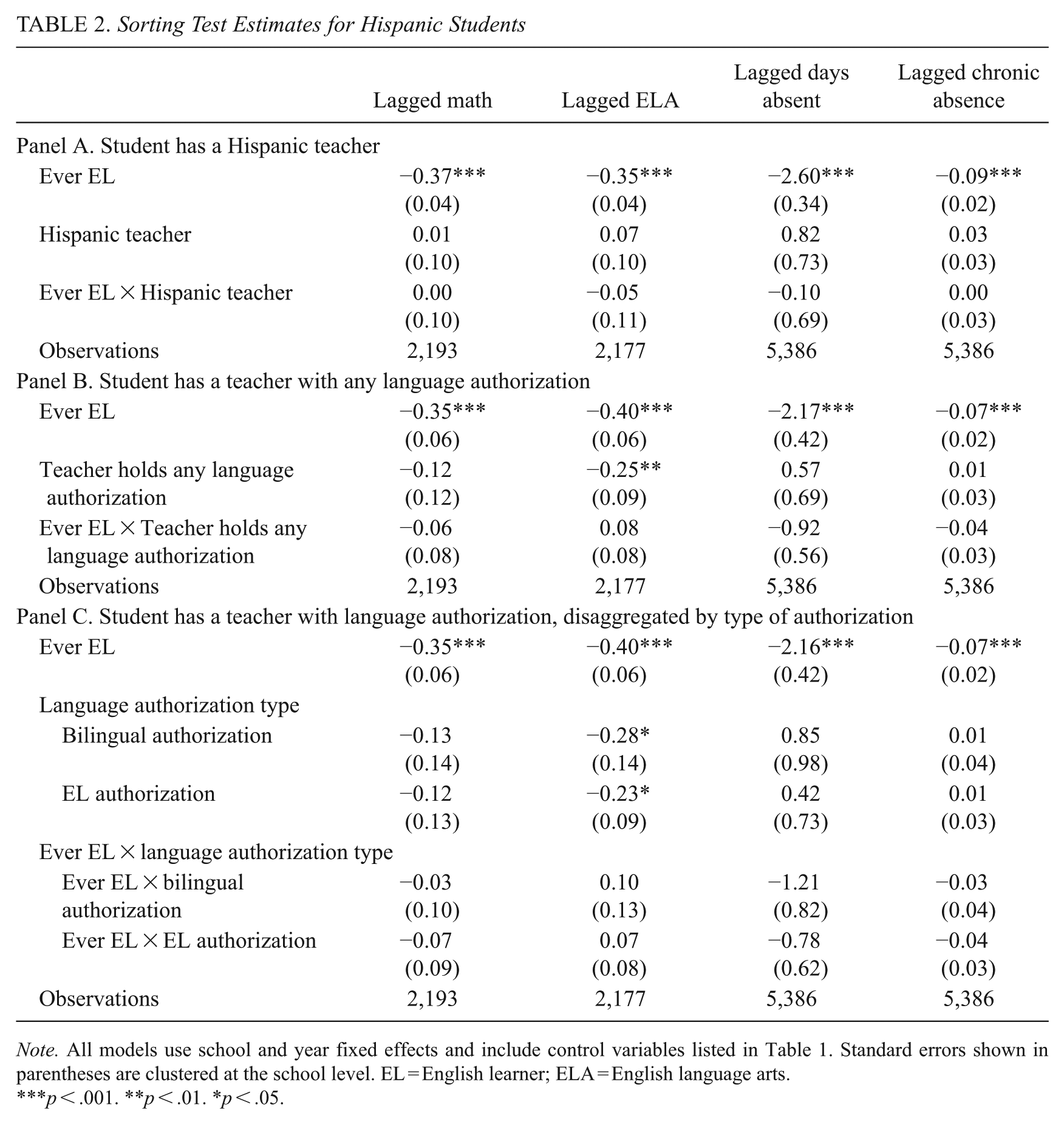
Note. All models use school and year fixed effects and include control variables listed in Table 1. Standard errors shown in parentheses are clustered at the school level. EL = English learner; ELA = English language arts.
p < .001. **p < .01. *p < .05.
Results
Research Question 1: Testing for an Ethnoracial Match Effect
Table 3 presents the findings for research question 1—whether Hispanic students have different standardized test score and absence outcomes in years when they are assigned to a Hispanic teacher, relative to themselves in years when they are assigned to a teacher of another ethnicity. Coefficients and cluster-adjusted standard errors are presented in parentheses. The bottom panel of the table indicates which variables are included in each regression, as well as which fixed effects are employed.
Matching and Effects on Hispanic Students’ Outcomes
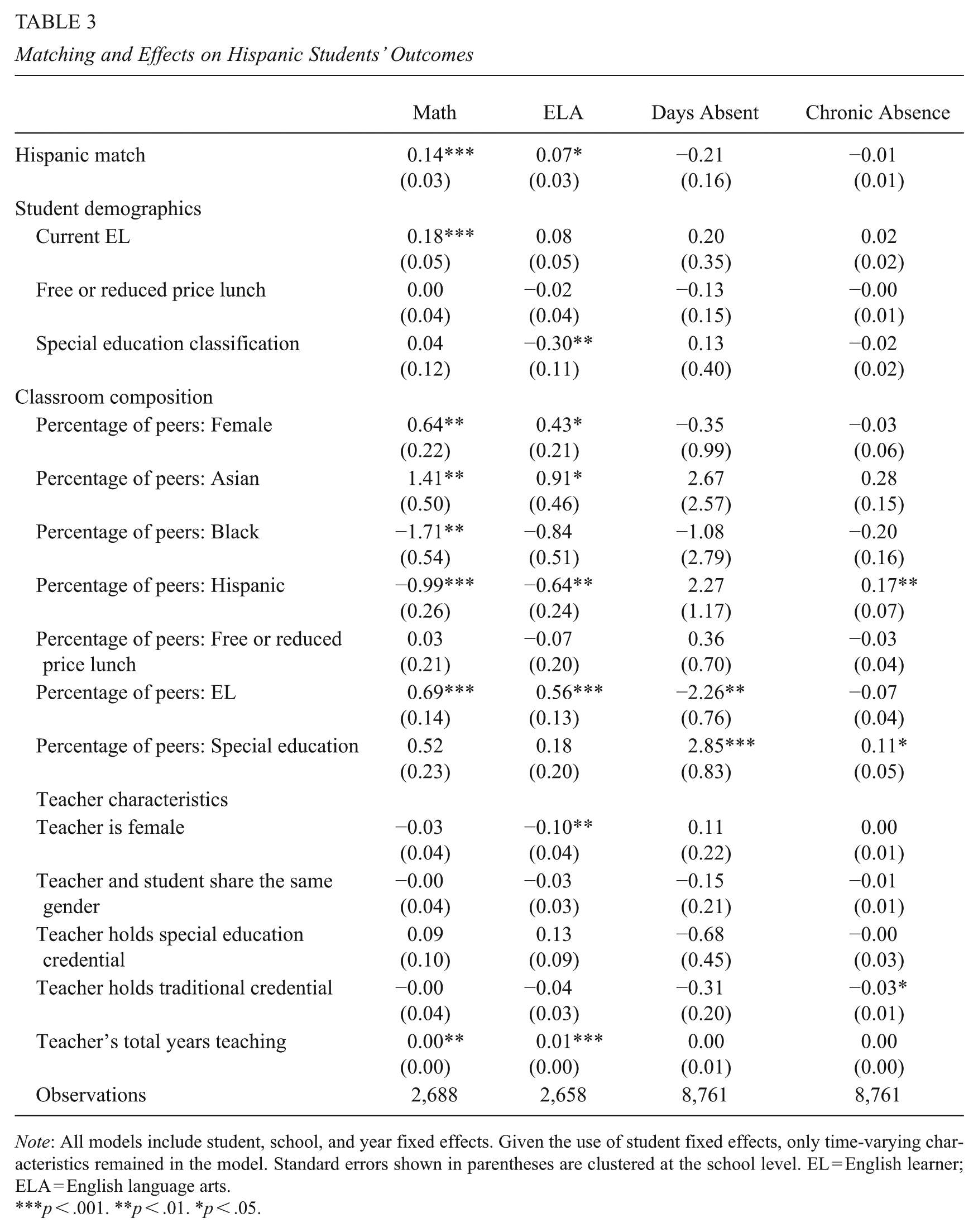
Note: All models include student, school, and year fixed effects. Given the use of student fixed effects, only time-varying characteristics remained in the model. Standard errors shown in parentheses are clustered at the school level. EL = English learner; ELA = English language arts.
p < .001. **p < .01. *p < .05.
Our results show a positive and statistically significant association between Hispanic student–teacher matching and student achievement in both math and ELA. The effect on math achievement is notably larger (0.14 SD, p < .001) than the effect on ELA achievement (0.07 SD, p < .05), with the math effect approximately twice the size of the ELA effect. In terms of days absent or chronic absenteeism, we do not find any evidence that shared Hispanic identity is linked to any changes in these outcomes for students in elementary school.
We turn next to research questions two and three, which take into account student language and teacher language authorization.
Research Question 2: Considering Both Ethnicity and Language Skills
Our second research question asks whether differences in student outcomes might arise based on the intersection of student ethnicity and language skills, relative to teacher ethnicity and language authorization. In Table 4, we present models where different measures of matching are examined separately for students who were ever classified as ELs, and students who were never classified as ELs. Within each panel, we examine three different types of matches: (a) Hispanic students matched with Hispanic teachers who hold a language authorization, (b) Hispanic students matched with Hispanic teachers who do not hold a language authorization, and (c) Hispanic students matched with non-Hispanic teachers who hold a language authorization. All columns represent the same models as in Table 3, using student fixed effects.
Matching and Effects on Hispanic Students’ Outcomes
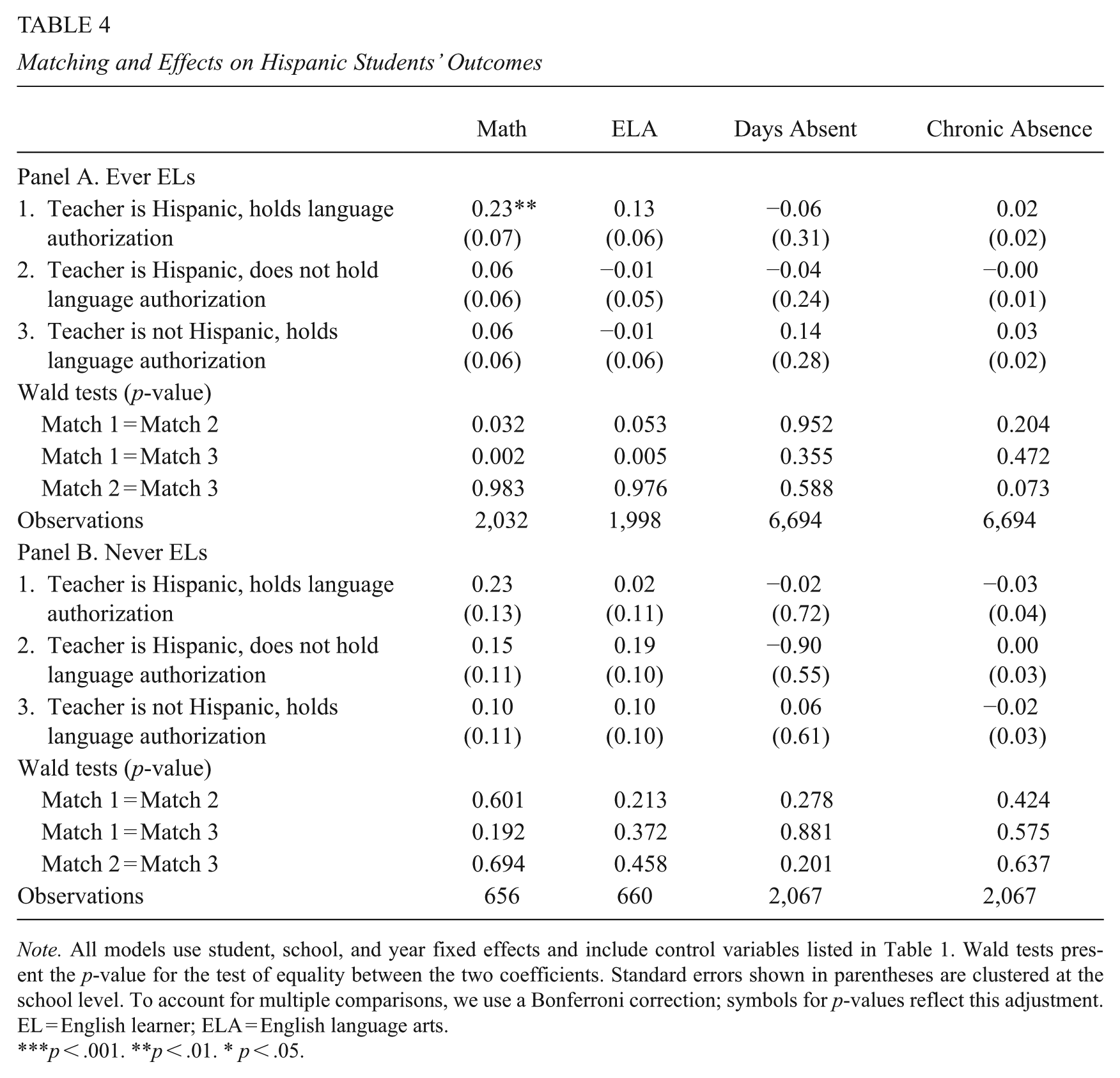
Note. All models use student, school, and year fixed effects and include control variables listed in Table 1. Wald tests present the p-value for the test of equality between the two coefficients. Standard errors shown in parentheses are clustered at the school level. To account for multiple comparisons, we use a Bonferroni correction; symbols for p-values reflect this adjustment. EL = English learner; ELA = English language arts.
p < .001. **p < .01. * p < .05.
Math and ELA
In Panel A of Table 4, we explore findings for Hispanic students who were ever classified as ELs. We present math results in column 1 and ELA results in column 2. When Hispanic ELs are assigned to Hispanic teachers with a language authorization, they have significantly higher math test scores (0.23 SD, p < .001). There is no analogous change in the ELA scores of Hispanic ELs matched to Hispanic teachers with a language authorization. In Panel B, we explore findings for Hispanic students who were never classified as ELs, observing null effects across both math and ELA outcomes. Taken together, these findings imply that the overall ethnoracial match effects reported in Table 3 were masking important subgroup effects of bilingual Hispanic teachers for Hispanic ELs in math. Because we failed to consider effects separately by student EL status and by teachers’ language authorization in Table 3, we missed a key insight regarding math outcomes.
In sum, these test score findings reveal that parsing apart teachers’ language authorization and teacher ethnicity is essential for understanding the teacher/student matching phenomenon for Hispanic students. Namely, as a baseline, the math and ELA models in Table 3 indicate that Hispanic students score higher when matched with a Hispanic teacher. Yet, when teacher language authorization is taken into consideration in Table 4, it becomes clear that Hispanic EL students matched with Hispanic teachers with a language authorization score even higher in math (0.23 SD, p < .001). In ELA, on the other hand, both Hispanic ELs and Hispanic non-ELs experience no change in their scores, regardless of the type of teacher match.
These achievement models underscore the importance of students and teachers sharing a Hispanic ethnicity, and these elementary school findings confirm prior work examining high school Hispanic students matched with Hispanic teachers (Gottfried et al., 2021). Our work also extends prior findings by accounting for a teacher language credential.
Absences
Column 3 of Table 4 examines potential matching effects on a student’s number of days absent and column 4 examines effects on a student’s likelihood of being chronically absent. Looking across Panels A and B, it does not appear that either measure of absenteeism is related to teacher ethnicity or language authorization.
Research Question 3: Disaggregating by Language Authorization Type
Fortunately, we can further unpack teacher language authorization by disentangling authorization type into two subcategories: teachers holding a bilingual authorization and teachers holding an EL authorization. The results of this analysis are presented in Table 5, which shows how Hispanic EL and Hispanic non-EL students perform in terms of both test scores and absence measures. Each column represents a separate regression, and we present results for ELs and non-ELs separately.
Matching and Effects on Hispanic Students’ Outcomes, Disaggregated by Type of Language Authorization
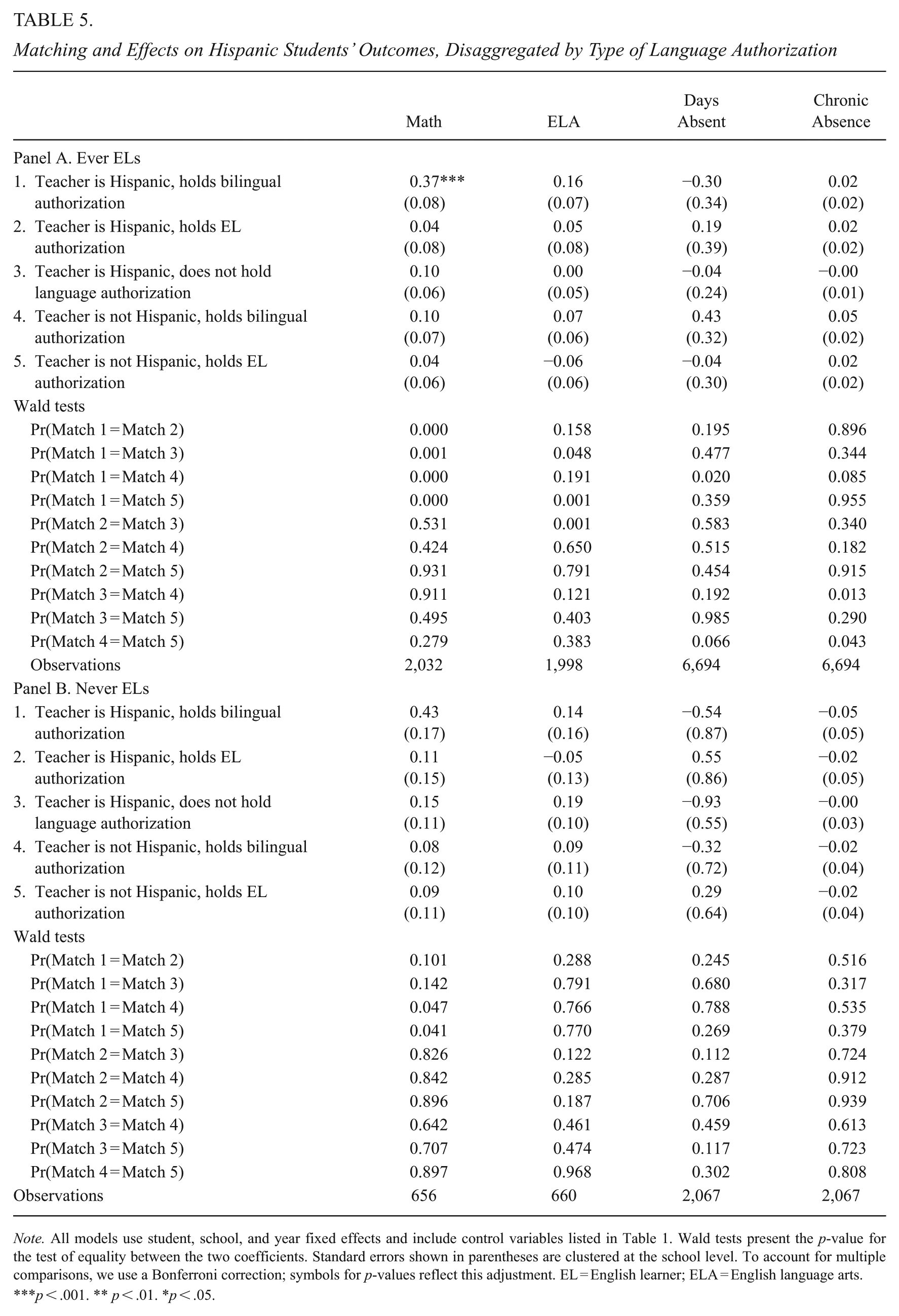
Note. All models use student, school, and year fixed effects and include control variables listed in Table 1. Wald tests present the p-value for the test of equality between the two coefficients. Standard errors shown in parentheses are clustered at the school level. To account for multiple comparisons, we use a Bonferroni correction; symbols for p-values reflect this adjustment. EL = English learner; ELA = English language arts.
p < .001. ** p < .01. *p < .05.
Math
When Hispanic EL students are assigned to Hispanic teachers with a bilingual authorization, they have significantly higher math scores. Student EL status does appear to moderate this relationship as the relationship is not present for Never EL students. Specifically, in Table 5 Panel A, we explore findings for Hispanic students who were ever classified as ELs, reporting an effect size of 0.37 SD (p <.001). In Panel B, we explore findings for Hispanic students who were never classified as ELs, finding null effects. Interestingly, when Hispanic students are assigned to Hispanic teachers with an EL authorization instead of a bilingual authorization, their math scores are unchanged.
English Language Arts
In Table 5 Panel A, we report findings for Hispanic ELs. There is no evidence of a change in the ELA scores of students in this group assigned to a teacher who is Hispanic but who holds either a bilingual authorization or an EL authorization. In Panel B, we report findings for Hispanic non-ELs. Likewise, we observe no change in ELA scores for students in this group assigned to a teacher who is Hispanic but who holds either a bilingual authorization or an EL authorization. This finding is perhaps expected, given that these students were never classified as ELs and therefore would be less likely to derive additional benefit from either type of teacher language authorization.
Absences
As before, it does not appear that teacher ethnicity or specific language authorization influences days absent or chronic absenteeism.
Reflecting on this set of results from Table 5, one insight in particular stands out, which is that further disaggregating language authorization into bilingual authorization and EL authorization is key. The math results associated with an ethnoracial match that we reported in Table 3 were positive and statistically significant, but they did not fully account for the specific type of language authorization a teacher possessed. Here, we can see that Hispanic teachers who hold a bilingual authorization are particularly effective with Hispanic students. To quantify this observation, the positive and statistically significant math effect we report for ELs matched with a Hispanic teacher who holds a bilingual authorization in math is 61% higher than the effect size reported when we examined the same students matched to a Hispanic teacher with any language authorization in Table 4 and 164% higher than the effect size reported when we examined Hispanic students matched to Hispanic teachers in Table 3. Taken together, these results reveal that paying attention to the combination of teacher bilingual authorization and teacher ethnicity is essential for understanding the teacher/student matching phenomenon for Hispanic students.
Robustness Checks
To assess the robustness of our findings, we re-estimated the preferred model that disaggregates by type of language authorization using alternative specifications. Results are presented in Table 6. In columns labeled (I), we provide the baseline estimates from Table 5 to facilitate comparisons. In columns labeled (II), we add grade fixed effects to control for unobserved factors that vary across grade levels, accounting for grade-specific contexts that might influence student outcomes, such as curriculum differences or developmental factors. In columns labeled (III), we remove student fixed effects and introduce controls for lagged outcomes, along with additional controls for class-level average lagged outcomes. This adjustment is crucial because the non-random sorting of students into classrooms is often correlated with prior academic achievement. By controlling for lagged student performance, we aim to capture any systematic differences between students assigned to teachers with bilingual or EL authorizations and those assigned to teachers without such qualifications.
Robustness Checks for Matching and Effects on Hispanic Students’ Outcomes, Disaggregated by Type of Language Authorization.
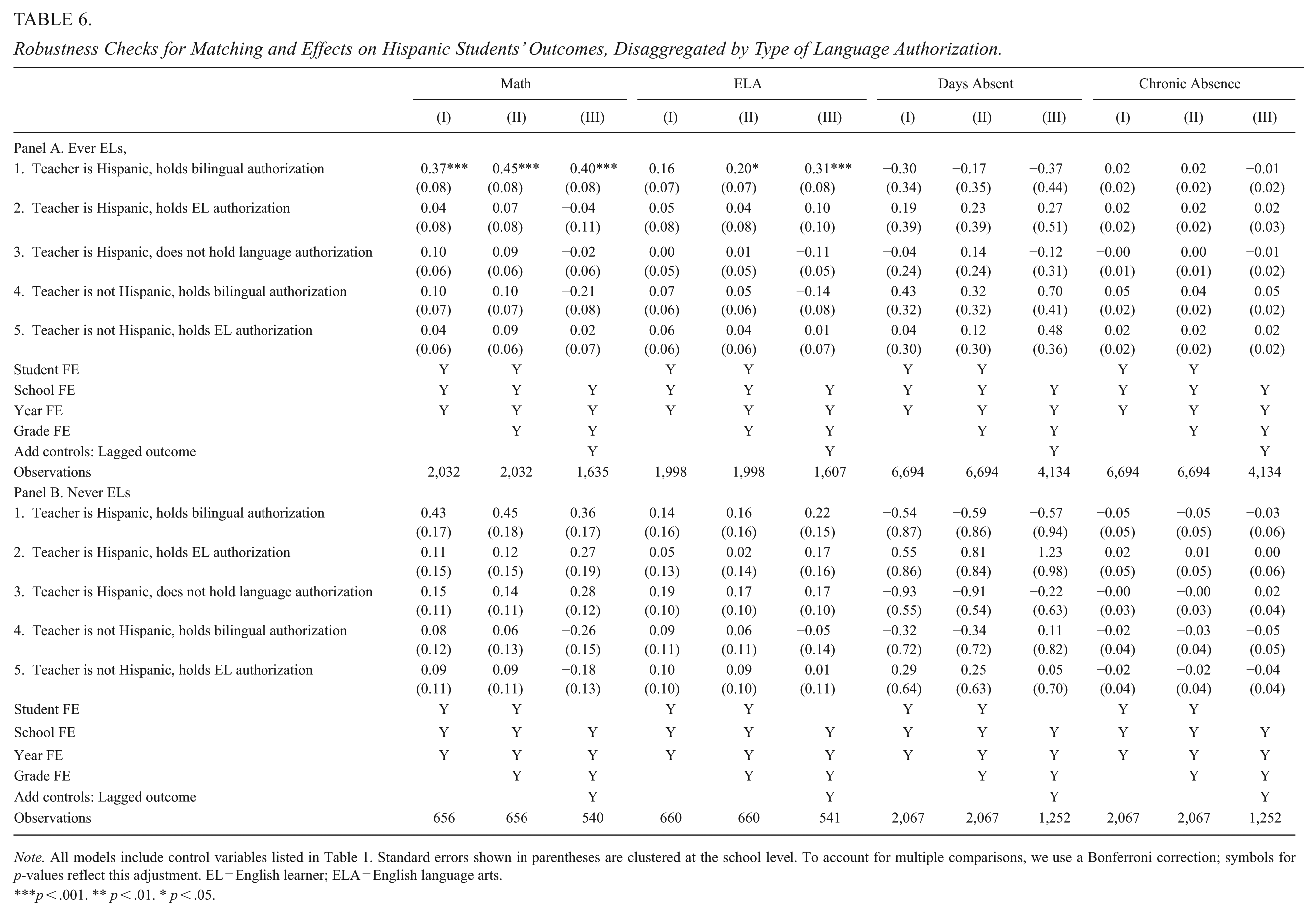
Note. All models include control variables listed in Table 1. Standard errors shown in parentheses are clustered at the school level. To account for multiple comparisons, we use a Bonferroni correction; symbols for p-values reflect this adjustment. EL = English learner; ELA = English language arts.
p < .001. ** p < .01. * p < .05.
Looking first at math results, the coefficient is robust, remaining positive, statistically significant, and of a similar magnitude across all three specifications. Specifically, the effect size reported for Ever ELs is 0.37 SD, 0.45 SD, and 0.40 SD across the three specifications examined. Similarly, for non-ELs, the effect is statistically insignificant across these three specifications.
Looking next at ELA results, it is interesting to note the positive and statistically significant coefficients in Specifications II and III for Hispanic ELs assigned to a Hispanic teacher who holds a bilingual authorization. Although our primary model reported null results, these alternative specifications suggest a different story, one that is consistent with the findings in math. For Hispanic non-ELs, we previously reported null effects. This finding is bolstered by these alternative specifications, which also report null effects.
Turning next to measures of student absenteeism, we consistently observe null effects for both the “days absent” outcome and the “chronic absence” outcome.
As a final set of robustness checks, we examined whether the observed effects of teacher–student matching held when using a sample of non-Hispanic students. We reran all relevant tables presented in this study across different matching scenarios: assigning non-Hispanic students to Hispanic teachers, considering whether the Hispanic teachers held any language authorization, and disaggregating the authorization into bilingual and EL authorizations. Across all models and outcomes, the results, though not presented for the sake of clarity, did not yield consistent or robust evidence of an effect. Given that Hispanic and White students are the two largest subgroups in the district, we also conducted a similar analysis restricted to White students to ensure broader representation. As with the broader non-Hispanic sample, no model consistently demonstrated an effect across the outcomes examined.
Discussion
In this study, we examine both ethnoracial matching as well as teachers’ language authorization and how these related, but distinct, phenomena are linked to students’ academic outcomes. Prior work has already established the role of ethnoracial matching in supporting students’ academic outcomes (e.g., Dee, 2004; Egalite et al., 2015; Joshi et al., 2018; Harbatkin, 2021; Morgan & Hu, 2023; Redding, 2019), which includes higher test scores, better school attendance, higher graduation rates, and stronger college enrollment patterns. We contribute to this literature by considering an additional layer of nuance to the teacher/student matching phenomenon.
Until now, the field of student–teacher matching has predominantly focused on matching along the lines of student and teacher race and ethnicity. The work is important as it underscores the necessity of teacher diversity, an ongoing challenge for a predominantly white workforce serving an increasingly diverse student body. Yet, little attention has extended beyond racial and ethnic demographic matches, particularly considering the role that shared language may also play in boosting the known effects of sharing race or ethnicity. The little work that has been conducted on this topic focuses on outcomes pertaining to teacher perceptions or teachers’ evaluations of students (Seah, 2021). These prior studies are important and certainly shine light on the mechanisms undergirding matching, but they do not necessarily provide insights into whether this type of matching itself directly improves students’ academic outcomes. Our study directly evaluates whether Hispanic students matched with Hispanic teachers experience different academic outcomes based on student and teacher language skills.
Using administrative data from an anonymous Western State school district, we are able to examine both Hispanic ethnoracial matching as well as teachers’ language authorization. As shown in the results section, our initial findings aligned with prior research, indicating statistically significant math and ELA test score gains for Hispanic students matched with Hispanic teachers. As our analysis became more nuanced, however, the full portrait became clear. Namely, we considered differences for Hispanic EL students as well as Hispanic non-EL students matched with Hispanic teachers who hold bilingual or EL authorizations and non-Hispanic teachers who hold bilingual or EL authorizations. This difference had been unexplored in prior work.
These findings reinforce the academic benefits of ethnoracial matching for improving students’ academic outcomes but also highlight the previously underexplored benefits of matched race and ethnicity in conjunction with teachers’ language skills. Hence, our findings reinforce the call for improving overall teacher diversity to align with the growing racial, ethnic, and linguistic diversity in our nation. Students from Hispanic backgrounds and Spanish-language backgrounds both benefit from having Hispanic teachers as well as Hispanic teachers who are authorized to provide bilingual instruction.
Implications
The first implication of our study is that focusing on just ethnoracial matching alone is insufficient. The rich connections built in a classroom community draw upon multiple aspects of a teacher and students’ identity, background, culture, and prior experiences. Prior research on this topic has not always had access to helpful indicators such as we have been able to do here, accounting for teacher proficiency in what is often their student’s first language. As school district data managers consider what variables to collect moving forward, we encourage thoughtful conversations around including the types of variables that offer clues as to student and teacher culture and competencies.
The second implication of this work revolves around the finding that teacher language credentials are important but also insufficient to generate the same benefit as a shared cultural background. In the short run, policymakers and school leaders might prioritize better cultural competency and language training for the existing stock of teachers. But in the long run, the educational system more generally needs to make great strides to improve all kinds of diversity, including language diversity, in the educator pipeline. What we see here is that the combination of ethnoracial and language diversity together can be powerful.
A final implication of these findings is the invitation they create to better understand the characteristics, practices, and norms that teachers establish in a classroom that allow students to thrive academically. Future qualitative research should delve into the interactions and experiences that contribute to these positive outcomes to shed light on the mechanisms at play. Professional development materials for new and existing teachers of all backgrounds would benefit from such insight.
Limitations
Though this study contributes new insights into the dynamics of student–teacher similarity, there are several limitations, all of which could serve as points of access for future research. All of these limitations are typical of studies that rely on administrative data. First, the district dataset did not include information on a student’s immigration status, citizenship, or the immigration status of their families (which would allow us to distinguish between recent immigrants, first-generation immigrants, second-generation, and so on). This information would offer much richer insight into their experiences and circumstances, given what we know from prior research about the influence of first versus second generation status on key student outcomes (Sattin-Bajaj & Kirksey, 2019). We leave this topic open for future research, which will hopefully be able to combine data on race and ethnicity with data on students’ language and immigration status. An additional future area of research would be to compare similarity in child immigration status with teacher immigration status.
Another limitation of the current study is that the data did not allow for exploration of mechanisms or explanations. Therefore, it is not possible to disentangle the proposed explanations as to why both ethnoracial and language student–teacher matching might affect academic outcomes. For instance, it was not possible to determine if teachers changed their explanations or helped students feel more connected to the classroom environment, generally, and the content being studied, specifically. Likewise, it was not possible to determine if and why students felt more engaged. Future qualitative research might explore these possible pathways by which our findings have emerged.
Third, while our data contain significant detail on the language authorizations that the state provided to teachers, it is not possible from our data to determine language capabilities beyond certification. That is, there may be some teachers who are fluent in Spanish but are not authorized to provide bilingual instruction by the state. Therefore, it may be possible to see different (and possibly larger) effect sizes if it were possible to have information about language ability beyond what the state certifies. This would of course be a significant challenge to collect these types of data, but they would certainly add value.
Fourth, we acknowledge the reduced statistical power associated with examining more fine-grained student–teacher matchups, particularly in subgroup analyses. This limitation is especially relevant for the Never-EL group, which represents only 24% of Hispanic students in our sample. As a result, detecting statistically significant effects in this subgroup is more difficult, and null findings should be interpreted with caution.
Finally, this work focused on student and teacher similarities. The data did not allow for an explanation of parent-teacher similarities, though our ecological model indicates that parents are key actors. Thus, a third limitation of our work is that we cannot explore the implications of parents sharing similarities with teachers. This would be an important next step in the analysis, and we urge for future research—both quantitative and qualitative—to support research in which parental responses can be explored.
Conclusion
These findings serve as a helpful reminder that existing work on the importance of teacher diversity has only scratched the surface by leveraging what data are available on student and teacher race/ethnicity. There are many other dimensions of a teacher’s identity that can serve as an asset in the classroom, to draw students into the classroom community, foster a love of learning and an excitement about school, and to improve the connection between home and school. Celebrating and capitalizing on all aspects of a child’s unique identity—their culture, their upbringing, their home language, and more—has long been something that great teachers have intuitively known and practiced. Research that can quantify the value of these globally-minded efforts offers a first step in improving outcomes for a diverse student body.
Footnotes
Author’s Note
Anna J. Egalite is now affiliated with the Institute for Governance and Civics at Florida State University.
Declaration of Conflicting Interests
The authors declared no potential conflicts of interest with respect to the research, authorship, and/or publication of this article.
Funding
The authors received no financial support for the research, authorship, and/or publication of this article.

Notes
Authors
MICHAEL GOTTFRIED, PhD, is a Professor at the University of Pennsylvania in the Graduate School of Education. His research focuses on absenteeism, early education, special education, and career and technical education.
JENNIFER FREEMAN, PhD, is an Assistant Professor of Education Policy at Texas Tech University. Her research examines the connections between high school, higher education, and the workforce, focusing on students who take nontraditional pathways as they navigate these sectors.
ANNA J. EGALITE, PhD, is a Professor of Educational Evaluation and Policy Analysis at North Carolina State University and a visiting fellow at the Institute for Governance and Civics at Florida State University. She studies how targeted education reforms, such as diversifying the teaching profession and expanding school choice, influence efforts to close racial and economic achievement gaps.