




Abstract
This mixed-method study examines Michigan’s Partnership policy for school turnaround, which positions the district and superintendents as key policy implementation actors. We first interviewed 21 of 35 Partnership superintendents/leaders across Michigan and surveyed teachers to understand the initial response to the turnaround policy and the strategic planning process. We then used our understanding of these leaders’ responses to conduct a purposively sampled embedded multiple comparative case study of three varied districts. These case studies helped us more deeply understand and compare how districts engaged in the process of crafting coherence and school-level stakeholders’ perceptions of activities related to coherence and implementation of the reform. Based on these two levels of data collection and analysis, we found that many leaders used the opportunity to create new changes, roles, and partnerships, but the majority also symbolically adopted policy demands by aligning their turnaround plans with pre-existing efforts. Using cross-case comparisons of our three districts, we argue that some degree of strategic buffering from policy demands may be warranted, especially when districts have low capacity and face significant challenges recruiting and retaining teachers.
Keywords
S
Much of the literature focuses on turnaround efforts at the school level although districts and district leaders theoretically play a prominent role in setting important parameters around school leaders’ ability to enact change (e.g., curricular and professional development requirements, evaluation policies, collective bargaining agreements) and in building the capacity of low-performing schools identified for turnaround. Scholars are increasingly pointing out that the role of the district for turnaround is “essential” (Meyers & Sadler, 2018; Zavadsky, 2012). As districts are critical mediators of policy implementation and turnaround and Michigan’s policy specifically asks district leaders to create goals and implement a 3-year strategic turnaround plan, this study uses and informs the concept of crafting coherence, defined as a process where districts and schools interact to align, ignore, or adapt external policy demands considering their internal goals and existing school improvement efforts (Honig & Hatch, 2004).
A recurring theme in policy implementation literature is the idea that educators’ sensemaking and interpretations of state and district policy strongly shape whether and how reforms are implemented in alignment with the intent of the policy (Coburn, 2005; Woulfin, 2018) because teachers and principals act as “street-level bureaucrats” (Taylor, 2007). One response to the external demands imposed by a policy is decoupling, an idea proposed by new institutional theorists in which formal structures and policies help organizations comply and maintain legitimacy with external constituencies while allowing practitioners flexibility such that structures do not necessarily change organizational practice (DiMaggio & Powell, 1983; Meyer & Rowan, 1977). Crafting coherence theory categorizes such responses as “symbolic adoption,” broadly defined as instances when an organization “align[s] its stated goals and strategies to reflect external demands but intentionally leave[s] its day-to-day work largely unchanged” (Honig & Hatch, 2004, p. 23). An example of this might be to use the language or discourse of policy but not allow the policy to change pre-existing goals or practices (Honig & Hatch, 2004). This study examines this ongoing dilemma, looking at how Michigan’s policy does or does not influence the thinking and practice of districts and schools to meet turnaround goals.
Policy Context: Michigan’s Partnership Model
Michigan’s Partnership policy was enacted in 2017 and is part of the state’s ESSA plan. The Michigan Department of Education (MDE) identified the lowest performing traditional public and charter schools as Partnership schools and their district or central office as a Partnership district. Two cohorts of Partnership districts and schools were identified in 2017–2018, which included a total of 123 schools (about 18% charter) across 36 districts (about 56% charter) that were identified for Partnership turnaround.
As the first step in the turnaround process, superintendents are required to work with a range of stakeholders to develop a Partnership Agreement that outlines a 3-year turnaround plan for their identified schools. Partnership Agreements must include specific and measurable student achievement goals, partners, and strategies that would help them achieve these goals, and accountability measures for schools that fail to meet goals, which may include closure or reconstitution. Although districts were encouraged to craft ambitious yet feasible goals and establish new partnerships, decisions around the content of Partnership Agreements were largely up to leaders, which may be one reason why they generally perceived the Partnership policy as supportive rather than threatening (Strunk et al., 2019). The Partnership Model implies that new interventions and/or strategies are warranted for identified schools, but leaders are free to draw from prior or ongoing improvement plans as they see fit.
To support turnaround work, the State provided 21H grant funding, which districts could apply for to help pay for new initiatives and separate funding for Intermediate School Districts (ISDs) to provide technical support to Partnership districts. In Michigan, ISDs are regional entities serving multiple districts in a geographic area that provide supports such as teacher coaching and professional development. The additional funding for ISDs was a significant change in the case of charters, which rarely had prior relationships with their ISD (Strunk et al., 2020). MDE also assigns each Partnership district or charter organization a Partnership Agreement Liaison (PAL). The PAL helps leaders comply with policy and to generally align their work to support the needs of the district. Finally, the Partnership Model also asks districts to identify community organizations as partners to support turnaround efforts.
We first interviewed Partnership district leaders, which focused on the strategic planning process and how they engaged the external demands of the reform in light of their existing improvement efforts. We then interviewed 60 district school leader, teacher, and partner stakeholders across three intentionally varied case study districts and analyzed 1,117 teacher survey responses to understand implementation of these strategic plans more deeply.
Conceptual Framework
This study draws on the concept of crafting coherence (Honig & Hatch, 2004) to understand Partnership policy implementation. Crafting coherence is defined as a process where schools, school districts, and other partners work together to “continually negotiate the fit between external [policy] demands and schools’ own goals and strategies” (Honig & Hatch, 2004, p. 16). The process of negotiating multiple external demands can help or hinder the achievement of organizational goals and involves bridging and buffering in response to the demands of a policy. Depending on the context, either strategy can help an organization achieve coherence and meet policy goals (Russell & Bray, 2013).
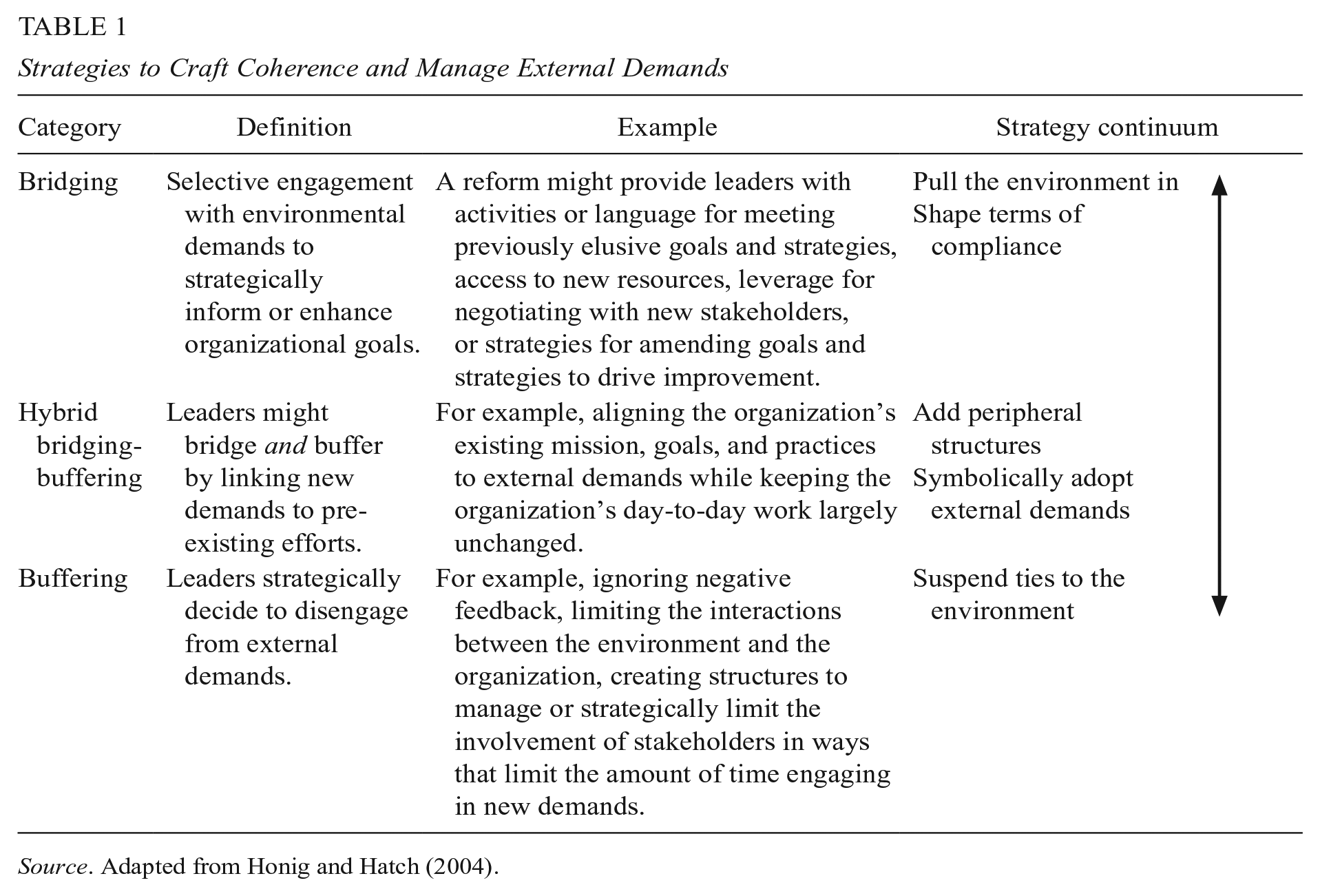
Honig and Hatch (2004) note that studying locations where crafting coherence can be observed in action “[would be] particularly productive for advancing theory and practice” (p. 27). Partnership represents an opportunity to do so because superintendents (those charged with negotiating the external demands of the policy in this context) agree to coordinate with central office staff, external partners, and school-based staff to craft the Partnership Agreement. Crafting coherence also mirrors the three broad requirements in the Partnership process. Honig and Hatch (2004) theorize that the process involves (a) setting school-wide goals and strategies, (b) schools using their goals and strategies to bridge to and buffer (see Table 1 for definitions) themselves from external demands, and (c) the central office supporting any new forms of school-level capacity building and decision-making. Our three case studies allow us to describe how contextual factors shape how leaders bridged and buffered in response to Partnership efforts.
Strategies to Craft Coherence and Manage External Demands
Source. Adapted from Honig and Hatch (2004).
According to Honig and Hatch (2004), bridging activities that encourage interaction with external demands include district or school leadership “pulling in” actors from the external environment and engaging them in the local-level work and “shaping terms of compliance activities,” such as lobbying. One buffering strategy is to “suspend ties to the environment,” by disengaging with programs or turning down funding to avoid participation in a policy. Between these extremes are activities that fall into a hybrid response: “adding peripheral structures” such as offices or positions to address a particular policy or aspect of the reform represents a response closer to the bridging side of the continuum. “Symbolic adoption” represents a response closer to the buffering end. With symbolic adoption, organizations can adopt (e.g., use the language of reform) but not use activities associated with external demands, or they could demonstrate that their existing practices meet or exceed environmental demands (Honig & Hatch, 2004, p. 24).
Given that “the same arrangement[s] may be experienced differently by principals, teachers, and other implementers” (Honig & Hatch, 2004, p. 17), it is important to understand how they are responding to Partnership. In addition, messages from the institutional environment can reach the school and classroom level to influence teaching and learning (Coburn, 2004). For instance, Finnigan and Gross (2007) find that awareness of accountability messages/threats can influence teachers by focusing their efforts to meet a policy’s goals.
Thus, our first research question focuses on the superintendent interviews, and our second question focuses on survey and case study data to understand responses outside of the district:
Background Literature
Crafting Coherence and the District Role in Policy Implementation
While much research looks at policy implementation within schools, this work often overlooks the important mediating role that districts play in responding to federal, state, and regional policy (Elmore, 1993; Purkey & Smith, 1985; Rorrer et al., 2008; Rorrer & Skrla, 2005; Spillane, 1996; Trujillo, 2016). District leaders can build instructional leadership capacity across schools, and they often work to adapt external policy demands to fit with the internal goals of the district and schools within it (Honig, 2012; Rorrer et al., 2008). Central offices can innovate, expand, resist, or passively implement policies in ways that strongly shape how educators respond to the demands of a policy (Firestone, 1989; Rorrer & Skrla, 2005; Spillane, 1996).
Crafting coherence involves understanding the interactions between policy, district central offices, and schools (Honig & Hatch, 2004). Yet few studies describe these interactions—both the nature of these relationships and their potential effects on school improvement. This is critical to understanding the process because districts provide an infrastructure to build capacity of schools to meet shared goals (Peurach & Neumerski, 2015; Trujillo, 2016; Wong, 2016).
Most studies that apply the concept of crafting coherence to the data analysis process only focus on interactions at the school level. For example, Seashore Louis and Robinson (2012) used surveys and interviews with teachers and principals to study how state and district accountability policy shaped instructional leadership behaviors. They found that policies had a positive effect on instructional leadership behavior provided they aligned with leaders’ values, preferences, and the presence of supportive district structures (Seashore Louis & Robinson, 2012). Stosich (2018) examined how schools made sense of accountability policies such as teacher evaluation and the Common Core and found that meeting the demands of one policy came at the expense of another. Implications pointed to the mediating role districts could play in responding to and managing these conflicts but did not explicitly study the district’s role in the process (Stosich, 2018).
Russell and Bray’s (2013) study considered superintendents, principals, and teachers but largely focused on sensemaking about the policy goals and the tensions between them rather than explaining how these tensions affected the process of school improvement. Honig (2009) looked at policy implementation of new small autonomous school initiatives in two large districts and found that district actors bridged and buffered to change policy, build capacity, communicate requirements, and protect schools from scrutiny. Honig (2009) found that “bridging and buffering appeared productive in both contexts” (p. 418), but the study focused mainly on school district employees’ perceptions. District actors’ perceptions of productivity may be different than those charged with implementing or experiencing changes at the ground level.
Conditions Affecting the Efficacy of Coherence and Turnaround
While early work on school turnaround found mixed or negative effects on outcomes (see Herman et al., 2008; Malen & Rice, 2016), more recent meta-analyses find slightly positive overall effects for turnaround (see Redding & Nguyen, 2020; Schueler et al., 2022). Scholars are finding that positive staffing changes help explain these results (Dee, 2012; Papay & Hannon, 2018; Schueler et al., 2022). For instance, in Tennessee, turnaround schools that were placed into an innovation zone (iZone) saw significant positive effects while those that were placed into a largely charter-operated state-run district did not—bringing more effective teachers and principals into iZone schools contributed to these results, while turnover among teachers may have limited the efficacy of turnaround in Achievement School District (ASD) schools (Henry et al., 2020).
Chronic turnover can limit the efficacy of turnaround efforts in any number of ways—instructional quality and continuity suffer, teaching assignments and professional development must be reconfigured, the relational trust required for dramatic improvement decreases, and accordingly, norms for instruction, teacher collaboration, or student behavior are destabilized (Simon & Johnson, 2015). Turnover is thus intimately connected to the capacity of schools to meet turnaround goals. Turnover also shapes how leaders craft coherence because new policies can increase the demands on educators (Honig & Hatch, 2004). In theory, organizations with chronically high turnover may stretch their already limited capacity when attempting to bridge new policies and new efforts with pre-existing improvement plans (Honig & Hatch, 2004; Simon & Johnson, 2015). Moreover, Michigan charter schools are known to have higher turnover and employ younger teachers than traditional public schools (Levin & LeMee, 2021).
Turnaround Policy and Issues of Capacity and Centralization
Prior studies suggest that districts are critical to the success of turnaround—for example, studies of Comprehensive School Reform (CSR) schools find that participants in the most improved schools cite district support as instrumental to their success (Aladjem et al., 2010).
Scholars also note that “high stakes accountability reforms cannot realize their stated aims unless targeted schools have or acquire the capacity to meet prescribed performance standards” (Malen & Rice, 2004, p. 632). Malen and Rice (2004) compared a school undergoing reconstitution and another that had graduated sanctions and found that both cases experienced organizational freneticism (the volume, pace, and intensity of the work done to meet the demands of policy), which contributed to substantial anxiety, stress, and exhaustion, but the case with graduated sanctions experienced it to a lesser degree because they kept their basic infrastructure intact. In both cases (and despite new resources being provided to support the work), the pressure of the accountability label, upheaval of reconstitution, or creating multiple new initiatives to respond to the policy “undercut the productivity of the available resources . . . [in ways that] diminished the schools’ capacity for substantial, sustained improvements” (Malen & Rice, 2004, pp. 652–653). These findings suggest that leaders must strategically engage in the process of crafting coherence if they hope to build rather than undercut their capacity to meet the goals of turnaround policy.
Another consideration for school capacity building involves the degree of school and district centralization and autonomy. In governance reforms such as Portfolio Management Models (PMMs), districts provide significant school-level autonomy, but this can come at the cost of investment in centralized capacity such as professional learning supports, teacher recruitment efforts, and other infrastructure because schools opt to choose how to invest in or create these options on their own (Bulkley et al., 2021). Charter schools and Educational Management Organizations (EMOs—which act in a similar capacity to districts to provide centralized support infrastructure)—also face this tension because they have autonomy to create their own targeted school supports, but this can come at a cost in terms of work intensification and less time for leadership to focus on improving instruction (Bickmore & Dowell, 2011; Carpenter & Peak, 2013; Torres et al., 2018). In these ways, autonomy can affect school capacity because it shapes the ways leaders allocate resources and time. Although Partnership requires districts to craft and implement strategic plans, they are allowed substantial autonomy over their goals, plans, and use of new resources, further underscoring the importance of studying these tensions as leaders craft coherence to build or maintain capacity to meet improvement goals.
Methods
We began with purposive sampling of “Partnership leaders” that were closest to the design of the Partnership Agreement, either superintendents or charter school leaders. In this initial stage, we aimed for maximum variation sampling, in which we could identify “widely varying instances of [a] phenomenon” (Merriam & Tisdell, 2016, p. 98) such that categories, themes, patterns, and variations could be explained and emerge out of heterogeneity (Patton, 2015). As we collected and analyzed these data, we noticed variations in how district leaders were crafting coherence. We used this initial understanding to theoretically sample for districts that varied in their planning and perceptions of implementation. Theoretical sampling “begins with an initial sample chosen for its obvious relevance to the research problem . . . [and] the data lead the investigator to the next [stage of data collection]” (Merriam & Tisdell, 2016, p. 99).
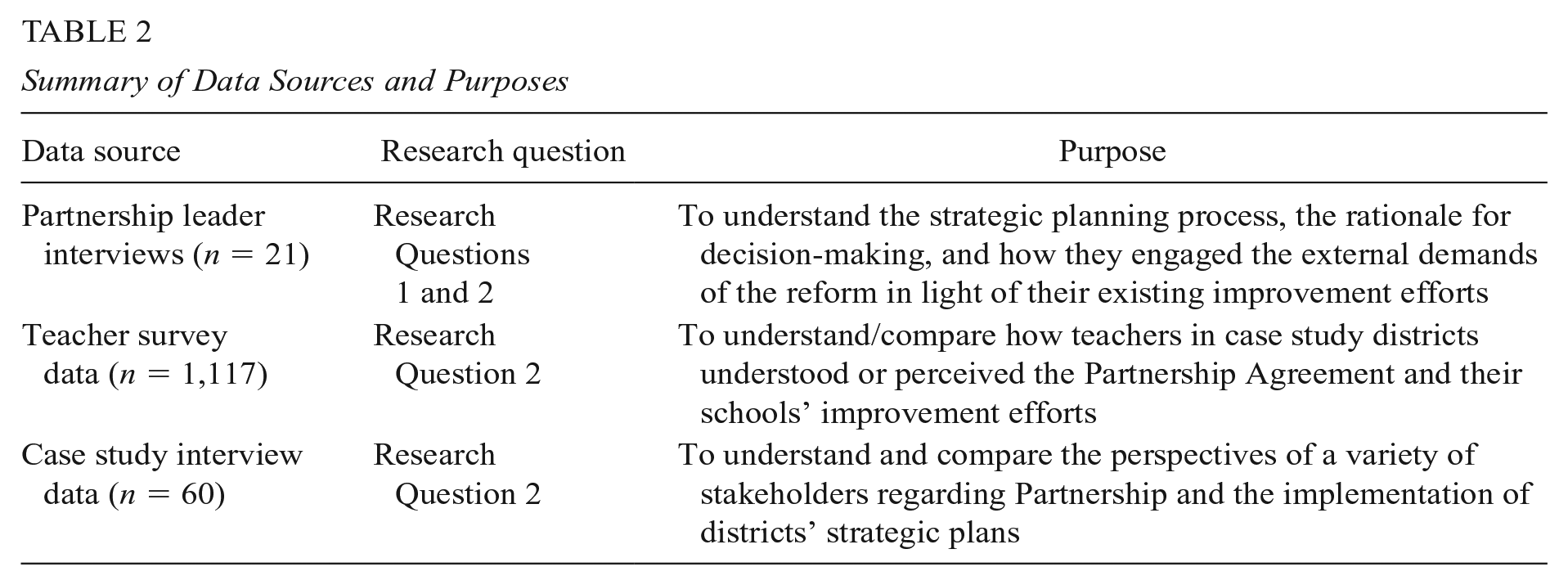
The second stage of data collection and analysis employed an “embedded case study design” which acknowledges that cases have “subunits” within them that have different perspectives or experiences relevant to understanding the larger phenomena (Yin, 2014). We recruited three districts as cases and interviewed teachers, principals, central office staff, and partners as subunits within each case. We summarize the types of data collected and their purposes in relation to each phase of the study in Table 2.
Summary of Data Sources and Purposes
Data Collection: Partnership Leader and Case Study Interviews
We invited all 35 organizations identified for Partnership and conducted semi-structured interviews in 2018–2019 with 21 Partnership leaders. Nine Partnership organizations in this sample were charter schools and seven of these charter schools were managed by four different EMOs which operate networks of schools and act in a similar capacity as a traditional district. We interviewed EMO leaders and two standalone charter leaders who operated in a similar role as a traditional superintendent in the sense that they managed central office support and (in the case of EMOs) leaders at multiple schools.
For district case studies, we interviewed 60 stakeholders across three Partnership district case sites (two traditional districts and one charter network). We first invited central office employees and principals of a Partnership school within each case. Principals emailed available teachers about the opportunity to meet with our research team during on-site visits. Across the study, interviews were semi-structured, lasted approximately 45 to 60 min, and were audio-recorded and transcribed. Questions focused on the context leading to identification, the development of the Partnership Agreement, the implementation process, and perceptions of Partnership. We assigned hockey team pseudonyms and professional titles were generalized.
Data Collection: Case Study Sampling and Rationale
District case sites were purposively selected to capture the variety of responses districts had to the Partnership approach. Initial Partnership leader interviews allowed us to understand how contexts and implementation differed across sites, and we recruited districts purposively based on variations in these interviews. Intentional variation in case selection helped us understand mechanisms and processes that matter to implementation, uncovering how and why differences and similarities in response occurred based on differences in context (Small, 2009). Table 3 provides rationale for these variations based on relevant literature.
District Case Study Sampling Criteria and Rationale
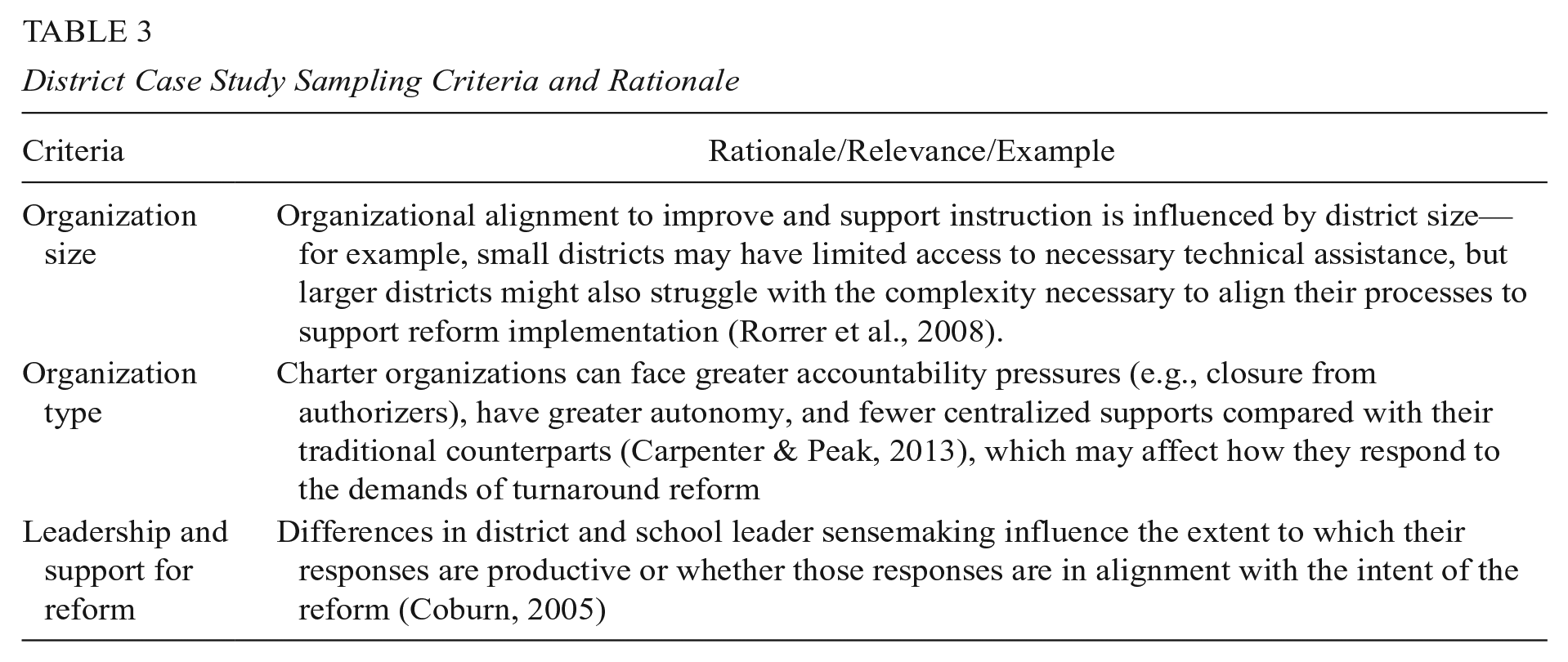
For example, Blues and Penguins both indicated they were experiencing improvements in their Partnership schools but varied in terms of their size, organizational context (charter vs. traditional), orientation toward the reform, and longevity of superintendent tenure. 1 By contrast, participants in Whalers struggled with the politics surrounding policy implementation.
Data Analysis: Partnership Leader and Case Study Interviews
We analyzed Partnership leader interviews using Dedoose software in three rounds of analytic coding. The first round of coding focused on data reduction and was primarily deductive, capturing patterns in how participants enacted the Partnership Agreement. For example, codes included challenges and benefits of the reform, the conditions that impacted coherence of the reform, and the role of various partners in the reform. In this initial round of coding, we noticed two distinct approaches: compliance and a new course of action. These deductive codes were then used to complete an Excel matrix allowing us to look within and across cases for patterns and trends (Miles & Huberman, 1994), for instance, by looking up and down columns allowing us to understand the frequency and nature of bridging.
We used the observations, quotes, and notes from this matrix to create a visualization of district responses using the crafting coherence framework. We coded a third time to finalize categories of bridging and buffering. For instance, pull-in activities, or activities that actively involve outside entities, and shaping terms of compliance were considered forms of bridging and adding peripheral structures, such as creating positions or offices to coordinate Partnership activities, or symbolically adopting external demands were considered bridging-buffering hybrid activities. Suspending ties to the environment activities, such as selectively not implementing PAL recommendations or minimizing meetings regarding Partnership, were considered buffering activities. Throughout each round of coding, we each coded two transcripts independently and then met to ensure we had sufficient inter-rater reliability.
We followed a similar coding process to analyze data from our three comparative case studies, with one important difference: we used a role-ordered matrix (Miles & Huberman, 1994) which facilitates comparison of patterns in codes within roles and across different roles. For instance, we were able to check whether superintendent’s perceptions matched teachers’ perceptions of this same work at the school level, and why these differences existed. We took a similar approach to the analysis of education and community partner interviews (see Table 4), triangulating district leaders’ perceptions with those of partners they worked with.
Summary of Interviewee Data
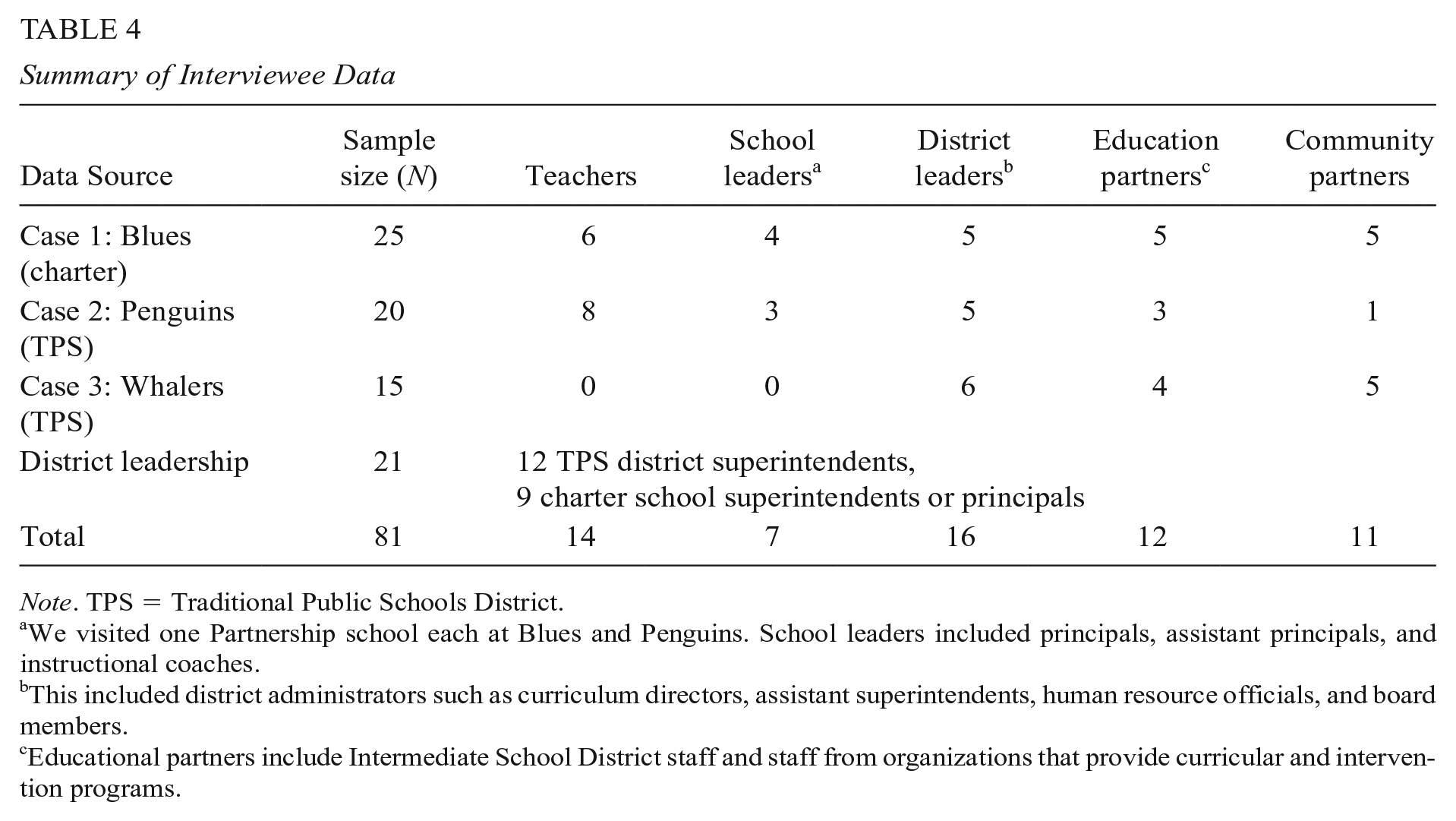
Note. TPS = Traditional Public Schools District.
We visited one Partnership school each at Blues and Penguins. School leaders included principals, assistant principals, and instructional coaches.
This included district administrators such as curriculum directors, assistant superintendents, human resource officials, and board members.
Educational partners include Intermediate School District staff and staff from organizations that provide curricular and intervention programs.
Teacher Survey Data Collection and Analysis
Our survey data were collected in the fall of 2018 as part of a larger study on the impact of the Partnership Model on educator and student outcomes. The survey asked questions on a range of topics that included awareness and understanding of the Partnership Model and school/ district improvement goals, perceptions of supports, culture and climate, the challenges faced by the school and district, and perceptions of school and district effectiveness and implementation. Teachers’ awareness of reforms and messages from the institutional environment can influence how they respond at the classroom level (Coburn, 2004; Finnigan & Gross, 2007); thus, we thought it was important to assess whether and what teachers understood about Partnership.
All teachers and principals in Michigan’s Partnership districts were invited to participate in this survey (n = 7,386), which yielded an overall response rate (RR) of 37.9% (n = 2,799). We analyzed a subset of these survey responses from teachers working in identified Partnership schools (n = 1,117, RR = 42.3%). RRs for Partnership teachers varied across the districts examined in our case studies at 66.7% for Blues, 42% for Penguins, 53.6% for Whalers, and 37.6% in all non–case study districts. We analyzed our survey data using descriptive statistics to examine the average response(s) of teachers in Partnership schools overall as well as how those responses differ between districts. To make survey responses more representative of the larger population of teachers in Partnership schools, we weighted survey responses using an inverse probability weighting scheme that modeled response using teacher and school characteristics, 2 allowing us to make more valid inferences about Partnership teachers’ perceptions of the reforms.
Limitations
Our analyses and findings are limited in a few important ways. First, these are perception data; thus, we are only able to discuss the perceived (rather than actual) impact of leaders’ responses on the coherence continuum. However, perceptions are still important because they relate to understanding the how and why behind implementation processes. Second, we were unable to collect as many teacher interviews as we would have liked in each case district. To address this limitation, we triangulated inferences from teacher interview data with teacher survey data from each case district to ensure conclusions were supported by both sets of data. Our survey results may be biased if unobserved factors made some teachers more or less likely to participate, which could in turn be magnified by uneven RRs across districts. We aimed to address this using a weighting scheme (described above), and as a sensitivity check, we ran analyses using raw, unweighted responses. This yielded similar results, which enhances the validity of our survey results, although this does not rule out bias due to unobserved factors.
Findings
Partnership Leaders Crafting Coherence: Examining Variation in Bridging and Buffering
Districts are considered primarily “bridging” when there was evidence of embracing the Partnership reform through a new course of action. For example, a district that “pulled in” a new curriculum specifically as part of the process of putting together or implementing the Partnership Agreement was considered bridging. Evidence of buffering responses included minimizing the number of meetings or purposefully not engaging in new partnerships. We also identified a variety of hybrid responses. The most common was symbolic adoption wherein previously written strategic plans were aligned to Partnership Agreements, indicating a continuation of efforts already engaged in rather than a new course of action. Overall, we find that districts primarily engaged in three strategies on the coherence continuum (see Table 1) when implementing Partnership Agreements: pull-in activities, adding peripheral structures, and symbolically adopting external demands. We characterize the overall response of the district in a Venn diagram visualization—as some districts had a variety of bridging-buffering responses, they are placed in the overlapping spaces (see Figure 1).
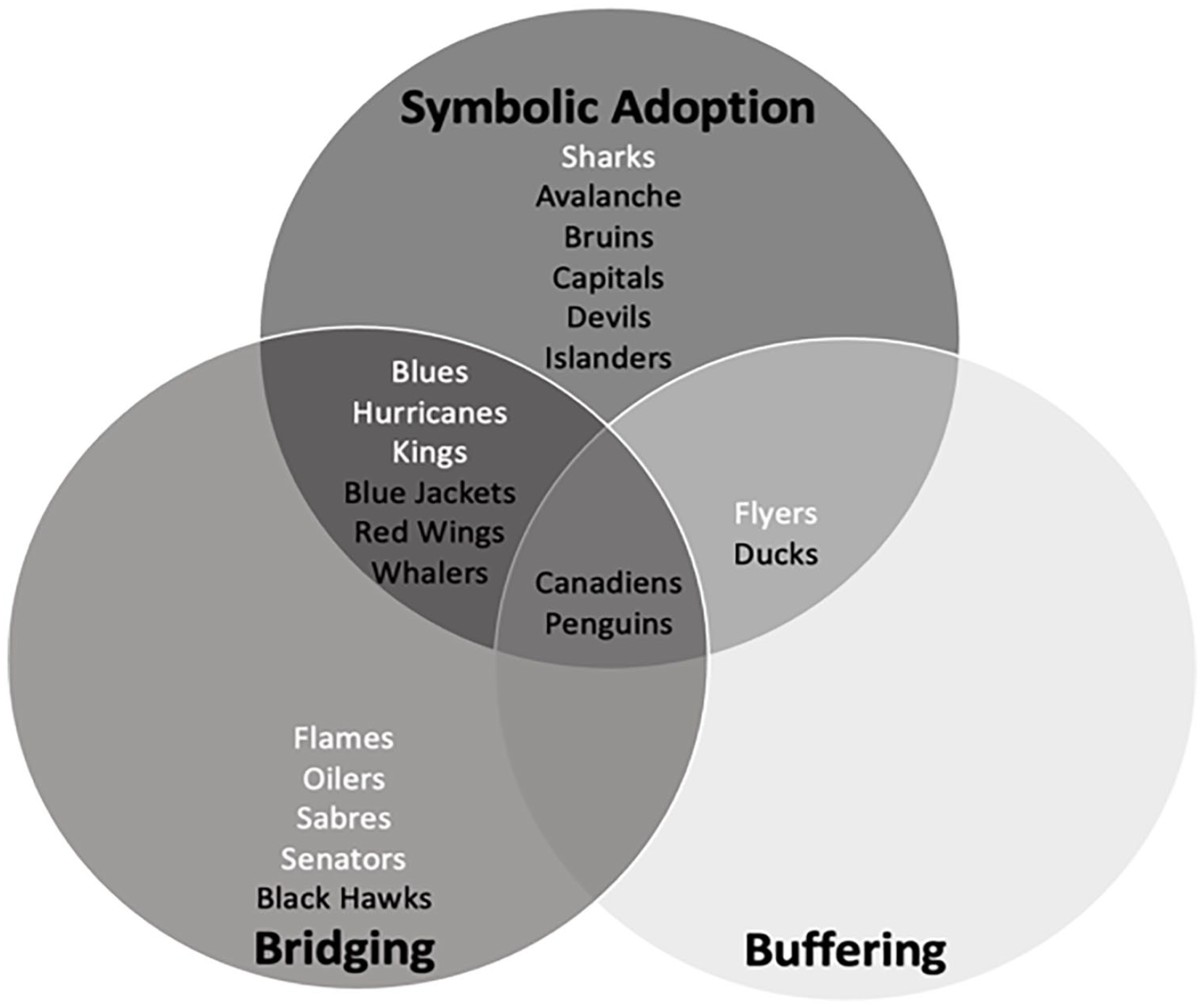
Partnership districts’ bridging and buffering responses.
To better understand this variation in crafting coherence approaches, we focus on what types of activities district leaders emphasized in their descriptions of their implementation efforts (pull-in activities, shaping terms of compliance, adding peripheral structures, symbolically adopting external demands, and suspending ties to the environment). We extend coherence theory by describing bridging to buffering responses in context, emphasizing how variation in the nature and purpose of responses shape and are shaped by contextual factors.
Pull-In Activities
Pull-in activities are efforts to involve others outside of the immediate organization to manage external demands (Honig & Hatch, 2004). More than half of the leaders discussed “pulling in” new partners as part of their implementation efforts and did so to increase their district’s capacity to meet their goals. The leader of Senators said the Agreement helped them to “[get] out in the community and [let] people know that we’re here, we need your help,” adding that this changed their perspective on the role of the community in student outcomes:
Sometimes it takes a village. You cannot do it alone, and you have to be able to have collegial conversations with colleagues, community, to get a perspective of, “What else do I do? How do I continue to do this?” It can’t just be the principal. It can’t.
Here, the leader of Senators emphasized that engaging with new partners could add fresh ideas and perspectives for accomplishing the work. Other districts discussed engaging with partners from their local community to provide enrichment activities, school supplies, teacher training, and wraparound services. The requirements of the Partnership Agreement provided a catalyst to engage more with outside community groups, or as the leader of Kings said, “[our outside partnerships] were in like a rudimentary type of stage right before the Partnership Agreement, but they have blossomed since the Partnership Agreement.”
Others discussed how the reform helped forge a new relationship with MDE, with 18 leaders discussing MDE’s role positively. Hurricanes’ leader indicated that the district’s MDE liaison (PAL) had been integrally involved in the implementation of the Partnership Agreement:
I think the benefit, subsequently since working with [PAL] . . . they have been very helpful in us figuring out how to get support outside of what we can do, because we’re still a small staff, so pulling resources to help supplement what we’ve been doing. I think that that would be the biggest benefit, not only to my school but to any school. Because . . . when you’re dealing with the day-to-day running of a school, you’re trying to improve it all. You’re not necessarily in a space to be able to pull those resources.
In this way, liaisons enhanced the district’s capacity by expanding their knowledge of available resources and helped districts capitalize on other expertise. Most described this collaborative relationship with MDE as “new.” As the leader of Flames noted, “I definitely feel it is a partnership now between MDE and [our ISD] and our schools that we haven’t gotten in the past.”
Charter leaders noted the importance of expanding weak relationships with their ISDs. While ISDs serve both traditional districts and charter schools, most of the charter leaders we spoke to elected not to work with ISDs prior to their Partnership Agreement because of the monetary costs. Partnership allowed them to engage the services of ISDs using new financial resources. The leader of Senators described how the ISD brought new resources to the district:
I realized that there was a wealth of [ISD] resources available in actually helping with student achievement . . . they [also] provided support for leadership. I have a mentor myself. They provide professional development for teachers, as well as support for culture and climate, support with assessment, support with all subjects and getting resources . . . We’re selecting a new curriculum now, and they helped me [determine] that we have the right curriculum resources and development for the staff.
Many other leaders similarly discussed ISD resources that they felt directly built instructional capacity in their district. The leader of Oilers also expressed that the new relationship with their ISD gave their charter school a new advocate in conversations with MDE, saying, “I think it’s been just another person who understands who we are. Whenever you feel that sense of understanding from somebody, it’s a good partner to have.” While the ISD resources were always available to these districts, the Partnership Model provided a shared set of goals and an incentive to increase engagement, including additional funding for ISDs to work with their constituent Partnership schools, which seems to have benefited these districts.
Some also used the Partnership Agreement as an opportunity to make changes to curricula or instructional focus, “pulling in” new initiatives. The leader of Sabres called their approach to providing new interventions “a complete reset” and the leader of Flames said, “there were too many things that were being done just because that’s the way we’ve always done it. It lit a fire under us and just made things very—just to look at it from a different lens.”
Add Peripheral Structures
Honig and Hatch (2004) note that creating new, distinct units to address external demands (or adding peripheral structures) can serve to bridge or buffer organizations from reforms. Leaders in seven districts created new positions, offices, or roles to distribute management of aspects of their Partnership Agreement which helped them manage the demands of the reform and align or coordinate structures to build organizational capacity. Blues used state-allocated grant money for Partnership districts to fund a position to coordinate Partnership Agreement and strategic plan work, specifically tracking progress, preparing for meetings, and working collaboratively to implement new efforts. Black Hawks similarly added a district-level position to review data related to Partnership Goals and communicate with interventionists. Other districts designated someone to coordinate with outside partners, like Whalers:
They communicate with each of the partners on a regular basis in saying, “Okay, you have these goals in the Partnership Agreement. How are you coming with these goals?” They’re pulling information from them every month and creating a document called Partnership Updates.
Districts used the peripheral structures, often data managers, to increase the district-level capacity to manage compliance, communication, and relationships. These positions were typically used in more of a bridging fashion by bringing attention to the Partnership Goals, as coordinators worked directly with teachers and other school staff to review data and strategize.
Shape Terms of Compliance
We saw little evidence of bridging by shaping terms of compliance or making efforts to change the terms of external demands. There was some contextual evidence that districts opposed and actively sought to challenge the state’s approach to chronically underperforming schools. Prior to the Partnership Model, school accountability was administered by the state’s School Reform Office (SRO), a position created by the Michigan Legislature in 2010 that had the power to close low-performing schools. Three districts that were later identified for Partnership filed a lawsuit challenging the SRO’s authority to close low-performing schools. Later, some districts also structured their Partnership Agreements to give them greater agency in backing out of the Agreement. For instance, several districts included clauses in their Agreement that allowed them to terminate it without repercussions from MDE.
However, there was little additional evidence of leaders actively changing the Partnership Model. This could be because the policy left considerable leeway for districts to work within the confines of the reform, specifically as districts set their own goals, and initially consequences, in Partnership Agreements. Because of the policy’s flexibility leaders had some autonomy to shape compliance within the external demands themselves.
Symbolically Adopt External Demands
Many districts symbolically adopted the demands of the reform—even prior to the introduction of the Partnership Model, a wide range of superintendents explained that they were already engaged in intensive school improvement and turnaround work that they then folded into the requirements of the policy. Honig and Hatch (2004, p. 24) note that symbolic adoption can range from adopting the language of demands without the associated actions, showing how existing activities already meet the external demands, and aligning organizational goals and practices to the demands (more than half symbolically adopted in some way—see Figure 1).
Districts varied in the degree of bridging or buffering that occurred even when they symbolically adopted demands in this manner. For example, even when districts aligned their Partnership Agreement with pre-existing goals, we noted that bridging could still take place when leaders used Partnership to push necessary initiatives forward or used the Agreement process to reflect and change improvement processes later (thus locating them in the bridging and symbolic locations of our Venn diagram). As one example, the leader of Blues explained,
What we did in [Blues] was when I first came, we were wrapping up the creation of a five-year strategic plan that coincided timewise [with a series of district reforms]. Then it coincided with the creation of Partnership schools. Because of that, our Partnership Agreement [. . .] was the first three years of the five-year strategic plan.
In this way, we argue that the initial act of writing the Partnership Agreement was an example of symbolic adoption because they demonstrated how “existing arrangements meet or exceed environmental demands” (Honig & Hatch, 2004). Yet the implementation of the Partnership Agreement led to several bridging opportunities (see Case Study section for more detail).
For example, the Partnership Agreement gave Blues the opportunity to reflect on how partners could align with their pre-existing strategic plan goals. This allowed them to eventually identify and add new partners, illustrating how these leaders made changes to meet new demands.
Conversely, sometimes goals and pre-existing partnerships were included in Agreements in less reflective ways with the intent of showing compliance. This buffering form of symbolic adoption could be seen when districts adopted previously determined improvement goals without reassessing how to use the resources of the Partnership Model to meet those goals differently. Several districts were already engaged in the MI Excel Blueprint program, which is a program that guides districts through systems-building in the district. The leader of Avalanche shared “It was just because part of the Blueprint [. . .] we had already put a lot of that stuff in writing. That’s a part of the documentation that was already a part of that work.” The leader of Avalanche said Partnership did not change goals or activities, suggesting a buffering response meant to meet the requirements of the policy. In either case, leaders felt symbolic adoption helped them meet external demands in ways that best fit their districts’ needs. In organizations with limited capacity, time, or those juggling multiple reforms, reusing plans was one way district leaders helped ensure coherence while meeting the demands of turnaround reform, at least on paper.
Other districts symbolically adopted by including already existing partners in their Agreements, rather than using the Agreement as an opportunity to seek out new community or technical partners to address needs. The leader of Islanders said the district selected “pretty much existing partners.” One district leader even critiqued the policy’s theory of action that the Partnership Agreement would encourage districts to seek out new resources within the community as “some blend of naiveté and condescension” because district leaders have often already established such partnerships. Leaders often discussed including community partners in terms of compliance—leaders did not often forge new relationships with community partners.
Being identified for Partnership status did not necessarily drive the districts to implement new school improvement efforts because they were already deeply involved in what they considered turnaround work. Canadiens’ leader summarized how the district tried to holistically approach compounding reforms, even among schools not included in a Partnership Agreement:
Our district is going through so much reform, and a lot of that reform is similar. We’ve had to do basic things linked to reform, like change the curriculum and align it to the standards, apply standards training for teachers, create tools to diagnose school improvement throughout the year through interim assessments. Then group students differently for our interventions. That’s what you would normally do in a deeper way in low-performing schools, but we’ve had to build that culture and those systems district-wide. A lot of it sounds the same outside of . . . and inside Partnership schools.
The leader from Devils puts it this way when asked if the work that is being done under the Partnership Agreement was actually more MI Excel Blueprint work, “You’re talking about the why. I’m talking about the how.” This captures how many districts who chose to symbolically adopt aspects of the reform seemed to feel: that the actual practices or “work” of implementation was more important than whether the work resulted from Partnership demands.
Suspend Ties to the Environment
Because of the requirement that districts craft a Partnership Agreement or face measures such as school closure, we saw limited evidence of districts choosing to not interact with external demands. Districts typically tried to reduce engagement with the reform by limiting meetings. For example, the leader of Ducks talked about protecting principal and teacher time:
[A]n example of that would be the [Partnership Agreement] Liaison check in meeting. They said we want you to have your partners there, your principal, and I was like, ah, no, because there’s no reason for them to just sit in a room for three hours. You meet with me and the district transformation team will update you on progress and keep moving. I don’t believe in capturing people’s time to check a box.
While MDE expected meetings to include multiple stakeholders and their viewpoints, the superintendent of Ducks intentionally limited additional stakeholders’ involvement. Partnership leaders said that turnaround work took considerable time and energy, especially from school-level staff, so leaders buffered them from obligations they felt would add little. For this leader, it was more coherent to have partners and school leaders use their time to implement the actions to meet goals, rather than discuss work already completed.
Some districts actively buffered themselves against working with partners. The leader of Avalanche had negative past experiences with partners that led them to avoid this:
[We’ve] had really bad experiences with some community partners, where they have funding for certain things that don’t align, necessarily, to the work we’re doing. [Nonprofit Organization] has been a partner with us for years but sometimes the way they get funding allocated is for certain things and if it doesn’t align to our mission and the work we’re doing to improve the education of our students, I’m not really interested in doing that just for the sake of having a partner.
Reforms like the Partnership Model that requires navigating multiple stakeholder relationships also require balancing competing priorities, and some leaders recognized that a Partnership is not beneficial if stakeholder goals are not closely aligned.
Interviews with state leaders responsible for design and implementation of the policy emphasized the importance of teacher “buy-in” and awareness of Partnership goals, but district leaders varied in terms of whether or how they involved teachers or made them specifically aware of Partnership, with one or two noting significantly involving teachers in the process, others noting logistical constraints to doing so, and some saying it did not make sense to overwhelm or scare teachers. As the superintendent of Ducks said about drafting the agreement, “[MDE] asked for teachers as well, and I protected them from that.” The next section provides additional evidence (Penguins) of why district and school leaders might choose to buffer teachers from involvement in the demands and language of Partnership.
Case Study Findings: Bridging and Buffering in Three District Contexts
We present case study findings to explain why particular activities along the coherence “continuum” (see Table 1) were enacted and perceived during implementation. We first provide context for each district, then focus on how and why each case bridged and buffered.
Cross-Case Community Context
Turnaround reforms are typically imposed on high poverty, low-resourced schools serving predominantly students of color and our districts were no exception. Both Blues and Whalers are “urban characteristic” 3 (Milner, 2012) cities, have median incomes less than US$30,000, and have roughly three-quarters of the population identifying as Black or African American (U.S. Census Bureau, 2019, 2020). Penguins is an “urban emergent” (see Note 3) city, with slightly higher median income of roughly US$40,000 and a more racially diverse population, with just over half of the population identifying as White and the remaining half constituting residents of color.
Each case experienced years of reforms and chronic leadership and teacher turnover. In Blues and Whalers, trust with the broader community was seen as fragile. Various participants told us that these new superintendents were viewed skeptically by community groups who had experienced a revolving door of leaders and policies and were understandably wary of outsiders and imposed change. Community mistrust was less apparent in Penguins, which had a more established superintendent with many years of experience and the trust of the school board. All superintendents highlighted how underfunded their schools were historically and how difficult it was to compete for teachers with nearby districts who could offer thousands of dollars more. These issues of trust, leadership, turnover, and underfunding severely limit the capacity of teachers and leaders to enact and take up new changes necessary for dramatic turnaround.
Case District 1—Blues: Using Partnership as a Call to Action
Interviews with central office employees, ISD staff, and MDE employees working with Blues, a small urban charter organization, illustrated a variety of new initiatives and strategies such as the creation of a new position at the central office to help oversee and coordinate Partnership implementation, adoption of a new curriculum to meet Partnership goals, hiring new instructional coaches, and regular central office outreach to establish new partnerships with community organizations, universities, MDE, and the local ISD.
Central office employees felt positively about new changes but not necessarily teachers because of issues with chronic turnover and teachers’ concerns about new initiative overload and associated feelings of being overworked. Blues is an example of an attempt to use Partnership reform as a tool to bridge and create new resources and change in the district, yet this case also highlights the challenges of seeing the results of these changes at the school level.
Case District 2—Penguins: Strategic Bridging and Buffering
Penguins is a mid-sized urban district with stable superintendent leadership. Numerous stakeholders (from the board/district/school levels) described the superintendent as a strong leader who had created coherent plans and partnerships over the years. They were largely symbolically adopting the Partnership Model in the sense that they used these pre-existing strategic plans and partnerships to comply with the requirements of the Partnership Agreement. However, the superintendent also used the reform to strategically accomplish Partnership goals (bridging) that would otherwise be a “political nightmare.” This case shows why leaders chose to buffer teachers from the time and demands of the reform, presents evidence about teachers’ lack of awareness of the policy, and links this to leaders’ deliberate attempts to buffer teachers.
Case District 3—Whalers: Partnership Implementation Undermines Improvement Efforts
Whalers was trying to implement new initiatives to meet the recommendations of the Partnership reform. For example, central office staff explained that the new superintendent devoted considerable time reaching out to and meeting with new community partners that might help them meet the district’s Partnership goals. They felt this took away the leader’s time from implementing important new instructional and curricular initiatives that had been put in place just before the Partnership policy took effect. These new changes also exacerbated tensions within the district and placed additional demands on an already capacity-stretched organization.
Bridging in Blues: Calls to Action Hampered by Turnover and Burnout
In Blues, participants working at the district level unanimously reported that the new superintendent was an inspiring leader and instrumental in implementing changes. For example, one district administrator said, “I will tell you that this district would not be where it is without [superintendent]. They’re the force behind this turnaround.” This highlights how various central office personnel viewed turnaround efforts and the superintendent positively.
The superintendent of Blues as the “force” behind the turnaround used the Partnership Agreement to communicate urgency for new initiatives and desired changes. They explained,
For me [Partnership] gives a little bit more teeth behind it sometimes. Sometimes when we’re like, “Okay, should we do this, should we not?” We sat down and looked at the data. It stunk. It mirrors our MSTEP data or our SAT data that says less than ten percent of our kids are proficient as readers. We said, “Okay, so what are we going to do about this?”
Here, the superintendent explained a committee’s debate about when to implement a plan to address reading. They discussed whether to wait another month so that teachers would not be overburdened. Ultimately, Partnership was a way for the superintendent to advocate for more urgency: “How do we help the teachers feel this urgency? That’s where I think the power of the Partnership can come in if you capitalize on it, like, look, [we’ve only got so much time].” The district leader used Partnership to “pull in” new curricula to meet goals expediently.
Teacher survey responses in Figure 2 suggest that the superintendent’s message was clear. Educators in Blues reported greater awareness of the district’s Partnership Agreement (91% compared with 44% in Penguins, 63% in Whalers, and 49% in non–case site districts) and greater understanding of why they were identified as a Partnership school relative to other case sites and to the full survey sample of Partnership educators, as shown in Figure 3 (4.1 out of 5 compared with an average of 2.7 out of 5 for Partnership educators in our full sample).
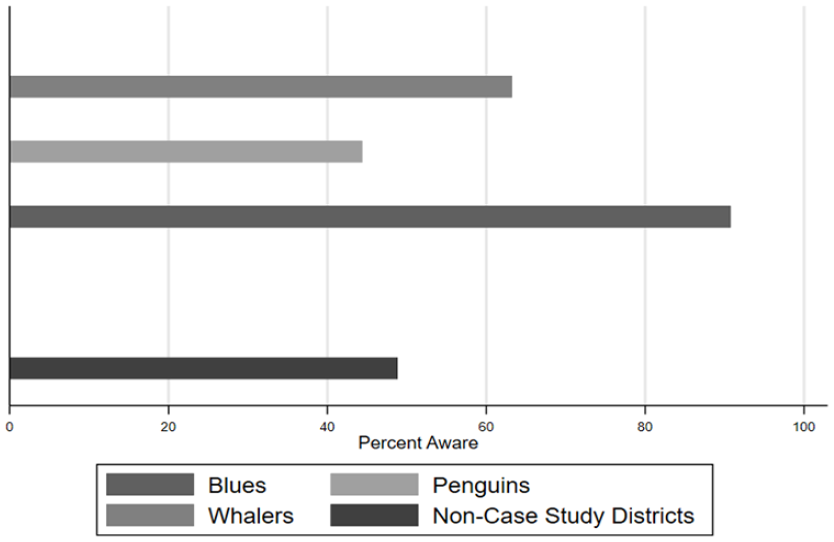
Teachers’ awareness of partnership.
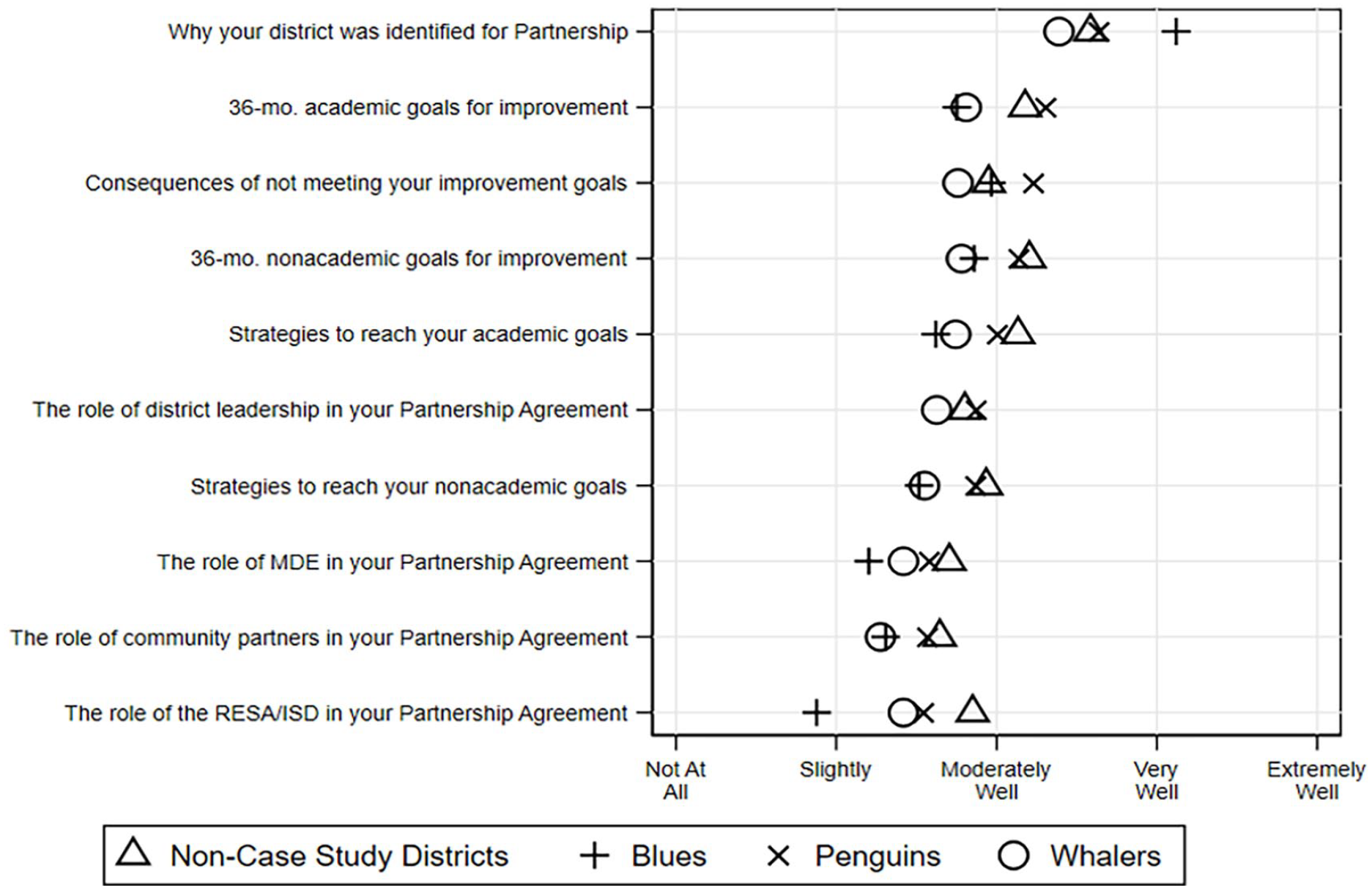
Teachers’ understanding of their Partnership Agreement.
As noted, many new initiatives were underway at Blues to accomplish the difficult work of turnaround. Despite excitement about this change, implementation was challenging. Stakeholders at every level cited teacher turnover as perhaps the greatest challenge to reform implementation. In a set of survey items that asked teachers the extent to which a range of factors hindered progress toward their school’s improvement goals, educators in Blues’ Partnership schools identified teacher turnover as the greatest hindrance. As shown in Figure 4, teachers in Blues rated the “high rate of teacher turnover” as a much greater hindrance in their district compared with the other two cases and all other Partnership districts.
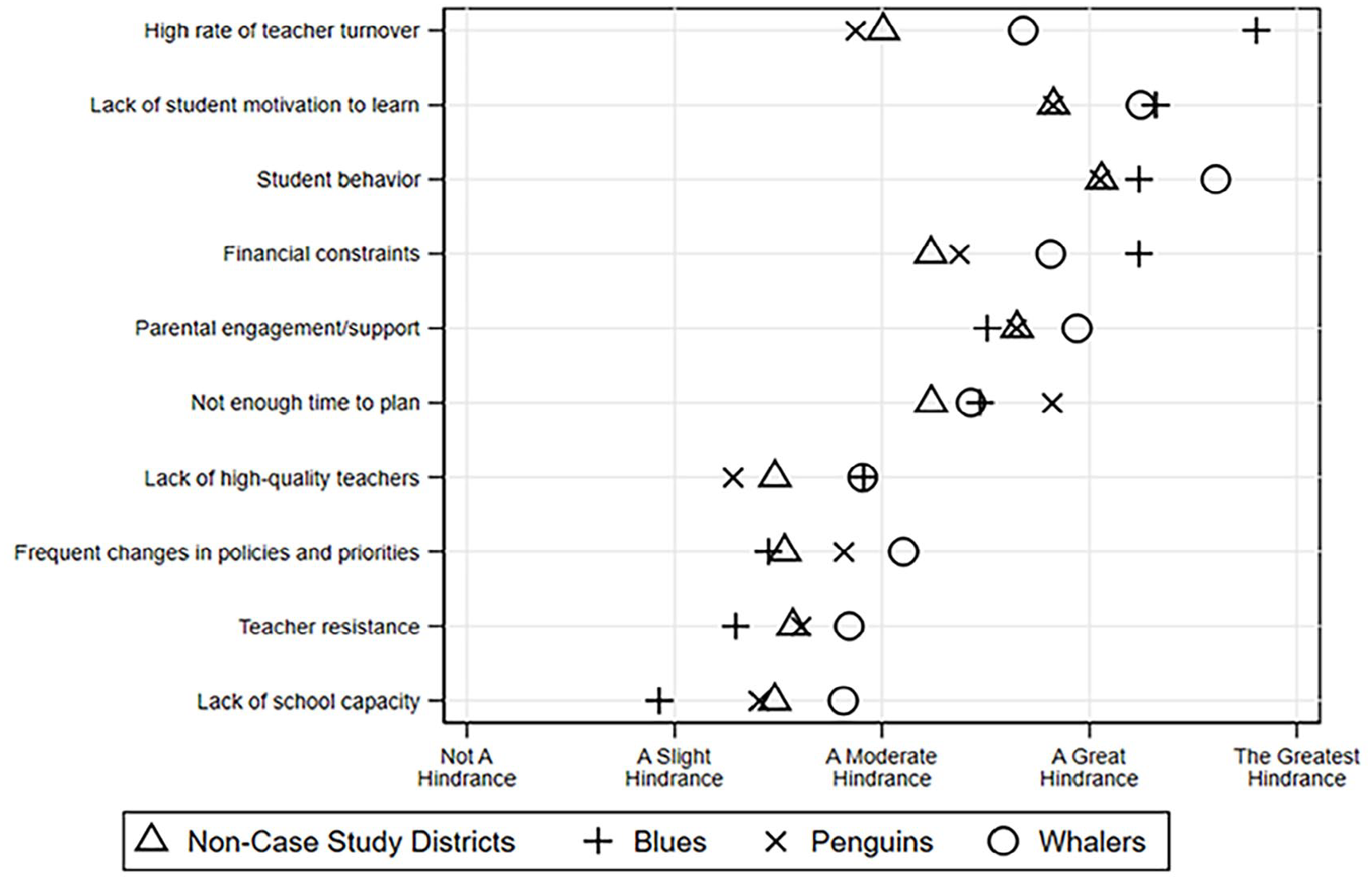
Hindrances to school improvement.
The superintendent also cited turnover as one of their greatest challenges. They explained, “Every year we put $100,000 into training our staff, and then the next year half of them leave.” Teacher turnover proved to be a compound problem that affected new policy implementation efforts—the “trickle down” effects of educator instability inhibited turnaround efforts in Blues as it became even more difficult to implement necessary reforms. Educators throughout Blues made this point in various ways. For instance, a district employee explained that staff had to familiarize and train new (and existing) employees and that these intensive processes needed to be repeated for each new wave of employees. They explained,
We have to intensely focus on those new people coming in, making sure that they know all of the pacing guides, the curriculum, resources when they need additional help, who to go to. There’s a lot of things that aren’t in place here, so we’ve been spending a lot of time trying to create systems.
This was a tricky dynamic for district personnel, as they worked to simultaneously implement many different programs and systems amid substantial teacher turnover. One teacher expressed a common sentiment about staff “resistance” to all the different demands: “It’s hard for us to get on-board with stuff, and it might sound really good and exciting and we’re ready to go, and then at the last minute, ‘Oh, here’s 20 other things that need to go on.’” In sum, bridging efforts to implement various new initiatives amid chronic turnover might have exacerbated burnout.
For example, another teacher explained that constant turnover made it difficult to “build working relationships with colleagues.” A district employee focused on instruction described why turnover caused persistent issues with getting teachers necessary professional development:
We started to spin our wheels again this year even though we have these systems now. It was just like every third day we had new staff . . . To train them and to spend the time with them was taking up [most of] our time. We never got our feet off of the ground. We have decided that once a month on Fridays is our new staff onboarding. Our principals [cover] the rooms for that day if they have to . . . Hopefully we can find someone to help cover classes, but I know this week for sure a couple principals will have to go in and support our Friday PD to pull the teachers out to give them that.
This quote highlights difficulty finding substitute teachers able to cover classes, which meant that instructional leaders often found themselves doing so, which took precious time away from their leadership and coaching responsibilities—all in an effort to train the revolving door of new teachers (referred to as “[spinning] our wheels”). Another teacher also noted, “We have lost too many teachers. Last year, we were combining classes. That’s what started it. No planning periods, burnout. It’s already hard enough in this district if everything ran smoothly.”
New decisions as important as the curriculum and instructional programs needed to accommodate staff turnover. One district employee explained that one of the reading programs was specifically selected to deal with the problems of constant churn:
One of the things that we did, honestly, [was] take into account teacher turnover. That is one of the reasons why we chose the language arts program that we did because anyone literally could come in, and it is a scripted program. It’s aligned to Common Core, and it’s exactly what we needed, that if we had a long-term sub come in, say, “They left off on lesson three. You need to start with lesson four.” That you can go in and start with lesson four on there. That was one of the things. I know that we should have teachers put their own spin on things, but we personally, the district needs something that is more scripted, so somebody can just come in and move on, and if they did lesson three, then they can do lesson four. Then if someone else comes in, then they can do lesson five.
The curricular decision was made in part to help with the issue of turnover, and indeed, turnover only compounded the demands and stress of the job because it took substantial time and resources away from other initiatives. These examples starkly illustrate how turnover impacted capacity-building efforts aimed at meeting the goals and demands of Partnership.
Bridging and Buffering in Penguins
In contrast with Blues, Penguins’ district and school leaders largely buffered themselves from the demands of Partnership. As one school board member puts it, “[Penguins] does what it was going to do anyway.” District interviewees described symbolically adopting many of the external demands of the reform (e.g., listing pre-existing partners/partnerships in the Partnership Agreement, using their district improvement plan and associated interventions as the basis of their agreement, etc.). However, the district did use the sense of urgency to institute difficult changes that district leadership preferred but might have been untenable without the reform.
Specifically, the superintendent used the Partnership reform to accomplish the goal of changing a Partnership school’s “toxic” culture. They felt this could be accomplished by reconstituting and changing the composition of the school, including students (e.g., changing the grade configuration at the school), teachers, and the school leader. The superintendent noted that pursuing this strategy was often a “political nightmare” that would face opposition from the union or local community. But like others in our study, this superintendent felt that the policy offered an opportunity to navigate those politics and implement this difficult change. Teaching positions were posted across the district, current teachers had to reapply for their positions, and a new principal was hired to lead the reconstituted school. The superintendent explained,
Sometimes there are schools that just need to be shut down and restarted. We have done that with a few of our schools. We’ve taken full advantage of the option to do a turnaround as opposed to transformation. By saying we’re hiring staff from the beginning now, the principal’s going to be hired. We just started all over again and set the expectations for what you want.
Like in Blues, educators at Penguins also identified staffing as one of their biggest challenges for their urban district. Unlike Blues, however, Penguins was able to resolve some of these staffing issues by reconstituting the Partnership school. Reconstitution was a bridging strategy that helped bring in new leadership and allowed them to attract and hire staff that would help turn around the school’s academics and culture. Participants unanimously viewed this new principal as a strong leader capable of leading the turnaround work, and many credited her with early changes in school systems and culture and climate, as one district administrator explained:
We picked an administrator from a school that has historically had [a similar student population] and then we moved them over to [case site], and they’re a strong administrator. As a result of the population change and the change of administration and the [new programming] that’s been I think a significant reason why we’ve seen changes in the culture and climate of that school.
Some teachers cited the principal’s leadership as a reason that they chose to teach at this school. For example, one teacher who followed the principal explained his or her motivation to move:
They’re a good principal. They really do care about the teachers here. They care about the students. They’re fair. They treat everyone equally . . . They’re being pulled in so many different directions, but they’re someone you can really depend on. I really followed them along with [other teacher].
Another teacher moved to this school after hearing about the new principal:
Before I made the decision to leave my school I was fishing around to see, “What do you like about this school? Should I [apply to] this opening here?” Everyone kept saying, “[principal name]. You want to get [principal name], they’re great. They listen to the teachers. They’re what a principal should be.”
In this way, the strategy of bringing in this new leader helped the district address the common challenge of attracting well-matched educators to work in Partnership schools.
In contrast with Blues, the district and principal were careful not to overwhelm teachers with too many new demands and buffered them from the language of Partnership. For instance, the principal explained that the conversation around goals was not necessarily a conversation about Partnership. Rather, it was a conversation about the school improvement plan. They explained that there was not really a need to discuss Partnership explicitly because so much change was happening at once. Similarly, when asked about teacher awareness, the superintendent said, “I would say principals are [aware of Partnership]. They’ve been to the meetings . . . I think I’d be an ostrich putting my head in my sand if teachers were.” In other words, the district and the principal used language with which teachers were already familiar, “symbolically adopting” the reform while also seeking to explicitly buffer them by doing so. This made sense to them from a leadership perspective given all the other staffing and culture changes transpiring in the newly reconstituted school. Corroborating this, none of the teachers we interviewed reported being aware of what the Partnership Agreement was, although they knew what a priority school (the prior policy term for a Michigan turnaround school) was. As one teacher said when they confused Partnership with Priority status, “I don’t know. I guess in my mind it’s all lumped together.” Although teachers in Penguins were generally not familiar with the specifics of their school’s Partnership Agreement, they were aware of their school’s larger improvement efforts and rated them favorably when compared with teachers in other districts. Figure 5 illustrates teachers’ evaluation of different dimensions of their school’s overall improvement goals. This shows that teachers in Penguins gave more positive ratings about improvement goals than those given by teachers in other districts. This suggests that leaders’ intentions to buffer teachers did not necessarily affect teachers’ perceptions that reform goals/efforts were sound.
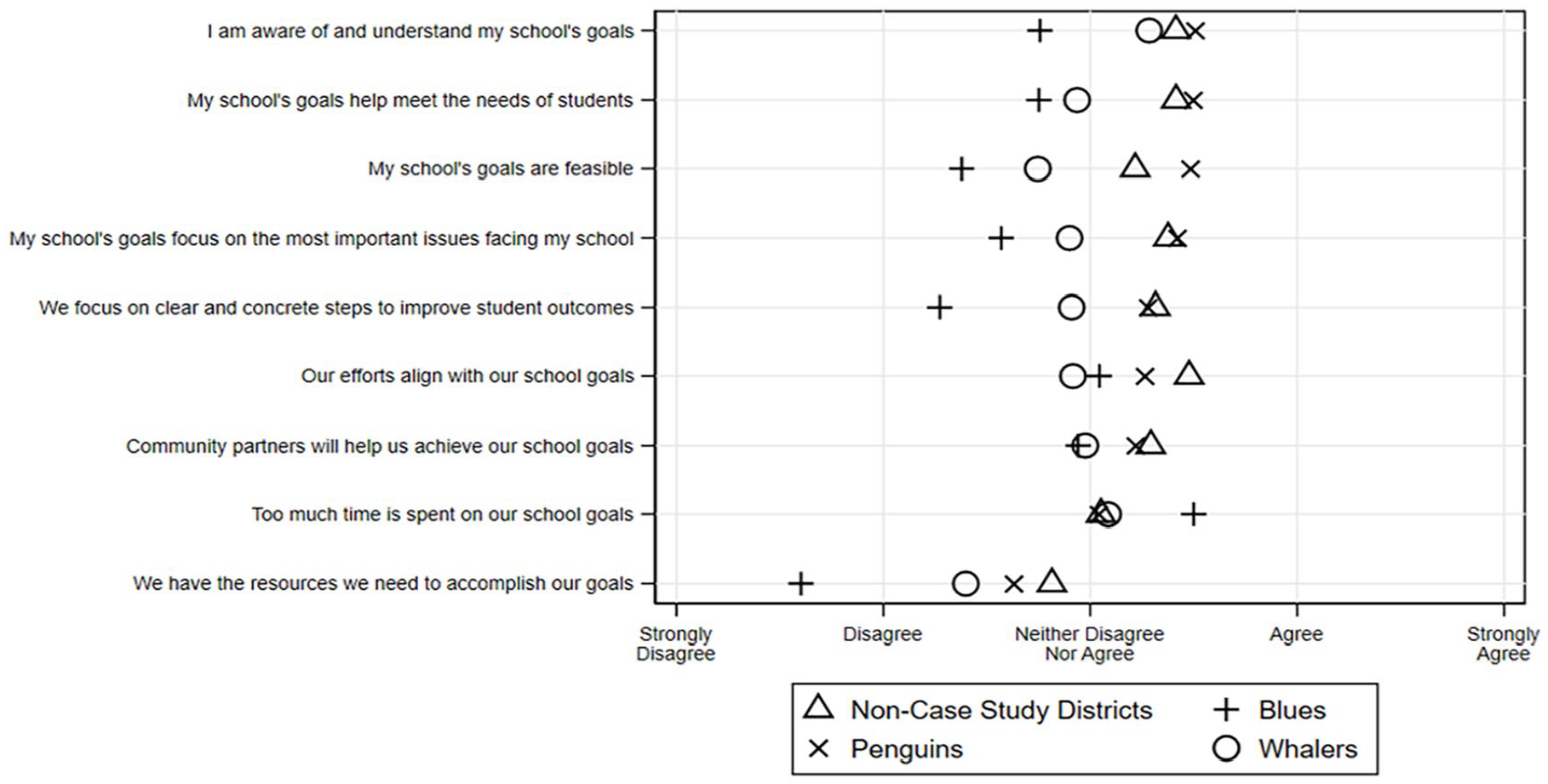
Teachers’ evaluations of school goals.
Whalers: Bridging and a Need for Buffering?
This case highlights how compliance with reform demands can undermine rather than bolster school improvement efforts. The superintendent of Whalers led an effort to create the Partnership Agreement—crafting ambitious new academic and nonacademic goals and spending considerable time creating several new community partnerships, making a strong effort to pull in outside organizations. However, district employees and local ISD partners said it was extremely difficult to craft shared goals because of distrust between the community, school district, and the board, and disagreement about what was best for the community. One district employee explained, “there was some disagreement on what the board was wanting us to do, what [superintendent] wanted us to do, what the Partnership Agreement was trying to do.” Good faith attempts to comply with the demands and trying to bridge to new resources suggested by the policy ended up taking precious time and attention away from other improvement efforts.
Specifically, district staff noted that the superintendent had already developed instructional and curricular systems for school improvement, but the compliance and partner-building elements of the reform were drawing them away from that work. One explained,
Now we’re supposed to get help from all these other [partners]. [The state] wasn’t really clear on how we were going to do that. I think for the situation the district was in, it added another level of complexity in the midst of a situation where we already don’t have enough. It’s not just money resources. It’s people resources, too, and ability, and the skill and the will of the folks who are here every day trying to make a difference. It became one more thing to do . . .
Another district administrator agreed that the time spent was “more trouble than it was worth,” echoing the idea that they were spending too much time and manpower in a situation where they “already [didn’t] have enough.” When asked about the process, this employee added,
Has [Partnership] impacted us? It’s impacted us negatively. It stops the work. It doesn’t promote the work, unfortunately. As soon as this Partnership hit, we stopped. Halted completely. [Our other work] was dead in the water because we spent so much time, weeks at a time, all day in this room knocking out the Partnership. That was us. Then . . . when our part was written . . . [superintendent] has been out of the picture working on bringing in partners, meeting partners.
This sentiment underscores how bridging hampered efforts to implement existing school improvement efforts. Another district administrator expressed agreement with this sentiment when asked what advice they would give to a district entering Partnership:
My first advice would be to take the work that you’re already doing and look at it. Use your data, look at it, and go from there. Don’t try to do something different. Try to be a little more forceful with MDE and your partners. Maybe limit the number of partners, then get some very specific commitments from them before you embark on this . . . When you get down to it, the partners don’t really do much.
In essence, this district administrator recommended symbolically adopting the Partnership Model, somewhat like Penguins had done, by using prior school improvement goals/initiatives.
Second, attempts to create the Partnership Agreement required consensus building and ended up exacerbating the already difficult relational dynamics between the district and the community. Nearly everyone we interviewed acknowledged the lack of trust between certain district employees who were themselves viewed as “outsiders” and the board as the elected embodiment of the community (“insiders”). One district employee felt that while the superintendent was working to implement Partnership reform by building strong relationships with external partners, they should have been investing more time addressing this distrust:
I think [superintendent] built his/her relationships with [state agency] and some of the partners, and maybe didn’t have a strong relationship with the board. I’m not sure that’s good for the district. The Partnership is intended to be reflective of the community, but I think it only reflects a portion of the community, whereas the board is elected by the community. Whether we’re happy or not that they’re our board, they are our board, and they’re elected by the folks who pay for this district. I think if you’re going to prioritize external relationships, probably the board relationship has to be stronger than the actual partnership.
The board reportedly mistrusted other technical partners. An ISD partner who was sent to work with the district felt there was initially some pushback from the board to ISD involvement:
When I took the job I felt like I was coming in to—I don’t know—for lack of better words, trying to come in and help save the district. After I got here, I didn’t get that feeling from the community and the board . . . The board president at that time in several board meetings referred to—and I took it very personally at first, and I had to learn not to—but the board president at that time would say, “Those people from [highway] and [highway],” referring to those of us that do not live in the community and drive in, and never had a lot of positive things to say.
Considering community/board distrust of outsider involvement, interviewees suggested that creating partnerships potentially increased conflict between the board and the superintendent.
An ISD partner indicated that the board relationship was a challenge for the district leadership because the board frequently became improperly involved in decision-making:
I think . . . certain school board members not knowing their role as a board member. They get involved with employee evaluation decisions and hiring decisions. They don’t properly delegate that to the superintendent. Also, is it interference because they’re muddying the waters, they aren’t letting HR and the process work? They’re jumping in or requesting that an employee be terminated or non-renewed based on hearsay or some personal interaction they’ve had with the person.
Several interviewees referred to this cross-over of responsibilities as a failure of the board to “stay in [their] lane.” This sentiment was repeated in terms of pressures they felt from MDE. Although most superintendents/leaders mentioned an improved relationship and strong support from MDE, the Partnership Liaison appointed to help Whalers was perceived as less helpful in their support role than liaisons in other districts. This contrasted sharply with experiences in Blues and Penguins, where liaisons aided and facilitated connections for district leaders as needed. It was not that the Whalers liaison could not or would not try to help—to the contrary, one district administrator reported that the liaison worked to support the district. They said,
[Liaison] was already here supporting us in various ways . . . They offered a voice from MDE to help guide us in creating the goals, some of the narrative pieces as well. Once we created it, we kind of ran things by [them], and [they] offered input . . . that was the support personally that was there.
However, another district administrator felt that the liaison engaged with community politics in a way that did not fully support to the district’s reform efforts. This district staff member stated,
The meetings that [we] were at yesterday, it was confirmed that our liaison is [. . .] painting a different picture than what exists. It’s [like] which picture do you believe? Ours, which is not great, we’re zero performance, we’re climbing right? We’ve always been very transparent about our challenges. Or her/his [picture] where, you know, you’re just not working, not doing anything.
Finally, district administrators also spoke about the liaison “staying in [their] lane,” as some felt that they were given directives about what they needed to do rather than being supported to implement the plan they had already collaboratively established. As one district employee said, “[Their approach] is ‘You will do this. This is what needs to be done. Do it now.’ . . . It’s more that top-down hammer approach.” This fueled some distrust between the district and MDE.
Ultimately, these district-board-MDE dynamics alongside new efforts to enact Partnership contributed to leadership turnover in the central office. Interviewees described how the superintendent’s efforts to create new, ambitious academic goals and new partnerships in the community were perceived negatively by the board. This led to decisions being made that resulted in turnover of multiple positions at the district and ultimately, an inability to maintain continuity and cohesion around Partnership and other school improvement efforts.
Discussion
This study used the crafting coherence framework to focus on how districts and schools implemented Michigan’s Partnership Model, which targeted the district and the superintendent as the key unit of change in school turnaround work. In the initial phase of the study—our analysis of superintendent interviews—we found that the flexible design of the policy encouraged a variety of bridging strategies focused on pull-in activities such as engaging in new work with external partners or adding peripheral structures (e.g., district-level positions) to help manage new policy demands. We saw less evidence of buffering or direct challenges to the policy compared with other responses on the coherence continuum because the policy asked districts to either create goals and terms for a new 3-year Partnership Agreement or accept punitive accountability measures. The most common response we heard from superintendents was a blend of bridging and buffering termed symbolic adoption (Honig & Hatch, 2004). For example, districts and charter organizations did this by using prior strategic plans and inserting existing partnerships into Partnership Agreements. Turnaround districts that are constant targets of reform may find it difficult to change directions and end up “spinning [their] wheels”—working with existing plans even when drastic change is warranted (Hess, 1999). Even when districts symbolically adopted Partnership, there was variation in district support for it, with some expressing positive feedback about the reform and the supports associated with it and others simply going through the motions of compliance. This underscores a need to understand differences in outcomes and motivation when symbolic adoption occurs.
This study adds to our understanding of the crafting coherence theory by (a) using data from multiple districts to portray the coherence continuum and illustrate variation in bridging and buffering responses and (b) triangulating perspectives from the district with those of teachers and principals in schools during the policy implementation process. While symbolic adoption can help maintain coherence while still meeting the goals of policies, it remains unclear whether symbolic adoption signals actual support for reforms. Studying whether the threats of probation influenced teacher motivation to meet policy goals in Chicago, Finnigan and Gross (2007) found that teachers’ awareness of accountability threats could change their practice and focus their efforts to meet policy goals. Therefore, district responses are important to understand considering that the language and goals of policy might influence teachers’ efforts.
Our analysis of district comparative case studies illustrated how and why strategic buffering could be beneficial for policy implementation. In Blues, district leaders felt strongly that new initiatives and efforts were positive, yet some teachers expressed feeling overwhelmed with excessive change and chronic turnover, echoing findings from Malen and Rice’s (2004) study of schools experiencing organizational freneticism when attempting to implement multiple new initiatives in response to accountability policy. In Penguins, symbolic adoption of the reform created efficiencies while strategically buffering teachers in the newly reconstituted school from Partnership may have helped insulate them from being overwhelmed by too much change. Finally, Whalers lacked the capacity to sustain their prior improvement efforts while simultaneously engaging with the various new demands of Partnership, which resulted in conflict, leadership turnover, and stalling or failure of improvement efforts. Building on Honig’s (2009) work that illustrated conditions for productive bridging and buffering at the central office, our study provides explanations for how and why efforts to bridge can be counterproductive when external demands overwhelm a district’s capacity to enact change.
In addition, Penguins illustrated the potential for buffering, while Blues and Whalers showed how some degree of buffering might be warranted to create coherence, especially when districts are extremely challenged by recruiting and retaining educators. Prior work on crafting coherence focused mainly on school-level responses, and this study highlights the importance of understanding how districts and schools interact during the policy implementation process, as responses and initiatives at one level (the district) may be perceived very differently by another (school level) in ways that influence implementation and policy coherence. Indeed, in the case of Blues although district leaders felt positively about new efforts, teachers described new initiative overload, complicated by the need to deal with issues of staffing and chronic teacher turnover. This example illustrates the need to understand perceptions of policy implementation at both the district and school level, especially when districts are policy targets.
Our findings further illustrate why and how district capacity is a critical mediator of the effectiveness of reform implementation and efforts to bridge or buffer. When district capacity is already low, attempts to bridge and create new change could further weaken and strain improvement efforts without concurrent efforts to buffer and create coherence between new and existing demands. District leaders faced with overwhelming demands and limited capacity should strategically bridge and buffer in ways that align multiple efforts and create greater coherence (Honig, 2009). This is particularly important in Michigan which consists of many smaller organizations, because small districts/charters often have less capacity compared with larger districts to implement reforms (Rorrer et al., 2008). As teacher supply and turnover are such strong mediators of the effectiveness of turnaround policy implementation (Henry et al., 2020), policymakers can work to increase the capacity of districts to address this key problem. While greater financial resources might help districts provide new curricula or additional professional development, leaders face barriers in deploying these resources to stabilize staffing, especially in the long term. This may be particularly important for charters that disproportionately struggle to recruit and retain educators nationally (Torres, 2016) and in Michigan (Levin & LeMee, 2021). Despite this, Partnership leader interviews suggested that supports were particularly useful in enhancing the capacity of charter networks by “pulling in” additional technical support partners that were previously unavailable to them, like regional ISDs. Indeed, the added supports from MDE and ISDs helped explain why all but two of the charter schools in our sample were in the “bridging” continuum. While adding new technical partners like ISDs can enhance capacity, the experience in Whalers showed that adding too many pull-in activities could stretch it. Although MDE Partnership liaisons were largely seen as supportive in Partnership leader interviews, Whalers illustrated how they also could exacerbate existing tensions in counterproductive ways. This highlights the difficult balance between the accountability and support functions that State Education Agencies play in supporting educators through school improvement reforms.
Policymakers impose turnaround reforms with hopes of improving student outcomes, and they assume this requires substantive changes in existing practices (Strunk et al., 2020). Yet our study reinforces the idea that district and school leaders must be thoughtful about deciding whether and how to make changes in response to a policy’s demands. Our findings suggest that bridging and buffering influence the coherence of turnaround depending on the context: the existing capacity of the organization (including current initiatives and educator supply/turnover) and trust between a variety of stakeholders are especially important conditions that can create or undermine coherence and that may influence whether bridging or buffering is warranted in any given scenario. Although buffering may be productive in some scenarios, districts also need to consider the potential costs of excluding teachers from policy and implementation demands. Teacher interviews and survey responses suggest that less control over reform at the school level could be related to decreased school-level educator motivation for change. Leaders must be thoughtful about when and how to involve and communicate with teachers, balancing the potential to overwhelm them with the need to increase motivation and buy-in for changes.
This study shows that the Partnership Model has some merit as an approach to turnaround (Burns et al., 2023). Most of the leaders we interviewed expressed satisfaction with the supports and resources provided by the state, and they generally appreciated having some flexibility to create their own goals and plans. However, this study underscores the promises and pitfalls of crafting coherence, as some districts were able to use the reform to their advantage while others floundered to some degree when attempting to implement new plans. Given the implementation issues we saw in our case studies, districts should carefully collaborate with school-level staff on potential initiatives and evaluate the capacity of schools to implement them.
Although new narratives and policies are positioning the district as equally or more important to school turnaround (Meyers, 2020; Zavadsky, 2012), an enduring policy dilemma persists around the degree to which schools should have more autonomy and control from the district over how the work gets done (Bulkley et al., 2020; Gamson & Hodge, 2016). While governance reforms like PMMs often strive to give schools greater autonomy from the district, this can create tensions and missed opportunities as districts invest less in capacity-building supports for schools (Bulkley et al., 2021). The Partnership Model may represent the opposite kind of reform, in which districts rather than schools are given substantial control over turnaround and how to best meet student achievement targets. Johnson, Marietta, Higgins, Mapp, and Grossman (2015) illustrate how different districts achieved coherence with both centralized and decentralized approaches. What mattered was whether and how the district supported and got schools invested in new initiatives, not simply the degree of centralization. Given tensions between autonomy and capacity, rather than simply providing autonomy to districts, policymakers can ensure that districts and the State identify needs and provide appropriate supports. The Partnership Model is well suited to striking this balance because MDE provides liaisons for communication and support.
Partnership is potentially a policy reversal from “bottom-up” reforms from the last two decades and acknowledges findings on the importance of districts as “gatekeepers” of reform (Spillane, 1996; Spillane & Thompson, 1997). In terms of coherence, reforms that enhance practitioner autonomy might lead to greater degrees of bridging and symbolic adoption because educators have greater power to control how they respond to policy directives, whereas reforms that are more top-down might lead to greater resistance and stronger efforts to buffer when directives are not well matched with the context, goals, and motivations of educators or families, as we see in cases such as the enactment of school closure (Wilson et al., 2023). Lines of authority can blur between districts, state education agencies, principals, and teachers, who all have responsibility and power to create and be accountable to change but may have different ideas and motivations when it comes to what is needed to meet policy goals. Thus, our study underscores the importance of collaboration, trust, and strong communication in reforms like Partnership because each context and the people within them are different.
Footnotes
Acknowledgements
We are grateful to the many people who gave their time in support of this work, including research participants, and those who provided technical and research support. We would like to thank Dr. Josh Cowen and Dr. Katharine Strunk for their support on this larger research project and for providing input on early drafts of this paper. We would also like to thank research partners at MDE such as Dr. William Pearson, Dr. Venessa Keesler, Dr. Gloria Chapman, and many staff at Michigan State University’s Education Policy Innovation Collaborative (EPIC) for their assistance.
Declaration of Conflicting Interests
The author(s) declared no potential conflicts of interest with respect to the research, authorship, and/or publication of this article.
Funding
The author(s) disclosed receipt of the following financial support for the research, authorship, and/or publication of this article: We would like to thank the Michigan Department of Education (Grant Number 180000000795) and the Institute for Public Policy and Social Research (IPPSR; Grant Number GS100355) at Michigan State University for funding the research reported in this study. Results, information, and opinions represent the analysis, information, and opinions of the author(s) and are not endorsed by or reflect the views or positions of grantors, MDE, or any employee thereof. All errors are our own.

Notes
Authors
A. CHRIS TORRES, PhD, is an associate professor of educational policy and leadership in the School of Education at the University of Michigan’s Department of Educational Studies. He studies urban and low-income school improvement efforts related to school choice, leadership, school turnaround, charter schools, and educator retention and turnover.
SANDY FROST WALDRON, MPA, is a research assistant and PhD candidate in education policy at Michigan State University’s College of Education. Her research focuses on the politics of education and stakeholders’ experiences with the policy process.
JASON BURNS, PhD, is an assistant professor of educational leadership, management, and policy at Seton Hall University. His research focuses on school turnaround, school accountability, and decision-making in education.