




Abstract
Over the past two decades, debates surrounding the marketization of higher education worldwide have intensified. The impact it is having specifically on academics and their careers is less well documented, but enough literature has emerged to certainly warrant a review. To investigate the topic, a systematic literature review was conducted to examine the implications of the increased marketization of higher education on academic careers. This secondary research reviewed 54 documents that included both theoretical contributions and empirical findings from 21 different national contexts. Our findings indicate that academic careers are affected on at least two levels: first, on a material level, career structures have undergone a progressive precarization, marked by an increase in temporary contracts and part-time jobs; and second, on an ideological level, in which fatalistic narratives such as “there is no other way out of the neoliberal game” appear to be prevalent. Our findings suggest that key collective and political aspects of academics’ careers may have become depoliticized through the individualistic “careerist strategies” they are encouraged to embrace to survive in an academic career.
Keywords
Across the higher education (HE) sector, academic careers have undergone profound transformations in recent decades (Cardoso et al., 2022; Magalhães, 2004). These transformations have been studied across multiple disciplines, from various angles, and using different approaches (Amaral & Magalhães, 2007; Burford et al., 2020). Overall, there is a broad consensus that the changes to HE signify the beginning of a new era in the 21st century (Bennich-Björkman, 2007; Cardoso et al., 2022; Oili-Helena, 2019). This new era is primarily associated with the adoption of market dynamics and logic by higher education institutions (HEIs), which has fostered significant transformations in academic work practices and career building. As Siekkinen and Ylijoki (2021) suggest, these changes have been intensified by the growing dependence of HEIs on external funding, along with a consolidation of the principles of new public management (NPM) and managerialism across most higher education systems (S. Acker & Webber, 2017; Benavides et al., 2019; Boossabong, 2018; Gonzales et al., 2014; Sigahi & Saltorato, 2022; Staniland et al., 2021). Courtois and O’Keefe (2015) add that the promotion of the “knowledge economy” narrative has accelerated the implementation of neoliberal policies in HEIs; has legitimized and encouraged these institutions to mimic corporations; and has led to the progressive incorporation of values such as competitiveness, performance, and profitability.
The adoption of market dynamics by HEIs results from a complex and systemic embeddedness of neoliberal practices and orientation into broader national ecosystems. This ranges from macro-social aspects, such as the economy, labor market, and law; to micro-social aspects that influence individual’s subjectivity, that is, influencing what “we think about, what we do, and our social relations with others” (Ball, 2012, p. 18).
These transformations have challenged foundational elements within academia, such as what it means to be an academic and what constitutes academic work and an academic career (Carvalho et al., 2022; Höhle, 2015; Laudel & Gläser, 2008; Magalhães, 2004; Shahjahan et al., 2021). Our study focuses on this particular aspect, and asks, What are the implications for academic careers stemming from the increasing global marketization of higher education? The term “increasing global marketization” refers to the global trend that has been spreading and intensifying at different paces across the world and higher education systems, with market-based values being the primary force shaping the needs, values, and behaviors associated with higher education.
Our methodological approach is based on a systematic literature review (SLR) of the international literature on academic careers. The study draws on secondary research and on an analysis of various theoretical contributions. The SLR covered 21 different national contexts and found significant commonalities arising from the global marketization of HE. It is important to note, however, that there is a limit to how “international” our, and indeed any contemporary SLR can truly be. As noted by Dolby and Rahman (2008), the power dynamics inherent in academic publishing have allowed English-language countries such as the UK, United States, Canada, and Australia to dominate academic publishing. Moreover, most published research is focused on the same Anglo-Saxon countries, whilst research from other national contexts remains marginal in the main publishing outlets. We used a strategy to partially mitigate this issue by searching in two different databases: Scopus and Scielo (a Latin America database aiming to increase the visibility and dissemination of literature from this geographical and epistemological area). Despite our efforts and largely unavoidably, however, our selection was overrepresented by research conducted in countries where English is the primary language (we will discuss the implications of this in our findings).
Tight (2019) provides a valuable overview of the key topics in contemporary research on HE. The most frequently researched topics are teaching and learning, course design, the student experience, quality, system policy, institutional management, academic work, knowledge, and research. Although it is embedded in most of these topics, the subject of the academic career per se was not identified as a major research theme. With regard to SLRs and meta-analyses of research on HE, Tight emphasizes that most of these have been published relatively recently, with 71% of SLRs dating from 2010 or later.
Given that SLRs have only recently been applied to research on HE—and, as noted by Chong et al. (2021), HE is already a somewhat disjointed academic field of study—the SLR presented in this article will prove valuable in expanding our knowledge about HE in at least three ways. First, despite the fact that it is a highly researched topic, as we will further demonstrate, and to the best of the authors’ knowledge, no previous SLR has addressed the impact on academic careers by global changes towards the marketization of HEIs. Second, it makes a relevant contribution to the debate on the global transformation of work and working conditions in the 21st century among a key group of social actors: the academic workforce (Braga, 2014; Cardoso et al., 2022; Carvalho & Diogo, 2021; Carvalho et al., 2022; Courtois & O’Keefe, 2015; Standing, 2014). Third, as Courtois and O’Keefe (2015) urge, it is important to better understand the extent to which academic careers have been affected by the casualization of academic work and the marketization of HE.
On this last point, according to Courtois and Sautier (2022), academic work in neoliberal regimes has resulted in a rise of temporary and casual employment in academia. This is characterized by the use of short-term contracts and casual positions, in effect making academic careers more precarious. Burton and Bowman (2022) describe precarity in holistic terms, as “both a set of structures which (re)produce inequalities but also as a pervasive and dominating culture or atmosphere” (p. 499). An OECD 1 report (2021) underlined that precarity in research careers is a widespread phenomenon across OECD countries 2 and singled out the precarity experienced by early career researchers as responsible for having a detrimental effect on their well-being and contributing to the deterioration of working conditions and the overall work environment. Academics from various regions raised concerns about the increasing trend of casualization in the academic workforce and the new “era of precarization” in academia. 3
Given these global trends of growing precarity, increased casualization of academic work, and the broader changes occurring in HEIs under marketized regimes, it has become crucial to better understand the implications of this phenomenon for higher education and, in particular, for academic careers.
Defining Academic Careers
The definition of academic careers used in this article draws on three sources: the sociology of professions (Larson, 2018; Murphy, 1988), studies focusing specifically on the academic profession (Carvalho, 2011, 2017; Enders & Kaulisch, 2006; Pustelnikovaite, 2018), and career studies scholarship (Baruch & Sullivan, 2022; Baruch et al., 2015; Dowd & Kaplan, 2005; Kaulisch & Enders, 2005).
Carvalho (2017) argues that knowledge and expertise are assumed to be essential elements within academia and that “it is one of the professions with the longest path of concurrent training and regular work combined with high levels of social closure” 4 (Carvalho, 2017, p. 72). Yet beyond knowledge and expertise, the academic profession and, therefore, academic careers, are far more complex and encompass specific features unique from other professions and career typologies (Altbach, 2009; Carvalho, 2012; Pekkola et al., 2018). One important aspect is the variety of forms the profession can take: Characteristics can vary between countries, HEIs and their systems, and academic disciplines. Additionally, the roles of academics are becoming more diverse, and the level of involvement in decision-making within their institutions can also significantly vary (Carvalho, 2017). In contrast to most other occupations, professional academics can receive recognition from outside of their employer, and their work extends beyond just their job within an organization; for example, academics are often embedded in transnational networks like scientific communities. Career regulation is another key feature: According to Enders and Kaulisch (2006), HEIs and national higher education systems limit and condition academic careers by defining certain career access and progression criteria. Tenure is another rather unique characteristic: Many higher education systems still offer tenure-track paths that provide some academics with a relatively high degree of job security. At the same time, it is important to note that tenure-track opportunities have been shrinking in many countries (Courtois & Sautier, 2022; Enders & Kaulisch, 2006) and are not equally accessed by scholars. A study conducted by Perna (2001) in the United States found out that Black, Hispanic, and Asian academics were less represented in tenured positions. Furthermore, this author calls attention to the fact that race should not be disconnected from citizenship and migratory status in the U.S. context, as the study showed that White tenured faculty at 4-year institutions who are not U.S. citizens appear to be less likely to hold the rank of full professor. Another example is provided by White-Lewis (2020), 5 who investigated hiring dynamics and found that faculty individual preferences as one of the most prominent explanations for hiring candidates and that “idiosyncratic preferences were masqueraded as fit assessments, which directly and indirectly disadvantaged minoritized candidates in the hiring process” (p. 844).
Pekkola et al. (2018) point out a few commonalities in the route to becoming a professional academic, such as the prolonged process of learning and maturation and the specific metamorphosis process that an early career academic (ECA) undergoes to become independent of scientific supervision. The literature on ECA refers to this independence as being mainly related to the skills required for conducting quality independent research (Bessudnov et al., 2015; Laudel & Gläser, 2008).
The elements that compound the route and the maturation process of becoming an independent academic are paramount when considering academic career development. As suggested by Laudel and Gläser (2008), a career in academia is highly connected to professional development and one of the core dimensions of an academic career: knowledge production. This framework illuminates how the evolution of a career in academia is intrinsically related to the interplay of at least three fundamental elements: the progressive acquisition of expertise and knowledge, the accumulation of research and teaching experience, and the development of relationships between academics and the broader global scientific community.
On the route to becoming a professional academic, formal higher education training and acquiring academic credentials, such as a PhD, are also relevant. However, for the purposes of this article, we define “academic” as staff employed full-time or part-time, pursuing an academic career within or related to academia. This includes interconnected aspects of research, teaching, management, and service to society, excluding postgraduate students and doctoral candidates. This decision has to do with this SLR’s focus, which aims to examine the professional development pathways of faculty members in academic positions, including postdocs and early to senior academics. Our primary rationale for this choice is closely tied to the dimensions of independence and professionalization within an academic career progression (Carvalho, 2017; Laudel & Gläser, 2008). During the PhD phase, individuals engage in guided research, with mentors likely playing a crucial role in defining the research problem, selecting, and validating methods, as well as analyzing the findings. Furthermore, there are significant differences between countries and HE systems regarding the status of doctoral candidates as students or HEI employees in an early career phase (Åkerlind, 2009; Bosanquet et al., 2017; Kehm, 2006; Kovačević et al., 2022). As Kehm (2006) points out, in most European countries and also in North America, doctoral candidates are considered students and are required to pay tuition fees. However, in some European countries (namely in Scandinavia and the Netherlands), doctoral students are considered HEI employees with duties, rights, and regular salaries (as opposed to living allowances). Due to the lack of consensus on the status of PhD candidates in the international academic landscape and our focus on the professional development of academics, we have decided not to include the experiences of PhD candidates in this SLR.
Concerning academic careers, the very idea of a career is sociologically rooted (Richardson & McKenna, 2003). Baruch and Sullivan (2022) note that careers are dynamic and influenced by many contextual factors, such as regional and global economies, technology, labor markets, and social and cultural structures. They define a career as follows: An individual’s work-related and other relevant experiences, both inside and outside of organizations that form a unique pattern over the individual’s life span. This definition recognizes both physical movements and psychological transitions, such as between levels, jobs, employers, occupations, and industries, as well as the interpretation of the individual, including his or her perceptions of career events. (p. 135)
Although expansive, this definition readily allows careers to be situated in the wider context of global changes in the world of work, mainly related to globalization and technological trends, the increasing precarization and degradation of working conditions, and other persistent structural inequalities in the division of labor (J. Acker, 2006; Enders & Kaulisch, 2006; O’Connor et al., 2015). Traditionally, careers were portrayed as a linear upward progression, yet this no longer captures what many careers resemble in the 21st century. In the case of academia, this traditional understanding is reflected in the structured career of successively moving from postgraduate student to research fellow, lecturer, senior lecturer, reader, and, eventually, professor (Blaxter et al., 1998).
Considering all of the above, we define an academic career as a professional path within or related to academia, encompassing the interconnected aspects of research, teaching, management, and service to society.
Situating the Review
Alexander (2020) contends, and we agree, that researchers should situate and clarify their own theoretical orientations. This applies no less to literature reviews: As Wilson and Anagnostopoulos (2021) note, researchers’ worldviews influence not only how, but why, literature reviews are conducted. Given the nature of our topic, in our case, our own different positions within academia are relevant and have been an influence: One author is a senior academic with many years of experience in education and higher education research; another is an academic with more than a decade of experience in educational research with expertise in migration, education, and internationalization; and another is a doctoral researcher in Educational Sciences studying academic careers, migrant academics, and epistemic (in)justice. Our life experiences and identities differ in notable ways: one woman and two men; two of us have a migrant background, and one has not; with two of us from Europe and one from South America. Despite these differences, our research and personal interests converged in finding it relevant to explore the impact of increasing marketization of higher education on academic careers. Certainly, our international background is reflected in the global perspective of this SLR, and manifestly in our efforts to promote linguistic and geographical diversity in knowledge production and dissemination by focusing on more diverse databases like Scopus and Scielo.
Our broader theoretical approach is focused on analyzing the effects of neoliberalism on politics, society, and economy, and its transformation of work and labor relationships (Ball, 2012; Courtois & O’Keefe, 2015; Harvey, 2006; Standing, 2014). Concerning neoliberalism, we follow David Harvey’s definition: Neoliberalism is in the first instance a theory of political economic practices which proposes that human well-being can best be advanced by the maximization of entrepreneurial freedoms within an institutional framework characterized by private property rights, individual liberty, free markets, and free trade. (Harvey, 2006, p. 145)
Harvey (2006) suggests that neoliberalism’s underlying forces, interests, and agents generate an impetus to create and expand markets in every possible area; it has subsequently spread and gradually become entrenched in areas well beyond macroeconomic structures (such as in education and higher education). Wright-Mair and Museus (2021) argue that neoliberalism has transcended the economic sphere: Gradually supplanting other perspectives, it has infused nearly every aspect of society.
According to Giroux (2002), a byword for neoliberalism is “corporate culture,” referring to “an ensemble of ideological and institutional forces that functions politically and pedagogically both to govern organizational life through senior managerial control and to fashion compliant workers, depoliticized consumers, and passive citizens” (p. 429). The “naturalization” of neoliberalism serves to protect this ideological political system against criticism concealing its problematic and uneven aspects.
Higher education and academic careers are no exception: Neoliberalism has shifted them towards the values and behaviors of the free market (Gonzales et al., 2014). Similarly, Gonzales et al. (2014) and Slaughter (2014) discuss the process of marketization of HE and its effects on academic careers under what is called “academic capitalism” (Slaughter, 2014). According to Slaughter (2014), academic capitalism first emerged in the United States, developed slowly, and was led by nongovernmental organizations (NGOs) and universities. In the European Union, academic capitalism developed rapidly and often started with state-led initiatives (p. 603). The UK was one of the first countries in Europe to adopt marked-based mechanisms and tuition fees (Alves & Tomlinson, 2021). In Sweden, the gradual reorganization of the funding system has been taking place since at least the end of the 1980s (Bennich-Björkman, 2007). This stands in stark contrast to Portugal, in which the process of democratization and massification of higher education was initiated only after the fall of the dictatorship in 1974 and, therefore, changes towards marketization were delayed until the early 2000s (Alves & Tomlinson, 2021).
Latin America has also been affected by the global tendency of marketization of higher education (Mollis, 2007). According to Mollis (2007), Mexico and Chile began reforming their systems in the 1980s in terms of funding models, closer relationships with industry, institutional efficiency, and evaluation and accreditations mechanisms. In the case of Peru, reforms initiated in the 1990s and had a more market-oriented approach, differing from Ecuador, where similar reforms included a more state-focused approach; that is, the higher education system was linked to its national development plan (Benavides et al., 2019).
Leathwood and Read (2013) argue that within this neoliberal framework, academic research and the possibility to generate income has become the primary good to pursue and to sell in the academic market. Wright-Mair and Museus (2021) show the impact of the neoliberal shift in how academics and HEIs assess and perceive academic success, as well as how it disciplines academics to behave in certain ways, that is, being “productive” within a highly competitive system.
Research Design
This SLR was designed to examine the effects of the growing global marketization of higher education on academic careers. We relied on methodological guidance from authors discussing SLR in higher education research (Tight, 2019) and education sciences (Alexander, 2020; Gough & Thomas, 2016; Ramos et al., 2014; Xiao & Watson, 2019). This academic literature informed the way we designed and prepared the steps that were followed systematically in the review, yet it is worth noting that we did not rely on this guidance acritically. This means we examined this stand of the literature in a critical manner, paying attention to the concerns and limitations of using an SLR in social science. The limitations and challenges accompanying our SLR process will be disclosed throughout the article and more clearly stated in the study limitation section. In accordance with Shahjahan et al. (2021), we do not position our SLR as an all-encompassing expression of the current state of marketization of higher education. Rather, it is a partial expression located geographically; inserted in a web of power relations; and derived from particular social, historical, and material contexts. These elements collectively lay the groundwork for how we, as authors, have crafted our SLR.
As per Alexander (2020), a systematic review is a dynamic process and an evolving product. This characteristic holds true for our SLR, as our comprehension of the subject deepened as we advanced through the review stages. As this author points out, a systematic review entails a thorough literature search based on clearly articulated parameters and establishing criteria to determine the inclusion or exclusion of identified literature. To initiate our review, a search strategy was developed with the support of the librarian from our university library, who played an essential role in the search, planning, and reporting process. A preliminary search was conducted to identify possible studies with similar goals in selected higher education journals 6 using the following Boolean equation/search string: “systematic literature review” AND “academic careers” AND “mapping study.” These two different pairs of keywords (“systematic literature review” and “mapping study”) were meant to broaden the results, given that numerous terminologies are used to describe this type of research. This preliminary search did not return any results.
As a second step, to define the main equation/search string, we carried out an exploratory search in the same higher education journals, 7 examining the most frequently cited keywords 8 in papers focusing on academic careers. This led to the following combination: “academic career” OR “academic profession” OR “academic labour” OR “research career” NOT “academic identity.” The decision to exclude academic identity relates to the fact that it is a rather specific topic within HE research, and two SLRs were found that focused exclusively on academic identity (Castelló et al., 2021; Mula-Flacón et al., 2021). We did not include terms such as marketization, academic capitalism, or neoliberalism in our search terms in an attempt to avoid inadvertently narrowing the initial pool of results and to capture documents discussing academic careers with diverse theoretical orientations. This decision was informed both by our exploratory search of frequently cited keywords on papers focusing on academic careers, and by relying on previous research showing that documenting academic careers during the era of marketization might not specifically acknowledge the influence of marketization, academic capitalism, and neoliberalism (e.g., Dowd & Kaplan, 2005; Sang et al., 2022; Zellers et al., 2008).
After these two steps, and following a discussion between the authors, the manager of our research center, and the librarian, it was agreed to run the main SLR searches in two databases: Scopus and Scielo. 9 Scopus was selected because it offers the broadest coverage, with over 25,100 titles from more than 5,000 international publishers. 10 Scielo was selected to expand coverage beyond English-speaking documents. Scielo was founded in Brazil in 1997 as an open-access database that gained rapid recognition and popularity, and has been adopted by several countries in Latin America and Africa. The Scielo database is mainly funded by public universities in Latin America, and most of its publications are in local languages such as Portuguese and Spanish (Guzmán-Valenzuela et al., 2022).
The equation/search string shown above was then used to perform searches in Scopus (in English) and Scielo (in Brazilian Portuguese 11 ) within “article, title, abstract, keywords” in February 2022, leading to the following results: 475 (Scopus) and 39 (Scielo). After removing duplicates (n = 5), the final pool had 509 entries. Four pieces of software were used to organize and manage the dataset—Notion (organizing); Obsidian (notetaking), NVivo (data analysis), and EndNote (reference management).
Out of the 475 entries yielded from Scopus, most were journal articles (72%); meanwhile, journal articles made up 100% of the entries from Scielo. Regarding Scopus, most articles were published in English, owing largely to the monolinguistic character of contemporary science. With respect to this, Shahjahan et al. (2021, p. 5) note that “databases, due to their algorithms and other ranking criteria, are biased, nonneutral platforms that filter out and restrict access to a wide range of literature.” In this regard, as analyzed by Martín-Martín et al. (2021), it is also important to consider the differences between the technologies behind search platforms, which can vary substantially. This can result in documents not being retrieved despite the keywords used and issues related to non-transparent rationales behind algorithms and how they process queries and rank results.
It is worth noting that the volume of research publications matching our equation/search string has been significantly increasing over time. During 2001 to 2010, the number of published studies ranged from 1 to 14; after 2011, this number grew consistently, reaching a peak in 2020 with 62 studies published in Scopus journals.
Two levels of screening were performed on the 509 documents selected. For the first level, we began by reading all 509 abstracts. At this stage, we employed the following inclusion and exclusion criteria (which were further refined throughout the process). To initiate the retrieval of potentially relevant documents, we limited the search to (a) peer-review published articles, book chapters, editorials, and reviews, eliminating book-length publications; (b) documents published between 2000 and 2021—the decision to search after the year 2000 is connected to the fact that it was mainly after this year that a more generalized shift towards marketization in higher education began (Floyd & Dimmock, 2011; Magalhães, 2004; Skea, 2021); (c) documents published either in English or Portuguese to suit the first authors’ language skills, and (d) documents with the abstract available online. At this stage, our criteria to select documents were explicitly and primarily focused on academic careers, comprehensively covering the professional developmental pathway aligned with our definition stated in the “Defining Academic Careers” section, above.
Given the complex, overlapping, and cross-disciplinary nature of research focused on academic careers as well as the inherent subjectivity in researchers’ reflection and decision-making processes, we encountered procedural challenges in determining whether a document was aligned with our definition of academic careers. To address this, we established two qualitative criteria (a) direct and explicit mention: we determined whether the document expressly referred to “academic careers” in its title, keywords, or abstract (in the first screening level); and (b) alignment with career dimensions: we examined whether the document focused on one or more dimensions associated with academic careers, specifically within the period encompassing early to senior career pathway. This dimension was a key reference point for assessing the document’s relevance and alignment with our SLR scope. Furthermore, as it is often the case in SLRs conducted in social sciences, the second criterion was subjected to our subjectivity, idiosyncrasy, and our own comprehension of the document’s alignment with the scope of the review.
Figure 1 depicts the full process of searching and selecting documents and lists the reasons for exclusion. Please see the online supplementary material, which contains a table (no. 1) that provides detailed information on included documents and two full lists of excluded documents in the first and second screening round.
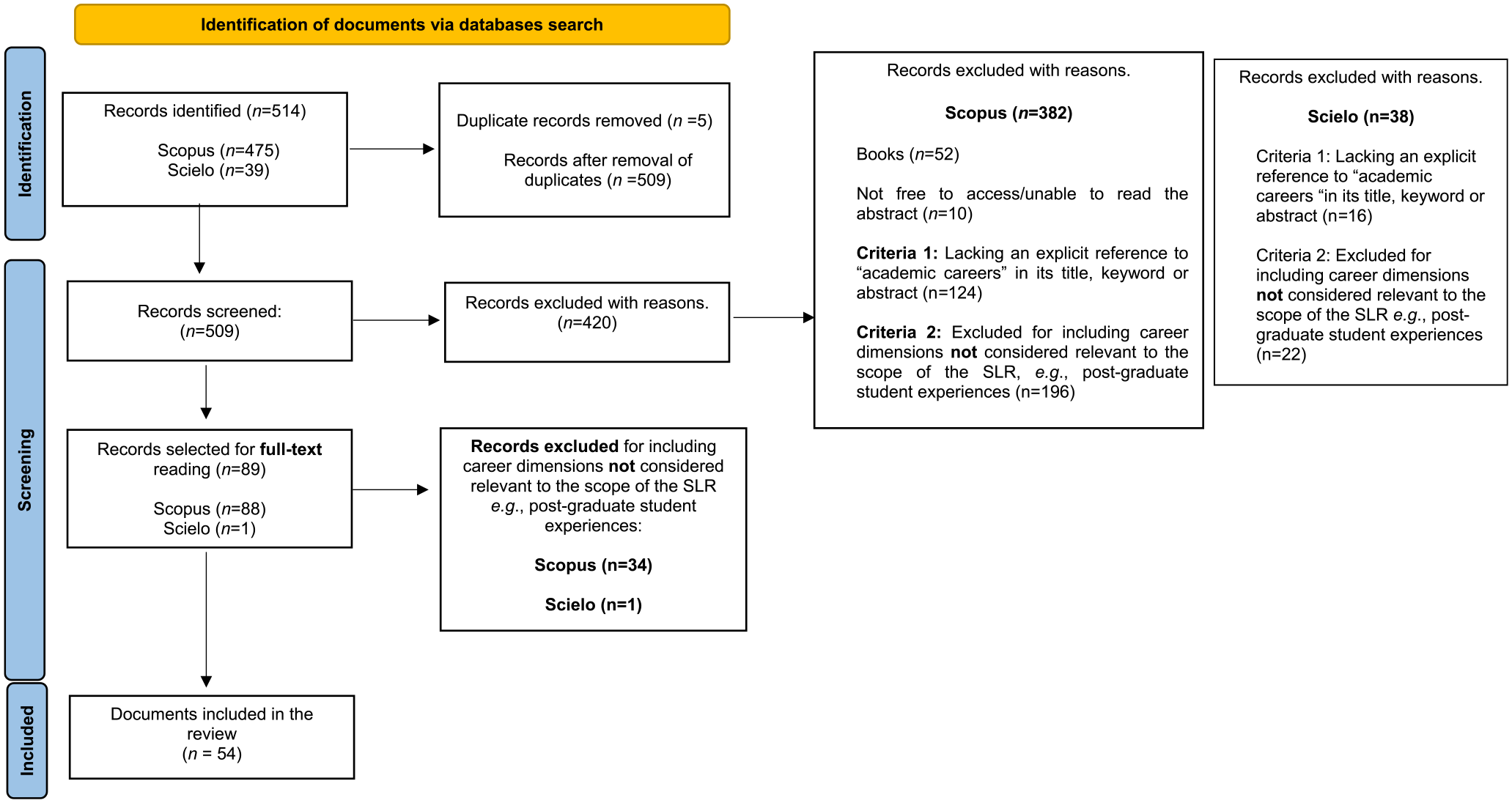
Authors’ adaptation of the Prisma Diagram. Figure elaborated based on the template elaborated by Page et al. (2021) (for more information, visit http://www.prisma-statement.org/).
After applying the inclusion and exclusion criteria, 420 articles were discarded (reasons are listed in Figure 1), while 89 were selected for the second screening level, which consisted of a thorough reading of each document. At this level, an additional 35 documents were excluded for not matching the inclusion and exclusion criteria described above (Figure 1 lists the specific reasons for document exclusion in this phase too).
Limitations
Like any research endeavor, this systematic review had its own set of constraints that warrant acknowledgment before proceeding to the illustration of our findings. As previously discussed, the definition of our search parameters (equation/search string) and the technology behind the functioning of search engines may have impacted the document retrieval process. Moreover, there are implications related to challenges inherent to the SLR method.
Despite our best efforts, it was impossible to fully address the impact that our search parameters may have had in the review, such as potentially excluding important literature that explores oppressive dynamics within academia, particularly regarding race and minority issues (which are often discussed in the related literature, albeit did not emerge much within the pool of documents retrieved in this review). At the same time, it is important to highlight that the objective of our review was not to focus on the experiences of specific marginalized academic workers. Therefore, we did not include terms such as race, gender, minorities, and inequalities in our main search string.
Moreover, we recognize that this review may have missed other aspects of academic careers, as it is also impacted by the dominance of the Anglo-Saxon world in academic publishing and other delimitations criteria (e.g., timeframe, type of publication, alignment with our definition of academic careers, and so on). This limitation is also related to the SLR method, which relies on certain criteria, limited search algorithms and the subjective decisions of research authors regarding their publications’ keywords. Even if our search parameters had been broader and more diverse, such structural constraints would not have guaranteed that all relevant research on the topic could be captured in this review.
Findings
To answer our research question, “What are the implications for academic careers stemming from the increasing global marketization of higher education?” the final selection considered 54 documents (denoted with an asterisk in the reference list). The 54 selected articles were imported into NVivo and subjected to thematic analysis to identify meaningful patterns within and across them (Braun & Clarke, 2006). NVivo enabled us to explore relationships between the articles, as well as facilitate the coding process, the identification of themes, and the process of looking for patterns and connections within the dataset throughout the research process (Braun & Clarke, 2006; Merriam & Tisdel, 2016; O’Neill et al., 2018).
An inductive approach was taken to thematic analysis once the key analytical dimensions emerged from the data. In this section, the findings will be presented in two steps: first, an overview of the main features of the entire dataset; and second, a more in-depth description that focuses on the main objective of this study. The discussion then relates back to our research question.
Most of the selected documents came from countries—or included a country in a comparative study—where English is the primary language, that is, the UK, Ireland, Australia, Canada, the United States, South Africa, and New Zealand (n = 33). Beyond the English-speaking world, Estonia was the subject of two articles, while other countries—Portugal, Poland, Slovakia, Peru, Czech Republic, Ukraine, Sweden, Mexico, Spain, India, Italy, France and Germany—yielded one article each. In four articles, the geographical scope was not specified. One article presented an analysis involving more than 140 countries, another examined the context of international academic conferences, while one explored academic careers through migration experiences (involving diverse geographical locations).
Methodologically, most of these articles employed a qualitative research design, the largest share using interviews as the main data collection technique (n = 24) and case study design (n = 6). These were followed by mixed-methods (n = 8), theoretical reflections (n = 5), a quantitative approach (n = 4), autoethnography (n = 3), documentary analysis (n = 2), participatory qualitative approach (n = 1), and collective autoethnography (n = 1). Regarding the field of academic research, the results align with the body of research on HE that states the interdisciplinary nature of studies in this area (Amaral & Magalhães, 2007). The largest share of the articles were classified as interdisciplinary (n = 16), on the basis that their authorship comprised researchers from different disciplinary backgrounds and affiliations. These were followed by educational sciences (n = 11); studies from higher education research centers (n = 10); business, economics, and management (n = 7); sociology (n = 4); social science (n = 3); communication studies (n = 2); and social psychology (n = 1).
Despite our efforts to expand the analysis beyond research published in English and the Anglo-Saxon context through the inclusion of the Latin American database (Scielo), our attempt was unsuccessful: No article from Scielo remained after applying the selection criteria. We highlight this finding, which has also been acknowledged in other SLRs (Campbell & Neff, 2020; Cardoso et al., 2022; Pagel et al., 2014; Shahjahan et al., 2021), not to suggest that researchers should cease to include databases or journals outside the Global North, 12 but rather to reflect on how this limits the possibility to conduct international analyses that reflects a diverse range of languages and regions. Moreover, this may be a limitation of this type of research strategy; knowing this upfront, future research may be able to develop further innovative strategies to overcome it.
To address the main research question, we have identified the following themes: (a) academic careers as an individual project, (b) surviving the academic career “game,” (c) academic careers influenced by emotionality, and (d) academic environments as places of inclusion and exclusion. Bellow, the references that came from the set of analyzed documents are marked with an asterisk (*).
Academic Careers as an Individual Project
As previously discussed, one of the main features of neoliberalism is the impetus to individualize and commodify life. As a political and social philosophy that becomes increasingly part of individuals’ way of living, neoliberal principles often emerge intertwined with narratives that place significant importance on personal independence, self-reliance, and individual rights, often in alignment with “meritocratic” and individualistic accounts (Giroux, 2002; Harvey, 2006). These accounts tend to promote narratives that hold individuals accountable for their failures, regardless of societal conflicts, antagonism, class struggles, and other social and political arrangements, as well as the historical processes that might have shaped these circumstances (Brand & Wissen, 2021; Harvey, 2006; Standing, 2014).
As Brand and Wissen (2021) argue, the naturalization and internalization of principles of contradictory social forms—such as neoliberalism and capitalism in their current forms—can only be sustained if they become hegemonic, meaning that they must be incorporated into everyday social practices and common sense. As these authors argue, individualism is one clear manifestation of the penetration of neoliberalism into individuals’ ways of living and is both a consequence and a strategy of capitalism and neoliberal hegemony. In the documents analyzed in our SLR, we identified two areas in which individualism is reflected in academic career dynamics: (a) competitiveness, which refers to the material reality of the need and necessity for competition stemming from the generalized marketization of higher education, within the flourishing of a competitive environment that tends to foster and encourage institutions and academics to view themselves as competitors in a marketplace, rather than as members of a shared academic community (S. Acker & Webber, 2017; Brew et al., 2018; Clarke & Knights, 2015; De Angelis & Grüning, 2020)*; and (b) individualization, as a straightforward personal consequence that manifests in how academics might internalize marketization dynamics, individualizing their academic career projects (Gil-Juárez, 2019; Manky & Saravia, 2021; Meschitti, 2020; Res-Sisters, 2017)*.
Regarding the first area, as Baruch et al. (2015)*, Höhle (2015)*, and Kindsiko and Baruch (2019)* have drawn attention to, the necessity for competitiveness is highly related to the rapid changes in HE that have disrupted the traditional career model, in which careers progressed in a linear fashion along planned pathways, and most of the selected articles agree that the gradual marketization of HEIs has been the critical driver of it (S. Acker, 2010; Brew et al., 2018; Clarke & Knights, 2015; Taberner, 2018)*. In addition, these authors suggest that the marketization of HEIs has led to a deterioration in career prospects and an increase in casual and part-time contracts, while increasing the requirements for entering, maintaining, or further developing an academic career (Laudel & Gläser, 2008; Res-Sisters, 2017; Whitchurch et al., 2021)*.
Although, as Kindsiko and Baruch (2019)* note, the factors contributing to a successful academic career are far from clear, the reconfiguration of HEIs by their approximation to business practices has also reconfigured the key features that may enable an academic career. Quantifiable outputs such as publishing, or obtaining institutional and individual funding, have become central to enabling or further developing one’s academic career (Clarke & Knights, 2015; Oili-Helena, 2019; Read & Leathwood, 2018; Skea, 2021)*. For instance, in the case of the UK, the Research Excellence Framework (REF) 13 is a direct consequence of these trends, further aggravating competitiveness in its academic system (Clarke & Knights, 2015; Edwards, 2020; Floyd & Dimmock, 2011; Meschitti, 2020; Oili-Helena, 2019)*.
Yet it is important to acknowledge that similar situations (e.g., lack of funding, hypercompetitive academic environments), under neoliberal regimes, can lead to different attitudes and understandings. As Edwards (2020)* argues, this focus on quantitative outputs may also encourage some academics to pursue (unfunded) research as a liberatory act—for the sake of knowledge, in which research is not necessarily following mainstream trends or funding agencies’ agendas.
With regard to the second area, that is, individualization, it is visible in the documents included in this SLR that academics from different contexts have experienced managerial pressure of a highly individualistic nature, in which each academic is entirely responsible for developing their full potential, to finance themselves, and in this way finance their institution (Gil-Juárez, 2019)*. According to Cannizzo et al. (2019)*, managerial pressures on academics may be both a cause and consequence of what some refer to as academics’ complacency regarding neoliberal rationality (Banda et al., 2017; Clarke & Knights, 2015; De Angelis & Grüning, 2020)*. The potential complacency of academics with the neoliberal rationality might be related to what Skea’s (2021)* work draws attention: the association between the principles of neoliberalism (e.g., performance, accountability, and corporate culture) and its manifestation into academics subjectivities. As Doan (2014) argues, complacency, seen as a form of acceptance of the status quo and as a way of political inertia, may sustain a specific type of rhetoric that suggests that despite the increase and concrete reality of degradation of work conditions in academia, scholars can succeed through diligent work and meeting specific criteria. Consequently, academic success and failure are often attributed to individual effort and responsibility. This diminishes recognition of collective class struggles and the challenges faced by the professional academic community, such as the worsening work conditions resulting from the increasing marketization of higher education.
Gil-Juárez (2019)* states that pursuing an academic career has become less about producing socially relevant knowledge and more about an individual’s capacity to build a desirable curriculum vitae. Clarke and Knights (2015)* and Gil-Juárez (2019)* mention that in this increasingly marketized context, the act of writing a book, as opposed to a scientific article, may mean a possible “career death” or even “career suicide.” This example highlights the changing perception of what is deemed important for enabling an academic career. From this excerpt, a book that once might have been considered a core academic project that may well require years of dedication, research and intellectual effort is seen as potentially detrimental to an academic path. The emphasis of this argument must not be put on the nature of the activity in question—writing a book or a scientific article—but on how it illustrates the shifts related to one of the core consequences of the marketization of higher education: the dominance of quantitative outputs over other types of academic outputs, and in its consolidation as one of the primary factors that (might) enable an academic career (Burford et al., 2020; Clarke & Knights, 2015; De Angelis & Grüning, 2020; Edwards, 2020; Gil-Juárez, 2019; Res-Sisters, 2017)*. In sum, this theme reveals that the increasing marketization of HE is closely tied to the prevailing emphasis on quantitative outputs, individualism, and pursuing an academic career as an individual endeavor.
Surviving the Academic Career “Game”
In the analyzed documents, academic careers were often portrayed as being a “game” (S. Acker, 2010; Chubb & Watermeyer, 2017; Clarke & Knights, 2015; Res-Sisters, 2017; Skea, 2021; Whitchurch et al., 2021)*. This “game” feature is seen as being inextricably linked to careerist practices, which generally emphasize competition for grants, publication records, and other metrics defined by the culture of audit and “excellence.” Chubb and Watermeyer (2017, p. 2366)* identified gaming metaphors frequently in their interviewees’ accounts: “Playing the game” was an idea voiced by several interviewees across disciplines and countries to describe the process of securing (or winning) funding; “it’s going to be a game, you know” (p. 2366). The gaming metaphor was more often associated with the “publication game” or “neoliberal game” than with other academic career aspects, such as teaching or service (Meschitti, 2020)*. Several studies from countries with a strong managerial culture (e.g., the UK, United Stataes, and Australia) have found that the research-intensive culture has changed academics’ attitudes towards teaching (Clarke & Knights, 2015; Gil-Juárez, 2019; Taberner, 2018)*. Teaching has, to put it simply, become devalued in a culture that prioritizes and incentivizes research. According to Clarke and Knights (2015, p. 1869)*, Recently, this career game has generated a comparative neglect of teaching and students in favour of research and writing, partly because publication output has a measurable status that lends itself to the preoccupation that new managerial regimes have with ranking individuals, organizations and institutions.
Another theme discussed is the means to acquire knowledge of the ‘‘rules of the game.’’ As Read and Leathwood (2018)* suggest, it is not enough to know the overtly established rules; one must also know the unwritten and tacit rules if one wishes to increase one’s chances of “surviving” in the game. In this sense, the literature suggests that the process of acquiring this knowledge may not be totally within the individual’s control. Bessudnov et al. (2015, p. 1590)* point out that “given that there is a lot of tacit and field-specific knowledge about what is required for a successful academic career, managing expectations of newcomers to academia is important, and mentoring by senior colleagues, both formal and informal, becomes invaluable.” Cidlinská (2019)* draws attention to field-based differences that benefit early-career academics (ECAs) coming from STEM 14 subjects, as they are more team-oriented and spend more time at work with their senior mentors or colleagues in comparison to ECAs from the social sciences. ECAs in STEM subjects may thus have better conditions or opportunities to acquire informal knowledge about the steps they can take to enable or advance their careers.
Based on their research on “academic stars,” Goyanes and Demeter (2021, p. 76)* underline that success in an academic career may be achieved by “following the research conventions, interests and values of a research community and conducting ‘sound research’ based on tacit rules of the scientific craft, which were acquired at elite universities” (p. 76). Similarly, Wapman et al. (2022) research on faculty hiring and retention in the United States shows that a small minority of elite universities supply a large majority of faculty across institutions in the country. This indicates that aside from the relevance of learning the tacit rules of the academic career “game,” one is likely to have a greater advantage in pursuing an academic career if one completes doctoral training at the “right” institution. More fully acknowledging such privileges—in this case one’s academic pedigree—can challenge more meritocratic and individualistic accounts that reinforce market-based explanations of success.
Staniland et al. (2021)* highlight the role cultural differences—particularly between individualistic and collectivist cultures—play in the way academics position themselves with respect to “the game.” For some Māori scholars, for example, the neoliberal game represents an intense conflict with their communal cultural values. Kidman (2020)* argues that this is a significant challenge for other indigenous scholars, too. Yet this challenge is not exclusive to marginalized and racialized academics but affects the whole of academia, as Res-Sisters (2017, p. 269)* points out: Ironically, we are confronted with these same forces within contemporary academia. We are simultaneously reflexive about, and constrained by, the intersectional inequalities that shape our sense of belonging within academia. We are also mindful of how we might be guilty of reproducing and sustaining the very systems that trouble us, where our ‘manic productivity’ (Hey 2004: 33), justified as a ‘labour of love’, may be evidence of our compliance with the demands of the neoliberal academy. (p. 269)
It is worth noting that several studies mentioned the personal toll taken on academics as a result of playing the academic career “game.” These include high levels of stress, anxiety, feelings of surveillance, and increasing disillusionment with the profession (S. Acker & Webber, 2017; Cannizzo et al., 2019; Cidlinská, 2019; De Angelis & Grüning, 2020; Höhle, 2015; Joseph & Johnson, 2019; Staniland et al., 2021)*.
Laudel and Gläser (2008)* indicate that early career academics are the most vulnerable group in the science system due to their limited negotiating power. These academics experience firsthand the worsening career prospects and are the principal victims of the growth of the academic “precariat” (Hollywood et al., 2020)*. The same authors refer to the ever-increasing number of academics who cannot articulate their future career plans, as their paths so far have mainly been marked by uncertainty and insecurity. Looking at the workplace in Canadian academia, S. Acker and Webber (2017, p. 551)* found that, as early career academics progress in their careers, they will likely not resemble their senior counterparts, because they have operated from the outset within this precarious environment, in a different, more neo-liberal environment replete with expectations for greater accountability, intensified workloads, demonstrable social impacts and chronic competition over scarce resources. There will be more annual reviews and future promotion prospects to consider as our ECAs move into middle and late career stages. (p. 551)
Thus, the analyzed academic literature suggests that within this hypercompetitive environment, in which academics have become players in a “neoliberal academic game,” struggling for survival has become the modus operandi of an academic career. The prevailing strategy to survive the game is reducible to simply this: produce the “right” outputs (S. Acker & Webber, 2017; Arvanitakis et al., 2019; Bessudnov et al., 2015; Brew et al., 2018; Clarke & Knights, 2015; Laudel & Gläser, 2008; Meschitti, 2020)*.
While research-intensive characteristics were found in the academic culture of all of the locations analyzed (De Angelis & Grüning, 2020; Kindsiko & Baruch, 2019; Luczaj, 2020; Manky & Saravia, 2021; Vieira et al., 2014)*, except for Ukraine (Aksom, 2018)*, certain particularities can be observed. One such case is the academic system in Peru, where a research-oriented culture is only just emerging (since 2015), even though changes towards the marketization of higher education started in the 1990s (Benavides et al., 2019), and teaching is still highly valued (Manky & Saravia, 2021)*. This shows that the implication of marketization is context-specific and may play out differently depending on the particular HE culture and system. Among Ukrainian academics, researching and publishing do not have the same value as they do for academics working in research-intensive countries, as their salaries and promotion prospects do not depend on specific metrics regarding research that targets publication in top-tier ranked journals (Aksom, 2018)*. As Aksom* explains, “the idea of publishing in Ukraine is reduced to the matter of publishing just for publishing” (2018, p.1187), suggesting that in this context, publication emerges as simply an option and not as a necessary condition for career progression and “survival.”
Whitchurch et al. (2021)* note that in the configuration of this “survival” mode, time has become a vital element. Academics, in their hectic lives, have to “juggle” key activities (research, publishing, funding) as the best shots to survive in the academic “game.” Contemporary academics are laboring in environments akin to a pressure-cooker, in which “the impetus is to produce as much as you can, as quickly as you can, with the number of outputs being the focus of all-important REF submissions” (Skea, 2021, p. 406)*.
Academic Careers Influenced by Emotionality
As discussed in the theme of “academic careers as an individual project,” scholars’ internalization of neoliberal principles are related to a conception of pursuing an academic career as an individual endeavor. In this sense, while the significative integration of neoliberal principles in HEIs has resulted in a hypercompetitive culture and worsened work conditions, it is puzzling that very few articles discuss actual forms of how academics have been resisting or reacting to these changes. In our SLR, only 2 (out of 54) documents directly reflected upon academics’ reactions to the escalating deterioration of their working conditions. This apparent lack of attention to concrete responses from scholars regarding the worsening of their working conditions may be linked to another noteworthy finding in our review: the emotional aspect tied to how academics perceive their pursuit of an academic career.
In this regard, the documents analyzed frequently mentioned how academics often evoke emotional accounts such as the love and happiness for their work (Banda et al., 2017; Clarke & Knights, 2015; Edwards, 2020; Oili-Helena, 2019)*. Despite the ongoing deterioration of work conditions, the expressions of love and happiness associated with pursuing a career in academia appear to be intertwined with narratives that normalize exploitation practices in the context of increasingly marketized institutions. As Luczaj (2020)*, puts it, academics are often caught in a “passion trap,” whereby on the one hand, they have jobs that are a source of passion and pleasure; but on the other hand, they experience passion—in all spheres of their lives—in the most literal sense of the term: pain, suffering, and fatigue caused by unstable contracts and working conditions. (p. 608)
Oili-Helena (2019)* argues that narratives of happiness and love challenge the willingness of academics to speak out or criticize their working conditions, because they may perceive their jobs as being meaningful and may take some pleasure in them. Indeed, within these narratives, academics—whether consciously or not—create mechanisms to differentiate and distance themselves from others, such as the “real,” “true,” “passionate” academic who works long hours out of love versus the “nine to five” academic who fails to meet those same standards (Oili-Helena, 2019)*. These narratives are particularly prevalent among the English elite: In the happiness narrative the managerial changes are more than welcome. Conversely, this means that all kinds of complaining about their disastrous impacts are forbidden. It is emphasised that although people tend to talk so much about increasing stress, strain, pressure and anxiety in academia, this is not an accurate and justified perception. On the contrary, the changes have been beneficial in several ways. (Oili-Helena, 2019, p. 112)
As highlighted by this excerpt, the idea of an academic paradise free from stress, pressure, and anxiety does not resonate with what we found in this review. In fact, our review indicates that the consolidation of a neoliberal culture in HEIs has influenced academic careers primarily through the dominance of quantitative outputs and the deterioration of working conditions. As a result, academics are experiencing high levels of stress, anxiety, and frustration, together with the inability to articulate future career plans (Acker & Webber, 2017; Cannizzo et al., 2019; Cidlinská, 2019; De Angelis & Grüning, 2020; Höhle, 2015; Joseph & Johnson, 2019; Staniland et al., 2021)*.
The emotionality that might be present in how academics make sense of their work in academia or, as mentioned before, “the passion trap,” may also shed light on what certain documents identify as the normalization of a culture of excessive workload and the endorsement of exploitative work practices (Clarke & Knights, 2015; Kidman, 2020; Luczaj, 2020b; Skea, 2021)*. In this regard, as Skea (2021, p. 405)* suggests, “discourses of being over-worked and on the brink of exhaustion are common, although strangely this may be seen as ‘heroic’ rather than detrimental.” Kidman (2020, p. 251)*, in the context of New Zealand, mentions that “in the neoliberal era, the ‘cheerful robot’ of academia has become part of a responsibilizing therapeutic narrative that links university faculty to rational and economically motivated subjectivities” (p. 251). The “cheerful robot” idea aligns with the discussion around the role of happiness in public life, which has also been referred to as the “happiness turn” (Ahmed, 2007). The happiness turn refers to the neoliberal strategy of individual governmentality, which claims that happiness or being promised happiness at “some point” is used to place all responsibility for the concrete reality that individuals may be facing—such as the consequences of social and political issues, or worsening work conditions—on the individual themselves (Ahmed, 2007). If happiness as the core emotion mobilized within these accounts, is perceived as a commodity, attainable through hard work or to be found in the future, individuals may endure present hardships with the hope of eventually experiencing that happiness.
Thus, emotions and feelings such as love and happiness embedded in academics sense-making of their careers are complemented by discourses related to being “lucky,” in which academics may feel satisfied with their position (even if it is temporary, insecure, or precarious) because “at least” they have one. As S. Acker and Webber (2017)* explain, The ‘being lucky’ narrative comes into play when the participants see others much like themselves struggling, as Canadian universities have increasingly moved towards hiring cheaper, insecure, contingent faculty (also called adjuncts or sessionals) to fill teaching vacancies instead of investing in full-time tenure-track academics. (p. 549)
In this sense, it seems reasonable to infer that scholars emotionality related with their academic work has become a powerful instrument to justify and normalize exploitation by HEIs and to encourage academics’ self-exploitation practices. Likewise, as Clarke and Knights (2015) suggest, these emotional narratives may reinforce the constitution of academics as particular neoliberal subjects.
Academic Environments as Places of Inclusion and Exclusion
Academic careers are also discussed in terms of the types of environments in which career development mostly occurs. Most of the articles address gender inequalities as one of the most visible exclusionary features of academic environments (S. Acker, 2010; Barnard et al., 2021; Burford et al., 2020; Cidlinská, 2019; De Angelis & Grüning, 2020)*. Across the dataset, regardless of the geographical context, gender-based discrimination was illustrated by fewer women progressing into senior academic roles (S. Acker, 2010; Barnard et al., 2021; Burford et al., 2020; Cidlinská, 2019; Meschitti, 2020)*. Academic “housework” was also an issue raised relating to the gendered nature of academic careers. As defined by Heijstra et al. (2017, p. 765) academic “housework” refers to “all the academic service work within the institution that is performed by all academic staff, both women and men, but that receives little recognition within the process of academic career making or within the definition of academic excellence.” S. Acker and Webber (2017)* and Burford et al. (2020)* suggest that academic “housework” is also related to the caring responsibilities and emotional labor required by academic work, which are mainly carried out by women. Burford et al. (2020)* explored the gendered nature of the academic workplace, particularly with regard to academic gatherings such as conferences (where networking and peer recognition may occur), taking a feminist lens on the invisible and domestic labor performed in these spaces. This study also brought attention to the gendered nature of decisions that might affect one’s career, such as whether or not to accept a particular job or move to another country, whether or when to have children, and so on (S. Acker, 2010; Cannizzo et al., 2019; Cidlinská, 2019; Kindsiko & Baruch, 2019)*. The “male-dominated” and sexist academic environment, with its “old boys’ network” was also mentioned as a possible reason for the exclusion of female academics (Barnard et al., 2021; Meschitti, 2020; O’Connor et al., 2014)*.
The selected research focused less frequently on other inequalities, such as racial, ethnic, and cultural (Banda et al., 2017; Cruz et al., 2020; Joseph & Johnson, 2019; Kidman, 2020)*. In fact, racial and/or ethnic issues were explored in only four of the studies (Cruz et al., 2020; Kidman, 2020; Rabe & Rugunanan, 2012; Staniland et al., 2021)*, while four other articles noted that future research could benefit from a deeper understanding of the roles that race and ethnicity play in the development of an academic career (Bennich-Björkman, 2007; Goyanes & Demeter, 2021; Luczaj, 2020; Manky & Saravia, 2021)*. This finding is somewhat surprising, as race and ethnicity are frequently researched within the broader higher education literature (J. Acker, 2006; Ahmed, 2012; Morley et al., 2018; Wright-Mair & Museus, 2021). One possible reason for this could be the political and theoretical orientation of the researchers, which may challenge or diminish the relevance of including race and ethnicity as a relevant aspect of their research. Pervasive understandings that frame race in light of unquestioned whiteness, claimed postracial and race-neutral views might play a role in how race and ethnicity are diluted or sidelined within the discussion of marketized universities (Ahmed, 2012; Shahjahan & Edwards, 2021).
From the 54 included documents in this SLR, 51 had research participants, and from those only 15 accounted for race/ethnicity in their description of research participants, while 36 did not include any information on this aspect. DeJesus et al. (2019) found a similar result across an analysis of 1,149 articles published in 2015 and 2016 in 11 psychology journals, in which 73% did not specify participants’ race/ethnicity. According to Roberts et al. (2020), paying or not paying attention to race in research endeavors is already an indication of wider racial issues: “race plays a critical role in the extent to which people even care about race” (p. 1296). These authors also point out that
one might expect white journal editors—whose gatekeeping function positions them to govern what is worthy of publication—to be less likely than journal editors of color to publish research that highlights the role of race in human psychology. (p. 1296)
Lentin (2008) argues that in Europe, from where more than half of the selected documents (n = 33) came, there is subtle consensus on banishment and expunging of race from the political lexicon (and, therefore, it is reasonable to infer that it might influence the discussion of race within the research lexicon too). This author points out that the embarrassment and refutation of race after the Second World War has led race to be stripped both of its politics and its modernity. As such, race seems to be a controversial topic, and therefore, sometimes, is rendered invisible or diluted in the European context (Ahmed, 2012; Lentin, 2008). Moreover, as Farkas (2017) 15 explains, most European Union countries do not collect official data disaggregated by race and ethnicity (p. 6). Instead, information on these subjects is sometimes gathered problematically under the broader category of “migration background,” which effectively conceals the experiences of racialized European citizens. This approach contributes to a troubling political silence surrounding discussions about race and ethnicity in Europe and avoids providing a scientific snapshot of accurate demographic data reflecting the racial diversity of European populations today.
The importance of further research on racial and ethnic dimensions was highlighted by Edwards (2020, p. 1),* who points out discrepancies in the success rates of funding applications in relation to various markers of identity: These success rates are not equally distributed either institutionally or among academics. Analyses show significant disparities in the rates and size of grants secured by women, disabled and ethnic minority applicants for UKRI (United Kingdom Research and Innovation) Research Council funding as compared to their male, non-disabled and White counterparts. (p. 904)
Cruz et al. (2020)* highlight that exclusion in academia may take the form of microaggressions, as a way in which discrimination is reproduced in everyday interactions. Joseph and Johnson (2019)* stress that microaggressions are naturalized within academia, leading them to go unnoticed, and are usually targeted at minorities: jokes, sarcastic comments about accents, questioning competency, and even resistance from students (in the case of foreign professors).
Rabe and Rugunanan (2012)*, in their study on female sociologists in South Africa who had left academia, noted that gender issues cannot be separated from racial ones, suggesting the latter played a significative role in the decisions of young female Black sociologists to withdraw from academia. Staniland et al. (2021)* point out that race played a role in Māori scholars’ self-perceptions, as well as those of their peers, regarding the legitimacy of their position as knowledge producers.
To provide a visual representation of this theme in the selected research, the word cloud presented in Figure 2 illustrates how inequalities were portrayed in the analyzed documents. We ran word frequency queries to list the most frequently occurring 100 words under the code “inequalities” that informed this analytical dimension. The relative size of the keywords denotes their prevalence within the selected literature.
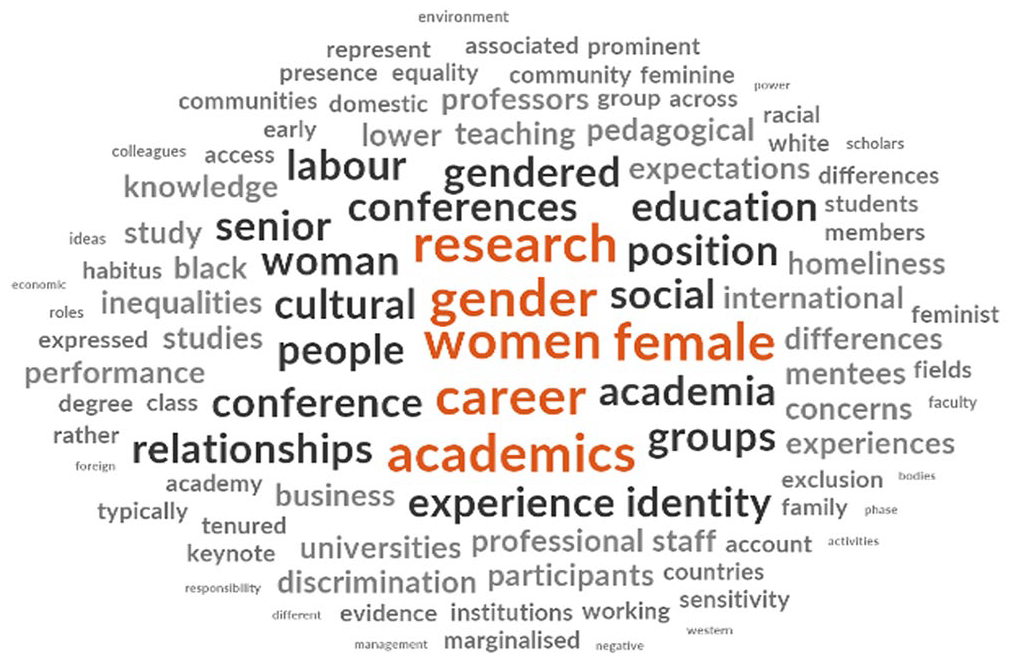
Word Cloud.
The words “gender,” “women,” “feminine,” “woman,” and “gendered” stand out in our word cloud, indicating, as mentioned above, that when discussing inequalities in higher education, researchers often tend to discuss them from a gender perspective. Although the word “feminism” does not stand out, the strong focus on gender inequality in the documents selected may have to do with policy advances as well as the growing discussion of feminist agendas in higher education, which are rooted in the debates of various feminist movements worldwide. Aside from the gendered aspects, words such as “senior,” “position,” “early,” and “tenured” appear highlighted in the word cloud, showing that the discussion of inequalities in academic careers is likely to be discussed relying on data concerning the institutional positions academics hold. By way of illustration, a frequently conveyed argument in the selected documents regarding gender inequality was that there are fewer women in leadership positions (S. Acker, 2010; S. Acker & Webber, 2017; Cidlinská, 2019).*
Concerning geopolitical inequalities, Goyanes and Demeter (2021)* refer to the top positions within communication studies as being mainly occupied by (and favoring) academics with a Western education and credentials: “This means that, in order to be in a leading position, it is not enough to have Western degrees, but also elite credentials such as education from Ivy League
16
or Russell Group universities
17
” (Goyanes & Demeter, 2021, p. 66)*. Rao et al. (2019, p. 607)* note that migrant academics moving from non-Western countries (often developing countries with colonial pasts) to the English Western world experienced a more pronounced pedagogic othering in that they expressed that their pedagogical values were perceived by themselves as being less desirable as they did not conform to the expectations of their host HEIs. (p. 607)
The Matthew effect emerged three times as a plausible way to reflect on these inequalities (Goyanes & Demeter, 2021; Kindsiko & Baruch, 2019; Siekkinen & Ylijoki, 2021). As Kindsiko and Baruch (2019, p. 124)* explain, “The Matthew Effect signposts the cumulative advantage situation triggered by the role of authority in an academic (research) world; in other words, unknown scientists are unjustifiably victimized and famous ones, unjustifiably benefited.” Goyanes and Demeter (2021, p. 66)* argue that research experience gained in locations such as the United States and other countries in which English is the primary language are regarded as being more valuable than that collected in more peripheral countries, and that “rich countries have a disproportionally higher number of citations, grants and publication output than developing countries” (p. 66).
Discussion
Our findings suggest that the main implications of the increased global marketization of higher education for academic careers relate to two main levels: a material one, in which academics and their professional paths are being reconfigured from secure trajectories into uncertain and increasingly precarious ones; and an ideological level, on which embracing the neoliberal rationality appears the “one and only” way to enable or further develop one’s academic career.
The Material Level: From Privileged Intellectuals in Ivory Towers to High-Skilled Workers Trapped in the Wheel of Precarity
Under the influence of the marketization of HE, academic careers have been affected by increasingly precarious and casualized forms of labor within the academic profession. The growth of precarization is marked by a strengthening of the neoliberal agenda, along with reductions in public funding, which have increasingly prompted HEIs to resort to casualized forms of labor to reduce costs (Skea, 2021; Whitchurch et al., 2021). In this context, academics’ hopes of either pursuing a secure career path or achieving a tenured position have been jeopardized.
Twenty years ago, Giroux (2002) warned of the risk of subjecting higher education to “corporate culture” as this could orient higher education’s ethos away from its critical social role of educating citizens who can sustain and develop inclusive and vibrant democratic public spheres. However, as this SLR has shown, and following the broader HE literature (Burton & Bowman, 2022; Courtois & O’Keefe, 2015; Courtois & Sautier, 2022; Slaughter, 2014; Wright-Mair & Museus, 2021), the marketization of HE has become a reality in many HE systems across the world. The increasingly widespread casualization within the academic workforce, and the pervasive academic capitalism across different higher education systems, is both an instrument and a consequence of the marketization of higher education (Courtois & O’Keefe, 2015). According to Ferreira (2022) more than 95% of all research activities in Portugal are developed under precarious labor conditions. Butler (2013) 18 notes that in the UK, British HEIs are more than twice as likely to employ staff on zero-hours contracts 19 as other workplaces. Ryan et al. (2013) demonstrate that while the overall Australian workforce has become increasingly casualized, one of the highest users of casual employees is the higher education sector, where casual academics are estimated to account for 50% of the overall teaching load.
Another relevant element in terms of the material impact of marketization (and one that, for now, remains underresearched) is the prevalence of early- and midcareer academics performing highly skilled work for free (Aczel et al., 2021; Edwards, 2020). According to Edwards (2020), engaging in unpaid work, such as conducting unpaid research, can be both an act of complacency or an act of resistance against the hypercompetitive system. In terms of resistance, the author suggests that academics are often allowed to be intellectually and creatively driven when conducting unfunded research. In terms of compliance, unpaid work can be an act aligned with neoliberal rationality, with the drive to do so being in line with the same “careerist” strategies described above that influence academics’ decisions and time management concerning their academic career. Unpaid work appears to have become naturalized and may relate to the same phenomenon of the precarization of careers (Grossmann & Brembs, 2021). Aczel et al. (2021) shed light on this discussion, presenting some disturbing numbers in their estimation of researchers’ contributions in terms of time and equivalent salary—for instance, with regard to peer-review work: The cost of peer review is typically not included. Here, we found that the total time reviewers worked on peer reviews was over 130 million hours in 2020, equivalent to almost 15,000 years. The estimated monetary value of the time US-based reviewers spent on writing reviews was over 1.5 billion USD [U.S. dollars] in 2020. For China-based reviewers, the estimate is over 600 million USD, and for UK-based, close to 400 million USD. (p. 5)
Within this reconfiguration of academic careers, and using the framework established by Standing (2014, p. 10) concerning the reconfiguration of work in general, academic workers are becoming an integral part of “the precariat”: One defining characteristic of the precariat is distinctive relations of production: so-called “flexible” labor contracts; temporary jobs; labor as casuals, part-timers, or intermittently for labor brokers or employment agencies. But conditions of unstable labor are part of the definition, not the full picture. More crucially, those in the precariat have no secure occupational identity; no occupational narrative they can give to their lives. And they find they have to do a lot of work-for-labor relative to labor, such as work preparation that does not count as work and that is not remunerated; they have to retrain constantly, network, apply for new jobs, and fill out forms of one sort or another. (p. 10)
In relation to the growth of this academic precariat, it is worth noting that its consequences, in terms of worsening work conditions, are not experienced equally by academics as a whole, but that old and persistent structural problems in academia have an impact (S. Acker, 2010; Burford et al., 2020; Cruz et al., 2020; Goyanes & Demeter, 2021). Within the scholarship on early career academics, generational inequalities are key (S. Acker & Webber, 2017; Altman et al., 2020; Cannizzo et al., 2019; Höhle, 2015; Laudel & Gläser, 2008). In addition to a general worsening of career prospects, marginalized academics have to deal with further layers of inequality stemming from the structural configuration of academia, which is an environment dominated by male, White and Western supremacy (Read & Leathwood, 2018; Shahjahan & Edwards, 2021). As Shahjahan and Edwards (2021) note, academia is ingrained within a web of power relations, and the lenses of gender and race are fundamental for a critical understanding of the unfolding of global academic systems: White nations’ manipulation of global educational structures positions them as the future for which the rest of the world must aspire. Their control of educational imaginations and aspirations also evokes particular investments, which reinforce dominant nations’ occupation of the center. When non-White nations explicitly adapt their educational agendas in response to global trends, they implicitly participate in the spread of White imaginations and aspirations because, “performance is an orientation towards the future, insofar as the action is also the expression of a wish or intention (Ahmed, 2007, p. 153).” (p. 751)
Structural inequalities have been a constant issue within academia. Throughout its history, academia has never been a space in which exclusion, elitism, and issues of power relations have been solved (de Oliveira Andreotti et al., 2016; Kidman, 2020). Quite the contrary: Academia has never engendered a sense of security for all, and it has always been highly hierarchical and inegalitarian space (Read & Leathwood, 2018), while reproducing epistemic inequalities and colonial logics (Ploner & Nada, 2020).
The Ideological Level: There’s No Other Way Outside the “Neoliberal Game”
In referring to the “ideological” implications for academic careers of the increased global marketization of HE, we mean the strong relationship identified between the widespread acceptance of the mantra that neoliberal rationality is “the one and only” way in which it is possible to build a career in academia. Changes within HEIs that have suggested a turn in their prevailing values and practices often refer to terms such as the “entrepreneurial lifestyle,” “entrepreneurial ecosystem,” “the entrepreneurial university,” and “entrepreneurial competencies” (Burford et al., 2020; Cidlinská, 2019; De Angelis & Grüning, 2020; Kidman, 2020; Staniland et al., 2021). Ongoing changes in academic careers have promoted a structural transformation in what it means to be an academic. Once considered privileged intellectuals with secure paths in the ivory tower, they are currently becoming high-skilled workers trapped in a wheel of precarity (S. Acker & Webber, 2017; Courtois & O’Keefe, 2015; Oili-Helena, 2019; Res-Sisters, 2017). Indeed, as Oili-Helena (2019) suggests, it is not enough to discuss the widespread global changes in work conditions—it is also essential to identify key elements that might effectively regulate academics’ behaviors and may influence their capacity to mobilize resistance against the increasing degradation of their careers and profession. Time-consuming applications for scarce competitive research grants (individual or institutional), combined with constant pressure to undertake curriculum-related activities to gain promotion or increase one’s chances of being better placed for future applications, appear to require more time than academics’ contractually agreed working hours (Meschitti, 2020). Likewise, because academics are caught in the “wheel of precarity,” there is “never enough time” to do all that is required.
As we illustrated in the Findings section, neoliberal practices in academia have often been portrayed as a source of degradation and deterioration in career prospects. Despite the strong critiques of the marketization of higher education presented in the two decades of research reviewed, none of the articles, except for Edwards (2020) and Res-Sisters (2017), examined or explored a concrete response by academic groups to the ongoing “uberization” 20 (Carvalho et al., 2022) of their profession and careers. We highlight this because those academics researching academic careers are producing knowledge about themselves and their professional group, suggesting that expressing a critical or unsatisfactory view of career structures may not, on its own, be enough to encourage collective responses from academics to face or even reverse the process of career degradation.
In light of this discussion, these findings may indicate that academic careers have, to some extent, become depoliticized. In the analyzed studies, there was scant evidence or discussion of revindication or of any collective and political action. This topic would benefit from further research. Indeed, studies in other fields (Pinheiro-Machado & Scalco, 2021) suggest that neoliberal rationality affects the subjectivity and agency of individuals concerning the system in which they are embedded. Here, the notion of “neoliberal subject” is particularly relevant: The extent to which people accept personal responsibility both reveals the depth to which neoliberal ideologies have penetrated personal life and shows the centrality of such ideologies for the success of neoliberalism. Indeed, if one had to boil what it means to be a “neoliberal subject” down to a single concept, “responsibilization”—the process whereby individuals are “made responsible” for their choices and actions, while the state increasingly surrenders responsibility for their health, economic security and well-being—would be a legitimate candidate. (Watts, 2021, p. 8)
As shown by Nada et al. (2022), the nurturing of the neoliberal subject is performed from an early age by families, educational and state institutions alike, when the responsibility for one’s educational and future life success is placed on—and easily interiorized—by young people. Consequently, as De Angelis and Grüning (2020) explain, the “neoliberal subject” has internalized the neoliberal rules, and hence domination and exploitation occur simultaneously at a structural, organizational, and personal level. Furthermore, the growing precarization of academic careers—as noted by Skea (2021), and associated with socialization practices among academics such as the “long hours” culture and narratives of “happiness,” “love,” and “being lucky”—may create a combo that favors academics’ self-exploitation, and pushes them towards the dimension identified in our analysis as “surviving the academic career game.” Exhausted and overworked, academics may have little or no time to spend discussing and engaging in political and collective struggles to find alternatives to overcome their situation.
Conclusion
This systematic literature review has shown that the increasing marketization of higher education worldwide has affected academics and their careers in diverse and profound ways. We highlighted two main dimensions of this impact: the material and the ideological. On the material level, academic careers are being developed under increasingly exploitive conditions that mainly relate to increasing workloads (both paid and unpaid), diminishing job security, fewer opportunities, and time constraints affecting research and knowledge consolidation. Despite these worsening conditions, academics are pressured to increase their scientific production via publications, which has become the key requirement for survival in the academic career “game.” On an ideological level, there is widespread acceptance among academics that playing according to the neoliberal “rules of the game” is “the one and only” way in which it is possible to build an academic career.
Differences and similarities arising from the marketization of HE across 21 different national contexts point to three prominent trends: increasing casualization of academic work, deterioration of working conditions, and inequality reproduction in academic careers. However, our findings also highlight the need to consider local specificities: One cannot assume that the marketization of HE will lead to the same consequences in all contexts.
Precarity has become the rule rather than the exception in academic careers. Yet, as noted by Burton and Bowman (2022), precarity is also rooted in structures, policies, and social norms that produce vulnerability as part of one’s living and working conditions. Exposing workers to fragile and vulnerable working conditions may limit and/or challenge their ability to engage in resistance. Meanwhile, this type of manufactured vulnerability is also associated with enduring and persistent social and cultural inequalities, including race, gender, class, language, and nationality, among others. Exclusionary practices within standard work arrangements have historically shaped work in the HE sector (S. Acker, 2010; Ahmed, 2012). Whereas the marketization processes in HE seem to account for environments marked by exclusion, it is important to note that regardless of being marketized or not, HEIs have always been fertile grounds for inequality (Ahmed, 2012; Shahjahan et al., 2021). Future research may profitably focus on examining the intersections between precarity and structural inequalities in academia, and by taking a more politicized and historicized perspective in order to reveal antagonisms and contradictions in HEI and academics’ experiences.
Although the neoliberal turn in academic careers has put more academics in casualized positions and has expanded exclusionary practices throughout academia and among academics, the design of the current systems is not detrimental for all. If it is true that the possibility of developing a dignified academic career has been jeopardized and/or diminished under academic capitalism and in marketized HEIs, the market created around the academic publishing landscape has become a highly profitable business. Hagve (2020) notes that the academic publishing industry functions as an “oligarchy” dominated by five large publishing houses: Elsevier, Black & Wiley, Taylor & Francis, Springer Nature, and Sage. The largest of them has a profit margin approaching 40%, which is higher than that of companies such as Microsoft, Google, and Coca-Cola (Hagve, 2020). Their remarkable profit margins result almost entirely from a simple labor-saving device: unpaid and voluntary editorial work performed by academics.
This raises the question: Why are academics willing to do this type of work for free? Future research should focus on how and why academics are willing to provide uncompensated labor, even though they know that it is the foundation for the enormous profit margins of academic publishing houses. Our systematic literature review suggests that exploring the role of subjectivity and academics’ sense-making of their careers, perceptions, and motivations may provide insight into this issue. The academic publishing industry’s huge profit margins are related to its business model, in which academic publishing houses have minimal costs in their production chain, since their editorial work heavily relies on free and voluntary work performed by qualified academics. Equally important would be to document academics’ reactions to and actions against the deterioration of their working conditions through questions such as: What forms of resistance are possible in marketized HEIs? Are academic unions effective? What are the characteristics of institutions that have resisted these marketization trends? This would encourage a more in-depth discussion on potential alternatives to overcome, or at the very least challenge, the widespread marketization of HE and the worsening of academic career prospects in different parts of the world that this review has clearly identified.
Supplemental Material
sj-docx-1-rer-10.3102_00346543231226336 – Supplemental material for Navigating an Academic Career in Marketized Universities: Mapping the International Literature
Supplemental material, sj-docx-1-rer-10.3102_00346543231226336 for Navigating an Academic Career in Marketized Universities: Mapping the International Literature by Taísa Oliveira, Cosmin Nada and António Magalhães in Review of Educational Research
Supplemental Material
sj-docx-2-rer-10.3102_00346543231226336 – Supplemental material for Navigating an Academic Career in Marketized Universities: Mapping the International Literature
Supplemental material, sj-docx-2-rer-10.3102_00346543231226336 for Navigating an Academic Career in Marketized Universities: Mapping the International Literature by Taísa Oliveira, Cosmin Nada and António Magalhães in Review of Educational Research
Supplemental Material
sj-docx-3-rer-10.3102_00346543231226336 – Supplemental material for Navigating an Academic Career in Marketized Universities: Mapping the International Literature
Supplemental material, sj-docx-3-rer-10.3102_00346543231226336 for Navigating an Academic Career in Marketized Universities: Mapping the International Literature by Taísa Oliveira, Cosmin Nada and António Magalhães in Review of Educational Research
Footnotes

Notes
Authors
TAÍSA OLIVEIRA is a PhD fellow at the Centre for Research and Intervention in Education at the Faculty of Psychology and Education Sciences, University of Porto, Rua Alfredo Allen, s/n 4200-135 - Porto, Portugal; e-mail:
COSMIN NADA is a research fellow at the Centre for Research and Intervention in Education, at the Faculty of Psychology and Education Sciences, University of Porto, Rua Alfredo Allen, s/n 4200-135 - Porto, Portugal: e-mail:
ANTÓNIO MAGALHÃES is a full professor at the Faculty of Psychology and Education Sciences of the University of Porto, and Director at the Center for Research in Higher Education Policies, Rua Alfredo Allen, s/n 4200-135 - Porto, Portugal; e-mail:
References
Supplementary Material
Please find the following supplemental material available below.
For Open Access articles published under a Creative Commons License, all supplemental material carries the same license as the article it is associated with.
For non-Open Access articles published, all supplemental material carries a non-exclusive license, and permission requests for re-use of supplemental material or any part of supplemental material shall be sent directly to the copyright owner as specified in the copyright notice associated with the article.
