




Abstract
The out-of-school time (OST) field in the United States has a complex history. The push to offer programming reflects a legacy rooted in moral panics about racially minoritized youth. However, this field is populated by community spaces that act as multipurpose sites of culturally sustaining educational practices supporting positive youth development. We report findings from interviews with OST leaders, youth workers, policy influencers, and youth about how to create, sustain, and protect more liberatory and humanizing practices, demonstrating that racism and deficit-based thinking continue to inform programmatic practices and youth experiences. Furthermore, this study reveals that programs with expansive ideas of youth voice, healing justice, and whole-child approaches to youth development create better opportunities for connection and belonging.
In the spring and summer of 2020, the killings of Breonna Taylor, Ahmad Arbury, Tony McDade, and George Floyd; increased anti-Asian violence; and far too many blatant acts of racist state violence led to an eruption of uprisings across the country (Howard, 2021; ross, 2020). This social unrest catalyzed individuals and organizations across many sectors to reckon with their complicity in racism. Many vowed to “do better,” including donating funds to social justice organizations, hiring racially minoritized folks, releasing statements supporting Black Lives Matter, and other efforts to confront and disrupt systemic racism. As former youth work professionals and scholars, we witnessed community-based educational spaces provide a soft space to land for racially minoritized young people as they routinely witnessed racist violence amid a global health pandemic. We watched youth work professionals join young people to protest police brutality and racial injustice in our cities.
Like other sectors, the field of youth work had to come to terms with its perpetuation of and complicity with racism and other forms of oppression. Amid what many termed a “racial reckoning” and as the COVID-19 health pandemic exacerbated existing social inequities, the significance of community-based education and out-of-school time (OST) 1 programs became even more apparent. In the pandemic summer of 2020, approximately 70% of programs remained open, and 65% continued to provide virtual programming and resources (Afterschool Alliance, 2020). OST programs’ persistence amid social unrest has highlighted community-based education’s enduring role in holistically supporting youth. At the height of this social upheaval, we interviewed leading experts in OST and youth development across the United States—young people, youth work professionals, community-based program leaders, scholars, and policy influencers—to better understand the promise and challenges of programs serving marginalized youth populations. Community-based educational spaces have played a significant role in the lives of young people, especially those marginalized by racism, anti-Blackness, settler colonial violence, and poverty, at a critical time marked by violence, death, and uncertainty. Interviews and focus groups with OST stakeholders, we suggest that the field’s roots in racist paternalism and kid-fixing (Kwon, 2013) discourse shape how programming is delivered and received today in a sociopolitical context that demands greater understanding within the field. This article shares key insights about pressing issues faced by programs serving racially minoritized youth. Through our findings, we offer education researchers and practitioners an opportunity to grasp how racism and intersecting forms of oppression influence organizations and practices, undermining and threatening youths’ interest and sense of belonging within programs, and practices and possibilities for how to disrupt pervasive inequities.
In what follows, we provide a brief historical background and review of the literature highlighting how the sociopolitical context of OST programs—including anti-Black racism and colonial mindsets—impacts young people and youth work professionals. Next, we discuss the pressing problems of practice experienced and identified by our participants, followed by their insights about the precarity of OST programming and its workforce. We then explore how programs and youth workers provide opportunities for healing-centered justice and culturally sustaining mentorship to foster connection, dignity, and belonging. Finally, after sharing the implications of our findings, we offer directions for the field moving forward.
Sociohistorical Context of Out-of-School Time Programs
Although OST programs can provide educational access and social opportunities, various sociopolitical forces have shaped their purposes and practices, including moral panics regarding emerging adolescence in urban areas and paternalism (Kwon, 2013). For example, in late 19th-century America, the decline of child labor and the implementation of compulsory education laws created the context for the emergence of after-school care (Halpern, 2002; Hirsch, 2005). For children living in poverty, having free time after school was framed as a “problem” by educators and social welfare advocates. Early OST spaces, such as Hull House in Chicago, engaged children in workforce development, citizenship education for European immigrants, play, and gender-segregated social activities (Halpern, 2002). Moreover, although the early 1900s saw an expansion of gender-segregated social clubs and activities created by national youth organizations such as Boy Scouts of America and Campfire, they emphasized the “normal” development of White children through settler colonial histories and curricula that encouraged “playing Indian,” which erased complex Indigenous knowledges, beliefs, and realities (Johnston-Goodstar, 2020).
In the late 1970s and early 1980s, divestment in urban settings, the erosion of the welfare state, and racialized and class-based legislation (like the War on Drugs) contributed to a moral panic about Black and Latine youth in cities. Parallel to increases in mass incarceration (Alexander, 2010), community-based programs proliferated in urban centers across the country (Ginwright & Cammarota, 2002). Whereas local and grassroots-led OST spaces often recognized structural constraints to employment and affirming educational experiences for racialized youth, the framing of after-school spaces as sites to control “male criminality and female sexuality” soared in the public’s imagination in the 1980s and 1990s (Kwon, 2013, p. 9). Then, in 1994, on the heels of national reports about opportunities for youth development (Carnegie Council on Adolescent Development, 1992), the U.S. Department of Education granted funding to after-school programs in rural and urban contexts through the development of 21st Century Community Learning Centers grants (Quinn, 2022). This vital source of federal funding supported spaces that engaged marginalized youth academically and supported college and career readiness.
With increased federal investment and growing research about OST participation benefits, recent studies have revealed an increasing gap in extracurricular access between youth from working-class and middle-class backgrounds (McNamara et al., 2020; Nelson, 2016). This is in part due to parent investment in “pay to play” extracurricular clubs, such as school-based sports teams, test preparatory programs, and experiential learning programming in high schools in middle- and upper-class districts (Snellman et al., 2015), which significantly differ from the experiences of youth expected to provide care for family members after school (Intrator & Siegel, 2014). According to the 2020 America After 3 p.m. report, there has been a “dramatic escalation in the unmet demand for afterschool programs” in all but six states (Afterschool Alliance, 2020, p. 2). Barriers to program participation—such as fees and transportation—are much more significant for low-income families and families of color; indeed, the unmet demand for programming is highest among Black and Latine youth (Afterschool Alliance, 2020). Equity and access issues were exacerbated due to the pandemic and magnified by a global reckoning with racism and anti-Blackness across public institutions both in and outside school (Gabriel et al., 2021). Yet anti-Black racism and colonial mindsets (as Johnston-Goodstar’s, 2020, work revealed) are deeply embedded within youth work programming.
Naming and analyzing anti-Blackness within the youth work profession offers more specificity for discussing the suffering and harm youth and professionals experience. Within education, constructions of anti-Blackness have been crucial to understanding the ontological positioning of Blackness outside of humanity, as a structuring antagonism in education policy, and as an analytical tool to explain the violence, humiliation, and degradation experienced by Black children and youth at the hands of the state, school systems, and the criminal justice system (Dumas, 2016; Dumas & ross, 2016; ross, 2021; Sharpe, 2016). Anti-Black framing and social and educational policy have shaped the field of youth work since its inception—from Black youth being excluded from settlement housing where after-school programs were first provided to European immigrants (Halpern, 2002) to the proliferation of community-based youth organizations in urban centers on the heels of War on Drugs legislation where the anti-Black framing of youth as “super predators” positioned youth programs as spaces of containment and control for Black and Latine youth to more contemporary framing of Black and Latine youth being labeled as “at risk” and “needing to be fixed” or “saved” by youth programs (Baldridge, 2014; Ginwright & Cammarota, 2002; Kwon, 2013). These social policies and histories that shape youth work practice in the United States are not just racist or paternalistic—they are deeply anti-Black because they render Black children and youth as objects to be surveilled and contained. Taken together, anti-Blackness, Indigenous erasure and appropriation (Johnston-Goodstar, 2020), and racialized and class-based paternalism are embedded into the fabric of the sector and manifest in programming, as previous scholarship and our participants reveal. Furthermore, these forces intersect with contemporary efforts to privatize education (Baldridge, 2019).
Race and Market-Based Reforms
The OST sector has become increasingly privatized and corporatized, mirroring the broader neoliberal shift in education policy since the late 1990s, which has been marked by the ascendance of market-based accountability approaches to K–12 schooling defined by narrow test-based measures of academic success (Apple, 2004; Lipman, 2011). In our literature review, we identified several links between neoliberal logic and program structures, such as the deficit-oriented framing of racially minoritized youth by program leaders and donors’ funding (Baldridge, 2014; Kwon, 2013; Singh, 2018; Small et al., 2012), competition with charter schools for funding (Baldridge, 2014; Nygreen, 2017), pressures to make OST more like traditional school spaces (Baldridge, 2019; Chang, 2019), staff turnover and precarity, (Heathfield & Fusco, 2016; Vasudevan, 2019), obscuring structural roots of inequity, and the “non-profitization” of justice-oriented youth activism, where funding guidelines lean toward “individual solutions to systemic problems” (Beam, 2018, p. 4).
Recent empirical scholarship details how the current context of education reform has similarly negatively impacted program practices. For example, studies indicate how the increased pervasiveness of quantitative logic models, which reframe how programs measure their success, constrain youth workers’ practices by narrowing their success to solely quantifiable, measurable outcomes within the United States (Baldridge, 2014; Fusco et al., 2013; Lardier et al., 2018) and abroad (Ahmed & Carpenter, 2017; de St. Croix, 2018). Quantifying success has included pressures on program leaders to rapidly increase youth participation and require daily attendance as a central measure of engagement (Fusco et al., 2013). Research with programs focused on identity and sociopolitical and cultural development indicates pressure to narrow the scope of work to academic development at the expense of other forms of youth development and well-being (Baldridge, 2014; Kwon, 2013). Neoliberal programming models with racially minoritized youth encourage programs to focus on individual and cultural behaviors instead of the structural conditions young people must navigate within their schools and communities (Baldridge et al., 2017; Bax & Ferrada, 2018; Singh, 2021).
Racialization of the OST Sector
Racist and deficit discourses continue to permeate the sector. Racially minoritized youth, even today, continue to be framed as at risk and needing to be saved or fixed through programming. Many program leaders and youth workers who recognize this framing often resist these labels and approaches, reshaping their work by using more affirming and humanizing language to talk about youth within program literature, in reports to funders, and in presentations of their work (Baldridge, 2019; Ginwright, 2010; Kwon, 2013).
These complex origins of the field—and the contradictions that persist today between approaches rooted in “kid-fixing” discourses on the one hand and humanizing, culturally sustaining (Paris & Alim, 2017) approaches on the other—call for careful research that draws on the expertise of youth work contributors. As noted by Baldridge (2020), these competing values and approaches sometimes coexist within the same programs—conceptualized as the “youthwork paradox,” in which program leaders and youth workers can approach their work from a humanizing and asset-based lens and yet can simultaneously participate in programming framed as spaces that “contain” or “fix” minoritized youth populations. To grasp contemporary challenges to racial equity in programs while also elevating people and practices engaged in emancipatory programming, we designed a study with various perspectives and partners, including policy influencers, youth workers, funders, and youth.
Research Context: Foregrounding Equity and Sociopolitical Context
We define equity in OST programs as the work of individuals and communities to interrogate, name, and actively disrupt systems of oppression that impact historically minoritized and marginalized youth. Equity is often narrowly defined as fair or impartial treatment based on an individual or group’s specific needs regardless of their structural positioning in society. However, this definition limits the understanding of equity concerning sharing power and the distribution of resources. Studying (in)equity includes closely examining how power and resources are currently distributed and how OST organizations are governed. As researchers committed to improving practice, we pay close attention to strategies and innovations addressing long-standing equity issues across race, social class, citizenship, gender, sexuality, religion, culture, and ability.
Study Design and Methods
To center equity, we employed a critical bifocal lens (Weis & Fine, 2012), a research methodology that clarifies the relationship between structural inequalities and lived experiences. In this study, we bridge (a) sociopolitical context (the historical, social, and political conditions and constraints that shape the OST program landscape) and (2) the lived experiences of program stakeholders and the programming they design, keeping in mind young people who are multiply marginalized and experience intersecting or compounding forms of oppression. Therefore, our research and analysis situate individual testimonies within broader social or political forces. Utilizing critical bifocality, we explored the following question: What are the pressing challenges and innovative ideas toward equity across programs that center the lived experiences of marginalized youth? To answer our research question, we (a) reviewed scholarship from the last 30 years; (b) interviewed 58 experts in OST research, policy, and practice with known or recommended experience addressing issues of equity; (c) facilitated seven focus groups with a total of 35 experts to discuss specific OST settings and youth populations, including youth organizers, museum-based educators, school-district-run after-school programs, and programs designed for LGBTQIA+ youth; and (d) conducted a youth participatory action research (YPAR) subproject, described in the next section (Browne, 2022a).
As community-engaged scholars, we contacted our professional, educational, and practice-based social networks to identify participants. We intentionally recruited influential experts in OST who held social justice approaches to youth development (Ginwright & Cammarota, 2002) or equity-oriented missions toward increasing access and opportunity to programs. Our purposive recruitment to identify social justice and equity-oriented experts best answered our study’s focus on gaining nuanced understandings of pressing equity issues and innovative practices to address inequities. After gaining Institutional Review Board approval with shared recruitment language, each author began the process of inviting identified experts via email. The participants who ultimately agreed to be part of the study accepted their identification as an expert, agreed to share their insights through an hour-long interview or focus group, and were offered a $75 Tango gift card as a token of appreciation. We also asked each initial participant to nominate participants across OST and youth work policy, practice, and research; we solicited community nominations for two rounds of recruitment and data collection. In addition to identifying national leaders and equity- and social-justice-oriented experts, we paid attention to representation and diversity across program types, geographical regions, and children and youth populations served. To ensure diversity across several dimensions of our interview corpus of data, we collectively tracked and reviewed community-nominated participants in an Excel table, including information such as job title, organization, area of expertise, primary OST perspective, and city, state, and region of the country. In Table 1, we provide a brief overview of our sample and the type of role participants were in at the time of their interview. Many of our participants straddle multiple roles throughout their careers. For example, we spoke with youth work scholars who also held positions as program directors or previously worked in foundations. Using the shared table, we purposefully sought participants across dimensions less represented in our sample. Through iterative rounds of interviews, our snowball-like sampling reached saturation, where we believed we heard from a robust range of participants representing policy, practice, and research in the OST field and participants with a stated commitment to equity and social justice.
Description of Participant Roles
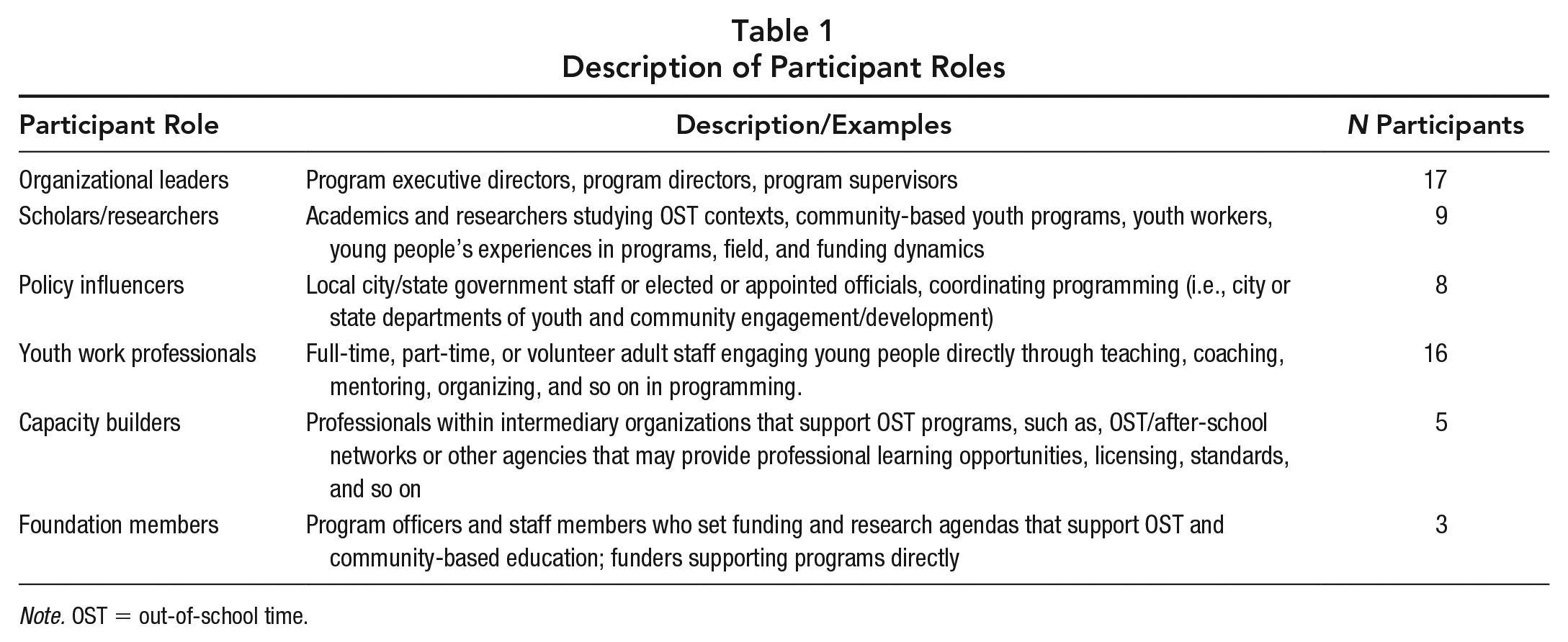
Note. OST = out-of-school time.
With attention to equity, we designed focus groups around affinity topics and youth populations that reflect known areas of OST focus. Those include (but, of course, are not limited to) seeking out participants with special insight into working with LGBTQIA+ youth, immigrant and refugee youth, racially minoritized youth, civic/city/systems-involved youth, youth organizers, and college-level youth workers. The purpose of clustering these participants was to encourage targeted and free-flowing conversation on what we conjectured would be more grounded and specific discussions on problems of practice. Our interviews and focus groups were all conducted via Zoom and transcribed with the support of Zoom and research assistant authentication.
The OST program landscape is vast and diverse. Our participants represented many different types of youth organizations, including but not limited to national after-school programs with regional chapters, grassroots independent programs, faith-based programs, youth organizing programs, detention centers, university-affiliated/sponsored youth programs, and city-led or school-district-run programs. The similarities and distinctions between these types of programming within the OST landscape are reflected in a forthcoming article (Baldridge et al., in progress).
YPAR
We formed a multigenerational, multiracial research team with five university researchers and 12 high school and college students from New York, Colorado, and Kentucky. Similar to how the adult participants were recruited through known networks and community nominations, the youth research team was recruited vis-à-vis the authors’ existing professional, educational, and practice-based social networks. In particular, the authors whose scholarship is based mostly on empirical work with community-based youth organizations were most leveraged for their networks—this meant that youth from community-based organizations in and around Lexington, Kentucky; New York, New York; and Denver, Colorado, were invited to apply and participate. We recruited from organizations aligned with the goals of the broader project—that is, to focus on the study and design of OST experiences for youth from racially minoritized communities. Current program students or alumni were eligible.
Our adult research team emailed invitations and applications to join the YPAR team to community-based organizations in Kentucky, New York, and Colorado. All youth who completed the application and interview process were accepted as part of the team. In line with emerging evidence on the importance of providing compensation to youth for expanded learning and enrichment opportunities, particularly for youth from low-income households who may be expected to contribute to family and household expenses, youth researchers were paid a $600 stipend for data collection, analysis, and presenting findings completed during the fall of 2020. Six youth researchers, who continued on the project to reanalyze data and present findings in new venues, received an additional $175 stipend and travel support. Reflective of community-based organizations from which they were recruited, the youth researchers were predominantly from minoritized communities along racial and socioeconomic lines and predominantly young women.
Drawing on YPAR principles that center the lived experiences of young people (Kirshner, 2015; Torre et al., 2012), the primary project graduate student facilitator began the research cycle by asking youth researchers to reflect on their own experiences in OST programs. After a series of facilitated small and whole-group conversations about their experiences and interests, they were asked to identify questions and topics for further inquiry. Ultimately, the youth team identified “bright spots and pain points” of young peoples’ program experiences, including their own, as the object of inquiry.
The group met eight times for 2-hour meetings via Zoom during the fall 2020 and early 2021 with the graduate student lead for the YPAR team and three of the five principal investigators. After discussing their own experiences and identifying salient issues to investigate, the team completed four peer-to-peer focus groups and administered an online survey to 191 young people between the ages of 13 and 19. To recruit participants for their mixed-method study, the team leveraged their own social networks, including school, organizational, and neighborhood peers. Youth researchers carried out the recruitment, tracking, and administration of small stipends to the people they surveyed and interviewed, with an attentiveness to capturing diverse experiences and perspectives. The only inclusion criteria were the age range (ages 13–19) and some prior experience in an OST program. After focus group and survey data were collected and analyzed by the youth researchers and their adult research allies, the youth team shared their findings in a range of venues, including a podcast, a conference presentation, a professional meeting, and a foundation report (Arguelles et al., 2022; Browne, 2022b).
Data Analysis
Study findings are rooted in our thematic analysis of interviews and focus groups and our research team’s collective expertise as OST scholars and former youth work professionals. After identifying key constructs related to our research questions, conducting a literature review, and completing initial reads of interviews and focus group transcripts, we developed a coding scheme for collaborative data analysis (Cornish et al., 2013). Consistent with our tandem focus on problems of practice and innovative ideas, our coding system was organized into two main “parent” codes: “problems of practice” and “innovative practices.” Data files were uploaded to an online collaborative data analysis application (Dedoose), and research team members coded transcripts using shared decision rules. An iterative process of descriptive, low-inferential coding, collaborative meaning-making, and memo-writing (Miles & Huberman, 1994) led us to prioritize three broad categories of findings, which respond in distinct ways to our guiding research questions. Analysis within the context of the YPAR project followed a similar but condensed approach. We used the time together to discuss interpretations of data before splitting up to pursue specific questions in pairs. Taken together, our question and subsequent analyses interrogated the existing landscape of inequity that persists within and across the OST landscape. Consistent with our critical bifocal lens, in this article, we present three findings that sit at the intersection of sociopolitical context and the design of more anti-racist and dignifying community-based learning environments.
Limitations
We acknowledge two key limitations of our design and findings. Because of the study’s timing during a global health pandemic, data collection depended on people’s accounts of their experiences without supplemental observations that might confirm, complicate, or contextualize self-reported data. Additionally, our sampling method led to an overrepresentation of programs in urban areas serving adolescents. We addressed this by collecting a second wave of data to recruit underrepresented sectors, such as programs serving younger children and youth in rural settings.
What We Learned
Participants highlighted pressing challenges they faced in their work. Findings demonstrate how racism and colonial mindsets shaped program leaders’ and youth workers’ engagement with youth and their respective programs. Our findings capture the complicated power dynamics between youth workers and young people and the suppression of youth voices. This study confirmed and further revealed the precarious nature of the OST workforce and its impact on the youth work professionals’ well-being and livelihoods. Finally, we share key findings from participants about innovative, equity-oriented practices that foreground the dignity of racially minoritized youth.
Pressing Challenges: Racism(s) Within Organizations and Program Practices
Analysis of interviews and focus groups showed that many youth-serving organizations are still burdened by a legacy of white saviorism, paternalism, and anti-Black racism, in which Black, Latine, Native Asian, and Pacific Islander youth continue to be positioned as at risk and needing to be fixed or saved by programs. Several participants in our study who were either current or former OST directors named the challenge of institutional racism through sharing personal and colleagues’ experiences. They described how racially minoritized program leaders experienced tokenization in their roles and were disregarded by the predominantly White boards of directors. Some participants encountered barriers to promotion when speaking out against tokenization and racial disparities; some even specifically described their experience of learning about pay and benefit disparities between White and racially minoritized workers.
A Black woman executive director with over 2 decades of program leadership in the Northeast vividly illustrates how structurally embedded anti-Black racism manifests in the leadership and design of OST programs:
I think the whole business model [of youth nonprofits] is paternalistic [and] patriarchal. It mimics an old southern cotton field. You got the White folks in, in the Big House, setting the rules. . . . But even I know that my power and influence. Because while I’m doing the work, I’m also navigating the fact that I’m a Black woman. And then, you look out in the cotton fields, and guess who’s out there?
Here, this executive director illuminates how boards of directors and funders, often White, wield programmatic decision-making and financial power while those in the “field” are Black or racially minoritized program directors and youth workers engaged with youth within the parameters set by those “setting the rules.” This reflection aligns with prior research on the specific experiences of Black program leaders and youth work professionals (Baldridge, 2020; Heathfield & Fusco, 2016). Our participant’s invocation of American chattel slavery may seem extreme to some; however, the relationships between nonprofit organizations, their leadership, philanthropic entities, and front-facing staff are often situated along the axis of structurally racialized power (Gilmore, 2017; Jaffe, 2021). This longtime director’s quote speaks to the anti-Black paternalistic ways whiteness seeks to control and “feast” on Blackness (Henry, 2023) in ways that render the desires of Black youth workers and Black youth in OST programming irrelevant. Black youth workers who directly engage with Black youth in predominantly White-led programs or Black-led organizations bound to and by White philanthropy (Allen, 1990; Baldridge, 2019) are indicative of the afterlife of slavery (Hartman, 1997/2022), where the struggle for autonomy, independence, and freedom seems fleeting at best and impossible at worst and where such historical comparisons may at times feel apt.
Both the youth worker interview and focus group data directly spoke to the difficulty of navigating racially hostile settings and protecting racially minoritized youth from racist experiences. According to youth workers in our study, they are often retaliated against. For example, during a staff meeting, a Latino youth work professional from the West Coast shared his experience calling out his program’s tokenization and stereotyping of Black students in their promotional videos. Unfortunately, he shared that this concern for Black youth participants was met with retaliation from White leadership; he was demoted from his program director role, where he engaged with youth directly, and was assigned behind-the-scenes tasks, such as translating program documents into Spanish.
Program leaders and youth workers detailed experiences with racism in organizations and the proliferation of mundane deficit-based approaches and practices to youth work, which shaped their roles as leaders and the experiences of youth in the program. Several program leaders and youth workers we interviewed, for example, noted that white savior and deficit-based lenses tend to see or recognize certain kinds of voices, such as those that mirror linguistic practices of “Academic English.” In contrast, and to address this phenomenon, some longtime youth workers described how they intentionally elevated racially minoritized youth to leadership positions because they are often among those who are explicitly marginalized from formal student government opportunities in their schools (Ginwright & James, 2002).
Due to our intentionality in recruiting experts who value social justice approaches to youth development and whose organizations have a reputation for focusing on equity, many of our participants discussed prior personal experiences and encounters with racism in their work and how they have tried to disrupt it. Although our sample of experts strategically focused on leading scholars, policy influencers, and practitioners who are invested in issues of equity and social justice, we did note differences in comfort and knowledge in talking about racial inequities and racism within OST programs and organizations in our conversations between White and racially minoritized adult participants. Additionally, data analysis from the YPAR project revealed that racially minoritized and marginalized youth reported mixed experiences of relationships, belonging, and community through their participation in clubs and programs. On one hand, YPAR findings showed that a sense of belonging and feeling valued were among the most central reasons why youth stayed in a program, returned the following year, and/or recommended the program to a friend. On the other hand, some youth participants revealed that their peer and adult relationships were not consistently high quality, including experiences of favoritism or racial marginalization in OST spaces. These paradoxical experiences were reflected among our youth participants, confirming that programs may have missions to elevate racially just approaches to youth work while also perpetuating racist and paternalistic narratives.
Pressing Challenges: Field and Workforce Precarity
The most resounding and frequently articulated problem of organizational practice across data analysis of youth workers, program leaders, and scholar interviews was funding precarity. Data revealed that funding concerns related to financial stress within organizations, competition for grant funding, or wages for youth work professionals proved to be a significant concern. “Funding precarity” refers to the often unstable and inconsistent ways programs are financed through competitive grants (both public and private) and individual donations, often called “soft money.” Grant awards are usually short-term, and funding priority areas frequently shift. Program directors expressed concerns about the scarcity of multiyear or general operating grants; they discussed how current grant-giving structures create competition among like-minded organizations. As a program founder in the rural Southeast noted, “Right now, we’re in a good cycle, but next year . . . we’ll also be scrounging for funding like everybody else, and then you’re competing against other organizations, and that never feels good.”
Competitive local grants particularly affected smaller, grassroots organizations because applications required more organizational capacity. Participants also discussed how competitive funding models prevented small organizations from coordinating their efforts and sharing resources. As an executive director of a youth organization in the Midwest explained: “The biggest challenges still are scarcity-based funding models that promote competition instead of collaboration . . . among us local organizations that go for the same pots of money.”
A second significant implication of funding precarity was its impact on workforce precarity. As echoed throughout the previous articulated themes, youth work professionals are vital to young people’s experiences within community-based programs. Analysis from all data sources revealed organizational instability connected to sustaining a long-term OST workforce. The most common concern among participants was the need to create a livable wage for youth workers. As one participant explains,
If I take care of my team, right, by providing benefits, by providing as much wages as I can afford them, if they’re not worried about financial things, right? If they’re not worried about . . . basic rights to health care things, then they can show up more fully in their work.
Other study participants highlighted the challenges of not being part of a protected class of educational professionals (e.g., job security, part of a union, good benefits), which leads to low wages and job instability, often in rapidly gentrifying cities where housing affordability is a significant issue. Of note, these interview findings are consistent with research and evaluative reports on youth workers’ experiences of precarity that lead to staff turnover and career exits (Baldridge, 2019; Bloomer et al., 2021; Borden et al., 2020; Starr & Gannett, 2015; Vasudevan, 2019). Findings confirm and deepen the urgency to focus on and invest in youth workers’ occupational experiences and livelihoods.
Innovative Practices: Healing-Centered Engagement
Despite the precarity shaping the field and the workforce, our participants led equity- and justice-based work—providing healing-centered engagement (Ginwright, 2015), culturally sustaining mentorship (Paris, 2012), and pedagogical practices that fostered belonging for youth participants. Moreover, we learned from participants that these approaches and practices were intentional and subversive, ultimately fostering deeper engagement and belonging among marginalized youth.
Participants shared practices that centered on wellness or whole-child development in nearly every interview and focus group conversation. Practices include providing basic needs like food, shelter, and financial support. They further address harms that take an emotional or psychological toll on youth, particularly if they internalize those harms and blame themselves for their struggles. Unlike wellness strategies prioritizing the individual, healing justice is a community-centered approach that elevates shared experience and hope (Chavez-Diaz & Lee, 2015; Ginwright, 2015, 2018; Page & Woodland, 2023). For example, a youth worker with extensive experience leading youth organizing groups spoke about the need for healing justice to account for the trauma experienced by racially minoritized youth:
Folks experiencing intersecting and multiple forms of domination . . . often have a lot of trauma that can make it hard to function as an organization. But, instead of that trauma being ignored, we can help young people understand where that trauma came from; how that trauma has potentially taught them things about systemic inequality, racism, sexism; and how their experience within those systems gives them a particular and essential understanding of different kinds of oppression.
This theme of healing and wellness became acute during 2020 as programs responded to the intertwined harms of COVID-19, white supremacy, police brutality, and economic precarity. In addition to creating opportunities to process, understand, and interpret the root causes of community trauma, program leaders articulated how their organizations employed creative approaches to mutual aid during the pandemic that addressed gaps in food, childcare, or shelter. For example, one participant, a youth work scholar and founder of a youth mentoring program in southern California, shared the origin story of a wellness center for Queer youth. The inspiration came from a youth mentoring program participant who wanted to know how to build access to resources through a “community-level organized system of wraparound supports.” Through securing donations and grants, the center now provides programming, housing, and basic needs for youth. Growing frustrated with the “bureaucratic mess” of accessing wellness, this program founder developed community partnerships with grocery stores, gyms, and wellness centers so youth and their families could partake in services for little to no cost. As a program leader in the Northeast echoed, such efforts that center healing justice approaches acknowledge “the fact that regardless of where you come from, you deserve to feel well.”
Innovative Practices: Intergenerational Models That Center Youth
The OST field has historically struggled to attract “older” youth (i.e., high school or post-high school age) into voluntary programs (McLaughlin, 2000). Part of the problem has been adultist mindsets that limit young people’s voice, power, and input. This problem showed up in some of our interviews, the YPAR survey, and focus group findings. As one practitioner in our study shared, the OST community needs “to rethink how we’re working with young people . . . [currently] everything is top-down. Everything is rooted in adultism. And . . . I’m trying to get us to a point where we’re, like, really listening to young people, right?”
At the same time, some youth work researchers and professionals challenged the binary between adults and youth and spoke about the nuanced types of guidance that near peers, young adults, or even elders play in settings that center youth voice and choice. For example, one participant argued that novice youth workers often swing too far toward a “child-centered” approach to guidance in reaction to or fear of replicating traditional teacher/adult-centered pedagogies:
It’s . . . this “adult-centered,” “youth-centered” binary that I don’t think actually serves people well. And so, I’ve been learning from and pushing for intergenerational learning as a different framework that helps us get into its fundamental differences from top-down adult-centric approaches but doesn’t swing to the other extreme in a way that kind of creates this vacuum.
In addition to limiting opportunities to learn through intergenerational relationships, when adults step back too far, they may unintentionally send young people the message that an activity is trivial or just a school-like exercise. From the YPAR study, the analysis suggested that young people simultaneously want their voices to matter in program design and for the adults connected to programming to be invested in true cross-age collaboration.
Innovative Practices: Culturally Sustaining, Collective Mentorship
Authentic youth-adult partnerships like mentoring, coaching, and relationship building are central to meaningful youth programming. Interestingly, participants in our study pushed back on “status quo” models of mentoring programs that foster top-down or one-to-one approaches (Weiston-Serdan, 2017). Instead, they proposed fostering and sustaining collective and grassroots mentoring models within racially minoritized and queer communities. This also means acknowledging how the sociopolitical context creates challenging conditions for youth. As one program leader explains, “This is where we’ve gone wrong in programming around mentoring. Why am I trying to fix the young people when the context around them is toxic?” This point resonates with the approach of healing justice whereby programs understand and acknowledge the structural oppression that creates trauma and harmful experiences youth must navigate (Ginwright, 2015; Page & Woodland, 2023). The connection between healing-centered justice and culturally sustaining (Paris & Alim, 2017) and collective mentorship opportunities for youth (Weiston-Serdan, 2017) proved vital for several of the participants in our study.
One participant noted that traditional models of one-to-one mentoring are limiting: “One-to-one. Like, in what collectivist community is one-to-one a thing, right? We get raised by everybody in the community, not one person.” This point reflects what we learned in our focus groups, specifically with practitioners working with immigrant and refugee populations, LGBTQIA+ youth, and racially minoritized youth. It is imperative to understand that young people belong to intergenerational communities where they are mentored, guided, and loved by entire communities.
Innovative Practices: Commitment to Financial Support
For many in our study, a commitment to financial support for youth experiencing economic distress was an important priority. Acknowledging the trauma and economic distress caused by decades of underinvestment in Black, Latine, Indigenous, and low-income communities, nearly half of the youth workers and program leaders in our study made a specific recommendation to pay for youths’ participation, particularly when discussing roles related to youth leadership and voice. This recommendation was echoed in the YPAR data, which showed that youth feel more valued as authentic contributors when they are paid for their time; if they are not paid, older youth may opt for paid work instead of OST opportunities.
The YPAR team found that youth often encountered stress choosing between paid work, caretaking responsibilities, and enrichment. Roughly 25% of Latine youth reported that they had to prioritize a paid job over joining a program, and 75% reported that they knew someone else who could not join a program because of cost or distance from their homes. Equity-driven programming, in this case, means that financial pressures should not prevent access. It is not enough to offer a free program, but especially for older youth, providing them compensation to attend a program could be the deciding factor in their participation.
Discussion: Fostering Dignity, Connection, and Belonging
Empirical analysis of stakeholder interviews and the YPAR study suggest that practitioners are designing innovations in programming that leverage different modalities of engagement and attempt to do so in culturally relevant ways. In practice, this looks like programs offering space for agency and voice for youth participants that promote creative self-expression, community engagement, and collective meaning-making. To resist the deficit narratives that shape how minoritized youth are framed and engaged in programming, participants shared purposeful practices to affirm and humanize youth, which is consistent with best practices from scholarship on culturally relevant and culturally sustaining pedagogy (e.g., Ladson-Billings, 1995; Paris, 2012). Simply put, practices that locate the deficit in structures of power and domination that lead to inequities instead of within youth or their communities inspire young people to engage and affirm their dignity.
We see evidence for problems of practice that cut across program types, particularly regarding youth worker precarity. Our literature review findings demonstrate that positive, culturally relevant youth-adult relationships and partnerships are instrumental in effective programs for racially minoritized and marginalized youth. This finding is consistent with most literature on OST programming. However, aligned with our analysis of the field’s sociopolitical context, youth work is already tenuous and is exacerbated by the neoliberal context of education (Baldridge, 2019; Kwon, 2013; Singh, 2021). To sustain equity-oriented programming for marginalized youth populations, we suggest further interrogating (a) the links between youth worker precarity and its impacts on marginalized youth experiences in programs and (b) current youth workers’ practices, pedagogies, and experiences in the field. Inclusive, culturally responsive programming depends on who facilitates these programs and their ability to receive ongoing training and professional development. Furthermore, commitment to this kind of programming and support of OST staff requires an honest interrogation of how racism(s) and colonial mindsets are embedded within the field and concerted efforts to push back alongside young people.
We also identified problems of practice that vary based on funding structures and organizational contexts for programs. For example, some of the most promising innovations for youth programming occur in relatively nimble grassroots programs anchored in local communities led by staff with deep roots. Such groups can be responsive to changing youth interests and neighborhood dynamics. What they often need help with, however, is core support to ensure stability and sustainability for their staff and program spaces. These challenges relating to attrition, turnover, and career not only still exist but also appear to overwhelmingly shape the everyday experiences of the youth work professionals and the youth who participate in programs.
Recent policy efforts across the country shows some promise. Some state and city youth development and after-school networks (e.g., California and Madison, Wisconsin) and school districts (e.g., Tulsa Public Schools) have leveraged federal and state pandemic relief funds (Elementary and Secondary School Emergency Relief Funds and American Rescue Plan Act) and local funding sources to address pressing issues of equity, such as increasing the living wage for youth work professionals, increasing access to programs for youth who need it most, and building partnerships between communities, families, schools, and higher education institutions to better support youth well-being and create sustainable career pathways for those who wish to enter the workforce (Every Hour Counts, 2023). Additionally, there is promise in advocacy efforts to expand federal funding streams such as 21st Century Community Learning Centers, with an assertion that funding will increase access to interest-driven enrichment opportunities across the country (versus serving as a forum for standardized test prep and rote learning; Quinn, 2022). The Power of Us Workforce survey 2 is a recent effort to better understand the work experiences, needs, and equity issues facing youth-allied fields’ professionals and volunteers (Bevan et al., 2023). Findings from national studies such as The Power of Us, hopefully, will inspire a closer look at this essential workforce and pave the way for further inquiry, advocacy, and policy change—at the local, state, and federal levels—to improve the pay, labor standards, and organizational conditions for youth workers.
Toward a Liberatory, Anti-Racist, and Community-Driven Field
For a long time, the OST sector has sought to establish its legitimacy in education and social services. This legitimacy is needed and deserved. Youth experiences of agency, belonging, and cultural affirmation make OST programs valuable. As a subset of OST spaces, community-based organizations have a proud tradition of disrupting educational inequity (Baldridge et al., 2017). They often have more autonomy than schools in developing anti-racist communities of care, promoting leaders from within minoritized communities, and designing programming that responds to young people’s desires, agency, and lived experience. To earn and sustain this legitimacy, however, the sector needs to engage in critical reflexivity and imaginative dreaming.
The field needs collective, inward-facing work to understand its historical roots in racist, deficit-based, kid-fixing discourses and how these histories influence and inform everything from program design and staffing to accountability measures and funding. Our study participants discussed the impacts of everyday, ongoing colonial mindsets and racism(s) they experienced as youth workers and program leaders. We encourage more research to uncover how racism and interconnected forms of oppression shape the sector, youth experiences, and youth work professionals to understand how harm is enacted to disrupt it. Furthermore, we implore the field—policy influencers, scholars, organizations, and funders—to shift how we define the field and the work done on behalf of youth. We encourage more humanizing and dignifying language and practices that reflect the power of youth and communities.
In tandem with various types of inward-facing critique, the field can also nurture and support the affirming and liberatory visions held by educators and young people in community-based educational spaces and OST programs. Communities should define their work with youth as they deem fit, free from white supremacist, paternalistic, and deficit narratives determined by funding and public discourse about racially minoritized youth. In this climate, where a “racial reckoning” coincides with a concerted effort to dismantle anti-racist, culturally sustaining practices within education and social policies, the OST field must continue its tradition of disrupting educational inequity through creative, youth-centered engagement opportunities. As a sector, we can continue to elevate programs and people enacting humanizing, anti-racist approaches to working with youth. Visionary organization leaders like those we spoke to for this study are experimenting with approaches that humanize, affirm, and inspire. Innovative programs organized around healing justice, youth organizing, collective care, and multigenerational collaboration deserve investment and support. Doing so offers our best chance for realizing the liberatory promise of community-based education.
