




Abstract
In this article, we argue that healing from trauma in a racialized context requires an act of collective, critical resistance whereby educators and researchers reject a White-dominant colonial perspective of trauma on the grounds that it is pathologizing in several ways. We introduce a holistic trauma framework for understanding and responding to trauma within a racialized context. First, our framework seeks to draw on multiple forms of knowledge and experience to gain a deeper sense of trauma, suffering, and healing. Second, it uses an organic approach to promote relationships and support healing. Third, our framework explores multiple timepoints by introducing proactive, interactive, and reactive approaches for addressing trauma more comprehensively. We hope our framework will enhance the field of trauma research, which is, at present, overpopulated by White-dominant, colonial perspectives that mask systemic racial inequities.
Keywords
Police killings, a global pandemic, and necessary social isolation have caused many of us to think and talk more about the trauma we and others experience. Meanwhile, political world views on these and other matters heavily influence the national discourse, causing some people to experience even deeper wounds as they are pushed further to the margins of society (Shepherd et al., 2020). Amid so many traumatic happenings motivated by White supremacy, we argue that relying on a White-dominant colonial logic to think and talk about such traumas can have grave consequences for Black, Brown, and other marginalized people of color across domains, such as economic, cultural, cognitive-moral, somatic and, in a sense, even ontological (Mills, 2003). For one, this logic diverts attention away from the systemic racialized sources of trauma, namely poverty and institutional violence (Garo et al., 2018; Slopen et al., 2016). Two, it (un)intentionally perpetuates deficit-oriented trauma narratives that reify racism and White supremacy (Goldin et al, 2021). Third, such a logic obstructs society’s collective capacity to engage in holistic healing (Ginwright, 2018). In short, when it comes to trauma, there is a need to move the discourse and scholarship beyond a myopic, White-dominant, colonial perspective that masks systemic racial inequities and prevents collective healing from colonial abuses, such as racism, sexism or xenophobia (Alvarez, 2020). Therefore, our goal in this article is to introduce a holistic trauma framework that can function as a conceptual tool for reframing trauma discourses and for enhancing trauma research with participants across the educational spectrum, especially young people of color who are marginalized within and around oppressive school structures.
Our interest in advancing research on race, trauma, and healing is personal. Before we began our work together 7 years ago, Author 1, a Mexican American man, had been an elementary teacher for 6 years in a racially and culturally diverse school at a psychiatric treatment facility in Central Texas. Author 2, a Nigerian American woman, was a secondary educator who worked with culturally and linguistically diverse students in an urban public school in Texas. As people of color, we both share similar racialized experiences with our former students and, like some of them, we carry trauma in our own respective bodies—the trauma of U.S. public schooling. We have intimately experienced racial trauma in White supremacist educational settings that attempted to deculturize us (Spring, 2016), devaluing our families’ ancestral languages, cultural knowledges, and ways of being. Although our own children (there are six between us) are at various levels in their educational journeys, we, like many other parents of color, worry about the potential racialized wounds they will experience. Therefore, we humbly come to this work with shared wounds, guided by reflexivity and humanizing intentionality. In short, we arrive here with an urgency to better advocate for (our) children of color and heal our collective spirits, minds, and bodies.
We begin by laying a theoretical foundation to explain several shortfalls of addressing trauma through a White-dominant approach. Then, we will argue that healing from trauma in a racialized context requires an act of collective, critical resistance whereby educators and researchers reject White-dominant colonial logics and pursue a more holistic framework for understanding and responding to trauma in and across educational contexts. Holistic approaches, as we will discuss, not only challenge notions of reductionism and determinism but also encourage collective healing across multiple domains and identity spaces. In particular, we outline three features of a holistic trauma framework. First, our framework aims to draw on multiple forms of knowledge and experience to gain a deeper sense of one’s suffering and to understand the source of that suffering. Second, it uses an organic approach to promote relationships and support healing. Third, our framework explores multiple timepoints by introducing proactive, interactive, and reactive approaches for addressing trauma more comprehensively.
Troubling White-Dominant, Colonial Logics on the Concept of Trauma
In general, conflict theories describe how different status groups engage in struggles to either oppose or maintain hegemonic norms (Collins, 1971). 1 When race is a central analytic component, societal conflicts occur when racial groups struggle to either maintain or disrupt the institutions, ideological boundaries, behaviors, interests and emotions of the dominant racial group in a racialized social system (Bonilla-Silva, 1997, 2019). According to Bonilla-Silva (1997), racialized social systems are “societies in which economic, political, social and ideological levels are partially structured by the placement of actors in racial categories or races” (p. 469). Consequently, dominant racial groups absorb the cumulative advantages, or, for marginalized racial groups, the disadvantages, from said systems along with the residue from historical conflicts between racial groups trying to uphold or change the racial status quo.
Furthermore, by normalizing a racial ideology, Bonilla-Silva (2014) argues, common sense, meta-narratives about racial matters function not only as an epistemological form but also as an organizational map by which social systems shift, as needed, to maintain the White racial group’s dominant status. The point here is that in racialized societies Whiteness runs deep and creates such a stronghold at the underground intersection of institution, ideology, and identity (Leonardo, 2013), causing White, hegemonic structures to perpetuate racial inequities across social systems (Jupp et al., 2016). Ultimately, as Table 1 synthesizes, in racialized contexts, White-dominant systems, structures and beliefs shape the concept of trauma, the conditions in which people in the United States experience trauma and the ways in which White-dominant institutions discuss and address trauma (Alvarez, 2020).
Trauma/Healing in the Context of Racialized Social Systems
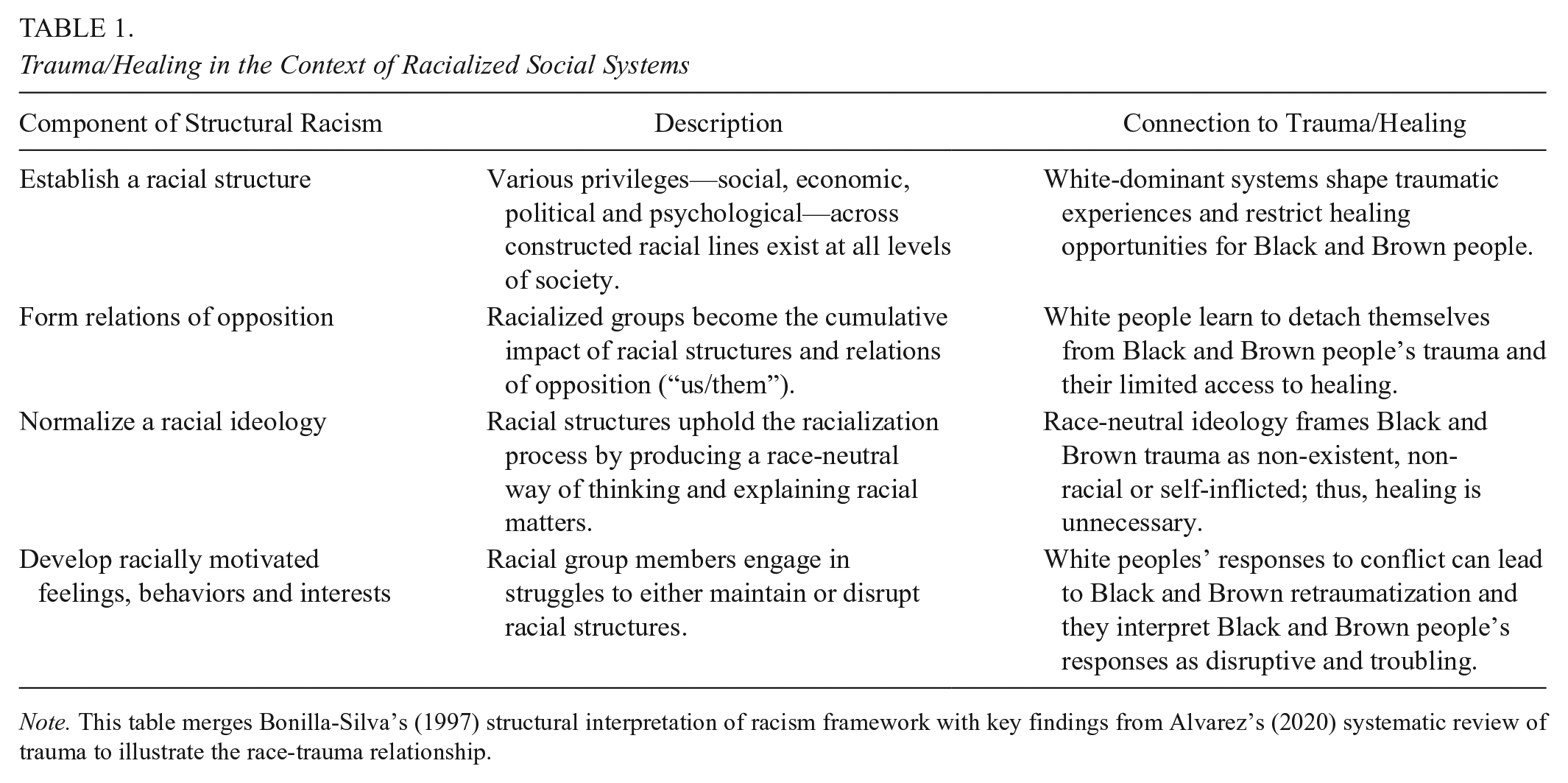
Note. This table merges Bonilla-Silva’s (1997) structural interpretation of racism framework with key findings from Alvarez’s (2020) systematic review of trauma to illustrate the race-trauma relationship.
The historical legacy of structural racism in the United States is a perpetual trauma machine grounded in White settler colonialism. Patel (2015) establishes that “Settler colonialism is a continuous process and logic with three mutually dependent components, all of which work in tandem and rely on each other to maintain the overall structure” (p. 33). First, seize the land, resources, and culture. Then, rationalize the seizure by using institutional forms of violence to erase indigenous people and replace them with White settlers and White dominant ways of knowing and being. Finally, the few land and resource owners render human beings as chattel and capitalize on slave labor. Moreover, elite capitalists rely on racial conflicts between and among working people with few or no civil rights as they compete for limited resources and status. The historical legacy of racism has conditioned many White people—who also experience trauma from institutional violence—to oppose racialized “others,” which, in turn, weakens the potential for collective work across various sites of oppression (Au & Apple, 2009; Dillard, 2000; hooks, 2014).
Because a structural component of racism is to minimize the impact race has on people’s lives, we first explore trauma as a socioeconomic issue. Barrera’s (1997) assessment of internal colonialism and class segmentation is useful here to illustrate a class-only analysis of traumatic exposure. He explains, “Having adopted a class-differentiated colonial perspective, it remains to spell out the nature of structural discrimination in more detail and to relate the model to the American class structure” (p. 37). For Barrera, the establishment of an oppressive colonial structure exists at four different social class levels, where a segmentation line separates the dominant and subordinate groups in each stratum. The gist of Barrera’s (1997) model is that people in the dominant and subordinate groups may have similar economic interests, such as “working class” groups’ interests in higher wages and better working conditions, but their sense of collectivism to advance their economic interests is obstructed by the colonial structure dividing them.
When we take Barrera’s model and map it onto national data showing traumatic exposure by race and family income, we notice an important pattern (see Figure 1). For all youth, the effect of income on reducing trauma-exposure is quite substantial, indicating that children in the lowest income-earning families are almost four times more likely to experience multiple traumas than children in the highest income-earning families (Slopen et al., 2016). This finding should not be surprising as homelessness, food scarcity, and other issues related to poverty and economic stress are among the strongest predictors of trauma (Sacks & Murphey, 2018). However, that White children in the lowest income-earning families have a higher propensity to experience multiple traumas than children of color in the same income group (see “low” family income panel in Figure 1), an emergent question might be, “if structural racism were such a driving force, why are White children in high poverty areas reporting multiple traumatic experiences at a greater rate than children of color?” To answer this question, one might begin with the “authoritative guide” on these matters.
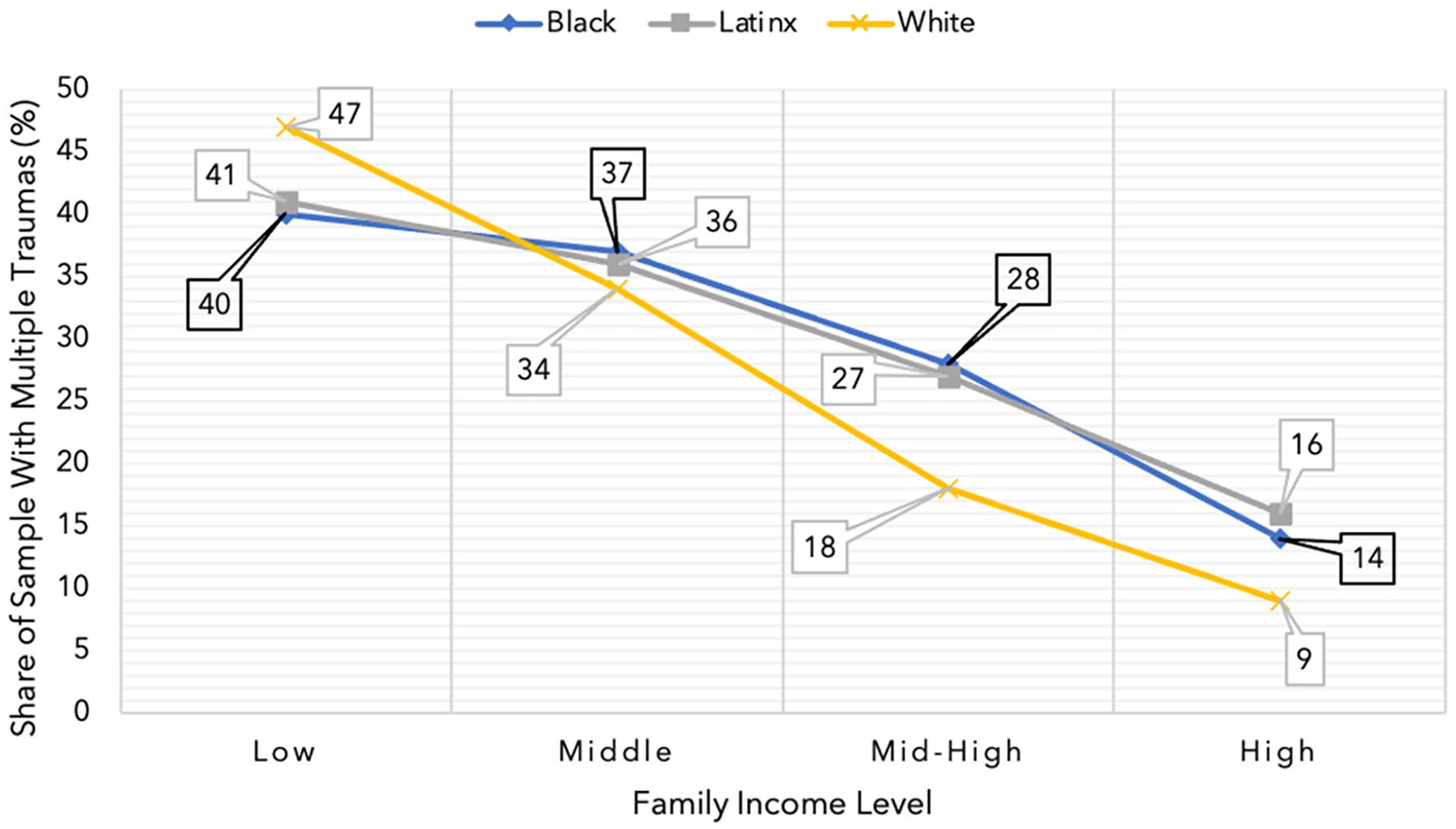
Multiple Traumas by Race and Income Level.
The American Psychiatric Association’s website notes, “The Diagnostic and Statistical Manual of Mental Disorders (DSM) is the handbook used by health care professionals in the United States and much of the world as the authoritative guide to the diagnosis of mental disorders” (https://www.psychiatry.org). In its most recent revision, the DSM-5 narrows the types of experiences that qualify as traumatic and it clarifies issues, such as witnessing other people’s trauma—it notes that witnessing must be in-person and not through media outlets. Although these changes may seem trivial, they illustrate how state agencies and institutions uphold White dominance using westernized, colonial logics, namely by controlling resources and knowledge production (Marable, 2015; Matias, 2016; Patel, 2015). Such epistemological strongholds grounded in the DSM-5, for instance, can normalize the type of racial ideology that disregards the collective, vicarious trauma that Black, Indigenous, and other marginalized people of color can experience through observing televised acts of murder, bodily harm, and civil rights violations imposed by agents of the state. That people are even placed into categories based on what “authoritative guides” say about their dysfunctionalities is outright troubling and it promotes an “us/them” division.
Nonetheless, to the question, “why are White children in high poverty areas reporting multiple traumatic experiences at a greater rate than children of color,” the logic of dysfunctionality would suggest that White youth in high poverty areas lack the grit, resilience or capacity to cope (Bethell et al., 2014; Bloom, 2014; van der Kolk, 1989). 2 Clearly, this is theory rooted in deficit thinking because it fails to acknowledge the dearth of social, political, and economic forces influencing the lives and experiences of young people. However, this exact logic is used when Black and Brown youth are the subjects, and such a stance can be used to rationalize racial stratification and create inter-racial conflicts and relations of opposition between groups within the same socioeconomic strata.
Many psychologists and others working in the field of medicine claim that trauma alters brain functioning and causes several internalizing behaviors, such as depression or withdrawal, or externalizing behaviors, such as aggression or risk-taking (Cook et al., 2005; Ford et al., 2012; Shonkoff et al., 2012). However, if medical professionals claim that trauma alters brain functioning, would this not infer that people of color in the United States experience more brain dysfunction and developmental delays because they are significantly more trauma-exposed than White people (Sacks & Murphy, 2018)? Again, this form of trauma theorizing is rooted in race-neutral, deficit thinking, as it upholds racial stratification and blames disparate trauma outcomes on a lack of resilience, coping skills or social emotional capacity. Our contention is not that some children who experience trauma can encounter developmental challenges. Rather, we argue that White-dominant discourses on trauma and brain functioning are reductionistic, deterministic, and can propagate racial inequities. 3 For one, this should spur some critical parallels to the eugenics movement and subsequent deficiency theories. Although most would agree that biological deficiency theories have been held in disrepute for quite some time, surprisingly, some trauma studies still pander to these ideas by highlighting Black youth’s low IQ scores, for instance (Delaney-Black et al., 2002). Similarly, under Moynihan’s (1965) model where the Black family structure is perceived as weak, thus causing emotional problems, low achievement in school and other pathological issues, trauma might be interpreted as a generational deficiency in family social structure that is passed on from parents to their children. A problem with these theories of deficiency is their inadequate structural interpretation of racism—namely an interconnected set of empirical questions investigating how a racialized social system shapes what trauma is, the contexts in which trauma occurs, the institutions in which guiding frameworks for trauma are developed, and the nature of the collective knowledge of people within said institutions.
There is one final point we want to address on the limitations of a White-dominant colonial logic on trauma: the hypocritical intersection of individualism, meritocracy, and in-group solidarity. Here, we return to Figure 1 as an analytic site for troubling the notion of individualism. If trauma were based on one’s individual level of resilience, for instance, then children in middle income families, according to the national data, must have similar levels of resilience. Furthermore, the racial gap in multiple traumas for children in middle-high income families (about 10 percentage points) and high income-earning families (about 6 percentage points) widens, suggesting that White children, somehow, substantially increase their own resilience as their families’ income increases. By this logic, children of color in the lowest-income earning families seem to be more resilient than their White peers. To think that the multiple traumas that young people experience depend mostly on their own capacities or their caregivers’ level of income, to us, seems far-fetched and inappropriate. Indeed, such an irrational assessment, we believe, upholds the racialized social system, which advantages higher income-earning White families.
The reality is that, in many higher income earning communities, White people are over-represented and we suspect that they benefit from in-group solidarity in ways that people of color who live among them may not. 4 In fact, that some Black parents and caregivers engage in practices to compensate for the various opportunities that are denied to their Black children across socioeconomic levels, we believe, speaks to the importance of community and connectedness (Delale-O’Connor et al., 2020). Even in the case where scientists have focused on poverty’s negative impact on youth brain development, the primary lever for improving brain functioning is supportive parenting (Brody et al., 2017). Similarly, we know that high-poverty urban communities of color with a high concentration of organizations can promote a strong sense of interconnectedness and solidarity among their Black and Brown youth (Emory et al., 2008; Molnar et al., 2004), which could be why youth of color have fewer reports of multiple traumas than their White counterparts in the same communities. Relational capacity is an important protective factor. Although Slopen and colleagues (2016) do not explain the similar levels of trauma exposure among middle-income youth, our hypothesis is that more racial diversity may promote more interracial solidarity, meaning fewer targeted racialized traumas.
What might this mean for high-poverty rural communities? Although Black people comprise 8% of the rural population, they make up 15% of rural residents living at or below the poverty line; in contrast, White people account for 80% of the rural population and about 65% of the people in poverty conditions (United States Department of Agriculture, 2018). Within a racialized social system that has touted individualism and meritocracy, one could argue that some White youth and families who grapple with economic hardship are experiencing what psychologists refer to as cognitive dissonance. If, for so long, White people have bought into the idea that their success is based solely on their hard work ethic, how then do hard-working White people who experience homelessness, joblessness, and food insecurity make sense of their economic struggles? Indeed, Whiteness as a site of privilege (McIntosh, 1988), property (Harris, 1983), or power (Johnson, 2018) may seem difficult to grasp for White people whose families, despite all their hard work, still struggle. Tobin and colleagues (2021) note, “Meager economic rewards are inconsistent with expectations of racial privilege. . . . This status inconsistency for low-SES Whites who occupy racially privileged and economically disadvantaged positions may make this population vulnerable to depleted psychological resources” (p. 19). This argument may also explain why some White people in high poverty rural areas have significantly high rates of depression, suicide, and inter-personal gun violence (Herrin et al., 2018; Hirsch, 2006).
Although people may want to decenter race in the broader trauma discourse, this is an unfounded form of idealism. In addition to dispelling the (de)racialized notion that trauma exposure is a class-based issue, we have argued that a White-dominant colonial perspective on trauma must be rejected, or at least challenged, on the grounds that it is pathologizing in several ways. First, it relies on “experts” who use an “authoritative guide” to evaluate one’s experience and assess the degree to which one’s response to said experience deviates from an established norm. Such experts and guides can perpetuate relations of opposition between racial groups and, consequently, reify racist ideologies. Second, the White-dominant perspective on trauma over-accentuates the notion of neurological diversity, which can function as a type of neo-eugenics. Essentially, this argument may infer that trauma-exposed people, due to epigenetics, are less developed or inherently deficient in cases of generational trauma. Third, this White-dominant view reproduces the myth of meritocracy and individualism because it suggests that without hard work, grit, and resilience one cannot adequately cope with the high-stress, traumatic conditions that others have managed to overcome. Thus, this perspective draws attention away from the structurally racist systems that lay the foundations for traumatic experiences and the perceptions people have of others’ pain. Finally, this White-dominant view on trauma places the onus of healing on the individual, while obstructing the possibility for inter-group solidarity and collective healing between and among sub-groups.
Pursuing a Holistic Trauma Framework
Our pursuit of a holistic trauma framework is influenced by a Mexican Indigenous perspective on healing (Anzaldúa, 2015). Anzaldúa argues that trauma is a breach in one’s reality caused by colonial abuses, such as racism, sexism, or homophobia. Moreover, when people experience structural, state-sanctioned violence on their bodies, boundaries, or identities, they may be shocked into a new way of seeing and being in the world. Thus, trauma is an all-encompassing experience resulting in soul loss—a wound that disrupts all our collective views on reality. In effect, structural, state-sanctioned violence may be intended for people who are marginalized across multiple identity spaces but those wounds impact us all. Therefore, healing from traumatic wounds, for Anzaldúa, is about restoring balance between and among people and a shared land. Further, by promoting a sense of belonging and participation in society, we can intentionally work through our collective wounds. Grounded in this perspective on trauma, suffering, and healing, we now introduce a holistic trauma framework (see Figure 2).

Holistic Trauma Framework: A Visual Representation
Draws on Multiple Forms of Knowledge and Experience
First, rather than relying on an authoritative guide, a holistic trauma framework aims to draw on multiple forms of knowledge and experience to gain a deeper sense of one’s suffering and to understand the source of that suffering. This work is about “Learning to witness without arrogance” (Pillow, 2019, p. 123). Indeed, to resist the colonial act of erasure, we would argue that people who experience attacks on their marginalized identities and humanity need co-conspiratorial witnesses to their testimonies (Love, 2019). By erasure, we are certainly referring to marginalized peoples’ knowledge and experiences with suffering. Without such an account of suffering narratives, the structural violence that shapes peoples’ suffering is also erased and one’s suffering is minimized to a personal issue of health and stress management (Clark, 2016). Rather than naming others’ traumatic experiences for them, we maintain that those with knowledge about various forms of suffering and experience with state-sanctioned violence and colonial abuses are much better positioned to enhance our collective understanding. In essence, a holistic trauma framework enhances what we know about others’ suffering and how, at times, we contribute to those sites of suffering.
Additionally, a set of diverse onto-epistemologies can enhance our understanding of healing. For instance, Two-Eyed Seeing refers to using strengths of both Indigenous and Western ways of knowing and being for the benefit of all (Marsh et al., 2015). Although we acknowledge that the notion of “seeing” could raise questions, for some, about the limitations of visual perceptions and various observer subjectivities, we reject these ableist ideas. Indeed, as Castañeda (1992) writes, seeing is, “An intuitive grasp of things, or the capacity to understand something at once, or perhaps the ability to see through human interactions and discover [covert] meaning and motives” (p. 21). From this vantage point, “seeing” is less about visual discernment (with the eyes) and more about an intuitive discernment (with the spirit) one might develop through exploring historicities and various forms of experiential interactions. Such explorations into a set of diverse onto-epistemologies could be vital for understanding and healing from our collective trauma and sufferings.
We find that aspects of liberation theology are also quite useful for explicating the interconnected forms of collective trauma, suffering and healing. In short, the liberation theology movement was sparked in 1960’s Latin America to upend institutional violence and poverty. Some liberation theologians have suggested that, without suffering with the poor, their suffering cannot be understood (Boff & Boff, 1988). Here, “poor” referred to the “collective poor” (p. 4), or various socially marginalized groups throughout history, including women, people of color, people with disabilities, and exploited laborers. The movement drew members from atheist, Marxist, and Christian organizations which, despite their ideological differences, sought solidarity through their collective struggles and interests in improving the human condition. Essentially, anti-violence/poverty work, from a liberation theology perspective, is a sacrificial act of love that explores the contradictory salvation-suffering nexus, sometimes requiring the loss of one’s own material resources and social networks for the purpose of improving the living and working conditions of others (Cone, 2011; Gutierrez, 1988).
Furthermore, the revolutionary consciousness of Black feminism deepens our conceptualization of trauma, suffering and healing. Despite the attempted erasure of Black women by colonial forces, Black feminism unapologetically centers and values the standpoint, perspectives and experiences of Black women, dismantling the pervasive White patriarchal viewpoint that is normalized and given universal status (Collins, 2000; hooks, 1981; Lorde, 1984). Moreover, as a form of political resistance against White hegemonic colonial logic that (re)traumatizes Black and Brown people through structural violence and racialized policies (Evans-Winters, 2019), Black feminists espouse a praxis of healing, self-care and self-love (hooks, 1989, 2005; Lorde, 1988; also see Angelou, 1994; Bambara, 1980; Giovanni, 1974). As Lorde (1984) questions, “What does it mean when the tools of a racist patriarchy are used to examine the fruits of that same patriarchy?” (p. 110) We posit that the “master’s tools” cannot be used to make sense of the trauma Black women and other marginalized people experience because such an analysis would unequivocally omit the root causes of said trauma. Although trauma is a macro-phenomenon that emanates from the structural processes of our historical and contemporary social systems, it is an all-encompassing micro-phenomenon that can be carried in our bodies, minds, and spirits.
Healing of the spirit is a common thread weaved within Black feminism. For Dillard (2008), engaging in healing work entails an alignment with “indigenous practices/pedagogies that explicitly engage and enact the cultural knowledge, historical and traditional wisdom, politics, and ever present spiritualities of Africa and her diaspora” (p. 286). Through this healing praxis of action, there must be an abandonment of epistemologies and practices that dishonor and devalue indigenous spiritual ways of knowing and being and an adoption of spiritual methods, such as “unconditional love, compassion, reciprocity, ritual, and gratitude . . .” (p. 287). To be clear, in the face of insurmountable and enduring trauma, many Black women have relied on spirituality, hope, and faith (hooks, 2005) as mechanisms of healing. Indeed, there is much to learn about pain and suffering from the healing works of Black women as they model, with grace, a powerful sense of liberatory healing for self and others (Cespedes et al., 2017). Perhaps, hooks (2005) said it best when she emphatically proclaimed that to be whole, “Black women [and all minoritized people] deserve to have multiple paths to healing, multiple ways of thinking about spirituality, multiple paths towards recovery. . . . When we choose to heal, when we choose to love, we are choosing liberation” (p. xxx). Transformative onto-epistemologies, methods and natural remedies are needed and necessary to eradicate oppressive and harmful trauma discourses for the collective healing and liberation of us all.
Uses Organic Approaches
Second, a holistic trauma framework uses an organic approach to promote relationships and support those who suffer, instead of pathologizing them. For us, the term “organic” has layers. In this context, organic refers to being local or homegrown. In a previous study, Alvarez (2017) described Mr. Sellers’s approach as organic because the school where he worked was in the same community in which he lived and attended school. 5 Chicana feminists have found that organic, home-grown knowledge and experiences can function as epistemological and pedagogical tools (Cervantes-Soon, 2012; Levins Morales, 2001). Similarly, Mr. Sellers drew on his localized knowledge and experiences to better understand and support the students in his class. In addition to being local, Mr. Sellers’s approach was organic, and healing-centered (Ginwright, 2018) because he was neither scripted nor pathological in his characterization of his students’ responses to the social and economic conditions they faced.
We also understand that an organic approach to understanding trauma and healing is natural. For instance, in contrast to labels of dysfunction and the use of toxic, synthetic pharmaceutical interventions (such as antipsychotics to treat people labeled as psychotic or antidepressants for people labeled as depressed), traditional and faith healers often speak to the importance of water, sacred bundles, plants, or other herbal medicines (van der Watt et al., 2018). We honor the power that natural resources, such as water or plants, can have for healing and the ways in which native cultural practices draw on contextual knowledge to understand and support people in a particular community. Indigenous ways of knowing illustrate the interconnectedness between mind, body, spirt, and land. Some Māori healers believe that healing should be grounded in reparation, reconciliation, collaboration, and connection (NiaNia et al., 2019). To be clear, organic approaches are not meant to be in opposition to Western-oriented interventions; rather, as Marsh and colleagues (2015) note, what we are calling “organic approaches” may work in tandem with western interventions. However, in developing hybrid approaches to healing, one must also consider the historical, cultural, and sociopolitical contexts in which healing forms have been used by and on certain people and for what purpose.
Through an organic approach, we can also learn to resist what Ricks (2018) calls “normalizing chaos” (e.g., perceiving racial and gendered microaggressions and macro assaults as common interpersonal transactions). Such chaos and violence on people’s identities and bodies, we argue, is not normal and can yield undue stress. Rather than normalizing chaos, an organic approach would be to normalize healing. In the tradition of Black feminists (Lorde, 1988; Walker, 1983), Ricks advocates for a paradigm shift toward radical healing through three approaches we view as organic: rest, self-care, and self-love. None of these organic mechanisms requires labels of dysfunction or the use of synthetic interventions; yet, they are all natural and provide meaningful support across multiple domains, such as physical, emotional, and psychological. To Ricks’s point, educators must be willing to acknowledge the racialized and gendered experiences of Black girls and create space to rest and heal. In addition to providing healing spaces, educators must normalize resistance to the ways in which society tries to harm marginalized people. In our own reflection, we know that people who are marginalized because of their race, class, status, labels, and various forms of othering, often do not have the privilege (time, space, or access) or the luxury to engage in such organic healing practices.
Considering that trauma can breach our realities and disrupt our identities, it is essential to remember that identity is relational and cultural, meaning who we are and what we do depends on those around us, our environment, and our shared interactions and narratives (Anzaldúa, 2015). As a form of action–resistance, advocacy, or relationship-building, talk can be an organic approach to working through conflict, connecting deeply, building trust and expressing empathy and support (hooks, 1989). For school settings in particular, talk can be a pathway for relationship cultivation, meeting people where they are, trying to understand them and making connections (Milner, 2020). Moreover, as Milner notes, “Language is perhaps the most important mechanism we have to construct relationships” (p. 224). For instance, Richardson (2018) points to the promise, power, and potential of Black feminist healing circles in educational spaces to mitigate entrenched historical trauma. She affirms that “Marginalized students of color (particularly Black women) often feel (re)traumatized by academic spaces . . . [and] grapple with the denial of their identities and humanity” (pp. 281–282). Given the traumatic realities for many Black and Brown bodies and spirits, education must “unsettle” colonial Whiteness (Patel, 2015), not reproduce or weaponize it and should work to heal not harm, assisting students in dreaming and reclaiming identity and self—toward wholeness.
Addresses Trauma at Multiple Timepoints
Third, a holistic trauma framework addresses trauma at multiple timepoints. Before we explain, we want to speak to the concept of time, in the context of healing. “Time heals all wounds,” and other common idioms are meant to suggest that pain and suffering naturally subside over time. However, some psychotherapists have learned that trauma is timeless insofar as one may continuously re-experience a past traumatic event through their present thoughts (Royden, 2019). We believe this means one cannot simply forget about a deeply inflicted wound by ignoring it long enough. Indeed, from some cultural and epistemological stances, the circularity of time and its relation with spirit means that past, present, and future are intertwined, which is why it is important to (re)member what we have learned to forget (Dillard, 2012).
In addressing trauma at multiple timepoints, we are building on an earlier conception of holistic responses to youth trauma, which emerged from a recent systematic review of trauma research (Alvarez, 2020). It was clear that the primary mode of addressing youth trauma was reactive. In other words, programs, therapy, and professional development were mechanisms used to offset poor student outcomes following a traumatic event. Consequently, Alvarez recommended that trauma work evolve from solely reactive approaches to include more proactive approaches to addressing trauma. These ideas about addressing trauma more holistically contribute to an emerging body of work that centers race, justice, and humanity in the practical side of trauma-informed education (Ginwright, 2018; Goldin et al., 2021; Venet, 2021). To intentionally address trauma, suffering, and healing, it is imperative to take a comprehensive approach that is organic and informed by multiple knowledges. Ultimately, to go beyond White-dominant, colonial logics, addressing trauma should not just be reactive—supporting young people after a traumatic experience impacts other areas of their lives—but it should also be proactive and interactive.
Although our intention is to provide a comprehensive approach to responding to youth trauma, the following approaches may be transferrable to other teaching and learning contexts, such as outside of school time settings, teacher preparation programs or, more broadly, in higher education contexts. In modifying these approaches to varying educational environments, the focus should be tailored to the unique student population, their trauma exposure, and understanding which services from the outlined approaches below may best meet students’ needs. From this perspective in PK–12, higher education, and out-of-school educational settings, every “effort [should be] made to minimize the possibilities for inadvertent retraumatization, secondary traumatization [vicarious traumatization], or wholly new traumatizations in the delivery of services” (Carello & Butler, 2014, p. 156).
Proactive Approaches
Proactive approaches systematically reduce traumatic exposure. Poverty, exposure to violence, and racism are three of the most prevalent sources of youth trauma (Alvarez, 2020). In addressing these traumas, there is a litany of proactive methods educators can employ to address common issues trauma-exposed students face before entering schools. First, regardless of context, is the inclusion of student voice and experiences in constructing interventions (West et al., 2014). It is pertinent to frequently check in with students and maintain open and responsive dialogue. Also, considering that out-of-school sociological factors influence teaching and learning in classrooms (Milner et al., 2015), examples of such proactive approaches may include: offering free lunches or food vouchers and snacks at school, promoting equitable school practices in disciplining, faculty and staff hiring, and curriculum design, providing childcare services and vouchers, identifying and utilizing community mentors and support systems, and partnering with community mental health organizations that treat from an asset-based perspective and that acknowledge the generational pain and suffering of anti-Black policies and discourses (Dumas, 2016). Additionally, Dorado and colleagues (2016) introduce Healthy Environments and Response to Trauma in Schools (HEARTS), “a whole-school multi-tiered approach [that provides] support at the student, school personnel and system levels” (p. 163). Many of these approaches are meant to meet the foreseen needs of students, as indicated by data, and should be employed through a praxis of balance, belonging, and healing.
Acknowledging the strong relationship between poverty and exposure to violence (Buitrago et al., 2017; Garo et al., 2018), proactive approaches should seek to reduce poverty and economic stress before trying to magnify police presence in economically stressed schools or communities. For one, an increased police presence often makes students feel less safe (Lewis, 2003) and the level of resources used to militarize schools may serve students and families in other beneficial ways. For instance, data shows that pre-K educational resources and opportunities have positive, lasting effects on children in low income-earning families who live in high poverty areas (Pearman, 2020). The idea is that young people in high-poverty areas may be confronted with trauma from economic stress and, consequently, exposure to violence. So, what highly impactful and healing supports can be established before young children begin their journeys in school? Proactive approaches seek to answer this critical question. Moreover, aligning with culturally responsive wraparound supports (Fallon & Mueller, 2017), proactive trauma-informed approaches should already be in place to foster: child success and independence via (a) the delivery of individualized supports (e.g., therapy) across settings; (b) active participation of family, school, and community (e.g., agency) stakeholders; (c) access to [a full range of] resources (e.g., community asset mapping); and (d) a commitment to a strength-based team process of collaborative problem solving. (Fallon & Mueller, 2017, p. 202)
A combination of these proactive approaches may increase the likelihood of student success as students navigate trauma exposure.
Additionally, social emotional learning has become quite popular in the educational lexicon (Gueldner et al., 2020). Warren and colleagues (2020) define social and emotional learning (SEL) as “a process through which youth and adults cultivate skills and abilities necessary to effectively problem solve, negotiate conflict, and efficiently navigate the world around them” (p. 2). Still, we believe that social and emotional learning must consider race/ethnicity and class to be an effective trauma-informed support mechanism offered in education settings (Cavanaugh, 2016); otherwise, SEL becomes nothing more than a mechanism of White-dominance (Camangian & Cariaga, 2021; Simmons, 2021). Nonetheless, having a knowledgeable team of school and community leaders (e.g., psychologists, counselors, or community members) who can speak to the historical nature of racism and various forms of oppression would be essential to any proactive strategy.
Most importantly, schools must proactively engage in an “un-othering” process by nurturing a sense of belongingness for students and their families. Such un-othering can be achieved by implementing anti-racist professional developments for educators that encourage race talk (Alvarez & Milner, 2018; Farinde-Wu et al., 2020; Milner, 2017) or even developing family-educator or campus community anti-racist learning collaborations that build off the class- and race-based practices that Black parents use, for instance, to promote academic and social enrichment for their Black children (Delale-O’Connor et al., 2020). These are just a few intentional healing approaches to employ in advance of students entering schools.
Interactive Approaches
Turning to in-the-moment responses, interactive approaches address micro-level issues in real time. Educators must be responsive and enact practices to assist students as they actively work through stress and trauma. The foundation of effective interactive approaches is a positive student–educator relationship rooted in trauma-informed care (Baker et al., 2015; Carello & Butler, 2015; Thomas et al., 2019). As mentioned, one powerful interactive strategy is the simple, organic act of talking—speaking and verbalizing trauma. For hooks (1989), talking back is a tool used to redress trauma. She asserted that, to heal, Black people must speak out loud about trauma inflicted by their colonizers, “to recover and realize ourselves” (p. 3). To empower students to speak their truth about the harm they have experienced, educators must become radical listeners, listening not to clarify, conflate, ask questions, compare, or impose their own ideas or identities on students’ stories (Tobin, 2009). Rather, radical listeners actively hear and subsequently thank students for speaking and naming their pain to heal. We reiterate, though, without positive student–teacher relationships, teachers could retraumatize youth by asking them to process or recall painful experiences.
Although interactive approaches can work responsively to micro-issues in the moment, they should be delivered cautiously. Take the concept of mindfulness, for instance, which has gained traction among school-based actors. At its core, mindfulness speaks to an intentional awareness of one’s energy, spirit, and location in the present moment (Kabat-Zinn, 2003), but it may not necessarily disrupt oppressive systems of injustice that drive young people’s high stress and trauma (Torres, 2019). For this reason, educators who want the best for their students, according to Duane and her colleagues (2021), should be mindful themselves to go beyond breathing exercises and “interrogate the Whitewashed version of mindfulness practices, while unpacking the cultural appropriation, weaponization, silencing and erasure that may occur in our classrooms” (p. 12). Essentially, they argue, mindfulness should be affirming, liberatory, and empowering.
Evans-Winters (personal communication, March 31, 2021) also recommends engaging in body work to heal from trauma. Educators enacting body work with students can utilize these physical strategies as direct interactive responses. Examples of body work include, but are not limited to, encouraging students to dance, sing, breathe, move (walking/running), scream, hug, and create. Such bodily labor redirects, refocuses, and releases energy toward peace and unity with self. At the same time, body work may also include rest and self-care (Ricks, 2018). In other words, in the moment, educators can normalize healing not chaos when they are flexible and allow students’ wellness to take priority by listening to what students need and validating them. Complimenting body work, we also offer mind work for responsive educators working in the moment with trauma-exposed students. Mind work encompasses consciousness exercises to also reconnect with self. Mind work strategies can encompass journaling, active stillness or pausing, cultivating sacred truth spaces (San Pedro et al., 2020), culturally responsive restorative methods (Lustick, 2017), indigenous practices such as meditation, prayer, community healing gatherings, or healing circles that foster a space of healing and self-advocacy, catharsis ceremonies, and land and nature healing (reconciling with the soil, air, water, environment, and earth).
We acknowledge that these recommendations are not an exhaustive list as there are numerous considerations for minimizing trauma that should be explored and shared. Again, regardless of the type of approach used, balance, belonging and healing should be at the core of all student-centered interventions, and educators should act with the “heart work” of teaching in mind (Farinde-Wu et al., 2017).
Reactive Approaches
Reactive approaches are based on co-constructed policies, processes, practices, and programs aimed at improving academic, behavioral, health or social outcomes that have been negatively impacted by a recent traumatic event or series of traumatic experiences. Punishment, estrangement, and isolation are simply inadequate reactive approaches to trauma. At present, for example, rigid deadlines and zero-tolerance policies for turning in homework late illustrate a lack of empathy from teachers towards students who may be grappling with both traumatic losses from COVID-19 and feelings of powerlessness with the sudden move to online learning (Literat, 2021). Instead, what school leaders could do, as Literat notes, is to draw on the voices of students themselves to implement necessary changes that are responsive to students’ needs and well-being. Rather than reprimanding students, listening to their stories and experiences could also be insightful for understanding the ways in which environmental stress and other various triggers can impact their emotional and psychological state, causing them to feel angry or to use withdrawal as a coping strategy (West et al., 2014). Indeed, given that chronic absenteeism, for example, is so tightly connected to many factors, including students’ sense of well-being (Childs & Lofton, 2021), reframing policies on issues, such as attendance, is a reimagined reactive approach worth pursuing.
Several years ago, in a California school district serving almost all Black and Latinx students, a landmark case ensued after school administrators discovered a suspended high-school student sleeping on the roof of the school and threatened to have him arrested for trespassing (Peter P. et al. v. Compton Unified School District, 2015). The facts in the case revealed that Peter P. was experiencing trauma from economic hardship, namely homelessness, and several recent incidents of loss due to violence and family separation. Rather than punishing students and contributing to the school to prison pipeline (Farinde & Allen, 2013; Morris, 2016), reimagined reactive approaches need to restore students’ sense of belonging and participation in school life.
Similar to PK–12 educators, higher education faculty and outside of school time providers can play a critical role in empowering students (Murray & Milner, 2015; Wolpow et al., 2009), enhancing their prosocial behaviors, reducing aggression, and broadening their understanding of the political struggles that drive their traumatic experiences (Alvarez & Tulino, 2022; Harden et al., 2015; Kisiel et al., 2006). Another critical element of reactive approaches to addressing trauma is that support mechanisms (e.g., programs or policies) must be context-specific and co-constructed. A major critique of trauma intervention studies has been that they fail to meet specific sub-groups’ needs, such as children with varying levels of trauma (Báez et al., 2019), children of military families (Brendel et al., 2014), teens in pregnancy prevention programs (Martin et al., 2017), preschool-age children (Loomis, 2018), or post-secondary students (Thomas et al., 2019). To more adequately address the trauma-related needs of young people, it is vital to learn from them and invite their families or caregivers to co-design supports in which they can also participate and modify as needed.
Conclusion
In this article, we argued that using a White-dominant colonial logic to think and talk about trauma within a racialized context can have grave consequences to the overall well-being of people of color. What was once purposefully concealed through micro and macro systemic structures of oppression manifests in experiences with trauma, pain, and suffering. To advance healing, we build on the sacred realities and knowledges of marginalized people and advocate for an onto-epistemological shift—offering a holistic trauma framework that is mindful of historical and current human conditions within a global racial reckoning and pandemic. Although we recognize that no framework is all-encompassing, we are confident that the holistic trauma framework can begin to disrupt the myopic and deficit-oriented trauma discourses that not only promote meritocracy and individualism but also uphold colonial logics and structural racism.
As we all exist in a pandemic state, relentlessly experiencing visual, emotional, and psychological trauma, the dismantling of a White colonial logic is essential, especially in our work and research on trauma. Hence, we stress the need for educators and researchers to fervently become co-conspirators with trauma-exposed youth. Gasping for air, “othered,” and terrorized, many of our students, like us, seek healing from colonial abuses and wish to reclaim their minds, hearts, and sprits through an organic and holistic connection with self, others, and their shared land. Through our work here, we hope to encourage others to engage with us, build on the ideas we have shared in this article, and be bold in enhancing the ways in which we think, talk about, and research trauma.
Footnotes

Notes
Authors
DR. ADAM J. ALVAREZ is an assistant professor of urban education at Rowan University in the Department of Language, Literacy, and Sociocultural Education. Dr. Alvarez uses race-based analytic frameworks and diverse methodological approaches to study how race, violence, and trauma shape the social context of education across various settings.
DR. ABIOLA FARINDE-WU is an assistant professor of urban education in the Department of Leadership in Education at the University of Massachusetts Boston. Highlighting how racial, social, and cultural issues impact the educational opportunities and treatment of Black women and girls, Dr. Farinde-Wu examines pedagogies, policies, structures, and practices that influence their recruitment, retention, and matriculation in urban schools and contexts.