




Abstract
Literature examining the context of reception reveals how various structural and cultural factors shape newcomers’ experiences, and thus their opportunities for integration. Fewer studies explore how school districts are situated in this broader context of reception, or how district policies and practices for newcomers are enabled or constrained by the local context. This study draws on a zones of mediation framework to examine how external forces mediated districts’ approaches to serving growing numbers of immigrant and refugee newcomers. Analysis of interviews with 57 stakeholders from across three districts revealed that the presence or absence of community-based support networks, as well as the extent to which local policies and perceptions emphasized inclusion, mediated districts’ programmatic approaches. Implications for district and community leaders are discussed.
Worldwide migration patterns, shaped by global conflict, natural disasters, violence, and economics, have changed the demographics of many U.S. communities (Suárez-Orozco, 2019). At the same time, the context of immigration in the United States has long been characterized by xenophobic and discriminatory practices and policies. In recent years, the climate of fear created by the large number of forced removals during the Obama administration was exacerbated by a range of Trump-era reforms, such as executive orders that issued travel bans for particular countries in Africa and Asia (including the Middle East), the escalated presence of Immigration and Customs Enforcement officers, demands for a wall on the U.S.–Mexico border, and increased separation of migrant children from their parents (Quinn et al., 2017).
Reflecting the intertwined relationship between this federal context of reception and local educational practices, recent research reveals that increased federal immigration enforcement negatively shapes teachers’ and students’ experiences in U.S. schools (Ee & Gándara, 2020).
The context of reception denotes how a society’s structural and cultural features shape the economic, social, and educational opportunities that newcomers are afforded (Portes & Rumbaut, 2006). Scholars employing this concept have described how community demographics, governmental policies, labor market conditions, and the degree of openness in a society shape differential modes of incorporation (Jaworsky et al., 2012; Marrow, 2011; Portes & Rumbaut, 2006; Stepick & Stepick, 2009). Building on this work, a few recent studies delineate the nested contexts of reception that young adults experience, where distinct policies and practices at the federal, state, and local levels combine to facilitate and/or hinder their postsecondary educational opportunities (Golash-Boza & Valdez, 2018; Perez, 2020).
At the local level, school districts represent an important context that shapes how newcomer students and their families are incorporated (Brezicha & Hopkins, 2016; Umansky et al., 2020). Given that districts are often one of students’ and families’ first points of contact with the U.S. society (Capps et al., 2005; Lowenhaupt, 2014), how they are received by district and school staff can determine the supports and opportunities they are provided in both the short and long term (Umansky et al., 2018). Some students are formally identified on entry to U.S. schools as English learners (ELs) and thus are entitled to specific language supports. Yet newcomers may also be grappling with political, cultural, psychological, and health challenges associated with migration that often go unaddressed (Dentler & Hafner, 1997; Hos, 2020; McBrien, 2005; Sibley & Brabeck, 2017). In addition to these needs and challenges, all newcomers bring cultural, linguistic, and experiential assets that, when incorporated into curricula, can foster learning and engagement (Bajaj & Suresh, 2018).
Despite the important role that school districts play in shaping newcomer incorporation, few studies explore how districts’ approaches are nested within, and thus mediated by, the local context of reception. Drawing on an analysis of semistructured interviews with 57 district and school staff and community partners in three mid-sized U.S. cities serving growing newcomer populations, we examined the relationship between the local context of reception and districts’ educational approaches. Our study considers local context and district approaches for both immigrant and refugee newcomers. Prior scholarship suggests that refugees encounter more positive local contexts of reception than immigrants, with formal policies and support agencies that facilitate their resettlement (e.g., Jaworsky et al., 2012) and social constructions that position refugees as more deserving (Schneider & Ingram, 1993). Nonetheless, much educational research describes the inequitable conditions and deficit-based approaches that both immigrant and refugee newcomers experience in U.S. schools (e.g., He et al., 2017; Kirksey et al., 2020).
We conceptualize the context of reception through a zone of mediation framework, which supported an analysis of external forces in the community (e.g., resources, policies, and perceptions) in relation to districts’ approaches to newcomer support. Findings revealed that districts’ levels of programmatic support, as well as educators’ beliefs, were mediated by the presence or absence of community-based networks and the extent to which local policies and perceptions emphasized inclusion. Our findings have implications for the opportunities immigrant and refugee newcomers were afforded and offer insights to educational policymakers seeking to enable newcomers’ integration.
Conceptual Framework: Zones of Mediation
Originally developed to explore factors shaping educational reform, a zone of mediation framework (Oakes et al., 2005) situates school districts “within locally constructed ‘zones’ of normative and political mediation that embody larger cultural patterns” (p. 283). In these zones, external forces (e.g., policies, power hierarchies, resources) act on and within districts and shape interactions between educators. These external forces define the boundaries within which district policy and practice occurs (Renee et al., 2010). For instance, anti-immigrant policies and perceptions at the local level can constrain school district policymaking for newcomers, unless power hierarchies are actively shifted in the community that open up possibilities in the district (Brezicha & Hopkins, 2016). Thus, to understand how districts respond to demographic change, it is important to assess each district’s “own unique zone” (Holme et al., 2014, p. 39).
As depicted in Figure 1, districts’ responses to growing newcomer populations can be characterized by technical, normative, and political dimensions. The technical dimension includes programmatic structures and associated practices such as resource allocation, curriculum adoption, and staffing. While district leaders tend to rely on technical dimensions in response to changing demographics (e.g., Holme et al., 2014), scholars argue that equity-minded change must extend beyond these technical features. In a study analyzing one district’s response to a new immigrant population, Brezicha and Hopkins (2016) explain, “Illusory technical responses are neither sufficient nor sustainable as they do not address systemic issues and are easily eliminated” (pp. 380–381). Lasting change thus also requires attention to the normative and political dimensions.

Zone of mediation.
The normative dimension includes beliefs and ideologies shaping district culture (Oakes et al., 2005). The normative dimension includes how immigrants and refugees are socially constructed, and whether they are viewed as deserving or undeserving of policy benefits (Schneider & Ingram, 1993). Scholars argue that attention to the normative dimension should begin with district leaders (Frankenberg et al., 2015; Holme et al., 2014), given that shifting assumptions about students often requires culturally responsive leadership (Cooper, 2010).
Unfolding in concert with technical and normative dimensions, the political dimension attends to power relations and the extent to which those in positions of power are able to facilitate equity-minded change and the redistribution of resources (Oakes et al., 1992; Oakes et al., 2005). The success of change efforts often depends on whether and how leaders attend to political pressures and power dynamics, in addition to the normative aspects of change described above (Holme et al., 2014). Building on prior work examining the zone of mediation in a specific district context, our study compares the zone of mediation across three school districts, and considers how districts’ technical, normative, and political responses to their growing newcomer populations were shaped by external forces. We asked, “How do external forces in the local community (e.g., local policies, perceptions, and resources) mediate school districts’ approaches to serving increasing numbers of newcomers?”
Method
We employed a qualitative comparative approach using semistructured interviews with district and school staff and community partners from three K–12 school districts. These interviews provided various perspectives on community and district approaches to serving newcomers, and allowed us to learn, from participants’ perspectives, whether and how external forces were aligned with district-provided supports.
Research Contexts
Each of the districts in our study was situated in a mid-sized city of between 110,000 and 150,000 residents. We focused our study on mid-sized cities given that many have grown faster than large metropolitan areas and experienced much demographic change in recent decades (Frey, 2015). Though we focus on the local level, we acknowledge that national and state contexts also shape the context of reception (Golash-Boza & Valdez, 2018; Perez, 2020). Because data were collected between 2016 and 2017, the national context described by participants was largely characterized by the newly elected Trump administration’s anti-immigrant discourse. However, each district was situated in relatively supportive state context, as all three states were historically Democratic-leaning and generally receptive to immigrants and refugees. At the time of our study, each state had either recently passed sanctuary laws and/or joined lawsuits opposing the federal government’s proposed deportation laws. Including districts that were nested within somewhat similar state contexts allowed us to hone in on external forces at the local level (see Table 1).
Select Characteristics of Cities Included in the Study Sample

Districts were selected for inclusion in the study in collaboration with the English Learners Collaborative of the Council of Chief State School Officers, who provided support for the broader project (Umansky et al., 2018). Districts were nominated for consideration if they were experiencing an increase in their newcomer population and had an interest in participating. Districts were selected from the pool of nominees for their geographic diversity yet similarity in size. Specifically, while each was a mid-sized district serving about 20,000 students, with an average of 20% of whom were identified as ELs, they were located in different regions of the country and ultimately served demographically distinct populations.
Middleton 1 was located in the Midwestern United States, where the population was 60% White, 20% Black, and 15% Latinx (see Table 1), and participants described newcomers primarily as refugees from diverse countries of origin (e.g., Burma, Iraq, Somalia, Sudan, Syria). In contrast to the other two districts, Middleton served a larger Black student population (though we could not disaggregate U.S.- and foreign-born Black students) and a higher proportion of students below the poverty line (see Table 2). Furthermore, Middleton was the only city of the three where a Republican majority was observed in the 2016 Presidential election (see Table 1).
Select Demographics of Districts Included in the Study Sample

In Southside, which was located in the Southwest, the Latinx population represented the majority in the community and the school district (see Tables 1 and 2), and newcomers were described as predominantly Latinx immigrants from Mexico and Central America. The third district, Northridge, was located in the Northeastern United States, and it served a student population that was 50% White, 30% Latinx, and 15% Asian (see Table 2); in this district, participants noted the presence of both refugee and Latinx immigrant newcomers.
Data Collection
After obtaining the requisite university and district approvals to conduct research, we communicated with either an EL program director or family engagement coordinator in each district who served as our point person. These individuals were study participants, and they helped us identify other district staff as well as leadership and teaching staff in one elementary, one middle, and one high school who we could invite to participate. Overall, we interviewed three to five district leaders in each district (see Table 3), including superintendents, directors of EL programs, program specialists who provided instructional and/or assessment support to multiple schools, and community liaisons who provided outreach to families. We also interviewed two community partners in Middleton and Northridge who worked to facilitate newcomers’ transition; however, no such partners were present in Southside.
Interview Participants by District and Role
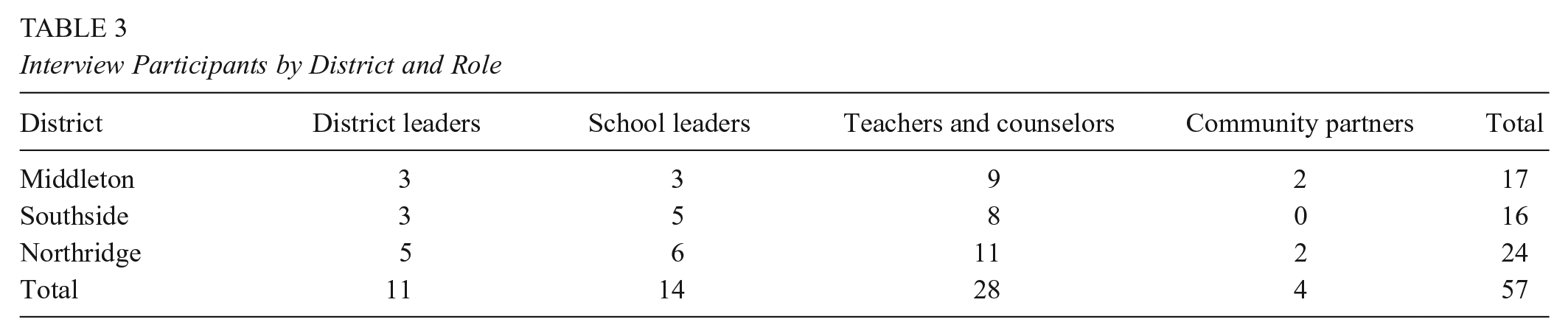
Within schools, we interviewed between three and six leaders, including the principal and assistant principal, as well as EL program coordinators or other personnel who served in leadership roles pertinent to newcomer education. Then, we interviewed between eight and 11 teachers and counselors in each district (see Table 3). Counselors and teachers were selected based on their involvement with newcomers; for example, if a school had a newcomer-focused program, our interviews focused on staff who were involved in that program; otherwise, we interviewed teachers and counselors who worked with ELs more broadly. We also chose teachers to represent a range of grade levels when possible. Across all three districts, we interviewed 11 district leaders, 14 K–12 school leaders, 28 K–12 teachers and counselors, and four community partners, for a total of 57 study participants (see Table 3).
Interview protocols were semistructured and included questions pertaining to (a) descriptions of newcomers and their perceived needs and strengths, (b) perceptions of the local context and its supportiveness of newcomers, and (c) district policies and programs for newcomers, from intake processes and instructional programs to family-related services. Due to time constraints, our interviews with teachers typically lasted about 30 to 45 minutes, whereas interviews with district and school leaders and community partners lasted an average of 1.5 hours. In total, our dataset included more than 65 hours of recorded audio that we transcribed verbatim and uploaded to Dedoose for analysis.
Data Analysis
Our analysis occurred in four phases and was conducted by the first three authors. First, we collectively read one district leader and one teacher interview from each district, for a total of six interviews (i.e., about 10% of the sample). We independently generated an initial list of codes and met to compare and contrast our lists. We developed a draft code list to include deductive (etic) codes that mapped onto our zones of mediation framework (see Figure 1). Second, we independently coded and recoded the original six interviews, engaging in consensus discussions during weekly meetings over a period of 2 months to establish inter-rater reliability (Guest & Macqueen, 2008). During these meetings, we also decided to code each excerpt according to its focus on the local context or district response.
In the third phase, we wrote memos summarizing each interview, as well as memos identifying themes for each district (Ryan & Bernard, 2003) related to external forces (e.g., local networks, perceptions, and policies) as well as the technical, normative, and political dimensions of district approaches. These memos allowed us to hone in on each interviewee’s account, while also comparing and contrasting findings across interviews and confirming and disconfirming themes. Finally, we created a series of data displays to develop initial assertions pertaining to the relationship between local context and districts’ responses (Miles et al., 2014), and to compare this relationship across the three districts.
Findings
Findings demonstrate that policies, perceptions, and resources in the local context mediated how districts responded to growing newcomer populations. In the following sections, we draw on the zones of mediation framework to illustrate how external forces in the local context shaped the boundaries of district response by informing the technical, normative, and political dimensions of support provided for immigrant and refugee newcomers.
Middleton: “A Welcoming City”
External Forces
Interviewees overwhelmingly described Middleton as a place that has long been welcoming of immigrants and refugees. Some recounted Middleton’s involvement in the Bracero Program in the 1950s, which brought guest workers from Mexico to the community. Middleton’s superintendent, who formerly worked with the district’s Migrant Education Program, noted, There were many parents who I worked with in the Migrant Program who themselves were Braceros . . . We have been welcoming people from around the world for a long, long time. It really is part of the fabric of this community.
Aligned with the Superintendent’s description of Middleton as receptive of immigrants, a community member who worked for a refugee resettlement agency stated, “We’re really lucky, we do have a welcoming city.”
Importantly, immigrants, and particularly refugees, were described as integral to Middleton’s economic well-being. In the late 1990s and early 2000s, Middleton lost more than 8,000 residents due to industry decline, but subsequent increases in the refugee population helped bolster the local economy. In 2005, a local official publicly stated that immigrants and refugees kept the city going by filling jobs, opening stores, buying houses, and paying taxes. Local political support continued into the 2010s, with the city council approving a policy in 2016 officially designating Middleton as a welcoming city to immigrants and refugees.
In addition to support from local politicians, interviewees described a robust network of community resources including faith-based charities and nonprofit organizations. One of the most referenced was the grassroots Refugee Support Center (RSC) founded in the mid-2000s. The RSC was described as providing formal and informal learning opportunities primarily to refugees, but also other newcomers, in Middleton. Programming included English classes, after-school tutoring, summer camps, and crisis intervention. As explained by the RSC coordinator, the center collaborated closely with the school district: We [the RSC] have a long history of designing programs with the district and offering them so that they’re not in duplication of their programs, but making sure we are serving as many people as possible and meeting those needs.
Agencies such as the RSC were supported by the Immigrant and Refugee Collective (IRC), an advocacy group created to coordinate services across Middleton. The IRC met monthly and served as a space to “share information about what’s happening in the community,” as one staff member described it. After the 2017 Presidential inauguration, the IRC organized rallies and marches in support of immigrant rights and drafted a letter against proposed anti-refugee state legislation. Illustrating the robust network of supports available in Middleton, an IRC staff member explained that the collective letter was only possible “because of all these stakeholders and how well we work together.”
District Response
In several ways, Middleton’s supportive local policies and perceptions, as well as the network of community-based organizations, mediated the district’s response to serving immigrant and refugee newcomers. Reflecting a supportive technical response, the district had several programs and services in place. When newcomer students and families entered the district, they were supported by staff at the Welcome Center, which was created in 2016 on the heels of Middleton’s Welcoming City resolution. The director of EL Services explained, “We [in the district] said, ‘If we are a Welcoming City, then the district should have a Welcome Center.’” The Welcome Center facilitated intake, which included language proficiency testing, transcript review, and trauma assessments. Reflecting the interconnection between external forces and district response, the Welcome Center staff worked closely with the RSC to offer family orientations and adult language classes. The Director of EL Services emphasized the importance of these community partnerships for creating a welcoming atmosphere: “To have a school that can educate [newcomers], there has to be a welcoming environment. And that welcoming environment is not created by one person; it’s created by a community.”
Further illustrating the supportive technical response, district policy dictated a “cluster model,” in which newcomers were placed in one of three schools that offered a specialized program for recently arrived students. The superintendent cited this approach as central to creating a supportive climate during newcomers’ first year in the country. Ensuring that newcomers had a “safe place to land” was also important from a funding perspective, as these students were critical to maintaining district enrollment numbers. Describing this political dimension, the superintendent framed newcomers as “keep[ing] the district afloat” amid fluctuations in enrollment as families moved or otherwise opted to send their children elsewhere.
Despite what might be viewed as a pragmatic need to support newcomers, district and school leaders made efforts to engage in culturally responsive practices. At one high school, for example, administrators described creating a hybrid teacher-counselor position to attend to the diverse needs of high school newcomers, who were both immigrants and refugees. The district not only staffed newcomer cluster sites with bilingual assistants and cultural brokers, who served as translators and interpreters, but also supported district efforts to solicit input from families. Through a program called “Cross Cultural Learning with Parents,” parents from the largest language groups in the district were invited to share their experiences with cultural brokers, who then acted as interpreters and shared their insights with district leaders. This program reflected a key political aspect of the district’s response, as newcomer families were positioned as partners in supporting student learning and viewed as sources of expertise.
In addition to building relationships with families, bilingual assistants and cultural brokers ensured that other educators remained attuned to their newcomer students. The Director of EL Services described these staff members as important for “protecting” newcomers, stating, “They protect [newcomers] from being neglected. Teachers don’t bother trying to put them [newcomers] at the back of the classroom and let them just be quiet. There’s an understanding that we have created a system, and somebody would know.” In this sense, technical aspects of the district response such as newcomer-specific staff positions and programs were intertwined with normative beliefs that newcomers deserved attention and support.
This normative belief was evident across several participants’ descriptions of newcomers, and especially refugees. When asked to describe their newcomer population, district and school staff tended to focus on the trauma that refugees experienced in their home countries or during migration to the United States and thus that educators should be mindful of their social and emotional needs. As the high school teacher explained, participants tended to view social-emotional support as central to serving newcomers: “Their needs as just human beings are immense. This is a place for them to receive a lot of their services and a lot of the skills they need and information they need to succeed in life.” Emphasizing the importance of comprehensive programming, the Director of EL Services asserted, We have to have so many other things in place to be able to help [newcomers] function in a school. By the time we get to instruction, it’s because we were able to clear a lot of other different obstacles.
As evidenced by the reflection above, social-emotional supports were often positioned as foundational to supporting newcomers’ learning. The high school principal noted that, to build on this foundation, teachers would benefit from capacity-building opportunities focused on instruction: “[Teachers’] base of understanding of newcomer instruction is so low that they just freak out.” The elementary principal also described a need to support teachers’ professional learning, stating “we need to make sure that 100% of our staff—not only the EL teachers—is highly qualified to serve these students.” Overall, leaders framed newcomer-specific capacity-building opportunities as an area for growth in the district. Nonetheless, the staff we interviewed tended to praise the existing levels of support for newcomers, including one elementary teacher who stated, “When we stop and think in terms of what other districts don’t have, we really have to stop and realize the blessings that we do have here. We have a plan.”
Southside: “A Lot of Discomfort”
External Forces
Contrasting with Middleton, many Southside participants described the local context as unwelcoming of immigrants in particular. Several interviewees noted that the community was highly segregated, with the White population concentrated on the west side where the majority of economic development efforts focused, and the Latinx population located primarily on the east side, which was closer to local farming areas. Newcomer immigrants, they stated, often settled on the east side in Spanish-speaking enclaves.
The elementary principal, whose eastside school served a majority Latinx population, described the area near their school as “low-income and family-centered,” with many immigrant-owned businesses. By contrast, other areas of Southside were described as hostile toward immigrants: “There are certain communities that get very angry when Brown people arrive” (EL director). Similarly, the district’s community liaison noted that for many long-standing White residents, perceptions of immigrants were characterized by “discomfort” with changing demographics: “They [long-standing White residents] very much feel ownership, and they’re very angry about what they see has changed. There’s a lot of discomfort, so we have a lot of people who don’t want to help.”
Negative perceptions of immigrants in Southside were reflected in decisions made by the city’s leadership. Although Southside’s Congressional district historically voted Democrat (and 2016 was no exception), the mayor and city council were described as outwardly anti-immigrant and supportive of the Trump administration. In 2017, the mayor came out against a state law that would limit what local law enforcement agencies could do in response to immigration enforcement, and the council issued a resolution supporting the federal government’s lawsuit against state sanctuary laws. Relatedly, several interviewees described heightened tensions resulting from an increased presence of U.S. Immigration and Customs Enforcement officers in the community. The elementary principal noted, for example, that many parents were afraid to send their children to school because an U.S. Immigration and Customs Enforcement van was regularly stationed between their apartment complex and the school.
While community resources were present in Southside, few were tailored specifically for immigrant families. Community organizations offered services such as access to food and nutritional information to any community members who might benefit. Unlike the tightly connected network of immigrant and refugee services available in Middleton, community resources in Southside tended to operate independently from each other and focused on supporting all low-income families.
District Response
Aligned with the local context, the normative dimension of the district’s response was characterized by negative and prejudiced perceptions of Latinx newcomers and their families. Southside’s community liaison provided an example of these views, summarizing an exchange with an administrator about their fall family information night: He says, “So it’s at 6 o’clock, but it’s for Latino families, so that really means 6:30.” But if I had said it was for families at Shadow Ridge [a majority White school], he would have been confident they would be here by six. And, when a Latino family walks in late, there’s an assumption that they just don’t respect time. But if a White mom walks in late, he’s like, “She was probably just dropping off the kids.”
This recent exchange reflected discriminatory views of Latinx students in the district. Relatedly, the superintendent explained, Twenty years ago, when we created the EL Master Plan [which outlined the services that would be offered to EL students], there was a lot of negative back and forth about, “I don’t know how to teach the Brown kids.”
He reflected that there was more willingness to teach Latinx students in recent years as teachers became more accustomed to the changing population: “I never hear a teacher now say, ‘I don’t teach Brown kids.’ So, that’s a success.”
Although the superintendent framed teachers’ lack of explicit refusal to teach Latinx students as a success, comments from other participants reflected ongoing bias. For instance, the elementary EL coordinator suggested that immigrant parents were not capable of helping their children: The parents will say, “I don’t know what to do because I don’t speak the language.” Then the kid thinks, “I’m the child, but I’ve got to fend for myself, because my parents can’t help me or support me or know how.” There’s helplessness on the parent’s side, and on the kid’s side, and they’re just hoping someone has empathy for them.
Comments like the one above reflect how the normative dimension of Southside’s response was characterized by negative beliefs about Latinx immigrant students and families as helpless.
Aligning with these normative beliefs, technical supports for newcomers such as programs and services were minimal in Southside. At the time of our study, the district’s EL Master Plan, which included newcomer-related policies, had not been updated since the late 1990s. The plan articulated few specific services for newcomers, which meant that most schools served newcomers in the same way they served other students identified as ELs. Newcomers attended neighborhood schools rather than being clustered at specific sites, which meant that they were dispersed across the district’s 20 schools, though primarily concentrated on the eastside. School intake occurred at the school site as it did for any other student, and newcomers were typically placed into general education classrooms with few, if any, specialized supports. The EL director lamented the district’s lack of newcomer-specific programs, noting that district leaders were not willing to put resources into offering programs in schools with small numbers of newcomers: “I think it’s money, because it’s really expensive to run a class with eight to ten kids. But it’s really horrible to throw eight or ten kids into a general class with no support.”
While the vast majority of schools did not offer many technical supports, one middle school and one high school had recently implemented a small number of specialized language and content courses. A middle school administrator explained, “A lot of times newcomers didn’t have the language support, so we were able to create classes where those students are put into a self-contained class with a teacher for part of their day.” These classes were made possible by the EL director, who used nearly all of the district’s EL-specific funds to create them and had to advocate at the state level to do so. Reflecting limited political support for newcomers, district leadership did not provide resources for the program to be expanded across Southside.
Staff in Southside also described a lack of newcomer-specific professional development. One elementary teacher explained, “We do get some professional development on ELs, but it’s not newcomer-specific.” Teachers expressed concerns about meeting newcomers’ needs and about confusion related to when and how often they should teach in Spanish. A teacher explained, “I have a dilemma that I don’t know how long I should continue [using Spanish] until it negatively impacts them.” Other teachers described feeling challenged to adequately serve newcomers while also attending to other students’ needs. Reflecting on this issue, a teacher shared, “Do newcomers get a lot of my time? No, they don’t. Are they very lost in my class? Yes.”
While instructional support for newcomers was minimal, some district leaders worked with community organizations to offer resources such as food and nutrition services. However, these supports were not specific to newcomers, as they were offered to all students and families from low-income homes. Furthermore, the superintendent noted that many immigrant families did not receive services because they were wary of providing their information: We have a robust nutritional program that provides food for low-income families, and we’re very good about identifying the families. But, there are definitely newcomers who go unidentified. We try to get them on the radar, but they don’t always show up for food distribution. A lot of these families aren’t excited about writing their names on forms.
The superintendent suggested that the broader context of immigration (e.g., fear of deportation among undocumented immigrants and mixed-status families) affected newcomers’ desire to be formally identified for such services.
Though district leaders acknowledged newcomer students’ and families’ fears of deportation, they were not outwardly supportive of undocumented immigrants. For example, the community liaison shared that they had planned a “Know Your Rights” workshop for immigrant families and that about 40 parents signed up. However, district leaders canceled the workshop a few days before it was scheduled, as they did not want to be perceived as partisan by the school board and other community members. Reflecting the political dimension, leaders seemed wary of providing support for immigrant students and families that misaligned with broader sentiments in the Southside community.
Northridge: “Quietly Doing the Work”
External Forces
A majority White community with a historically large population of Latinx immigrants, Northridge, recently experienced an increase in their refugee population from Africa, Asia, and the Pacific Islands. The superintendent described how the influx of refugees catalyzed supportive perceptions of newcomers: I think that the refugee group has caused our community to step up and take notice in a positive way which will benefit our other newcomers. While it came out of a crisis for families that came into our community, it bridges that awareness.
Much support for refugees was organized by a local nonprofit organization, the Northridge Refugee Alliance. Coordinating a network of community resources, the Alliance was similar to the IRC in Middleton in that it bridged relationships across resettlement agencies, faith-based organizations, businesses, nonprofits, government organizations, and community members. A leader from the Alliance described their motivation as “viewing all refugees as valued and contributing members of society.” A staff member from a resettlement agency said that they had been “floored by the support” of the Alliance, noting how the organization worked with local and district leaders to facilitate partnerships that offered services to refugee families and provided teachers with relevant information.
While community resources were described as robust, participants’ characterizations of the local political context were mixed. Although situated in a historically left-leaning Congressional district, some interviewees framed Northridge as supportive of newcomers, and others described it as “conservative” and anti-immigrant. On one hand, a group of residents organized two rallies in support of immigrant rights after the 2017 inauguration; on the other hand, the city council was split on its vote to oppose a state law that would repeal sanctuary status protections for immigrants. The superintendent described this mixed reception of immigrants: The city’s response is done quietly and under the radar. There are people that would say, “This [supporting immigrants] isn’t what our community should be doing.” So, we have that divide, and that might be why a group of community members at the Alliance is quietly doing the good work.
The director of elementary EL education described the local context similarly: “I always thought [Northridge] was super conservative, and then I moved here and I see it’s kind of split. I really didn’t think refugees would be welcomed here, but there are folks offering support.” Given the “split” nature of Northridge as it pertained to perceptions of immigration, those working to support newcomers tended to do so outside the public eye. Furthermore, their work tended to focus on refugees as opposed to other immigrants.
District Response
The district’s response to newcomer students in Northridge aligned with the emerging supports observed in the local community. The district had served a predominantly Latinx immigrant population for several decades, yet experienced a recent influx of refugees from African and the Middle East. A middle school principal described how this change had led to shifts in technical (e.g., programs and services) and normative (e.g., beliefs about students) responses: [Our refugees] are from a totally different culture; they speak different languages. We had to shift our focus and the way we support students, and learn more about where they come from, especially for the refugee camps, and from a religious perspective and a cultural perspective. They’re just totally different than what we have been accustomed to.
Similar to Middleton, normative beliefs about refugees tended to focus on students’ experiences with trauma. In comparing refugees with other newcomers, the superintendent stated, Newcomers who come to us, let’s just say in a Russian language but have an intact family that hasn’t experienced extreme trauma, are different from refugees who nearly died getting here and into your school. How do you help kids who come from such trauma?
Many teachers described the importance of ensuring students felt safe, given the trauma they had experienced. A middle school teacher explained, “We’re focused on allowing students to feel safe in their new environment. I can’t even fathom to understand or comprehend the amount of trauma that goes along with their situations.” In this sense, normative beliefs tended to frame refugee students in particular as deserving of expanded support.
Aligning with this normative dimension of response, district leaders made the development of technical supports for newcomers a priority as the refugee population increased. The director of secondary EL education noted, “All of a sudden, the superintendent was like, ‘[newcomer education] is a priority. Our English learner programs are one of our biggest problems, and this needs to be a district initiative.’” To support the initiative, the district developed an intake process to help acclimate newcomers. All newcomers registered at a district intake center (rather than at a school site) with a native language specialist, who were available for the top 10 languages. These specialists conducted language and academic assessments and analyzed transcripts if they were available, and nurses collected any pertinent medical and dietary information. Newcomers were then assigned to a specialist who assisted with the orientation. As one specialist described it, My main responsibility is to bridge that gap between when they come into our district until they get into the school. I spend about a full week with them. I will ride the bus with them so they get used to the protocols, what you’re supposed to do on the bus, to walking them to the classroom or walking them to breakfast, helping them pick out the correct breakfast choices for their diet, showing them how to sit down at the tables.
As this reflection suggests, technical supports such as specialized staff roles were designed to foster a culture of support for newcomers and, especially, refugees.
Although the expanded newcomer intake process was well-articulated, instructional services were less clearly defined. The director of elementary EL education shared that the district had previously offered an elementary-level newcomer program but no longer did so because the school board “valued having kids at their neighborhood schools.” Therefore, elementary newcomers attended neighborhood schools and were placed in age-appropriate classes. Although some elementary schools offered English-Spanish bilingual programs, these programs were designed differently at each school—“Twenty different ways at twenty different schools,” according to the Director—and newcomers were not necessarily enrolled in them. One principal described elementary newcomers’ divergent experiences: “Some are in classes with a lot of other English learners, but others are in a class where they are the only one. So, making the whole day meaningful is a challenge.”
At the secondary level, technical support for newcomers was described as more robust. The district created a director of secondary EL education position in 2014 when the superintendent mandated the new focus on newcomer education. The director designed a clustered program similar to what was offered in Middleton. In these programs, newcomers at the middle and high school levels spent the majority of the day at one of four schools in language and content classes with other newcomers, then attended math and elective courses with the broader student body.
As the secondary newcomer program was implemented, middle and high school principals recalled feeling like they were “flying by the seat of their pants,” and “building the plane while flying it.” School leaders also voiced the need for teacher professional development that focused on trauma-informed approaches and best practices for instructing newcomers. One high school principal implied that teachers were not prepared to work with the refugee population now entering their school: “All the struggles with the refugee students and the newcomers that are here now are causing so many, I won’t say problems, but complications for our teachers because they’ve never encountered this before.” As in Middleton and Southside, participants observed a need for more teacher capacity–building opportunities.
Emerging programmatic supports for newcomers in Northridge were intertwined with political aspects of the district’s response. Reflecting the mixed reception of newcomers in the local community, programs in the district were framed by some participants as protecting students from negative treatment. The high school principal from a cluster site noted, [Newcomers] are pretty sheltered here. If you go to a different high school, the parents will talk horribly about our families. There’s some of that in the community, too. We did have a parent drive up with a Confederate flag. You want to protect your kids from that, but I can’t tell them to not fly their flag.
This statement suggests that newcomer programs functioned as an inclusive space amid broader anti-immigrant sentiments. Further illustrating this protective function, the school board passed a “Safe and Welcoming Schools Resolution” after the 2016 election. The resolution declared that, “Every child needs to feel safe [in our schools] regardless of where they’re from.” Reflecting the emerging nature of support in Northridge, the resolution was framed by some educators as reactionary. A district-level EL instructional leader explained, It took a group of angry educators and community members to say we need safe and welcoming schools. The superintendent and the board jumped on it, and so they eventually did the right thing, but unfortunately it was a reaction.
Overall, supports for newcomers were developing in Northridge in response to varied perspectives in the local context.
Discussion
We employed a zones of mediation framework to examine how external forces in the local context mediated approaches to serving growing immigrant and refugee populations in three U.S. districts within similar state contexts. Findings suggest that local-level forces such as the presence or absence of community-based support networks and the extent to which local policies and perceptions emphasized inclusion aligned with the technical, normative, and political dimensions of districts’ responses. For example, the robust supports characterizing Middleton’s response aligned with local policies supporting both immigrants and refugees, as well as a robust network of community resources. More specifically, the Middleton district response included substantial technical supports (e.g., a well-articulated intake process, cluster model for serving newcomers, specialized staff), normative beliefs framing refugee students in particular as deserving of support, and political dynamics positioning newcomer students as integral to maintaining enrollment numbers. Conversely, both local and district supports for newcomers in Southside were limited, and many stakeholders held negative perceptions of their Latinx immigrant population. Finally, emerging district-level supports for newcomers in Northridge aligned with growing community resources and mixed perceptions of immigrants and refugees among community members. In the sections below, we discuss implications for theory, practice, and future research.
Implications for Theory
This study expands the current body of literature on support for newcomer students in U.S. school districts. More specifically, the zones of mediation framework helped unpack various forces in the local context that serve to mediate districts’ support for immigrant and refugee students. Our study helps build theory around the facets of the local context that matter for school district policy making, suggesting that local policies for and perceptions of immigrants and refugees, as well as the presence or absence of networked resources in a community, may help explain some of the differences we observed in districts’ approaches.
Overall, we found that district-level support for newcomers mirrored forces in the local context, corroborating the notion that external forces tend to define the boundaries within which district leaders implement policies and practices (Oakes et al., 2005) and that contexts of reception for immigrant and refugees are nested within one another. The leaders in our study acted within the scope of their zones of mediation, offering supports (or not) that would be largely uncontested by the local community. Operating within the boundaries of their zones of mediation, the districts functioned primarily as microcosms of their local context. However, findings from Northridge suggest that the relationship between external forces and district response is neither static nor unidirectional, as the school board and superintendent took a public stance promoting inclusion for immigrant students amid mixed community perceptions.
Findings from this study also add to previous work outlining how the construction of target populations shapes policy benefits (Schneider & Ingram, 1993). Participants in our study tended to perceive refugees as dependent and deserving, whereas Latinx immigrants were perceived as undeserving. These perceptions aligned with the supports provided in both the local community and school district. For example, refugees in Middleton were described as having undergone significant trauma and in need of attention and support, and they generally experienced welcoming policies and programs. Notably, Middleton afforded benefits to its refugee population even though it was the lowest-income community in our study and the only city that voted Republican in the 2016 presidential election. In Southside, on the other hand, Latinx immigrants encountered pervasive negative perceptions and were generally not afforded specific policies or programs aimed at facilitating their transition to U.S. schools. These findings suggest that the normative dimension (i.e., constructions of immigrants and refugees) may be a particularly strong external force that defines the boundaries of a district’s zone of mediation.
Implications for Practice
While support for newcomers varied across districts, participants from all three districts referenced the need for more professional learning focused on newcomer instruction. This was true even in Middleton, where intake processes, course offerings, and specialized staff roles were relatively robust. Prior literature illustrates the importance of teachers possessing specific knowledge and skills to support linguistically and culturally diverse populations (e.g., Bunch, 2013; Lucas & Villegas, 2011). Recognizing that participants rarely referenced the assets newcomers bring, it may be valuable for professional learning to explicitly address immigrant and refugee students’ unique talents and strengths. Districts may consider partnering with EL families and relevant community organizations in this work.
Relatedly, given that the districts in this study were microcosms of their local contexts, it may be beneficial for district leaders to involve local stakeholders (e.g., staff from community-based organizations, city council members) in efforts to support immigrant and refugee students. In doing so, they can better understand how external forces such as local policies, resources, and perceptions might enable or constrain the district’s approach and how these forces shape opportunities for immigrant and refugee students and families similarly or differently. Involving multiple stakeholders has been described as a critical component of equity-minded change, because such collaboration can help attend to political and normative forces mediating improvement efforts (Renee et al., 2010). When external forces do not align to support equity-minded change for newcomers, district leaders may need to serve as advocates who promote a culture of inclusion, as leaders in Northridge had begun to do.
Implications for Future Research
While findings from this study provide key insights into the factors mediating districts’ responses to growing newcomer populations, additional research is needed. Because this study took place in three mid-sized districts in similar state contexts, future research is needed that compares support for newcomers across smaller and larger districts, and in diverse state and national policy contexts. Future research including perspectives from more stakeholders would also be valuable. Such stakeholders could include district and school staff who are not engaged in providing newcomer-related services and, perhaps most important, students and families. Furthermore, future research might explore how individual actors, especially district leaders, can influence the zone of mediation. A few highly engaged and motivated individuals within a district or community might have a substantial impact on how districts respond to growing immigrant and refugee populations (see Brezicha & Hopkins, 2016). Future work might seek to identify how leaders work to shift a district’s zone of mediation and how broader district policies and politics enable and constrain efforts to serve newcomers.
Additionally, this study examined the external forces mediating districts’ responses at one point in time. Longitudinal research could help deepen understanding of how both external forces and districts’ support for newcomers shift over time, and the interactions between these factors. Recognizing that the zones of mediation framework outlines a bidirectional relationship between external forces and district response (see Figure 1), longitudinal research could also examine how technical, normative, and political dimensions of district-level support for newcomers may influence facets of the local context. Given the intertwined relationship between local and district contexts, additional research is needed that examines how external forces and district-provided opportunities for immigrants and refugees mutually shape one another, particularly amid evolving migration patterns.
Footnotes
Acknowledgements
The authors thank the Council of Chief State School Officers for their support of this work as well as the two anonymous reviewers who provided helpful feedback. They also gratefully acknowledge the contributions of Kathryn E. Wiley and Leslie Gautsch to earlier versions of the manuscript, and Lorna Porter to data collection and analysis.

Notes
Authors
MEGAN HOPKINS is an associate professor in the Department of Education Studies at the University of California, San Diego. Her research examines whether and how policies and practices support equity and civil rights for students identified as English learners.
HAYLEY WEDDLE is an assistant professor of education policy at the University of Pittsburgh and previously served as a postdoctoral researcher at the University of California, San Diego. Her research examines the equity implications of policy implementation across state and local levels.
PETER BJORKLUND, Jr., is a postdoctoral researcher at the University of California, San Diego in the Department of Education Studies. His work centers on social network analysis, belonging, trust, identity, and refugee education in K–16 settings.
ILANA UMANSKY is an assistant professor of educational methodology, policy and leadership at the University of Oregon. Her work explores how education policy affects the educational opportunities and outcomes of immigrant, multilingual, and English learner–classified students using large-scale data, and longitudinal and quasi-experimental methods.
DAFNEY BLANCA DABACH is an associate professor at the University of Washington’s College of Education. Her research focuses on immigration and education.