




Abstract
Perfectionism among students is recognized as a factor that has complex associations with academic performance and well-being. Yet, we know little about how teachers perceive and make sense of it. Consequently, this qualitative study explored teachers’ perspectives on student perfectionism in classroom contexts. A sample of teachers (n = 26; 84% female) completed semistructured interviews that revealed that teachers are commonly confronted with perfectionism in their classrooms and have complex understandings of its benefits and drawbacks for students. Although teachers acknowledged some benefits of perfectionism, they concentrated primarily on its negative effects. Each theme was assessed for potential differences in perspectives between teachers who self-identified as perfectionists and those who did not. However, no group differences emerged, and as such, all themes can be understood as representing both perfectionistic and nonperfectionistic teachers. Collectively, results support the critical role that teachers can play in understanding perfectionism among students, including how it impacts student learning and well-being.
Introduction
When given the chance to speak at length with teachers, the questions about perfectionism that researchers cannot resist asking are, “What can you tell me about the perfectionistic kids in your classroom?” and “What do you see?” In this study, we posed these questions on a grand scale by asking teachers about their perceptions and understandings of perfectionistic students. Broadly, perfectionism is defined as a personality style centered around demanding perfection of the self and/or others (Hewitt & Flett, 1991). Our focus here reflects the fact that perfectionism is a growing public health issue among young people, with 20–30% of adolescents experiencing high levels of perfectionism (Flett & Hewitt, 2022; Sironic & Reeve, 2015) and seminal research indicating that perfectionism is on the rise among younger generations (Curran & Hill, 2019). Moreover, researchers have extensively documented how perfectionism among youth contributes to poorer mental and physical health (e.g., Flett et al., 2016; Molnar et al., 2023b; O’Connor et al., 2010; Sironic & Reeve, 2015) alongside greater social disconnection (Magson et al., 2019; Roxborough et al., 2012). Interestingly, research focusing on educational contexts has demonstrated that perfectionism can be both helpful and harmful for students, whereby some dimensions of perfectionism are linked with some academic gains and others are linked with underachievement and maladaptive educational outcomes such as test anxiety and burnout (Blackburn et al., 2024; Madigan, 2019; Osenk et al., 2020). Given these complex findings, it is imperative to consider teachers’ understandings of perfectionism in their classrooms, including its role in the health and well-being of students. As such, this qualitative study was designed to gain insight into teachers’ perspectives on student perfectionism and stands to make a critical contribution to the existing literature by providing a novel perspective on youth perfectionism by centering teachers’ unique observations.
The Many Faces of Youth Perfectionism
To situate this work, we drew on the Comprehensive Model of Perfectionistic Behavior (Hewitt et al., 2017), which considers perfectionism to be a multilevel and multifaceted construct that functions at the self-relational, other-relational, and dispositional levels (Flett & Hewitt, 2022; Hewitt et al., 2017). Beyond its multilevel approach, this model is particularly relevant to the current work given that it has been adapted for understanding perfectionism in childhood and adolescence (Flett & Hewitt, 2022). According to the Comprehensive Model of Perfectionistic Behavior (Hewitt et al., 2017), perfectionism is expressed at the self-relational level as an internal dialogue involving frequent, automatic thoughts about needing to be perfect accompanied by harsh self-criticism (Flett et al., 1998). Perfectionism manifests at the other-relational level as a self-presentational style focused on concealing perceived shortcomings and projecting a flawless public image (Hewitt et al., 2003). Finally, at the dispositional level, perfectionism is theorized to be a deeply entrenched requirement for perfection consisting of both intra- and interpersonal elements (Hewitt & Flett, 1991). Specifically, self-oriented perfectionism is an intrapersonal dimension of trait perfectionism entailing inordinately high standards coupled with punitive self-criticism when standards are unmet. Other-oriented perfectionism is an interpersonal trait dimension of perfectionism centering on demanding perfection from others. Finally, socially prescribed perfectionism is an interpersonal dimension of trait perfectionism involving the belief that significant others demand perfection and are highly critical when those demands are unmet (Hewitt & Flett, 1991). Notably, there are other models of multidimensional trait perfectionism. For example, according to Frost et al. (1990), there are six dimensions of trait perfectionism: personal standards, doubts about actions, concern over mistakes, parental expectations, parental criticism, and organization. Alternatively, Slaney et al. (2001) conceptualized three dimensions of trait perfectionism: high standards, discrepancy, and order.
Importantly, theoretical models of perfectionism are largely based on research with adults (Molnar et al., 2023a). In many respects, youth perfectionism appears to emulate that of adults, yet research has underscored some notable distinctions. For example, the roles of an ego-involved social comparison orientation, order and organization, and emotional reactivity appear to be defining features of perfectionism in youth (Flett & Hewitt, 2022; Molnar et al., 2023a; Parker, 2002; Speirs Neumeister et al., 2007) but are rarely discussed in the adult literature. Further, there is thought to be vast heterogeneity in perfectionism among young people such that it presents differently among individuals and in different contexts (Flett & Hewitt, 2022). Recent research has shed light on this heterogeneity using qualitative approaches with youth (Molnar et al., 2023a). Accordingly, we employed a qualitative approach in this study to add further nuance to our understanding of youth perfectionism through the unique perspectives of teachers.
Perfectionism in Educational Settings
Perfectionism is salient in educational contexts, where exceptionally high standards are promoted, evaluation is ever present, comparative and competitive processes are emphasized, and achievement is venerated (Fletcher & Speirs Neumeister, 2017; Rice et al., 2016). Indeed, perfectionism and fear of making mistakes were identified globally by educators among the top 10 problems experienced by students (Rescorla et al., 2007). Further, understanding how perfectionism manifests in school settings is important, considering findings indicating that perfectionism in schools may differ from general perfectionistic tendencies (Dunn et al., 2005).
To date, research examining student perfectionism has focused largely on academically gifted students (Noor, 2023; Parker, 2002; Speirs Neumeister et al., 2007, 2009) and on its association with academic achievement (Blackburn et al., 2024; Madigan, 2019). For instance, findings have suggested that perfectionistic gifted students tend to be averse to failure, to experience negative emotions when faced with imperfect outcomes, and to experience motivational challenges (Noor, 2023; Parker, 1997, 2002; Speirs Neumeister et al., 2007, 2015). However, researchers caution that giftedness is not necessarily synonymous with perfectionism given that evidence is mixed with respect to whether there are marked differences in levels of perfectionism between gifted and nongifted students (Cash & Lin, 2021; Stornelli et al., 2009; Stricker et al., 2019b). Regarding academic achievement, research has indicated that some forms of perfectionism (e.g., socially prescribed perfectionism, doubts about actions, concern over mistakes, and discrepancy) are related to underachievement, whereas other forms of perfectionism (e.g., self-oriented perfectionism, personal standards, and high standards) are associated with some gains in academic achievement (see Madigan [2019] for a meta-analysis). Finally, a notable meta-analysis illustrated how trait perfectionism contributes to helpful and unhelpful learning outcomes (Osenk et al., 2020). Specifically, discrepancy, concern over mistakes, doubts about actions, and socially prescribed perfectionism were associated with negative psychological outcomes that tended to hinder academic performance (e.g., test anxiety, burnout, and stress). Conversely, self-oriented perfectionism, personal standards, and high standards were positively associated with helpful motivational outcomes that promoted academic success (e.g., self-efficacy and adaptive learning strategies; Osenk et al., 2020). Thus, it appears that some forms of perfectionism tend to contribute to poorer educational outcomes, whereas others tend to enhance academic outcomes.
Although this body of work has enriched our understanding of student perfectionism, it has relied primarily on students’ self-reported assessments (Rice et al., 2016). There are certainly advantages to directly asking individuals about their perfectionism, including obtaining the unique perspectives of individuals and ease and efficiency of data collection (see Paulhus & Vazire, 2007). Still, overreliance on self-report data may yield an incomplete picture of perfectionism and its associated outcomes in educational settings because perfectionistic youth may engage in self-deprecating or self-enhancing processes that bias their responses (Smith et al., 2022b). These disadvantages have prompted perfectionism researchers to advocate for the use of observer ratings of perfectionism (e.g., Rice et al., 2016; Sherry et al., 2013; Smith et al., 2022b). Put differently, assessing perspectives from key informants represents a critical step toward gaining a more nuanced understanding of youth perfectionism in various contexts. Specifically, we argue that teachers represent critical informants in research centered around youth perfectionism given the relevance of perfectionism in academic settings due to the competitive and comparative aspects of the school environment that may promote and maintain perfectionistic tendencies among students (Rice et al., 2016). Teachers work firsthand with young people in academic contexts and, as such, stand to offer unique insights into the specific ways perfectionism presents in school contexts compared with parents or caregivers, who do not bear direct witness to these manifestations in the classroom as they play out in real time. Moreover, teachers are well positioned to identify perfectionism in the classroom and to implement classroom-based programming aimed at mitigating perfectionism among students (Flett & Hewitt, 2014). For instance, research has demonstrated that teachers tend to be accurate reporters of students’ personalities (e.g., Poropat, 2014), which is unsurprising given that the average Canadian student spends at least 5 hours a day for a minimum of 187 instructional days per year with their teachers (Statistics Canada, 2020). Despite this, perfectionism research remains scarce with respect to examining teachers’ perceptions of student perfectionism.
However, there are some notable exceptions. First, theoretical writings by Cohen (1996) and Pacht (1984) have identified markers of perfectionism that teachers may observe among students, including dichotomous thinking, redoing assignments, difficulty experiencing pleasure in and taking credit for success, procrastination, impossibly high standards for performance, high emotional reactivity to mistakes, and reluctance to participate in class unless they are confident in their abilities. Moreover, in a qualitative study, Brophy and Rohrkemper (1989) found that teachers were familiar with perfectionism among their students, often describing it as deeply ingrained within the perfectionists in their classrooms and as associated with stress and underachievement. Finally, more recent work that included the perspectives of both parents and teachers identified the pervasive nature of perfectionism among gifted students in self-contained classrooms, underscoring the increased pressure to be perfect among high-achieving students (Noor, 2023). Importantly, teachers in this study identified the pressure to be perfect as a critical challenge for gifted students given their perception that these pressures incur barriers to achievement as well as negative emotional reactions.
This work builds on the work of Brophy and Rohrkemper (1989) and Noor (2023) to examine whether these insights apply to current generations of young people and beyond self-contained gifted classrooms, respectively. Concerning the latter, although prior research has focused on teacher perceptions of perfectionism in self-contained gifted classrooms, less is known about how perfectionism is understood in general education settings. These contexts differ in key ways because self-contained classrooms typically serve high-achieving students and emphasize advanced academic performance, whereas general education classrooms include a more diverse mix of learners in terms of academic ability, behavioral characteristics, and learning needs. As a result, teachers in traditional settings may encounter and interpret perfectionistic behaviors differently. Understanding how teachers in these more diverse environments perceive perfectionism is critical to identifying how such traits are recognized and understood across the wider educational system.
Taken together, evidence, albeit limited, supports the notion that teachers can identify and evaluate perfectionism in students as well as recognize its drawbacks. However, it remains unclear which components of perfectionism teachers are referring to when they are identifying perfectionism in students. Further, these studies framed perfectionism as problematic at the outset, consequently limiting the possibility that teachers may recognize benefits of perfectionism among students. Finally, it is important to recognize the compelling influence of individual differences in shaping how people perceive others. Indeed, robust evidence supports the role of perceiver effects (i.e., proclivities to view individuals in particular ways; Kenny, 1994), which are often shaped, in part, by personality (Wood et al., 2010). Indeed, people tend to view others in the same way that they perceive their own personalities (Kenny, 1994; Wood et al., 2010). Despite these findings, to our knowledge, research has yet to assess whether teachers’ own perfectionism impacts their perceptions of students’ perfectionism. This is an important consideration given links between perfectionism and broader personality traits (Stricker et al., 2019a) and considering theory and research highlighting the interpersonal nature of perfectionism such that individuals higher in perfectionism tend to be preoccupied with assessing others (Hewitt et al., 2017).
Given these gaps in the literature, it is critical to provide an updated and in-depth examination of teachers’ perspectives on the ways in which perfectionism presents among students in their classrooms and to assess how teachers’ perfectionism may influence those insights. Not only do teachers’ unique viewpoints stand to make substantial contributions to our understanding of youth perfectionism in educational settings, but their input also has the potential to inform school-based intervention and prevention efforts to help mitigate the costs of perfectionism among young people.
This Study
The overarching aim of this qualitative study was to provide an in-depth examination of how teachers understand student perfectionism in the classroom. Further, we assessed how teachers’ own perfectionism may contour their perceptions of student perfectionism. To achieve this aim, semistructured interviews with teachers from Ontario, Canada, were analyzed using thematic analysis based on descriptive phenomenology (e.g., Sundler et al., 2019). Specifically, the analyses focused on understanding the lived experiences of the teachers in this study while maintaining an open mind to the accounts shared with the research team during the interviews by critically reflecting on our own preunderstandings (e.g., beliefs, theories, and assumptions that may restrict researcher openness) throughout our analyses (e.g., Dahlberg et al., 2008).
The qualitative approach of this work offered numerous advantages given that the bulk of perfectionism research has employed quantitative methods (e.g., Flett & Hewitt, 2022). Our qualitative approach allowed for a more comprehensive and tangible understanding of the real-life experiences of perfectionistic students as understood by their teachers by concentrating on perfectionistic students rather than perfectionism as a construct (Patton, 2002). Further, the qualitative approach provided a more nuanced understanding of context compared with relying solely on quantitative approaches (Hill et al., 2015; Molnar et al., 2023a). Finally, a key advantage of the qualitative nature of this study was its examination of idiosyncratic experiences of perfectionism, which is important considering the substantial heterogeneity among young perfectionists (Flett & Hewitt, 2022; Molnar et al., 2023a).
Due to the notable heterogeneity among young perfectionists and the fact that established models of perfectionism derived from adult data may not be fully applicable to youth (Flett & Hewitt, 2022; Molnar et al., 2023a), we did not offer teachers a specific definition of perfectionism in this study. This is consistent with previous studies of perfectionism in adults and youth (e.g., Hill et al., 2015; Molnar et al., 2023a) and helped to assuage possible bias while facilitating teachers’ rich and untethered descriptions of student perfectionism. Further, considering the dearth of research examining teacher perceptions of student perfectionism, this study was largely exploratory. Therefore, no specific a priori hypotheses were preregistered for this study. The primary research questions guiding this study were (a) “How do teachers describe perfectionistic students in their classrooms?” and (b) “Are there differences in those descriptions between teachers who identify as perfectionistic and those who do not?”
Methods
Participants
Participants included 26 teachers between the ages of 25 and 69 years (M = 41.19; SD = 10.95). Most participants were female (n = 22; 84.62%), with four participants identifying as male (15.38%). The sample was predominantly White (n = 24; 92.31%). The remaining two teachers (7.69%) selected “Asian” and “Other.” Regarding annual family income, teachers reported the following ranges: $50,000–$99,999 (n = 6; 23.08%), $100,000–$149,999 (n = 8; 30.77%), and $150,000–$200,000 or more (n = 10; 38.46%). Two teachers (7.69%) did not report their annual family income. Eleven teachers (42.31%) reported that they considered themselves to be perfectionists, whereas 15 (57.69%) did not identify as perfectionistic. Independent-samples t tests revealed that self-identified perfectionists were significantly higher on all forms of trait perfectionism (i.e., self-oriented perfectionism, other-oriented perfectionism, and socially prescribed perfectionism) compared with nonperfectionists (see Supplementary Material A in the online version of the journal). However, although self-identified perfectionists appeared to score higher on all three facets of perfectionistic self-presentation (i.e., perfectionistic self-promotion, nondisplay of imperfections, and nondisclosure of imperfections) relative to nonperfectionists, these differences were not statistically significant (see Supplementary Material A in the online version of the journal). Please see Supplementary Material B in the online version of the journal for a description of the scales used to measure trait perfectionism and perfectionistic self-presentation, respectively.
Most teachers held permanent full-time contracts (n = 23; 88.46%). One participant (3.85%) had a permanent part-time contract, and one participant (3.85%) had a limited-term contract. One participant (3.85%) did not report their position. Teachers reported teaching for between two and 48 years, with an average of 15.85 years (SD = 10.77). Approximately two thirds of the teachers (n = 17; 65.38%) were elementary school teachers (i.e., taught kindergarten through grade eight), whereas approximately one third (n = 9; 34.62%) were secondary school teachers (i.e., taught grades nine through twelve). Seventeen teachers reported involvement with extracurricular activities (65.39%). Finally, with respect to subjects taught, most elementary school teachers (n = 15) taught all subjects to their students, as is common practice in Ontario, Canada, where the current study took place. Two elementary school teachers exclusively taught French as a second language. However, the secondary school teachers in this sample reported the subjects they specialized in. Most of the secondary teachers in this sample (n = 6) focused primarily on teaching humanities, social sciences, and/or art classes (e.g., English, history, family studies, and drama). The three remaining participants reported teaching the following subjects: (a) math and science; (b) math, science, physical education, health studies, and business; and (c) physical education and health studies.
Procedure
The data for this study came from a broader longitudinal project examining teachers’ perspectives, experiences, and well-being (July 2021–April 2022). The design of this project (including all materials and analytic strategies) was preregistered on the Open Science Framework before data were collected (see https://osf.io/vj9kf/). Data and analysis code for this study are available on Open Science Framework (see https://osf.io/vj9kf/files). Inclusion criteria required that participants (a) be certified with the Ontario College of Teachers and (b) have a minimum 2 years of teaching experience in Ontario. All procedures were approved by the university ethics board. Participants were recruited through a variety of methods, including social media posts, stories in the online university newspaper, physical posters in the community, and passive snowball sampling. Interested participants then contacted the study coordinator via email to receive a detailed information letter. All interested participants were invited to complete online surveys on their personal devices at three timepoints spaced approximately 2 months apart. Informed consent was confirmed electronically at the beginning of the baseline survey. At each timepoint, a subset of teachers was invited to complete online interviews based on interest indicated in the survey. Teachers received virtual Amazon gift cards for each survey and/or interview completed.
More specifically, this work focused on the baseline interviews (completed July–October 2021). Of the 197 teachers included in the broader study, 26 (13%) completed a baseline interview. We employed purposive sampling such that potential interviewees were approximately balanced with respect to self-identified perfectionist status and elementary- versus secondary-level teaching. Specifically, the interview participant pool including all interested participants was divided into four subsamples based on responses in their baseline surveys: elementary/self-identified perfectionist, elementary/nonperfectionist, secondary/self-identified perfectionist, and secondary/nonperfectionist. Each batch of interview invitations sent out included equal representation from each of these four groups.
Interviews were semistructured and ranged from 60 to 90 minutes. The interview guide included two sections: (a) “Perfectionism and Education” and (b) “Pandemic and Education.” Given the aims of this study, the analyses focused on the perfectionism portion of the interviews, which included questions about teachers’ experiences working with perfectionistic students as well as their perceptions of the roots of perfectionism among students. See Supplementary Material C in the online version of the journal for a full list of interview questions. Baseline interviews were led by the fourth author, two postdoctoral research associates, and two graduate-level research assistants. Table S2 in Supplementary Material D in the online version of the journal provides details about the interview team. All interviews were completed on an online videoconferencing platform and were audio recorded for transcription purposes. In addition to the interview data, demographic information as well as scores of validated measures of trait and behavioral measures of perfectionism were pulled from the interview participants’ baseline surveys for descriptive purposes.
Data Analysis
The research team employed a variety of credibility strategies throughout the research process, including personal responsibility, reflexivity, cross-checking, and positionality, in line with a descriptive phenomenological approach to thematic analysis (see Supplementary Material D in the online version of the journal for more detail). Anonymized audio files were entered into NVivo (QSR International Private Limited, 2020) for automatic transcription. The resulting transcripts were cross-checked against the audio files for accuracy. Corrected transcripts were reentered into NVivo for coding. We used principles of descriptive phenomenology (Sundler et al., 2019), consensus coding (Zinga et al., 2013), and hybrid inductive-deductive (Fereday & Muir-Cochrane, 2006) thematic analysis (Braun & Clarke, 2021) to guide our approach to coding. The first and second rounds of analysis focused on coding and were conducted primarily by the fourth author, who is experienced in qualitative methods, as well as an undergraduate research assistant trained in qualitative analysis. The coding team worked under the supervision of the first and third authors, who have extensive expertise in perfectionism research and experience with qualitative methods, respectively. Table S3 in Supplementary Material D in the online version of the journal provides details about the coding team. In the first round, the primary coders independently reviewed a selection of transcripts and identified a list of potential inductive codes. The coding team then met to discuss those codes as well as potential deductive codes based in perfectionism theory. Once consensus was reached, a coding guide including six deductive, theory-based codes and 13 inductive codes was established. Supplementary Material E in the online version of the journal provides the complete coding guide. Using this coding guide, the primary coders then coded all the transcripts in the second round of analysis.
Once coding was completed, the analysis team began the third round of analysis by categorizing responses to each interview question as well as the excerpts included in each inductive and deductive code. Table S4 in Supplementary Material D in the online version of the journal provides details about the analysis team. In this round of analysis, the categorization process was restricted to each question and code document individually. In the fourth round of analysis, the analysis team then met to review the categorization and discuss connections based on a shared understanding of the characteristics of perfectionistic students across questions and codes. Once these connections were agreed on by the research team, categories were merged to represent broader themes in the data. Following this meeting, the second author constructed a thematic map that integrated question- and code-level excerpts while tracking responses prompted by interview questions versus those that emerged organically throughout this process. See Tables S5 and S6 in Supplementary Material F in the online version of the journal for audit-trail tables.
Once the thematic map was agreed on by the analysis team, the second and fourth authors completed the fifth and final round of analysis by independently checking for group differences based on self-identified perfectionist status across themes. We selected these authors to complete this stage of analysis given their familiarity with perfectionism research and qualitative methods, respectively. Each subtheme was recategorized by perfectionists’ versus nonperfectionists’ responses to assess potential differences in the subthemes endorsed by each group and in the content, length, and detail of responses across groups. Both authors concluded that there were no group differences, and the final report was put together (presented below). Please go to https://osf.io/vj9kf/files/bej7w for the final analysis document, including all excerpts and frequencies. The themes outlined below can be understood as representing both perfectionistic and nonperfectionistic teachers. Please go to https://osf.io/vj9kf/files/kum4y for the group analysis document, including all excerpts and frequencies.
Results
Overview
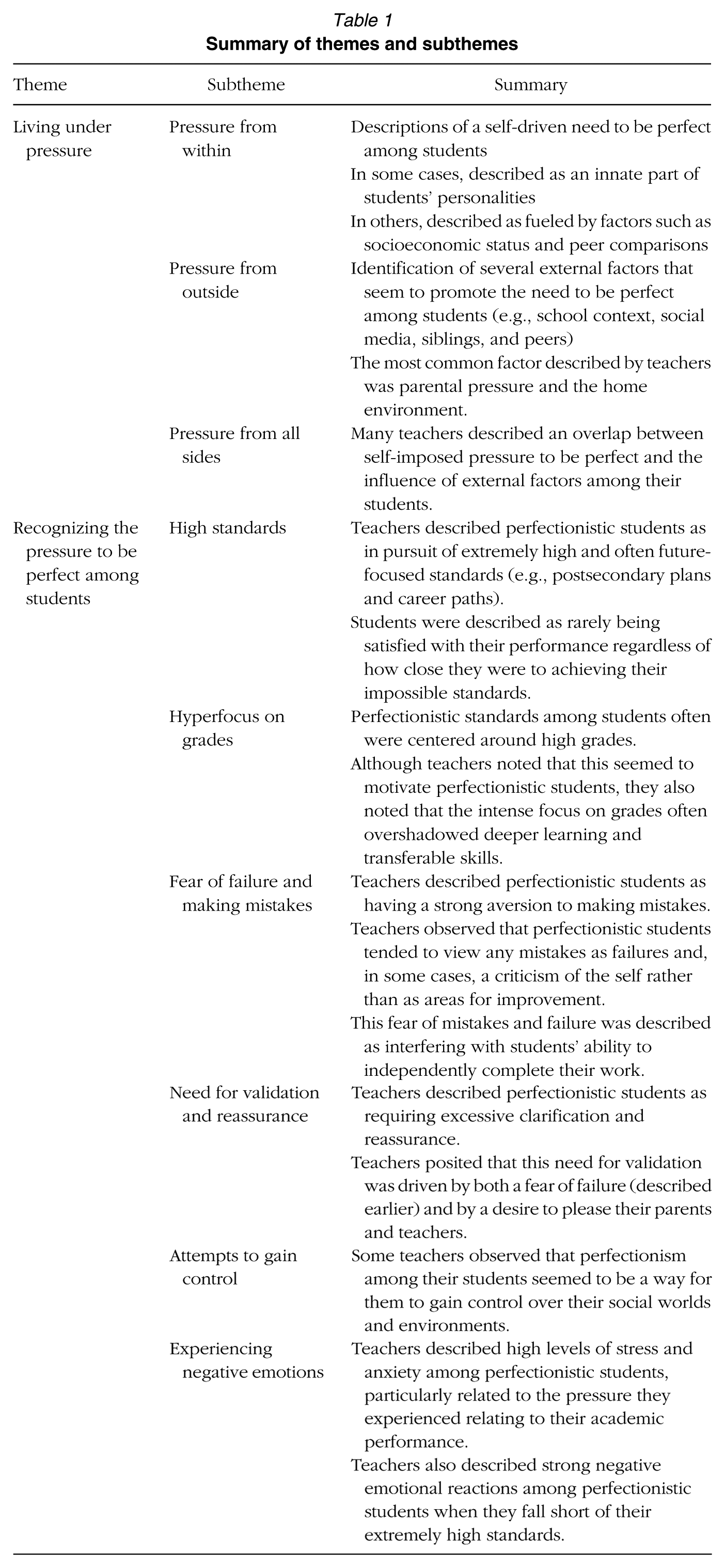
The common thread drawing together teachers’ descriptions of perfectionistic students was the perception that these youth are under immense pressure. Consequently, two broad themes were constructed. The first theme, living under pressure, represented teachers’ descriptions of the pressure to be perfect among students and had three subthemes: pressure from within, pressure from the outside, and pressure from all sides. The second theme, recognizing the pressure to be perfect among students, captured teachers’ observations of how this pressure manifested among perfectionistic students through six subthemes: high standards, hyperfocus on grades, fear of failure and making mistakes, need for validation and reassurance, attempts to gain control, and experiencing negative emotions (Table 1 provides a visual depiction of the key themes).
Summary of themes and subthemes
For all subthemes, teachers’ descriptions of perfectionistic students began in response to Question P1 (i.e., “Have you had students who you would describe as perfectionistic?”). With respect to the subthemes subsumed by living under pressure, many discussions were prompted more deeply by Question P3 (i.e., “What do you think the source of perfectionism is among students?”). However, teachers continued to discuss these notions throughout their interviews, beyond Questions P1 and P3. As such, all subthemes included both question-based data and data generated from thematic coding. See Supplementary Material F in the online version of the journal for more detail.
Living Under Pressure
Pressure from Within
Many teachers identified that some perfectionistic students were self-driven and tended to “feel a lot of pressure, even if a lot of it is self-imposed pressure.” Interestingly, teachers distinguished between students who had “innate” perfectionistic tendencies and those who generated pressure within themselves in response to external factors. With respect to the former, following observations that some students demonstrated self-driven perfectionistic tendencies with no clear external push, one teacher wondered, “Can you be born with [perfectionism]?” Another indicated that “sometimes . . . it’s just their personality.” With respect to the latter, teachers identified a handful of sources that seemed to fuel the pressure perfectionistic students place on themselves, including socioeconomic background (“At my school, it’s a lot of internal push because it’s them wanting to do better and then wanting a fresh start and show that they’re here for a reason and they can do these things”) and peer comparisons (“Students [placing pressure] on themselves and just trying to match the success level of their peers so they’re not feeling left out or like they’re not good enough”).
Pressure from the Outside
Teachers also identified several external factors that seemed to drive students toward perfectionism. Although these accounts included references to the school context (“This push at school that if you’re that 65%, 70%, B kid, that someone’s always harping on you. It’s not good enough”), social media (“I think their access to technology makes it that much more common to know what other people are doing and what successes they’ve had. So then they feel like they need to be successful”), and peers and siblings (“There’s a lot of competition among the students”), the bulk of these discussions surrounded parents. Indeed, one teacher framed perfectionism as originating in the home environment (“I don’t think anybody is born a perfectionist. I think that comes from nurture rather than nature because I think the pressure starts very, very young”). Many teachers identified an explicit pressure from parents around performing at high academic levels: Usually that comes in the form of high expectations—maybe parents questioning why their child didn’t get everything perfect. Sometimes the parents will actually say things like “In our house, we expect everything to be right” or they might explain something they do like “Every night they have to sit down and do so much work because we want them to be perfect in spelling.”
Interestingly, a few teachers highlighted that parental pressure seemed to be increasing over time, attributing this shift to increased parental investment in their children’s performance (“I think that the amount of parental expectation is different, like parental overinvolvement has changed. So some of that perfectionism is because of parents being overinvolved and overinvested”). Another interesting nuance in teachers’ discussions of parental pressure was the interplay of culture, whereby teachers perceived parents in particular demographics as placing more pressure on their children to achieve great academic successes (“I notice from my students with immigrant parents, there is a pressure to be better than they were because these students have an opportunity that they potentially didn’t in their home country”; “A lot of it was first-generation parents. They’re awesome, but I think a lot of them are really pushing their kids more so”).
Pressure from All Sides
Notably, teachers did not always view internal and external pressures as mutually exclusive. Many teachers indicated that students seemed to experience a combination of parental pressure and an internal drive toward perfection (“I think for most of the students, it’s like parental pressure and self-pressure of getting those things done and accomplishing it and making sure it’s right and having those high marks so that they can apply to university”). Some teachers highlighted the causal relationship between these pressures among perfectionistic students, whereby the pressure seemed to originate from the parents and consequently became internalized within the student: I’ve never come across someone who as a student is a perfectionist that isn’t getting that push toward perfectionism from home, because there’s always that little bit of “Oh, my dad isn’t going to like this mark” . . . so I guess in a sense it comes from themselves, but it was placed there by somebody else. It was a seed that was planted long ago that they now can’t deal with on their own.
However, the relationship between self-driven and parent-driven pressure was not always clearcut. Indeed, some teachers described students who seemed to hold the belief that their parents had high expectations of them and would be disappointed in “poor” performances despite the parents indicating that they did not place this pressure on their child: A lot of the times when I do talk to parents about it, I find out it’s not the parents who are putting the pressure on them. In most cases, it’s the students themselves who have that internal drive, and they feel there’s a pressure on them. My first LTO [long-term occasional, i.e., substitute role] was a one/two split, and I had a little boy who used to erase holes in his paper because he was afraid of disappointing his parents. And when I talked to the parents about it, they were like “We don’t even have that expectation.”
Although teachers’ accounts indicated that perfectionistic students differed with respect to the sources of perfectionism, it was abundantly clear that teachers felt that these students were under an immense amount of pressure when it came to their schoolwork. Further, teachers highlighted that this pressure manifested in a variety of observable ways, described in detail later.
Recognizing the Pressure to be Perfect Among Students
High Standards
Often perfectionistic students were described as going “above and beyond” to reach their extreme standards (“In any classroom, there will always be students who want to get 100% and do as much as they can and do things a certain way”). Teachers noted that these standards were often unattainable (“All of a sudden they want to know, ‘How can I get a 95?’ Well, the way averages work, a 95 is basically impossible”). Finally, teachers recounted that perfectionistic students never seemed to be satisfied, no matter how close they got to achieving their impossibly high standards (“They’re never seemingly happy. They always want more. . . . They still wanted more no matter how above and beyond they’ve already gone”; “They want 100%. Even if they have in the level 4, 80% to 100% range, they want the 100%, and they will continually, sometimes to a detriment, resubmit the assignment again and again”).
Another interesting observation among teachers was that these standards seemed to be future focused (“There are some expectations for the future, for postsecondary. Getting certain grades in order to get into programs”). They were often focused on having successful careers and “good jobs.” Further, teachers frequently pointed out that perfectionistic students believed that the only way to pursue successful career paths was to get a university-level education (“In most cases, they seem to be university bound. Not college bound, not workplace bound but really focused on going to university”). Interestingly, it was not only secondary teachers who pointed out this fixation on university. As one elementary school teacher explained: Once we hit grade seven and especially grade eight, it does become important to them because they’re starting to think about their next steps. So in high school, because of streaming, they’re starting to think about what level [they’re] going to go into. And then there’s some students that are thinking even further and they’re thinking toward university.
However, some teachers highlighted that perfectionists in their classrooms often did not have a clear idea of why they wanted to go to university (“It’s kind of funny to me because these students have these goals of what they want their marks to be, but have absolutely no idea what they want to do in post-secondary”).
Hyperfocus on Grades
Similarly, teachers noted that perfectionistic students tended to be “fixated on” achieving grade-related standards and to have an “attachment to the numerical grade.” Teachers were of two minds in their descriptions. On the one hand, teachers identified this hyperfocus on outcomes as fueling a motivation that led students to invest a high degree of effort into schoolwork (“They want to do their work very well and will come for feedback and go and do it and come back for feedback”). On the other hand, teachers pointed out that this unyielding focus on outcomes often superseded deep learning (“Very mark oriented. They don’t focus necessarily on the process but more on the end product. So they miss the whole picture of how to get to the end product”; “It’s minor changes that they think is going to get them to 100%. But it’s adding a comma or removing a sentence. So they’re not actually learning anything; they’re just trying to get to the 100%”). One teacher captured the tension between the benefit of high effort in pursuit of perfectionistic standards and the cost these endeavors had with respect to learning: “Those are the kids who take extra long and follow exactly step by step, which I respect. But it does get in the way of learning sometimes.” Moreover, teachers expressed concern that this overemphasis on grades came at the expense of the development of transferable skills, including communication and teamwork (“So yes, it’s great if they get a 90 percent. But if they don’t know how to work in a collaborative setting, that 90% isn’t going to help them.”).
Fear of Failure and Making Mistakes
Teachers also pointed out that perfectionistic students were averse to the possibility of making mistakes (“Children being afraid to take risks, afraid to make mistakes, afraid of anything less than the absolute best”). Teachers highlighted that this seemed to be driven by an all-or-nothing mindset such that areas for improvement were seen as blemishes or, in extreme cases, total failures (“I had a student who would see the mark and he would see the feedback as negative. Like ‘Oh, you had something to say about where I can improve, I must not have done well’”; “They see it as a failure as opposed to ‘I got a 99’”). Some teachers also pointed out that perfectionistic students seemed to interpret feedback as a criticism of the self (“I would say the kids that are perfectionistic view it as an attack on them. Like they suck and they’re imperfect humans”).
Teachers further identified that perfectionistic students’ fear of making mistakes often interfered with their ability to complete their work. In some cases, students would abandon work they thought was failing to come together perfectly (“You have a student that will never hand in an art project because it’s not perfect”; “I’ll have children who will abandon something because it doesn’t look the way they thought it would be”). In other cases, students would avoid submitting their work (“He just took forever on everything because if it wasn’t perfect, then it was not being given to me”). One teacher linked this avoidance and fear of failure quite succinctly: “Not wanting to turn things in was also something this individual did. . . . They didn’t want to be graded almost. They wanted to get a really great grade. But to avoid disappointment, I would assume, they were just like ‘Oh, I’m not done it yet.’”
Finally, illustrating this aversion to mistakes, teachers reported that perfectionists would often ask for excessive clarification before they were willing to attempt their work on their own: They ask a lot of questions. They do a lot of check ins. “Am I doing this right? Is this right?” “Is this what I should be doing?” It’s like they don’t have the confidence to do it on their own and to take that risk. They are always asking “is this right?” They need clarification before they try. . . . I think the biggest thing for me is not willing to take risks and want to make sure things are right before they try.
Need for Validation and Reassurance
Similarly, teachers often described perfectionistic students as requiring excessive validation and reassurance. As described earlier, this often manifested as questions about assignments to confirm that they were on the right track: Just kept asking what they could do better and nervous about making mistakes. And were scared of trying something without knowing for sure if it was going to work or they knew how to do it. . . . So for example, with the younger kids, spelling is a big one. They don’t really know how to spell, but they’re trying to write. So those kids want to come to me for every single word they’re writing, but I can’t necessarily help them every time.
Some teachers noted that this questioning became excessive at times and required stricter boundary setting (“These students would tend to email me all the time about little things. So we had to set up boundaries, not that I didn’t want them to email me, but so that they could filter what was really important”; “I redirect them to answer their own questions so that they know they have it in them already. . . . I do think they look for affirmations”).
Teachers also pointed out that perfectionistic students often relied heavily on feedback from teachers (“They want feedback immediately. Like five minutes after they’ve submitted something, they want my feedback on it”). Interestingly, teachers posited that although this need for clarification was due in part to a fear of failure, it also seemed to be driven by a desire to satisfy and impress others (“Sometimes looking for external praise”; “They’re always worried about pleasing others instead of pleasing themselves”). Primarily, teachers identified this as a desire to please their parents (“I do think that a lot of it comes from children wanting to please their parents”) and their teachers (“If a teacher has high expectations, I think oftentimes the perfectionism can come from trying to meet the expectations of that teacher”).
Attempts to Gain Control
Some teachers characterized perfectionistic students as needing to assert control over their world (“A lot of perfectionism is just that need for control. A lot of times, it’s little ones who don’t have a lot of control in their lives. So they hold on very tightly where they can control”) and stressed that many of these students felt as if they did not have control over many aspects of their environments (“If the kids at my demographic are being perfectionists, it’s having some control over their life. Because the rest of their life is not in control”). There was some sense that this need for control was related to both a motivation for engaging in perfectionistic tendencies and a motivation to handle negative emotions and pressure.
Experiencing Negative Emotions
Finally, teachers described negative emotions among perfectionistic students. First, many teachers described high levels of stress and anxiety in school settings among these students (“They were always stressed out or on edge about making sure that they get that top mark”; “Those are the ones that have anxiety. They’re a little nervous”). Largely, teachers linked this stress and anxiety to the pressure perfectionistic students experienced surrounding their grades (“I feel like there’s a high level of anxiety with those students to the point where they question a lot of the marks that they receive and why they receive those marks”; “I think they’re a little nervous about what their parents say about their marks or the work they produce.”).
Additionally, teachers described negative emotional reactions among perfectionists when their academic performance did not live up to their standards (“They try to do a lot and complete a lot of things and might panic or get upset if things are not exactly as they wanted them to be”; “They would be upset with themselves if they didn’t get that grade that they wanted”). Although this was primarily linked to grades among older students, one teacher pointed out a similar emotional reaction to performance more broadly among younger students: I’ve also got children who were very afraid to do any pen-to-paper work in terms of being very afraid to write their name because it had to look the way it does on their name card. They get upset if, you know, for an N, they put an extra hump and now it looks like an M and they’re like “Oh no, no.”
Some teachers described more extreme cases of negative emotional responses to falling short of expectations. For instance, one teacher pointed out that perfectionistic students were the ones who “look at the grade and it either makes or breaks their day, and they never look at that work again.” Another described a student whose negative emotional reactions to imperfections interfered with her school attendance: She may be coming back—we were trying to encourage her to come back—but she was to the point where it was like things needed to be perfect to a T. And if it wasn’t, it was like the end of the world and then she would not be at school and just have meltdowns.
Discussion
To our knowledge, this is the first qualitative study to evaluate teachers’ perspectives of student perfectionism beyond self-contained gifted classrooms and to examine how teachers’ own perfectionism may shape their perceptions. Several key insights emerged from teachers’ astute accounts of perfectionistic students. Results demonstrated that teachers perceive students to be under an immense amount of pressure to be perfect, whether it comes from within themselves, external sources, or both. Teachers identified several ways in which they observed this pressure manifesting, including unattainable standards for success, an incessant fear of failure, continual needs for reassurance, and negative anticipatory and reactionary emotions concerning academic performance that collectively undermine students’ abilities to engage in independent work, gain transferable skills, and achieve deep levels of learning. Findings are discussed next with attention to how the present results corroborate key themes in the existing literature and contribute new insights into perfectionism among young people. These insights shed light on both the benefits of perfectionism and its costs in educational contexts and inform school-based intervention and prevention efforts.
This work both replicates and extends what is known from previous work on teachers’ perspectives of perfectionistic students. First, although Brophy and Rohrkemper (1989) demonstrated that teachers are familiar with perfectionism among their students and perceive perfectionism to be deeply ingrained among them, their work focused on the strategies used by teachers in their work with perfectionistic students rather than highlighting how perfectionism manifests among students specifically. This study both updates and supplements the findings of Brophy and Rohrkemper (1989) by highlighting key markers of perfectionism in educational contexts that teachers and teacher candidates can use to identify perfectionistic students in their classrooms who may require additional support. Second, this work aligns with the findings of Noor (2023) in highlighting high levels of pressure and stress among high-achieving students and the impact this pressure has on the well-being of these students. However, this study helps to elucidate our understanding of how perfectionism among students manifests within the classroom, including extremely high standards, a hyperfocus on grades rather than learning, a strong fear of failure and mistakes, and requiring frequent validation from teachers. Additionally, this study extends to a broader educational context by focusing on traditional classroom settings rather than self-contained gifted classrooms.
One key finding was that the concept of immense pressure was central to teachers’ understandings of student perfectionism. This was aptly illustrated by an elementary school teacher who pointed out that “They have that pressure on them all the time. . . . I find it can really get in the way and really, if anything, hold them back a little bit.” This is consistent with research demonstrating that pressure is a key characteristic of perfectionism in youth (Flett & Hewitt, 2022). For example, Flett et al. (2016) found that perfectionism was associated with greater academic pressure among Chinese high school students. Additionally, a qualitative study that included teachers’ perceptions of gifted students highlighted the challenges of pressure and perfectionism in self-contained gifted classrooms (Noor, 2023). Finally, a qualitative study of self-identified adolescent perfectionists found that many young perfectionists understood their perfectionism as a compulsion in the form of constant pressure (Molnar et al., 2023a). Collectively, the emerging picture of perfectionistic youth is that they experience unrelenting pressure that goes well beyond a healthy and voluntary pursuit of excellence. This pressure has key implications for perfectionistic adolescents in terms of both psychological well-being and physical health given that pressure is a chronic form of stress (Hewitt & Flett, 2002).
Further, this pressure, especially when self-imposed, has key motivational implications consistent with the notion that self-oriented perfectionism entails an internal form of controlling motivation (Flett & Hewitt, 2022). Indeed, in the interviews, teachers often discussed a self-driven form of perfectionistic striving among students consistent with intrapersonal understandings of perfectionism, such as the model of clinical perfectionism by Shafran et al. (2002) that frames perfectionism as an overreliance on the pursuit and achievement of excessively high self-imposed standards. Interestingly, some teachers posited that perfectionism may have biological underpinnings given they could not identify any external sources for some students’ perfectionistic tendencies. These were remarkable insights considering findings establishing a hereditary component of perfectionism (Iranzo-Tatay et al., 2015). Finally, teachers’ recognition of a self-driven form of perfectionism among students is consistent with qualitative work that documents perfectionists’ tendencies to view perfectionism as originating from within themselves and as involving punitive self-criticism, resembling the conceptualization of self-oriented perfectionism (e.g., Hill et al., 2015; Molnar et al., 2023a).
That said, teachers also consistently identified external pressures to be perfect among students in their interviews, particularly from parents. Interestingly, teachers’ recognition of the role of parents in students’ perfectionism harmonizes with theoretical frameworks concerning the development of perfectionism that underscore the importance of the family environment. For example, Flett et al. (2002) highlighted developmental pathways related to parenting behaviors that contribute to youth perfectionism (e.g., high parental expectations, modeling of perfectionism by parents, and harsh parenting styles). A revealing meta-analysis provided support for the framework of Flett et al. (2002) by demonstrating several unique and positive associations between parenting factors and child perfectionism (Smith et al., 2022a). Specifically, parental expectations were positively related to child self-oriented perfectionism, other-oriented perfectionism, and socially prescribed perfectionism. Additionally, parental criticism was positively associated with child socially prescribed perfectionism. Finally, parental self-oriented perfectionism and socially prescribed perfectionism were each linked to child self-oriented perfectionism and socially prescribed perfectionism, respectively (Smith et al., 2022a). Our research further supports links between parenting and child perfectionism by highlighting teachers’ perceptions of the key role that parents play in young peoples’ experiences of the pressure to be perfect.
Interestingly, although the teachers were never directly asked about potential benefits and challenges of perfectionism for students, they overwhelmingly focused on the negative consequences of perfectionism in their classrooms. For instance, teachers expressed concern about the high levels of stress and negative emotions they observed among perfectionistic students. These findings add to the prolific literature demonstrating the deleterious consequences of perfectionism for young people, in which perfectionism is linked with higher levels of psychopathology (e.g., Limburg et al., 2017) and stress (e.g., O’Connor et al., 2010), as well as poorer health (e.g., Molnar et al., 2006) and poorer relationship functioning (e.g., Roxborough et al., 2012), and extend these findings beyond self-report to include teacher observations. Notably, Flett and Hewitt (2016) have argued that much of the vulnerability of perfectionists lies within their characteristic ways of reacting when things are not going according to plan (e.g., perfectionistic reactivity). In this investigation, teachers seemed attuned to perfectionistic reactivity among students, as captured by their accounts of strong, negative emotional responses when students’ performance is below their exacting standards. This reactivity seemed to be rooted in the considerable anxiety and pressure described by teachers, indicating that teachers bear witness to how already stressed students respond in maladaptive ways when receiving feedback about their performance that heightens self-consciousness and defensiveness.
It is worth noting that the accounts included in this work highlighted both the advantages and disadvantages of student perfectionism, as reflected in the existing literature (Flett & Hewitt, 2022; Madigan, 2019; Stoeber & Otto, 2006). Specifically, teachers often referred to perfectionistic students as high achievers and highlighted that perfectionism appeared to motivate students to put extensive effort into their schoolwork. However, when teachers mentioned the high levels of achievement and motivation among perfectionistic students, it was often to contextualize the negative consequences that accompany perfectionism, including how perfectionistic students pay an emotional price and experience negative educational consequences. With respect to academic consequences, teachers described how perfectionism among students seemed to promote unattainable standards, fuel a fear of failure and consequent needs for constant validation and reassurance, and foster negative anticipatory and reactionary emotions surrounding schoolwork, as well as impede students’ ability to work independently and engage with deep levels of learning and transferable skill development. Further, even when teachers indicated that perfectionism seemed to foster increased effort, many pointed out that this effort was heavily directed toward achieving a particular grade rather than toward generating a meaningful understanding of content. As such, teachers explained that this high degree of effort often backfired and ultimately served as a barrier to students’ overall learning, supporting literature highlighting links between perfectionism and negative educational outcomes (e.g., Osenk et al., 2020).
Moreover, many of these academic challenges supported models of multidimensional trait perfectionism outside the Comprehensive Model of Perfectionistic Behavior. For instance, consistent with the notion of discrepancy by Slaney et al. (2001), teachers highlighted that perfectionistic students were rarely satisfied with their performance regardless of how close they came to their exorbitant standards. Instead, they fixated on the small difference between their performance and their goal. Further, the fear of failure and constant need for validation discussed by the teachers are reminiscent of descriptions by Frost et al. (1990) of concern over mistakes and doubts about actions, respectively.
Interestingly, despite some literature suggesting the relative adaptiveness of internal forms of perfectionism (e.g., Stoeber & Otto, 2006), teachers largely reported learning-related barriers and difficulties across all perfectionistic students, irrespective of the driving force behind their perfectionism. However, it is worth noting that one teacher emphasized that students experiencing external pressures to be perfect tended to have more marked emotional reactions to less-than-perfect academic performance: “When that pressure is coming from parents, then they’re fearful if something happens when they go home and their parent finds out they got a level two on something. . . . I think the emotions come up higher when it’s the parents putting the pressure on them.” This remarkable insight supports theoretical frameworks that posit interpersonal forms of perfectionism as incurring the greatest threat to well-being (e.g., Hewitt & Flett, 1991; Hewitt et al., 2017; Stoeber & Otto, 2006) as well as research demonstrating stronger, more consistent relations between interpersonal forms of perfectionism and maladaptive outcomes relative to those with intrapersonal dimensions of perfectionism (Flett et al., 2022; Limburg et al., 2017).
The heavy emphasis on the impact of perfectionism on learning-related behaviors and outcomes in the interviews was particularly interesting given that teachers also tended to link perfectionism with greater academic achievement. These nuanced findings support Missildine’s (1963) accounts of perfectionists as “successful failures” (p. 77) by highlighting that although perfectionistic students may appear to be succeeding, they are doing so despite the challenges that come with their perfectionistic tendencies rather than because of any motivational advantages. In sum, although teachers did report grade- and motivation-related advantages to perfectionism in this work, it is critical to acknowledge that these advantages were accompanied by a plethora of disadvantages to students’ learning and well-being that were of great concern to the teachers in this study.
Finally, it is interesting to note that no discernible differences were detected in the themes and subthemes derived from interviews with teachers who self-identified as perfectionistic compared with those who did not. This finding may be attributed to different factors. One possibility is that this was due to the fact that there were relatively few teachers in each group, which may not have been sufficient to disentangle more subtle nuances in the way perfectionistic versus nonperfectionistic teachers view their students. In qualitative research, sample sizes are often determined by the concept of saturation, which refers to the point at which no new information or themes are emerging from data collection (Glaser & Strauss, 1999). Studies suggest that saturation can be achieved with as few as nine to 17 interviews, particularly when the study population is homogeneous and the research objectives are narrowly defined (Hennink & Kaiser, 2022). However, when aiming to capture a broader range of perspectives, larger samples may be necessary to uncover more nuanced differences. Additionally, the absence of differences could reflect a shared understanding among teachers regarding the challenges associated with perfectionism, leading both groups to emphasize similar concerns and observations. This shared perspective might arise from common educational frameworks and training that highlight the importance of addressing perfectionism’s impact on student well-being and performance. Given these considerations, future research with larger and more diverse samples is warranted to further explore potential differences in perceptions between perfectionistic and nonperfectionistic teachers.
Strengths and Limitations
Limitations of this study should be considered when interpreting the findings. Our sample was limited with respect to sociodemographic characteristics because most teachers in this sample were White women. Thus, the generalizability of our results cannot be presumed. Relatedly, this work is situated within a North American context and, as such, may not generalize to other cultural contexts where perfectionism may be perceived differently or have differential impacts on educational experiences and student well-being. Thus, we recommend that this work be replicated in countries outside of North America to examine potential similarities and differences in teacher perspectives on student perfectionism across cultures. Also, although one strength of this study was its focus on unique perspectives of student perfectionism from an informed outsider, the findings still rely on single-source data, which are susceptible to shared-method variance (e.g., Podsakoff et al., 2012). Consequently, we encourage researchers to take the next step forward and conduct studies that assess both teacher- and student-reported perfectionism, achievement, and well-being within classrooms to increase the validity of findings and provide a more complete picture of teachers’ understandings of student perfectionism. Notwithstanding these limitations, a primary strength of this study was its qualitative design, which elicited rich idiographic narratives from qualitative methods to gain a comprehensive understanding of how teachers recognize and understand perfectionism among students.
Implications
Teachers are well positioned to play an important role in the prevention of perfectionism among young people given the considerable amount of time that teachers spend with their students and the integral role of teacher–student relationships in students’ learning and development (Martin & Collie, 2019; Statistics Canada, 2020). Results from this study support teachers’ ability to recognize perfectionism among their students and indicate that teachers consider perfectionism to be a critical issue affecting students, voicing that perfectionism was relatively common in their classrooms and often undermined students’ learning and well-being. Considering these findings, we echo Flett and Hewitt’s (2014) calls for the implementation of universal school-based prevention programs aimed at decreasing perfectionism and its harmful effects among youth.
An interesting finding from this study was how many teachers identified parental overinvolvement as playing an important role in fostering perfectionistic tendencies among students. Although specific parenting styles were not explicitly referenced by participants, their descriptions are consistent with well-documented patterns of overparenting found in the literature. For example, “helicopter” parenting, which involves excessive monitoring and control, has been linked to lower self-efficacy, poorer well-being, poorer academic achievement, and higher levels of perfectionism in young people (McCoy et al., 2024; Schiffrin & Liss, 2017; Schiffrin et al., 2019; Segrin et al., 2013, 2020). Similarly, “snowplow” or “lawnmower” parenting, where parents attempt to remove obstacles and challenges from their children’s paths (Miller & Bromwich, 2019), may unintentionally undermine the development of resilience and adaptive coping skills. Such well-intentioned overinvolvement may, however, send implicit messages that mistakes are unacceptable and that self-worth is tied to achievement, potentially reinforcing perfectionistic tendencies in young people (Darlow et al., 2017). Consistent with Flett and Hewitt’s (2014) framework, our findings emphasize the critical role of parents in both the development and prevention of perfectionism, because teachers in this study highlighted how parental expectations and criticism can shape and sustain these patterns. Together, these insights point to the need for stronger collaboration between teachers and parents to promote balanced, supportive environments that nurture student autonomy, set realistic expectations, and encourage healthy, intrinsic motivation for achievement.
Another intriguing finding from this study was teachers’ observation that some students may adopt perfectionistic behaviors as a coping mechanism in response to broader feelings of uncertainty or a lack of control, particularly within their home environments. In light of this finding, teachers may play a crucial role in supporting students by creating classroom environments that foster a sense of control in more adaptive and psychologically beneficial ways. Research on autonomy-supportive teaching practices suggests that when students are provided with meaningful choices, opportunities for self-directed learning, and constructive feedback, they report greater motivation, engagement, and emotional well-being (Patall et al., 2019; Reeve & Cheon, 2021). These practices may serve as protective factors against the development or reinforcement of perfectionism.
Additionally, promoting a growth mindset and normalizing mistakes as part of the learning process can help students reinterpret challenges as opportunities rather than threats to their self-worth (Dweck, 1999; Dweck & Yeager, 2019). Integrating emotional literacy or self-compassion practices into the classroom context also may help students develop healthier coping strategies and reduce self-critical tendencies associated with perfectionism (Flett & Hewitt, 2014, 2022). Overall, by purposefully fostering autonomy and emotional resilience, teachers may be able to help students replace maladaptive coping mechanisms, such as requiring perfection of themselves and others, with more adaptive, sustainable approaches to managing academic and personal demands.
Finally, another interesting finding from this work was teachers’ observation that perfectionistic students often become hyperfocused on grades, including the most specific or seemingly arbitrary elements of grading criteria (e.g., formatting rules or assignment minutiae) at the expense of deeper learning and conceptual understanding. This preoccupation likely reflects a broader pattern among perfectionistic students, who may conflate performance with self-worth and interpret grades as a measure of their value. In doing so, they may prioritize “getting it right” over engaging meaningfully with the material. This pattern is consistent with research on goal orientation, which distinguishes between mastery goals, which are focused on learning and self-improvement, and performance goals, which are centered on demonstrating ability and avoiding failure (Dweck, 1986; Maehr, 1984; Nicholls, 1984). Perfectionistic students, particularly those with higher levels of perfectionistic concerns, socially prescribed perfectionism, or self-critical perfectionism, are more likely to adopt performance-avoidance goals, which are associated with anxiety, fear of failure, and shallow learning strategies (Elliot & Church, 1997; Elliott & McGregor, 2001; Stoeber et al., 2008, 2009). These students may become consumed by the need to meet perceived expectations and avoid mistakes, which can inhibit both creativity and critical thinking.
To better support perfectionistic students, teachers may consider shifting toward more mastery-oriented approaches to assessment. This includes grading practices that emphasize growth, understanding, and effort rather than rigid adherence to formalities or outcome-based performance. For example, formative assessments that include detailed, constructive feedback rather than being focusing solely on grades can help redirect students’ attention to learning objectives (e.g., Dweck & Yeager, 2019). Additionally, practices such as standards-based grading, self-assessment opportunities, and assignment rubrics that reward process and insight may ease the pressure to be perfect and encourage students to take intellectual risks (e.g., de la Fuente, 2017). By adopting assessment strategies that reflect mastery-oriented principles, teachers can contribute to a classroom setting that better supports perfectionistic students in shifting away from an excessive preoccupation with grades and toward a healthier, more engaged relationship with learning.
Conclusion
Important lessons can be gained from the teachers whose multilayered understandings of perfectionism among young people reflect real-world experiences working with perfectionistic students. Specifically, this study highlights the importance of considering teachers’ perspectives of perfectionism among students by demonstrating that teachers are quite familiar with student perfectionism and have complex understandings of its roots and manifestations in educational settings as well as its benefits and drawbacks for students. Although teachers acknowledged some benefits of perfectionism (e.g., high grades and motivation), they predominantly focused on its negative consequences. Specifically, teachers highlighted the detrimental nature of perfectionism regarding students’ mental and physical health, social relationships, stress levels, and learning-related behaviors.
Supplemental Material
sj-pdf-1-aer-10.3102_00028312251412913 – Supplemental material for Under Pressure: Teacher Perspectives and Understandings of Perfectionism Among Students
Supplemental material, sj-pdf-1-aer-10.3102_00028312251412913 for Under Pressure: Teacher Perspectives and Understandings of Perfectionism Among Students by Danielle S. Molnar, Melissa Blackburn, Dawn Zinga, Natalie Tacuri, Paul L. Hewitt and Gordon L. Flett in American Educational Research Journal
Footnotes
Funding
This work was supported by the Social Sciences and Humanities Research Council of Canada (Award No. 435-2017-1472). This research was undertaken, in part, thanks to funding from the Canada Research Chairs Program awarded to Danielle S. Molnar (CRC-2020-00095) and to Gordon L. Flett (950-219523).

Data Availability
D
M
D
N
P
G
References
Supplementary Material
Please find the following supplemental material available below.
For Open Access articles published under a Creative Commons License, all supplemental material carries the same license as the article it is associated with.
For non-Open Access articles published, all supplemental material carries a non-exclusive license, and permission requests for re-use of supplemental material or any part of supplemental material shall be sent directly to the copyright owner as specified in the copyright notice associated with the article.
