




Abstract
The significance of personal tutoring continues to increase as a result of contextual developments and the outcomes of key research on student retention and success, and yet these developments simultaneously create significant challenges in delivery within the pastoral model of personal tutoring. In addition, it remains an under-developed and under-researched area. Personal tutors’ needs and concerns have been established, and assessment of an intervention to address them has been recommended. This study examines the impact of the intervention of tailored professional development materials for tutoring within a pastoral model created in response to these issues. It reveals the usefulness of this developmental support and the need for such guidance for this work. It is argued that there are implications in terms of approaches to tutoring within this pastoral model, developmental support provision and a need for consistency of standards in personal tutoring across the sector.
Keywords
Personal tutoring
The need to support increasingly diverse students has emphasised the ‘personalised learning experience’ as an expectation of students and obligation of institutions. This has led universities to review their individualised support for students, which in institutions where there is a personal tutoring system in place means tutorial arrangements, in terms of not only structure and model but also fitness for purpose and rigour (McIntosh and Grey, 2017). Personal tutoring stems from the in loco parentis moral tutor system used at the universities of Oxford and Cambridge since the 16th century. Newman’s notion of the ‘ideal university’ (Newman, 2014) brought individualised learning to prominence in the 1800s. The University of Oxford’s tutorial system, as it is conceived of today, places significant emphasis on the dialectic of the individual and the Socratic method (Lochtie et al., 2018; Markham, 1967). Personal tutoring has evolved and adapted considerably since. The expansion of university numbers in the 1960s saw the tutorial method criticised as outdated and inefficient (Lochtie et al., 2018) foreshadowing the questioning of its viability in the context of present day ‘massification’. However, personal tutoring is seen as very important in helping to create an environment that supports and facilitates student resilience (McIntosh and Shaw, 2017) and which may foster attributes such as self-management and also help in social integration (McIntosh and Shaw, 2017) and therefore needs further attention (Binnie, 2016).
Earwaker (1992) proposed three models of personal tutoring. The most common is the ‘pastoral’. In this, every student, undergraduate and postgraduate, is assigned an academic member of staff known as a personal tutor, and it is the standard model used in the UK sector.The personal tutor is a ‘normal’ lecturer/academic member of staff; one who is employed as a lecturer, a senior lecturer or a professor. They may or may not teach or have taught their personal tutees, but they are tasked with the responsibility of supporting their tutees’ academic and personal development, supporting their transition into university and between levels, discussing academic progress and achievement with their tutees and encouraging students to engage with opportunities offered more widely within the university. They are normally the person responsible for writing students’ references and, importantly, for signposting services to students, such as centrally provided counselling or other student support services to ensure that students get appropriate professional guidance on academic and/or pastoral matters, that is, over and above what a ‘normal’ lecturer/instructor could be expected to provide. There may perhaps be regular, timetabled meetings between personal tutor and personal tutee, organised by the tutor, or it may instead be the case that personal tutees contact their personal tutor only when the student feels that there is a need to do so (Yale, 2019). While there is no single definition of the personal tutor (Mynott, 2016), the literature represents a basic definition of personal tutors as academic staff who provide these functions and this is commonly mirrored in universities’ descriptions of the role.
The ‘professional’ model is where students are not assigned a personal tutor but that if they ask their lecturer/instructor for help and/or guidance on a matter that is more pastoral in nature, they are usually referred to centralised, trained specialists. However, the personal tutor would still meet and listen to students in office hours along with providing specific academic guidance on marks/grades and writing references, for example. The ‘curricular’ model has tutoring embedded into the academic experience, that is, by way of embedding structured activities within the timetabled class(es) of a particular module/unit or a range of modules/units within a programme and assessing students on these. These modules/units are usually around the development of study skills, and are most likely to be found in the first-year curriculum, when students are new to university. These marks/grades may be credit-bearing to maximise impact (Lochtie et al., 2018). The evolution of Earwaker’s (1992) three baseline tutoring models is evident from the range of hybrid versions existing in today’s institutions, including that of McIntosh’s (2018) ‘integrated model’ of personal tutoring, which combines the proactive elements of these three models.
However, while personal tutoring is seen as important, how best to deliver it effectively remains a challenge. Moreover, in the pressurised metrics-based environment, tutoring, as a cost-intensive exercise, is subject to under-resourcing of not only staffing but also support and development. This despite almost all academic staff being asked to undertake the role of personal tutor in countries where personal tutoring of this nature/type exists at some point in their career (Mynott, 2016). In addition, the purpose, models and structures of personal tutoring are often inconsistent or not clearly articulated.
Furthermore, it could be argued that very little research has been carried out into personal tutoring (Thomas, 2018; Yale, 2019). Views of personal tutors identify associated issues with perceived confidence and competence (and factors affecting this), challenges in delivery and gaps in training and ongoing support (McFarlane, 2016; Owen, 2002; Ridley, 2006; Stephen et al., 2008). This work inevitably gathered information on the functions of the role and thus, by implication, definitions of the role (although not named as such). A key study here focused on support for personal tutors and their perceived confidence and competence with findings about contrasting approaches and the emotional response of tutors within a pastoral model (McFarlane, 2016). Despite these studies establishing the importance and value of personal tutoring, few demonstrate the impact in terms of student outcomes (Webb et al., 2017) – access, retention, attainment and progression – increasingly demanded in the current climate. This calls for increased support for personal tutors (Ridley, 2006; Stephen et al., 2008) and intervention impact assessment as an important area of future work (McFarlane, 2016) within a pastoral model. Tutor/student interaction through effective tutoring is central to student retention and success, yet it is cost-intensive (it takes up a great deal of the time of a lecturer/personal tutor). There is therefore a need to look further at its cost-effectiveness.
Support for personal tutors: informational versus developmental
There is a lack of clarity over the personal tutor role within the pastoral model (McFarlane, 2016; Owen, 2002; Ridley, 2006). While some seems to exist relating to role functions and requirements (e.g. the number of tutorials to be carried out per semester), how the personal tutor actually carries out the role and, by implication, what constitutes effective practice in the case of the use of the pastoral model, remains uncertain. These quotes from personal tutors sum it up: ‘What am I supposed to be doing differently?’ and ‘Actually, what do I do?’ (McFarlane, 2016: 83). Likewise, although structures and models of personal tutoring exist (Laycock, 2009; Thomas and Hixenbaugh, 2006), the link to practice can be indirect and there remains a gap when it comes to ‘what to do’ in practice and how good practice is assessed.
In the United States, the Council for the Advancement of Standards in Higher Education (2014) defines sector-wide standards for the role of academic advisor (broadly synonymous to the role of personal tutor, Grey and Lochtie, 2016) but UK regulatory bodies do not provide an equivalent underpinning of personal tutoring professional development (Grey and Osborne, 2018). There are some frameworks and standards in the UK, such as The UK Professional Standards Framework (UKPSF) (Advance HE, 2011), Personal Tutoring National Occupational Standards (Learning and Skills Improvement Service, 2013), The UKAT Professional Framework for Advising and Tutoring (UK Advising and Tutoring (UKAT), 2019), Academic Support Benchmarking Tool (NUS, 2015a) and Charter on Personal Tutors (NUS, 2015b). However, whatever the themes, principles, frameworks and other sources of guidance, it is argued that there is a gap between these and their operationalisation, that is, when it comes to actual practice(s).
This gap is reflected in the lack of definition(s) of personal tutoring resulting in a tacit understanding (McFarlane, 2016; Stephen et al., 2008) which can lead tutors to ‘fall back on a variety of misguided historical practices’ (Wootton, 2006: 115). Web-based and other materials provided to personal tutors contain institution-specific definitions – often minimal or too wide-ranging – but lack definitions of effective practice. As with definitions, support and training for personal tutors differs in breadth and depth across organisations and is often informational/transactional rather than developmental (Lochtie et al., 2018). There is therefore a need to look further and to address the following within the context of a pastoral model of personal tutoring:
What are personal tutors’ perceptions of their effectiveness in supporting students?
Prior to the provision of tailored personal tutor professional development resources, what resources and support do personal tutors draw on to support students and how useful do they feel they are?
After engagement with tailored personal tutor professional development resources, what is the impact of them on personal tutors’ perceptions of effectiveness in supporting students?
Methodology
The study was approved by the School of Education Research Committee at the University of Lincoln and a qualitative method was employed. Personal tutoring at the University of Lincoln reflects the ‘pastoral model’ (Earwaker, 1992) and, through having ‘senior tutors’ co-ordinating tutoring in academic schools, elements of the ‘integrated’ model (McIntosh, 2018).
Participants
The population consisted of eight personal tutors across the four colleges of the University of Lincoln in the United Kingdom: Arts, Science, Social Science and the Business School. The participants were identified using a quota sampling technique across a range of variables, the key ones being gender, level of experience and subject discipline. Half of the participants had been in a personal tutor role for less than 2 years and the other half had two or more years’ experience. A further criterion was that they had had first-year undergraduate students as tutees. Information on the participants is shown in Table 1.
Participant information.
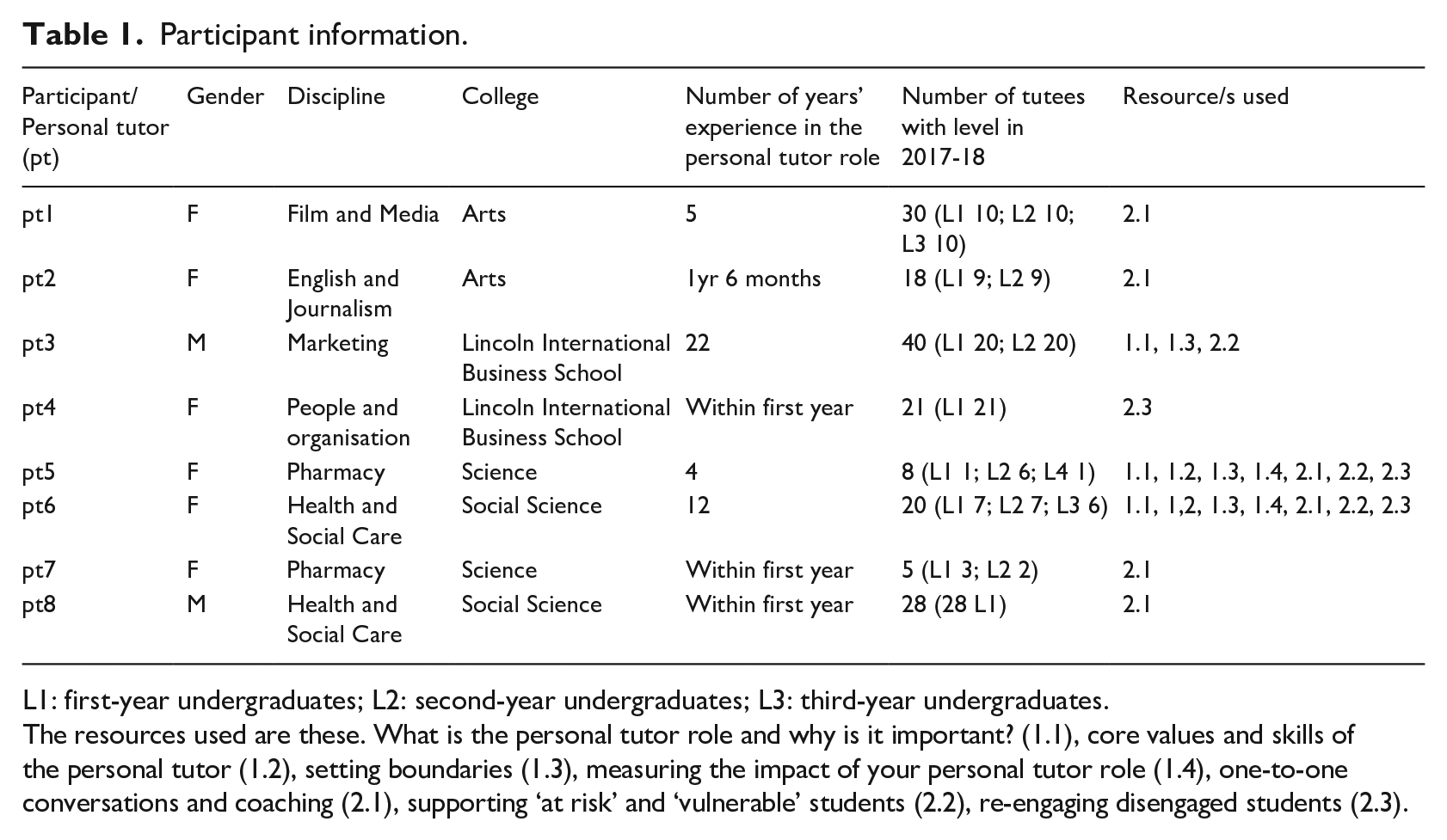
L1: first-year undergraduates; L2: second-year undergraduates; L3: third-year undergraduates.
The resources used are these. What is the personal tutor role and why is it important? (1.1), core values and skills of the personal tutor (1.2), setting boundaries (1.3), measuring the impact of your personal tutor role (1.4), one-to-one conversations and coaching (2.1), supporting ‘at risk’ and ‘vulnerable’ students (2.2), re-engaging disengaged students (2.3).
Instruments/materials
The study gathered the views of personal tutors in two stages: pre- and post-intervention. The intervention was the design and provision of staff-facing development materials for tutoring created as part of a national research project, Intervention for Success, funded by the Office for Students (OfS), and arising from Lochtie et al. (2018). The topics of the materials were constituted from themes arising from previous studies and took the form of seven interactive e-learning resources (using the software Microsoft Sway). They contained common features: learning outcomes, introduction, text and visual content, ‘thinking points’, listening points (audio content), case studies (modelling real-world tutor–student scenarios), ‘what we have learned’, reflection questions, self-assessment, references and further reading. The list of resources falls into two categories. One, ‘background to the personal tutor role’ (‘what is the personal tutor role and why is it important?’, ‘core values and skills of the personal tutor’, ‘setting boundaries’, ‘measuring the impact of your personal tutor role’) and two, ‘key activities of the personal tutor’ (‘one to one conversations and coaching’, ‘supporting ‘at risk’ and ‘vulnerable’ students’, ‘re-engaging disengaged students’). A link to a full exemplar resource can be found here: https://sway.office.com/ygmzsEH0HjAsgWgG?ref=Link.
The resources represent a development programme and connect to each other but each can also be used individually. Participants were asked to commit to the use of a minimum of one resource during the research period of 12 teaching weeks. In terms of how the resources were to be used, participants were asked to work through them (reading all content and undertaking the activities within) and a suggested time of 30 minutes to an hour was given. The specific resources used are shown in Table 1. The terms ‘support’, ‘training’ and ‘development’ are often used interchangeably, as are ‘materials’ and ‘resources’. The intervention here is in the latter categories but by its nature, represents a form of professional development. Therefore, it is mainly referred to as ‘resources’ but the other terms are used where relevant. It is important to note, however, that these are individual activities rather than the group activities which ‘training’ and ‘development’ can imply.
Design
The research was conducted through two sets of semi-structured one-to-one interviews undertaken during each tutor’s delivery of the role in one academic year (2017–2018), one interview before and one after a 12-week teaching period when the materials were used. By using the same method on different occasions, it represented ‘within-method triangulation’ (Denzin, 2009), a technique suitable to seeking a holistic view of a complex phenomenon (Cohen et al., 2011). The content of both the interviews and resources being assessed were based on the outcomes of the literature review which suggested key areas in which personal tutors needed support and were worthy of further exploration (e.g. McFarlane, 2016). The interview questions reflected the research questions and were ‘wide ranging’ in the sense of dealing with large complex issues: perceptions of effective tutoring and the impact of the resources on this. An insider perspective was sought through detailed exploration of individual lived experiences and the meanings that these hold for the participants (Smith and Eatough, 2007).
During the first set of interviews, personal tutors were asked for their views on the importance or otherwise of being a personal tutor, how confident they felt in the role and why, how they would define an ‘effective personal tutor’ and what the key attributes and functions of one would be, the recurring topics/issues raised by students in their tutorials, the support (general and/or resources) available and their use/usefulness or otherwise, what ‘gaps’ there might be in terms of the support provided, the impact/influence that they felt a personal tutor had on their students, their department and the university more widely and the relationship between personal tutoring and teaching. They were also asked to comment on how, specifically, they carried out their role with ‘at risk’ (of withdrawal or underachievement), ‘vulnerable’ or ‘disengaged’ students, how confident they were in dealing with such students and how effective that support might be. They were asked to comment on whether or not they felt that they knew where the boundaries were and when to refer their personal tutees to services such as counselling and asked for examples of when those boundaries might have been ‘stretched’. They were also asked if they thought that they had to look after themselves, for example, when working with ‘at risk’ or ‘vulnerable’ students and if so how, and what help/support was available to help them to do this.
During the second set of interviews, some 3 months later, they were asked to comment on their confidence, experience and views of personal tutoring at that time, whether anything had changed over that period of time and whether they had used the resources that had been made available to them. If they had not, why that was. If they had, they were asked which particular resources they had used and how, how helpful they found them and why/why not and what they might do differently, in future, having used them. They were also asked if, having used these resources, it had prompted more thoughts on what the ‘gaps’ might be. They were asked how, practically speaking, they had used them, for example, whether with individual students or in small groups, with a particular group of students, for example, those ‘at risk’, to what extent and for how long they had used a particular resource, how helpful or otherwise they had found them and what improvements they felt could be made to these resources.
In summary, Interview 1 (pre-intervention) commenced with open questions on tutors’ confidence and competence in undertaking the role, and its parameters, before questioning participants specifically on existing resources and support in detailed terms, for example, awareness, availability, usefulness and any gaps. The second (post-intervention) interview questions reflected the detail and themes of the former interview and were used to assess the impact of the intervention.
Data analysis
Interpretative Phenomenological Analysis (IPA) (Lyons and Cole, 2007) was used. A thematic content analysis (Braun and Clarke, 2006; Bryman, 2008) of the two sets of interview transcripts followed. Codes were established to give ‘categories’ before further clustering of common responses, connection and collation to identify themes and subthemes. As such, Saldaña’s (2015) model for qualitative inquiry was followed where a process of abstraction from the ‘real’ to the ‘abstract’, and ‘particular’ to the ‘general’, was undertaken. After the data from the two sets of interviews was analysed separately, it was triangulated for validity and reliability.
Findings
What are personal tutors’ perceptions of their effectiveness in supporting students?
Tutors’ perceptions of their effectiveness in the role varied. Factors aiding effectiveness were approach and early intervention. Factors inhibiting effectiveness were difficulties associated with measuring the impact/effect, causal factors, limited confidence (the importance of background/previous employment, pastoral or academic aspect of the role) and limited understanding of role requirements (lack of clarity/consistency and boundary confusion).
Several referenced ‘some sort of [positive] effect’ (pt4) but were unclear on specifics. Approach was felt to be all important. Expressed in terms of fostering independence rather than dependence, uncovering ‘underlying’ issues and reinforcing boundaries, it nevertheless relies on personality and an element of training: ‘I think making yourself available, approachable . . . makes a huge difference: between being friendly and being friends’ (pt1).
If you use the right strategies, and engage in collaborative conversation, rather than rescuing or rejecting, then you could have a massive impact; you could turn 99% of people round that were failing or vulnerable. It is just having the skills, abilities, knowledge, courage and competence to do that. (pt8)
Early identification (of ‘at risk’ students) and referral were viewed as equally significant, ‘If we catch them, and have the time, then the work is extremely effective’ (pt3). Questioning of effectiveness was expressed in terms of factors inhibiting this. The difficulty of measuring effectiveness was raised, ‘I probably need to ask them’ (pt6). Influencing the risk level was seen as not possible by one participant given the barrier of causal factors, ‘I’m dealing with the effect, not the cause’ (pt3).
Perceived confidence depended on which aspects of the role were being referred to, with multiple respondents stating they were more confident with the academic rather than pastoral side: ‘some of the pastoral stuff, some of the issues that students came up with, presented me with an “I don’t know”’ (pt5). ‘I feel a bit less comfortable with the personal issue aspect, because we don’t have training in that area, and you feel anxious about doing something that could make the student feel worse’ (pt2). As might be expected, the greater the level of tutoring experience, the greater the level of confidence; however, this was not consistent across all participants, with some experienced tutors still unclear about role expectation. The previous employment of some was an important determinant of confidence in carrying out tutoring interactions: ‘I think my background gives me the confidence to deal with issues and problems . . . [I have] drawn on my experience within HR’ (pt4). ‘I am influenced by my background in teaching communication, counselling skills’ (pt6).
Among factors affecting understanding and performance of the role, a lack of clarity and consistency was a view held by five participants,‘. . . you just have a mixed bag out there . . . I think we should be more unified, in terms of how we approach personal tutoring. At the moment, I think it is fairly ad-hoc’ (pt3). School (departmental) conceptions of tutoring can conflict with institutional ones or what the individual tutor thinks it should be: . . . I think the personal tutoring role is a rescuing role in this school, at the moment . . . if someone has got an issue, whatever that issue is, the personal tutor can sort it out . . . If you use the right strategies, and engage in collaborative conversation, rather than rescuing or rejecting, then you could have a massive impact . . . (pt8)
Much of this role confusion was expressed in relation to boundary issues, a dominant theme. The question of who had responsibility for particular duties was raised and a questioning of the guidance given in relation to the pastoral and academic side of the role was apparent: . . . they are told to come and see their personal tutor if they have personal issues. We are meant to just hand over to student welfare; but that is very difficult; particularly if you have an upset student; to keep that boundary. (pt2)
This lack of clarity manifested itself in limited understanding of tutors when it comes to the parameters of the role, ‘I would say that I know 10%. I don’t know what those boundaries are. I am sort of muddling my way through; as opposed to knowing exactly what it is that you do or don’t do . . .’ (pt8). A range of responses about the pastoral/academic boundary were elicited from ‘I am still happy to be able to do this [student coming to you in a crisis]’ (pt1) to ‘I think there is that emotional empathy that you get into that you have to be careful of’ (pt2).
Prior to the provision of tailored personal tutor professional development resources, what resources and support do personal tutors draw on and how useful do they feel they are?
Three key themes emerged. The first was the importance of colleagues and teams and the second was the limited knowledge and use of generic university-wide support. The third, gaps identified, was constituted of the need for clear induction, lack of university-wide resources and the need for more training on the pastoral side.
The views of tutors on the support, both general and in terms of specific resources, available to them varied fairly significantly. The importance of informal support from peers, trusted colleagues and the tutors’ departmental teams was evident from half of the participants’ responses. The senior tutor was identified as a figure who provides support and guidance and as a ‘first port of call’ on emotionally challenging situations (pt4). Use and knowledge of department and team-specific resources was evident; however, of these, ‘Sometimes you have a task that is useful, and sometimes you have handouts that are completely irrelevant’ (pt2). While some awareness of ‘support mechanisms’ (use of professional services such as Wellbeing) was elicited, a lack of awareness and knowledge of formal mechanisms was indicated. ‘I’ve had to proactively go out . . . I don’t know what I don’t know’ (pt8); ‘I don’t know what other personal tutors do’ (pt4). ‘Nothing specific/only what I would do myself . . . I really don’t know’ (pt7).
Any institution-wide support was in relation to referral (to professional services) and on any support for tutoring ‘at risk’ students a reliance on individually produced resources was evident. Here, multiple tutors made reference to the need for clear induction, ‘I am not entirely clear what we’re meant to be doing . . . there was no personal tutoring induction to the role’ (pt2), and a pre-emptive package, for example, a step-by-step guide to follow when a student says they want to leave the course. An inability to answer the questions which arise was evident, ‘I guess it comes down to credibility as well; if all you ever do is tell the tutees that you don’t know the answer to that’ (pt8).
More training and support on the pastoral side of the role was needed according to tutors. The question on the parameters of the role elicited ‘I don’t know what those boundaries are’ (pt2), that a lack of techniques are given (which counsellors have) and the need for support on ‘looking after yourself’ and ‘formal supervision’. The challenge of mental health issues among tutees was referenced, ‘in the face of increasing demand [more] support in mental health issues, for example training on how to deal with depressed students [is needed]’ (pt1). The lack of knowledge of support on the pastoral side was further evident: ‘Not a lot that I know of, to be honest. It would just be off my own back; not specific resources’ (pt2) and role confusion was highlighted: ‘I’m not sure what support is available with that, because the line we are given is that you don’t deal with those personal issues which I don’t think is a reflection of what really happens in personal tutoring sessions’ (pt2).
After engagement with tailored personal tutor professional development resources, what is the impact of them on personal tutors’ perceptions of effectiveness in supporting students?
All the participants expressed that their chosen resources were helpful for a variety of reasons connected to key themes which emerged including structure, clarification, employing different approaches with students and their developmental nature.
They represented a comprehensive and in-depth source of development, providing support on methods which are challenging to carry out effectively and a model for tutors to embed into their practice: I really like the theory base behind it of encouraging the student to talk; and you listen to that student. I don’t think those skills necessarily come easily without some training . . . I know how hard that is to actually embed that way of working . . . I thought the materials were really rich on that [conversational interactions with students]; that could be a whole seven months of development to actually incorporate them. I like the way it is put together. (pt6)
The complexity of undertaking personal tutoring, something colleagues may think is straightforward, was highlighted by the resources, ‘the danger with tutoring things is that people are going to think that they know all this; and actually don’t’ (pt6). Clarification on the role was evident: ‘The key issue is what is the point of the personal tutor? . . . [Resource 1.1] is helpful here’ (pt3), and the resources helped to address what tutors saw as inconsistency among some fellow tutors in terms of time allocation and boundary setting: . . . I engaged in a conversation with one of my colleagues . . . who doesn’t let go of students; and I think spends far too much time with students . . . So I did like this whole area of who has the expertise; and what expertise do you have; and also time. (pt3)
What tutors would do differently as a result of using selected resources was evident. They provided a clear approach to key tutoring activity. This particularly focused on one-to-one conversations with students using a coaching approach, for example, questioning techniques to elicit a greater response, using a ‘solutions focus’ and a particular type of language: . . . rather than asking what the problem was; I said that ok we can see that we have a problem, what do we need to do to change that problem? . . . more of a positive outcome of the solutions; with targets and actions rather than just talking about what was wrong . . . we had an action plan; which I probably haven’t done before in such a way. (pt5)
‘to rephrase it in a way that highlights a more positive approach . . . we want the students to find and work out an ability to find the solution, with the support of the tutor’ (pt1).
The coaching approach and guidance on avoiding judgement was seen as useful: . . . get the students to talk, and not ask them closed questions; . . . get them to open up in that non-judgemental atmosphere. . . . a student that is dis-engaging, the last thing that is going to help them is to judge them; . . . What do they need? I really liked that aspect of the materials . . . If the student is in distress, how can I tell them what to do? It is having that belief that the student is the expert on themselves; deep underneath, they know; so if you can use the right skills to encourage them to talk to you about that, you’ll get to a better place in the end. (pt6)
Other prominent ways in which the resources chosen helped included strategies to uncover how students feel they are progressing and enabling them to articulate this. In this way, it showed a way to overcome certain barriers to progress: ‘The way that I interact. One of the things that I realised is that I would ask – ‘Do you have any problems?’, and they would say, No, I’m ok’. It would basically end there; but since reading the material that was given, it suggested ways how you can get more out of the student; that’s what I needed really. Instead of just going through the tick box that ok, they are fine. (pt7)
Six of the eight tutors perceived the value of the resources in enabling greater student independence and providing a solutions focus to be co-created with the student. This also linked to greater clarity over referral: ‘Ok, if they have problems, but also those problems sometimes go round and round, and the tutor becomes part of the circle. That was really helpful; and the whole issue of letting go – when do we let go; referrals’ (pt3).
In terms of connecting and supporting colleagues on the topic of tutoring, the materials were cascaded to colleagues and used to support new tutors as well as develop the more experienced: I think they support me in supporting new tutors . . . they act as a reminder to those more experienced; and to help them develop their skills; because of the depth of them . . . As a senior tutor, it would be to offer more support to new tutors; and guide them with the materials and what’s in them; that has helped confidence. (pt6)
By implication, these responses highlight gaps filled by the resources. On this specific question, tutors referenced their detail and applicability across different subjects. Prior to this provision, there was a lack of support or nothing existing of this type: ‘This certainly helped fill some [gaps]; is somewhere, at least, for a tutor to go if they do have a student with an issue; at least there is guidance to at least deal with certain students’ (pt5). ‘These were the only ones I was aware of for staff support. We had no kind of induction; we were just given students, and that was it, really’ (pt2). ‘Prior to using these, I wasn’t made aware of anything else . . . These have been a lifeline, really’ (pt4).
Finally, a central theme, which acts as a summation of the preceding ones outlined, transpired. As something which can teach staff, the resources are developmental in nature, in contrast to the informational nature of any pre-existing support and materials: ‘They [existing personal tutoring resources] were student based’ (pt3). ‘The key issue is what is the point of the personal tutor? Getting staff to understand that and buy in . . .’ (pt3). ‘We get a personal tutor handbook as part of the school . . . more the process [than resources to support]’ (pt7). ‘. . . before, I wasn’t sure there was much support . . . So I think this is something that can teach staff’ (pt5).
Discussion and conclusion
Research on the impact of providing interventions within a personal tutoring system was called for (McFarlane, 2016). Through assessing the intervention of the resources provided to personal tutors within a pastoral model of personal tutoring, while being mindful of viewing ‘impact’ critically, the study described in this article has resulted in evidence of impact in many of the principal areas identified. Among the participants, perceived confidence and competence was increased and role confusion (McFarlane, 2016) reduced by providing definition and structure. The resources themselves represent a filling of the gaps in ongoing support (McFarlane, 2016; Owen, 2002; Ridley, 2006; Stephen et al., 2008) by either providing greater detail and depth or supplying what did not exist before. Information on how the role of a personal tutor within a pastoral model is practically undertaken and the importance of approaches within a personal tutoring interaction had been gathered (McFarlane, 2016) in addition to identifying deficiencies in this area, ‘Actually, what do I do?’ (p. 83). The intervention provided content on approach and strategy with impact evident from personal tutors’ views on its clarity and helpfulness in terms of language use, a coaching approach, questioning techniques to elicit a greater response and using a ‘solutions focus’.
The results provide further evidence to support that found in two further key areas in the literature on personal tutoring within the pastoral model. One, the importance of boundaries (McFarlane, 2016; Ridley, 2006). The intervention provided ways for personal tutors to categorise boundaries and, in turn, recognise, acknowledge and set them. Two, the importance of dialogue with other colleagues (McFarlane, 2016). The intervention was used to support new personal tutors and develop the more experienced. By eliciting the issues which personal tutors perceive to be effective in delivering the role, and what they draw on to help with this, the study has provided evidence for the need for an intervention of tailored institution-wide developmental professional support within the pastoral model. Many of the emerging key issues, for example, the pastoral or academic intersection, role confusion, lack of clarity/consistency and boundary confusion relate directly to the topics covered in the resources used in the intervention.
The study has demonstrated how positive the impact of such developmental support can be in terms of supporting personal tutors in carrying out their role within the pastoral model. Albeit through a relatively small number of participants, not all of whom completed all the resources, it identified ways in which this intervention provided a modelling of real tutoring situations, in particular, through presenting clarity, content and associated language for boundary setting and a coaching approach. In addition, the intervention was seen to address gaps in resources, support and development identified in the literature and from the participants through its developmental, detailed nature and purpose contrasting with current informational/transactional provision for personal tutors. These benefits were seen to apply across levels of experience. This study reveals some positive impact of certain professional development practices, such as the value of one-to-one conversations and coaching. After initially establishing parallels with previous findings about personal tutors’ perspectives on practice, the research described in this article initiates some of the key aspects of further work within the pastoral model which these studies recommend.
McFarlane’s (2016) study questioned ‘who tutors the tutors?’ within the pastoral model. Fundamentally, the research described in this article has posed the question, ‘having been provided with tailored support/resources in key areas, how helpful was it and why?’ to those undertaking the role. It presents the positive effect of developmental support for personal tutors addressing the concerns of most relevance to them.
As with any study, there are limitations. Impact is concomitant with change and therefore any measurement of it needs to be a measurement of change including a comparative element over time. This study contained a comparative element through analysis of data from two sets of interviews using the same participants; however, the short time period makes any assertions of ‘trend’ problematic. The resources were not the only changed variable during the research period. Determining impact from experiences and perceptions subjective in nature is complex, something which could be offset by widening the measure of impact to include statistical analysis. In addition, the data came from only one UK institution from participants representing only seven disciplines and concerned support of only undergraduate tutees. The impact in terms of students and their outcomes was not measured. Only one intervention (the tailored professional development materials) of a certain type (interactive e-learning resources to be used individually) was assessed. Other interventions were not covered, such as supervision, so this is an area of future work. The designer of the resources and the researcher being the same person may have affected the data. There is also the small sample size, the fact not all participants engaged with the full set of resources, short research period and the context based nature of the study.
As for future work, as well as expanding the number of institutions, disciplines and national context, useful future extensions of the study include the involvement of students’ perspectives and outcomes, the use of quantitative data, such as the key performance indicators of retention and success, a larger sample size and a more longitudinal approach. Other future work could assess the impact of group, not only individual, staff development and include academics providing structured reflections (or ‘case studies’) on effective support for personal tutoring. There is also a need for further studies into models other than the pastoral one explored in the study described within this article.
There are implications for practice at three interlinked levels when it comes to the pastoral model of personal tutoring. For individual practice, the greater use of non-directive and coaching approaches is recommended. For institutions, the provision of resources and support which are developmental (not just informational/transactional) and cross-institutional is needed. For the sector, given the responsibility of institutions regarding retention, progression and employability, and personal tutoring as an influencer on these metrics, the importance of work to address these gaps is underlined. Through the key issues identified in this study, there is a need for sector-wide transferable principles of effective tutoring and developmental activity to better support personal tutors in their delivery within a pastoral model of personal tutoring.
Footnotes
Author’s note
Ben W Walker is now affiliated with Manchester Metropolitan University and the University of Derby.
Declaration of conflicting interests
The author(s) declared no potential conflicts of interest with respect to the research, authorship and/or publication of this article.
Funding
The author(s) disclosed receipt of the following financial support for the research, authorship and/or publication of this article: This research was supported by the Lincoln Higher Education Research Award and the resources produced under the Intervention for Success project funded by the Office for Students.
